A Baker’s Half-Dozen

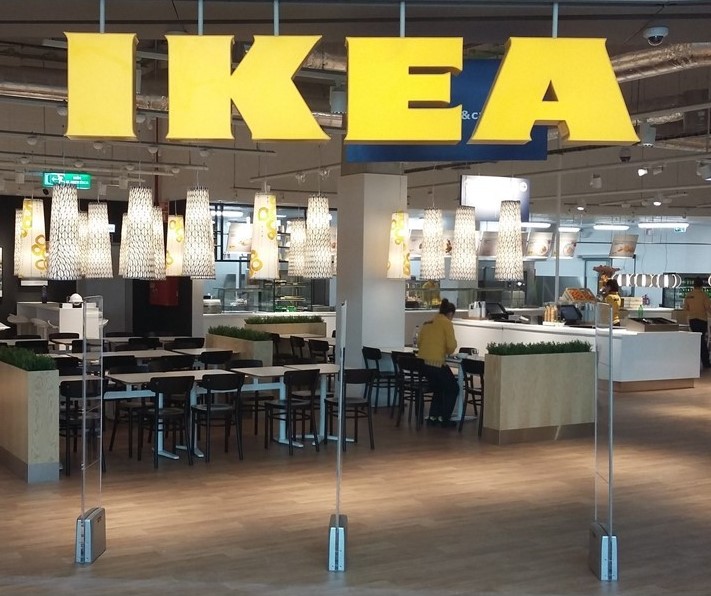
If you’ve ever been to an IKEA home furnishings store, you know the shopping experience is more about navigating a vast warehouse than a cozy “store”.  IKEA retail covers several football fields worth of showrooms and merchandise, with clever navigation arrows projected onto the floor so you don’t lose yourself in the maze.  Before or after your purchases, IKEA offers a spacious sit-down cafeteria, so you can fuel or restore your energy levels as needed.  And it is here – in the IKEA cafeteria – where I can’t help but picture the Swedish Chef from the The Muppet Show.

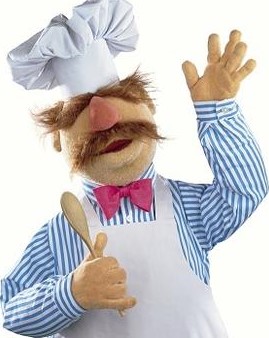
You remember Swedish Chef, don’t you?  Even if you only occasionally glanced over the shoulders of your children as they watched The Muppet Show, Swedish Chef left an indelible impression.  Chef had those big, bushy brows completely covering his eyes.  He always had a handful of utensils, inevitably launched into the air of his kitchen as his gibberish songs ended with “… BORK, BORK, BORK!”  Chef sported a colorful bow tie, a white apron, and the distinctive toque blanche (white hat) on his head.  Swedish Chef was always my favorite Muppet.

Chef could be working behind the counter of the IKEA cafeteria, because naturally; IKEA serves Swedish food.  My favorite entree (as if I dine at IKEA regularly) is the Swedish meatballs in brown sauce (köttbullar), served with a side of the crepe-like potato pancakes (raggmunkar) and a dollop of lingonberry jam (Sweden’s famous “food freshener”).

There’s another fellow in the States who reminds me of Swedish Chef, and he doesn’t work in the IKEA cafeteria.  Ever heard of Mimal, “the Man in the Middle of the USA”?  Mimal lives in the Midwestern states, and he’s a big boy.  In fact, Mimal’s so big he barely fits between Canada’s border to the north and Mexico’s to the south.

Have a look at the map.  Mimal (sometimes called “the Elf”) is a silhouette of a chef, represented by the outlines of seven American states.  MIMAL is quite literally (M)innesota, (I)owa, (M)issouri, (A)rkansas, and (L)ouisiana.  He holds a pan (Tennessee) of fried chicken (perfectly represented by Kentucky).  Mimal can thank the west bank of the Mississippi River for the shape of his five-state body.  He also looks like he’s about to march his chicken right off the map, over the Atlantic Ocean, and on into Europe.  Maybe he’s headed to Sweden?

Whoever discovered Mimal hiding in America came up with a clever way for children to memorize a handful of states.  Appropriately, Mimal the chef is made up of a baker’s half-dozen of them.  A baker’s dozen (13) began in the 11th century, when an extra loaf was added to the bread basket to guarantee the minimum sales weight.  A baker’s half-dozen then – rounded-up – is seven loaves.  Or seven American states.

Leave it to Americans to deny Mimal his innocence.  Based on one or more unsolved mysteries in the MIMAL states, the elf-chef was once connected with a real-life kidnapper/murderer.  The legend claimed if you drove straight from Minnesota to Louisiana – through each of Mimal’s five “body” states, you’d be abducted (never to be seen again) once you crossed Louisiana’s northern border.  My logical brain asks how said abductor knows you made it through all five states?  But this is legend we’re talking about, much like the monster in Scotland’s Loch Ness.  Tabloid fodder at best.

Educators expanded on Mimal’s seven-state profile, including all fifty American states in a story designed to help students memorize names and locations (would’ve been helpful back in my school days, when I’d confuse Wyoming with Colorado).  Still, I prefer to limit the game to Mimal’s baker’s half-dozen.  I can’t help but see a big chef every time I look at a map of the United States.  I also can’t help hearing him sing, “…BORK, BORK, BORK!”

Some content sourced from Wikipedia, “the free encyclopedia”, and the Laughing Squid blog.

Ever Eat a Pine Tree?

If I ask you to recall a catchphrase – a word or statement you heard repeatedly and probably won’t forget – you could come up with several examples. Movie quotes, for instance. (“I’m the king of the world!”)  Song lyrics. (“I get by with a little help from my friends.”)  And television commercials; where the product or “jingle” yields a branded catchphrase. Just this week I learned a new one: bindle stiff, which describes a homeless person through the bag of personal items (bindle) on the end of his/her stick. I’m no hobo, but Euell Gibbons once was. And Gibbons once uttered one of the most famous catchphrases ever.

Who the heck is Euell Gibbons?  Any American kid growing up in the 1970’s would know.  Gibbons was the spokesperson for Post Grape-Nuts cereal, made instantly famous by a single television commercial where he uttered, “Ever eat a pine tree?  Many parts are edible.”  That statement was so bizarre – and laugh-out-loud to us kids – it spread like wildfire (and sold a ton of Grape-Nuts cereal). But it was only recently I learned Gibbons wasn’t just a hired bindle stiff, but a man ahead of his time.  He had a lifelong interest in foods foraged from “nutritious-but-oft-neglected plants” (surely learned from an impoverished and transient childhood).  He wrote several successful whole-foods cookbooks, including “Stalking the Wild Asparagus” (1964) and “A Wild Way to Eat” (1967).  In his later years, Gibbons and his wife joined a community of Quakers in Philadelphia, where he cooked the daily shared breakfast (of course he did).

“Many parts are edible.”

I love Grape-Nuts cereal, back to when I was a kid.  I’m not sure if Gibbons gets the credit, or because Grape-Nuts just tastes good (“…reminds me of wild hickory nuts…”, as Gibbons also said).  Admittedly, Grape-Nuts was a little off the beaten path of children’s cereals.  Very low in fat and sugar, Grape-Nuts looked and crunched like a bowl of light brown gravel.  Add in milk as a softener and sugar as a sweetener however, and something about the cereal just clicked with me.  After college I forced myself to give up Grape-Nuts, because I developed jaw pain from too many hard foods.  Maybe that’s why Post developed Grape-Nuts “Flakes” cereal, or Grape-Nuts “Trail Mix Crunch Cranberry Vanilla”.

GORP

Speaking of trail mix (convenient segue), Euell Gibbons comes back to the conversation.  Trail mix was introduced about the time Gibbons was born (1910), as a combination of dried fruit and nuts.  Trail mix was lightweight and therefore easy to carry on long hikes.  The carbs and fat created a quick energy source and an ideal snack food, and the mix became immensely popular to outdoors-people, especially sugared up with a few M&M’s or yogurt coverings (which Gibbons never would’ve approved of).  Yet it wasn’t always called “trail mix”.  In another word familiar to 1970’s kids, Gibbons coined the acronym GORP, which either meant “good ol’-fashioned raisins and peanuts”, or “granola, oats, raisins, and peanuts”.  Yep, I ate a lot of GORP in my childhood.  Might’ve even had my first taste at Hadley Fruit Orchards, a place in the California desert my parents like to frequent.  Hadley – alongside others – claims to be the “inventor” of trail mix.

Euell T. Gibbons

As if “Euell Gibbons” is not unique enough for an American, his middle name was “Theophilus”.  The only Theophilus I’m aware of lived in biblical times, when Luke wrote his Gospel (and the book of Acts) as letters to an individual by the same name.  Perhaps Gibbons should’ve lived in biblical times.  As God’s people sought the Holy Land he could’ve helped them with his foraging skills.  Or at least introduced them to Grape-Nuts.

Some content sourced from Wikipedia, “the free encyclopedia”.

Ribbons and Bows

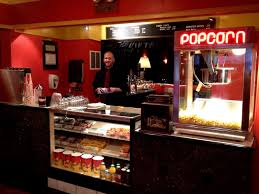
My wife and I went to the movies the day after Christmas. The theater lobby looked a little forlorn after the holiday rush. There weren’t many patrons besides the two of us. The employees wandered here and there without seemingly much to do. The concessions were woefully under-stocked. In fact, as we stood at the counter, we realized there were no nachos, no hot dogs, and not a single bottle of water to be found. Did all those “Star Wars” groupies buy up everything before us?  Did a link go missing in the supply chain? Can we blame the aliens?  Ah, but popcorn.  At least they had popcorn.

I can’t see a movie without cradling a big ol’ tub of theater popcorn.  Don’t ask me what chains the two together, but popcorn and movies are a heaven-on-earth marriage.  It’s like that Kacey Musgraves Christmas song about a ribbon without a bow.  The movie might be Oscar-worthy but there’s a big something missing without popcorn.  The next time you watch “Field of Dreams”, consider the ball field is surrounded by acres and acres of corn.  As if you need a metaphor.

Popcorn wasn’t always an option at the movies.  In the early 1900’s, the theater-going experience was different.  The auditoriums were much smaller.  The carpets and seats were lush and expensive.  The patrons tended towards upper-crust.  And the movies themselves… had no sound.  Any one of those reasons made popcorn a poor concession choice.  Theaters didn’t want kernels ground into their pricey floor coverings.  Patrons didn’t want a snack associated with the lower-class circuses and sporting events of the time.  Most importantly, no one wanted to hear crunching and munching while trying to read the subtitles of a silent movie.

The Great Depression – and “talkies” – ushered in the union of popcorn and movies.  A broader cross-section of patrons sought the theater for an inexpensive distraction to the hard times.  Popcorn was easy to mass-produce, and the smell and pop created an effective lure for the concession stand.  Crunching and munching was no longer a concern up against soundtracks.  And popcorn was affordable, even to those who could barely scrape together enough for the movie itself.

Do you prefer “mushroom” or “butterfly”?

There’s a little science behind popcorn to get it from husk to Hollywood.  Growers developed the appealing “butterfly bud”, with several “ears” to trap the butter and salt.  Growers also worked to shape popcorn to take up as much room in the bag as possible (less air), giving a more satisfying feel to the overall weight.  They coined terms like “expansion rate” and “mouth feel” and “finger control” – anything to make you buy more of the fluffy stuff.

All this talk of popcorn reminds me of a children’s book about a farmer who grew acres and acres of corn.  He’d store his corn in giant metal silos next to his field.  One summer day, the silos got so hot the corn inside started to pop.  The farmer heard the sound and climbed on the roof of one of the silos to see what was going on.  Suddenly the silo burst open, and the roof started rising above all that popcorn.  Up, up, up went the farmer.  When the popping finally stopped, the farmer was high up in the sky with no way to get down.  His neighbors came from miles around to try to help him.  The fire department’s ladders weren’t long enough.  The town had no helicopter.  Finally, the people talked it over and realized all they had to do was start eating the popcorn straight from the silo.  Down, down, down came the farmer until he was safe.

As much as I love popcorn, I only seem to eat it at the movies.  When my son was in college, he admitted to going to the theater, buying popcorn at the concession stand, and… leaving the building.  Who does that?  Then again, there’s nothing wrong with the idea (high price aside).  It’s like having turkey when it’s not Thanksgiving.  Or dessert before dinner.  Seems a little off, but really, why not?

As for me, I’ll continue to enjoy my popcorn with my movie.  I’ll pay the ridiculous price for the shrinking bag, and still eat too much.  The only problem with this scenario?  Finding decent movies anymore.  They seem to be fewer and further, at least on the big screen.  Thank goodness for Netflix and my air popper.

Some content sourced from the Wall Street Journal article, “How AMC Gets Its Popcorn From Stalk to ‘Star Wars'”, and from the Smithsonian Magazine article, “Why Do We Eat Popcorn at the Movies?”

The Twenty-four Days of Christmas

The Christmas season seems to begin a little earlier each year. Stores decorate and start their sales around Halloween. Lights go up on houses well before Thanksgiving, while Christmas cards show up in mailboxes by Black Friday.  The longer the season though, the more abrupt the conclusion. Be honest; who among us sings Christmas carols (or watches Hallmark movies) on December 26th?  Not many.  We worry and scurry for weeks about a single day – then suddenly it’s over.  Here’s a better approach.  Let’s focus instead on the one, true Christmas season preceding the day. Let’s focus on Advent.

For most Christians, Advent refers to the twenty-four days before Christmas (not to be confused with the song-famous Twelve Days, which come after Christmas).  Advent begins four Sundays before December 25th.  The word literally means “coming”, as in the (first coming) birth of Jesus at Christmas, and the (second coming) reappearance of Jesus at the end of time.  If you’re looking for the season’s theme song, go with “O Come, O Come Emmanuel”.  It’s the one, true Advent carol.

Once upon a time Advent included fasting, penance, and daily prayer, but today the season seems to be nothing more than a countdown.  Even in Sunday church services, the four candles of the Advent wreath are lit as the four Sundays pass by – a weekly countdown to the Christmas candle in the center. Here’s a more efficient idea.  Let’s add another ball in Times Square; one that takes twenty-four days to drop instead of sixty seconds.  Might save a lot of wreaths and calendars.

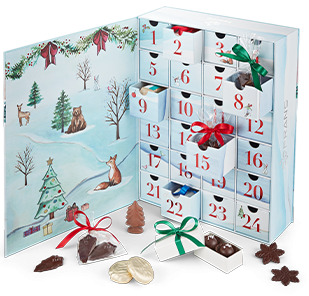
Speaking of calendars, maybe a countdown is enough to signify a season.  Advent calendars are all the rage these days.  I had one when I was a kid; the flat, cardboard kind with twenty-four numbered doors of varying shapes and sizes.  Oddly, the doors were never arranged numerically, as if the calendar was made more appealing by having to search for a given day.  Not so oddly, each door fronted a bit of chocolate.  As if waiting twenty-four days for Christmas wasn’t hard enough, Advent calendars forced a kid to wait twenty-four hours to “open” each piece of chocolate.  A test of patience.


If cardboard and chocolate don’t catch your attention, perhaps you’d prefer a more elaborate version of an Advent calendar.  Consider Fran’s Chocolates of Seattle (above left), which produces its annual calendar fronted by an original watercolor.  Add in twenty-four delectable chocolates in twenty-four drawers, and this calendar sets you back $175.  Or how about Liberty London’s “Beauty Advent Calendar” (above right), which includes twenty-four wellness products – many of them full-size – like probiotic deodorant, essential oil candles, and skin bronzer?  This one sets you back $275, with the price justification you can re-gift whatever items are not to your taste.

Lest you think a fancy (or not) calendar is the only way to acknowledge Advent, I can’t close without mentioning the Christingle.  I don’t remember creating one of these as a kid.  A Christingle is made up of an orange, a candle, a bit of red ribbon, and four sets of dried fruits or sweets, skewered on cocktail sticks.  It’s a strange-looking assembly, but the Christingle gets an “A” for symbolism.  The orange represents the world.  The candle represents Jesus as the light of the world.  The red ribbon represents God’s love (or Jesus’ blood).  The fruits/sweets represent the gifts God gives us, and the cocktails sticks represent the four corners of the globe.  Lots going on in one sort-of-neat package.

Austria may lay claim to the biggest Advent calendar in the world!

If you’re reading this post before December 1st, you have the entire twenty-four days of Advent ahead of you.  Twenty-four days to slow down and appreciate the meaning of day twenty-five.  Sounds more like a season than a single day, doesn’t it?  Mark your calendar then.  Advent is here.

Some content sourced from Wikipedia, “the free encyclopedia”.

Agony or Ecstasy?

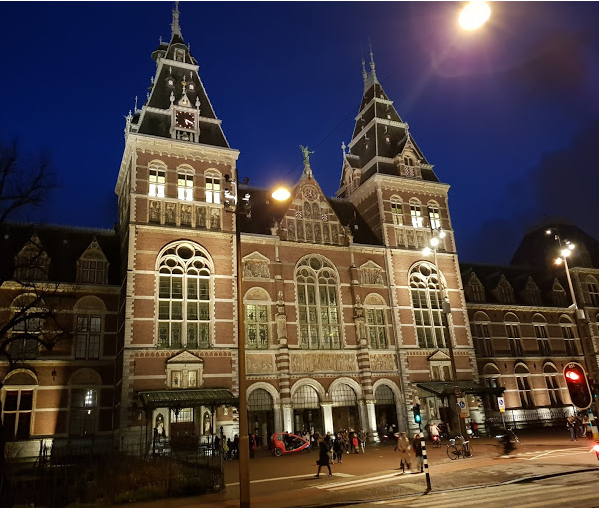
Rijksmuseum, Amsterdam, The Netherlands

On a first visit to The Netherlands earlier this year, our plan was to traverse the quaint canals and bridges of Amsterdam, stand in the shadows of Kinderdjyk’s working windmills, and learn more about the country’s wartime era, perhaps through a stop at the Anne Frank House. I also looked forward to a field of their famous tulips, and Dutch treats like stroopwafels, poffertjes, and bitterballen.  Sure, I ticked the boxes on several of these items, but I was also blindsided by a group-tour-captive stop at Amsterdam’s Rijksmuseum. 8,000 artworks covering 800 years of Dutch history (in what felt like 80 different rooms)?  Not my idea of a delightful morning in Holland.

I’m not what you’d call a “patron of the arts”, though I’m about to contradict myself.  I love a classical performance by a symphony orchestra.  I’m drawn to the theater’s foremost stage productions (Les Miserables comes to mind).  I even enjoy the occasional visit to a museum, provided the subject is specific and of my choosing (ex. Amsterdam’s Dutch Resistance Versetsmuseum).  But endless rooms of paintings on walls and free-standing sculptures behind glass?  As the Dutch would say, nee bedankt ik zal slagen.  No thanks, I’ll pass.

Here’s where I contradict myself a second time.  As I type this post I’m sipping morning coffee from the mug in the photo.  The mug is a souvenir from my “captivating” visit to the Rijksmuseum.  The painting on the mug is called “Children of the Sea” (1872), by Dutch artist Jozef Israels.  Go figure; I was able to blow past the throngs flocking to the Rembrandts and Vermeers and van Goghs; yet a small artwork in the corner of Rijksmuseum Room 118 captivated me enough to take a little piece of it home.  I probably spent as much time in front of that painting as I did the rest of the museum.

Jozef Israels’ “Children of the Sea” (1872), Rijksmuseum, The Netherlands

Naturally I had to learn more about “Children of the Sea”.  When I returned to Colorado, I read up on Jozef Israels.  Not only was he “… a leading member of a group of landscape painters known as the Hague School…”, Israels was “… the most respected Dutch artist of the second half of the nineteen century”.  Do I know how to pick ’em or what?  Maybe I have a little art appreciation in me after all.

“Children of the Sea”, as you might expect, offers a deeper message than a group of kids playing on the beach.  Their simple clothing and toys hint at a life of poverty.  The eldest child is quite literally carrying his family on his shoulders.  The boat suggests the rigors of life at sea.  From that perspective, I find the painting even more enthralling.

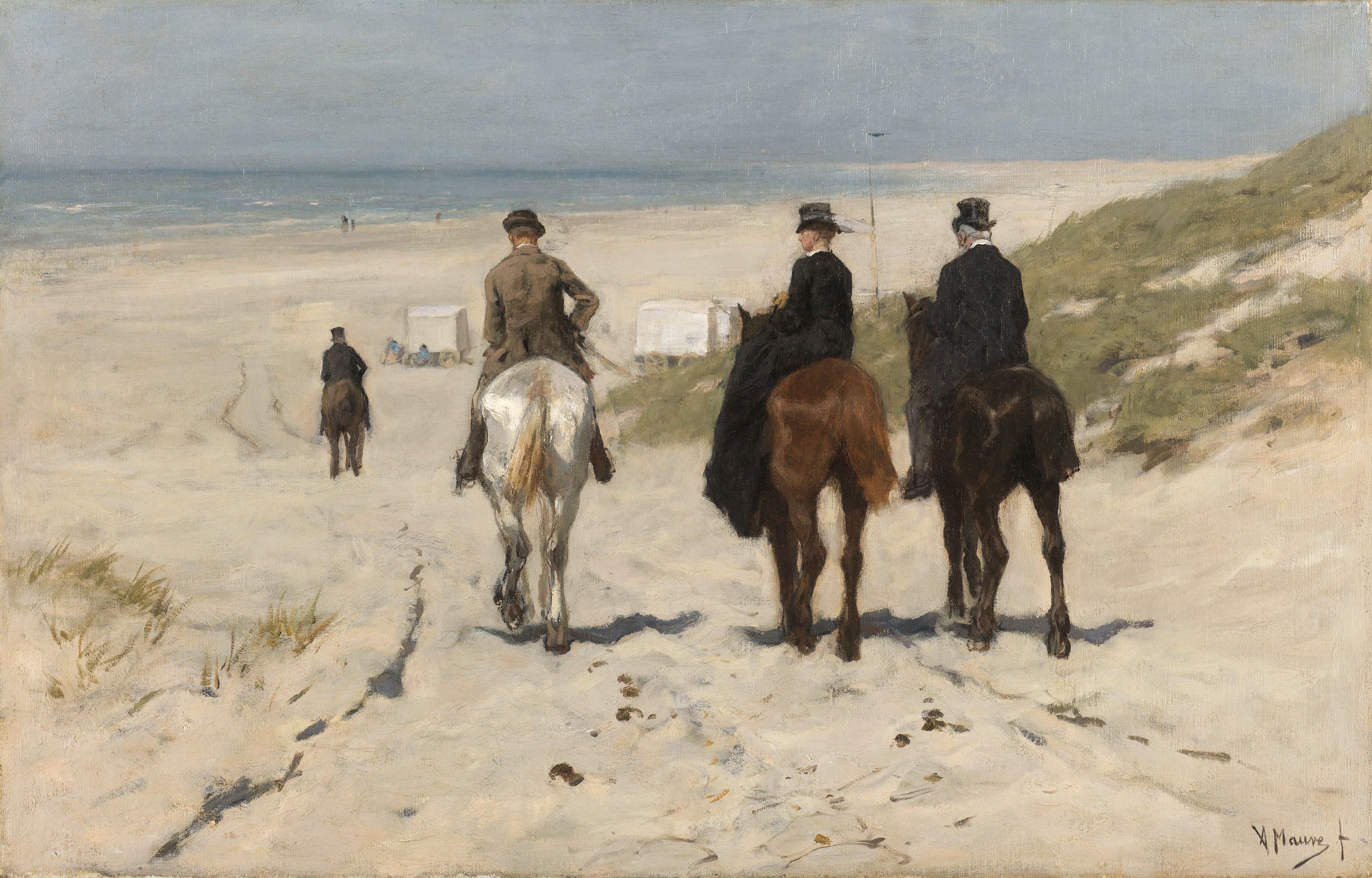
Anton Mauve’s “Morning Ride along the Beach” (1876), Rijksmuseum, The Netherlands

Adjacent to “Children of the Sea” in Rijksmuseum Room 118, I also enjoyed a moment in front of the artwork shown above.  It is called “Morning Ride along the Beach”, and I mistook it for another Jozef Israels masterpiece.  Instead, “Morning…” was painted by Anton Mauve, another Dutch painter of the same era (and Hague School).  “Morning…” provides a contrast to the harsh existence of the poor fishermen of the time, by focusing instead on the “well-to-do bourgeoisie”: horses, elegantly dressed riders, bathing cabins – all on a pastel-colored sunny day.  No souvenir mug with this one, but equally compelling to the eye.

Caravaggio’s “The Calling of Saint Matthew” (1699-1700), Contarelli Chapel, San Luigi dei Francesi, Rome

Admittedly, the Hague School paintings weren’t the first artwork to stop me in my tracks, nor were they the last.  In my college year of architecture studies in Rome, the Renaissance-era paintings and sculptures were as impressive as the cathedrals that housed them (I could write an entire post on the stunning chiaroscuro works of Caravaggio).  Case in point, I was so taken by the life and work of Michelangelo I read all 700 pages of Irving’s Stone’s fictional biography, “The Agony and the Ecstasy”.

John Dowd’s “Provincetown Summer” (1997), Provincetown, MA


As for my latest artwork pause, my wife and I visited Cape Cod last month, all the way out to Provincetown at the tip.  One of Provincetown’s pier-side shops sold tiles of local artists’ paintings.  The tile above (left) – John Dowd’s depiction of a nearby Provincetown Cape house in 1997 – sits on our fireplace mantle now.  The photo above (right) is how the painter’s subject looks today.

Someday I would love to return to The Netherlands for more adventures, but I assure you my itinerary would not include another trip to the Rijksmuseum.  However, I can’t claim I wouldn’t pause on the sidewalk if I walked past the museum’s massive entrance.  After all, in Room 118 there’s a very small painting, utterly captivating to this non-patron of the arts.

Some content sourced from The Netherlands Rijksmuseum website, and Wikipedia, “the free encyclopedia”.

Supply Chain Reaction

My neighbor to the north – the one with a mansion lording over the rest of the hood from the highest point around – hosts equestrian events on weekends. Whether reining or cutting competitions, or “quaint” social gatherings, his barn and surrounds burst with dozens of horses and riders just about every Saturday. His property is large enough we’re pretty far removed from the hubbub, except the convoy of horse trailers and trucks barreling down the street beforehand. The wheels rumbling over the washboardy dirt road and balloons of dust floating high overhead are hard to ignore.

Maybe you don’t have a parade of horse trailers in your neighborhood (or a washboardy road), but guess what?  You do have a procession of vehicles making their way to your driveway, and the list of participants is growing.  Home delivery is the latest block party where everybody seems to have an invite.

In the 1970’s the only vehicles coming up our driveway were the red, white, and blue jeeps of the United States Post Office (USPS) or the brown, boxy trucks of the United Parcel Service (UPS).  Then Federal Express vans (FedEx) joined in with a little purple and green, while DHL (the initials of the three founders’ last names) added a healthy dollop of yellow.  Taste the rainbow!

 That’s a pretty good line-up right there, but in the last decade or so home delivery (or “last mile delivery”, to use the trendier term) picked up several more players.  Amazon (black vans with a blue “swoosh” on the side) and WalMart (several colors) extended their supply chain by adding home delivery trucks.  Your pizza guy has been joined by restaurant delivery of all kinds, like DoorDash, Grubhub, and UberEats.  AmazonFresh is competing with your local grocery store to make sure you consider home delivery of products from Whole Foods.

Here are a few of the more “colorful” entries coming soon to a driveway near you:

  • Postmates – Pizza, prescriptions, shoes, and tech products, just to name a few Postmates delivery favorites.  What makes Postmates unique?  They’re not affiliated with any business or product line.  If you need it, they’ll find it.
  • LuggageForward – Boasts “doorstep pickup”, so all you worry about is transporting you from your home to your travel destination.  LuggageForward guarantees your bags arrive before you do, and their “shipping experts” track your items every step of the way.
  • Piggybee – Just like LuggageForward, except you’re entrusting your luggage or other item to a random person who happens to be traveling to your destination anyway.  Sounds a little dicey, but isn’t the name great?
  • Entrusters – The opposite of Piggybee, but the same concept.  You find something you want to buy in a distant locale, and the random person who happens to be traveling to your city brings it to you.
  • goPuff – A “convenience store caterer”, tempting you with products like that pint of Ben & Jerry’s you don’t really need.  Perfect for college students?  Yes, and the company was started by college students.  “goPuff”?  No clue.
  • Drizly – Not only wine, beer, and liquor to your door inside of an hour, but also all the mixers, garnishes, and supplies you need to make your party tipsy.  Hopefully you’re not the only one at the party.  Hopefully your Drizly driver doesn’t partake in whatever he or she delivers.
  • Stitch Fix – A competitor to Nordstrom’s Trunk Club, Stitch Fix offers a stylist and all the designer clothes you could ever want.  Try them on and keep ’em or return ’em within three days.  Might as well close the doors on your local shopping mall.
  • Washio – Just what you would guess: home-delivery wash, dry, and dry-cleaning of your wardrobe.  Your hamper just moved to the front door!  Washio’s “ninjas” pick up and drop off inside of 24 hours, and even leave a cookie on top of the clean-clothes bag.  Sadly, Washio lasted less than three years; it’s founders claiming, “sometimes you make it, sometimes you don’t”.

As we speak, many of these deliverers are hopping the fence into each other’s domains.  Postmates is test-marketing convenience store items in New York City, sourcing from 150+ Walgreens and Duane Reades.  Doordash is trying out same-day grocery delivery in 22 states.  AmazonFresh distinguishes itself as food delivery with its lime-green (not black) vans.

With so many entrants in the home delivery circus, it’s fair to say the concept is still in its infancy.  We’ll need several years to see who and what will ultimately come out in the wash (clearly, not Washio).  But mark my words, you can always count on someone to rain on the parade.  Amazon is already experimenting with “Prime Air”, a drone-service.  In other words, home delivery may be a little less grounded in the future.

Some content sourced from the 10/2/19 Wall Street Journal article, “Postmates, DoorDash Want to Deliver Your Groceries, Too”.

Coffee Breakers

Every now and then I take this blogging habit out onto the road, so to speak.  Instead of typing paragraphs from the home office, I’ll liberate my laptop from its cables, hop in the car, and head over to the local coffee house.  Working in a caffeinated environment – especially one buzzing with grouplets of chatty patrons – brings out the creative juices in me (if not the ability to concentrate).  Lately however, I’ve decided my little laptop show pales in comparison to some of the real road warriors out there.  Apparently, I need to show up with more toys in hand.  It’s time to go “Venti” instead of “Tall” and become one of the true coffee-breakers.

Perhaps you’re familiar with the patron I’m talking about here.  Coffee-breakers recreate their home office (or “office office”) on a table in the middle of Starbucks.  They consume more than their fair share of coffee house real estate (but not their fair share of coffee relative to their extended stay).  They arrange face-to-face meetings with colleagues, and interviews with prospective employees.  They hold Bluetooth conversations as they stare at nothing in particular.  Or FaceTime conversations as they have one-on-one’s with their phones.

I’ve come across several breakers in my coffee house stays.  They demonstrate distinct behaviors to separate themselves from those of us who simply want laptop time with our lattes.  First, breakers set up their workspaces, with enough time and attention to detail to announce, “Notice me!”  Then they go to the counter to place their coffee orders, deliberately leaving their setups unattended (as if to say, “This space is reserved!”).  Finally, they begin their “work”, which doesn’t really seem like work.  I can’t help thinking coffee-breakers are more often show than substance.

A few weeks ago at the local Starbucks, I left my laptop and Flat White to take a quick phone call outside the store doors (the polite thing to do).  When I returned, I found I’d been joined by a coffee-breaker.  She was carefully positioning two Bluetooth speakers on the table in front of her; then fiddling with her phone and a few other components from her oversized backpack.  As soon as her speakers gushed music (clashing with the Starbucks music playing overhead), she put in her AirPods and simultaneously took a phone call.  She operated as if she was in her own little world (i.e. I didn’t exist).  Therein lies another distinct coffee-breaker behavior: virtual walls.

On another visit, I was party to a conversation between a commercial real estate broker and a prospective tenant.  He sat his client (deliberately) adjacent to the counter queue, which (conveniently) put him in the center of the store.  The broker was hawking lease space in the adjacent soon-to-be-opened retail center.  No wonder he raised his voice as he spoke.  This coffee-breaker’s sales pitch was as much for me and my fellow patrons as for the captive soul sitting right in front of him.

The Wall Street Journal (WSJ) recently published a dozen rules for coffee-breakers; rules that should be laminated to every Starbucks building in the land.  Examples: Work only where and when you’re wanted (i.e. ask first).  Buy first, sit second.  Buy more than one small black coffee during the day.  Don’t take work calls – ever.  And so on.  Perhaps more enlightening was the reader comments in response to the rules.  I perused four pages’ worth (30+ comments) and not one came to the defense of coffee-breakers.  In fact, several comments added more rules to the list.

To my earlier comment about going “Venti”, I talk – of course – tongue-in-cheek.  A little attention is a good thing, but my hope is most of us would not deliberately choose to be a coffee-breaker (else this is the end of Western civilization as we know it).  Nope, I think I’ll take my road show to the library instead.

Some content sourced from the 8/27/19 Wall Street Journal article, “How to Act Like a Human When Working From a Coffee Shop”.

Vowing To Be Different

When my son and his wife were married five years ago, there was a moment in the planning stages where I realized their wedding day would be anything but “traditional”. Credit their beautiful outdoor venue (no church), the “mixed-up” wedding party (ladies aside the groom; men aside the bride), their Keds canvas sneakers (no formal shoes beneath the tuxes and dresses) or the trays of truffles after dinner (no wedding cake) – they found dozens of details to make their day unique and memorable. But given the most recent wedding trends, perhaps my son and his wife were more old-school than I thought.

Hindsight being what it is, my own wedding to my wife thirty-two years ago now seems downright formulaic.  We were married in a church, accompanied by an organist and harpist.  We exchanged rings and vows before a priest.  We lit a “unity candle” at the altar.  Our reception was in a hotel ballroom, with an open bar and live band.  Dinner was served, wedding cake was cut, and the only time the dancing stopped was to toss the bouquet and garter.  Our one and only off-script detail? We included a contemporary John Denver song in the ceremony (much to our priest’s dismay).  Otherwise ours was a carbon copy of just about every other wedding of the 1980’s.

I’m sure you have examples of just what makes weddings different these days.  Let me guess.  They’re no longer just outdoors; they’re now in backyards or in barns or at faraway “destinations”.  The ceremony is facilitated by an officiant (“basic online ordination package” – $29.99!)  The bride grooves down the aisle to something more like Metallica than Mendelssohn.  The vows – far removed from the dusty “to have and to hold” – could double as songs or poems.  The receptions take place in twinkly-lit tents.  The food is more likely “finger” than “buffet”.  The wedding cake has been replaced by a cupcake tower.

“Non-traditional” should be a non-surprise when it comes to modern-day weddings.  After all, the average age of today’s marrying couples is 29, which typically follows years of living together or even a purchased home.  Four of five couples who marry are millennials, and millennials are all about personalization.  Thus, 44% write their own vows, and only one in four have their ceremony in a religious institution.

Fido bears the rings?

Let’s dig deeper, shall we?  If you’re not convinced the traditional wedding has gone completely off the altar, check out the Chapel of the Flowers website (“Voted Best Wedding Chapel in Las Vegas!”), particularly their article, “New Wedding Traditions to Trade In for the Classics”.  Perhaps you and your future spouse will consider the following from their list of suggestions (not that I would):

  1. Rings – Skip the jewelry store and head for the tattoo parlor.  Your wedding band tat will never fall off and the ink will remain… “until death do you part”!  For that matter, your tattooist might also be an officiant, so you can have the whole shebang right there in the parlor.  I’m sure the biker dude in the next chair will be happy to witness the signing of your marriage certificate.
  2. Wedding Dress – Skip the white in favor of pastel hues or bright, tropical colors.  After all, the “innocence, purity, and light” of white may not be – ahem – the appropriate statement.
  3. Pocket the Phones – As in, ask guests to refrain from taking their own photos.  Really?  Is the Force with you or something?  Unless you hand out physical restraints as your guests walk through the doors, those phones will keep on a-clickin’.  Moving on…
  4. Smaller Wedding Parties – 1-3 family/friends at most.  This suggestion is either overlooked, ignored, or most likely mocked.  If anything, wedding parties seem to be getting bigger these days.  Moving on again…
  5. Gifts – Out with the wedding registry and in with “donations to a good cause”.  Say what?  I get that modern-day couples live together and already have most everything they need, but what about cash?  Clearly, money dances have fallen by the wayside.  Donations to good causes works for funerals but not for weddings.  Hard pass.
  6. Delayed Honeymoons – Don’t delay… I repeat, don’t delay.  I know several couples who never had a honeymoon because, well, “more important” things got in the way (i.e. real life).  I also know a couple who divorced before they even made it to their honeymoon.  Don’t delay.  Have some fun while you’re still carefree and unconditionally happy.

No matter how you feel about “new traditions” at weddings these days, there’s an underlying positive to be gleanedAt least we still have weddings.  The vows may raise your eyebrows.  The food and festivities may not be your particular glass of champagne.  But those details don’t really matter, do they?  At the end of the day, you still have two “I do’s” and one “I now pronounce you…”, sealed with a kiss.  You still have a marriage.

Some content sourced from the Wall Street Journal article, “They Solemnly Swear Their Wedding Will Ditch Tradition”. (8/6/19)

The Senior Years

A human life has several stages, but exactly how many stages will probably cost you a Google search. Would you believe nine? Pregnancy, infancy, “the toddler years”, childhood, puberty, “the adolescent years”, adulthood, middle age, and “the senior years”. That’s a lot of stages (and I suddenly feel tired).  According to my age – 57 – I’ve battled Father Time through the first seven on the list and hover somewhere between the last two. And therein lies today’s question: What the heck defines “the senior years”?

In case I forget – as seniors are wont to do – allow me to wish you a very happy “Senior Citizens Day”!  No joke (and no Hallmark card – I checked), August 21st is the calendar date set aside “to increase awareness about the issues that face older adults”.  Well now, doesn’t that just call for a celebration?  No, it doesn’t.  In fact, my fingers feel a little more arthritic just typing about it.

Admittedly, I’ve been a senior before, back in a couple of those earlier life stages.  I was a senior in high school.  I was a senior in college.  In the Boy Scouts, I was a senior patrol leader.  If I’d thought to name one of my sons after myself, I could’ve been “Dave Sr.”.  Now however, wrestling with the idea of advanced middle age, I’m forced to confront the one, true definition of “senior”.  The word in that sense (especially senior citizen) – is a little daunting.  I prefer “older” or “more experienced”.  You know, the softer side of Sears.

Reagan

Blame former U.S. President Ronald Reagan if you’re looking for a scapegoat.  After all, he’s the one who – while in office – declared August 21st to be “National Senior Citizens Day” in America.  Reagan signed said proclamation in 1988 at the ripe (older) age of 77.  By all definitions, that made Reagan a senior citizen himself.  Isn’t that kind of like throwing yourself a party?

Speaking of definitions, for all my searches I can’t thumb a tack into the specific age one enters life’s final stage.  Consider the following takes on “senior citizen”:

  1. A polite expression for an old person.
  2. An older person, usually over the age of 60 or 65, esp. one who is no longer employed.
  3. The age at which one qualifies for certain government-sponsored benefits (i.e. Social Security, Medicare).
  4. The United Nations has agreed that 65+ may be usually denoted as “old age”.
  5. Being a senior citizen may be based on your age, but it is not a specific age (say what?)

The definitions get even vaguer, but you see the pattern.  No one – not the United Nations nor Merriam-Webster – wants to tag “senior citizen” with a specific age.  Well, I do.  I want my bedside clock to turn to midnight on the designated date, and instead of beeping the alarm it squawks, “Senior Citizen! Senior Citizen!”  I suppose, if someone held my aging feet to the fire and said, “Choose!”, I’d go with Definitions #2 and #4.  At least then I’m backing up my truck to “middle age”.

Perhaps your definition of senior citizen is more towards retail; as in, the age you start qualifying for discounts, freebies and such.  Sorry old man (old woman?), you’re just complicating the matter (and seniors don’t do “complicated”).  The shopping website DealNews just updated their article, “The 123 Best Senior Discounts to Use in 2019”.  That’s a lot of “bests”, DealNews.  But there’s even more homework for those nearsighted eyes.  You must also know which discount kicks in at what age.  Senior discounts ≠ senior citizen unless you need the following thirteen-year time frame to get used to the idea:

  • Hardee’s – age 52 (that’s me!)
  • McDonald’s – 55 (that’s me again!  But only for coffee and I don’t do McDonald’s coffee).
  • Applebee’s – 60 (may require “Golden Apple Card”.  Oooooooo)
  • Fazoli’s – 62 (and you get the “Club 62” discount menu.  Okay, that sounds cooler than a “Golden Apple Card”)
  • Taco Bell – 65 (plus free drink – ¡Olé!)
  • Wendy’s – “age and offer vary depending on restaurant location” (c’mon, Wendy’s!)

Atta boy, Norm!

Poets and playwrights try to soften the blow of “the senior years” with their eloquent quotes.  The Englishman Robert Browning said, “Grow old along with me!  The best is yet to be.”  The American Ralph Waldo Emerson said, “As we grow old… the beauty steals inward.”  Nice tries, noble poets, but I’ll go with positive thinker Norman Vincent Peale instead.  Norm simply said, “Live your life and forget your age”.  Take that, senior years!

Comfort Food For Thought

If you read my post last week, you know I was a little distressed over the recent shootings in my country.  Blogging was intended to bring me a comfort in troubled times.  In hindsight, maybe I was overthinking the situation.  Maybe all I needed was comfort food.  Enter Chick-fil-A.  The popular fast-food chicken restaurant may never be forgiven for removing their awesome coleslaw from the “Sides” menu a few years back, but just this week they brought a new guest to the party.  Hello, macaroni and cheese.

Amanda Norris is Chick-fil-A’s executive director of menu and packaging.  She’s now my new best friend.  A chicken sandwich and waffle fries, with a second side of mac & cheese?  Heaven in a to-go bag, my friends.  As Amanda puts it, “Mac & cheese is the quintessential comfort food… the perfect pairing… but it’s also great on its own as a snack”.  In other words, I’ve just been given permission to drive-thru Chick-fil-A and order only mac & cheese.  I’m a kid again!

Chick-fil-A’s mac & cheese

Chick-fil-A’s mac & cheese is made with a special blend of cheddar, Parmesan, and Romano, and baked fresh every day. Uh, push the pause button here.  Three cheeses sounds a little fancy for the mac & cheese I had in mind.  If the restaurant really wanted to arrow the bullseye, they should’ve done a deal with Kraft Foods and offered the mac & cheese.  You know the one – the proud little blue-and-gold box of the “cheesiest”, with the pile of pasta curls and pouch of powdered who-knows-what?  There’s simply no equal.

Kraft introduced its “Macaroni & Cheese Dinner” in 1937 with the slogan, “Make a meal for four in nine minutes”.  Back then – the Depression years – you could buy two boxes of Kraft for a single food-rationing stamp (Make a meal for eight…!)  Fast-forward to the 1980’s, when my wife and I were managing our shoestring food budget.  At least we knew we could buy Kraft mac & cheese.  Three boxes for a dollar!

Three-cheese blend aside, I agree with Chick-fil-A.  Mac & cheese is the quintessential comfort food.  Comfort food is defined as “… providing a nostalgic or sentimental value to someone”, and “…tends to be high in calories, high in carbs, and easy to prepare”.  Well hey, you might as well just say, “Kraft Macaroni & Cheese Dinner”!  Sure, you could turn to other comfort foods on Wikipedia’s short-list, like chicken soup, chocolate-chip cookies or grilled cheese (Tater Tots and sugary breakfast cereals didn’t make the list – for shame!), but take my money – and give me comfort – Kraft mac & cheese earns the top spot.  Just ask any Canadian; it’s the most-purchased grocery item in the country.

Recently, mac & cheese sits side-by-side with Brussels sprouts as a trendy restaurant offering, even in the fancy places.  The problem is in the spin – all those added ingredients for a supposedly better taste.  Lobster mac & cheese.  Mac & cheese pizza (topped with shredded Colby-Jack).  Mac & cheese pie (with a bready crust).  Even Kraft messed with the Original (“Star Wars-shaped” pasta?  Come on!).  Admittedly, their “Shells & Cheese Dinner” with the Velveeta cheese sauce is a pretty good option.  But it’s not the Original.

Comfort foods are further defined as “… food associated with the security of childhood. They are believed to be a great coping mechanism for rapidly soothing negative feelings.”  There it is, and that’s what I need right now.  The couple of Kraft boxes in my pantry are calling me home.

Some content sourced from Wikipedia, “the free encyclopedia”, and the foxnews.com article, “Chick-fil-A’s Mac and Cheese Hits Menus Nationwide”.