
Like many towns these days, my own hosts an annual festival featuring a series of running races; the 5k on up to the marathon. My choice of those is the 10k, about six miles start to finish. Those miles give me a good tour of everything our town has to offer, including Civil War-era buildings and landmarks. But even better, the middle miles of the run go down a street I consider utterly unforgettable. After all, the street is named after my mother.
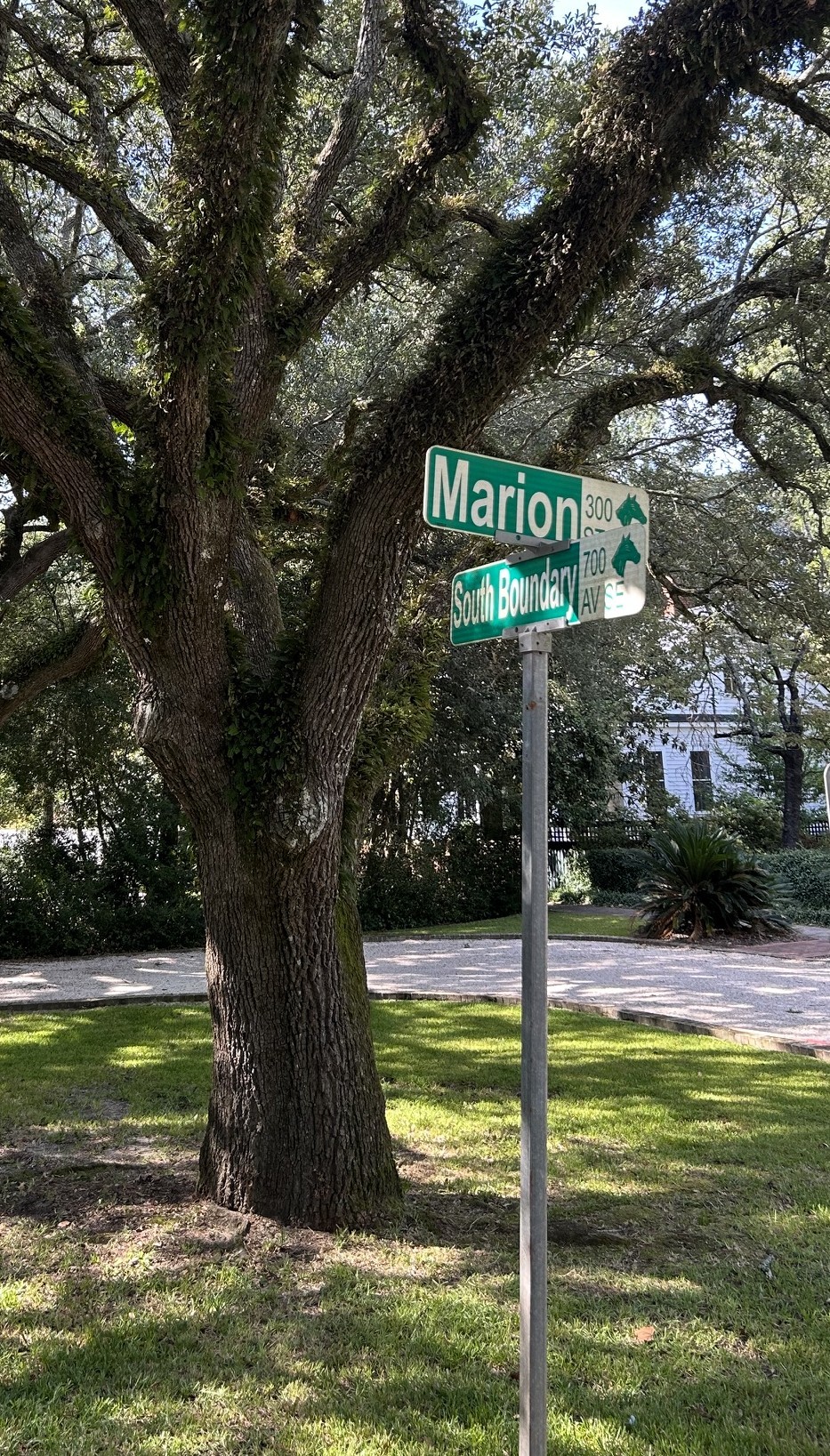 Okay, it’s safe to say Marion Street is not named after my mother because it was added to the map almost a hundred years before she was born. But the name grabs my attention because of the spelling. My mother is “Marion”, not “Marian” or “Maryann” (or however else you choose to spell it). Besides, when our town’s other streets default to standards like “Second”, and “Park”, a woman’s name smack dab in the middle of them all certainly stands out.
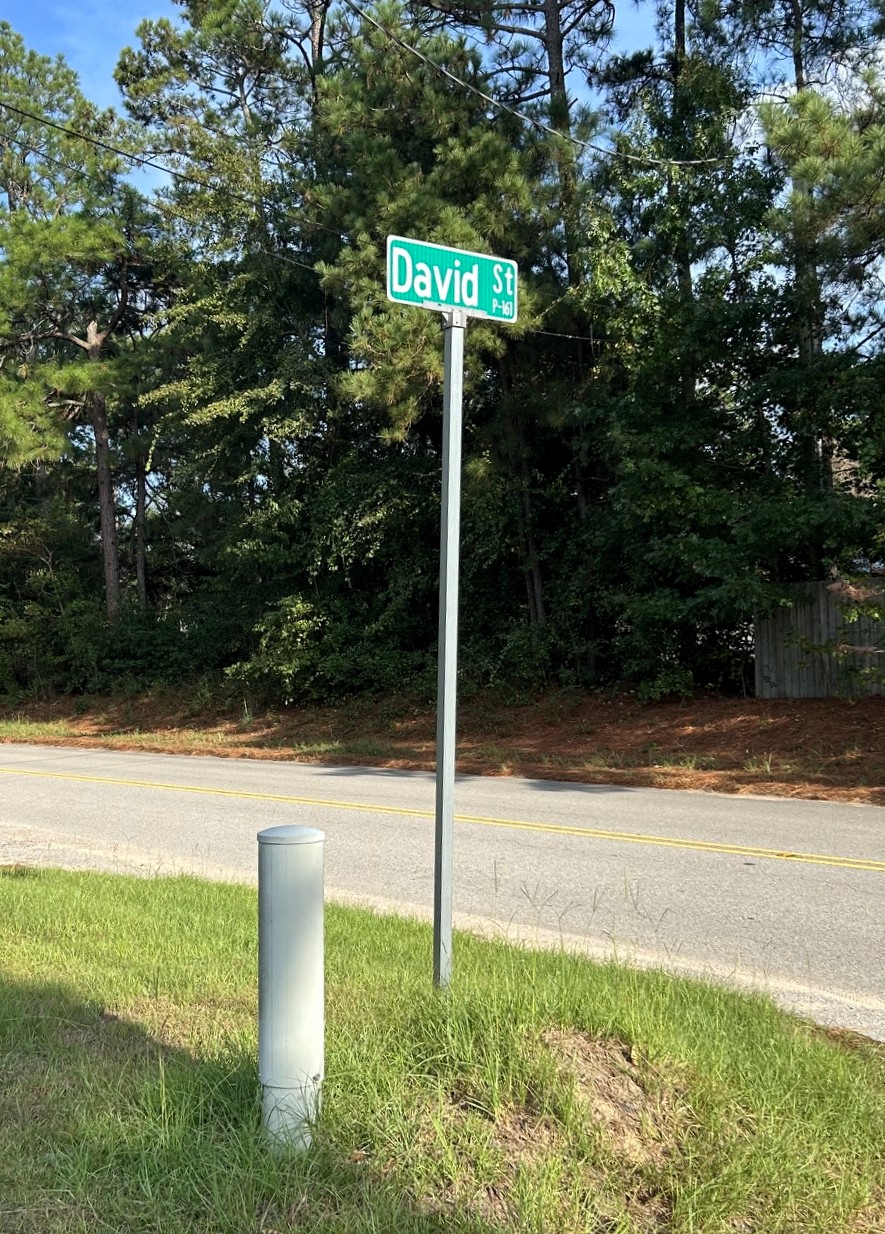
I ran the town 10k for the fourth time last April, so it was another chance to blow a kiss to my mother as I huffed/puffed down her street. But this topic never would’ve become a blog post without broadening the search a little. Which brings me to “David Street”, a discovery I made just this past weekend. Driving down a road I rarely traverse, the street sign popped up just after a curve, causing a double-take and a tap on the brakes. Marion Street and now David Street? What’s going on here?
Believe it or not, the study of street names (like we’re doing today) also has a name: odonymy. “Odonyms” in U.S. cities prefer to go with numbers, trees, or landscape elements. There’s a good chance your town has a Second Street, Elm Street, and/or a Park Avenue. If you do have a street named after someone, that person was likely a U.S. president or a prominent figure in American history. And the person is most assuredly dead, because tradition says we don’t name our streets for the living.
Odonymy trivia: “Second” is the most common street name in the United States (there are over 11,000 of them), followed by “Third”, followed by “First”. Why is “First” in third place? Because “First” is often replaced by “Main” (for a town’s most prominent street) or “Front” (if that street fronts something noteworthy like a river).
If a town’s grid is big enough the street names can be part of a group. In San Diego, the city chose trees in alphabetical order (e.g. “Ash”, “Beech”, “Cedar”) intersected by numbered streets, so your location at say, “Fourth and Elm” is very easy to find. Austin, TX named its streets after Texas rivers. Palo Alto, CA went with distinguished colleges and universities. And even though Tucson, AZ didn’t go with a group of names at all, they still get points for calling their streets on the diagonal “Stravenues”.
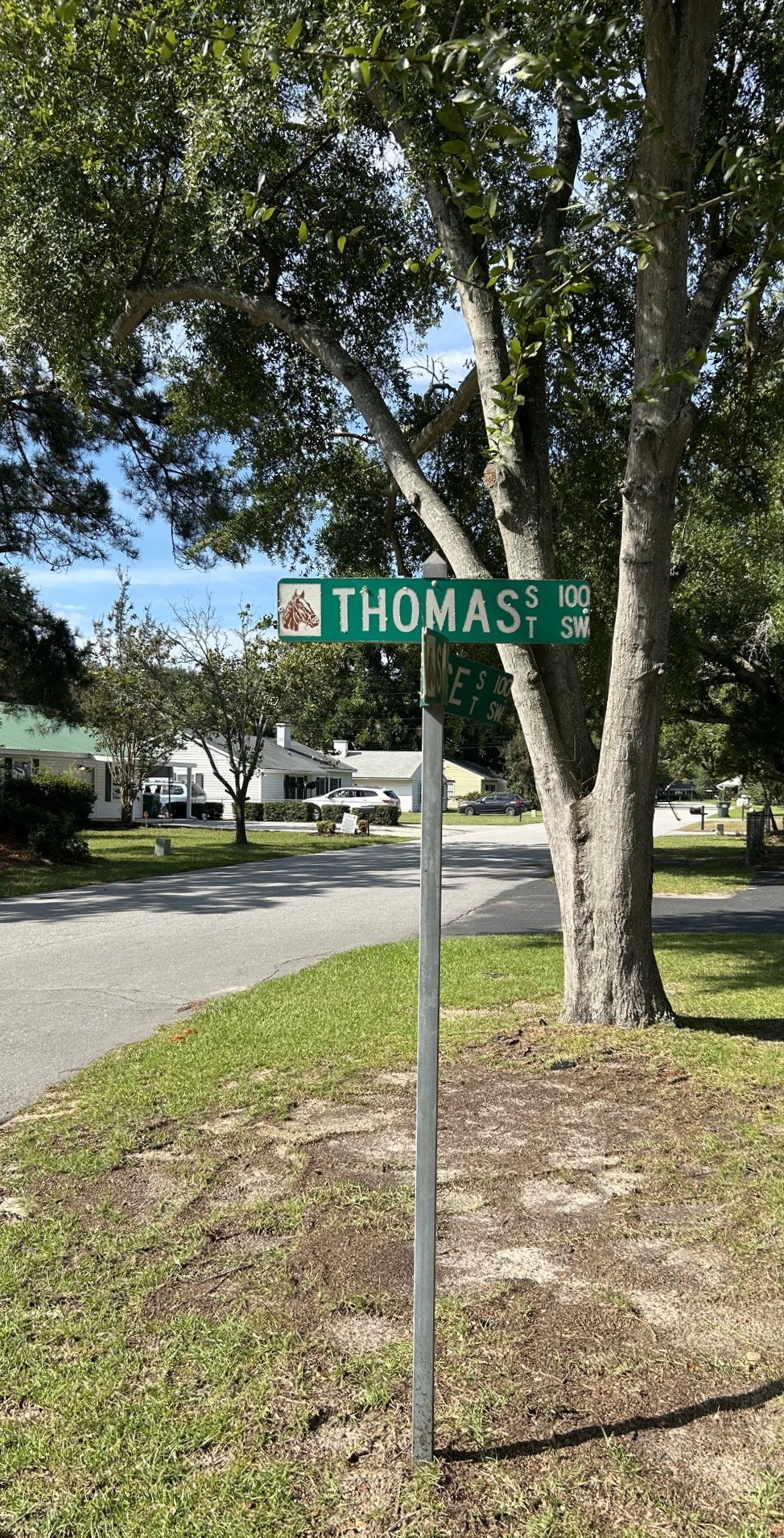
Because I can’t resist a good treasure hunt I looked up the rest of my family on Google Maps. Guess what? Of my four brothers, two are on street signs right here in town, while the other two are less than thirty minutes away. My three children are in the neighborhood as well. As for my father? Well, the nearest “Bob Street” is over two hours away, yet that seems apropos. After all, my dad was always one to endeavor far beyond his immediate surroundings.
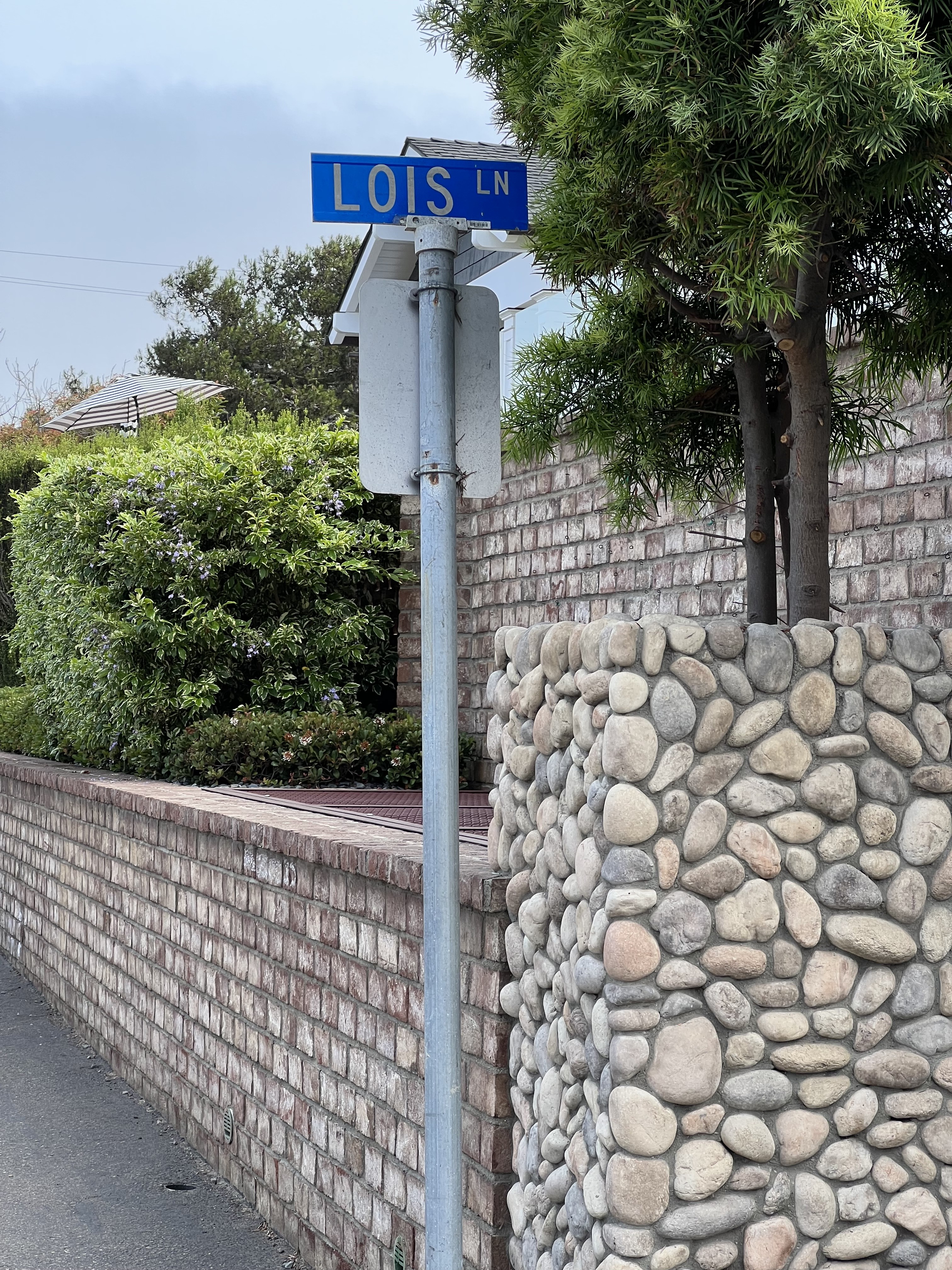 To bring us back to where this all started, the mystery of Marion Street is really no mystery at all. My town chose South Carolina counties for its street names and Marion County is one of those, just off the Atlantic coast. The name “Marion” honors Francis Marion, the “Swamp Fox” brigadier general who served in the Revolutionary War. But I prefer to honor a certain someone else instead. So every chance I get I’ll run down her street, give a little wave to her sign as I pass by and say, “Hi Mom!”
Some content sourced from Wikipedia, “the free encyclopedia”.
———————————————————–

LEGO Neuschwanstein Castle – Update #7 (read about the start of this project in Fit for a (Fairy Tale) King
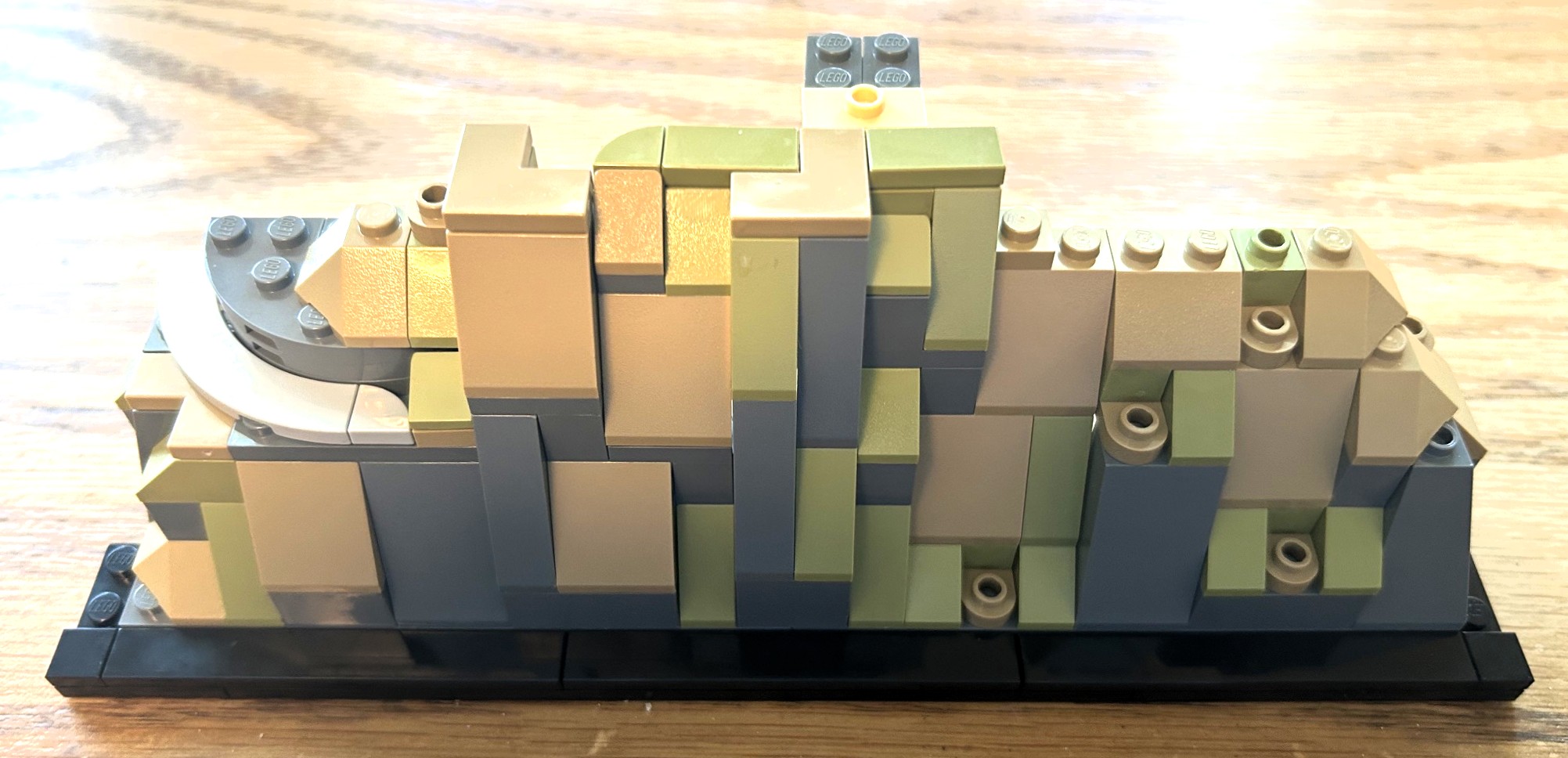
King Ludwig’s castle is determined to be the most difficult LEGO build I’ve undertaken, even if the construction has been fairly straightforward so far. Bags 13 and 14 (of 23 bags of pieces) returned to the Bavarian Alps below the structure, working to close in the far end of the castle’s earthly foundation. Today was effectively ninety minutes of adding more of the green, grey, and beige pieces you see in the surround of the model. And the build was going just swimmingly… until it wasn’t.
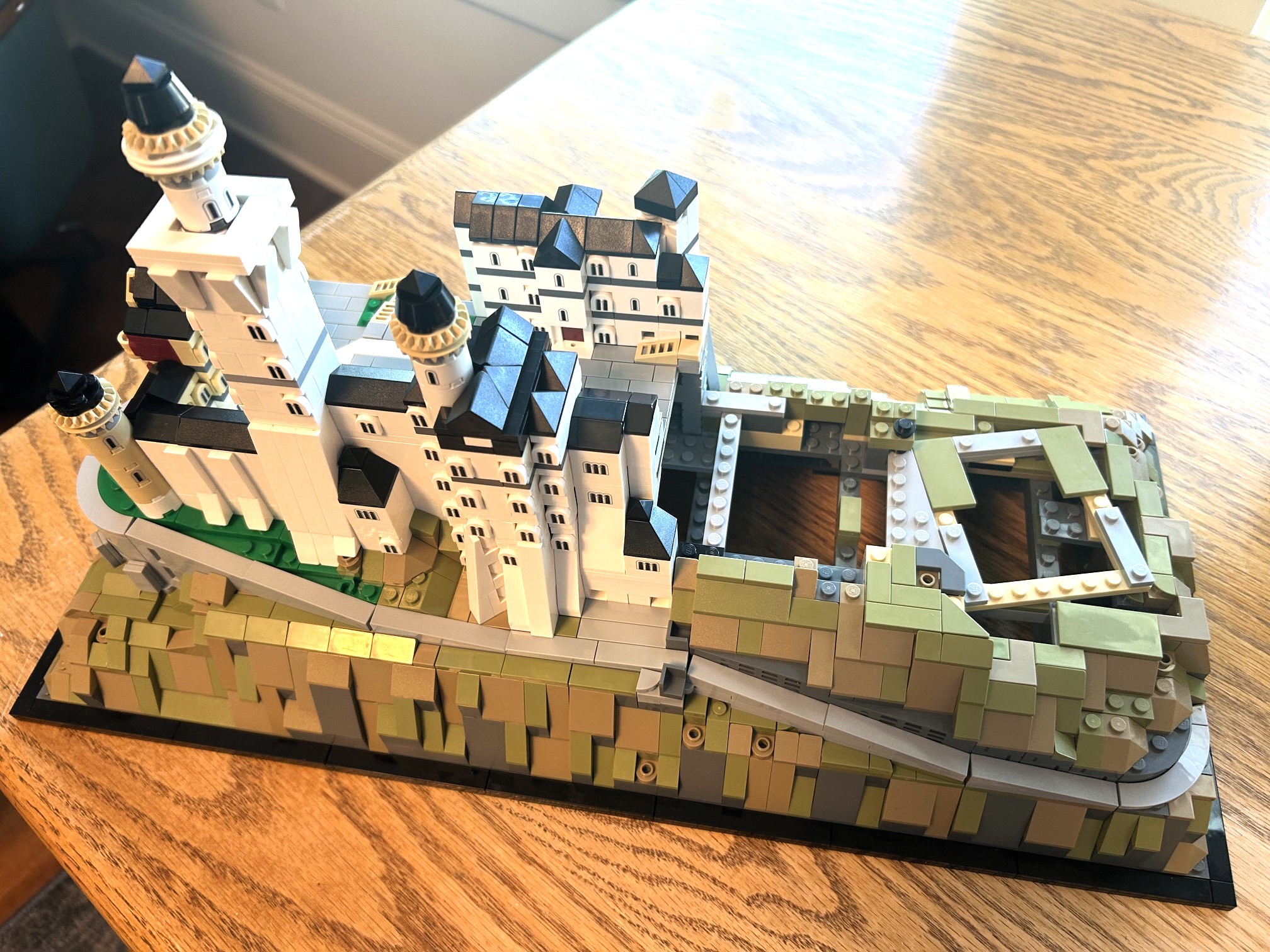
LEGO left another piece out of the box (or so I thought). As I wrapped up construction of the contents of Bag 13, I realized the little bugger simply wasn’t there – and it was an important little bugger. I looked everywhere to no avail. So clever me improvised by replacing the piece with a fairly similar one from my pile of leftovers. It wasn’t until I was well into the build of Bag 14 that I noticed the missing piece staring up at me from the remaining parts. Which begs several questions. 1) Did LEGO put the piece into the wrong bag? 2) Did I somehow mix up the pieces from both bags (since I emptied them out together)? Or most probably, 3) Did the piece not want to be held captive in the model and was trying to make a run for it?
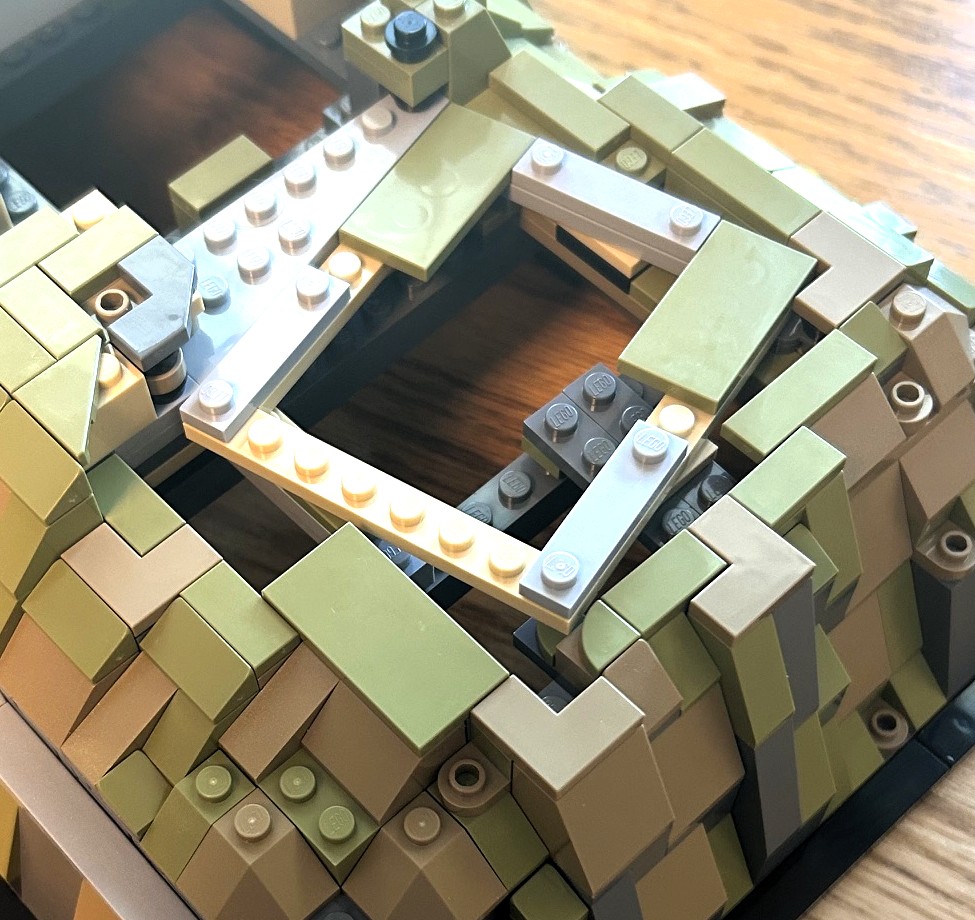
Whatever actually happened I managed to install little bugger where he originally belonged, but not before having to take apart a good chunk of the angled area you see here to gain access to his rightful location. You can’t even see this missing piece when all’s said and done, but it does serve as an anchor for the pieces above it so it’s kind of necessary. I’m happy to report, our little runaway is now officially captive inside of the model. Forever.
Running build time: 6:41.
Total leftover pieces: 41.
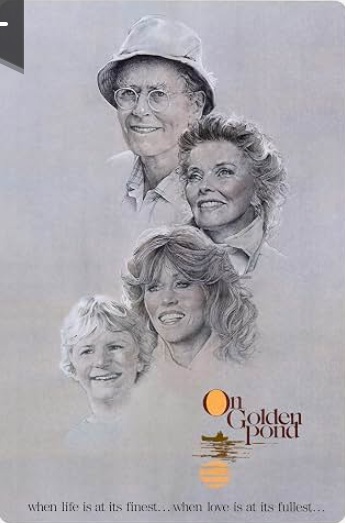 Accompanying movie soundtrack: On Golden Pond (1981). After last week’s barrage of Italian opera solos from Breaking Away I was ready for something calmer. And it doesn’t get much calmer than the music from On Golden Pond. The story itself is not a walk in the woods (by design) but who among us baby boomers wouldn’t jump at the chance to see Henry Fonda and Katharine Hepburn in the same film? Both won Academy Awards for their performances. The soundtrack, as it turns out, isn’t much more than the movie’s theme song, a beautiful wandering piano solo with a little flute (and a few loons). So I just put Spotify on repeat and hung out on Golden Pond (over and over) for awhile. Listen to the melody here.


My mother and her mother were both named Marion. Maybe that is why mom called herself Mari from an early age, effectively changing it legally in an age when you could do that without legal paperwork and purely through usage. In fourth grade, my teacher (a nun) corrected my pronunciation of my mom’s name, telling me it was pronounced “Mary.” We had a good laugh about that at home since my mom and I both knew exactly how she pronounced it.
LikeLiked by 1 person
I’ve never heard the name shortened before! Love the exchange with your teacher. It wasn’t until later in life I realized the name worked for men as well (e.g. John Wayne)
LikeLiked by 1 person
Love this street trivia! Who know that ono…whatever word! (Apparently, I still don’t know it.) “Stravenues” is brilliant. I approve. And I’ve totally seen the San Diegan tree-themed streets. I like those because I like trees. Did your mom ever get to learn of the street named after her? {wink wink} I say the same thing about Florence, Italy being named after my mom. 🙂
LikeLiked by 1 person
San Diego came immediately to mind with this topic. Tucson was a revelation. Florence is a beautiful name (and city) as long as it’s not shortened. And sadly, my mother left us before she had the chance to see her street. Hence I keep an eye on it for her 😉
LikeLike
Good that you’re looking after your mom’s street. 🙂
LikeLiked by 1 person
This is quite interesting!
LikeLiked by 1 person
That is a coincidence about your mom’s name and yours Dave. I don’t think I’ve known anyone named Marion. Thanks for the new words “odonyms” and “odonymy”. In my city, lots of words revolve around the name “Lincoln” and our high school sports teams were/are the “Railsplitters” and our yearbooks “The Log”. In the Memorial Day parade we have President Abe and Mary Todd Lincoln leading the parade and many streets are named after the presidents. No “Linda” streets or numbered streets though. No wonder you need some soothing, beautiful music to help get you through the frustration of occasionally ripping apart the areas you labored over in your LEGO build. I remember the movie “On Golden Pond” and listened again to the music, appreciating the soothing sounds of the loons. The other day I listened to the soundtrack of “The Thorn Birds” … I had the theme song in my head for some reason and tracked it down on YouTube. I loved the book and the miniseries.
LikeLiked by 1 person
Did Lincoln have any connection with your area? I know he had a house in Illinois but I’ve never heard anything about Michigan. Glad I finally included a movie you’ve seen and yes, the choice was helpful in light of the unexpected challenges this week! Never saw “The Thorn Birds” but I certainly remember the title.
LikeLiked by 1 person
No, there is no connection to President Lincoln and the city of Lincoln Park – so that’s odd that he is such a big part of the City’s heritage. The City turned 100 last year. I did know there is a Lincoln Park, Chicago – it’s much more famous than here. Our city is only five miles square. Yes, finally a movie I know with soothing music to boot.
There were so many great miniseries back in the 1970s and 1980s and “The Thorn Birds” was one of those where everyone talked about it while getting their morning coffee in the office kitchen the next day. Funny, in later years in a big office, everyone got their morning coffee at Starbucks, or some other coffee house in Downtown Detroit, thus eliminating that morning gathering and rehashing. For our law firm, it was the many TV legal dramas as well.
LikeLiked by 1 person
Office coffee and morning greetings – absolutely. In the first office I worked in it was pretty much the only place where people could gather – a counter kitchen of the smallest dimensions. God protect the poor soul who left the pot empty without making more! My own recollection of a mini-series is Lonesome Dove, one that my wife and I watched on DVD well after it came out. The immortal Robert Duvall and Tommy Lee Jones, with a supporting role from a young Diane Lane. The very definition of an “epic”.
LikeLike
I have Henry Mancini’s version of the theme from The Thorn Birds on my walking playlist = what a wonderful piece.
LikeLiked by 2 people
Yes, it’s a beautiful theme song Joni … I was thinking of the movie and hunted down the theme song on YouTube and heard the whole album. I also went down a rabbit hole and watched a few videos about that mini-series including one called “The Thorn Birds” in 10 minutes”. Back when TV was great!
LikeLiked by 1 person
I didn’t recognize the theme from “The Thorn Birds” but it’s beautiful. The flute almost sounds like a piccolo. I saw where Richard Chamberlain died last year. The several chapters of his acting career make for an interesting read (IMDB.com) and his performance in The Thorn Birds appears to be a highlight.
LikeLiked by 1 person
I always liked it, and when I was checking out some Henry Mancini music a few years ago, I came across it again.
LikeLiked by 1 person
Fun topic about street names and so many of your family names CLOSE by!
LikeLiked by 1 person
Great progress on the Lego.
So far I’ve not run across an “Andrew St.” anywhere. There are a lot of St. Andrew towns, cities and a couple of streets with that name, but I haven’t found a plain “Andrew” anywhere.
and Reno has a 2nd street — right behind my church on 1st street which is near River St. …
LikeLike
My research did include that streets are named after saints (as are churches, schools, and so on). Of course, your namesake is a lot more popular than mine. David was the patron saint of Wales, which I would categorize as a “little known fact” 🙂
LikeLiked by 1 person
Francis Marion–he was the Swamp Fox of Disney fame! (You’re probably too young to remember!) ‘Love all this trivia about street names. It’s such fun to come across streets that bring to mind family, friends, or places we’ve been. I’m at the age now where just about everything reminds me of something!
LikeLiked by 1 person
Played by a young Leslie Nielsen! You’re right, I’m a little too young to remember (which is a comment I don’t get very often these days 😉 ) BTW, you’ll be happy to know we have a Nancy Lane in town.
LikeLike
That’s a cute story. I didn’t know you were a runner, so it’s nice you can wave to your mom. I can’t think of any streets here that are named after first names, but plenty of last names, usually important people from the past. My sympathy on the runaway part – it think I would find the whole process too frustrating, like doing a jigsaw puzzle and finding a piece missing.
LikeLiked by 1 person
No question frustration enters the LEGO building equation every now and then, but usually it’s the result of impatience or not following directions. LEGO is very good with illustrations and logical step-by-step instructions. Every time I think a piece is missing (except once) it magically appears right in front of me. The search-and-find aspect is right in line with jigsaw puzzles.
LikeLiked by 1 person
Also, your Jays are going to take it down to the wire, aren’t they? Seven games to catch Houston and Chicago! C’mon Toronto!
LikeLiked by 1 person
Thanks for rooting for them Dave, but they won’t get a wild card spot. Just being realistic here. They are 3 spots out, and the last two games against Texas were dismal…lots of mistakes and they are short pitchers still. I have no hope. Still, they have done well considering where they were at one point.
LikeLiked by 1 person
Loved this! Now I know that my entire county is (kind of) named after your mom. But I have to go a county away to find Edith Street, which shares my mother’s name.
Another interesting subset is streets with someone’s full name. Doesn’t every decent sized city have a “Dr. Martin Luther King Jr.” Street? Which requires really small print on the sign. Another is from my hometown of Fort Wayne, which named a street after a former mayor: “Harry W Baals Drive”. A distinctive name, for sure!
I have to confess that I have never seen On Golden Pond. I need to remedy that.
LikeLiked by 1 person
Colorado Springs has a prominent bypass named after Dr. King. In the thirty years we lived there I never heard anyone share an event or connection that would make that naming logical. Like U.S. presidents I suppose it’s just another way to strengthen the legacy. My shortcoming with “On Golden Pond” is that it’s the only movie I’ve ever seen with either Fonda or Hepburn. Talk about “I need to remedy that!” Same goes for Jimmy Stewart. “It’s A Wonderful Life” and no others.
LikeLiked by 1 person
You could do worse than Hitchcock’s Rear Window, from 1954 with Stewart and Grace Kelly!
LikeLiked by 1 person
I spent 8 years in a 4-H Club where our leaders were named Gerry (a gal) and Marion (a guy), so I always thought Marion was the male spelling of Marian. But apparently “Marion” is an equal opportunity name!
LikeLiked by 1 person
John Wayne’s real name was Marion Morrison so I always knew the name could apply to guys and gals. Versatile!
LikeLike