Cold Brew

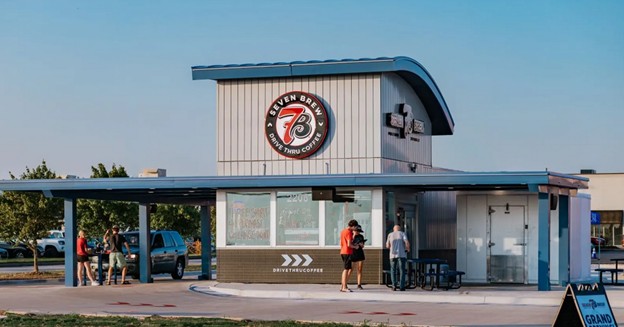
Seemingly overnight, a new drive-thru named 7 Brew showed up next door to our local supermarket.  A quick glance as I drove by suggested their slogan: “Come for the coffee, come again for the people” is on the mark, with more employees dancing around the drive-thru lanes than making drinks in the petite building itself.  7 Brew advertises an “experience” as much as it does a menu of coffee and energy drinks.  It’s just the latest concept to steal market share from Starbucks.
7 Brew

Did you know today is “Red Cup Day” at Starbucks?  Red Cup Day is the coffeemaker’s nod to the beginning of the holiday season.  Buy a Starbucks “holiday” drink and you’ll also receive a festive reusable cup – more distinctive than the usual white ones.  The red cups suggest Christmas comes early this year, and encourage the purchase of peppermint mochas, eggnnog lattes, and iced gingerbread chais.  Somewhere in all that there might even be coffee.
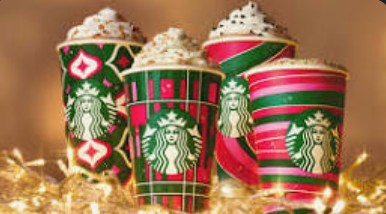
I admit, the Starbucks Chestnut Praline Latte really is Christmas in a cup.  The drink tastes of the same spices you’ll use with Grandma’s cookie recipes this season.  And on a recent trip through Chicago O’Hare, my wife and I caved to a couple of Starbucks’ ever-popular Pumpkin Spice Lattes.  But here’s my point.  Starbucks is no longer my go-to for coffee drinks.  It never was my go-to either, but there were plenty of morning commutes when I couldn’t pass up a Flat White and a couple of egg bites.  Now I drive by without pause, the same way I’ve done so with McDonald’s for decades.  It begs the question: has Starbucks become passé?

There are signs suggesting we’ve already put Starbucks in the rear-view mirror, even if 38,000 locations still dot the globe.  Like 7 Brew, Starbucks has always tried to deliver an experience as much a drink.  Come on in.  Hang out for awhile.  Even if you don’t, peruse all the “merch” while you’re standing in line.  Chances are pretty good you’ll spend more on logo items and baked goods than coffee.

This year, Starbucks features a 20-oz. “Bearista” cup.  It’s a refillable glass ontainer with a straw and it’s being marketed as a collectible.  You’ll find these bears at your nearest Starbucks for $29.95.  Or maybe you won’t, because they seem to be disappearing as fast as they’re put on the shelves.  If you’re a little desperate, find one on eBay for $500 or more (coffee not included).

To me that’s a good way to describe Starbucks these days… a little desperate.  They’re closing stores without drive-thru lanes, which suggests they’re trying to reduce the money they spend on leases.  They’re laying off retail and non-retail employees, the typical corporate strategy to try to do more with less.  And they’re coming up with bear-shaped cups the size of a Starbucks “Venti”, so you’ll purchase their largest coffee when you wouldn’t have done so with a regular cup.
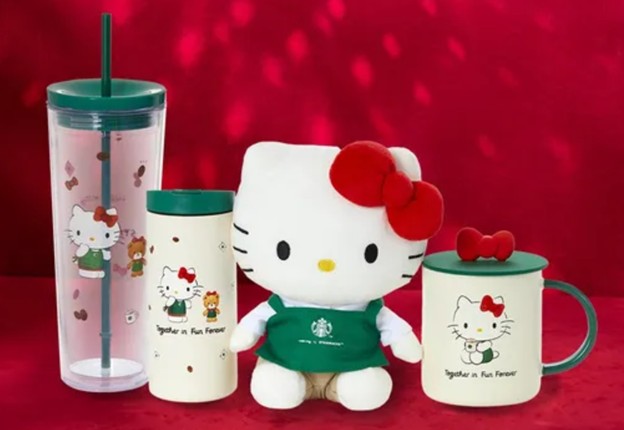
If you think the “bearista” is cute – and would pay $29.95 for it – how about “Hello Kitty” products?  Coming soon, you can buy a “plush” wearing a Starbucks green apron, and any one of five Hello Kitty containers, from water bottles to ceramic mugs.  Each of these runs you $30 or more (again, without the coffee).  Cats and coffee?  It’s a desperate strange marketing strategy, perhaps aimed at a generation of consumer that seeks something more trendy than coffee in a red cup.

This year, the Pumpkin Spice Latte showed up on the Starbucks menu on August 26th; hardly what I’d call “fall”.  Their Christmas-y drinks debut today, fully two weeks before Thanksgiving.  That’s stretching the seasons a little.  But let’s say I still splurge for a Grande Flat White, a couple of Egg Bites, and a slice of Iced Lemon Loaf.  I’ll pay $20 before I even consider the purchase of a “bearista” or a kitty.  It may be time to move on from the red cups.  Maybe I’ll give 7 Brew a try instead.  $7 gets you their smallest size… even pricier than Starbucks.  No guarantee you’ll find any coffee in that cup either.

(Coming next week: more updates on the LEGO Trevi Fountain!)

Fruit of the Bloom

On Monday I noticed a lot of the wearing o’ the green because, of course, Americans celebrate St. Patrick’s Day as if we are somehow Irish. It’s a fitting burst of color as winter slowly but inevitably surrenders the seasonal baton. Soon you’ll find a full-on rainbow of blooms in every garden you pass. For now however, let’s drink and dance in honor of another bright color this week: pink. More to today’s topic, cherry pink.

If you’re tuning in from Washington D.C. you already know where I’m going with this one.  Today is the first day of spring, and the beginning of the Cherry Blossom Festival in our nation’s capital: four weeks of seemingly countless opportunities to celebrate the flowering of the graceful trees on the banks of the Potomac.  If you’d asked me a week ago what the bloomin’ fuss is all about, I’d have said the festival’s significance is as shallow as the water in the Lincoln Memorial Reflecting Pool.  But now I’m properly informed.  There’s more to this story than just pretty in pink.

“Yoshino” cherry blossom

In the early 1900s, America and Japan were unconditionally friendly countries (years before that little dust-up in the 1940s).  To acknowledge the friendship, Tokyo’s mayor shipped 3,000 Japanese cherry trees to Washington D. C.  There’s a longer, more convoluted history behind this gesture, including players from both countries making repeated efforts to populate the city with trees, but the details are about as interesting as pushing a bill through Congress.  Suffice it to say cherry trees were planted along the river, up and down the avenues, and in numbers worthy of an annual festival starting in the 1930s.

I love cherries; always have.  I think the flavor itself appealed to me before the fruit, in the popular junk food of the 1970s.  Hostess Fruit Pies.  Life Savers.  Slurpees from 7-11.  Or the proverbial maraschino on top of an ice cream sundae.  As much as I got my fill of those, I could never get my fill of my mother’s homemade cherry pie, and I mean homemade.  The cherries were passed down from her mother each year, picked, jarred, and ready to go.  The crust was made from scratch, including the signature latticework on top.  It’s a wonder the butter wasn’t churned from the milk of a family cow.

Alas, no longer on the menu

It’s also a wonder I’ve never been to D.C.’s Blossom Festival, considering my unabashed affection for the fruit.  I’m sure I’d find a couple dozen new ways to enjoy cherries besides the usuals.  I’d happily scarf down a serving of flambéed Cherries Jubilee over ice cream, or the cherry-filled sponge cake of a Black Forest gateau.  For the more adventurous there’s a savory Hungarian soup made with sour cherries.

“Petals and Paddles” race

Of course, there’s a lot more to the Blossom Festival than just food.  You’ll find parades, concerts, and kite-flying, with every shade of pink you can imagine.  Tour the historic Anderson House, filled with art and floral displays (featuring the cherry blossom, of course).  Compete in a “Petals and Paddles” boat race across the tidal basin surrounded by the trees.  Or get wet in “Pink in the Pool”, a family-friendly swim party replete with colorful beach balls.  There’s even an “Opening Ceremony” event on the first Saturday, (already sold out by the time I checked the website).  The weeks-long agenda proudly declares “events are primarily free” but I beg to differ. Tickets to the first several on the list were decidedly pricey.

For all I’ve just written, it’s a wonder the word “cherry” appears less than ten times in the hundreds of posts I’ve published on Life In A Word.  One time I referred to the children’s game “Hi Ho! Cherry-O”.  Another I talked about Cherry Coke.  The rest were the same things I mention here – ice cream sundaes, Slurpees, and so on.  So let’s add the Blossom Festival to the list, shall we?  With four weeks of celebrating, it’s safe to say life is a lot more than just a bowl of cherries.


LEGO Notre-Dame de Paris – Update #9

(Read about the start of this “church service” in Highest Chair)

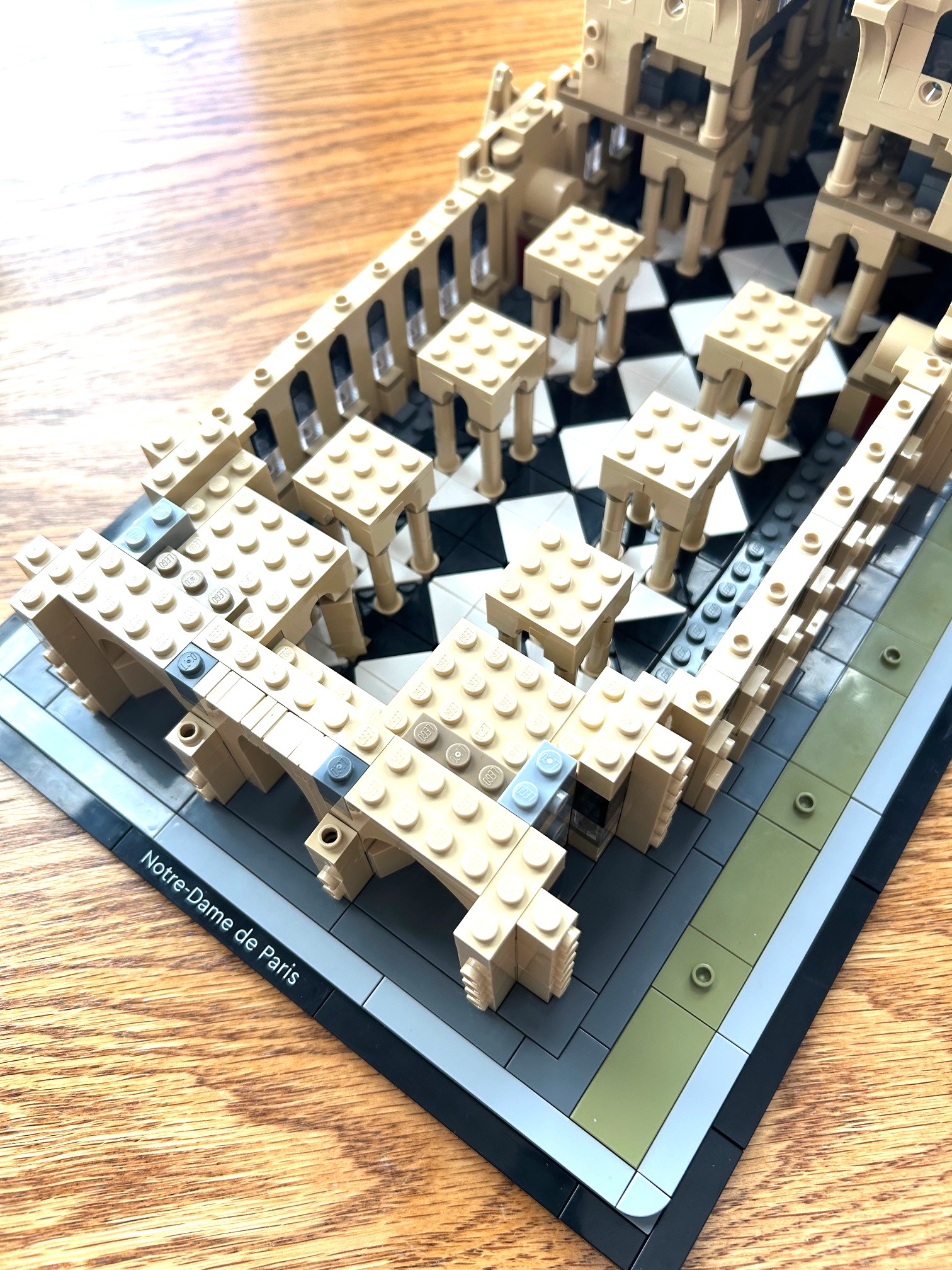
What was once a giant box of LEGO pieces is finally starting to resemble a cathedral!  Bags 15 and 16… of 34 bags of pieces, focused entirely on the body (nave) of the structure.  We’re now building in the years 1220-1225, when the walls of the nave rise to the same height as the semicircular chancel at the east end.

Under construction
Fully fortified

The parishioners look rather tiny, now that we’re working so far above them.  And notice all those free-standing columns from last week aren’t so free-standing anymore.  We’ve capped them with structural elements to support what is still to be built up above.  Also notice we’ve closed in the west end of the cathedral, which patiently awaits the addition of the soaring bell towers.

West end “front doors”

Okay, it’s time to address the elephant in the room; an elephant that gets bigger with every update.  A few of you have sounded the alarm on my running count of leftover pieces.  It’s a fair concern, considering the LEGO Grand Piano also started as thousands of pieces but only amounted to a handful of extras.

extras

Here’s the truth of it: the twenty-six leftovers shown here amount to just a handful as well.  Every one of them is among the tiniest pieces in the entire cathedral.  It probably cost LEGO pennies to add in these “bench players”.  And given the tendency of pieces to run away I’m grateful to have them.  Heck, by the time the cathedral is finished maybe I’ll have enough leftovers to build a small elephant. 

Running build time: 7 hrs. 57 min.

Total leftover pieces: 26

Some content sourced from the National Cherry Blossom Festival website, and Wikipedia, “the free encyclopedia”.

Dave meets “Evy”

Renting a car at the airport used to be so hassle-free. You’d book the vehicle online, walk or bus to the parking lot, and bypass the counter by signing up for the company’s free membership program. All of that still happens, so what’s the difference today? You never know what vehicle you’re going to get, even if you choose the make/model ahead of time. And if you’ve never driven an electric vehicle (“Evy”) before, renting one is a real adventure.

Blame it on my laptop keyboard.  As I pecked my way through a recent Avis reservation, I inadvertently chose “Mystery Car” instead of “full-size sedan”.  Mystery car?  What the heck does that mean?  It means more flexibility for the rental car agency.  “Mystery car” means Avis gives you whatever it feels like giving you from its leftover inventory.  Maybe you get what you wanted.  Maybe you get a luxury vehicle for even less.  Or maybe you get Evy like I did.

I admit, I am not with the times of the latest vehicle technology.  I couldn’t tell you the first thing about operating Evy, let alone how she works under the hood.  So there I stood in the Avis parking lot, faced with the prospect of my first miles behind her wheel.  The rental companies should put a beginner’s guide on the driver’s seat for people like me.  I mean, imagine my hesitation (panic?) when I pushed Evy’s start button and nothing happened?  Something happened, of course.  The engine “started”; it just didn’t make any noise.  Yep, this was going to be a different kind of ride.

My first issue with Evy (or at least, the Genesis I rented) is the inexplicable need to make the dashboard wildly different than a conventional vehicle.  You don’t find the basic needs (ex. headlights, windshield wipers) where you expect to.  I actually considered talking to the vehicle instead of pushing random buttons, especially after my seat suddenly firmed up and vibrated when my I let my posture slip a little (“driver safety feature!”)  Seriously, all I’m asking for is dashboard buttons and levers where I expect them to be.

Once I found a modicum of comfort with Evy, the real challenge dawned on me: I have to recharge her before I go back to the airport.  And this, my friends, proved to be a challenge worthy of reality TV.  Those who already know Evy are welcome to say, “Oh c’mon Dave, it’s not that hard!” but truth be told, my charging station experience was just as daunting as the first time I pulled up to a gas pump as a teenager.

Credit Genesis, you can look up the nearest charging station right there on the dashboard.  The search gave me a choice of three.  The first station was in an Urgent Care clinic parking lot… and wasn’t working.  I’ve read that 15% of EV charging stations don’t work so now I’m a believer (EV Charging Flaw #1).

The next charging station option was in a McDonald’s parking lot.  When I arrived, both slots were occupied (EV Charging Flaw #2 – not enough to go around).  I have no problem waiting in line at gas stations but charging Evy takes a lot longer.  So I chose to drive another mile to the third option, a charger in a bank parking lot.  Nope.  No station to be found from one end of the lot to the other.  Genesis needs to update its locator software.

So back to McDonald’s I steamed went (and not for a Happy Meal, mind you).  The charging stations were still occupied, which begs the question, where do you form a line?  If I parked behind either car I’d be blocking their exit.  I’d also be blocking the McDonald’s drive-thru lane.  The only option was the parking space adjacent to the charging stations, with hopes of quickly maneuvering into an available charger before the next person pulls up (EV Charging Flaw #3).

This story only gets worse from here, so let’s keep it brief.  Once a station was finally available, I pulled in only to realize I had to face the car the other way for the charging cable to reach (EV Charging Flaw #4).  Then I tapped my credit card on the charger, only to find you have to download an app to make the station work; no cash or credit accepted (EV Charging Flaw #5).

Fifteen minutes later (because that’s what it takes when you only have one bar of wireless service – grrrrr) I got the app installed, the charging cable connected without electrocution (in pouring rain), and ta-dah… NOTHING!  Nada!  Zilch!  No “PRESS HERE TO CHARGE” or some other obvious way to get things started.  Instead, by the good graces of my EV-knowledgeable brother over the phone, I learned I had to zoom in on the tiny app map, identify the McDonald’s location of my charging station, and tap it (EV Charging Flaw #6).  Suddenly Evy’s gods smiled down on me through the thunderstorm and declared “Charge”.

To say I was giddy to make it back to the airport a day later without a dead Evy is an understatement.  To say I was the target of a sick joke when my very next Avis rental – same day, different airport – was a hybrid is undeniable.  But hey, at least a hybrid gives you the option of gasoline, so you get to fuel up the “old-fashioned way”.  Which brings me, humbly, to declare Dave Flaw #1:  Get to know Evy very, very well before your life – or at least your transportation – depends on her.

Meet Cute

Every now and then McDonald’s gets it right. In 1973, they introduced the Quarter-Pounder because customers demanded more than a 10 oz. patty inside of a boring bun. In 1987, McDonald’s added “PlayPlace” indoor playgrounds to suburban locations: crawl tubes, slides, and ball pits contributing to countless happy childhoods.  This year, the restaurant chain is stepping it up with its McCafé Bakery offerings. The Apple Fritter, Blueberry Muffin, and Cinnamon Roll will step back to give the spotlight to the newest McDonald’s kid on the block: the adorable Glazed Donut.

Seriously, just look at this little guy.  Isn’t he the cutest donut you’ve ever seen?  The McCafé Glazed Donut looks like a happy gathering of donut holes, all nestled up against each other for warmth and protection.  The Donut is pleasingly symmetrical.  Even the spelling is cute (instead of the more substantial “doughnut”).  And the best part: its “donettes” pull apart the way you would a hot, flaky croissant.  It’s like getting seven for the price of one.  And it’s cute to boot.

I admit I didn’t wake up this morning intending to write about cute donuts.  Even the headline about this doughnut’s upcoming debut didn’t really catch my eye.  But then I saw the photo and I was utterly smitten.  It’s the same way I felt when I first saw a package of those colorful little Plink garbage disposal cleaners.  I just had to have them.

Some would describe this as a “meet cute” moment.  Meet cute is the early-on scene in television or movies where two people connect for the first time and you just know they’re headed for romance.  The Hallmark Channel is all about meet cute.  Any scene where Hallmark movie man meets Hallmark movie woman, combined with something funny or unusual is 99% headed towards future romance.  It’s like you’re ten minutes into the story and you already know how it ends.

Plenty of “meet cute” in this one

And that’s how it’s gonna go with the McCafé Glazed Donut.  We had our meet cute this morning.  Now I have two weeks of anticipation and heart palpitations before I can actually buy one.  But I already see it.  I (almost) already taste it.  And the whole pull-apart thing?  Pure sex(y) appeal.

Meet cutes don’t always lead to predictable endings.  After the meet, the movie leads you to believe the characters are destined for romance.  But sometimes they’ll throw a curve (usually in the form of a third character) and the story goes in another direction.  Could happen with the Glazed Donut too.

Let’s use supermarkets as an example.  You stroll into the store, grab a basket, and think about your shopping list.  But before you even reach the aisles you’re greeted with front-of-store marked-down day-old doughnuts.  They’re just sitting there like little round orphans, begging you to spend another $0.69 to “adopt” one.

They’ll be front-of-store by tomorrow

So you do.  And you make sure the little guy’s placed in your basket as an easy find.  Then you slide behind the steering wheel and polish him off before you even leave the parking lot.  Tastes great, right?  Maybe now.  Later you’ll reflect on the slight, sickly feeling in the pit of your stomach and wonder why you caved.

That’s my thinking with the McCafé Glazed Donut.  I can cruise past the Fritter, Muffin, and Cinnamon Roll without so much as a passing glance.  But mark my words, next month I’ll find any excuse to be near a McDonald’s during McCafé Bakery hours.  I’ll purchase the Glazed Donut and my meet cute will blossom into a full-on romance. When I consider the Protein Shake I have most mornings, I’ll feel like I’m about to cheat on my mainstay.  Heck, this scandal could go viral! I see the headline now: Man Opts for Sweet & Sexy over Cold & Icy.  But can you blame me?  My Protein Shake really IS cold and icy, and there’s nothing satisfyingly pull-apart about it at all.  Meanwhile a small, soft, almost UFO-looking donut beckons.

Forgive me, my beautiful, healthy breakfast-in-a-cup.  Looks like I’m gonna stray.

Some content sourced from the CNN.com article, “McDonald’s is adding a sweet new treat for fall”, and Wikipedia, “the free encyclopedia”.

Behind the Wheels

Every summer when my wife and I head to the West Coast for a little sunshine and sand, the only intentional exercise we get is a walk on the beach or a dip in the ocean. So this year we decided our vacation equation needed to get behind the wheels. We skipped the flight, racked the bikes onto the back of the SUV, and drove 1,100 Utah/Arizona/Nevada desert miles to bridge the gap between Colorado and California. Now the Pacific Coast sun shines above, the Pacific Ocean waves crash below, and the bikes… well, the bikes just beckon to be ridden every day.

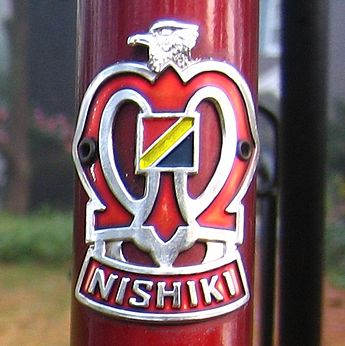
It’s already happened, as I suspected it would.  When we took our first pedal tour around this little seaside town, I saw him for a few fleeting moments.  He was a younger, thinner, blonder version of me.  He was seated confidently behind the drop handlebars of a white Nishiki Regal ten-speed, focused solely on the road in front of him.  He was dressed in Converse tennis shoes, ballcap in place of a bike helmet, white socks halfway to the knees.  When this kid wasn’t body surfing, playing basketball, or working the evening shift at McDonald’s, he was logging mile after mile on his bicycle, in search of driver’s license freedoms, even if he wasn’t old enough to have one.

My fleeting companion is the “me” of forty-five years ago.  In most respects it’s a long period of time.  In others we could be talking about last week.  Bicycling was serious thread in the fabric of my childhood.  It was a way to leave the familiar behind, to pursue esoteric wonders beyond the streets I grew up on.  Bicycling asked the questions, “Where would you like to go?” “Why?”  “And how far?”  At fifteen years old, the answers were limitless.

The Schwinn “Lemon Peeler”

My love of cycling began at a young age (and continues today in weekly spin classes at the gym).  I still remember the very first hand-me-down bike my brothers and I shared – a small blue two-wheeler with no gears, the kind you had to pedal backward to brake.  From there I graduated to a glam Schwinn Lemon Peeler Sting Ray, the all-yellow beauty with the fenders above fat tires, sporting the signature banana seat.

But my Nishiki Regal ten-speed brought bicycling to a whole new level.  I bought it myself: months of hard-earned allowance and odd-jobs cash plunked down for the biggest purchase of my young life.  The Nishiki granted me access to the more sophisticated language of bicycling; terms like “chain stay”, “saddle”, and “derailleur”, even if I couldn’t afford the Raleigh or Motobecane imports more deserving of those words.

Also, the Nishiki meant bike maintenance became a labor of love instead of a chore; a bonding afternoon with friends.  The shade of my dad’s carport colored our “workshop”, where we dismantled, fine-tuned, and reassembled over and over; my friends and I exchanging tools and advice for each other’s spare parts.  I still remember the final touch when the Nishiki was all back together: the pristine white finishing tape wrapped carefully around those drop handlebars, signifying it was finally time to ride.

I was never far behind…

One story of me and my Nishiki will always stand out.  It was all about beating the school bus home.  When the bell rang after my final class, I’d sprint to the rack, jump on my bike, and launch into the six-mile trek back to my house.  The bus meanwhile, needed several minutes to load its passengers, not to mention dozens of stops before it would’ve dropped me.  It was always a neck-and-neck battle as I’d pass the bus and then it’d pass me.  Most times I’d lose the race by mere seconds, easing up on the pedals in exhausted frustration.  But every now and then I’d get the victory.  Did some of my friends deliberately take their time exiting the bus, knowing I was in hot pursuit?  Maybe.

In 1979, a few months after I turned seventeen, a wonderful little film called Breaking Away won the Academy Award for Best Picture.  The movie centered around four friends, bicycling, and Bloomington, Indiana’s “Little 500” bike race, but it was mostly about coming of age.  Learning life’s lessons while putting the miles on the pedals.

Little wonder Breaking Away‘s lead character was named Dave.

[Note: If anything about this post resonates with you, be sure to read Steve Rushin’s Sting-Ray Afternoons.  The author’s childhood is set in Minnesota, but the growing-up memories are remarkably similar to my own.  Even the kid on the cover looks a little like me.  Steve and I could’ve been brothers.]

Some content sourced from Wikipedia, “the free encyclopedia”.

Ketchup Catch-Up

At the Communion rail in our pre-COVID, in-person church days, my wife and I would sometimes laugh at the size of the hunk of bread they’d tear off the loaf. The pieces were so big I’d often be chewing all the way back to my seat (and think I should’ve asked for seconds). On the other hand, today’s “drive-in church” Communion amounts to hermetically-sealed plastic capsules handed gingerly through the car window. Peel back the plastic to reveal the tasteless wafer and half-swallow of grape juice inside. No, it’s not breakfast by any definition, but at least we’re still achieving the higher purpose.

Communion and ketchup are strange bedfellows but I’m about to explain why they belong in the same sentence.  If you’ve followed the headlines lately, you know – just below the latest details of the Myanmar conflict – we’re all worried about whether there’ll be enough ketchup packets for our next take-out meal.  That’s right, the world is currently lacking in – not ketchup – but ketchup packets.  If we don’t address the situation soon, buildings will burn and looting will run rampant.  Even worse, we might have to top everything with mustard instead.

It’s the pandemic to blame, of course.  As soon as traditional sit-down restaurants shifted to pick-up and delivery, their demand for packeted condiments jumped up to the level of Wendy’s and McDonald’s.  In fact, Wendy’s and McDonald’s removed ketchup packets from their front counters, not because customers were taking too many, but because other restaurants were raiding their supplies.  Yep, it’s gotten that kind of desperate out there in burger land.

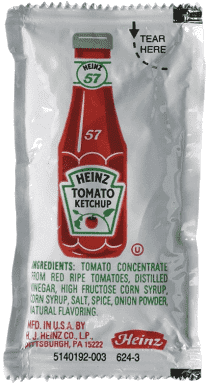
Heinz, the undisputed king of ketchup, recently committed to increasing packet production by 25% to fend off potential mayhem in the streets.  125% of Heinz’s typical annual production amounts to, well… let’s just say there’d be enough to place a packet in the hand of every man, woman, and child on the planet.  Dang.  That’s a whole lot of processed tomato spread.

Speaking of processed tomato spread, here’s my favorite ingredient in ketchup: mustard (powder).  It’s true.  Go check the ingredients list on the bottle I know you have in your refrigerator.

Will there be enough to go around?

But I digress.  Let’s get back to the global packet shortage.  Call me highbrow but I’m having a hard time caring, because honestly I can’t remember the last time I used a ketchup packet.  The restaurants of my choosing always bring the bottle to the table when you ask for it.  Furthermore – burgers aside – I don’t have a lot of use for ketchup.  Not on my fries, not on my meatloaf, neither eggs nor hash browns.  And while we’re at it can we all agree: mustard only on a bratwurst or a hot dog?  It should be a cardinal rule.

But I digress… again.  FOCUS!

If I don my eco-friendly hat for a moment (and don’t I look sharp?), the last thing I want to hear about is Heinz upping ketchup packet production to 12 billion a year.  That sounds like enough plastic to Ziploc a small country many times over.  But I get it.  In these times of please-pass-the-virus (or better yet, don’t), we demand individually wrapped one-and-done solutions.  Like ketchup packets.  Like Communion elements.

Handy host

Good things come in small packages, so the saying goes.  Yeah, well, they come in big packages too.  Like ketchup from a bottle instead of a plastic packet.  Like Communion from a loaf of freshly baked bread instead of hole-punched from a sheet of Styrofoam. And seriously, who uses just one ketchup packet?  Picture a baby burger you can balance between your finger and thumb and maybe it’s enough.  Anything larger and you’re grabbing packets by the handful.

Let’s wrap this topic on a personal note.  If ketchup packets disappear, my granddaughters won’t understand a really good bedtime story, the kind where they’ll giggle every time they talk about it.  You know the story, the one where my buddies and I pocket ketchup packets from our school lunch trays, take ’em out to the playground asphalt, and stomp on ’em to give some unsuspecting kid a tomato facewash?  Oh please, drop the mock horror.  You know you were out there on the playground too, doing the very same thing.

Some content sourced from the 4/8/2021 CNN.com article, “America is facing a ketchup packet shortage”.

R.I.P. Restaurants

The next time you dine out, take a good look at the menu options. You may find a few favorites missing thanks to COVID-19. Whether gaps in the supply chain or trims in the workforce, the virus-born experiment of modified operations has restaurants scrutinizing menus for what makes (fiscal) sense and what does not.

Examples: McDonald’s “all-day breakfast” – implemented in 2015 and an immediate success – retreated to morning hours shortly after the virus exploded. Drive-thru wait times promptly decreased – by an average of 25 seconds – so the change may be permanent. Outback Steakhouse axed its wedge salad and French onion soup, favoring fewer appetizers with faster production.  Before you know it Outback may offer steaks, potatoes, and nothing else.

Subtle menu changes like these got me thinking about restaurants closing their doors for good.  At some point all of them go to their graves.  Maybe this is the beginning of the end for McDonald’s and Outback.  Maybe ten years from now we’ll look back and wonder what brought on their respective demises.  I know I would, which brings me to the real topic of this post: what happened to the eateries of my youth and why are most of them now defunct?  Here then, a eulogy of my more memorable ones:

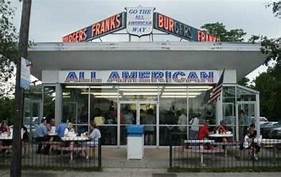
  • The All-American Burger – We had one of these red-white-and-blues in my hometown just a few blocks south of the church where I went to Sunday night youth group.  Mom supplied the cash while All-American supplied the fast-food dinner on those Sundays.  Not sure why AAB closed but they did have their fifteen minutes of fame in the 1982 classic, Fast Times at Ridgemont High.
  • Chi-Chi’s – A super-size Mexican restaurant and one of the first dates for my wife and me in college.  Great food, but Chi-Chi’s U.S. downfall was a grand-scale outbreak of hepatitis-A in one of its Pennsylvania restaurants, in 2003.  You can still find them in Europe and the Middle East.
  • Farrell’s – An ice cream parlor and a great place for parties, since the birthday kid got a free sundae.  Farrell’s had an early-1900’s theme: straw-hatted waitstaff, player-pianos, and menus printed on newspaper.  My favorite Farrell’s memory: “The Zoo” – a giant bowl of ice cream intended for ten or more topped with a menagerie of colored plastic animals.
  • Hamburger Hamlet – “The Hamlet” also had a location in my hometown, and for a burger joint the menu and decor were decidedly upscale.  It was known as a Hollywood celeb hangout.  Curiously, I associate Hamburger Hamlet with O.J. Simpson more than other celebrities.  Simpson’s wife Nicole and friend Ronald Goldman were murdered at the Simpson house, in the residential neighborhood nearby our Hamlet.  Nicole Simpson had just been dining at Mezzaluna (the restaurant where Goldman worked), also just a couple of blocks up from The Hamlet.
  • Lyon’s – The quintessential 1980’s smoke-filled greasy-spoon diner.  There was nothing memorable about Lyon’s (nor healthy on the menu) except the rip-the-boss conversations my coworkers and I had over lunch.  Lyon’s filed for bankruptcy in 1998 and never recovered.  No surprise; none at all.
  • Naugles – My go-to choice in college, Naugles never skimped on their portions of Mexican food (so who cared about the taste?)  Whether it was the massive “Macho Burrito”, the messy “Naugleburger”, or the trash-can sized sodas, Naugles was my all-nighter study buddy. Del Taco took over most of the chain in the 1990’s.
  • Pup ‘N’ Taco – Hot dogs, Mexican food, and – pastrami sandwiches?  I remember Pup ‘N’ Taco more for the buildings than the food; obnoxious red, white, and yellow structures with steep-sloped roofs, similar to the look of the Der Wienerschnitzels of the time.  Taco Bell bought out Pup ‘N’ Taco in 1984, more for the locations than for the menu. Obviously.
  • Sambo’s – I can’t tell you why I remember Sambo’s; I just know my family and I had several meals here.  At its peak Sambo’s had over 1,000 locations in 47 states.  Fittingly the only remaining location changed its name this year, to disassociate with the children’s story The Little Black Sambo.  George Floyd and all, you know.
  • Victoria Station – Chain together several boxcars and a caboose, add kitchen, tables, and steak-and-shrimp menu, and you have a heckuva unique restaurant. Victoria Station ballooned to almost a hundred locations at its peak.  The railcar restaurant concept evolved from a joint graduate project at Cornell University’s School of Hotel Administration. Victoria’s seemed like an upscale meal but maybe it was just the train car dining that made me feel upscale.

Someday soon (soon) we’ll be able to say we’re “post-pandemic” but by then it’s predicted thirty percent of our restaurants will have closed.  I’ll pray for those restaurants to R.I.P. as well, but not without another deserving eulogy.

Some content sourced from the 6/27/20 Wall Street Journal article, “Why the American Consumer Has Fewer Choices – Maybe for Good”, and Wikipedia, “the free encyclopedia”.

Not-So-Fast Food

If you’re like me, you’re prepping meals at home more often than you used to.  Your grocery lists are electronic or paper instead of in your head.  You may even be meal-planning and on your way to becoming America’s next gourmet chef.  But no matter the approach eventually you succumb to food out instead of food in.  “Taking away” meals these days means navigating an app, a website, a drive-thru, a phone call, or for the really daring, an unscheduled appearance at the front doors.  You never know which approach works until you try a couple.  Sometimes you simply give up.

Case in point.  Last Friday we took my wife’s truck for a service – scheduled just after sun-up. Leaving the house so early meant breakfast would be out instead of in.  My first thought?  McDonald’s.  An Egg McMuffin is still a pretty good on-the-go breakfast, and navigating McDonald’s hasn’t changed (drive thru, pay at the window, drive away, enjoy).  I also admit to a soft spot for the Golden Arches because I worked there in high school.

My wife had other ideas.  Since a breakfast sandwich was the order of the day she wanted Einstein Brothers Bagels, and with good reason.  Einstein’s offers a choice of five “classic” breakfast sandwiches and another seven “signature” specials: twelve different spins on bagels and eggs.  While Egg McMuffins are assembled from just four mass-produced ingredients, Einstein’s creations are made-to-order adventures with options like chorizo, avocado, spinach, and mushrooms.  If the choice is Einstein’s or McDonald’s it’s a no-brainer.  Except now.

“Save time?” I beg to differ.

Not knowing Einstein’s take-away approach during COVID, I parked in front of the restaurant while my wife went inside to place the order.  Nope.  Einstein’s allows two options: DoorDash or order from the app.  Well blast my bagels – DoorDash doesn’t even deliver to our neighborhood so it was either the app or go hungry.  Fine.  A quick download and I went in search of the “Order” button.  Nope.  Einstein’s wants an account first – phone number, email, birthday, credit card, and so on.  Fine.  At last we assembled our on-line order and I went in search of the “Pay” button.  Nope.  Einstein’s makes you bank a minimum balance first (and welcome to “Shmear Society Rewards”).  Really?  A cash reserve for a breakfast sandwich?  Once and for all, nope.  I X’d out of the app, deleted it from my phone, and left a skid mark or two as I accelerated away.

“McDelivery?” Not necessary.

McDonald’s was also on the way home, a couple miles up the road.  We didn’t have their app either but so what?  Order at the drive-thru, pay at the window, drive away with an Egg McMuffin, enjoy.  We even splurged on hash browns (and an order of breakfast sausage for the dog).  A McDonald’s breakfast for two people and a pet costs far less than a similar order at Einstein’s.  Was my Egg McMuffin forgettable?  Yes.  Did I consume my sandwich within minutes of leaving the restaurant?  Yes (today’s Egg McMuffin is smaller than your palm).  Did I wish I’d had a custom-made Einstein’s instead?  Of course.  But not if I must jump through a bunch of electronic hoops to get one.

I want to support restaurants through the COVID pandemic; I really do.  Our favorite Mexican place has nothing electronic, so you just place a phone order and take-away fifteen minutes later.  Our favorite coffeehouse is a converted bank, so it’s drive-thru, pay, and go, lickety-split.  That’s all I’m asking for: simple process, no hoops.

Einstein’s theory of relativity assumes accelerated motion (say, a car pulling away from a restaurant with an order of food).  Einstein’s Bagels requires decelerated motion (say, the unanticipated time to download, setup, and bank-load their app).  Take your pick: Einstein’s approach or Einstein Brothers’ approach?  For me, it’s Albert’s way every time.

The Senior Years

A human life has several stages, but exactly how many stages will probably cost you a Google search. Would you believe nine? Pregnancy, infancy, “the toddler years”, childhood, puberty, “the adolescent years”, adulthood, middle age, and “the senior years”. That’s a lot of stages (and I suddenly feel tired).  According to my age – 57 – I’ve battled Father Time through the first seven on the list and hover somewhere between the last two. And therein lies today’s question: What the heck defines “the senior years”?

In case I forget – as seniors are wont to do – allow me to wish you a very happy “Senior Citizens Day”!  No joke (and no Hallmark card – I checked), August 21st is the calendar date set aside “to increase awareness about the issues that face older adults”.  Well now, doesn’t that just call for a celebration?  No, it doesn’t.  In fact, my fingers feel a little more arthritic just typing about it.

Admittedly, I’ve been a senior before, back in a couple of those earlier life stages.  I was a senior in high school.  I was a senior in college.  In the Boy Scouts, I was a senior patrol leader.  If I’d thought to name one of my sons after myself, I could’ve been “Dave Sr.”.  Now however, wrestling with the idea of advanced middle age, I’m forced to confront the one, true definition of “senior”.  The word in that sense (especially senior citizen) – is a little daunting.  I prefer “older” or “more experienced”.  You know, the softer side of Sears.

Reagan

Blame former U.S. President Ronald Reagan if you’re looking for a scapegoat.  After all, he’s the one who – while in office – declared August 21st to be “National Senior Citizens Day” in America.  Reagan signed said proclamation in 1988 at the ripe (older) age of 77.  By all definitions, that made Reagan a senior citizen himself.  Isn’t that kind of like throwing yourself a party?

Speaking of definitions, for all my searches I can’t thumb a tack into the specific age one enters life’s final stage.  Consider the following takes on “senior citizen”:

  1. A polite expression for an old person.
  2. An older person, usually over the age of 60 or 65, esp. one who is no longer employed.
  3. The age at which one qualifies for certain government-sponsored benefits (i.e. Social Security, Medicare).
  4. The United Nations has agreed that 65+ may be usually denoted as “old age”.
  5. Being a senior citizen may be based on your age, but it is not a specific age (say what?)

The definitions get even vaguer, but you see the pattern.  No one – not the United Nations nor Merriam-Webster – wants to tag “senior citizen” with a specific age.  Well, I do.  I want my bedside clock to turn to midnight on the designated date, and instead of beeping the alarm it squawks, “Senior Citizen! Senior Citizen!”  I suppose, if someone held my aging feet to the fire and said, “Choose!”, I’d go with Definitions #2 and #4.  At least then I’m backing up my truck to “middle age”.

Perhaps your definition of senior citizen is more towards retail; as in, the age you start qualifying for discounts, freebies and such.  Sorry old man (old woman?), you’re just complicating the matter (and seniors don’t do “complicated”).  The shopping website DealNews just updated their article, “The 123 Best Senior Discounts to Use in 2019”.  That’s a lot of “bests”, DealNews.  But there’s even more homework for those nearsighted eyes.  You must also know which discount kicks in at what age.  Senior discounts ≠ senior citizen unless you need the following thirteen-year time frame to get used to the idea:

  • Hardee’s – age 52 (that’s me!)
  • McDonald’s – 55 (that’s me again!  But only for coffee and I don’t do McDonald’s coffee).
  • Applebee’s – 60 (may require “Golden Apple Card”.  Oooooooo)
  • Fazoli’s – 62 (and you get the “Club 62” discount menu.  Okay, that sounds cooler than a “Golden Apple Card”)
  • Taco Bell – 65 (plus free drink – ¡Olé!)
  • Wendy’s – “age and offer vary depending on restaurant location” (c’mon, Wendy’s!)

Atta boy, Norm!

Poets and playwrights try to soften the blow of “the senior years” with their eloquent quotes.  The Englishman Robert Browning said, “Grow old along with me!  The best is yet to be.”  The American Ralph Waldo Emerson said, “As we grow old… the beauty steals inward.”  Nice tries, noble poets, but I’ll go with positive thinker Norman Vincent Peale instead.  Norm simply said, “Live your life and forget your age”.  Take that, senior years!

Poultry Par Excellence

Among its endless and varied topics, Wikipedia includes a list of “notable chicken restaurants” (just about all of them U.S.-based). In the fast-food subcategory alone, you find over 75 fowl food-stops. I recognized about one in ten as I scanned the list, including Bojangles’, Bush’s, Church’s, El Pollo Loco, KFC, Popeye’s, Raising Cane’s, Wild Wings, and Zaxby’s. That’s a lot of drive-thru chicken. Yet put ’em all in the back seat, because I side with those clever Holstein dairy cows, begging me to “Eat Mor Chikin”.  And I do eat more – at Chick-fil-A.

As the kids morphed from teenagers to adults, fast food pretty much disappeared from our eating-out options.  Starbucks aside (because coffee is the elixir of life), we stopped navigating the circuitous drive-thru’s of McDonald’s and the like.  Our palates demanded better and healthier.  More appealing sit-down options beckoned on every street corner.  But Chick-fil-A stubbornly persisted in the mix, as if waving a banner with the words, “Exception To The Rule”.

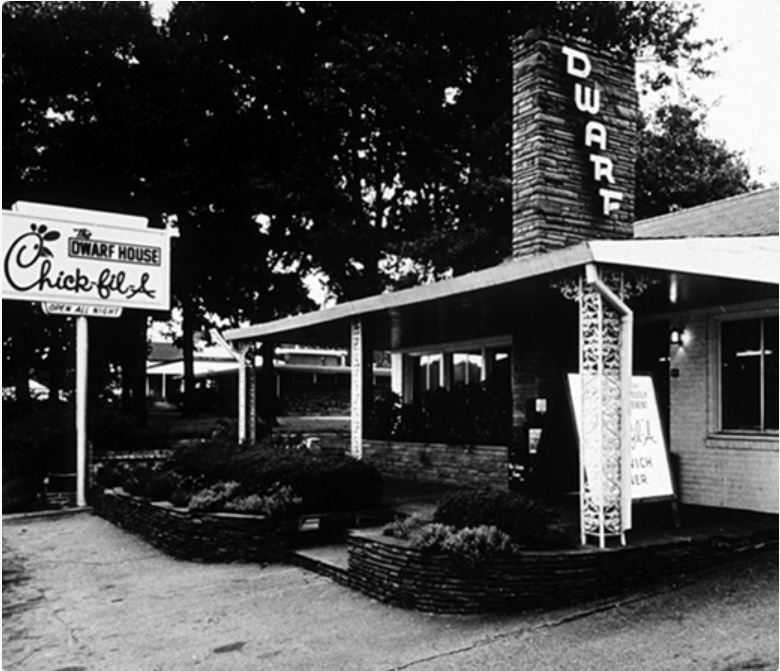
Dwarf House – Hapeville, GA

No matter how you label it, there’s a lot to like about Chick-fil-A.  For one, it’s the great American success story.  Its origins trace back to founder S. Truett Cathy, and a 1960’s-era restaurant near Atlanta called Dwarf House.  Its popularity swelled through twenty years of growth in shopping mall food courts. Its first free-standing restaurant opened in 1986.  Today, you’ll find more than 2,400 Chick-fil-A’s scattered across the continent, including a prominent three-story location in mid-town Manhattan, and several in Toronto, Canada.

It’s all about the food, of course.  Chick-fil-A’s most-ordered entree – the classic chicken sandwich (breaded, with pickles and a butter-toasted bun) – is a recipe unchanged since its inception fifty years ago.  The signature waffle fries accompanying the entrees are the most popular item on the entire menu.  And Chick-fil-A’s lemonade and milkshakes have a devoted following all by themselves.  Some patrons cruise the drive-thru for nothing but the drinks.

The Chick-fil-A’ “classic”

There’s more to like about Chick-fil-A.  Their brand of customer service is exceptional.  Chick-fil-A is the only restaurant I know where you’ll hear the words “my pleasure” in exchange for your “thank you”.  Between your order, payment, and the window itself, you’ll probably get “my pleasure'” three times in a single drive-thru.  That kind of courtesy never gets old.

American Customer Satisfaction Index (ACSI)

How about the numbers?  Chick-fil-A is the third-biggest U.S. restaurant chain ranked by sales (behind only Starbucks and McDonald’s).  Their sales have quintupled in the last ten years, to over $10.2 billion.  Chick-fil-A’s market share among fast-food chicken restaurants hovers around 33%.  Their nearest competitor – KFC – is a distant 15.3%.

Here’s one more reason to love Chick-fil-A: they’re closed on Sundays (as well as Thanksgiving and Christmas).  In the company’s own words, “Our decision to close on Sunday was our way of honoring God and of directing our attention to things that mattered more than our business.”  No matter the faith angle, you have to respect a restaurant giving its entire workforce the day off once a week.  Not to mention, a closed Chick-fil-A just makes the heart grow fonder.

A recent Wall Street Journal (WSJ) profile on Chick-fil-A shows they don’t mess with success.  McDonald’s regularly tests its patrons with trendy offerings (“Bacon Smokehouse Burger”).  Burger King reinvents itself with its upcoming “Impossible” (veggie) Whopper.  Meanwhile, Chick-fil-A maintains a little-changed menu of what’s been selling for decades: responsibly sourced, domestically produced, no-filler-no-preservative chicken.

At the conclusion of the WSJ article, I found one hundred reader comments about Chick-fil-A.  I scanned half of them, and every last one was positive.  That’s a first for me.  In today’s cynical world, 100% positive feedback may be the most telling statistic of all.

Final factoid.  For all my allegiance to Chick-fil-A, I must admit I didn’t know the origin of the name – until now.  Go figure, it’s just a mash-up of “chicken fillet”.  And the “-A”?  “Grade A”, a subtle nod to the quality of the Chick-fil-A product.  No wonder those cows push you to lay off beef.  They’re offering chicken par excellence instead.

Some content sourced from the official website of Chick-fil-A.