Sentimental Utensil

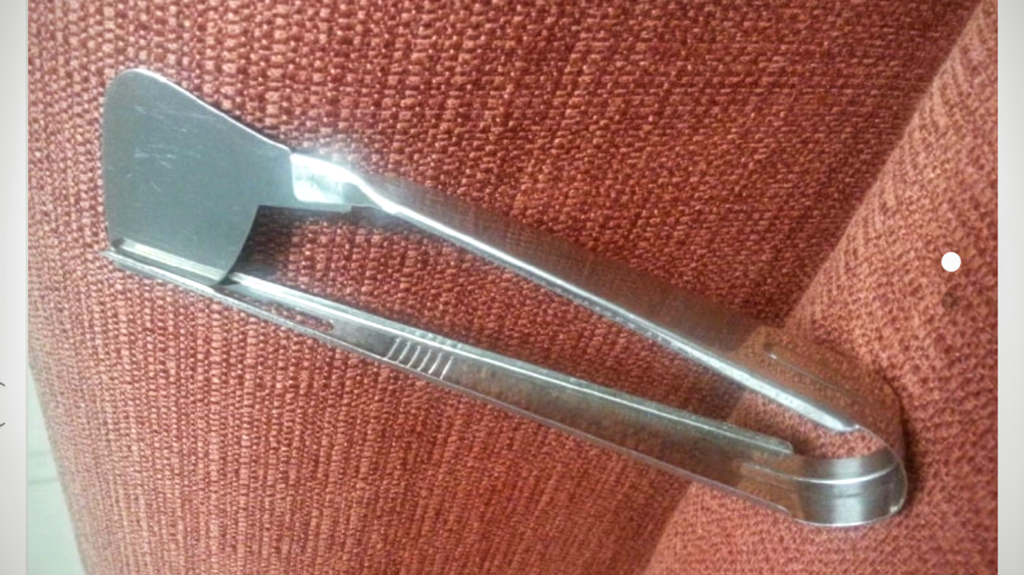
My wife and I were cleaning out the kitchen a few weeks ago when we came across a rather strange-looking device. It could be described as a combination between a small pair of metal tongs and some kind of slicer. We racked our brains trying to figure out what it was for.  Eggs?  Nuts?  Ice?  Bewildered, we wondered if it even belonged in the kitchen.

I showed our gadget to a couple of friends but they were as confounded as I was.  Then I turned it over to my ever-resourceful sister-in-law. She took it to a a couple of kitchen stores and asked several friends, all to no avail. Finally she showed the device to her hair stylist – who sent a phone video to his girlfriend – and voila! – mystery solved.  Turns out our little mechanical metal friend is a butter cutter.

I don’t blame you if you’re still confused.  Not only did I wonder why (as in, why do you need a butter cutter?) or how (as in, how do you use the darned thing?), but also when (as in, when did people ever use one of these?).

I’ll get to the why in a minute.  As for the how, a butter cutter is used by holding the blade perpendicular to a stick of butter, pressing the base down into the stick, then pushing down on the blade.  The push down and spring back of the blade produces the “pat” of butter you sometimes get with a dinner roll at restaurants.  Move on down the stick and you can churn out butter pats to your heart’s content.

As for the when, it turns out our butter cutter is vintage.  It was popular back in the 1950’s.  If you simply must have one for your kitchen, go here.  But my research also led me to ask which, as in which one?  It turns out there are several butter cutters for your consideration:

61-vintage-2Here’s another vintage model – a bunch of pats all at once!

     61-vintage-3        An updated model – regurgitates pats one at a time.

61-vintage-4The Rolls-Royce of cutters.  How thick do you like your pats?

   61-vintage-5      No comment.  This one is simply disgusting.

Remarkably, there are lots of butter cutters out there if you search long enough.  Some claim to also work on rolls of cookie dough.  Others claim to also cut potatoes into chips.  But the more models you find, the more you’re inclined to ask why?  Why go to so much trouble to cut butter when a perfectly ordinary kitchen knife will do just fine (and with far less mess?).  That earth-shattering question is actually covered at unclutterer.com, a blog about “getting and staying organized”.  Check out the hot debate and the wealth of reader comments here (from people who clearly have too much time on their hands).

My own take on why is more satisfying.  The more I thought about our butter cutter, the more I realized I probably inherited it from my mother.  Along with other kitchen items, she probably tossed it into a box as I was heading off to my first apartment so many years ago.  And thinking about it even more, I can picture my mother using her butter cutter when I was a kid, leaving a perfect little pat beside the crescent roll that was positioned carefully on the bread plate beside each place setting at the dinner table.  Because that was my mother.  She was all about the dinner table.  Everything had its place, even the pats of butter.  And there’s an element of grace that comes with the butter cutter that would not be found in simply using a knife.

Laugh at the pointlessness of a butter cutter if you must.  But I will cherish mine instead, as well as the vintage memories that spring back every time I use it.

Rings of Summer

Over the next two weeks, the world will be witness to the greatest gathering of athletes and sports mankind has to offer. The XXXI Olympiad -that’s 31st for you non-Romans – will be hosted by the city of Rio de Janeiro.  (Just saying “Rio” reminds me of “FedEx” – it’s simply not the whole enchilada).  I must admit I didn’t realize “Olympiad” refers to the four-year period between Olympic Games – not the Games themselves.  Count backwards by fours and you’ll realize the first modern Olympic games was held way back in 1896.

55 - Olympiad

You may say, non-sports-fan that you are, there is nothing seventeen days of sports competitions can do to stir your soul. But I urge you, put away the electronics and have a look, even if only for an hour or two. A moment will be there and you don’t want to miss it.

The first Olympic Games I remember well was 1976 in Montreal.  As a fourteen-year old, I was captivated watching Nadia Comaneci – also fourteen (!) – as she won three gold medals and scored seven perfect 10.0’s in women’s gymnastics.  I love this trivia item: the gymnastics scoreboard could only hold three digits, so Comeneci’s perfect scores were expressed as “1.0”.  For anyone who watched, it was one of the most electrifying performances in any sport and in any Olympics.  It was a moment to remember.

The second Olympic Games I remember well was 1980, but only because the United States boycotted the events due to Russia’s invasion of Afghanistan at the time (which is ironic given America’s involvement in that country today).

That brings us to 1984: the XXIII Olympiad in Los Angeles.  I was a senior in college, working a summer internship in Southern California.  I was witness to a city transformed.  The Games were hosted in a revitalized Coliseum (the same venue where the Olympics were held in 1932).  Ronald Reagan was President and opened the Games in person.  Sports venues were spread across the city, and the coincidence of several competitions on Fridays caused most businesses to shift to 4×10 workweeks.  American flags were everywhere.  The Olympic spirit was alive and well in the City of Angels.

I distinctly remember the torch relay at the L.A. Games, passing through the neighborhood where I grew up; John Williams’ glorious musical composition at the opening ceremonies (where dozens of white grand pianos were played simultaneously); Mary Lou Retton’s golds in women’s gymnastics; and Carl Lewis’s golds in track and field.  I also remember the women’s 3,000 meter run, highly-anticipated because America’s Mary Decker was racing South African sensation Zola Budd.  The two collided mid-race, Decker went down, and she never finished the race (Decker’s anguished face as she lay on the track is one of the Olympics’ classic photos).  There were moments in L.A.

Here’s one more Olympic moment which may surpass any I’ve mentioned above.  It was the women’s marathon.  I don’t even remember the city or the year or the woman who won the gold.  But I do remember the woman who won the bronze.  As she entered the stadium for the final meters of the race, she looked over her shoulder and saw… no one.  The bronze was hers.  She raised her arms in triumph as she finished that final lap, crying in apparent disbelief.  The unbridled joy and tears on her face as she crossed the finish line is a moment I’ll never forget.

The Olympics.  Rio de Janeiro.  Starting tomorrow.  Watch.  A moment will be there and you don’t want to miss it.

The Aging of Independence

Ten years from now – this month – the U.S. will celebrate its 250th birthday. That’s remarkable to me considering I still have vivid memories of America’s bicentennial back in 1976.  To put it another way, I’ve been witness to more than 20% of the entire history of the United States.  We really are a young country, aren’t we?

54 - sesquicentennial

Earlier this week my wife and I were driving back to Colorado from California, after a week of vacation at the beach. Passing through Utah we reached a small town called Cedar City. There’s nothing remarkable about Cedar City. It’s the home of Southern Utah University and almost 30,000 residents. But the name stirred a memory in the deep recesses of my brain. And then it hit me. Cedar City was part of a contest the Los Angeles Times newspaper sponsored when I was a teenager – a creative way of celebrating the nation’s big birthday.

The contest (if my vague memories serve me correctly) took place over fifty of the fifty-two weeks that year. Each week The Times published a trivia puzzle consisting of a jumbled American city name and a couple other facts you had to figure out about the locale or surrounding state. As the contest went on you realized The Times was picking one city from every state in the union. You cut out and completed each puzzle by hand, and at the end of the contest submitted the whole pile to The Times, to be included in a cash drawing. Our family’s World Book Encyclopedia – not the Internet that was still twenty years from reality – helped me with the research.

I didn’t win The Times contest but I know I learned a lot about our country in the process – including a few details about little Cedar City, Utah.  Needless to say we are a remarkably diverse collection of states, towns and people; especially for a country so young.

America’s 150th birthday – the “sesquicentennial” – was honored back in 1926 when Calvin Coolidge was president.  You can find Coolidge’s celebratory address to the people here.  One passage in particular resonated with me: “Amid all the clash of conflicting interests, amid all the welter of partisan politics, every American can turn for solace and consolation to the Declaration of Independence and the Constitution of the United States with the assurance and confidence that those two great charters of freedom and justice remain firm and unshaken.”  Powerful words then, but I wonder if today’s leaders would be so bold as to make the same statement?  Look no further than the current presidential election: the Constitution and the Declaration are being called into question like never before.

Ten years from now the U.S. will celebrate its “sestercentennial” – fully 250 years of glorious independence.  Philadelphia is already campaigning to be the host city for the national celebration.  2026 won’t be a presidential election year nor an Olympic year, but the fireworks and pageantry will surely be brighter.  Let’s hope another decade brings not only renewed pride and optimism in America, but also a sense that we are – states, towns, citizens – “united” once more.

Grim Reader

While visiting my parents last week, I was delighted to find a few dusty old children’s books on a quiet corner shelf in the family room.  The books carry sentimental value because they once occupied a shelf in my grandparents’ house.  They were the same books my father read when he was a child.  And as we grandchildren were expected to be “seen and not heard”, these books were our refuge, stoking our budding imaginations with dozens of characters and places we longed to be a part of.

51 - gratuitous

One book in particular – The Illustrated Treasury of Children’s Literature – stands out as a literary beacon of my childhood.  The stories within included Aesop’s Fables (i.e. The Hare and the Tortoise), the tales of Danish author Hans Christian Andersen (The Emperor’s New Clothes), and the works of The Brothers Grimm (Rumpelstiltskin).  The collection oozed with fantasy and adventure and innocence.

I reread a few of these stories last week and came to an unquestionable conclusion: The Brothers Grimm were a couple of messed-up dudes.  On the one hand the Grimms authored Snow White and the Seven Dwarfs and Rapunzel, which Disney sanitized and gave a more positive spin.  But more likely, you know the Grimms for their famous “fairy tales”, like Hansel and Gretel and Little Red Riding Hood.

Fairy tales.  Doesn’t the term conjure up images of enchanted forests and candy castles and magical sprites?  That’s what I thought too, but Hansel and Gretel would vigorously disagree.  These kids endured a nightmare on par with today’s R-rated horror flicks.  Take ten minutes and read their story (you can find it here).  The only detail I recalled was the house in the forest; the one made of cake and candy and spun-sugar glass.  But this time around I couldn’t get past the other aspects.  Within the first three paragraphs we read that H & G’s mother’s solution to a lack of food is to abandon her children in the forest.  Even after they find their way back to the house the mother finds another (more successful) way to leave them behind.  Later on, an old woman holds the kids captive in the candy house and prepares to “slaughter and boil” (and eat) Hansel.  Gretel gets to watch.  But the kids surprise the old woman by pushing her into the oven, and then she burns to death.  A celebration ensues.

Little Red Riding Hood (which you can find here) is no less violent.  A little girl in red may sound adorable but the story is really about the murderous wolf.  Not only does the wolf consume LRR’s grandmother, he has LRR herself for dessert.  And it doesn’t end there.  A huntsman happens by, recognizes the wolf, decides not to shoot him because “maybe the grandmother is inside”; then cuts open the wolf and pulls out the grandmother and LLR alive and intact.  Seriously?

The Treasury introduction says “eight, nine and ten is the fairy tale age”.  The Treasury also says “many a child will haul the volume from the shelf and spend countless happy hours…” are you kidding me?  This is gratuitous violence disguised as bedtime stories!

I used to cringe at the thought of my young children watching a PG-rated movie.  Not anymore.  There are over half a million copies of The Treasury out there in the world.  I need to find them all and have a bonfire.  Those Grimm images go to the grave with you!


Don’t Mess with Jack!

This week, the original junk food Cracker Jack introduces a new look to its packaging, and – brace yourself – no more “prize inside”.  The tiny toys synonymous with the brand since 1912 have been replaced with QR code stickers, which connect to games on your phone when scanned.  Farewell to those temporary tattoos, finger-sized comic books, and decoder rings; – another slice of Americana is gone.  Check out Facebook’s Cracker Jack page if you want a sampling of the overwhelmingly negative reaction to the news.

41 - click bait

Cracker Jack’s announcement shamelessly reduces the “toy surprise inside” to mere click bait.  Akin to so many Facebook posts, the allure of click bait is to discover the rest of the story.  In the process you get a healthy dose of advertising.  Click bait never gets my attention, nor will Cracker Jack’s QR codes.  The thrill of the prize is gone.

Cracker Jack has a special place in my heart.  My great uncle became synonymous with the treat when he showed up at family gatherings with enough boxes for his dozen grandnephews and nieces.  More significantly, I hid my wife’s engagement ring inside the prize packet of a box of Cracker Jack just before my proposal.  She used to be a Crunch ‘n Munch fan until she opened that particular “toy”.

Cracker Jack is another link to the past that has suffered never-go-back changes.  The boxes are smaller now (in fact, the latest packaging is not even a box), and the ratio of peanuts to popcorn has increased.  It’s the typical product manipulation that has you thinking you’re consuming the same thing you did ten years ago.  Like ice cream, where brands are now sold in smaller containers designed to look like the standard half-gallon.  Or fast-food “quarter-pound” burgers that are no longer as big, yet still qualify by definition.  Perhaps the most obvious example: Oreos have less filling and thinner cookies than the originals.  Ironically, today’s “Double-Stuff” are probably more like the “singles” from a generation ago.

Changes like Cracker Jack hit me hard, not only because I’m paying more for less but because the tampering seems like an injustice.  Why not keep the original and charge more?  I’d pay.  And I’m not alone.  Wikipedia claims the New York Yankees tried to replace Cracker Jack with Crunch ‘n Munch at home games ten years ago, but the public outcry forced them to switch back within a matter of days.  Don’t mess with Jack!

Speaking of baseball, Cracker Jack is immortalized in the lyrics of “Take Me Out To the Ballgame”, sung in the middle of seventh inning stretches.  I wonder if today’s generation knows what they’re singing about with “…buy me some peanuts and Cracker Jack”?  Even if they do they’re singing about a different product now, including the updated images of mascots Sailor Jack and his dog Bingo.  No doubt Cracker Jack’s founder had that in mind before he passed away in 1937.  The original Sailor Jack is carved on his tombstone.  Now there’s something they can never change.

Impersonal Delivery

Why does Amazon ask for “packaging feedback”?  Do they really want my opinion on a plain brown box?  Yesterday I came home to an Amazon delivery on my front door step.  But that’s already not true.  The box was dropped into a plastic bag and suspended from my mailbox (“front door step” just sounded better).  My packaging feedback to Amazon: lackluster.

40 - jejune

Let’s chat about delivery as it used to be.  My fondest childhood memories include the noisy, colorful, “old-fashioned” delivery trucks that made their way into the neighborhood regularly.  No kid from that era will ever forget the bakery, dairy, and ice cream trucks, and the allure of fresh-made bread and other goodies – temptations limited only by Mom’s permission or the amount of change in your pants pocket.

Growing up in Los Angeles, the Helms Bakery had a fleet of hundreds of bright yellow delivery trucks.  The drivers dressed in smart uniforms and used a distinctive “toot-toot” horn to announce their arrival.  The neighborhood gathering at the truck was as much social as it was for baked goods.  At the end of grade-school field trips through the Helms factory, each kid received a coupon for something free from the delivery truck.  It was like a golden ticket to a candy store, where you walk in and the owner spreads his arms and says “pick one”.

The dairy truck came from Edgemar Farms, not that we ever knew (or cared) where the farm was.  Edgemar delivered milk in glass bottles with foil caps.  The “milkman” would walk into the kitchen like he was family.  He’d take the order from Mom and return with his wire basket full of milk, eggs, and butter.  Then he’d unload everything right into the refrigerator, tip his cap with a cheery “good morning” and be on his way.  Now that’s anything but lackluster delivery.

Ice cream (Good Humor or some other brand) appeared in our neighborhood on summer nights – the very best truck of them all.  I can still hear the beckoning jingle from the roof-mounted loudspeakers.  The neighborhood kids would flock – I mean flock – to the truck’s side window, where the all-in-white ice-cream man would lean out and wait too patiently while we made up our minds.  Bomb pops.  Push-ups.  Ice cream sandwiches.  Heaven on earth delivered right into your hands.

Okay – end of time-gone-by chat – back to today’s delivery by Amazon.  Boring brown box.  Got it?  So how did my box get to me?  What did the truck look like (was it even a truck)?  Did the delivery person wear a uniform? Did he or she come to the front door?

Lack of delivery details equals lackluster delivery.  And it’s only going to get worse.  Amazon Prime Air is described as “a future delivery system designed to safely get packages to customers in 30 minutes or less using small unmanned aerial vehicles”.  So now my brown boxes are going to arrive by parachute.  In my packaging feedback, I’m going to request a beckoning jingle from the drones to announce their arrival – er, landing?


Sounds Good to Me

At the movies last weekend, as we waited for the lights to dim, two women were having a conversation in the row in front of us.  What struck me was not what they were talking about, but how they sounded.  Their voices projected loud and clear above the quieter chatter of others in the theater.  Yet they were talking normally, neither straining nor raising their voices.  It’s like they had built-in megaphones.

36 - velvety

I find that fascinating about the human voice.  With one person the words come out all velvety and smooth, like honey-dripped taffy.  With others it’s all cymbals and brass band.

Take “Debbie” on the current season of television’s “Survivor”.  If you watch, you know who Debbie is (the self-proclaimed uber-intelligent “Brain Tribe” member).  But even if you didn’t know all that about Debbie, you’d recognize her voice in a heartbeat.  There’s just something about her combination of accent, volume, and non-stop blah-blah-blah.

When I hear voices like Debbie’s, I’m spirited back in time to high school speech class.  Midway through that semester so many years ago, our teacher brought in an “alumna” to demonstrate public speaking at its most refined.  I’ll never forget it.  Our guest spent several moments standing quietly in front of us; eyes closed, breathing deep, as if preparing for a long delivery.  Then she simply said:

Thank you for the plums.  They were delicious.”

That was it.  That was her entire speech.  But I was utterly spellbound.  The way she delivered just two lines: enunciating each word completely, starting and finishing each sentence smoothly, captivating her audience with her words as well as her body language – was the total sensory experience.  I could hear her eating those plums.  I could see the juice dripping down her lips.  I could even taste those plums myself (and they were delicious).  To this day it is one of the most powerful moments of speech I have ever witnessed.

The accents in the Southern states – i.e. Virginia or South Carolina or Georgia – are similarly spellbinding.  I remember touring a plantation house once when I was a teenager, and our guide was a short, heavy-set black woman who possessed one the softest, sweetest voices I had ever heard.  Her words were so calming and mesmerizing I found myself falling asleep on my feet, jaw dropped.  I hope she realized that was a compliment, because I can still hear her voice to this day.

The Irish accent is even more affecting to me.  Male or female; on the Emerald Isle or watching the movie “Brooklyn”; there is something utterly captivating about the Irish spin on the spoken word.  It is soft and fluid, with subtle twists of pronunciation and emphasis.  It’s like an audio massage.  I could listen to the female Irish voice for hours on end (just as my wife could listen to the male equivalent.  Hate you for that, Colin Farrell).

Since I am neither Irish nor a resident of the South, nor even a refined public speaker, I settle instead for using words that simply sound nice.  Search the Web and you’ll find lists of “the most beautiful words” or “the sweetest-sounding words”.  Here are some of my favorites:

  • cashmere
  • cinnamon
  • chimes
  • dulcet
  • effervescence
  • grace
  • lithe
  • mist
  • murmur
  • rhapsody
  • sapphire
  • serene

Don’t those sound nice and velvety?  Don’t they bring just a tinge of comfort, or conjure up images of the nicer things in life?  To conclude, some of us may not possess the most pleasant of pipes (like Survivor Debbie).  But at least we have some sugary words that can bring us a little closer to that honey-dripped taffy.


Old-World Charming

One of my favorite musicals is “Brigadoon”.  The original production dates a long way back; to 1947.  Brigadoon tells the tale of two Americans traveling in the Scottish Highlands.  A town quietly appears to them through the fog: charming, simple and untouched by time.  It is idyllic.  To protect itself from the changing outside world, “Brigadoon” only appears to outsiders one day every hundred years.  So when one of these travelers falls in love with a Scottish lass from the town, he only has a few hours to decide if that love means remaining in Brigadoon and disappearing into the fog forever.  The ending is fitting (and not so predictable).  I won’t give it away here.

31 - idyllic

My own Brigadoon appears to me, once a year for only a week or two.  Just north of San Diego lies the little coastal town of Del Mar.  It is a quiet village by the sea, with pretty little shops and restaurants, a prominent hotel, and a train that whistles its way along the nearby cliffs several times a day.  You can stroll leisurely from the beach to the center of town in a matter of minutes.  You can sit in the park on the bluffs and lose yourself in the horizon.  The flip-flop pace is slow and the carefree inhabitants always seem relaxed and happy.  Like Brigadoon, Del Mar is simple, romantic, and idyllic.

I keep returning to Del Mar, just as I did when I was a boy.  Growing up in the bustle of Los Angeles, Del Mar was only a two-hour drive south by car or an effortless journey by train; yet always seemed a world away.  My family spent the summers at our house on the beach, including countless hours in the sand and surf.  In those days – a half-century ago or more (gulp) – Del Mar was as modest a burg as you can imagine.  The beachhouses were drab single-story wood-sided bungalows.  A walk on the shore encountered a lot of seaweed and rocks and only an occasional shell.  The town was unremarkable; more practical than boutique.  My child’s eye recalls the 7-Eleven as a highlight; the only place a kid cared about thanks to its Slurpees and pinball machines.  Del Mar’s drugstore was almost forgettable, except you could buy chocolate malt tablets (meant for indigestion but candy to us kids).  The park contained a snack shack where you couldn’t get much more than a grilled cheese and a Coke.  And my friends and I used to sneak under the highway through a culvert, giving us a back door entrance to the nearby horse-racing grounds.  I can still picture the jockeys, exercising their thoroughbreds in the ocean waves.

Del Mar is a wholly different animal today.  The draw of the coast, the consistently good weather, and the summer horse-racing season has transformed a modest locale into quite the tony address.  The beach is groomed daily and the sand is marked into areas for swimming and other areas for games and still other areas for dogs.  The hotel commands a nightly rate of $350.  The park on the bluffs is all spruced up – no more snack bar – and used for concerts and festivals.  A sunset wedding/reception sets you back $4k just for the use of the park.  The local Starbucks sells enough coffee and tea to rank among the most successful locations in the country.  The racetrack patrons hit the town in their Sunday best the first day of the season (think Kentucky Derby).  And most notably, a house on the beach – with a very narrow slot of property abutting the ocean – cannot be had for less than $10 million.  Yes, Del Mar is all dressed up these days and hardly simple.

But it’s still my Brigadoon.

My family and I make our annual pilgrimage to Del Mar every July.  We leave behind landlocked Colorado for yet another taste of the sun and surf and salty air.  And as soon as I arrive, the little town I remember reveals itself to me from the fog that has enveloped it over the years.  The fancy shops, restaurants, and patrons step aside in favor of the simpler and more idyllic memories of the Del Mar I first fell in love with.  If it were possible, I might just choose to take a leap – forever – into the Brigadoon of my yesteryear.