Getting My Juice GONE (p.2)

“Survivor” is reality TV’s longest-running program. “Survivor” is also my new middle name after a vicious three-day juice cleanse last weekend. For my pre-cleanse (sane) state of mind, refer to last week’s Getting My Juice On. For my current (questionable) state of mind, proceed with caution. The words that follow may be the equivalent of the movie scene you wish you never saw; the one still burned into your brain.

The quick recap: my daughter recently coerced my wife and I into trying Pressed Juicery, a hard-core player in the world of retail cold-pressed juice products. PJ offers gentle confections like coconut water with cinnamon, but for the truly gullible (me), they suggest a “cleanse”, where you down 336 ounces of liquid in three days (assuming you include the recommended twenty-four glasses of water). In those torturous seventy-two hours you get nothing else on the menu – no snacks, no bars; no solid food whatsoever. It’s just bottle after bottle of sickly-green liquefied vegetables (with an occasional fruit thrown in, which might as well be a lamb tossed into a pride of lions).

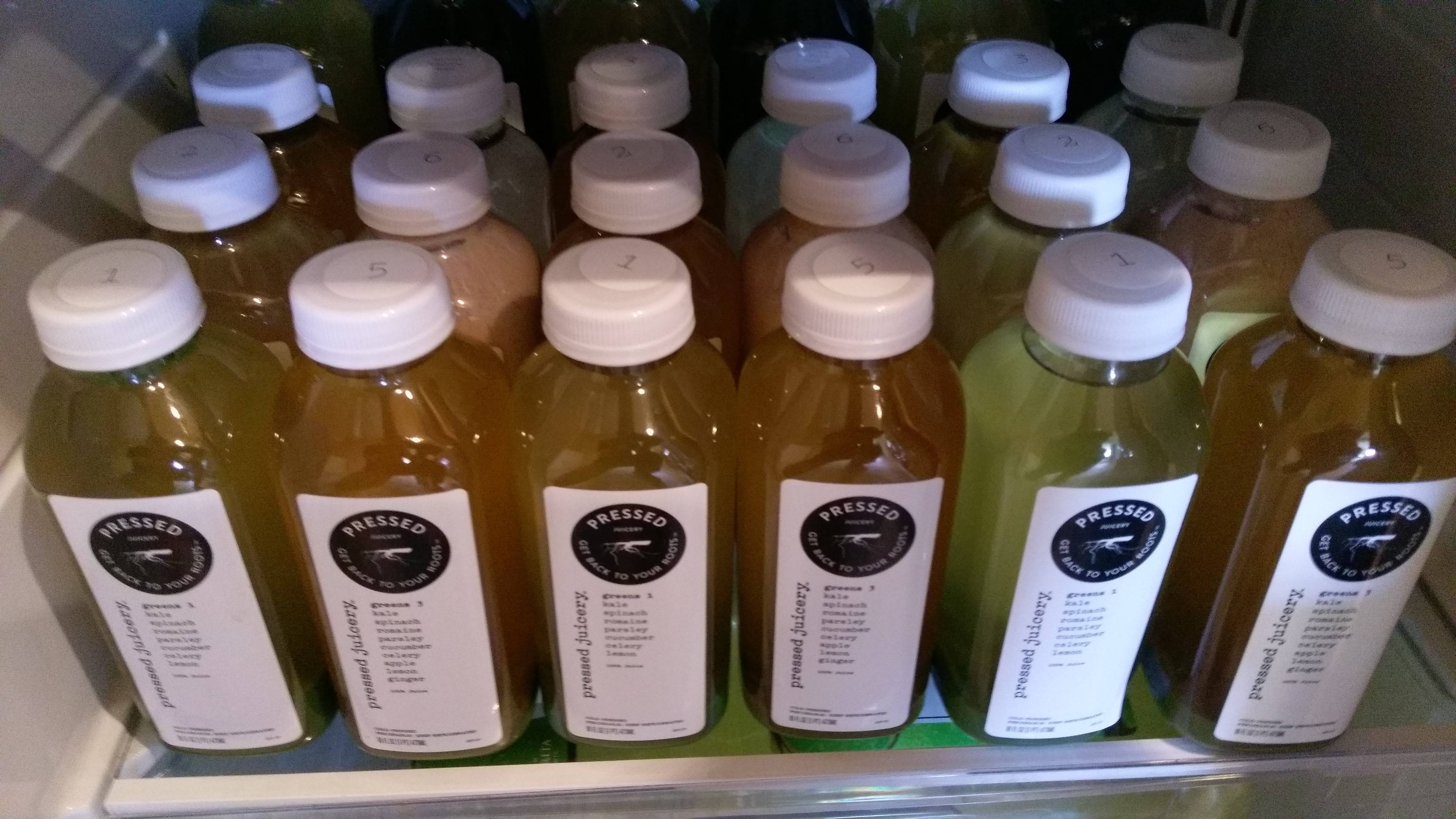
Considering I knew everything in the above paragraph before I took the first sip labels me as some kind of (raving lunatic)? But add my daughter to the equation and my voice goes rogue with, “sounds great, honey!”. Thus last Friday morning at zero-eight-thirty, I took my first sip of the PJ Kool-Aid. Let’s set the table with the scrumptious ingredients. Kale. Cucumber. Romaine. Spinach. Parsley. Lemon. I’d list the rest but I’m about to toss my cookies just thinking about them again (and believe me I’ve had a few cookies since that last fluid ounce).

In the beginning (this is a tale of biblical proportions), I assumed remarkable confidence staring down Cleanse Bottle #1. I consumed its contents in two or three gulps. Not so bad, I thought. Utterly vegetable with a sickly fungal aftertaste, but nothing a glass of water wouldn’t kill. But two hours later (which is a short 120 minutes on a juice cleanse), Bottle #2 came a-calling. This time I’m not so fast. It takes me a good half-hour to drain the contents. Now I’ve got thirty-two ounces of liquified vegetables in my system, which PJ claims is eight pounds of the real produce. That’s rough(age) on a body, and the body doth protest. After Bottle #3 the burps started. After Bottle #4 I enjoyed the occasional dry heave. By Bottle #5 I was asking for Mommy so I could tell her I didn’t want to do this anymore.

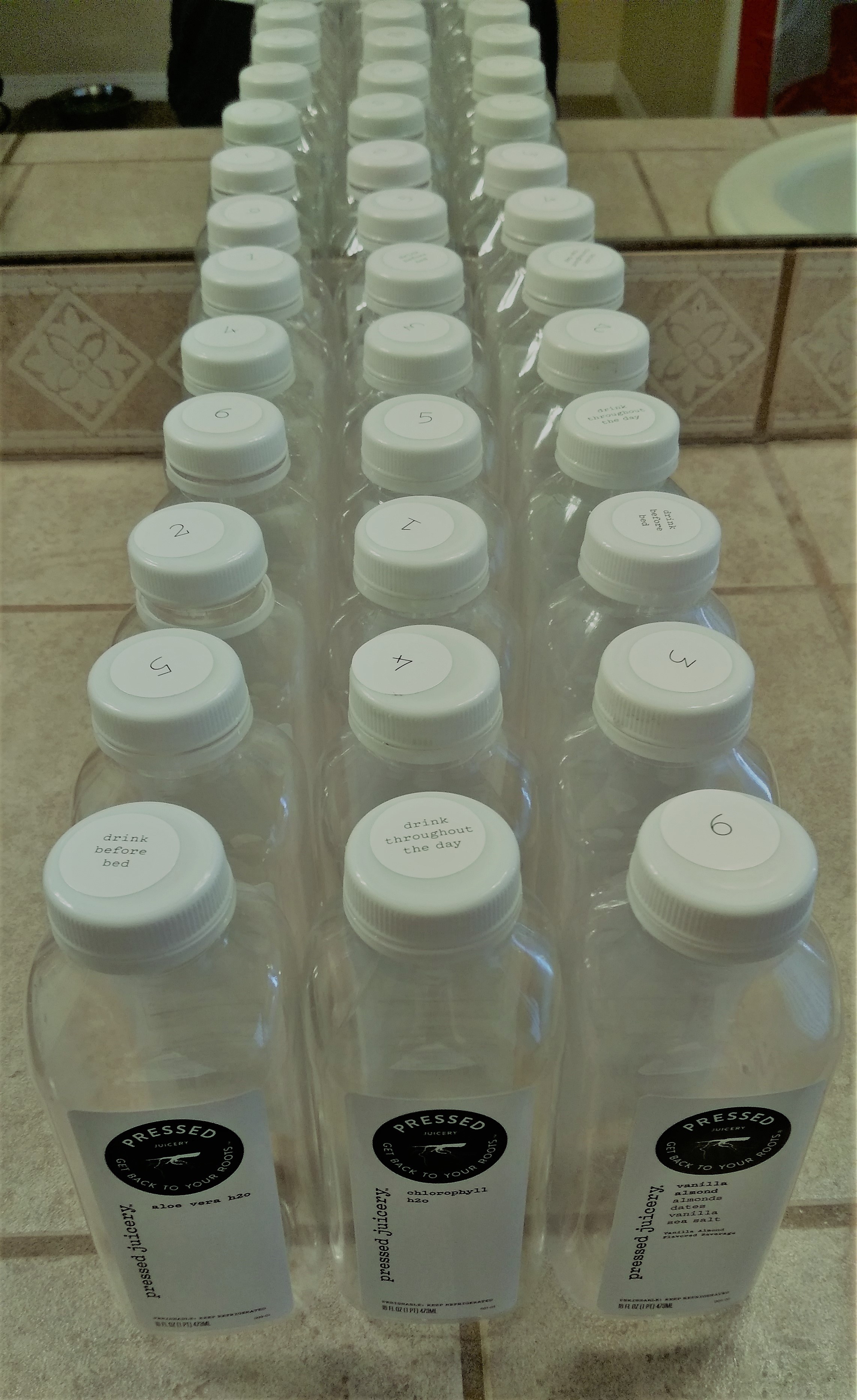
Unbeknownst to me (remember, I am gullible), I had created the perfect storm of stomach acids and vegetable puree deep down in my digestive system. Perhaps that’s why Bottle #6 is all almond milk and vanilla. It’s like dumping two cups of Pepto-Bismol over the whole mess (“Coats!” “Soothes!”). Okay fine, but try sleeping on that stomach. Your dreams are technicolor and downright scary.

Somewhere during Day 2, I looked in the mirror and saw a cucumber with a tomato head and broccoli-stalk arms. I stifled a scream. I put my hands on my hips and tried a “Ho-Ho-Ho” to see if I should audition for those Jolly Green Giant commercials. But there’s no time for auditions when a bottle beckons every two hours. Furthermore, deep into a juice cleanse you stop stop tasting the vegetables. That is, even when you’re not drinking, you’re tasting the green. Every gulp of air is tainted with chlorophyll. No breath mint is strong enough to conquer the stench. It’s like somebody threw your backyard garden into a giant blender, then filled your swimming pool with the resulting green muck, then threw YOU into the deep end. You’re six feet under in vegetable quicksand.

Enough of the madness – let’s cut to the merciful end of my story. Somehow I burped and lurched Day 3 away.  On Day 4, the clouds cleared, the sun rose, and I awoke to the promise of solid food. Bless my soul – a full-course breakfast awaited me. No longer would I spend as much time in the bathroom as I would in the free world. Life was good again. Or so I thought. As PJ smartly warns you, one cannot just return to normal eating/drinking immediately after a juice cleanse. One must slowly reintroduce the finer things in life. Choose carefully. Chew slowly. Limit thy portions. Rome was not built in a day.

Would I recommend a juice cleanse? No. (unless you’re gullible – then you don’t have a prayer anyway). Do I feel healthier after my three days in the garden? No, but I feel different, as if a vegetable alien is growing inside my stomach and may someday rip its way out.  Do I have any advice after the fact?  Yes. Damn, I could’ve had a V-8!

Getting My Juice ON (p.1)

My daughter has a knack for making me do things I wouldn’t choose to do myself. Perhaps it’s because she was unexpected at birth (I came from a family of five boys and already had two sons of my own). Perhaps because as a kid, she could scrunch up her face and use her best sweet-little-girl voice whenever she wanted something. Maybe it really began by relenting to little Girl Scouts and their boxes of cookies at my front door.  Whatever the reason, my daughter still finds a way, even as an adult in her mid-twenties.  And that is why I’m commencing a three-day juice cleanse tomorrow morning.

Cleanse. The word scares me a little. I think of those whirly scrubbing-bubble characters on TV, dashing around the bathtub disinfecting away soap scum.  Or I think about SOS pads and their steel-wool grittiness.  Is this simply a short-term liquid diet, or am I on the verge of a full-on purge?

My box-o-cleanse arrived last night; a liquid-brick wrapped carefully inside a foil space blanket. I opened the container to find twenty-four intimidating 16 oz. bottles staring up at me. I swear they were grinning. They looked like they couldn’t wait to get out of their box, sprout their scouring brushes, and commence the cleaning. Each bottle contains a different colored concoction, labeled rather impersonally.  Greens 3.  Roots 1.  Citrus 2.  I’ll drink one of these little guys every two hours in the waking hours of the next three days, chasing their green goop with a similarly-sized bottle of “Chlorophyll” water or “Aloe-Vera” water. Chlorophyll? Aloe Vera?  I feel like a plant already.

I can’t claim to be surprised by the contents of my box-o-cleanse. Just last week I visited one of the labs – er, retail outlets – for a sample of these products. Pressed Juicery, with locations close to the coasts and Hawaii, sells cold-pressed, 100% fruit & vegetable concoctions; all ingredients non-GMO. I tried one of their delicious coconut-cinnamon drinks… and that was my mistake. P.J. lures you in with mild, decent-tasting options like coconut and cinnamon. Then they gently suggest you consider a cleanse.  My daughter wanted to try one, and I was only too happy to foot the bill (these drinks ain’t cheap).  I figured Colorado was a safe distance from the cleansing craze, so my only involvement would be with my wallet. Wrong-o. P.J. is happy to overnight their products to just about anywhere.  Thus my twenty-four cleanse bottles mock at me today, anticipating tomorrow’s cleaning kick-off.

If I stepped back and gave Pressed Juicery a hard look, I might have used my better judgement, turned, and fled.  The retail outlets abound with stark-white surfaces and plate glass.  The employees dress in uniforms intimidating enough to double as lab coats.  The products emerge from a dark, back wall refrigerator, pre-assembled and ready to consume.  For some reason “drinking the Kool-Aid” just came to mind.  Gulp.

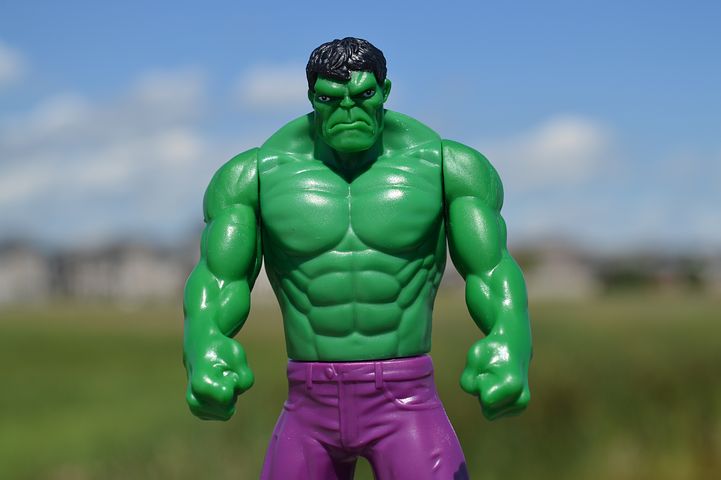
P.J. describes their juice cleanses with a selection of unnerving words. Reboot. Fresh Start. Body Do-Over. Cue a bout of mild nausea. Am I going to be more intimidated by a) the taste of “four pounds of fresh produce in every juice” or b) what those four pounds will do to my insides? Will my body a) turn green and sprout shirt-ripping muscles like “The Incredible Hulk”, or b) reduce to a puddle (think “Wicked Witch of the West”) through non-stop visits to the toilet?

My daughter is already halfway through her own three-day P.J. cleanse.  She claims she’s never hungry, feels really healthy, and only misses “the act of chewing”.  But she also admits to gagging trying to get a bottle of “Roots 2” down (she recommends shot-glassfuls).

If I’m still around next week, you can count on a post-cleanse blog report.  If I’m not, Lord help me for never saying no to my daughter’s ideas.

The Euphoria of Joe

Today I’m perched at one of my favorite Colorado coffeehouses, sipping the local version of a cafe latte.  The air is rich with the bitter aroma from the nearby roaster.  I’m surrounded by chatty patrons, each with their own coffee-based delight-in-a-cup.  If I had a handful of the crunchy chocolate-covered espresso beans they sell, I could say coffee’s hitting all five of my senses today (instead, I have a delicious apple fritter).  These days, coffee is as infused into American culture as baseball and Apple (pie).  And how far we’ve come from the cups of Joe former generations would brew with store-bought cans of Folgers.

How far have we come (besides the requisite latte foam-art)?  Consider this: my coffeehouse does not allow to-go orders.  You read that right: if you get your coffee here you’re drinking in-house.  According to the resident “roastmaster”, paper cups alter the flavor of the coffee and thus they won’t sell it to-go.  Hard for me to swallow (the cup thing, not the coffee), as my palate has never been very discerning.  Yet here I am, paying top dollar to drink real-cup coffee “in the house”.

It wasn’t always this way.  Not so long ago all you had on the menu was a “cup of coffee”.  Take it black or take it with sugar/cream, but that’s where your options ended.  And the reference to “Joe”?  That comes from a 1914 ban of alcohol on U.S. Navy ships by then Secretary of the Navy Josephus “Joe” Daniels.  The strongest alternative to a “real” drink on-board was black coffee.

Today’s kids get their first taste of coffee at Starbucks.  My own first taste took place in Italy, during the college year I lived there in the 1980’s.  Italians take their coffee very seriously.  Walk into an Italiano café, belly up to the bar, and order an espresso shot and sweet roll.  That’s your standard-brand Italian breakfast, and you take it standing up.  You’re in, you’re out, and you’re on your way again in less than a minute, sufficiently caffeinated.  Not many are baptized on straight espresso, but that was my experience.

My coffee journey continued after college, but it was quite a stumble.  I graduated from Italian espresso and regressed to the standard-brand Bunn coffeemakers of corporate America.  Starbucks and its kin would not arrive for another 5-10 years.  Office coffee was a mindless, characterless, tasteless experience.  A Styrofoam cup of black nothingness, with a few unbrewed grounds thrown in for texture.  It was like descending from the Golden Age of the Roman Empire to the Dark Ages.

Thankfully, my coffee habits persisted until coffeehouses became an American staple in the late 1980’s.  The houses themselves still aren’t the vision of Starbucks’ Howard Schultz: “comfortable, social gathering places away from home and work”, but at least we’re getting past the Frappuccino-this and macchiato-that, evolving back to straight coffee.

My one dedicated-cash phone app is for coffee.  I literally wake up and smell the coffee thanks to my Keurig; then structure my waking hours with the possibility of a drive-through cup of Joe later on.  To get really serious I could spend $200 on a Ninja’s home coffee bar, which claims to be a coffee system (“Variety of brew types and sizes!” “Built-in frother!” “Tons of delicious coffee recipes!)  Their tagline: “See what all the coffee buzz is about”.

Coffee buzz is no joke, as patrons of America’s 33,000 coffee shops will tell you.  The euphoria we desire – the blissful effects drawn from caffeine – actually has a name: “margaha”.  For that reason, whether your preference is a nitrogen-infused cold brew, a coconut-milk mocha Macchiato, or a take-it-straight cup of Joe, it’s safe to say coffee is here to stay.

Out of Sight

Jake Olson is a student at the University of Southern California. He’s a backup long snapper for the celebrated Trojan football team, and aspires to play golf on the PGA Tour after college. John Bramblitt is a budding artist whose work sells in more than twenty countries. He paints primarily by touch, claiming “different colors have different textures”. Christine Ha is an award-winning chef who never had a minute of formal training, yet developed a popular cooking blog and won the 2012 edition of the television show MasterChef.  Why mention these three achievers in the same paragraph?

They are all legally blind.

Two weeks ago – unbeknownst to just about all of America – we “celebrated” White Cane Safety Day (WCSD).  A national observance since 1963, WCSD was established by the National Federation of the Blind to remind the public about the significance of the white cane.  In 1930, blind people were given the freedom to lawfully move about the U.S. on their own, provided they used the white cane to navigate their way.  The implication is prior to 1930, blind people were either confined to their homes or could not move about without the assistance of another person.  My parents explained the meaning of the white cane the first time I saw a blind person on the street, but it never occurred to me the cane signifies a legal status.

Seeing may be believing (as the saying goes), but blindness takes belief to an entirely different level.  The people I mentioned above are just a few of the countless examples of accomplishments in all walks of life, minus the sense of sight.  Surely you can name a blind person without resorting to Google. Ray Charles. Helen Keller. Andrea Bocelli. Stevie Wonder. Aldous Huxley.  And those are just the famous ones.

Speaking of the famous, I recall – somewhere in the piles of books I read as a teenager – the fictionalized biography of Louis Braille.  Just as Irving Stone did for Michelangelo in “The Agony and the Ecstasy”, the author added fiction to fact to bring the story of the famous French educator/inventor to life.  Braille’s blindness occurred in his youth: the infamous accident with the awl in his father’s workshop (surely inspiring the plea of parents, “Don’t play with that!  You’ll put your eye out!”)  Remarkably, at only fifteen years of age and already blind, Braille took the very same awl and developed a method of reading/writing for his counterparts virtually unchanged to this day.  It reminds me of Beethoven, who lost his hearing in his early twenties yet somehow composed some of the world’s most famous symphonies and piano concertos.  Belief at an entirely different level.

Convenient to my topic, a new movie debuts in theaters this week called “All I See Is You”.  Starring Blake Lively and Jason Clarke, the story concerns a marriage where a blind spouse depends on her partner to see and feel the world around her.  Dependent, that is, until a corneal transplant allows the woman to regain her sight.  As you might expect, bringing vision to the blind is not all it’s touted to be.  A similar story was told in 1999’s “At First Sight” with Val Kilmer and Mira Sorvino.

Christopher Downey is an architect who, shortly after training in the profession, lost his eyesight to a tumor wrapped around his optic nerve.  No problem, apparently.  Downey now produces drawings from a tactile printer – raised lines akin to Braille’s raised lettering system.  As if you needed another example of belief.

I used to yearn for “as far as the eye can see”, considering the eye doctor routinely issues me a prescription far less than 20/20.  Thanks to these inspirational people however, it’s fair to say my vision is actually limited by my sight.

Pan-Pacific Keepsake

A year ago I wrote a piece called Athens of the South, a reference to the city of Nashville and its remarkable full-scale replica of the Greek Parthenon in downtown Centennial Park.  The Nashville Parthenon is a leftover from the 1897 Tennessee Centennial and International Exposition.  If you ever visit the ruins of the real Parthenon, you might want to add Nashville to the itinerary to see how the structure looked in its full splendor.

Shortly after my trip to Nashville, I traveled to San Francisco for my niece’s wedding.  She chose a remarkable venue for her ceremony – outdoors under the dome of the elegant Palace of Fine Arts, near the Golden Gate Bridge in the Marina District.  The Palace, as it turns out, has much in common with the Nashville Parthenon.  Despite more popular attractions, both structures belong on the “must-see” lists of their respective cities.

The Palace of Fine Arts, like the Nashville Parthenon, is one of the few remaining structures from its World’s Fair; in this case San Francisco’s 1915 Pan[ama]-Pacific International Exposition.  Typical of a World’s Fair, the Pan-Pacific showcased products, inventions, and cultures of the day, and remained open to the public for almost a year.  The 600+ acres of San Francisco’s Marina District (where I rented my first post-college apartment) served as the Exposition’s central footprint, with the Palace on the west end and “The Zone” of amusements and concessions on the east (near Fort Mason).  Even though the Pan-Pacific’s structures were designed from plaster and burlap – to literally fall to pieces after a year, a few have been preserved to this day. The Civic (Bill Graham) Auditorium is a Pan-Pacific structure in its original location.  The Japanese Tea House was loaded onto a barge and shipped down the bay to the town of Belmont, where it still stands today as a restaurant.  Two of the Exposition’s state pavilions (Wisconsin, Virginia) were relocated to nearby Marin County.

The Pan-Pacific Exposition – like the Tennessee Centennial – brimmed with remarkable structures, including ten exhibition “palaces” and the 435-ft. tall Tower of Jewels.  Surely none of these were more elegant than the Palace of Fine Arts.  My first visit to the Palace was back in the 1970’s, when it housed the Exploratorium, a kid’s-dream hands-on maze of exhibits showcasing the wonders of mechanics, physics, and chemistry.  The Exploratorium filled the Palace’s Exhibition Hall for 44 years before moving to its current location in the Embarcadero.  The Exhibition Hall was all about art for the Pan-Pacific, but it’s had several creative uses since, including tennis courts, storage of military trucks and jeeps, and a temporary fire department.

Let’s be honest though – the Exhibition Hall is not why you visit the Palace of Fine Arts; at least not anymore.  You’ll be captivated by the glorious Roman/Greek-inspired structure of dome, rotunda, and adjoining pergolas instead.  Take a walk between the colonnades to get a sense of its monumental scale.  Have a picnic on the grassy shores of the lagoon.  The Palace’s best photo opp: on the east side of the water under the Australian eucalyptus trees.  Your view is uninterrupted, and mirrored in the water’s reflection.  It’s a popular spot for wedding photos, as my wife and I discovered thirty years ago:

Personal connections or not, I like to think of the Palace of Fine Arts as a large-scale keepsake; a reminder of those simpler-yet-somehow-more-elegant days and generations gone by.  Perhaps the Palace gazes forlornly to the east, seeking the grandeur and crowds of the 1915 Pan-Pacific International Exhibition.  Perhaps she’s content to just watch over the parade of newlyweds on the far side of the lagoon.  Either way, I’m glad she’s still around.  Like the Nashville Parthenon, the Palace of Fine Arts is fine art.

Some content sourced from Wikipedia, “the free encyclopedia”.


Refuge and Reassurance

When the world goes off the rails like it did this week in Las Vegas, the very human reaction is fight or flight. Fight as in help to those who were impacted.  Flight as in shelter; consolation from an incomprehensible tragedy. My own flight, in extreme instances like this one, sometimes takes the form of fond memories of a journey my wife and I made five years ago, to a remote village on the west coast of Ireland called Clifden.

For those who travel to Ireland, Clifden is rarely on the itinerary.  It’s a four-hour cross-country drive from Dublin, and the final ninety minutes meander along a two-lane road through the forested expanse of Connemara National Park.  Clifden has a modest history for all of its two hundred years on the map.  The town evolved from farmers and fishermen who lived in the region, its commerce bolstered by the heir of a nearby castle.  Like most towns in Ireland, Clifden suffered the blight of the potato famine and the onslaughts of rebels from the north.  Its only claim to fame is the location of Marconi’s first wireless telegraphy station to the near south, broadcasting messages across the Atlantic to Nova Scotia in 1905.  Today Clifden has 2,000 inhabitants, still looking the part of “two churches, two hotels, three schools, and 23 pubs” it boasted in the early 1800’s.

As my wife and I discovered, Clifden is the very definition of “off the beaten path”.  We stumbled upon its welcoming neighborhood very much by chance.  Our intended stop was Galway that day, but once in the city-center (and having survived a five-lane roundabout), we yearned for something smaller and less urban.  Heading north along the coast and with dusk turning to dark, we experienced the thrill of the uncertainty of locating our as-yet-unknown destination.

After a middle-of-the-road stop for a funeral procession (popular guy, judging from the dozens of people descending upon the nearby church), and then passing by the dignified Kylemore Abbey, little Clifden emerged from the coastal fog.  We stopped into the first bed-and-breakfast we could find, but there were no rooms at such a late hour.  Instead, we were directed to the larger/older Foyle’s Hotel a couple of streets away.  What a blessing in disguise.  Foyle’s was the perfect introduction to the charms of Clifden.  A turn-of-the-century grand dame with wide hallways, creaking stairs, and no elevator, we felt like we’d stepped back in time a century or more.  Dinner was served in an elegant main-level salon just off the reception area, soft music playing in the background.  Our spacious room looked down on the center of town from one of the second-floor windows you see here.

The next morning, we took to Clifden on foot, wandering its quaint, narrow, up-and-down streets.  We stopped in at Walsh’s Bakery for breakfast, walking away with a few of the more tempting choices from the case. We then stopped in at St. Joseph’s Catholic Church, one of the two spires accenting Clifden’s modest skyline. We climbed to the higher part of town for a look down to the lazy harbor activity along the quay.  More than any sight or sound, we simply embraced Clifden for what it was; a quiet seaside village; is inhabitants contentedly going about their business.  In contrast to bright and busy Dublin, Clifden summoned a much-needed deep breath and a moment of halcyon reflection.

Perhaps our travels will bring us back to Clifden someday.  But the more I consider the idea the less inclined I am to make it happen.  Our idyllic experience was predicated on the chance decisions making our visit happen in the first place, the wandering road leading us to its cobblestone streets, and the saving grace of vacancy at the Foyle’s Hotel.

In Gaelic, Clifden means “stepping stones”.  That’s a nice coincidence, since my fond memories seem to guide me back to a more content frame of mind.  I keep the following illustration in my home office.  With just a glance I can find reassuring refuge once again.

Some content sourced from Wikipedia, “the free encyclopedia”.

Knight Watchman

This week’s headlines are full of speculation about Apple’s soon-to-debut iPhone X. We’re still a month away from pre-orders, yet iPhone X headlines carry the weight of those for the hurricanes and North Korea.

          Images courtesy of www.apple.com

iPhone X’s new/improved features sound impressive: “”It’s all screen”, facial recognition, surgical-grade stainless-steel, water resistance, wireless charging, superior camera functionality, and an “A11 Bionic” smartphone chip capable of 600 billion operations per second.  Sounds like a noticeable upgrade from the iPhone 7.

Despite this fanfare, my eye is still drawn to the iPhone’s most basic app: those numbers at the top of the “elegantly-rounded screen” silently telling the time-of-day.

I wear a watch.  Always have.  I wake up every morning, get dressed, pocket my wallet, handkerchief, and keys, and “wrist” my watch.  It’s a habit I’ve had since college days.  Granted, my wallet gets slimmer by the year, as the need for cash and physical cards dwindles.  My key chain is no longer a chain; not even a set of keys (rather, a small fob controlling my car without ever leaving my pocket).  Mercifully, my handkerchief hasn’t changed whatsoever (other than the purchase of a new one every couple of months).

My analog watch – though threatened by technology – remains steadfastly on my wrist.  I started wearing watches when I was a kid, and several decades later I still have the first two I ever owned.  My Snoopy watch was the wind-up type, telling time with its hours and minutes “paws”.  My gold (colored) Pulsar was one of the earliest of its brand, and seemed to say, “time to grow up”.

Several years after my Pulsar I purchased (or received) another wristwatch, followed by another and another and another.  At some point in the process my watches became too nice to part with, and “replace” became “collect”.  Today, I choose from half a dozen.

Recently, I gave smartwatches a try.  I figured, why not get my time and all those other time-saving applications on my wrist?  But it just didn’t take.  Like digital-display watches, I missed the elegant mechanics of a real analog watch.  For a short time, I tried wearing an analog on one wrist and a smartwatch on the other.  Also didn’t take (and probably drew a few curious looks in the process).

On yesterday’s commute talk-radio, the discussion was the iPhone X, and the host said, “anyone 40-and-older probably still wears a watch”.  That statement applies to me (both age range and habit).  I simply cannot forego my wristwatch for a smartphone.  No knock to smartphones, mind you.  In fact, with its $1,000 price tag, the radio host asked callers to predict whether the iPhone X would sell.  All ten callers I heard said people would buy, just as they did at the $500 threshold.  To anyone who thinks $1,000 is excessive, consider this: the smartphone has become a cultural necessity; a here-to-stay personal computer appendage (gather dust, ye laptops and desktops).  And $1,000 is a reasonable price for a personal computer these days.

Here’s a more concrete argument for the $1,000 price tag.  Make a list of the iPhone’s basic apps, and consider the cost of say, five years of physical materials to replace those apps.  Note pads, address books, calendars, paper maps, wallets, cameras, telephones, stereos, calculators, newspapers, and postage stamps (a wholly incomplete list).  Watches.  Well, what do you know; you just spent a lot more than $1,000!  Any further arguments?

No arguments from me either: the X will be a good and popular buy.  But you’ll still find a watch on my wrist.

Any Way You Slice It

Labor Day is right around the corner, but I call your attention to a couple of tastier holidays this time of year. Last Thursday was Peach Pie Day and a month henceforth will be Strawberry Cream Pie Day.  October will usher in Pumpkin Pie Day, as well as Boston Cream Pie Day.  In November, we’ll celebrate Bavarian Cream Pie Day.  Next May we’ll celebrate Apple Pie Day (and that one should be designated an American holiday).

These pie-eyed celebration days come and go with little more than crumbs for fanfare, but any attention to pie is a good thing in my book.  Whether sweet or savory, fruit or cream, single or double-crust, bite-size (“cutie pies”?) or multiple-serving-size; you can never have too many fingers in pie.

Pie is literally a part of my DNA.  My grandmother used to make delicious Cornish pasties, those hearty beef stew pocket-pies favored by generations of coal miners, each containing an entire meal within their flaky golden-brown crust.  My mother raised my brothers and I on the fruit pies her own mother taught her to make.  My favorites were cherry, peach, and mince; piping hot and a la mode (or in the case of mince, “a la hard sauce”).  I can still picture my mother adorning her creations with strips of dough – elegant top-crust latticework too pretty to consume.  She made it look easy as pie.

They say the signature of a great pie is its crust – ironic because history says pie crust was never meant to be eaten.  With the advent of flour in ancient Roman times, pie crust served a practical purpose: to contain and preserve the food within, especially for a soldier or sailor or some other kind of several-days traveler.  It wasn’t until bakers turned their attention to the crust when “real pie” was born.  Can you imagine the first time someone tasted a savory buttery crust, melded with hot fruit filling, cooled by the freshness of vanilla ice cream?  The whole is clearly greater than the sum of its parts.

   Royer’s Round Top Cafe, Texas

Any Texans reading this post will likely direct me to the Hill Country in the southeast, to little Marble Falls or tiny Round Top.  Both towns boast of serving “the best pies in the Lone Star State”, be that the Blue Bonnet Cafe in the former or Royer’s Cafe in the latter.  Blue Bonnet has a “Pie Happy Hour” and a regionally-renowned German Chocolate Pie.  (My favorite cake as a pie?  Sounds like a slice of heaven.)  Royer’s has something called a “Texas Trash Pie” (pretzels, graham crackers and coconut) and I can get one with a few clicks of my mouse.  Don’t tempt me.

No nod to pie would be complete without saluting Hostess Fruit Pies and Kellogg’s Pop Tarts – staples of the American childhood.  Hostess enticed you with those colorful wrappers and the promise of “real fruit filling” (though my favorite was actually the chocolate).  No matter the flavor, you consumed a brick’s worth of glazed sugar, chewy crust, and gooey fruit filling.  It’s a wonder we didn’t sink to the bottom of our swimming pools and bathtubs.


Kellogg’s Pop Tarts were svelte by comparison; a deck of large playing cards.  My mother favored the non-frosted fruit variety to keep our pantry “healthy”, but she snuck the brown-sugar cinnamon tarts into the basket too.  I ate hundreds of those.  Someone needs to invent a brown-sugar cinnamon pie.

Any Hollywood-types reading this post would remind me the ultimate pie movie is “Waitress” (now a Broadway musical), or “Michael”, where in one glorious scene Andie McDowell surveys a table’s worth of pie and gleefully sings, “Pie, pie, me-oh-my, I love pie!”

Thanks to a new local restaurant, I don’t have to travel to Texas to find amazing pie.  3.14 Sweet & Savory Pi Bar is as inclusive as it sounds.  Choose from a dozen or more “Pot Pi’s” for your entree (my favorite is the Irish-stew-inspired “Guinness Sakes”); then sprint to dessert by choosing from over twenty temptations (hello “Blueberry Fields Forever” Pi).

For the record, cake gets its share of celebrations as well.  Last Wednesday was “Sponge Cake Day” and November 26th is “National Cake Day”.  For me, those days will come and go like any other.  Those who celebrate cake should eat some humble pie and admit which dessert deserves the higher praise.  But hey, no time to debate; a chicken pot pie is in the oven and calling my name.

American Tune-Up

Each of the fifty United States is represented by more than just a flag. America’s state symbols include animals, birds, trees, flowers, and songs. As a kid growing up in California I memorized these items, and years later I’ve still got them.  The “Golden State” has the Grizzly Bear, the Valley Quail, the Redwood, the Poppy, and “I Love You, California”.  Imagine my interest then, when Brooklyn Magazine took an updated stab at the state songs, publishing “The Musical Map of the United States”.

Image courtesy of Brooklyn Magazine, October 2016

Brooklyn Mag’s map is more than meets the eye (see here).  It’s not a collection of easy ditties you and I might come up with: Beach Boys for CA, John Denver for CO, Frank Sinatra for NY.  Instead, it’s a broad spectrum of lesser-known tunes, attached to the states by writers who chose them.  Read their stories and listen to their song choices.  It’s like 50+ blogs in one, plus a playlist if you want to shift the whole shebang to your smartphone.

Here’s a sampling of the Map’s creativity.  The writers chose Kenny Knight’s “America” for Colorado, a “dusty, country rock gem” with lyrics befitting its patriotic title (even if the song itself twangs along modestly).  For California, the writers needed two songs – Joni Mitchell’s “California”, and Dr. Dre’s “The Next Episode”.  The former artist is Canadian; the latter raised in the gangland streets of Compton near Los Angeles.  You’ll find Mitchell’s folk music as appropriate as Dre’s rap for such a diverse state.

As I studied the Map, I realized each of us possesses our own musical geography, accumulating map dots as we move through life.  My own map began on the 8-track player of my father’s Cadillac in the 1960’s, crooning along with Perry Como as he claimed, “the bluest skies you’ve ever seen (are) in Seattle”.  By the 1970’s, I’d moved on to a hard-earned collection of 45-rpm records (“singles”), focusing on Top 40 bubble-gum one-hit wonders like Paper Lace’s “The Night Chicago Died” and Terry Jack’s “Seasons in the Sun”.  Also in the 70’s – courtesy of my brother’s extensive LP collection (and a stereo capable of a sonic boom) – I mapped to all kinds of rock, including Emerson Lake, & Palmer, The Eagles, Elton John, and Linda Ronstadt.

By the 1980’s, I’d graduated to cassette tapes and the easy-listening music of John Denver, Olivia Newton-John, and Barry Manilow (to which some would say, two steps forward three steps back).  Later in the ’80’s, I embraced compact discs with a budding affection for country music (Alabama), continuing to this day (Thomas Rhett).

Throw in a handful of downloads from my kids (Katy Perry, Meghan Trainor), sprinkle the whole mess with classical symphonies and concertos – a carryover from childhood piano lessons – and you have my musical map.  I’ll bet yours is wildly different.

Even the world of sports has a musical map, as Steve Rushin wrote in an excellent piece in this week’s Sports Illustrated (“Cheer and Trebling”).  You can’t hear the whistling of “Sweet Georgia Brown” without thinking Harlem Globetrotters, just as you can’t make it through baseball’s seventh inning without singing “Take Me Out to the Ballgame”.  You won’t leave Yankee Stadium without Sinatra’s “New York, New York”, just as you won’t hear John Williams’ spectacular “Fanfare” without thinking Olympic Games.  Moments of silence at sporting events are literally reserved for the dearly departed.  Otherwise it’s all marching bands, pipe organs, and loudspeaker instrumentals.

My now-home state Colorado has a set of symbols like California.  The “Centennial State” has the Bighorn Sheep, the Lark Bunting, the Blue Spruce, the Columbine, and John Denver’s “Rocky Mountain High”.  But the song could just as easily be Katharine Lee Bates’ “America the Beautiful”, inspired by the Rocky Mountain peak I can see as I type.  The song could also be Kenny Knight’s “America”.

You listen.  You choose.  There are no right or wrong answers here.  Remember, even Google Maps gives you several options as you navigate your way.

Sugar Cured

Coke. Zero. Sugar. Three little words; one new drink. In a nod to those who eschew sugar (and detest calories), Coca-Cola proudly offers its latest beverage. Coke was the original, of course. Coke Zero was the low-cal offering for men (Diet Coke was perceived as a “women’s” drink). And now the soda junkie may opt for Coke Zero Sugar, with the claim of original taste but no calories and no sugar.  For my money, let’s hope the sugared varieties still have a shelf life.  Otherwise my cure for headaches just went out the window.

Coke cures headaches?  Well, why not?  Those of us who experience the recurrent forehead fevers will jump on just about any bandwagon to chase away the relentless pain, and a Coke seems relatively harmless compared to the more potent options out there.  But truth be told, a can of Coke is only half the solution.  Chase the Real Thing with a Snickers bar and you have the coup de grace of headache cures. The combined overdose of caffeine, sugar, salt, and protein packs a punch more powerful than half a bottle of Excedrin tablets.

When I was a kid, headaches were my constant companion.  I could sense the pain unfolding well before it up and knocked on my forehead door.  In full bloom, my headaches could only be cured by retreating to a dark, quiet room and sleeping them off.  But try falling asleep when someone’s rapping a hammer against your brain.  The mental/physical anguish of the battle surely coined the phrase “toss-and-turn”.

My mother and my doctor (seemingly one and the same) drew frustratingly repetitive conclusions.  My headaches were not strong enough or persistent enough to prescribe migraine medication.  My headaches were likely brought on by “not enough of this or “too much of that.  Not enough sleep or not enough water.  Too much sun or too much sugar.  Too much sugar?  And now I’m promoting a headache cure with sugar as an essential ingredient?  Sorry Mom – it works.

At one point in my life my headaches were so bad I believed I could generate one by merely thinking about them.  My mother used to say, “don’t get too excited; you might get a headache”.  Ironically, her good intentions were dashed by the very mention of what she was trying to get me to avoid.  But the conjuring really did happen – on more than one occasion.  Think about a headache = get a headache.

Headaches are attributed – at least in part – to dilated blood vessels.  (Dilated blood vessels are attributed to way too many conditions to list here.)  The brain’s response to dilation is to summon a pain companion; a vehicle to announce, “something’s wrong”.  You see, for all its intelligence the brain lacks its own pain receptors, so it seeks another part of the body to act as its surrogate.  Enter: the headache.  Fascinating perhaps, but no fun for the recipient.  There were times I would’ve traded all of my worldly possessions (which admittedly didn’t amount to much) in exchange for the removal of headache pain.  On that note, I don’t want to even think about how a migraine headache feels (after all, I might get one).

Forty-five million Americans suffer from some form of headaches.  Thankfully, I’m no longer a member of that vast club.  Whether from corrective eye surgery I had as a teenager or better control of the “not enough of” or “too much of”, the pots-and-pans forehead pain endured as a kid simply doesn’t visit anymore.  I’m very thankful for that.  I’d like to think I’ve done my time with those miserable toss-and-turn episodes.  But as a former Boy Scout, I know it’s wise to be prepared.  If my brain gets into a “for old time’s sake” mood, I’ll have a can of Coke and a Snickers bar at the ready.