Rumble in the Jungle

Last Friday, a Miami prep school put on a senior prom.  The party included the usual accoutrements: decorated tables surrounding a darkened dance floor, strobe lights sweeping in rhythm to the blaring music, and the students themselves, dressed in never-be-seen-in-again styles and colors.  The theme (there’s always a theme at prom) was “Welcome to the Jungle”, played out through the room’s exotic backdrops and fabricated trees.  Somewhere during the festivities, a pair of fire-eaters put on a show.  And eying everything that moved, from a cage at the edge of the dance floor?  One extremely agitated, very-much-alive, time-for-dinner, full-grown Bengal tiger.


I had to watch the video (here) to believe the headline, but yes, snopes.com – true story.  A tiger went to prom.  Judging from the size of the cage and the attitude of the animal, it’s no wonder the authorities were all over this one, from the Florida Fish & Wildlife Commission to PETA.  The students – er, administrators – will “have some ‘splainin’ to do, Lucy”.  For starters, where the heck did Principal Pugh find a Bengal tiger for rent?  And then, did Pugh and his staff really think students would want to see said tiger up close and personal? My date wouldn’t have been impressed as I peed in my tuxedo pants.

Prom wasn’t always this way.  Once upon a time it was entertainment enough to simply go to a high school gathering off high school grounds.  Prom was more about the one time you got to borrow Dad’s fancy car; the one time you could be at one of your town’s finer hotels as a minor; the one time you could stay out past curfew (oops; discovered that last one wasn’t actually true after the fact).  Prom was simply dinner and a dance; 95% perspiration and 100% awkward moments.

I can’t remember how I asked my date to prom.  These days, the asking is an event all of its own.  “Promposals” – as the ladies now expect – are supposed to be “creative, elaborate, and over-the-top” invites.  A Breaking Bad fan convinced Bryan Cranston to film a promposal for his date.  Another guy changed his name and photo in his date’s cell phone, so when he called her, the promposal popped up on the screen.  Yet another had a pizza delivered to his date’s house, with “PROM?” spelled out in pepperoni.  A phone call just isn’t enough to get a “yes” anymore.

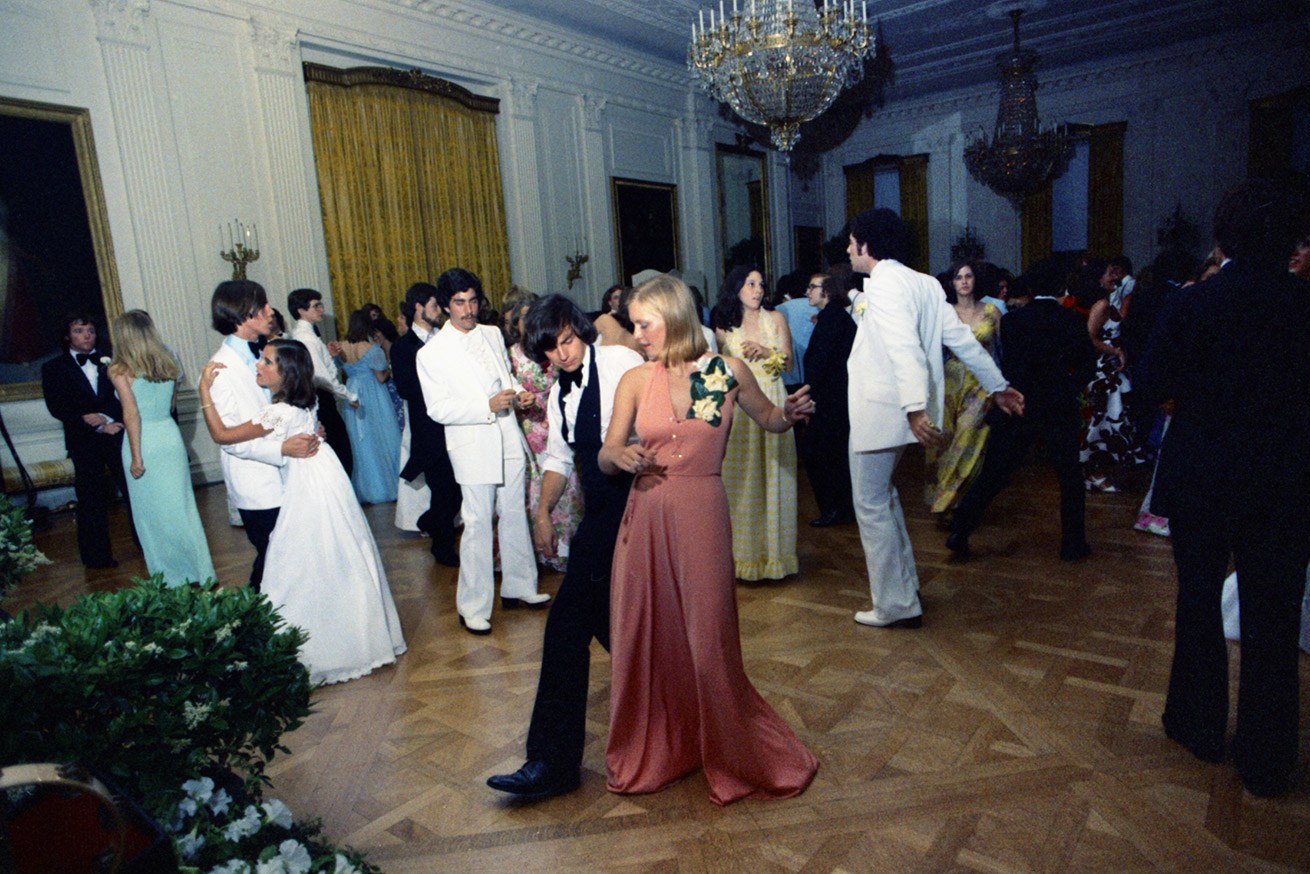
Proms go back a long way; well over a hundred years.  Proms were originally deemed “times of firsts”, as in first “adult” social event for a teenager, first time taking the car out after dark, first real dress-up affair, first ride in a limo, first formal photo with a date, and so on.  Today, firsts happen a lot sooner, don’t they?  Maybe that’s why we add tigers and fire-eaters to quicken the pulse.  Or hold our prom in the East Room of the White House, as Susan Ford (daughter of the late President) did alongside her Holton-Arms classmates in 1975.

Photo courtesy of Gerald R. Ford Presidential Library

Here’s a bit of prom trivia: the word is short for promenade.  Promenade means “a stroll or a walk, especially in a public place, as for pleasure or display”.  Makes sense, doesn’t it?  Further, promenade comes from the Latin word prominare, which means “to drive (animals) onward, with shouts”.  With a nod to Miami – makes sense, doesn’t it?

(Note: PROM also stands for “programmable read-only memory”; a form of computing memory where the setting of each bit is locked.  Makes me think of teenage hormones, especially at prom.  Locked/loaded – nothing you can do to change any of the settings.)

Not to rain on this parade – er, promenade – but every time I think of prom I can’t help but think of the movie “Carrie” – the original version of course, with Sissy Spacek.  Still terrifying after all these years (and I can still hear her mother’s haunting scream, “They’re all gonna laugh at you!!!”).  At least now I’ll just have nightmares about hungry tigers.

The Life of Spice

“Mikey’s Late Night Slice” in Columbus, Ohio, offers a pizza called “Fiery Death with Hate Sausage”, topped with three of the world’s hottest peppers: Carolina Reapers, Trinidad Moruga Scorpions, and Bhut Jolokias.  You must sign a waiver before Mikey’s serves you a slice of Death, acknowledging, “you’re an idiot”, and absolving the restaurant of any responsibility for the unpredictable aftereffects.  According to one taster, “It was pretty miserable.  My eyes welled up, my nose ran, and no drink could wash away the pain.”  Sounds like my kind of heat.

Photo by “Mikey’s Late Night Slice”

It all started with the tabletop pepper shaker. Salt’s brother-of-another-color stood quietly to the side in my childhood, hoping for the same constant attention given to his savory companion. If pepper was used at all in my day, it was nothing more than an obligatory shake; a decoration of the food versus a yearning of the taste buds.

Forty-odd years later, the pepper mill has become the king of the spice rack – my go-to final flourish before deeming a meal ready-to-eat. My pepper mill is always cranked to the furthest setting to the left, so the dozens of corns fall out of the bottom virtually intact. When I refill my pepper mill and spill a few of the little guys onto the counter, I scoop them up and pop ’em into my mouth like candy.  My family has learned to pass the pepper before I even ask for it.

I blame my parents, of course (something I seem to do with increasing frequency these days). My dad peppered everything on his plate – still does – and kept shaking away until his food literally disappeared under a blanket of black. My dad was the guy at restaurants who mercilessly trapped the poor fellow who politely asked, “would anyone like ground pepper”? My dad would always add, “you can be generous…”, and several minutes of grinding ensued.  My dad also had violent (but apparently enjoyable) fits of sneezing, sometimes seven or eight in a row.  I never made the association with pepper, but now I wonder.  I can still hear him concluding a sneezing session with the word “marvelous“.

My mom, who graduated from the Emily Post School of Etiquette with honors, commanded a family dining table to rival the tightest ships.  Every placemat, utensil, plate and bowl were in perfect symmetry.  The meal began with a table grace, and concluded with “please may I be excused?” In her world, “please pass the salt” meant passing the salt along with the pepper shaker, and with two hands instead of one so you couldn’t eat at the same time. Thus, the pepper arrived at my plate whether I wanted it to or not.

Sometimes I think my hankering for pepper is borderline-addictive.  Eventually the “shaker” no longer sufficed, as the pepper only came out in little bits.  Once I discovered the “mill”, there was no going back.  A handful of turns became ten, then fifteen; my food turning as dark as my father’s.  As it turns out, pepper was my gateway spice.  In the last several years I’ve discovered “red pepper flakes”; a significant leap in heat from peppercorns.  I used to shy away from those little plastic vials they include with pizzas.  Now I ask for two or three more.

Lucky for me, pepper (and all things spicy) appears to be a healthy habit.  According to an article by Dr. Joseph Mercola – an osteopath and proponent of alternative medicine – a full ounce of pepper provides most of the manganese, Vitamin K, and potassium we need in a given day, and even a good dose of iron or fiber.  Mercola then missteps when he acknowledges “…it’s true one would not have that much pepper in a day…”  Apparently, he hasn’t met me.

Pepper is described as a “stealth antioxidant”, discourages intestinal gas from forming (no wonder my wife peppers my food), and somehow aids in the breakdown of fat cells.  Finally, black pepper has much in common with cannabis, with aroma molecules functioning as “cannabinoids”.  To be clear, we’re talking about the therapeutic benefits of cannabinoids here.  Pepper isn’t playing with my brain cells (I don’t think), but it does help to reduce inflammation.

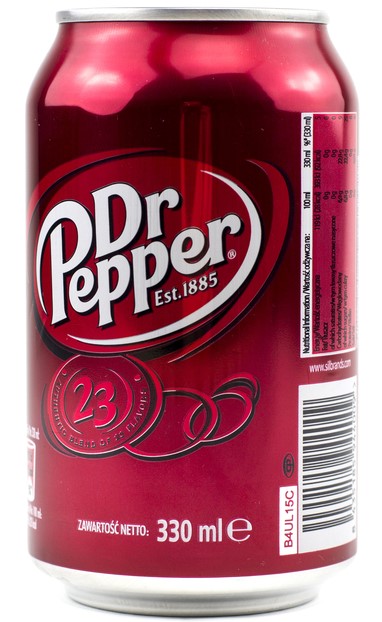
My children are destined to a life of pepper – I’m sure of it – and not because I turn my food black like my father or pass the shakers as a pair like my mother.  In high school, my daughter prepped for her team’s volleyball matches by “peppering” with another player (hitting the ball back and forth to warm the hands).  Now, she carries pepper spray in her purse.  One of my sons went to college in Waco, TX, where Dr. Pepper was invented in 1885 and vended on campus without a Coke or Pepsi in sight.  More recently, I’ve seen my children reach for the hot sauce (instead of the mild) at Mexican restaurants.  You see, it creeps up on you quietly.  Next thing you know they’ll be asking me to take them to Mikey’s Late Night Slice.

Good Times and Laughter Too

My wife and I will attend two weddings this summer; one for friends and one for family.  This week I noticed one of the brides-to-be on Facebook, requesting “songs you want to hear/dance-to at the reception”.  Clever girl, making sure her guests have a say in the music.  My guess is – whether requested or not – the deejay will find room for Kool & The Gang’s enduring party anthem, “Celebration”.  It’s as timeless now as it was when we first heard it in 1980.  And ce–lah–brate-ing good times is as timeless at weddings as it is for the passing of a loved one.

Plucked from another section of the significant-life-events portfolio, my wife and I attended a Celebration of Life this past weekend, for my uncle (my dad’s twin brother).  I label two aspects of my uncle’s passing as “merciful”: 1) He was weakened by a heart condition over the last three years of his life; and 2) One or two of his family members were not available for an immediate memorial.  Because of the first aspect, the extended family had plenty of time to make peace with my uncle’s eventual passing.  Because of the second aspect, what may have been a funeral became a celebration of life instead.

No need to vote on this topic.  Whenever circumstances permit, choose Celebration of Life over Funeral.  Funerals lean to the shock and mourning of a life lost – somber affairs are they.  Celebrations of Life revel in the happy memories of one life, and the joy brought to countless others.  Such was the case with my uncle.  His celebration included a church service, hymns, and a homily (given by the “celebrant”, of course), but what moved me to my core – and what I couldn’t get enough of – were the stories shared by my cousins (my uncle’s children) and my father (his brother).  Those memories included things I never knew about my uncle, such as his talent as a cartoonist and his childlike demeanor with his grandchildren.  I’m even more inspired by the man than I already was.

My uncle’s celebration moved on from the church to a beautiful setting by the San Francisco Bay, where drinks, lunch, photos and memories were shared for several hours.  It was as much a family reunion as a celebration, and my uncle wouldn’t have had it any other way.  Before he passed, he let it be known we should make merry instead of mourn.  And so, …There was a party goin’ on right there; a celebration to last throughout the years.

Whether we celebrate births or birthdays, weddings or wedding anniversaries, Sunday Mass or Christ-mas, we get a healthy dose of festive occasions in our lifetimes.  Perhaps that’s why we’ve come up with so many words to describe them.  Merriam-Webster published one such list here, including Bash (America’s melding of “bang” and “smash”, somehow maturing into “party”); Blast (surely inspired by loud musical instruments and champagne bottles); Rave (actually inspired by a Middle-Ages term for “acts of madness”); Blowout (once defined as a “one-off indulgence”; somehow morphed into “major festive occasion”), and finally my favorite – Wingding (once “feigned seizures”, now “wild partying”).

But enough digression.  Well, almost enough.  My nod to all things “celebration” wouldn’t be complete without a mention of the town in Florida by the same name.  Developed by Disney as a utopian master-planned unincorporated community “created from scratch”, and “a town worthy of its brand and legacy”, Celebration was/is Disney’s nod to New Urbanism: development based on the small towns of early America, with compact downtowns, “walkable” streets, diverse housing stock, and plentiful public spaces. Celebration doesn’t even consider itself a town, preferring instead the label of community, as in “strong spirit, and desire for friendship with neighbors”.  Sounds like a festive gathering to me!

There will be many more celebrations of life before the one that has my own name on it.  I’m okay with that.  Celebrations of life are a unique blend of revel and revere, partying and paying respects – the dual reasons we raise our glasses to someone’s name.  Just be sure it’s a party.  As Kool & The Gang puts it: We’re gonna have a good time tonight… Let’s celebrate… It’s all right.

Dream Puffs

Last year, Starbucks surpassed Subway as America’s #2 restaurant, measured by gross sales (McDonald’s is still top dog).  I don’t consider Starbucks a place to “dine”, so second-place is impressive.  Then again, Starbucks’ bakery case has matured since its initial offerings.  There are temptations-a-plenty now, en route to the barista.  The traditional breakfast items share space with yogurt parfaits, fruit-and-cheese boxes, “fold-over” sandwiches, and entree-size salads.  But it’s the smaller offerings I want to talk about today.  Look closely through the glass – you’ll see sous vide egg bites and Bantam’s bite-sized bagels.  Those little guys could be the future of fast food.

egg bites

I haven’t tried the mini bagels, but Starbucks wins me over with its egg bites.  The first time I gave them a whirl, my wife and I were in the middle of Lent, trying to find alternatives to the foods we gave up.  Egg bites to the rescue.  The sous vide prep means cooked in water, with nothing but a bit of spinach, red pepper, and cheese mixed in for flavor.  Simply elegant (elegantly simple?), and the light, fluffy texture makes them as delicious as they are convenient.

Three Little Griddles
Æbleskiver

Now let’s talk about real breakfast foods.  Last weekend, my wife and I went to a nearby restaurant called Three Little Griddles.  Much to my delight, Griddles had Æbleskiver on the menu.  If you’re Danish, you already know what I’m talking about.  Æbleskiver is heaven-sent breakfast: puffy little balls of pancake with a sweet surprise in the middle, finished off with a delicate dusting of powdered sugar and a side of raspberry jam.  Æbleskiver is Danish for “apple slices”, but you’re more likely to bite into a strawberry or a fruit-compote filling instead.  Three Little Griddles also offers Æbleskiver with an egg/bacon filling, coated with a maple-syrup glaze and powdered sugar.  A complete breakfast!

NOT Æbleskiver

If you haven’t heard of Æbleskiver and the first thing you thought of was “doughnut hole”, shame on you.  Doughnut holes don’t even qualify as poor man’s Æbleskiver.  Doughnut holes are a clever product designed to get you to buy more when it appears you’re buying less (think “fun-size” candy bars).  I have two issues with doughnut holes.  One, they’re not actually the “hole” of a solid doughnut, but prepared and baked separately instead.  Two, they’re not shaped like a doughnut hole should be (picture it – something more like the hub of a wheel).  They should be called doughnut balls.  But enough of this talk; I’m wasting words.  Let’s keep the focus on Æbleskiver.

My first taste of Æbleskiver came when I was little, in the Central California village of Solvang.  Solvang is like, well, a kid’s “Little Denmark” – a town small enough to walk around, with an overabundance of shops selling toys, candy, and ice cream.  Several windmills spin slowly above Solvang’s high-pitched shingle rooftops.  A church sits prominently on the edge of town.  A small park serves as the town square, complete with a bandstand-sized gazebo.  All that’s missing is some water-filled canals and cobble-stoned streets.  But meanwhile, there’s plenty of Æbleskiver.  Some restaurants even bake them out on the sidewalk, rotating those little dream puffs to perfection in their unique iron skillets.

If you credit the Danes with the invention of ball-shaped food, the rest of the world takes a distant second with its imitations.  China makes a spherical egg-based fruit-filled waffle called Gai Daan Jai.  Japan makes a variety of savory ball-sized snacks called Takoyaki. (Savory? Yuck.)  And America makes doughnut holes called Munchkins.

As if Æbleskiver isn’t cool enough as a food, it’s also a cool word with a unique spelling (note the “letter” Æ).  Perhaps Starbucks will start carrying it, along with the egg bites.  I’d buy both and a coffee for a complete breakfast.

Finally, if Æbleskiver has you wondering what other delights Denmark has to offer, consider ÆblekageÆblekage is “apple charlotte” – stewed sweetened apples layered with butter-roasted bread crumbs and crushed makroner (an almond-flavored meringue), topped with whipped cream and red currant jelly.  Oh my; sounds like dream stuff.

Æblekage

Some content sourced from Wikipedia, “the free encyclopedia”.

Mechanical Wonders

A Wall Street Journal headline stopped me in my tracks today.  In Guangzhou, China, you can now buy a car from a vending machine.  Starting with a smartphone app, you book a test drive before you arrive.  Once at the “dealership”, facial recognition software kicks the machine into gear, delivering your car-of-choice from an eight-story automated garage.  If you’re happy with the test drive, you negotiate the purchase through the app – no haggling salesperson to be seen – and off you drive with a new car.  I’d fly to China and take a test drive just to see the automated garage vend a car.  That’s some cool technology.

Photo by Aleksandar Plavecski

Vending is more sophisticated these days than the plain-Jane cigarette and candy machines of old, of course.  Airports dispense cell phones and other pricey electronics to travelers from vending machines.  Food-truck-like boxes dispense made-to-order pizzas.  A mall in Beverly Hills vends Beluga caviar from self-serve refrigerators ($500 a pop).  Las Vegas’s “The Lobster Zone” is like one of those machines where you joystick the claw to your toy of choice, only here you’re plucking live lobsters from a tank.  Finally, the cupcake company Sprinkles makes serious bank with its street-side “cupcake ATM’s”.


Speaking of bank, I used to collect mechanical banks when I was a kid. That sounds like a strange (nerdy?) admission – collecting toy banks – but that’s what kids did in the 1970’s. They collected things. Mechanical banks wouldn’t appeal to today’s youth for a couple of reasons. One, they’re battery-operated or “wind-up”, so you can’t control them with a phone or an app. Two, they work on the assumption you’re saving up nickels, dimes, and quarters for future purchases. Today’s kids seem less likely to save that way (if at all), and their purchases are with bills or electronic cash.  Mechanical banks prefer coins.

My collection of banks – which disappeared years ago – is a good example of the limitations of what and how a kid could purchase back then.  Almost all my banks came from the Johnson Smith Company, a manufacturer out of Chicago (“Since 1914!”)  Johnson Smith sold endless novelty and gag gift items: x-ray goggles, whoopee cushions, joy buzzers, and those really annoying “chattering teeth”.  They also sold mechanical banks; not the beautiful collector’s editions of old, but plastic, battery-operated cheapies, probably manufactured in China.  Johnson Smith was the closest thing a kid in my day had to Amazon.

Because I lived in Los Angeles and Johnson Smith sold their mechanical banks in Chicago, the U.S. Postal Service was a lifeline; the critical link between my quiet suburban neighborhood and the Midwest’s biggest city.  When I saved enough money, I’d stuff my bills and coins into an envelope, hand-address it, add several postage stamps (Mom helped with the calculation), and walk it out to the mailbox at the end of our driveway.  Four to six weeks later, a small brown box would arrive from Chicago, addressed to me and containing my latest mechanical wonder.

Think about that for a second.  Not only was I putting cash into a flimsy white envelope to be processed through the endless shipping and handling of USPS, but I was also leaving my hard-earned money out by the street, alerting the world to its presence with the little red mailbox flag.  That same transaction today – with “1-click ordering” – takes a single keystroke or voice command and shows up on my doorstep in two days or less.

The irony of collecting mechanical banks is that you’re spending your hard-earned pennies on the very thing designed to keep you from spending them.  Truth be told, my banks weren’t about saving money at all.  Instead, they were entertainment in the form of plastic-and-battery-operated mechanics, watching coins go here-and-there before finally disappearing from sight.

I never lost my fascination for mechanics.  I remember grade-school field trips to commercial bakeries, going behind-the-scenes to see how big vats of dough methodically evolved into sliced, packaged loaves of bread.  My kids and I used to watch the Food Network’s “Unwrapped”, a half-hour tour through the sophisticated mechanics behind a product’s evolution, from individual ingredients, through various stages of assembly (and several conveyor belts), finally to the finish line: a brightly-wrapped ready-to-eat consumable.

Mechanical banks may be long gone, but even in today’s age of electronics I say we’re still fascinated by mechanics itself.  It’s the reason we buy cars from vending machines or cupcakes from ATM’s.  And it’s the reason I still haul my pocket change down to the bank, just to see the teller dump the lot into the coin-counting machine; the noisy, mechanical wonder that sorts, counts, and spits out a receipt just before gobbling up every last penny.

Personal Space

We’re in the midst of Holy Week (for us Christians), which for some means spending more than the usual amount of time in church. Starting with this past Sunday, most Christian denominations conduct a total of five church services unique to this week: Palm Sunday, Maundy Thursday, Good Friday, Holy Saturday, and Easter Sunday. Our Methodist church here in Colorado devotes an hour to each of these services (short by Catholic standards); some during the day, others at night. No matter how you slice it, Holy Week means a lot of time in the sanctuary.

The church sanctuary wasn’t always a welcoming place.  Growing up in Los Angeles, my family and I belonged to a formal Methodist church, with a sanctuary I can only describe as intimidating (at least from a kid’s point of view).  You entered the building from the back, where the doorway greeters beckoned you to a narrow narthex.  So far, so good.  But the imposing sanctuary lay just beyond, through a wall of soundproof windows and closed doors, with stern-faced ushers protecting its every entrance.  The pews were hardwood and upright with thin cushions, thirty deep on either side of the main aisle, marching in perfect unison towards the steps of an even-more-intimidating white marble altar.  The booming organ drowned out any conversation (which was always at a whisper anyway), and the soaring structure of the ceiling made a kid wonder when it would all come a tumblin’ down like Jericho’s walls.

The congregation of worshipers was a lot of “old folks”; the kind of people who thought kids belonged in “Sunday School” instead of the sanctuary (that is, neither seen nor heard).  Hence as teenagers, my friends and I sat up in the balcony (at the back of the space, kind of like the last seat on the bus).  You couldn’t always hear the pastor, but at least we didn’t feel the eyes of the disapproving adults down below watching our every move.  From our vantage point they were just a bunch of suits and dresses, topped by a whole lot of gray hair.

“Sanctuary” took on new meanings as I grew older.  The San Diego Wild Animal Park (now the “Safari Park”) opened its gates in the 1970’s and put a completely new spin on the concept of a zoo.  Animals lived in wide open spaces instead of enclosures; broad, beautiful environments designed to mimic their natural habitats.  Instead of pressing noses against cages or glass, visitors saw the animals from a distance, confined to the seats of a quiet tram circling the park.  If I ever come back as a member of an endangered species (like the northern white rhino I mentioned last week), put me in the San Diego Safari Park.  That’s what I call an animal sanctuary.

Also in the ’70’s, Hollywood produced “Logan’s Run”.  The movie depicted a utopian society of the future, offering a wealth of pleasures and resources and good living… at least until you turn thirty.  At thirty you reported to the “Carousel”, where you were assured a place in “Sanctuary” – the supposedly better hereafter.  Logan and his friends decide to find Sanctuary before they turn thirty, and that’s where the curtain of the ugly truth is drawn back.  I can still hear Logan fighting the controlling supercomputer as he moans “THERE IS NO SANCTUARY!”  Logan’s world was seductive for sure, but it was the mystery of sanctuary that had me watching to the end.

Recently, sanctuary has taken on more puzzling associations.  In the 1980’s, American thrash metal produced the band Sanctuary (but nothing in my research explains the name).  Sanctuary Clothing is a line described as “…capturing the Los Angeles lifestyle… vintage styling with a handcrafted focus on detail…”  Again, nothing about the name.  The SyFy Channel’s Sanctuary ran for four seasons and explored gene therapy and cloning, and the “strange and sometimes terrifying beings” that emerged within the human population.  Finally, today’s sanctuary cities appear to be anything but, as the political feud between the Fed and the state overshadows any sense of actual security.

My definition of sanctuary will always be that primary space for worship in a church; or to put it in broader terms, “a place of refuge or safety”.  Whether that’s somewhere inside, worshiping in the pews as I’ll do tonight; or somewhere outside; say, walking on a quiet path in the forest, it’s more about a feeling than a location.  Sanctuary is all about personal space.

Chump Change

This week’s headlines included a downer from the animal kingdom.  The world’s last male northern white rhino passed away, leaving just two females to live out their days before the species goes extinct.  How sad is that?  Especially since the northern white’s demise is the result of the poaching of its horns – questionable behavior from we humans.

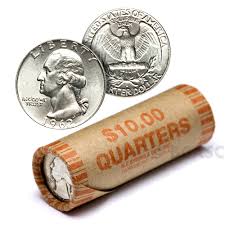
Speaking of questionable behavior, did you know the U.S. penny and nickel are also on the verge of obsolescence?  It’s true, if you believe the arguments of those who say the one-cent and five-cent pieces have outlived their utility.  Consider: 1) both coins cost more to mint than they’re worth; 2) a nickel today buys less than 20% of its worth in 1970 (a penny – less than 10%); 3) merchants routinely adjust pricing to avoid their use; and 4) the metals involved – zinc, copper, and nickel – have perfectly good uses elsewhere.

The prosecutions rests and the defense now takes the stand.  Pennies and nickels should not go the way of the northern white.  Consider: 1) Demand for the little guys is soaring; double what it was a decade ago; 2) The U.S. Mint “makes money” on its production of coins – fully 45 cents for every dollar’s worth (in 2017: a $400 million profit); 3) If zinc becomes too expensive (97.5% of the makeup of today’s pennies), a cheaper metal can be used for filler, and 4) eliminating pennies and nickels could threaten confidence in the U.S. dollar with a forced dependence on higher denominations.

I’ll get behind any of these arguments – pro or con – I just think they’re boring.  Defending our little Mr. Lincoln’s and little Mr. Jefferson’s can be so much more creative.  Take away pennies and nickels; then consider the following:

1) Penny loafers.  No longer the classic men’s slip-on shoes with the cool name, including the cross strap and small opening at the center; the perfect size and shape for a penny.  Add those Lincolns and you gave new meaning to the term “shoe shine”.  You also had a built-in conversation starter, when the girl asked why you put coins in your shoes.  You told her you were retro – back in the day a phone call cost a penny, and loafers were a convenient way to carry around the cost.

2) 99 Cent Only Stores.  Fifty years of U.S. retail, with over 400 locations and thousands of products priced at “ninety-nine cents or less”, goes belly-up without the penny.  How would a cashier make change on the dollar?  They’d have to give you a nickel instead, and… oops, the nickel’s gone too.  New math: buy something for $0.99, pay a dollar, and get a dime in change.  Huh?

3) Girls named Penelope.  They could no longer be “Penny” for short (or “Nickel”) because no one would understand what made the nickname so cute.  You say you don’t know anyone named Penelope?  Wait a few years.  In 2008, Penelope was #2,222 on the list of girl’s names.  This year it’s #573.

4) Your thoughts.  They used to be “a penny for…”.  Now you’ll have to pay at least ten times that much.  Keep them to yourself.

5) Beatles hits.  “Penny Lane” drops out of the Fab Four’s impressive list of #1’s.  The quaint little street no longer exists in Liverpool, England.  The barber never shows another photograph (of every customer he’s had the pleasure to have known).  There’s no fireman with an hourglass (nor in his pocket a portrait of the Queen).  You’re no longer there, beneath the blue, suburban skies.

6) Copper (+ zinc) floors.  Okay, I didn’t even realize this was a “thing” until recently.  Who ever said you had to spend a penny to give it value?

7) Your parent’s sayings.  Out the window goes “If I had a nickel for every time I heard that…”, or “we didn’t have two pennies to rub together”, or “that costs a pretty penny”, or “penny-wise, pound-foolish”, and so on.  Nobody would ever “nickel-and-dime” you again.

8) Derailed trains.  Okay, a derailed train was just a childhood power trip, to heighten the suspense of flattening pennies on the tracks.  The train rumbled on.  The pennies sometimes got lost.  Would a train flatten a dime or a quarter?  Never tried it; wouldn’t expect a kid to sacrifice that much pocket change for cheap thrills.

These arguments are solid; not a bad penny in the bunch.  We can’t let a subspecies like the U.S. penny or the U.S. nickel go extinct.  Think twice the next time a cashier takes a penny out of the counter cup just so she can give you change in dimes or quarters.  Think twice the next time you’re humming along with Billie Holiday:

Oh every time it rains
It rains pennies from heaven
Don’t you know each cloud contains
Pennies from heaven
You’ll find your fortune
Fallin’ all over town
Be sure that your umbrella is upside down

Some content sourced from the Wall Street Journal article, “”Should the U.S. Retire the Penny and Nickel?”

Wait For It

Let’s wager a guess over something that happened to you in the past few days. It probably happened several times in the past few days. It wasn’t by choice, nor were you alone.  It might even be happening right now. What is this recurring, oft-maddening event in your daily world (and mine)? Somewhere, for some good reason, in person or in the car, deliberately or unintentionally, you found yourself waiting in line.

Call it a common courtesy or call it the primary by-product of consumer demand. Waiting in line is a timeless (or time-wasting) necessary evil with no satisfactory alternative.  While the world behaves efficiently with smartphones, computers and even data-consuming “IoT” appliances, those snaking, switch-backing, several-option, several-category lines of humans seem to grow ever longer.  Including traffic on the highways – another version of waiting – you’ll spend one to two years of your life in line.

Consider some of the common reasons why we wait in line:
– store cashiers
– airport security
– phone calls (on hold)
– amusement parks
– voting
– public restrooms

If I wrote this post fifty years ago, I would’ve listed the very same reasons why we wait in line.  We have options now, but let’s face it; those options are waiting-in-line in disguise.  Store cashiers now work side-by-side with an area of self-check-out machines (which draws its own line).  Airports promote pay-for lines like TSA Pre and CLEAR.  Telephone on-hold mechanisms offer callbacks instead of waiting (“for an additional $0.75”).  Disneyland installed “FastPass” lines; again, for a fee.  Voting can be done by mail (forcing your ballot to wait in line instead of you).  And public restrooms?  Okay, there’s no option to waiting for the potty.  Maybe reconsider that second beer.

The Brits refer to a line of people as a queue.  I like that (and not just because we need more words beginning with the letter “q”).  Leave it to those on the far side of the pond to class up the most mundane activity imaginable.  At least we have our phones as distractions when we “queue”.  But the old-fashioned distractions still work.  It’s why they put candy bars by the cashiers, magazines in the waiting room, mirrors by the elevators, and televisions in the airport.  Anything to help you forget you’re waiting in line.

Julio C. Negron

You’d think waiting in line is mindless – no-brainer science really – but I have experienced flaws in the system.  Recently in Lowe’s, waiting patiently in a single, central line at the self-check-out area, I was confronted by the person behind me, who demanded I “choose one side or the other” (as if logic demanded a separate line for each row of self-check-out machines).  My response to him was not one of my finer moments.  Another example – at the airport – my wife and I waited at the curb with a dozen others for the parking lot shuttle, only to discover the “front of the line” was a variable determined by the point on the curb where the driver chooses to stop his vehicle.  If you want to see what not waiting in line looks like, try to catch a parking lot shuttle at the airport.

In today’s world, we have new reasons why we wait in line:
– to purchase the latest iPhone
– at restaurants, with pagers (clever disguise for waiting in line)
on-line (i.e. for concert tickets or sports tickets at a specified time)
– Black Friday sales

Finally, we will always stand in line for our kids, whether to see Santa Claus at the mall or to buy something they simply must have.  Years ago, I remember taking my kids to the local bookstore for the latest “Harry Potter” (which they started and finished before the next sunrise).  It was the only time I’ve stood in line for the right to stand in line again.  The bookstore insisted on selling a limited number of tickets at noon, to be exchanged for the book later that same day, when the publisher allowed its release.

I believe the longest I’ve ever waited in line is five hours – to see the first Star Wars movie in 1977.  With no electronic devices to keep my friends and I company back then, five hours was even longer than it sounds, especially knowing two consecutive showings of the movie would run before I even entered the theater.  Then again, the truly morbid among us believe we are all simply waiting to die.  If that’s the case, let’s hope we’re in a really, really long line.

Love Thee, Notre Dame

I used to love “back-to-school” nights in my elementary school days. My brothers and I would lead my parents through the gates of our asphalt-paved campus on the west side of Los Angeles, eager to show off the classroom projects and displays we prepared for their annual visit.  Mom & Dad would cram into our child-sized desks for talks from our teachers while we’d join friends for playground fun under the lights. Finally, we’d enjoy a KFC picnic dinner at the outdoor tables where we kids would have lunch during the day. Back-to-school night was equal parts adventure and pride, returning to campus at a time when we didn’t have to be students.

Such was the feeling this past weekend, visiting my alma mater in northern Indiana.  Notre Dame, that most Catholic of universities located near the south bend of the St. Joseph River – founded by Fr. Edward Sorin and his band of Holy Cross brothers in the mid-1800’s – drew me away from more convenient West Coast options like UCLA or Stanford (neither of which accepted me… details). Who was I, a Methodist from California, to attend a smallish Catholic school over 2,000 miles from home? Notre Dame’s admissions counselor did a heckuva sales job. Rather than own up to the humid months of the first semester or the penetratingly-cold months of the second, he focused instead on the promise of an outstanding faith-based education, coupled with small-dorm camaraderie, nationally competitive sports teams, and Midwestern hospitality.  When I graduated in 1985, it’s fair to say Notre Dame delivered on all of those.

Administration Building aka “The Golden Dome”, Central Quad

Thirty years later – this past weekend – I set foot on campus again, adding to only a handful of visits since my long-ago commencement. I won’t lie – returning to my college roots was a little daunting.  The Notre Dame of my years was by all definitions smaller, more modest, and less prestigious than the globally-renowned multi-campus university of today. My Notre Dame was an intimate cluster of buildings surrounding just three quads, one end of campus seemingly a stone’s throw from the other.  The student union was as small as a cracker box.  Two dining halls offered the modest sort of food – cafeteria style – I recognized from elementary school.  Diplomas were issued in just twenty fields of study. Four percent of the student body claimed a faith other than Catholic.  The clear majority of students came from Midwestern states, and only a handful chose to study abroad.

O’Shaughnessy Hall, South Quad

Thirty years later, my Notre Dame of yesteryear has been consumed by a property twice the size.  New quads and facilities cover the open fields that once hosted tailgaters before football games.  Another one hundred buildings have been added to the eighty or so of my day.  The new student union – opening just weeks ago – is the length of a football field (and in fact, co-located with the football stadium).  Today’s undergraduates choose from countless degree programs, with another fifty masters, doctoral, and professional programs to follow.  Add to the options, fifty foreign study-abroad opportunities in forty countries.

“Only” 80% of students are Catholic now (diverse by Notre Dame’s standards), and – speaking of diverse – almost 20% of the student body comes from outside the U.S.  Visiting one of the dining halls for lunch, it wasn’t the broad choice of foods (organic, ethnic, made-to-order) that impressed me, but rather the students themselves.  I witnessed a pretty good slice of the global pie at the tables around me.

Stairway to The Grotto and St. Mary’s Lake

Notre Dame’s mission statement includes the following: “In all dimensions of the University, Notre Dame pursues its objectives through the formation of a human community graced by the Spirit of Christ.”  Clearly that objective is reflected in the Notre Dame of today.  A school once known for little more than football is now an academic behemoth, built on an unwavering foundation of faith and service to God and fellow man.

“In Celebration of Family”

Notre Dame’s alma mater concludes with the following sentence: “…and our hearts forever, love thee Notre Dame.”  There may be a lot of “new” on campus today, but I still find the pathways of “my” years.  The Golden Dome, the Basilica of the Sacred Heart, and the Grotto will always form the heart of campus.  I maintain ties with only a handful of those who were in school with me, but we’ll always be proud members of the Fighting Irish family.  And every time I set foot on campus, I never fail to sense the memories of old, the encouragement of new, and the presence of the Spirit.  Indeed, Notre Dame is in my heart forever.

Land of Flying Cars

My wife and I live in a rural area of Colorado known as the Black Forest.  The high density of Ponderosa Pines in our small geography gives us our name.  Remarkably, there’s only one other notable place on the planet named “Black Forest”: the region near Bavaria in southwest Germany.  As it turns out, I have personal ties to both places, though I’ve never been to the south of Germany.  Follow along as I connect the Forests.

Fill in the blank, “Best Childhood Movie: ________”.  Most of you would respond with an offering from Disney.  Including “Snow White…”, “Mary Poppins”, and “The Little Mermaid”, you’ve already covered sixty years of film-making, with countless other Disney classics in between.  I don’t think I missed a single Disney growing up in the sixties and seventies, yet – go figure – my favorite childhood movie doesn’t come from the Mouse.  It doesn’t even come from my home country.  My childhood choice?  The UK’s “Chitty Chitty Bang Bang”, based on the 1964 novel by Ian Fleming.

“Chitty Chitty Bang Bang” – the captivating musical about the inventor and his kids who lived in a windmill cottage; about those wonderful-though-not-always-perfect inventions (my favorite: the eggs-toast-sausage breakfast machine); about the candy-maker and the toy-maker and the captivating castle world of Vulgaria; and most importantly about the magical flying motorcar itself – created figments of my imagination like no other movie.  The lyrics to the title song (“…Bang Bang Chitty Chitty Bang Bang, our fine four-fendered friend…”) were burned into my brain.  Someday I vowed to visit the lands of Caractacus Potts and Baron Bomburst.


As it turns out, the Potts’ windmill cottage really does exist (and not on a movie set) – as the “Cobstone Windmill” in Buckinghamshire, England. The mansion where “Truly Scrumptious” lived is in the same area of the country.  And the Scrumptious Sweets Company was a working factory in Middlesex (today a steam-engine museum).  But it was the castle and village in Vulgaria I really wanted to see.  Not long after seeing the movie of course, I learned “Vulgaria” was a fictitious country.  Baron Bomburst didn’t actually lord over the land, nor did he ever keep all those children as slaves beneath his castle. But the castle and the village are based on actual places.  The village is Rothenburg ob der Tauber in Bavaria.  The castle is Castle Neuschwanstein, also in Bavaria.  And how ironic; both locations were inspirations for Disney as well: Rothenburg for the village in “Pinocchio”, and Neuschwanstein for the Cinderella castles in the theme parks.

To bring my journey full-circle, Rothenburg, Castle Neuschwanstein, and Bavaria sit in southwest Germany, adjacent to… the Black Forest.  Germany’s version of the Forest is a mountainous land of picturesque villages, castles, vineyards and spas.  This is the region that brought the world Black Forest Ham and “truly scrumptious” Black Forest Cake.  This is the land of glass-making and cuckoo clocks.  From the photos above, it looks every bit as charming as “Vulgaria”.


Colorado’s Black Forest barely amounts to a dot on Google Maps.  Within our pines, the “town” is a hodge-podge of nondescript businesses clustered around a couple of traffic signals, with nothing more alluring than a Subway, a post office, and a couple of coffee shops.  The terrain is fairly flat, with no windmill cottages or mountaintop castles or cuckoo clocks.  But it’s a great place to live, with its own unique charm.  And every now and then, when I’m deep in the pines, I’ll start humming that forever-familiar Chitty-Chitty tune, as I gaze up to the skies in search of a flying motorcar.