Fit For a (Fairy Tale) King

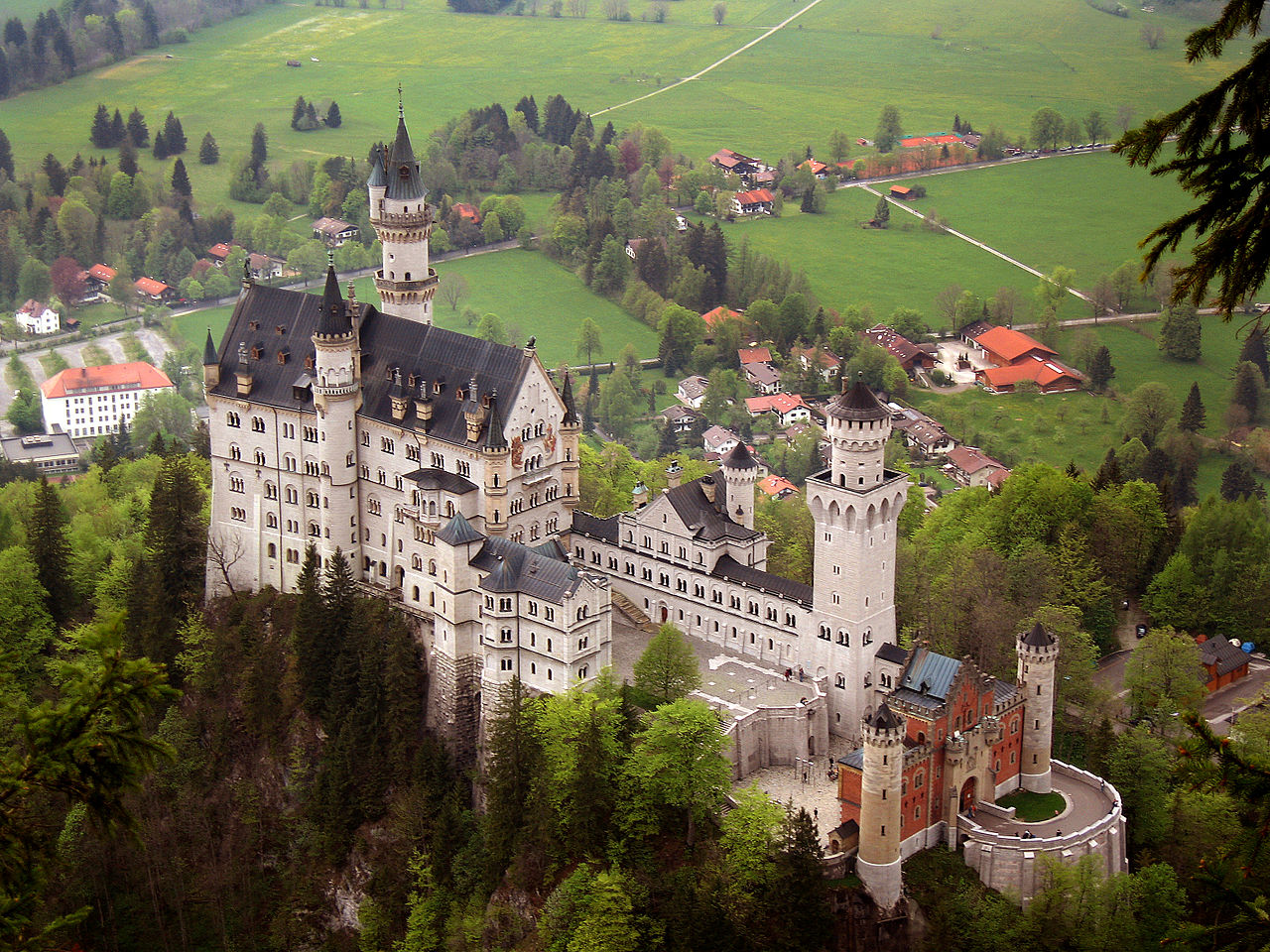
I was sorry to see the Germans bow out of the World Cup early, because I’ve had Deutschland on the brain lately. This month (seven years ago) my wife and I cruised down the Rhine River from the Netherlands to Switzerland, but it was pretty much all Germany in between. This month also signals full-on summer and more time in front of the barbeque.  On our grill you’ll find German bratwurst as often as American burgers. But more than river cruises and brats, I’m thinking about castles.  Not the kind made of sand on beaches, but the real ones made of bricks and stone on mountaintops. Like Germany’s Neuschwanstein Castle.

Neuschwanstein Castle

You’re already familiar with Neuschwanstein; I’m sure you are.  When 1.5 million people tour the castle every year – one of the most popular attractions in Europe – it translates to a lot of photos on Facebook.  Also, Neuschwanstein includes all of the castle elements you remember from childhood fairy tales: towers, turrets, balconies, gatehouses, courtyards, dungeons, and (the intention of) more than 200 lavishly decorated rooms, built up to the highest of heights.  There’s no surrounding moat, but Neuschwanstein gets along fine without one, perched on a hilltop in the middle of the Bavarian Alps.

Painting by Hubert Sattler (1904)

Frankly, all this castle needs to complete its picture is a king and his court.  Alas, Neuschwanstein never had a king – never – not even after its completion in 1892.  Yes, the castle was designed by King Ludwig II of Bavaria, but here’s where the fairy tale falls to pieces.  To begin with, Ludwig built the castle to escape the stresses of his primary palace life in Munich, so more than anything else it was meant to be a vacation home.  Then, Ludwig copied most of Neuschwanstein’s architectural elements from nearby castles, so the design is pretty much a mashup of structures that came beforehand.  Finally, and perhaps the saddest statement of all, Neuschwanstein was never completed – not even close.  With only a throne room, a “Minstrels’ Hall” (a sort of tribute to the entertainment of the time), a drawing room, and a dozen other spaces, Neuschwanstein’s construction fell well short of its intended 200+ rooms.

Neuschwanstein’s “Minstrels’ Hall”

The whole idea of Neuschwanstein feels like a bit of a charade.  Did Ludwig really intend to decorate and staff hundreds of rooms in a castle from which he didn’t care to lord over the surrounding land?  Was he really just frittering away Mom and Dad’s money because he was bored in Munich and had nothing better to spend it on?  And shouldn’t he have been focusing his time and energy on his royal responsibilities instead?  No wonder he was often referred to as “The Mad King”.

Let’s forget about Ludwig.  After all, this post is about a castle, not the king who never occupied it.  For all of its lack of completion, originality, and use, Neuschwanstein is still a model castle.  Most of you should recognize it from the castle designs it inspired: Disneyland’s Sleeping Beauty Castle and Walt Disney World’s Cinderella Castle.  But I prefer another one of its inspirations.
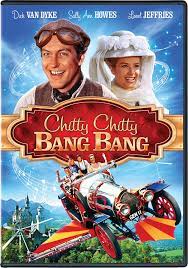
If Neuschwanstein is the ultimate castle, then Chitty Chitty Bang Bang (which I wrote about five years ago in Delicious Clicks) is the ultimate fairy tale.  The story of the magical flying car, its inventor Caractacus Potts, the evil Baron Bomburst, the lovely Truly Scrumptious, and on and on, comes back to me like it was yesterday.  Chitty Chitty Bang Bang was the first Ian Fleming book I ever read, well before anything James Bond.  Yet it never occurred to me until this post that Neuschwanstein served as the story’s castle.  The movie version includes several aerial shots (from the driver’s seat of a flying car, of course), and sweeping views of the surrounding countryside.  Neuschwanstein has always had a familiarity about it.  Now I know why.

Someday I’ll make the journey to see King Ludwig II’s creation in person… but not before I build it myself here at home.  Just when I thought I’d tackled my last LEGO project, along comes another one I simply can’t pass up.  The LEGO Neuschwanstein Castle is 3,455 bricks of towers, turrets, and Bavarian Alps, boxed and bagged along with the usual paperweight instruction manual.  I’m ready to don my crown and get started and as usual I’ll include small updates alongside my usual posts.  When all’s said and built maybe I’ll even suspend a flying car overhead, so the castle looks more like a fairy tale than a mere vacation home for a mad king.

Some content sourced from Wikipedia, “the free encyclopedia”.

Connection Protection

The college my wife attended many years ago was a small Midwestern campus, maybe twenty buildings in all. Because of the extreme winter temps, the college had the foresight to install tunnels between the primary buildings, allowing for warm, comfortable walks from say, the dorms to the central dining hall. It’s the same concept my wife and I discovered in Nuremberg, Germany last month, only this tunnel complex was on a much larger scale.  And getting from Point A to Point B wasn’t its only intent.

Nuremberg, Germany

You’ll find Nuremberg in the center of Bavaria, the forested southwest region of Germany.  The city served as the final destination on our recent Viking River Cruise on the Danube.  Like Salzburg, Austria a few days before, Nuremberg is known for its “Old City” area (now surrounded by modern-day sprawl).  Once inside those towering protective walls, it’s like you’ve stepped back into the Middle Ages.  If there’s a more preserved city of the period, with its moats, castles, towers, and bridges, I’m not aware of it.

A walking tour of Nuremberg is impressive enough with the history, architecture, and stories, but what trumps everything about it is what lies beneath the city.  My wife and I signed up for an excursion called “Flavors of Nuremberg”, expecting to enjoy a culinary sampling of regional delights.  Indeed we did.  Our first stop was for a plate of Nuremberg’s famous white sausages (with a tall beer to wash them down). This could have been lunch alone, but we pressed on for more.

Our next stop was for Lebkuchen, or gingerbread.  It’s even more famous than the white sausages.  Here are two things to know about Nuremberg gingerbread.  One, it contains no ginger.  Two, it’s not nearly as sweet as its American counterpart (typical).  Okay, let’s add a Three: Lebkuchen is absolutely delicious.  We packed a pile of gingerbread cookies into our suitcases to give to family members (but most of them ended up in our own pantry).

Our final stop – of course -was at a Nuremberg brewery for several glasses of local beer.  But what I wasn’t prepared for was how we would get to our beer  Instead of just walking through the front door of Hausbrauerei Altstadthof, our guide took us to the top of a stone staircase, set right into the middle of a nondescript Nuremberg street.  The stair was surrounded by modest iron rails but otherwise would’ve been something you’d walk by without pause.  Our guide explained how the original brewery was located on this spot centuries ago, marked by a plaque in the street.

What followed might have been my favorite moment of the tour.  Our guide excused himself to “go get the key”, so he could unlock the imposing door at the bottom of the stairs.  The key was held by some nearby merchant and our guide had the credentials to borrow it.  I find that charming, versus typing on a computer keypad or gaining the approval of a German guard.  You just open the door with an old brass key.

Our guide returned, beckoned us down the stairs, opened the door, and away we went.  Or should I say, down we went.  Even after passing through the door fifteen feet below street level, we continued down what must’ve been the equivalent of three more floors of stairs.  Our guide stayed behind to lock the door behind us, so we kind of descended on our own.  The walls closed in and it got darker as we went.  Suddenly beer was the last thing on my mind.

Which way do we go, Mr. Guide sir?

What followed was the equivalent of rats in a maze.  Seriously, if I planned to gulp fresh air or glimpse daylight ever again, I was entirely dependent on the movements of our tour guide over the next forty-five minutes.  He’d turn here or turn there, beckon us down one tunnel or push us through another, and he stopped several times to click on or click off the bare bulbs weakly lighting our way.  We passed through several intersections where we could’ve spun off in half a dozen directions, to be hopelessly lost under the city forever.  We saw what looked like dungeons and prison cells.  Suddenly I really wanted a beer.  Above ground.

Dungeon, or just storage?

Our guide stopped us would-be-spelunkers at several junctures to explain the fascinating history of Nuremberg’s miles-long network of hand-dug tunnels, originally used in the making of beer, then used as the city’s prison, and finally, remarkably, used to hide the thousands of residents the Nazis sought during WWII.  It’s an amazing history I can’t begin to do justice in this post, but you can read more about it here.  Suffice it to say, us tourists had a taste of what it’d be like to live in suddenly protective, seemingly endless tunnels for months on end.  Not for the faint of heart.

Watch your step!

At long last, we carefully ascended another long, irregular staircase, and our guide unlocked the final door at the top, where we burst into the sunshine and fresh air of Hausbrauerei Altstadthof‘s colorful outdoor biergarten.  It was a surreal moment, being thrust back into modern-day civilization from the medieval tunnels below.  The several beers that followed not only quenched my thirst but also calmed my nerves.  This “flavors” city tour was unquestionably the most adventurous excursion of the entire river cruise.

Relief in a glass

There was a time, when we lived in Colorado, where my wife and I considered connecting our house to our nearby barn.  We thought, why not string together a series of shipping containers below ground, to act as a tunnel to keep us warm during the frigid winter months?  After our subterranean tour of Nuremberg, I wondered what we were thinking.  Better to just hoof it through the snow than to get lost in the grounds of Colorado forever.

Land of Flying Cars

My wife and I live in a rural area of Colorado known as the Black Forest.  The high density of Ponderosa Pines in our small geography gives us our name.  Remarkably, there’s only one other notable place on the planet named “Black Forest”: the region near Bavaria in southwest Germany.  As it turns out, I have personal ties to both places, though I’ve never been to the south of Germany.  Follow along as I connect the Forests.

Fill in the blank, “Best Childhood Movie: ________”.  Most of you would respond with an offering from Disney.  Including “Snow White…”, “Mary Poppins”, and “The Little Mermaid”, you’ve already covered sixty years of film-making, with countless other Disney classics in between.  I don’t think I missed a single Disney growing up in the sixties and seventies, yet – go figure – my favorite childhood movie doesn’t come from the Mouse.  It doesn’t even come from my home country.  My childhood choice?  The UK’s “Chitty Chitty Bang Bang”, based on the 1964 novel by Ian Fleming.

“Chitty Chitty Bang Bang” – the captivating musical about the inventor and his kids who lived in a windmill cottage; about those wonderful-though-not-always-perfect inventions (my favorite: the eggs-toast-sausage breakfast machine); about the candy-maker and the toy-maker and the captivating castle world of Vulgaria; and most importantly about the magical flying motorcar itself – created figments of my imagination like no other movie.  The lyrics to the title song (“…Bang Bang Chitty Chitty Bang Bang, our fine four-fendered friend…”) were burned into my brain.  Someday I vowed to visit the lands of Caractacus Potts and Baron Bomburst.


As it turns out, the Potts’ windmill cottage really does exist (and not on a movie set) – as the “Cobstone Windmill” in Buckinghamshire, England. The mansion where “Truly Scrumptious” lived is in the same area of the country.  And the Scrumptious Sweets Company was a working factory in Middlesex (today a steam-engine museum).  But it was the castle and village in Vulgaria I really wanted to see.  Not long after seeing the movie of course, I learned “Vulgaria” was a fictitious country.  Baron Bomburst didn’t actually lord over the land, nor did he ever keep all those children as slaves beneath his castle. But the castle and the village are based on actual places.  The village is Rothenburg ob der Tauber in Bavaria.  The castle is Castle Neuschwanstein, also in Bavaria.  And how ironic; both locations were inspirations for Disney as well: Rothenburg for the village in “Pinocchio”, and Neuschwanstein for the Cinderella castles in the theme parks.

To bring my journey full-circle, Rothenburg, Castle Neuschwanstein, and Bavaria sit in southwest Germany, adjacent to… the Black Forest.  Germany’s version of the Forest is a mountainous land of picturesque villages, castles, vineyards and spas.  This is the region that brought the world Black Forest Ham and “truly scrumptious” Black Forest Cake.  This is the land of glass-making and cuckoo clocks.  From the photos above, it looks every bit as charming as “Vulgaria”.


Colorado’s Black Forest barely amounts to a dot on Google Maps.  Within our pines, the “town” is a hodge-podge of nondescript businesses clustered around a couple of traffic signals, with nothing more alluring than a Subway, a post office, and a couple of coffee shops.  The terrain is fairly flat, with no windmill cottages or mountaintop castles or cuckoo clocks.  But it’s a great place to live, with its own unique charm.  And every now and then, when I’m deep in the pines, I’ll start humming that forever-familiar Chitty-Chitty tune, as I gaze up to the skies in search of a flying motorcar.