I was sorry to see the Germans bow out of the World Cup early, because I’ve had Deutschland on the brain lately. This month (seven years ago) my wife and I cruised down the Rhine River from the Netherlands to Switzerland, but it was pretty much all Germany in between. This month also signals full-on summer and more time in front of the barbeque. On our grill you’ll find German bratwurst as often as American burgers. But more than river cruises and brats, I’m thinking about castles. Not the kind made of sand on beaches, but the real ones made of bricks and stone on mountaintops. Like Germany’s Neuschwanstein Castle.

You’re already familiar with Neuschwanstein; I’m sure you are. When 1.5 million people tour the castle every year – one of the most popular attractions in Europe – it translates to a lot of photos on Facebook. Also, Neuschwanstein includes all of the castle elements you remember from childhood fairy tales: towers, turrets, balconies, gatehouses, courtyards, dungeons, and (the intention of) more than 200 lavishly decorated rooms, built up to the highest of heights. There’s no surrounding moat, but Neuschwanstein gets along fine without one, perched on a hilltop in the middle of the Bavarian Alps.

Frankly, all this castle needs to complete its picture is a king and his court. Alas, Neuschwanstein never had a king – never – not even after its completion in 1892. Yes, the castle was designed by King Ludwig II of Bavaria, but here’s where the fairy tale falls to pieces. To begin with, Ludwig built the castle to escape the stresses of his primary palace life in Munich, so more than anything else it was meant to be a vacation home. Then, Ludwig copied most of Neuschwanstein’s architectural elements from nearby castles, so the design is pretty much a mashup of structures that came beforehand. Finally, and perhaps the saddest statement of all, Neuschwanstein was never completed – not even close. With only a throne room, a “Minstrels’ Hall” (a sort of tribute to the entertainment of the time), a drawing room, and a dozen other spaces, Neuschwanstein’s construction fell well short of its intended 200+ rooms.

The whole idea of Neuschwanstein feels like a bit of a charade. Did Ludwig really intend to decorate and staff hundreds of rooms in a castle from which he didn’t care to lord over the surrounding land? Was he really just frittering away Mom and Dad’s money because he was bored in Munich and had nothing better to spend it on? And shouldn’t he have been focusing his time and energy on his royal responsibilities instead? No wonder he was often referred to as “The Mad King”.
Let’s forget about Ludwig. After all, this post is about a castle, not the king who never occupied it. For all of its lack of completion, originality, and use, Neuschwanstein is still a model castle. Most of you should recognize it from the castle designs it inspired: Disneyland’s Sleeping Beauty Castle and Walt Disney World’s Cinderella Castle. But I prefer another one of its inspirations.
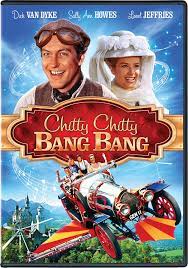 If Neuschwanstein is the ultimate castle, then Chitty Chitty Bang Bang (which I wrote about five years ago in Delicious Clicks) is the ultimate fairy tale. The story of the magical flying car, its inventor Caractacus Potts, the evil Baron Bomburst, the lovely Truly Scrumptious, and on and on, comes back to me like it was yesterday. Chitty Chitty Bang Bang was the first Ian Fleming book I ever read, well before anything James Bond. Yet it never occurred to me until this post that Neuschwanstein served as the story’s castle. The movie version includes several aerial shots (from the driver’s seat of a flying car, of course), and sweeping views of the surrounding countryside. Neuschwanstein has always had a familiarity about it. Now I know why.
 Someday I’ll make the journey to see King Ludwig II’s creation in person… but not before I build it myself here at home. Just when I thought I’d tackled my last LEGO project, along comes another one I simply can’t pass up. The LEGO Neuschwanstein Castle is 3,455 bricks of towers, turrets, and Bavarian Alps, boxed and bagged along with the usual paperweight instruction manual. I’m ready to don my crown and get started and as usual I’ll include small updates alongside my usual posts. When all’s said and built maybe I’ll even suspend a flying car overhead, so the castle looks more like a fairy tale than a mere vacation home for a mad king.
Some content sourced from Wikipedia, “the free encyclopedia”.