Ketchup Catch-Up

At the Communion rail in our pre-COVID, in-person church days, my wife and I would sometimes laugh at the size of the hunk of bread they’d tear off the loaf. The pieces were so big I’d often be chewing all the way back to my seat (and think I should’ve asked for seconds). On the other hand, today’s “drive-in church” Communion amounts to hermetically-sealed plastic capsules handed gingerly through the car window. Peel back the plastic to reveal the tasteless wafer and half-swallow of grape juice inside. No, it’s not breakfast by any definition, but at least we’re still achieving the higher purpose.

Communion and ketchup are strange bedfellows but I’m about to explain why they belong in the same sentence.  If you’ve followed the headlines lately, you know – just below the latest details of the Myanmar conflict – we’re all worried about whether there’ll be enough ketchup packets for our next take-out meal.  That’s right, the world is currently lacking in – not ketchup – but ketchup packets.  If we don’t address the situation soon, buildings will burn and looting will run rampant.  Even worse, we might have to top everything with mustard instead.
It’s the pandemic to blame, of course.  As soon as traditional sit-down restaurants shifted to pick-up and delivery, their demand for packeted condiments jumped up to the level of Wendy’s and McDonald’s.  In fact, Wendy’s and McDonald’s removed ketchup packets from their front counters, not because customers were taking too many, but because other restaurants were raiding their supplies.  Yep, it’s gotten that kind of desperate out there in burger land.

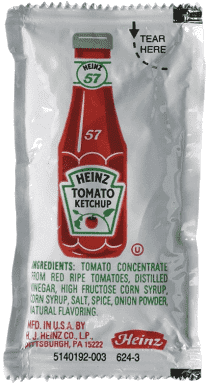
Heinz, the undisputed king of ketchup, recently committed to increasing packet production by 25% to fend off potential mayhem in the streets.  125% of Heinz’s typical annual production amounts to, well… let’s just say there’d be enough to place a packet in the hand of every man, woman, and child on the planet.  Dang.  That’s a whole lot of processed tomato spread.

Speaking of processed tomato spread, here’s my favorite ingredient in ketchup: mustard (powder).  It’s true.  Go check the ingredients list on the bottle I know you have in your refrigerator.

Will there be enough to go around?

But I digress.  Let’s get back to the global packet shortage.  Call me highbrow but I’m having a hard time caring, because honestly I can’t remember the last time I used a ketchup packet.  The restaurants of my choosing always bring the bottle to the table when you ask for it.  Furthermore – burgers aside – I don’t have a lot of use for ketchup.  Not on my fries, not on my meatloaf, neither eggs nor hash browns.  And while we’re at it can we all agree: mustard only on a bratwurst or a hot dog?  It should be a cardinal rule.

But I digress… again.  FOCUS!

If I don my eco-friendly hat for a moment (and don’t I look sharp?), the last thing I want to hear about is Heinz upping ketchup packet production to 12 billion a year.  That sounds like enough plastic to Ziploc a small country many times over.  But I get it.  In these times of please-pass-the-virus (or better yet, don’t), we demand individually wrapped one-and-done solutions.  Like ketchup packets.  Like Communion elements.

Handy host

Good things come in small packages, so the saying goes.  Yeah, well, they come in big packages too.  Like ketchup from a bottle instead of a plastic packet.  Like Communion from a loaf of freshly baked bread instead of hole-punched from a sheet of Styrofoam. And seriously, who uses just one ketchup packet?  Picture a baby burger you can balance between your finger and thumb and maybe it’s enough.  Anything larger and you’re grabbing packets by the handful.

Let’s wrap this topic on a personal note.  If ketchup packets disappear, my granddaughters won’t understand a really good bedtime story, the kind where they’ll giggle every time they talk about it.  You know the story, the one where my buddies and I pocket ketchup packets from our school lunch trays, take ’em out to the playground asphalt, and stomp on ’em to give some unsuspecting kid a tomato facewash?  Oh please, drop the mock horror.  You know you were out there on the playground too, doing the very same thing.

Some content sourced from the 4/8/2021 CNN.com article, “America is facing a ketchup packet shortage”.
Hopping on Pop

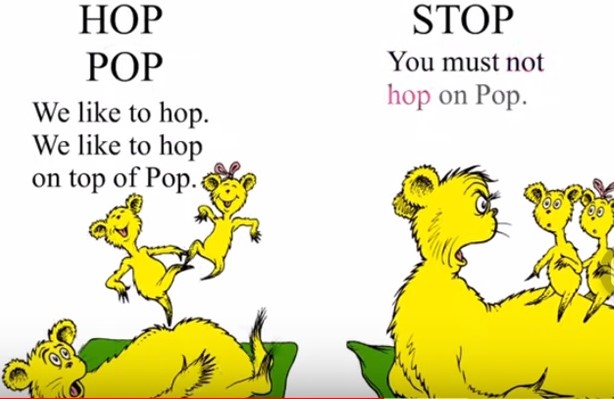
In the Dr. Seuss children’s classic Hop On Pop, readers travel through pages of rhyming word pairs, with the usual whimsical cartoon characters acting out the scenes (ex. “All Ball, we all play ball” and “Day Play, we play all day”). It’s not until about halfway through the book where you see the title pair, “Hop Pop”.  And when I saw “STOP, you must not Hop on Pop”, I decided Dr. Seuss was referring to the latest junk food mashup, “Pepsi x Peeps”.

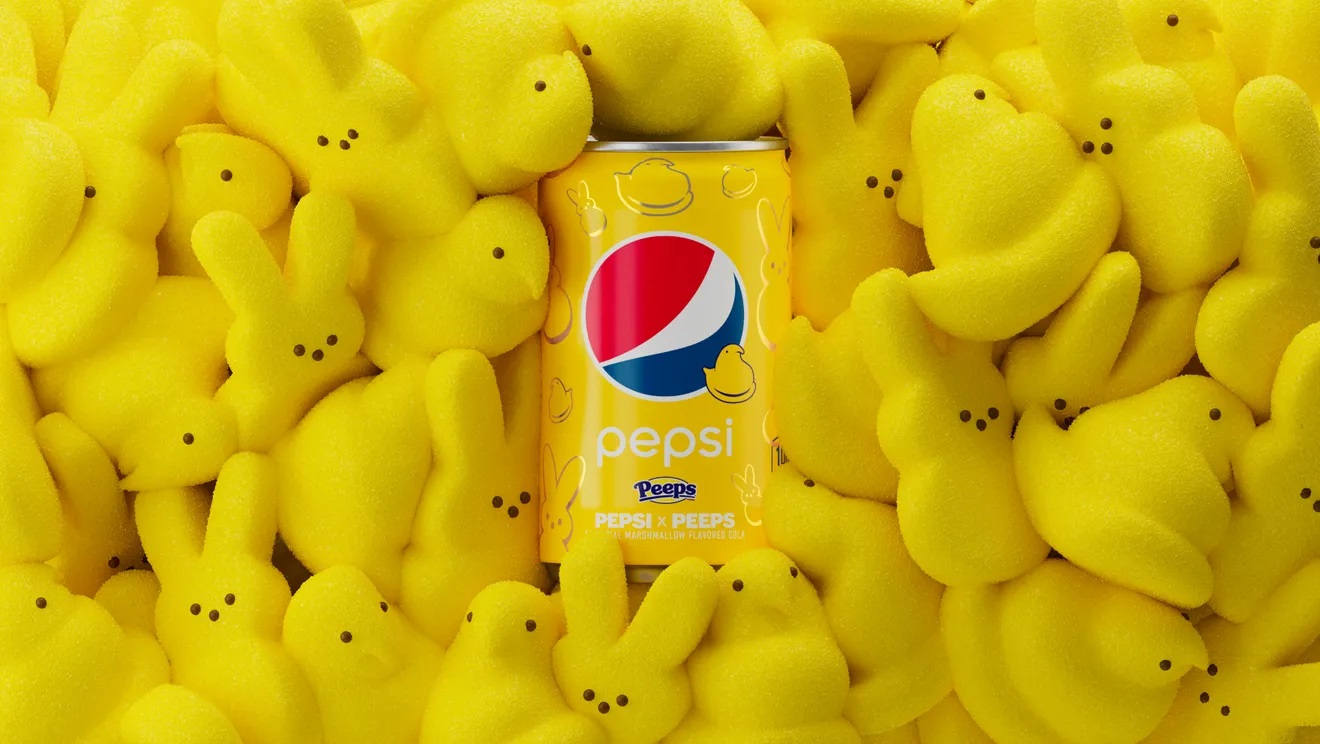
This blog often comments on sweets – so much so I should probably have a category called “sugar”.  I’ve talked about Halloween candy, chocolate, and licorice, and it’s a little unsettling I’ve discussed doughnuts in two of the last ten posts.  Naturally, my literary sugar addiction couldn’t resist a word or two on a truly disturbing concoction.  Just in time for Easter, Pepsi is advertising a Peeps-flavored soft drink.  I’m trying to get my taste-buds imagination around this “pillowy-soft and sweet” marshmallow-flavored cola.  I can’t taste it, can you?  All I come up with is sugar.  Lots and lots of sugar.

You know Peeps.  Of course, you do.  The colorful marshmallow bunnies and chicks are the hot item every Easter in the U.S. and Canada.  Consumer demand for the cute little creatures means Just Born Quality Confections cranks out 2 billion every year.  Naturally, Peeps has moved past Easter to be available year-round, especially for other holidays.  Just Born even expanded the product line beyond candy, most notably with a Peeps-flavored line of lip balms.

Courtesy of PepsiCo.

With off-the-charts (and inexplicable) demand for Peeps, I shouldn’t be surprised Pepsi injected the flavor into its latest hybrid drink.  But here’s what bothers me.  Even if marshmallow-tasting cola is your thing (and you should have your taste buds examined), why does it have to be “Pepsi x Peeps”?  It’s not as if the marshmallow taste of Peeps is unique. (It might as well be “Pepsi x Lucky Charms”.)  The appeal of Peeps is exactly what’s not in the Pepsi product: fluorescent colors, cute little creatures, and sugar-dusted spongy-soft marshmallows.

I consider “Pepsi x Peeps” a disservice to marshmallows everywhere.  Marshmallows deserve their place in more respectable foods.  Oozing out of S’mores around the campfire.  Adorning sweet potato casserole on Thanksgiving.  Buried in Rocky Road ice cream.  Abundant in Rice Krispy treats.  Floating gracefully in a sea of hot chocolate.  But reduced to a mere flavor, wandering aimlessly amidst the carbonation bubbles of a cola?  That’s just harsh.

A more deserving “frankenfood”

No matter.  Consumers love new products, especially combos of tastes that were already good by themselves.  Burger King combined Cheetos and Mac ‘n’ Cheese for a carb-loaded side dish.  Taco Bell combined Doritos and tacos into one of its all-time best-selling entrees.  And Reese’s perfected peanut butter and chocolate as a candy (as did many others as an ice cream).

Courtesy of PepsiCo.

I won’t be buying “Pepsi x Peeps” anytime soon.  But neither will you.  In the ultimate snub, this promotion is not for a product you will find on your grocery store shelves anytime soon.  Instead, you can only “win” the drink by hashtagging #HangingWithMyPeeps on your springtime photos.  3,000 of the most creative Instagram and Twitter promotions will win three-packs of the colorful cans.  I won’t be entering.  Instead, I’ll be expending my limited social media energy elsewhere.

I was raised in a Coke household so maybe it’s natural for me to knock Pepsi down a peg or two.  But they’re kind of asking for it when they’ve already test-marketed products like “Pepsi Holiday Spice” and “Pepsi Salted Caramel”.  They even amped the caffeine level in one of their varieties to promote it as a ‘breakfast drink”.  Pepsi will stop at nothing to get your business.  Including coercing you to provide free advertising on social media.  Suckers.

Stay strong, little one

I hope “Peepsi” amounts to nothing more than an out-of-reach sweepstakes giveaway.  I hope marshmallows soon return to their roles as cute, colorful, edible animals.  C’mon, Pepsi – the Easter Bunny wants you to know: Stop hopping on pop!

Some content sourced from Laura Miller’s YouTube audiobook, “Hop on Pop”,  the People.com article, “Pepsi and Peeps Have Joined Forces to Create Marshmallow Soda”, and Wikipedia, “the free encyclopedia”.

Sugarcoating the Shot

When my childhood sweet tooth took its toll so many years ago, I just about lived in the dentist’s chair getting cavities filled. Anesthetics weren’t as effective as what we have today so those drill sessions were miserable. The only upside was the shelf of free toys my dentist teased beforehand, “dangling the carrot” to get me to sit still. Now, starting Monday, Krispy Kreme is taking the same approach to entice COVID-19 vaccinations.

“Free doughnuts” – who doesn’t like the sound of that?  Even if you’re more of a Dunkin’ fan, the allure of anyone’s free doughnuts is undeniable.  As long as you show proof of a COVID-19 vaccination, you can get a free doughnut at Krispy Kreme every day for the remainder of 2021.  Heck, that’s enough incentive to permanently adjust the morning commute.  But not enough to get the vaccine.

I’m a huge fan of the Krispy Kreme “yeast doughnut”.  The original glazed version is light and airy and goes down so easy you could inhale a dozen in one sitting.  In fact, I’ve almost done just that.  My wife and I were driving to the airport with friends a few years ago, bound for Las Vegas.  We passed a Krispy Kreme store, checked our watches, and mad-dashed a U-turn so we could grab a few doughnuts for breakfast on the run.  “A few” amounted to two dozen and we had no problem finishing all of them on the rest of our drive.  That’s six doughnuts apiece and I didn’t even feel stuffed.

There’s the rub (or marketing genius) of the Krispy Kreme COVID-19 vaccination promotion.  There’s no way – I mean NO WAY you’re gonna walk into Krispy Kreme, get only a free doughnut, and walk out.  Nobody has that in their DNA.  Recall the Lay’s Potato Chip slogan: “Bet you can’t eat just one.”  The same applies to Krispy Kreme doughnuts in spades.  You don’t buy them by the “one” but rather by the dozen.

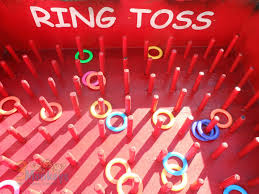
[Random thought: My mind just wandered to the midway at the county fair and those big games of ring toss.  Substitute doughnuts for the rings and syringes for the pegs.  Can you see it?  Yeah, probably not the best image for the Krispy Kreme promotion.]

If this story was about Voodoo Doughnuts or another baker whose creations are more akin to a large, filling dessert, maybe one free doughnut would be enough.  But at Krispy Kreme you’re going to get your free doughnut and promptly buy a dozen more.  It’s because you’re standing in the lobby and the slow-moving conveyor of hot, fresh doughnuts tempts you just beyond the glass.  You reach out for a touch or a taste but you can’t.  It’s how Krispy Kreme cajoles you into buying more of their product.

As for the vaccine enticement, Mary Poppins would certainly approve wouldn’t she?  Krispy Kreme should put her on their television commercials joyfully singing, “Just a spoonful of sugar helps the medicine go down…”.  Mary’d fit nicely into Krispy Kreme’s advertised “Be Sweet” initiative, designed to sell a lot of doughnuts but also, “…to inspire joy and kindness”.  Let’s hope hundreds and thousands of free doughnuts do just that.

Speaking of free doughnuts, whoever created this campaign must know what they’re doing or suffer the most awful form of job termination.  Here in Colorado, our vaccination rate hovers around 15.3% for a state population of 5.7 million people.  That means on Monday, Colorado Krispy Kreme stores could potentially see 872,000 customers demanding their free doughnuts.  And the day after that.  And the day after that.  Oh and – heh – Colorado only has TWO Krispy Kreme retail outlets in the entire state.  Traffic jams of epic proportions.

Now here’s the irony behind this Krispy Kreme headline.  For those who decide not to get the COVID-19 vaccine (and that would be me; don’t judge), we can still get a free glazed doughnut and a medium coffee at their stores on Mondays from March 29th to May 24th.  That’s nine free doughnuts and coffee for someone who didn’t even get the shot.  Does that inspire their intended “joy and kindness”?  You bet it does.

I only wish the nearest Krispy Kreme weren’t forty miles away.  Lucky for me there’s a new one under construction not fifteen minutes from my house.  They’re planning to open their doors at the end of December.  You know, just as their free doughnut promotion comes to a close.

Some content sourced from the CNN.com article, “Krispy Kreme is making vaccinations extra sweet…” and KrispyKreme.com.

Feeding Frenzy

Thanks to a whole lot of snow in Colorado I was pretty much housebound this week.  I was also reminded of the number of mouths I’m expected to feed. That total is nine… if I count the four horses, two cats, and one dog besides my wife & me. Now that I think about it, a horse eats enough for two so let’s bump the number to eleven mouths. And nine of those belong to animals.

A year or so ago I wrote a post called Sign Me Up!, where I marveled at the rapidly growing world of subscription-based services.  Among my own subscriptions I listed a magazine, a newspaper, and digital music, I also included Chewy, the online pet food supplier whose mission is “to be the most trusted and convenient online destination for pet parents (and partners), everywhere.”  At the time I was just trying Chewy out, not willing to go all-in with a subscription.  Today?  I’m fully on board and wondering why I didn’t sign up sooner.

Even the U.S. Post Office celebrates “fur babies”

Every time a Chewy pet food box shows up at my front door my first thought is, “Why didn’t I come up with this idea?”  Chewy’s concept is wonderfully simple… and wildly successful.  First, create a list of the world’s major suppliers of dog and cat food.  Second, negotiate bulk purchases of their products at a discount.  Third, set up a small network of fulfillment centers.  Finally, sell to customers with some of the discount, keeping the rest for your own operation and profit.  It’s a middleman’s recipe for millions.  Er, make that billions.

If you think this post is a plug for Chewy you’re darned tootin’ it is.  Chewy offers over 2,000 brands of pet food to 15 million subscribed customers.  97% say they’re satisfied.  Chewy’s net sales in 2019 were $4.8 billion dollars.  Nosh on that impressive number for a second.  $4.8 billion sounds like the GDP of a small country.  A small country with a lot of pets.

Foresight is everything here.  Ten years ago I wouldn’t have believed there were 200 brands of pet food, let alone 2,000.  If I go back to my childhood (way more than ten years ago) I can name exactly four pet food brands or products of the day: Purina, Friskies, Alpo, and a curious General Mills creation called Gaines Burgers (“The canned dog food… without the can!”)  Well, I also remember a variety box of dog biscuits called “Fives”, but that’s because I snacked on them every now and then when there wasn’t anything else in the pantry.  Fives were fit for human consumption.  At least, I think they were.

The pet food demand of the 1970s wouldn’t have sustained a subscription service like Chewy.  On the other hand, today’s market is a feeding frenzy, especially with more people opting for “fur babies” over children.  And don’t think Chewy hasn’t noticed all the doggy daycare and emotional support.  Now they also deliver food for your fish, your bird, your snake, and all those farm animals grazing on your backyard lawn (alpacas, anyone?)  Chewy even offers a pharmacy of over-the-counter meds when your pet is in some way under the weather.

Hello, “Chewy”!

I was going to wrap up this plug by smugly suggesting Chewy cater to our horses, but of course they already do.  I can’t subscribe to hay bales yet (I’m sure they’re working on that) but I can buy grain, treats, blankets, tack, and fly spray.  So instead, let me speculate it probably won’t be long before Chewy gets into the “human” food delivery business as well, to compete with Amazon, Wal*Mart, and Target.  With Chewy’s millions of subscribed customers, the new offering would take off like a bull in a china shop.  Or better, like a big, furry bad boy in a Star Wars movie.

Her Majesty’s Persistent Presence

America is a vast melting pot, her contents stirred for generations in a dogged effort to blend peoples and cultures into a cohesive whole. It’s the classic chemistry experiment, where the glass beaker is filled with all manner of substances and then shaken, only to watch the inevitable separation back to individual weights and colors.  The shake-up brings moments of drama though; the storm before the calm if you will.  It’s also an apt description of the British Monarchy.

Despite my best efforts to filter my newsfeed, I still got the announcement about Oprah Winfrey’s televised interview with Prince Harry and Meghan Markle last week.  I don’t know much about either former royal (or Oprah, for that matter) so I dismissed the headline and moved on.  But I was alerted to the interview again the following day.  And again the next day.  Finally, in a move that can only be described as can’t-help-myself, I got out of my chair, grabbed the remote, and programmed the DVR to record.  Something deep-rooted was telling me Sunday night’s interview was must-watch TV.

No it wasn’t.  The questions and answers were predictable.  The topics just begged for a response from Buckingham Palace (mission accomplished).  After two hours of back-and-forth (and too much time in a chicken coop) my take on this couple hadn’t changed.  Meghan shouldn’t have dabbled in the royals in the first place.  Meghan eventually orchestrated her way out of the palace (and the country).  Harry followed.  Now they’re barely surviving… in an 18,000 square foot house in Montecito, California worth $14 million.  Oprah is their neighbor.

Waste of two hours?  There’s no denying it.  Still, I chose to watch.

Americans don’t have royals, but we have a lot of movies about royals.

Why do I care about Harry and Meghan?  I don’t, yet somehow I do.  Maybe I should blame The Crown, the excellent Netflix series about the British monarchy.  By total coincidence, my wife and I started watching Season Four this week, which is all about Harry’s mother Diana.  Then my newsfeed tells me the Duke of Edinburgh (Prince Philip) suffered a heart condition last week, rough enough to land him in the hospital.  Add to that regular photos of Queen Elizabeth looking ever-regal at the ripe old age of 94 and the royals are all over the place.  They make themselves kind of hard to ignore.

The Queen (will live forever)

The episodes of The Crown are a revelation, especially for those of us in “New England”.  Each show kind of ungilds the lily of America’s perception of British royalty.  There’s more drama, politics, and in-fighting than we Yanks would’ve ever believed of fair princes and princesses.  Yet through it all stands the queen – at the epicenter of the shaken beaker – somehow maintaining poise and presence.  All of the events in The Crown take place within Elizabeth’s lifetime, yet it feels like we’re going several generations back. 

Despite The Crown and my newfound respect for Elizabeth, there’s no question it was the late Diana, Princess of Wales who first piqued my interest in the British royals.  Who could blame me, right?  Lady Di was beautiful and supremely innocent, a veritable Disney princess in the flesh.  She was born just a few months before I was.  Her wedding to Prince Charles in 1981 – the grandest of ceremonies watched by hundreds of millions of people across the world – was the stuff of fairy tales (Charles himself, not so much).  Diana embodied all that was good and somehow magical about life as a royal.

Lady Di belongs in this club

But then we have Diana’s shocking death not sixteen years after her marriage.  Talk about shaking the beaker.  My wife and I were at a party in California at the time and returned to our hotel late, staying up hours past midnight to watch the funeral on television.  Like the Oprah interview this week, I can’t explain why I gave up half a night’s sleep to watch.  I just felt compelled to.

Thanks to The Crown, the royals aren’t looking quite as regal as they used to.  Diana effectively sacrificed her life to be a royal.  The agendas of Elizabeth and her several prime ministers were in constant conflict.  Season Four has a poignant episode where Elizabeth arranges an individual lunch with each of her four children.  She needs a valet to prepare a brief of information on each child so she can have meaningful discussions with them.  Elizabeth may be “Queen Mother” but the title rates a distant second to “Queen”.

(photo courtesy of Fox News)

Harry and Meghan seem determined to move on from the monarchy.  They’ll never achieve “normal”, and whether their marriage is the real deal is TBD, but good on them for making a show of it.  Me, I’m moving on too.  The next season of The Crown isn’t until next year so it looks like I finally get a break from the royals.  Er, unless William and Kate are up to anything interesting.  Are they up to anything interesting?  Hm.  I’d better go check.

Some content sourced from Wikipedia, “the free encyclopedia”.

O-Love

I like a lot of foods people seem to hate. My favorite Thanksgiving pie is mincemeat, not pumpkin. My favorite licorice color is black (red is just a licorice imposter). You can heap any kind of shellfish you want on my plate except oysters. You’ll find blue cheese in my salad and Brussel sprouts cozying up to my steak. But what about “America’s Most Hated Food”? Was I born in the wrong country? Sorry fellow citizens, I must respectfully disagree with the winner of a recent survey on hated foods.  Black or green, stuffed or plain, sliced or diced, there’s nothing quite like the taste of an olive.

Zippia is a job-search engine I’d never heard of, until I came across their just-released survey called The Food Each State Hates the Most.  Zippia’s road to its results is rather unscientific.  First, come up with a list of forty-odd foods where people tend to say, “gross”.  Then, use Google Search Trends to determine which of these foods people look up the least.  Finally, group the search results by state.  After that meandering highway, here’s what you get:

    (Click image to enlarge)

I think Zippia produces these surveys as a clever way to attract customers.  Didn’t work for me – they just insulted my taste buds!  Thirteen of fifty states claim the olive as their most hated food?  Two of those states are California and Georgia, where the lion’s share of America’s olives is grown.  I’m already suspicious.

Not a pile of tires

I’ll grant Zippia’s survey this.  Most people I know don’t care for olives.  They don’t like the look or the smell, and even though they’ll admit to olive oil in their salads and heart-healthy recipes, they’ll still deny any affection for the fruit.  Yes, I said fruit, not vegetable.  Doesn’t that make those little sodium balls a bit more palatable?

The rest of the survey, I can buy.  Anchovies shouldn’t swim anywhere near a pizza (good call, America’s Heartland).  Washington and Oregon residents probably sat next to me in elementary school, overdosing on bologna sandwiches.  Eggplant, ick.  And beets… beets… I’m almost sixty years into this world and have yet to acquire the taste.  Check back with me in the next life.

If the Zippia survey is to be believed, I live in a state where turkey bacon is our most hated food.  Really?  We just bought several pounds of the stuff last weekend at Costco.  It’s not so bad.  On the other hand, olive oil and vinegar stores are trendy around here.  Most markets have an olive bar adjacent to the cheeses.  Meats and breads have been enhanced with bits of olives for years.  And for the really fancy, serve a tapenade with your crackers; a French spread made of finely chopped olives, capers, and anchovies.  Okay, so tapenade’s probably not for everyone.  But I like it.

I developed a taste for olives as a kid because my mother kept tossing them into her casseroles.  Before I knew it I was eating olives as a snack (and what kid hasn’t done the “wave” with one on each finger?)  One regrettable afternoon I downed a whole can of the large black ones before discovering my mother intended them for one of her recipes.  Believe I went to bed with no dinner that night.  At least my belly was full of olives.

[Side note: The only member of my family who likes olives is my daughter.  Maybe I should’ve named her Olivia? I did have a childhood crush on Olivia Newton-John.]

Not “monster eyeballs”

As if you need more proof of my love of olives, you’ll always find several cans in my pantry.  The sliced ones go into my pizzas, salads, and tacos.  The diced ones go into my omelets.  The whole ones sneak onto vegetable trays next to the carrots and celery (when my wife isn’t looking) or I just down ’em by the can.  And their green siblings with the red pimentos jammed down the middle?  They go perfectly with chips ‘n’ dip in front of the TV.

Step aside, America.  Spain produces more olives than any other country.  Italy and Greece aren’t far behind.  It would be appealing enough to live on the sands of the Mediterranean, growing old on their uber-healthy diet.  But also having trees of “America’s Most Hated Food” everywhere you look?  That clinches the deal.  I just might take my O-Love overseas one of these days.

Some content sourced from the Zippia.com article, “The Food Each State Hates The Most”, and Wikipedia, “the free encyclopedia”.

Fine Print

I’ll never forget the first time I saw the movie, Jurassic Park. I’d read the Michael Crichton novel so I already knew the story, but I still couldn’t wrap my mind around that first dino scene, where a brachiosaurus casually munches on the uppermost leaves of a forty-foot tree.  The gigantic creature was so lifelike I thought, “Where’d Steven Spielberg get a dinosaur?” In my defense, computer-generated imagery (CGI) was brand-spankin’ new back then.  A ferocious T-Rex looking and moving like the real thing was still jaw-dropping in the 1990s. And I’m having the same reaction to the stuff rolling off 3D printers right now.

A “printed” toy tugboat

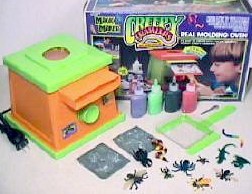
If you’re like me you haven’t paid much attention to 3D printing.  You see some of the items a 3D printer can generate and they seem like child’s play.  In fact, 3D printing reminds me of a 1970s toy called “Creepy Crawlers”.  You had these tubes of colored goop you squeezed into metal molds, and then the molds went into an electric oven.  The goop would grow from flat to 3D with heat, and suddenly the oven was spilling out all kinds of bugs and spiders you could drop on your friends.  (There was also consumable goop called “Incredible Edibles”; products to compete with whatever the girls were making in their Easy-Bake ovens).

But I digress.  Here’s my 3D printing naivete in a nutshell: I still think my 2D printer is the more impressive technology, cranking out high-resolution photos and perfectly addressed envelopes.  I mean, whatever would I need a third dimension for?

Yep, I am seriously naive about 3D printing.  The scope of this topic is mind-boggling if you really take the time to understand its potential. Here’s a good example.  Picture a printer as big as your living room.  Picture a printer cartridge of concrete instead of ink.  Now watch the printer build your living room, one horizontal layer at a time.  The printer can also build the rest of your house.  Just add plumbing and electric when it’s done.

“Printed” storage crates

Without getting too far into the weeds, let’s define 3D printing for what it really is: additive manufacturing (AM).  Here’s an easy way to picture the AM process.  When you build a log cabin you lay out the entire foundation of logs for the house – with breaks for the doors – before you add the next layer of logs.  You work your way up a layer of logs at a time, keeping those breaks for the doors, adding breaks for windows, pipes, and such, completing the structure with a sloping roof on top.  Perhaps you add a fireplace in the process; again, layering bricks on top of bricks until you’ve reached the top of the chimney.

That’s pretty much how a 3D printer works.  It “pictures” an object in horizontal layers and “prints” it from the ground up.  3D printing has been around longer than you think.  3D printers were developed as early as the 1970s (preceding your inkjet 2D printer!).  The early versions just had to be manually programmed.  Once we attached a computer and software, 3D printing really came into its own.

Watch the following video of a 3D printer confidently layering a basket weave – it’s mesmerizing:

https://upload.wikimedia.org/wikipedia/commons/transcoded/5/5d/Hyperboloid_Print.ogv/Hyperboloid_Print.ogv.360p.vp9.webm

The products speak for themselves, of course.  A shortlist of the more cutting-edge printed creations gives you an idea of where our world is heading:

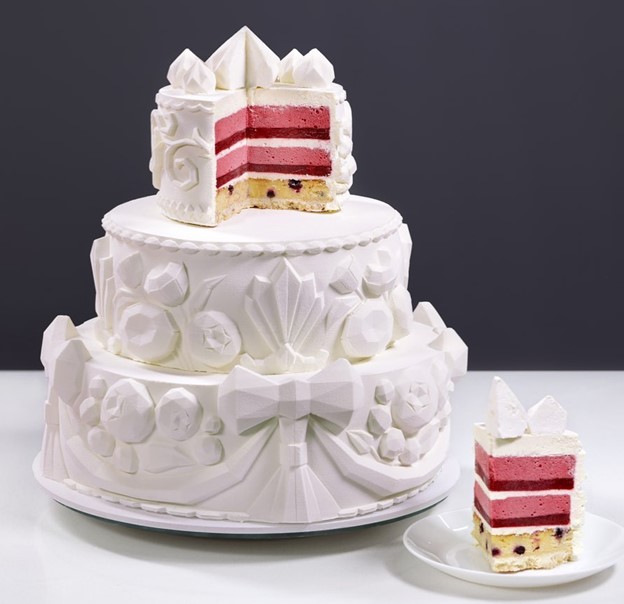
  • Cakes and pastries – The “ink” is baked goods in one nozzle and frosting in another.  Design it on your computer screen and then “print”.  It’s like the Easy-Bake Oven on steroids.  Only you don’t need the oven.
    3D-printed confectionery from Ukrainian chef/architect Dinara Kasko
  • Bones – No, not some plastic or other polymer designed to replicate bones, actual bones.  It’s called bioprinting – the fabrication of natural tissue using cells and other building blocks, and it’s coming soon to a clinic near you.  Don’t worry how long a broken bone will take to heal; just replace it!
  • Buildings – Forget about building that log cabin one layer at a time.  Your 3D printer will do the whole job for you (and it’ll still look like a log cabin).  Your printer can also build sturdier houses out of concrete.  This one’s on the market in Riverhead, New York, for $300K.
  • Vehicles – 3D printers have already created boats, kayaks, and most of the makeup of cars and trucks.  Long ago I was impressed with the robotics of the Ford Motor Company, employed on a long assembly line to build cars one part at a time.  A 3D printer can essentially do the same job standing still, no assembly line required.
  • You – I could speculate on the potential for a full bioprint but let’s avoid that scary future for now and just say, a 3D printer can create a figurine to look exactly like you.  Think of it as printing a 3-D photograph.

If your mind is not blown by what you’ve just read, consider this: 3D is already passe.  That’s right, we’ve already moved on to 4D printing.  4D – at least with printing – refers to materials that can change shape with time, temperature, or some other type of stimulation.  A good example would be a printed window shade, sitting tight and virtually unnoticed at the top of the window in daylight but expanding to full cover as darkness falls.

Don’t know about you but this level of technology makes my head hurt.  When I’m done with this post I’m gonna push “print” and generate a nice 2D copy for my files.  Oh, and maybe watch Jurassic Park again.

Some content sourced from the 7/24/2020 Forbes article, “What Can 3D Printing Be Used For?”, and Wikipedia, “the free encyclopedia”.

Dots ‘n’ Dashes

Back in my days in the Boy Scouts, they had a merit badge called “Signaling”. To earn the badge you had to build a basic communication device (buzzer, blinker) and demonstrate a knowledge of Semaphore – visual signaling by flags – and Morse – audible signaling by “dots” and “dashes”. Today most people wouldn’t have a clue about Semaphore, and their only familiarity with Morse might be from the frantic telegraph typing in the movie Titanic.  Dots ‘n’ dashes have stepped down, more associated with the mundane pavement markings of the streets we drive.  Well hey, at least they’re still signaling devices.

“Dashing through the… street…”

Let’s talk about street dashes first.  The highway to our rural neighborhood was recently restriped, mostly dashes but occasionally a solid for safety’s sake.  Some lanes were shifted, and they just covered up the old stripes with blackish paint similar to the asphalt below.  But my car was not fooled, no sir.  It still sees the old striping.  Anytime I pass over those areas my car’s “lane-keeping assist” emits an audible warning and tries to bump me back onto the road, when in fact I’m just passing over covered-up stripes.  That’s annoying.  Either car tech needs to improve or road striping needs to come up with a better cover.  Until one or the other happens I’m all over the road.

Here’s an even better story about dashes.  Long ago, my parents were driving my brothers and me back from my grandparents’ house.  We were cruising along a paved winding road late at night when all of a sudden my dad gets to wondering about those highway dashes.  He starts to guess – if you measured one, how long would a dash be?  Talk about useless information, right?  But then, right in the middle of a darkened highway, no cars in the rear-view mirror, my father stops the car, gets out, and starts measuring a dash, foot-in-front-of-foot like he’s taking a sobriety test.  Then he gets back into the car and announces proudly, “six feet”.  Think about that the next time you pass those stripes at forty miles an hour.  (But please, don’t get out and actually measure one).

California highways are usually dotted, not dashed.

Now let’s talk about street dots.  You know, those round, non-reflective raised pavement markers used to designate lanes and borders and such?  They’re actually called Botts’ dots.  It’s a name I’ve known since childhood because I grew up in California where they were invented.  California has over 25 million of the little guys marking its endless streets.  And if you must know, Botts’ dots were named for their inventor, Elbert Dysart Botts (and how’s that for a mouthful?)

Kinda cute, right?

Botts’ dots might’ve never been a thing were it not for their total makeover.  At first they were glass discs attached to the road with nails. (How’d you like to have that job?  Whack, whack, whack!).  But then they started popping loose, and people got flat tires from the nails and the broken glass.  So Botts (or a coworker) devised a hard plastic to replace the glass and an asphalt-friendly epoxy to replace the nails.  Now the dots – and the speeding cars above them – stay where they’re supposed to.

But now Botts’ dots have a whole new challenge.  We face a future with self-driving cars.  Turns out, Botts’ dots mess with that technology.  The car may or may not recognize a dot as the border of a lane.  That’s not good when you put your steering wheel in the hands of a robo-chauffeur.  But can you imagine the task of removing 25 million Botts’ dots?  That’s worse than hammering them in one by one!

Botts’ dots may go the way of the telegraph.

Over here in rural Colorado, I got pretty excited about the prospect of California surrendering all of its Botts’ dots.  We can use ’em.  You see, out here we have mostly two-lane highways divided by dashes, or occasionally solid lines instead of the dashes (don’t pass!), or very occasionally the luxury of a defined left-turn lane.  But “dash-it-all” when it snows.  You not only lose the striping, you lose the road.  At least a Bott’s dot would make noise and give you a jolt to let you know you’re not about to cruise into somebody’s cow pasture.

Alas, my dream of millions of Botts’ dots flying over the Rocky Mountains died before it was born.  Turns out the asphalt epoxy of a Botts’ dot cannot compete with the combined weight and speed of a snowplow.  The dots’d go flying every which way from the snowplow blade, like hundreds of tiny shuffleboard discs.  Ping! Ping! Ping!

Signaling merit badge was retired by the Boy Scouts in 1992 (yet another reminder of my advancing age).  Looks like the Botts’ dot is headed for a similar scrap heap, at least if self-driving cars become more mainstream.  Meanwhile, you’ll find me out in my neighborhood navigating the painted dashes.  Even if I do prefer the dots.

Some content sourced from Wikipedia, “the free encyclopedia”.

Chocolate Cremè de la Cremè

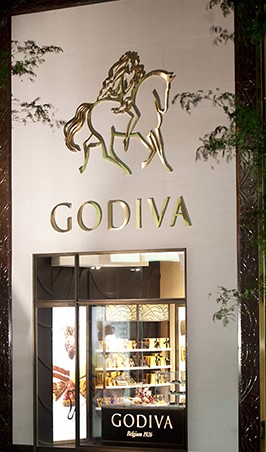
Godiva, the incomparable Belgian chocolate maker, is closing every one of its retail shops in North America.  Maybe you’re blaming the pandemic but Godiva claims foot traffic at shopping malls – where most of its boutiques are located – “plummeted” over the last few years.  I’m sorry to see Godiva go.  Mind you, it’s not that I make a habit of buying $3 truffles.  It’s more the idea that I could if I wanted to.

Godiva is the cremè de la cremè of chocolate.  Their products are born of a family business dating back to 1926.  Their Truffe Originale, “an intense dark chocolate mousse in fine dark chocolate, rolled in pure cocoa powder”, is the standard by which most Belgian truffles are measured.  Godiva’s three chefs are profiled on its website (I discuss one of them in my post Confection Perfection), and endeavor to maintain the very high standards of Godiva while churning out new and different creations.  It’s no wonder Godiva isn’t considered a “candy store” or a “chocolate shop” but rather a chocolatier.  Only the very best get a label like that.

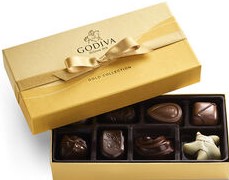
Godiva’s handcrafted “gold box” assortment

To me, Godiva chocolate is a taste of heaven on earth.  But it’s also a taste of a lifestyle – one most of us will never afford.  Godiva has me picturing mansions (not houses), yachts (not boats), private planes (not the middle seat in coach).  Godiva is a brief, delicious dip into the behind-the-gates world of the uber-wealthy.

I’ve stepped into a Godiva chocolatier exactly twice in my life.  The first was in college, after a visit to the Rizzoli bookstore at exclusive Water Tower Place in downtown Chicago.  After spending too much money at Rizzoli I was in the perfect mindset for Godiva (which was right next door).  I still remember selecting a single truffle from the glass display case.  The petit woman behind the counter wrapped up my tiny purchase in box, bow, and bag, as if I’d just purchased a fine piece of jewelry. She bid me a fond farewell.  I walked out of there feeling, well, special.

Would you pay $20 for six truffles?

My only other visit to Godiva was more recently with my wife and daughter, on a Saturday at one of Denver’s nicer shopping malls.  We’d just come out of Starbucks, coffees in hand, and there beckoned Godiva.  After much deliberation, we spent the better part of $10 and walked away with three truffles.  I’m sure they were elegantly wrapped.  I’m also sure they were delicious.  But with Godiva, it’s more about the taste of something beyond your means.  That taste may be more satisfying than Godiva chocolate itself.

Tiffany & Co, NYC

Tiffany is a comparable experience (as I wrote about in my post All That Glitters).  Walk past the front-door security guard into their multi-level department store in downtown Manhattan.  Your first thought will be either, “I don’t belong here”, or, “I’m underdressed”.  Ooh and ahh at their lavish necklaces, bracelets and rings, but don’t expect to see price tags.  Like Godiva, Tiffany’s best is behind glass and you have to ask a staff member about the cost.  My wife and I made it to Tiffany’s fifth floor before we found something we could afford – a pair of ceramic coffee mugs.  At least we also walked away with their signature blue gift boxes.

Think twice before entering!

Then there’s Prada, the Italian fashion house famous for its luxurious leather handbags and shoes.  My twelve-year-old daughter dragged me into their Madison Avenue boutique once (past the requisite security guard) but I realized our mistake as soon as we entered.  Prada displays maybe a dozen items in a single museum-like showroom, each carefully positioned on an individually lit shelf.  You are invited to sit on the central couch and offered a choice of beverage.  Then a person brings you items of your choosing (but don’t touch!).  Once I realized Prada purses start at $1,000, I asked my very disappointed daughter if maybe she’d like to go for ice cream instead.

Godiva’s tiny “biscuits”… $0.75 ea.

Godiva’s North America retail shops will be gone by March, but you’ll still have other options to purchase.  You can find small displays of their products at the cash registers of upscale department stores.  You can order most of their delicacies online (including “Gold Box” assortments, which cost more than you can afford).  You’ll even find Godiva’s “Signature Mini Bars” at lowly retailers like Target and Walgreen’s.  But let’s face it, Godiva is as much about the experience as it is the chocolate, and I’m just not gonna feel uber-rich when I’m at Target.

Some content sourced from the 1/24/2021 CNN.com article, “Godiva is closing or selling all of its stores in the United States”, and Wikipedia, “the free encyclopedia”.

Is It Live or Is It Memorex?

It’s the wood chipper for you, buddy.

New Year’s Day has come and gone (and a warm welcome to you, 2021), which means it’s time my wife and I take down the Christmas tree. For some, taking down the tree means disconnecting the branches from the trunk, the trunk from the base, and packing the whole thing into a cardboard box to be used again next year. For us, taking down the tree means lifting it off the stand, hauling it outside to the truck, driving it over to the drop-off lot, and donating $5 to fund the recycling. Yes, this year – as with all of my years – the Christmas tree is real, not artificial.

I’m not here today to debate real vs. artificial Christmas trees.  They both have pros and cons and your choice rests on where you live, your budget, and assorted other reasons.  For me, a real tree is simply a tradition I refuse to give up.  Picking out a tree with my family was a big deal when I was young.  There was something magical about living in sunny Los Angeles and watching dozens of pine-scented snow-dusted trees being unloaded from Canadian railcars.  Never mind we paid a little extra to have our tree “flocked” (adding a touch of spray-painted artificial snow).  It was still a real tree.

Memorex: Sound that “blows you away”.

Real vs. artificial goes way beyond Christmas trees.  When I consider one next to the other, I always think of Memorex.  In the 1970s and ’80s the Memorex Corporation produced audio cassettes, the precursor to the compact disc.  In their TV commercials Memorex included singer Ella Fitzgerald belting out a note powerful enough to shatter a wine glass.  Then they’d play a recording of Ella’s performance and the wine glass would still shatter, begging the question, “Is it live, or is it Memorex?”

Real vs. artificial also recalls Milli Vanilli, the R&B duo from the late ’80’s.  Milli Vanilli made it big with the album “Girl You Know It’s True”, then won the Grammy Award for Best New Artist.  But years later the world would find out Milli Vanilli never sang anything.  Instead they lip-synced their way to fame; their albums the voices of studio performers.  Milli Vanilli returned the Best New Artist Grammy shortly after that.

Let’s visit real vs. artificial a little closer to home; say, the kitchen.  As much as my wife and I seek whole, organic, locally produced foods, we can’t help including a few outliers.  I just went through our pantry and came up with a few good examples:

  1. Aunt Jemima syrup.  This pancake topper – destined for rebranding in the name of racial equality – is nothing but high fructose corn syrup, water, and a whole lot of chemicals.  The “Natural Butter Flavor” variety blatantly advertises “contains no butter”.  You’ll find all the pure maple syrup you want in Vermont but you won’t find a drop in a bottle of Aunt Jemima.
  2. Kellogg’s Pop-Tarts.  A long time ago Pop-Tarts contained real ingredients (else my mother wouldn’t have put ’em on the pantry shelf as kid snacks).  Today’s Pop-Tarts are enriched flour and a bunch of scary-sounding ingredients developed in a lab.  It takes half the height of the box to list everything that goes into a Pop-Tart.
  3. Kraft Mac & Cheese.  Make a bowl of pasta, top it with melted cheddar, and Voila! you have macaroni & cheese in two ingredients.  Kraft Mac & Cheese needs twenty-one to accomplish the same dish.  But man, don’t it taste great?
  4. Ritz Crackers.  More enriched flour plus lab ingredients.  (Maybe every food can be made from enriched flour?)  The Ritz Crackers box includes a warning, “Contains wheat, soy”.  Ha, if only that was all it contained.
  5. “Real” Bacon Bits.  My mother-in-law left this bottle of horror behind when she brought a salad for Christmas dinner.  But guess what?  It really is made of bacon (okay, and chemicals).  I must’ve been thinking of other brands, where the bits are actually “flavored textured soy flour”.  Oh ick.

Back to our real Christmas tree.  After the gifts were passed around and opened, we discovered one more, looking a little embarrassed behind the branches.  It was a brightly colored basket, the kind all dressed up with a cute wooden box and Christmas bow, overflowing with food items and protected in plastic wrap.

But here’s the rub.  We opened the basket and found a whole lot of nothing.  Generic cookies, coffee, candy, and a couple of cheap Christmas mugs, arranged carefully so as to suggest the basket contained much more.  To add insult to injury, none of the food items were name-brand (except for a handful of Lindor truffles).  The cookies and candy were made with a ton of artificial ingredients.  The coffee was so generically packaged it had me wondering if it was even coffee.  The whole basket made me think “Memorex”.

This is where I jump to a discussion about artificial intelligence, but your real brain needs a rest so that’s a topic for another day.  Meanwhile, my wife and I will keep heading out every Christmas to tree lots (or the woods) to find the perfect one.  “Artificial” may sneak into other parts of our lives now and again but at Christmas, we’ll always be keeping it real.

Some content sourced from Wikipedia, “the free encyclopedia”.