Supply Chain Reaction

My neighbor to the north – the one with a mansion lording over the rest of the hood from the highest point around – hosts equestrian events on weekends. Whether reining or cutting competitions, or “quaint” social gatherings, his barn and surrounds burst with dozens of horses and riders just about every Saturday. His property is large enough we’re pretty far removed from the hubbub, except the convoy of horse trailers and trucks barreling down the street beforehand. The wheels rumbling over the washboardy dirt road and balloons of dust floating high overhead are hard to ignore.

Maybe you don’t have a parade of horse trailers in your neighborhood (or a washboardy road), but guess what?  You do have a procession of vehicles making their way to your driveway, and the list of participants is growing.  Home delivery is the latest block party where everybody seems to have an invite.

In the 1970’s the only vehicles coming up our driveway were the red, white, and blue jeeps of the United States Post Office (USPS) or the brown, boxy trucks of the United Parcel Service (UPS).  Then Federal Express vans (FedEx) joined in with a little purple and green, while DHL (the initials of the three founders’ last names) added a healthy dollop of yellow.  Taste the rainbow!

 That’s a pretty good line-up right there, but in the last decade or so home delivery (or “last mile delivery”, to use the trendier term) picked up several more players.  Amazon (black vans with a blue “swoosh” on the side) and WalMart (several colors) extended their supply chain by adding home delivery trucks.  Your pizza guy has been joined by restaurant delivery of all kinds, like DoorDash, Grubhub, and UberEats.  AmazonFresh is competing with your local grocery store to make sure you consider home delivery of products from Whole Foods.

Here are a few of the more “colorful” entries coming soon to a driveway near you:

  • Postmates – Pizza, prescriptions, shoes, and tech products, just to name a few Postmates delivery favorites.  What makes Postmates unique?  They’re not affiliated with any business or product line.  If you need it, they’ll find it.
  • LuggageForward – Boasts “doorstep pickup”, so all you worry about is transporting you from your home to your travel destination.  LuggageForward guarantees your bags arrive before you do, and their “shipping experts” track your items every step of the way.
  • Piggybee – Just like LuggageForward, except you’re entrusting your luggage or other item to a random person who happens to be traveling to your destination anyway.  Sounds a little dicey, but isn’t the name great?
  • Entrusters – The opposite of Piggybee, but the same concept.  You find something you want to buy in a distant locale, and the random person who happens to be traveling to your city brings it to you.
  • goPuff – A “convenience store caterer”, tempting you with products like that pint of Ben & Jerry’s you don’t really need.  Perfect for college students?  Yes, and the company was started by college students.  “goPuff”?  No clue.
  • Drizly – Not only wine, beer, and liquor to your door inside of an hour, but also all the mixers, garnishes, and supplies you need to make your party tipsy.  Hopefully you’re not the only one at the party.  Hopefully your Drizly driver doesn’t partake in whatever he or she delivers.
  • Stitch Fix – A competitor to Nordstrom’s Trunk Club, Stitch Fix offers a stylist and all the designer clothes you could ever want.  Try them on and keep ’em or return ’em within three days.  Might as well close the doors on your local shopping mall.
  • Washio – Just what you would guess: home-delivery wash, dry, and dry-cleaning of your wardrobe.  Your hamper just moved to the front door!  Washio’s “ninjas” pick up and drop off inside of 24 hours, and even leave a cookie on top of the clean-clothes bag.  Sadly, Washio lasted less than three years; it’s founders claiming, “sometimes you make it, sometimes you don’t”.

As we speak, many of these deliverers are hopping the fence into each other’s domains.  Postmates is test-marketing convenience store items in New York City, sourcing from 150+ Walgreens and Duane Reades.  Doordash is trying out same-day grocery delivery in 22 states.  AmazonFresh distinguishes itself as food delivery with its lime-green (not black) vans.

With so many entrants in the home delivery circus, it’s fair to say the concept is still in its infancy.  We’ll need several years to see who and what will ultimately come out in the wash (clearly, not Washio).  But mark my words, you can always count on someone to rain on the parade.  Amazon is already experimenting with “Prime Air”, a drone-service.  In other words, home delivery may be a little less grounded in the future.

Some content sourced from the 10/2/19 Wall Street Journal article, “Postmates, DoorDash Want to Deliver Your Groceries, Too”.

Coffee Breakers

Every now and then I take this blogging habit out onto the road, so to speak.  Instead of typing paragraphs from the home office, I’ll liberate my laptop from its cables, hop in the car, and head over to the local coffee house.  Working in a caffeinated environment – especially one buzzing with grouplets of chatty patrons – brings out the creative juices in me (if not the ability to concentrate).  Lately however, I’ve decided my little laptop show pales in comparison to some of the real road warriors out there.  Apparently, I need to show up with more toys in hand.  It’s time to go “Venti” instead of “Tall” and become one of the true coffee-breakers.

Perhaps you’re familiar with the patron I’m talking about here.  Coffee-breakers recreate their home office (or “office office”) on a table in the middle of Starbucks.  They consume more than their fair share of coffee house real estate (but not their fair share of coffee relative to their extended stay).  They arrange face-to-face meetings with colleagues, and interviews with prospective employees.  They hold Bluetooth conversations as they stare at nothing in particular.  Or FaceTime conversations as they have one-on-one’s with their phones.

I’ve come across several breakers in my coffee house stays.  They demonstrate distinct behaviors to separate themselves from those of us who simply want laptop time with our lattes.  First, breakers set up their workspaces, with enough time and attention to detail to announce, “Notice me!”  Then they go to the counter to place their coffee orders, deliberately leaving their setups unattended (as if to say, “This space is reserved!”).  Finally, they begin their “work”, which doesn’t really seem like work.  I can’t help thinking coffee-breakers are more often show than substance.

A few weeks ago at the local Starbucks, I left my laptop and Flat White to take a quick phone call outside the store doors (the polite thing to do).  When I returned, I found I’d been joined by a coffee-breaker.  She was carefully positioning two Bluetooth speakers on the table in front of her; then fiddling with her phone and a few other components from her oversized backpack.  As soon as her speakers gushed music (clashing with the Starbucks music playing overhead), she put in her AirPods and simultaneously took a phone call.  She operated as if she was in her own little world (i.e. I didn’t exist).  Therein lies another distinct coffee-breaker behavior: virtual walls.

On another visit, I was party to a conversation between a commercial real estate broker and a prospective tenant.  He sat his client (deliberately) adjacent to the counter queue, which (conveniently) put him in the center of the store.  The broker was hawking lease space in the adjacent soon-to-be-opened retail center.  No wonder he raised his voice as he spoke.  This coffee-breaker’s sales pitch was as much for me and my fellow patrons as for the captive soul sitting right in front of him.

The Wall Street Journal (WSJ) recently published a dozen rules for coffee-breakers; rules that should be laminated to every Starbucks building in the land.  Examples: Work only where and when you’re wanted (i.e. ask first).  Buy first, sit second.  Buy more than one small black coffee during the day.  Don’t take work calls – ever.  And so on.  Perhaps more enlightening was the reader comments in response to the rules.  I perused four pages’ worth (30+ comments) and not one came to the defense of coffee-breakers.  In fact, several comments added more rules to the list.

To my earlier comment about going “Venti”, I talk – of course – tongue-in-cheek.  A little attention is a good thing, but my hope is most of us would not deliberately choose to be a coffee-breaker (else this is the end of Western civilization as we know it).  Nope, I think I’ll take my road show to the library instead.

Some content sourced from the 8/27/19 Wall Street Journal article, “How to Act Like a Human When Working From a Coffee Shop”.

Vowing To Be Different

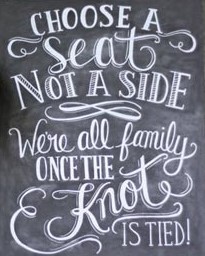
When my son and his wife were married five years ago, there was a moment in the planning stages where I realized their wedding day would be anything but “traditional”. Credit their beautiful outdoor venue (no church), the “mixed-up” wedding party (ladies aside the groom; men aside the bride), their Keds canvas sneakers (no formal shoes beneath the tuxes and dresses) or the trays of truffles after dinner (no wedding cake) – they found dozens of details to make their day unique and memorable. But given the most recent wedding trends, perhaps my son and his wife were more old-school than I thought.

Hindsight being what it is, my own wedding to my wife thirty-two years ago now seems downright formulaic.  We were married in a church, accompanied by an organist and harpist.  We exchanged rings and vows before a priest.  We lit a “unity candle” at the altar.  Our reception was in a hotel ballroom, with an open bar and live band.  Dinner was served, wedding cake was cut, and the only time the dancing stopped was to toss the bouquet and garter.  Our one and only off-script detail? We included a contemporary John Denver song in the ceremony (much to our priest’s dismay).  Otherwise ours was a carbon copy of just about every other wedding of the 1980’s.

I’m sure you have examples of just what makes weddings different these days.  Let me guess.  They’re no longer just outdoors; they’re now in backyards or in barns or at faraway “destinations”.  The ceremony is facilitated by an officiant (“basic online ordination package” – $29.99!)  The bride grooves down the aisle to something more like Metallica than Mendelssohn.  The vows – far removed from the dusty “to have and to hold” – could double as songs or poems.  The receptions take place in twinkly-lit tents.  The food is more likely “finger” than “buffet”.  The wedding cake has been replaced by a cupcake tower.

“Non-traditional” should be a non-surprise when it comes to modern-day weddings.  After all, the average age of today’s marrying couples is 29, which typically follows years of living together or even a purchased home.  Four of five couples who marry are millennials, and millennials are all about personalization.  Thus, 44% write their own vows, and only one in four have their ceremony in a religious institution.

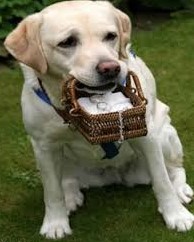
Fido bears the rings?

Let’s dig deeper, shall we?  If you’re not convinced the traditional wedding has gone completely off the altar, check out the Chapel of the Flowers website (“Voted Best Wedding Chapel in Las Vegas!”), particularly their article, “New Wedding Traditions to Trade In for the Classics”.  Perhaps you and your future spouse will consider the following from their list of suggestions (not that I would):

  1. Rings – Skip the jewelry store and head for the tattoo parlor.  Your wedding band tat will never fall off and the ink will remain… “until death do you part”!  For that matter, your tattooist might also be an officiant, so you can have the whole shebang right there in the parlor.  I’m sure the biker dude in the next chair will be happy to witness the signing of your marriage certificate.
  2. Wedding Dress – Skip the white in favor of pastel hues or bright, tropical colors.  After all, the “innocence, purity, and light” of white may not be – ahem – the appropriate statement.
  3. Pocket the Phones – As in, ask guests to refrain from taking their own photos.  Really?  Is the Force with you or something?  Unless you hand out physical restraints as your guests walk through the doors, those phones will keep on a-clickin’.  Moving on…
  4. Smaller Wedding Parties – 1-3 family/friends at most.  This suggestion is either overlooked, ignored, or most likely mocked.  If anything, wedding parties seem to be getting bigger these days.  Moving on again…
  5. Gifts – Out with the wedding registry and in with “donations to a good cause”.  Say what?  I get that modern-day couples live together and already have most everything they need, but what about cash?  Clearly, money dances have fallen by the wayside.  Donations to good causes works for funerals but not for weddings.  Hard pass.
  6. Delayed Honeymoons – Don’t delay… I repeat, don’t delay.  I know several couples who never had a honeymoon because, well, “more important” things got in the way (i.e. real life).  I also know a couple who divorced before they even made it to their honeymoon.  Don’t delay.  Have some fun while you’re still carefree and unconditionally happy.

No matter how you feel about “new traditions” at weddings these days, there’s an underlying positive to be gleanedAt least we still have weddings.  The vows may raise your eyebrows.  The food and festivities may not be your particular glass of champagne.  But those details don’t really matter, do they?  At the end of the day, you still have two “I do’s” and one “I now pronounce you…”, sealed with a kiss.  You still have a marriage.

Some content sourced from the Wall Street Journal article, “They Solemnly Swear Their Wedding Will Ditch Tradition”. (8/6/19)

The Senior Years

A human life has several stages, but exactly how many stages will probably cost you a Google search. Would you believe nine? Pregnancy, infancy, “the toddler years”, childhood, puberty, “the adolescent years”, adulthood, middle age, and “the senior years”. That’s a lot of stages (and I suddenly feel tired).  According to my age – 57 – I’ve battled Father Time through the first seven on the list and hover somewhere between the last two. And therein lies today’s question: What the heck defines “the senior years”?

In case I forget – as seniors are wont to do – allow me to wish you a very happy “Senior Citizens Day”!  No joke (and no Hallmark card – I checked), August 21st is the calendar date set aside “to increase awareness about the issues that face older adults”.  Well now, doesn’t that just call for a celebration?  No, it doesn’t.  In fact, my fingers feel a little more arthritic just typing about it.

Admittedly, I’ve been a senior before, back in a couple of those earlier life stages.  I was a senior in high school.  I was a senior in college.  In the Boy Scouts, I was a senior patrol leader.  If I’d thought to name one of my sons after myself, I could’ve been “Dave Sr.”.  Now however, wrestling with the idea of advanced middle age, I’m forced to confront the one, true definition of “senior”.  The word in that sense (especially senior citizen) – is a little daunting.  I prefer “older” or “more experienced”.  You know, the softer side of Sears.

Reagan

Blame former U.S. President Ronald Reagan if you’re looking for a scapegoat.  After all, he’s the one who – while in office – declared August 21st to be “National Senior Citizens Day” in America.  Reagan signed said proclamation in 1988 at the ripe (older) age of 77.  By all definitions, that made Reagan a senior citizen himself.  Isn’t that kind of like throwing yourself a party?

Speaking of definitions, for all my searches I can’t thumb a tack into the specific age one enters life’s final stage.  Consider the following takes on “senior citizen”:

  1. A polite expression for an old person.
  2. An older person, usually over the age of 60 or 65, esp. one who is no longer employed.
  3. The age at which one qualifies for certain government-sponsored benefits (i.e. Social Security, Medicare).
  4. The United Nations has agreed that 65+ may be usually denoted as “old age”.
  5. Being a senior citizen may be based on your age, but it is not a specific age (say what?)

The definitions get even vaguer, but you see the pattern.  No one – not the United Nations nor Merriam-Webster – wants to tag “senior citizen” with a specific age.  Well, I do.  I want my bedside clock to turn to midnight on the designated date, and instead of beeping the alarm it squawks, “Senior Citizen! Senior Citizen!”  I suppose, if someone held my aging feet to the fire and said, “Choose!”, I’d go with Definitions #2 and #4.  At least then I’m backing up my truck to “middle age”.

Perhaps your definition of senior citizen is more towards retail; as in, the age you start qualifying for discounts, freebies and such.  Sorry old man (old woman?), you’re just complicating the matter (and seniors don’t do “complicated”).  The shopping website DealNews just updated their article, “The 123 Best Senior Discounts to Use in 2019”.  That’s a lot of “bests”, DealNews.  But there’s even more homework for those nearsighted eyes.  You must also know which discount kicks in at what age.  Senior discounts ≠ senior citizen unless you need the following thirteen-year time frame to get used to the idea:

  • Hardee’s – age 52 (that’s me!)
  • McDonald’s – 55 (that’s me again!  But only for coffee and I don’t do McDonald’s coffee).
  • Applebee’s – 60 (may require “Golden Apple Card”.  Oooooooo)
  • Fazoli’s – 62 (and you get the “Club 62” discount menu.  Okay, that sounds cooler than a “Golden Apple Card”)
  • Taco Bell – 65 (plus free drink – ¡Olé!)
  • Wendy’s – “age and offer vary depending on restaurant location” (c’mon, Wendy’s!)

Atta boy, Norm!

Poets and playwrights try to soften the blow of “the senior years” with their eloquent quotes.  The Englishman Robert Browning said, “Grow old along with me!  The best is yet to be.”  The American Ralph Waldo Emerson said, “As we grow old… the beauty steals inward.”  Nice tries, noble poets, but I’ll go with positive thinker Norman Vincent Peale instead.  Norm simply said, “Live your life and forget your age”.  Take that, senior years!

Comfort Food For Thought

If you read my post last week, you know I was a little distressed over the recent shootings in my country.  Blogging was intended to bring me a comfort in troubled times.  In hindsight, maybe I was overthinking the situation.  Maybe all I needed was comfort food.  Enter Chick-fil-A.  The popular fast-food chicken restaurant may never be forgiven for removing their awesome coleslaw from the “Sides” menu a few years back, but just this week they brought a new guest to the party.  Hello, macaroni and cheese.

Amanda Norris is Chick-fil-A’s executive director of menu and packaging.  She’s now my new best friend.  A chicken sandwich and waffle fries, with a second side of mac & cheese?  Heaven in a to-go bag, my friends.  As Amanda puts it, “Mac & cheese is the quintessential comfort food… the perfect pairing… but it’s also great on its own as a snack”.  In other words, I’ve just been given permission to drive-thru Chick-fil-A and order only mac & cheese.  I’m a kid again!

Chick-fil-A’s mac & cheese

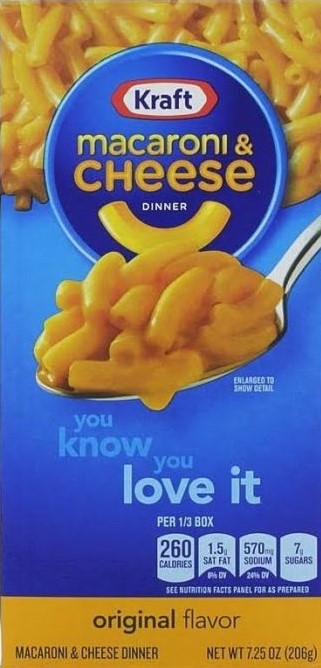
Chick-fil-A’s mac & cheese is made with a special blend of cheddar, Parmesan, and Romano, and baked fresh every day. Uh, push the pause button here.  Three cheeses sounds a little fancy for the mac & cheese I had in mind.  If the restaurant really wanted to arrow the bullseye, they should’ve done a deal with Kraft Foods and offered the mac & cheese.  You know the one – the proud little blue-and-gold box of the “cheesiest”, with the pile of pasta curls and pouch of powdered who-knows-what?  There’s simply no equal.

Kraft introduced its “Macaroni & Cheese Dinner” in 1937 with the slogan, “Make a meal for four in nine minutes”.  Back then – the Depression years – you could buy two boxes of Kraft for a single food-rationing stamp (Make a meal for eight…!)  Fast-forward to the 1980’s, when my wife and I were managing our shoestring food budget.  At least we knew we could buy Kraft mac & cheese.  Three boxes for a dollar!

Three-cheese blend aside, I agree with Chick-fil-A.  Mac & cheese is the quintessential comfort food.  Comfort food is defined as “… providing a nostalgic or sentimental value to someone”, and “…tends to be high in calories, high in carbs, and easy to prepare”.  Well hey, you might as well just say, “Kraft Macaroni & Cheese Dinner”!  Sure, you could turn to other comfort foods on Wikipedia’s short-list, like chicken soup, chocolate-chip cookies or grilled cheese (Tater Tots and sugary breakfast cereals didn’t make the list – for shame!), but take my money – and give me comfort – Kraft mac & cheese earns the top spot.  Just ask any Canadian; it’s the most-purchased grocery item in the country.

Recently, mac & cheese sits side-by-side with Brussels sprouts as a trendy restaurant offering, even in the fancy places.  The problem is in the spin – all those added ingredients for a supposedly better taste.  Lobster mac & cheese.  Mac & cheese pizza (topped with shredded Colby-Jack).  Mac & cheese pie (with a bready crust).  Even Kraft messed with the Original (“Star Wars-shaped” pasta?  Come on!).  Admittedly, their “Shells & Cheese Dinner” with the Velveeta cheese sauce is a pretty good option.  But it’s not the Original.

Comfort foods are further defined as “… food associated with the security of childhood. They are believed to be a great coping mechanism for rapidly soothing negative feelings.”  There it is, and that’s what I need right now.  The couple of Kraft boxes in my pantry are calling me home.

Some content sourced from Wikipedia, “the free encyclopedia”, and the foxnews.com article, “Chick-fil-A’s Mac and Cheese Hits Menus Nationwide”.

Ahoy, Matey!

At the Jolly Roger Restaurant in the small Southern California town of Oceanside, you can order an Avocado Blast as a starter (tempura-battered avo stuffed with shrimp and tuna), Orange Coconut Salmon as an entree (panko-crusted with a sweet ginger glaze), and fruit-topped New York Cheesecake as a dessert, all while watching live entertainment on Friday and Saturday nights. The “JR” may be a little fancy for your tastes but let me tell you; it’s a LOT fancy for mine. That’s because the only version of the Jolly Roger I ever knew was my favorite boyhood burger joint.  As pirates like to say, “Aarrr…

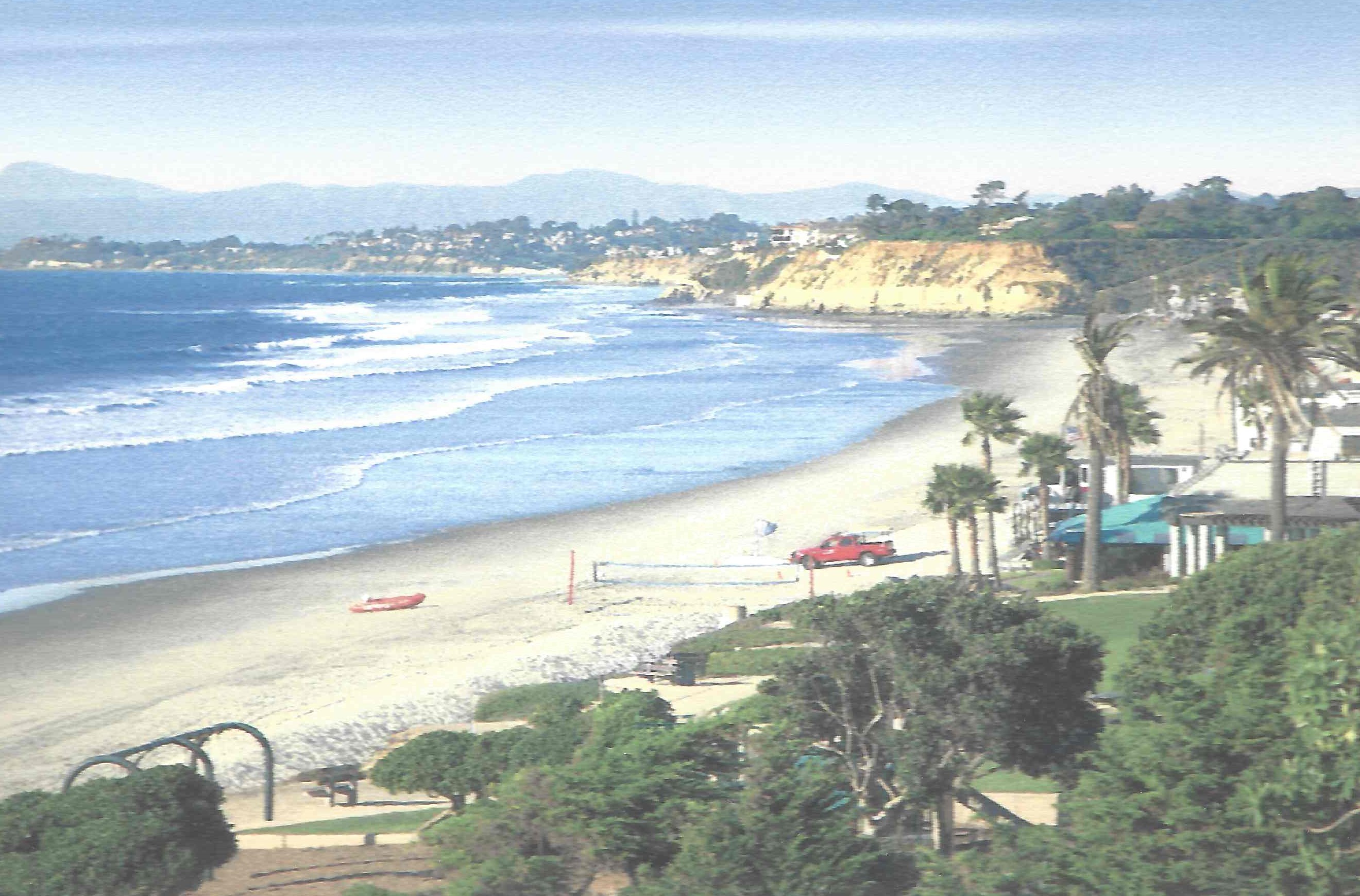
Why blog about a long-ago restaurant?  Because I’ve just returned from several days of vacation in Del Mar (just a few miles south of Oceanside), where my family and I spent my childhood summers.  Del Mar is renowned for its county fair and thoroughbred racetrack (“Where the Turf Meets the Surf”), but for me it was – and still is – a nirvana of sun, sand, and surf; chock-full of happy, carefree memories.  Including the Jolly Roger.

Del Mar beach

The beauty of Del Mar back in the day, besides its seaside location, was the sheer simplicity of the place.  The town was the perfect setup for a kid.  You could walk or bike from the residential areas to the shops in minutes.  You could spend pocket money on Slurpees and pinball at the 7-11.  You could meet/greet frequent passenger trains at Del Mar’s tiny station (while those same trains flattened pennies on the rails).  You could also sneak into the racetrack, collecting discarded betting tickets in hopes of finding an overlooked winner.  And if you were lucky, you had dinner at the Jolly Roger.

Del Mar train crossing

The Jolly Roger got its start as an ice cream parlor in 1945, adjacent to the lake in Big Bear, CA.  But the lake promptly went dry, which led to a lack of landlubbers walking through the doors.  The parlor then relocated to Newport Beach (where the ocean never goes dry).  Patrons soon asked for more than ice cream, so the JR evolved into a coffee shop; then into a chain of restaurants.  At its peak, the JR had forty locations, each adorned with the trademark black flag with skull and crossbones.  But as one article cruelly described its demise in 1985, “…the Jolly Roger pirate has ‘walked the plank’, and the restaurant chain has been consigned to Davey Jones’ locker.”  As far as I know, Oceanside is now the only remaining restaurant.

There’s more to my JR memories than those couple of seaside locations.  The JR also had a restaurant in the heart of Los Angeles, in a shopping center my dad developed back in the 1960’s.  The center is still there but alas, not the JR (now a Mexican restaurant).  No matter; the memories remain.  I never complained when my dad wanted to stop by his center on weekends.  That usually meant a family dinner at the JR, and a lot of yo-ho-ho-ing around the table.

Jolly Roger menu – original cover page

Sadly, the Jolly Roger location where my family and I shared many a dinner – next door to Del Mar in Solana Beach – is also gone (converted into a Starbucks – shiver me timbers!)  And the Oceanside restaurant has evolved into something a whole lot fancier.  No matter again.  My JR will always exist.  I picture the restaurant where the waiters dressed like pirates, the kid’s menus looked like a pirate, and the best options for dinner were burgers & fries, grilled cheese, and milkshakes.  The JR also had quite the dessert menu, including full-boat chocolate sundaes and coconut-cream pie.

Dead men tell no tales, but I sure do.  Thanks for the memories, JR!

Slush Fun

In the last few years, it seems every other corner in Colorado Springs sprouts a newly built “Kum & Go” gas station. Kum & Go’s bright red-and-white oval signs beckon consumers to plentiful pumps and come-hither convenience stores. Kum & Gos are clean and spacious, with competitive fuel prices. Started in Iowa by Krause Gentle Co. (hence the “K” and “G” in the name), Kum & Go operates 400 stores across 11 Midwestern states; rapidly adding more. They’re even gobbling up unwanted locations of my favorite childhood hangout: 7-Eleven.

7-Eleven, of course, is the remarkably resilient convenience store of the baby-boomer generation and before. 400 stores is a drop-in-the-bucket to 7-Eleven. Worldwide you’ll find almost 70,000. It’s safe to say 9 of 10 Americans – at some time in their lives – pass under the bright green, red, and orange of a 7-Eleven sign.

7-Eleven roots to 1927, when “Tote’m” Stores launched in central Texas (yes; a totem pole in front of every one). In the post-WWII era, Tote’m rebranded as “7-Eleven” to acknowledge an unprecedented window of operation – earlier in the morning and later at night than most others. Today of course, coupled with gas stations, 7-Elevens keep those doors open round the clock.

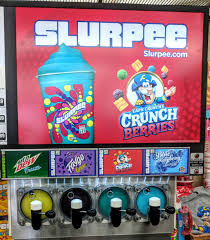
Last Thursday – and every year on “7/11” – 7-Eleven offered a free small Slurpee to all who passed through its doors. (I like number-calendar play, don’t you? “Pi Day” = 3.14, “Fry Day” – National French Fry Day = 7/13, and “Star Wars Day” = May the Fourth.) Best Slurpee trivia: its genesis was at Dairy Queen, where a franchisee put Cokes in the freezer and stumbled upon a soda slush he labeled the “ICEE”. 7-Eleven bought the license, changed the name, and the rest is history. Still one of the bestselling drinks anywhere.

This week, I find myself vacationing in the small coastal town where I spent many a childhood afternoon heading to 7-Eleven. I missed out on last week’s free Slurpee, but I went to one of their stores the day after just to have a look. I can’t tell you the last time I’d been in a 7-Eleven but know this: they haven’t changed much in fifty years. You’ll still find an entire aisle of candy. Hot dogs still rotate on heated rollers behind glass, ready for purchase. Doughnuts age in a plastic bakery case. The Slurpee machines grind away towards the back, beckoning with their cups and colors.

I’ll give you five reasons why 7-Eleven was the ideal destination for a tweenager of my day. First, 7-Elevens were located close enough to residential neighborhoods to get there on foot or by bike. Second, 7-Elevens were small; therefore, not intimidating. (A kid-sized grocery store, if you will.) Third, 7-Elevens parked a couple of pinball machines in the corner of the store (I can still hear the “knock” sound when you’d win a free game). Fourth, 7-Elevens had an entire aisle of “coin candy” (dozens of options for your hard-earned penny, nickel, dime, or quarter). Finally, 7-Elevens had Slurpees – the coolest kid drink around.

When I visited 7-Eleven last week, I bought a Slurpee for old time’s sake. Guess what? They’re exactly the same – that slushy mix of syrup, CO2, and water. You still choose from several sizes of paper/plastic cups (although now you can “Big Gulp” if you must have 32 oz.). The drink still rotates and mixes behind that round glass window; a tempting peek at the flavors before you commit. The straws still have that open spoon on the ends. And a Coke Slurpee is still the fan-favorite (I’d choose Cherry were it not for the stained lips). Frankly, the only difference between today’s Slurpee and the one in the 1970’s: you can buy a refillable cup for discounts on future purchases.

Kum & Go also offers a refillable cup – the $50 “gold” for unlimited coffee and soda for a year. But that’s hardly kid stuff nor kid prices. I only go to K & G for the gas anyway. But take my advice and stop into a 7-Eleven again. Buy a small Coke Slurpee (and a hot dog – they’re actually pretty good). The pinball machines are history, and the candy costs a lot more than a penny. Otherwise it’s like a step back in time.
Some content sourced from Wikipedia, “the free encyclopedia”, and the CNN.com article, “It’s 7-Eleven Day…”

Of Rings and Romans

Eggs are a favorite food of mine.  A breakfast plate is hardly complete without a couple of the fried, scrambled, or omelette-d variety. They’re delicious for lunch in an egg salad sandwich, or for dinner in a chef’s salad or a quiche. Don’t forget deviled eggs for a tempting appetizer. Nothing’s unusual about these egg-zamples, but here’s where it gets borderline obsessive. Earlier this week I imagined two sunny-side-up eggs placed flat-side to flat-side (don’t ask me why; I just did). What do you get when you do that? SATURN!


Perhaps you missed it on Tuesday, but the planet Saturn made a pageant-worthy appearance in our night sky.  Saturn “came to opposition” (sounds political), meaning Earth made its annual passage directly between the ringed world and the sun; at precisely 11am Colorado Time.  Saturn was closest to Earth at that very moment.  Ten hours hence, when Colorado’s sky was dark enough for stars and such, Saturn was already well above the horizon to the southeast.  At least I think it was Saturn.  Without a telescope, I channeled my most amateur inner-astronomer using handheld binoculars.  All I got was a shaky image of a bright, white pinprick in an otherwise fabric of black.  But I must say, it was a pretty big pinprick.

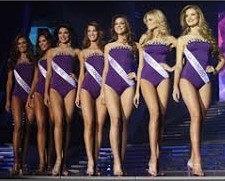
Saturn is certainly the most distinctive of the eight planets in our solar system (take that Pluto, you dwarf-pretender you).  Stage a planet beauty pageant and Saturn would simply flaunt her colorful rings to win ten out of ten times.  The distant runner-up, Mercury, would get a few sympathy votes for her steadfast “cool under fire”.  Mars would get no votes for her perpetual look of embarrassment.  Earth would be disqualified for serving as pageant host.  It’s Saturn with the sash every time.

There’s more to this heavenly body than meets the naked eye (WHOA; that may be the most risqué sentence I’ve ever written).  Saturn is a big ball of gas – hydrogen, helium – and less dense than water, which means if you threw her in the pool, she’d bob around like a big ol’ beach ball.  She completes a full rotation in ten hours; so fast in fact, her equator bulges enough to make her look like a flattened ball (not very becoming of you, Saturn).  Her glorious rings are circular masses of ice crystals, over sixty feet thick.  Her surface temperature is -300 degrees Fahrenheit, a reward for sitting sixth place from the sun.

All of which paints a not-so-rosy picture (but at least there are rings around the not-so-rosy – ha!).  If you could travel to Saturn (no spacecraft headed that way anytime soon), could stand on her surface (you can’t), and could withstand her “balmy” temps (one helluva spacesuit there), you’d still fly off into space on account of that zippy rotational speed and global shortage of gravity.  You’d probably splat into her pristine rings like a useless little bug. Ick.

Saturn

Saturn gets her name from the Roman god – not goddess – of agriculture and time.  Which begs the question, why am I calling him a her?  (Crud, I have to start this blog all over again.)  Even better, Saturn was also the god of wealth (now we’re talking).  In ancient Rome, the Temple of Saturn housed the town treasury.  And this same Roman god is why we call the first day of the weekend Satur(n)day (you’re welcome for that).  So, let’s review.  One of eight planets is named after you.  One of seven days is also named after you.  You must be one important dude.

And yet, Saturn (the planet or the god – you pick) doesn’t get much love in Earthly culture.  I scoured the web for references (okay; no I didn’t – I just looked up “Saturn” on Wikipedia), and all I came up with was a) a Sega video-game console, b) a discontinued brand of automobiles, c) a rocket booster (just the booster, not the rocket itself), and the annual trophies presented by the Academy of Science Fiction, Fantasy, and Horror Films.  Oh yeah, and a small, unincorporated community in Whitley County, Indiana.  Oh yeah again, and one of the primary characters in the “The Three Investigators” children’s books.  Er, wait, that was Jupiter Jones. Dang it!

Even if Earthly culture dresses down her sexy rings (again with the risqué), I still say Saturn wins the pageant (only now it’s a male pageant and that doesn’t work for me).  If you’re not convinced “he’d” win, consider this last fact.  Saturn has sixty-two moons.  Sixty-two!  Maybe Earth’s moon should head on out and join the party.  Can you imagine the night sky if you lived on Saturn?  The fabric would be loaded with pinpricks (including Titan, the second-largest moon in the entire solar system).  Moons, rings, Roman Gods, weekend days; what’s not to like?  As I said, it’s Saturn with the sash every time.  Now stop playing with your breakfast and get back to work.

Some content sourced from Wikipedia, “the free encyclopedia”, and the Universe Today article, “Ten Interesting Facts about Saturn”.

The Fourth on the Fence

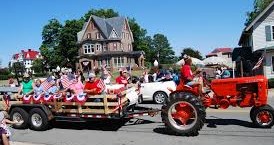
America’s Independence Day celebrations go full-on patriotic today, including a plethora of centuries-old traditions. Barbecues and fireworks. Downtown parades with marching bands. Baseball, apple pie, and ice cream. Flags, and countless costumes of red, white, and blue. Another round of Nathan’s Famous Hot Dog Eating Contest. These are the images consistent with America’s 243rd birthday party. But tennis shoes and tanks? Nope; not what I had in mind.

Photo by Nike

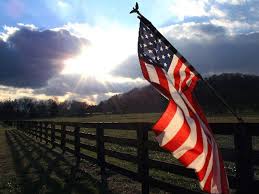
I’m referring to recent headlines, of course.  Nike – in an obvious nod to Independence Day – produced a limited-edition running shoe with the “Betsy Ross” on the heels (the version of the American Flag with a circle of thirteen stars on the field of blue).  The shoe would’ve made it to hundreds of feet were it not for concerns voiced by activist (and Nike spokesperson) Colin Kaepernick.  In response, Nike immediately recalled the shoe.  In response to that, the state of Arizona withdrew financial incentives for the construction of Nike’s latest manufacturing plant.  In response to that, the state of New Mexico created a political fence at the NM/AZ border, inviting Nike to “come on over”.  “Betsy Ross” instantly became a hot topic on Twitter.

Photo by Andrew Harnik – AP

As for the tanks, President Trump requested “reinforcements” for the “Salute to America” parade and flyover in Washington D.C.  In a nod to the U.S. Armed Forces, parade-goers will enjoy a convoy of loud-and-proud servicemen and women and their vehicles.  I can’t think of anything more patriotic: a fortified Independence Day parade in our nation’s capital hosted by the leader of the free world.  But like the Betsy Ross shoes, we have controversy.  D.C. locals are worried about tank-track damage to city streets and bridges.  More predictably, the progressive left sees President Trump’s actions (and Salute speech) as an inappropriate opportunity for political gain.  In response to that, there will be protestors and flag-burners galore.

My Independence Day childhood memories have nothing to do with flag-burning, let alone tennis shoes and tanks.  Our family would trek to the beach in Southern California full of pride and patriotism.  We’d spread blankets on the sand at dusk alongside thousands of others, with a couple of buckets of Kentucky Fried Chicken for dinner.  My brothers and I would run around in circles with sparklers.  When it got dark enough we’d enjoy the fireworks erupting from a nearby pier.

As a teenage boy – and budding pyrotechnic – Independence Day was all about the fireworks.  My dad would purchase a large “Red Devil” assortment and we’d set them off on the beach.  My favorites included “black snakes”, “ground-spinners”, and “fountains”. (Alas, I never experienced the machine-gunner thrill of hoisting a Roman Candle.)

When my own children were young, I delighted in our local (and thoroughly hokey) Independence Day parade.  Our supermarket participated with a group of dancing, shopping-cart-wielding cashiers.  Our dentist shamelessly advertised on a float with a giant toothbrush. But our son carried the flag as a Boy Scout and our daughter rode her pony as part of an equestrian team.  Later in the evening we’d gather at the shore of the nearby lake to watch the fireworks display, fully funded by donations to the local fire department.  Small-town America at its best.

Like any other living, breathing American, I have my opinions on the tennis shoes and tanks.  I don’t think Nike intended to dredge up Revolutionary War-era civil liberties simply by displaying the Betsy Ross on its products.  I don’t think President Trump did anything more than exercise the privilege of the office by serving as host of our nation’s capital’s celebration.  In both cases, I think digging for dirt below the surface only makes things dirtier.  I’d wear the shoes or attend the Washington D.C. bash without an iota of self-consciousness.  I’d simply be an American celebrating our Independence Day.

Nike defended its shoe recall by claiming it’s “proud of its American heritage”, but worried the Betsy Ross would “unintentionally offend and detract from the nation’s patriotic holiday”.  President Trump’s advocates said he’s “… not afraid to buck convention and put his own twist on these types of events”.  How about we get off the fence, take a step back, and remember what we’re celebrating?  America’s birthday deserves more than focus on yesterday’s regrettable events or today’s relentless politics.  Perhaps – just for a day – we could be the “United States” of America once again.

Cooler Water Cooler

In tiny Beaver, Utah – aside the I-15 and just south of the I-70 juncture, you’ll find a Chevron gas station (still) offering full-service at the pumps. Well, sort of full-service. You fill your own tank, and as soon as you do, the attendant comes over and cleans your windshield. He also checks under the hood. When all’s said and done, he doesn’t charge you extra nor will he accept a tip. It’s a nice throwback to a time when self-service was the exception. But these days we do just about everything for ourselves, don’t we? Including bottling our own water.

I have to admit; this is a new one on me: filling my own water bottle from a public dispenser. Sure, I already know the drill at the gym (just before I navigate the zoo of torturous cardio equipment). My gym’s water machine beckons me to place my bottle under the spout, auto-fills to within an inch of the top, then magically shuts off before overflowing. There’s even a digital counter tracking how many plastic water bottles we avoid in the process. Last I checked, my gym’s counter was into the several hundred-thousands.

Just this week – the “new one on me” – I noticed the same setup in the airport boarding lounge in Los Angeles.  Two self-service machines are built into the wall adjacent to the restrooms.  In the short time before my flight, at least three dozen people lined up and filled up, as if they’d been doing this for years.  I earn the old-timer label for thinking there should’ve been a drinking fountain on the wall instead.  Or a pay phone.

Like the full-service treatment in Beaver, Utah, self-service water dispensers are free of charge.  But that’s about to change, if you believe a recent Wall Street Journal article.  The water products of Coca-Cola (Dasani, Smartwater, Vitaminwater) or Pepsi (Aquafina, Life Water, Evian) may be your thing, and you’re about to get them – for a price – through self-service water dispensers.  For a little more cost, you can even carbonate your water or add fruit flavoring.  Safe to say, “plain water” (i.e. the brand-less, cost-less, out-of-the-tap option) may soon be hard to find in public places.

Now then, the facts.  Water is consumed by the (plastic) bottle more than any other beverage except soda.  America alone accounts for 42.6 billion bottles a year (the world: 200 billion bottles).  That spills to thirty-two gallons/person/year.  The cost?  $100/person/year.  You forgot that line item in your personal budget.  Put it just below the cost of your Starbucks habit.

Here’s another breakdown of the beverage.  Americans consume 2.2 million bottles of water every day, or 90,000 every hour, or 1,500 every minute.  No wonder proprietary self-service machines are the latest trend in airports (and just about every other place where people gather).  There’s a serious market for brand-name H20, and the manufacturers know today’s eco-friendly consumers prefer to drink from their own bottles.

[Nagging Thought for the Day:  There are more than 125 brands of bottled water across the globe; 125 unique recipes for a drink with essentially two ingredients.  What makes one different or better than the next?  For that matter, with reasonable filtering, what makes one different from the fill you can get from your taps at home?]

I wish I’d thought of self-service water dispensers myself (I also wish I’d “invented” bottled water).  I’d be drinking in the riches. These days, “dispensed” water is psychologically preferable to “tap” water, even though some calculations put it 2,000 times more expensive.  Are we just suckers for brand names?  Hey, maybe I’ll invent brand-name oxygen.  Oh wait – that ship already sailed…

Acqua di Cristallo

Here’s one more stat to quench your data thirst.  The most expensive of those brand-name waters – Acqua di Cristallo – costs $60,000 a bottle. The elixir (“water” doesn’t sound rich enough), is sourced from France and Fiji, comes in a 24-karat solid gold bottle, and contains a small sprinkling of gold dust.  Acqua di Cristallo might as well be advertised as a panacea.

Lucky for you, maybe one day Acqua di Cristallo will be offered through public self-service dispensers.  Might want to call your credit card company and increase your limit.

Some content sourced from the Wall Street Journal article, “Coke and Pepsi Want to Sell You Bottled Water Without The Bottle”, and the CreditDonkey article, “Bottled Water Statistics: 23 Outrageous Facts”.