Let’s Do the Twist!

My Amazon order history says a lot about my purchasing habits. I am a buyer of needs vs. wants. Pet food. Printer ink. Humidifier filters. But every now and then, a little something nostalgic sneaks into My Shopping Cart. Favorite childhood books for my one-year-old granddaughter.  A balloon-launching catapult to make a Thanksgiving turkey fly (it didn’t).  Italian chocolates from Perugia, also discovered during a year abroad in college.  And just today – on total impulse – a Rubik’s Cube.

Rubik’s Cube – adding a few wrinkles to us baby boomers – celebrates its forty-fifth birthday this year.  Back in 1974 when it was invented (and originally dubbed “Magic Cube”), the 3x3x3 trinket earned our attention for its mechanical magic as well as its almost-impossible-to-memorize solution.

To be precise, there are 43,252,003,274,489,856,000 (that’s “quintillion”) possible positions of Rubik’s colorful squares.  The Cube comes with neither instructions nor answers.  Already solved in its packaging, you can’t help twisting it up into a mess of color.  In our pre-Internet world, Rubik’s Cube required endless gyrations in search of the answer (instead of just, “Hey Alexa”).  But there was something immensely satisfying about the resulting nine squares of single color on each of its six sides.  There was also something tempting about peeling off the colored stickers and rearranging them instead.

Erno Rubik (courtesy of Wikipedia)

Erno Rubik, a Hungarian inventor, was an architect and architecture professor “searching to find a good task for his students” when he completed the Cube’s first working prototype – a mess of wood blocks and rubber bands.  A small plastics company took a chance on its manufacture and the rest is history.  In the first four years alone, two hundred million Cubes were produced and sold.

I was in college (and also an architecture student) when Rubik’s Cube first hit the shelves.  Its perfect symmetry and twisting ability to reinvent its colorful look went hand-in-hand with my interest in building design.  I remember keeping a Cube on my dorm room desk – at first for mindless manipulation; later for successful solving.  Not that I could solve it quickly, mind you.  The world record – an average of five solves – is six seconds.  The world record with one hand (???) is nine seconds.  The world record using only your feet (again, ???) is twenty-two seconds.  My solve is expressed in minutes, if not hours.


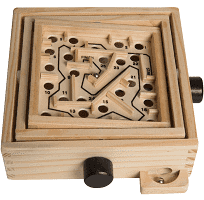
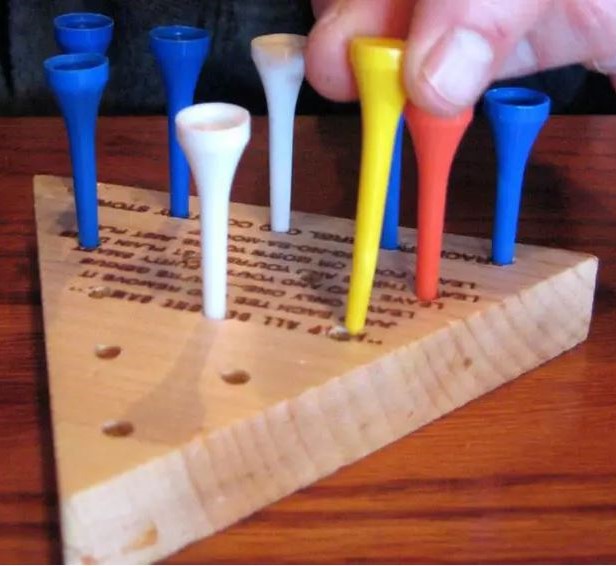
Few puzzles compete with Rubik’s Cube for sheer “can’t put it down”.  But there are a few.  One of my favorites was the wooden double maze, the box-like puzzle with the Etch-A-Sketch dials on the side, maneuvering the steel ball through the walled maze without dropping it through one of several holes.  I devoted hours and hours to that puzzle, always sweating those final tricky turns to the finish.  Another favorite: Marble Solitaire, where you hop-eliminated marbles in search of the perfect solution: a single marble standing proudly in the board’s center divot.  Finally (courtesy of Cracker Barrel restaurants), how about “Triangle Peg Solitaire”, the hop-elimination puzzle with the colored golf tees?  Thanks to that little game, my kids were supremely patient after the dinner order was placed.

With somewhere near four hundred million sold, Rubik’s Cube is considered the best-selling toy of all time.  Its inventive design landed the Cube in the permanent collection of the Museum of Modern Art (MoMA) in 1982.  The Cube also garnered “Toy of the Year” in eight countries, including Germany, France, and the U.S.

GoCube

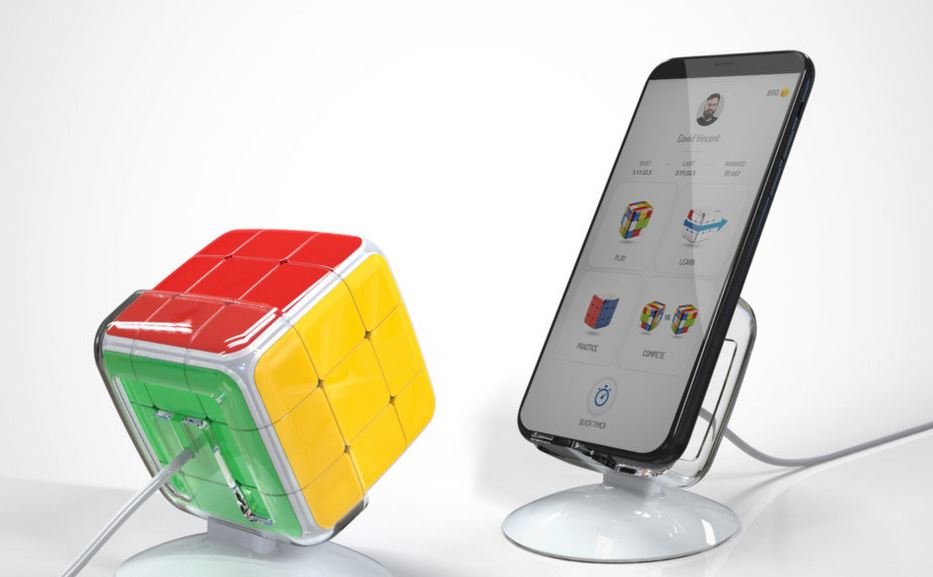
Inevitably, there were attempts to advance Rubik’s design, such as a 4x4x4 version (“Rubik’s Revenge”), or pyramid, dodecahedron, and hexahedron shapes.  But going completely off the rails, look no further than GoCube – a thoroughly high-tech update to Rubik’s.  GoCube is also 3x3x3, but rimmed with LED lights, and contains wireless smart sensors, an embedded gyro, and an accelerometer.  Download the GoCube app to your phone (of course there’s an app), and watch your twists on-screen instead of on the cube itself.  The app guides you to the solution (if you so choose), creates alternative mosaic-looking puzzles, and run reports on solving speed and efficiency.  You can even wage virtual head-to-head competitions.  All for “only” $119.

“The Pursuit of Happyness” (courtesy of Warner Brothers)

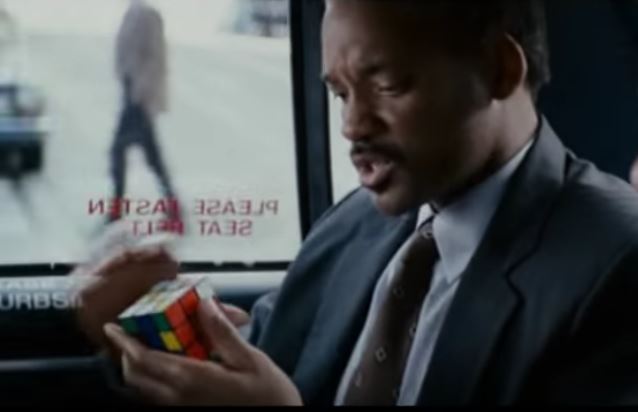
I’m sure Erno Rubik (and Will Smith) would pooh-pooh GoCube as too much of a good thing.  I would agree.  The app-driven, light-up, hundred-dollar GoCube is over the top, with zero nostalgia to boot.  On the other hand, Rubik’s Cube cost me $4.59 on Amazon.  That’s a sweet deal, and a cheap way to learn how to do the twist all over again.

Some content sourced from Wikipedia, “the free encyclopedia”, and the Wall Street Journal article, “Never Solved the Rubik’s Cube?…”

It’s All in the Cards

Back in the Boy Scouts, my troop-mates and I memorized statements designed to make us better young men. The Boy Scout motto was, “Be Prepared”. The Scout slogan: “Do a Good Turn Daily” (help others). The Scout oath – several sentences stated with a raised right hand (fingers forming the Scout sign) – included obedience to the twelve points of the Scout law. Recently I’ve been thinking about Point #2 of the Scout law, Loyalty; showing care for family, friends, and country.  But what about care for merchants?

Customer loyalty programs – those structured marketing ploys designed to tempt continued shopping at particular businesses – are standard retail procedure these days.  The use of plastic and punch cards, account numbers, or scanned apps is as common as pulling out your Visa.  I get suspicious when a merchant doesn’t have a loyalty program.  It’s all about the points, and the allure of discounts or freebies through accumulated spending.

American Airlines, credited with starting the first full-scale customer loyalty program in modern times (1981), had no idea its “frequent fliers” would become the trendsetters for countless programs to follow.  But the drive for customer loyalty started way before AA.  Anyone who remembers pasting S&H Green Stamps into collection books, clipping Betty Crocker coupons straight from the product box, fishing prizes from Cracker Jack caramel corn, or joining the Columbia House Record Club (“8 CD’s for a penny!”) has dipped their toe into the customer loyalty pool before.

I took a quick inventory of my own customer loyalty and the numbers surprised me.  I carry eight cards in my car.  I have another eleven apps on my phone and another ten on-line accounts.  That’s 29 unique programs, and over 30 if I include the couple of credit cards where my swipes eventually equal cash back.  For someone who rarely shops on impulse, that’s more attention to spending than I’d care to admit.

If I did a little spring cleaning, I’d likely reduce my loyalty programs by one-third.  Many sit gathering dust because I haven’t used the merchant or service in years.  Others accumulate points at a snail’s pace.  Fill my inbox with special sales alerts or saturate my voice mails with pleas to “buy now!”; it won’t matter.  I purchase on my own terms.

Here are two recent loyalty experiences; the reasons I chose this topic today.  Last September we took a weekend trip to Aspen, settling for a Westin hotel in nearby Snowmass (Aspen is over-the-top expensive to us commoners).  When I went to Westin’s website for the booking, I discovered their loyalty program (Starwood) was merging with Marriott Rewards (now Marriott Bonvoy).  Hallelujah – my Aspen getaway gets me points! But not so fast.  Logging into Marriott Rewards, the home page alerted me to the fact the program merge was still in progress, and a Westin stay might not result in Marriott points.  Long story short, I called the hotel, spoke to the front desk, and had them book the reservation for me instead.  Yep, you can still do it the old-fashioned way.  And you still get points.

My other recent loyalty experience involved Nicholas Mosse Pottery (Kilkenny, Ireland).  Mosse makes beautiful handmade plates and bowls and the like, and we’ve been collecting a few pieces at a time since visiting Ireland a few years ago.  Points for me (ha) for joining the Mosse loyalty program from the get-go.  Just this week they alerted me me to my quietly-amassed rewards.  I then purchased a $70 plate for virtually nothing.

My Mosse experience is the perfect example of my casual approach to customer loyalty.  I don’t keep track of points until they equate to something significant.  Sure, I favor certain products and services, but I’d still favor Marriott or Starbucks or Costco without their loyalty programs.  For someone who tracks every penny, there’s something very satisfying in the surprise of unexpected discounts.  That’s how it works best for me.

Here’s my advice.  Don’t let customer loyalty programs drive your spending habits.  If you do, the merchant “wins”, because you’re likely spending more along the way than whatever discount or freebie you end up getting.  Loyalty = showing care; yes, but with retail that should only mean preferring one store over another.  Despite what they’d have you believe, it’s not all in the cards.

Some content sourced from Wikipedia, “the free encyclopedia”, and from the Wall Street Journal article, “Inside the Marriott-Starwood Loyalty Program Turbulence”.

Sleeping with the Fishes

With Chinese New Year and Mardi Gras celebrations going on this month, you can bet the decibel levels around the world are higher than normal.  Orbit the globe and all you’d have to do is step outside your rocket to catch the sounds of fireworks and blasting dance music.  In this “Year of the Pig”, I find it funny my zodiac animal is the ox.  By Chinese definition I’m “hardworking, intelligent, and reliable”.  But forget about my “oxen” qualities for now.  Today I want to explore my alter-identity as a dolphin.

(Work with me a little, okay? Don’t dump me at Sea World or a performance of “The Little Mermaid”; just hear me out.  My dolphin identity has more legs than my ox.)

First, a question.  How’s your sleep these days (er, these nights)?  Getting your 7-8 hours, are you?  Do you hit the pillow at night and next thing you know it’s sunshine and chirping birds?  Do you wake refreshed and ready to tackle the day? If it’s “yes” to every question, you and your body clock are finely tuned.  To spin it with science, you “respect your circadian rhythms”.  But here’s where it gets interesting.  Body clocks aren’t wound the same way person to person, nor are they set to the same time.  One size most definitely does not fit all.  We are Timexes, Seikos, Bulovas, and Rolexes.  So which chronotype are you?

Chrono-what, you say?  If I steered this post towards a biology lesson, you’d start nodding off right about now (not the way to treat your body clock).  Instead, let’s keep it simple.  Chronotype is essentially your preference for waking early or sleeping in.  We all have a degree of one or the other, and we’ve had it since birth.

Let’s find out more about the “animal” within.  Take the following test from Dr. Michael Breus (“America’s Sleep Doctor!”) – thepowerofwhenquiz.com – and less than a minute from now you’ll know your chronotype.  You’ll also understand more about your propensity for sleep.  No question – I hesitated when I came up dolphin (c’mon, Dr. Breus – I could’ve been a lion, a bear, or a wolf!), but admittedly the description is spot-on.  I’m a light sleeper.  Naps don’t help me.  Attention to detail impacts my productivity (and my sleep).  I hit the sack at the same time every night and wake up at the same time every morning.  That’s me.  And that’s the dolphin chronotype.

[Note: the Breus test wants your email to get your animal.  Do it, and then unsubscribe.  Otherwise the good doctor spams your inbox with books, courses, supplements, and other stuff.  You just want your animal.]

To test the validity of chronotypes, I took the Breus test again… posing as my wife.  If my answers for her were correct, she’s a bear (the most common chronotype).  She’s not a light sleeper (Mardi Gras could be booming down the hall and she wouldn’t hear a thing).  She works hard in the day, relaxes at night, and often goes to bed later than I do.  She can sleep later into the morning if she so chooses.  She needs a couple of hours to be fully alert after she rises.  That’s my wife.  And that’s the bear chronotype.

Unfortunately, chronotypes are not as dependable as they sound.  For one, they shift as we age.  For two, they can’t always be respected (i.e. jobs and lifestyle drive us off our body clocks).  Finally, sleep is influenced by myriad factors having nothing to do with chronotypes (i.e. diet and exercise; light levels and sound levels; your dog, who always insists on going out at 3am.)  But chronotypes are built into your DNA, so it behooves you to get to know them a little better.

One last wink of sleep trivia before we part.  You know those nights when you wake up unexpectedly, and you feel completely, utterly out of it?  Like, you can’t even see straight, let alone carry a conscious thought – as if you haven’t slept at all?  That moment is called your circadian nadir; when your drive for wakefulness is at its lowest point.  It happens about two hours before your natural wake-up time.  For me – a dolphin – it’s not as disorienting a moment as most.  But I still feel pretty out of it.  After all, I’ve been sleeping with the fishes.

Some content sourced from the Wall Street Journal article, “Can a Night Owl Become a Morning Person?”

Danger, Will Robinson!

A strategic goal of the Federal Trade Commission (FTC) goes as follows: Protect consumers from unfair and deceptive practices in the marketplace. Unfair and deceptive practices seem to be the strategic goals of several other organizations out there, so I’m glad the FTC seeks to “protect” me. For example, they held a competition called the “Robocall Challenge”, looking for solutions to reduce those pesky and sometimes illegal phone calls we all receive. The competition winners – two software programs designed to intercept and divert – split the $50,000 first prize. The problem? The Challenge was conducted over five years ago, yet robocalls are more rampant than ever today.

courtesy of nbcconnecticut.com

The telemarketing calls of old seem quaint compared to the lifeless computer-generated voices of the last several years. Used to be, you’d answer the phone to a real voice; a sunny greeting in oft-broken English or heavy accent. The caller would say, “Yes, is this David Wilson, please?” or, “Hello Mr. Wilson, how are you doing today?” Who do you know who starts a phone conversation with wording like that? (Even better, when they’re looking for my wife Brigid – pronounced with a soft “g” – they mangle her name in ways I’ve never heard before.)

At least the old telemarketers sold you products or services too good to be true (“Congratulations – you’ve won a seven-day Hawaiian cruise!”), and at least they were human. Today’s robocalls are scams disguised as threats. Pay this tax bill immediately or the IRS will break down your door and haul you off to prison. Upgrade your Microsoft operating system now because your warranty’s about to expire. Buy this health insurance plan because yours doesn’t cover anything. I might listen to these pitches if they came from a real person, but the synthesized voice of a robocall triggers the involuntary reflex “hang up”.

courtesy of cio.com

For me, the most effective solution to robocalls is simply not answering in the first place. If the Caller ID doesn’t convince me it’s a real call, I let it go to voice mail. Sure, my provider offers a call-blocking service, but they charge a fee. Why would I pay good money to manage a situation I didn’t ask for in the first place? The same goes for the better call-blocking applications out there. They’ll make them go away, but it’s gonna cost you.

By the way, not answering in the first place also stops robocall breeding. Just by picking up the receiver or hitting “Answer”, you’ve identified yourself as a number that works, which means the robocall provider sells your number to other providers, and that means more robocalls. Picking up the phone is why Americans received 16.3 billion robocalls in 2018… and that was just January-May.

courtesy of komando.com

Robocalls are a nuisance – sure, but at least they’re not threats to the human race itself. That prospect turns my dreams into nightmares every so often. Whether vast supercomputers, unfeeling combat robots, or microscopic drones, you have to admit – we’re on the precipice of technologies just itching to get beyond our control. Fiction does a great job exploring the possibilities. Read Michael Crichton’s “Prey” (self-replicating nanotechnology), Daniel H. Wilson’s “Robot Uprisings” (just what the title suggests), or simply watch the brilliant 2014 film, “Ex Machina”. The final scene – when Ava walks confidently into the public domain and the credits roll – is perhaps the most chilling moment of the entire movie.

courtesy of IMDB.com

As if to mock this post, my brother-in-law – visiting here at the house as I speak – just received a call on his mobile phone. Another robocall, and probably another scam disguised as a threat. Maybe the call wasn’t by accident, but rather a triggered response from a nanobot keeping an eye on my keystrokes. A subtle message, as if to say: we’re here and we’re watching. Sure, I can plead “no-mo-robo” (which is also the name of a call-blocking company), but I know the robots are only growing in numbers. Better make room then – another highly-intelligent species is quietly joining the party here on Earth.

Slipping Away

Every time we travel to California – this past weekend, for example – I have to be reminded about their statewide ban on single-use plastic carryout bags.  You think I’d remember – Cali put the kibosh on the bags three years ago.  Still, we fill our basket with groceries, head to the check-out, and the cashier goes, “want to purchase bags?”  Argh.  I should store a couple of reusables in my suitcase; the very ones I keep in my car in Colorado.

Plastic straws followed plastic bags, of course.  Four months ago, the Golden State placed “discouragement” on the plastic variety (you must ask for them now).  We sat down to a meal and our waitress brought glasses of water – with paper straws (argh again).  Admittedly, “legal” sippers are pretty good.  No reduction to mush like breakfast cereal sitting too long in milk.  Other than the cost (several times more than plastic), and the fine ($25/day for un-requested plastic), paper straws are hardly inconvenient.

Now then, the real topic for today.  California is looking to “strike up the ban” yet again – on paper receipts; the little critters we receive after credit card transactions.  Say it isn’t so, West Coasters!  Bags and straws I can deal with, but a ban on paper receipts?  That’s just stealing another book from my old-school library.

According to a Wall Street Journal op-ed, the facts are these: paper receipts generate 686 million pounds of waste per year. (Can someone please quantify 686 million pounds – say, number of filled swimming pools?)  Paper receipts also generate 12 billion pounds of carbon dioxide. (Again, quantify – number of breathing humans?)  Also, paper receipts contain Bisphenol A (BPA); not exactly an appetizing compound.  In other words, don’t eat your receipts just because the food was lousy.

Without paper receipts, my personal budget maintenance takes a blow.  I keep everything in Quicken, so give me points for electronic accounting.  But I also use paper receipts – an old-fashioned double-check mechanism.  I enter the transaction from the receipt; then cross-check against the Visa statement (Jacob Marley reincarnated?)  Why do I do this?  Because once upon a time a waiter decided to triple my tip after I’d signed the bill and left the restaurant.  Later, my paper receipt didn’t reconcile with my Visa statement.  Busted.  I promptly called the manager, who investigated and lo-and-behold, discovered a pattern of gouging.  The waiter was fired.  More points for me!

Now here’s the irony in my triple-the-tip story.  What if the restaurant didn’t use paper receipts?  What if I processed my transaction through Square or an iPad, self-swiping my card and choosing the percentage tip?  For starters (and finishers) there wouldn’t have been gouging because there wouldn’t have been a waiter.  It would be like standing over the shoulder of the processor at Visa – instant reconciliation.  In effect, my story is a vote for no paper receipts.

Truth be told, I’m already evolving – slowly – from paper receipts.  When given the choice (Home Depot comes to mind), I select “email receipt” or “no receipt” more often than “paper”.  Unlike robo-calls, I accept the unsolicited side effects of electronic commerce (i.e. email spam).  In a nod to maintaining control, I select self-check-in at airports and self-check-out at markets.

More likely, I’m caving on paper receipts because I’ve already done so with a laundry list of other paper products.  My written letters have (d)evolved into email.  My paper-printed books have dissolved into bits/bytes on my Kindle e-reader.  My to-do lists now reside in a phone app.  Bills arrive in my online inbox instead of my streetside mailbox.

Phil Dyer, one reader of the Wall Street Journal piece, commented, “California will soon attempt to regulate earthquakes”.  49 of 50 U.S. states just LOL’d.  Me, not so much.  After all, I never thought I’d see the day where I’d give up my paper receipts.

Super Dough

The beauty of the Super Bowl is its broad entertainment value.  There’s something for everybody in the five hours between The Star Spangled Banner and the Vince Lombardi trophy. For sports fans, there’s a highly-anticipated football clash. The Super Bowl is not football at its best or most dramatic, but this year’s coast vs. coast, old coach+QB vs. young coach+QB match-up creates more than the usual intrigue.

If you’re not into football, you’re at least enjoying the musical entertainment.  Maroon 5 will be there after all (rumor had it they were pulling out), and the band acknowledges “… it’s the biggest stage you could ever play…”  Even if you’re not a fan of the 5, you get Gladys Knight (but no Pips) singing the national anthem before kick-off.

If neither live sports nor live music is your bag (and that’s a small rock you live under), you’re watching the commercials instead.  I admit – especially as a sports fan – there’s as much press for the Super Bowl ads as there is for the Super Bowl itself.  It’s the only sports broadcast I know where viewers fast-forward through the game to get to the commercials.

Courtesy of Anheuser-Busch InBev

No wonder advertisers are so worked up for this Sunday.  The Super Bowl is routinely the single-most tuned-in-to entertainment of the year.  Viewership has quadrupled over the last fifty years.  The 2018 Super Bowl drew over 100 million viewers; 25% more than second-place.  And what came in second?  The Super Bowl post-game show, of course (74 million viewers).  Say what you will about the NFL; people watch.  The four most-watched television shows in 2018 were NFL games, followed by a “This Is Us” episode… airing immediately after the Super Bowl.

Courtesy of Frito-Lay

Sunday’s line-up of Super Bowl commercials includes the usual products: cars, drinks (alcoholic), more drinks (non-alcoholic), foods (snack), more foods (fast), even more foods (avocados), and technology.  Of course, they’re all designed to get you to remember, long after the game is over.  Whether it’s a celebrity, a laugh, or a cute animal, it’s all about permanent placement of the product in your brain.  But even if you don’t remember, consider this: the commercials will be watched millions more times on YouTube.  Add in the Internet and the considerable cost of Super Bowl advertising is a little easier to swallow.

Speaking of cost, this year’s commercials will set producers back $5 million a spot, for a mere thirty seconds of air time.  That’s just the bill to CBS.  Production costs run as much as another $5 million.  Try counting “one-one-thousand, two-one-thousand” every time you watch a commercial this year.  You’re squandering $333,333 for every “-one-thousand” you utter.  That’s what I call super dough, and it’s only rising (ha).  The car companies account for 25% of the take (remember that the next time you negotiate the purchase of a vehicle), but Anheuser-Busch InBev is the “King of Advertising”, spending over $600 million on Super Bowl commercials since 1995.  Yes, Clydesdale horses are cute.  More importantly, they sell a lot of beer.

Courtesy of Anheuser-Busch InBev

To pique your ad anticipation, Town & Country Magazine’s website includes a list of the “50 Best Super Bowl Commercials” (including the videos).  The ads are listed chronologically, starting a-way, way back in 1967.  It’s entertaining to see what products and companies paid big for Super Bowl advertising fifty years ago.  Some are no longer around.  I’m guessing their advertising agencies aren’t either.

Courtesy of Apple

Mark my words.  Monday morning after the Super Bowl the water-cooler talk will not be about the game.  It will be about the commercials.  Which one was your favorite?  Which one left you scratching your head?  Which one was $5 million up in flames?  And most importantly, which one will still be talked about years from now?  Even this sports fan has to admit: the game will soon be forgotten, but not the ads.

Some content sourced from the Wall Street Journal article, “Why Advertisers Pay Up for  a Super Bowl Spot”; and from Wikipedia, “the free encyclopedia”.

Clothes Shrink

On our 25th wedding anniversary, my wife and I crossed the Atlantic for an unforgettable first trip to Ireland. We wanted a few keepsakes to bring back with us, so we shopped carefully as we went about our travels. She found a gold necklace with a St. Brigid’s cross (her namesake), and a few ceramic Christmas ornaments. I opted for a few logo items from the Guinness Brewery, and a coffee table book on the village of Kildare. We also purchased music from a lovely harpist, playing outdoors just steps from the Cliffs of Moher.  Last week, I came across one more Ireland item I forgotten about: the sweater you see below.  It’s colorful and it’s Celtic… and I think I’ve worn it once.

Don’t know about you, but the new year is always my opportunity for “spring cleaning”.  Maybe it’s because I’m already in the mode as I take down and box up the Christmas decorations.  Or maybe it’s because my office files burst with paper after a year of accumulation.  Whatever the reason, by mid-January I manage to a) empty my office of anything irrelevant to the coming year, and b) conduct something akin to an inventory reduction sale on my clothes.  The office files are easy, but the wardrobe; that takes a little more judgment.

When it comes to decisions about clothes, it’s safe to say guys have it easier.  We’re more utilitarian – by definition “designed to be useful or practical rather than attractive”.  Yep, that’s us guys – if the shoe fits, so to speak.  Of course, women flip the definition around and put the premium on “attractive”.  For them it’s more about fetching than fitting.  In fact, I’d venture to say a woman’s closet is 75% “attractive” and 25% “utilitarian”, while a man’s is the reverse.  And trust me; “utilitarian” is easier to shift to the giveaway pile.

Destined for Goodwill

My annual wardrobe shrink is always nostalgic.  Some items – particularly suits and sweaters – survive several years before reluctantly leaving the nest.  Others – admitted impulse buys – fly the coop having been worn just a handful of times.  I’ll never forget one year, when I brought eight suits to Goodwill.  Why so many?  I moved from California to Colorado and changed jobs in the process.  My CA job required the suits; my new CO job did not.  Even so, I had to swallow hard on that donation.  Those suits had plenty of mileage left in them.

Illustration: James Gulliver Hancock

Here’s a mistake I make all too often with my wardrobe.  I’ll buy a shirt or a pair of pants at a store.  Weeks later, I realize I really like what I purchased, so I go online and buy another half-dozen; same style in various colors.  That’s the mistake.  Not only am I a poor color-chooser through the Web, but I don’t wear that shirt or those pants as often as I think I will.  In other words, I over-shop (and I’m a guy!)  Then comes wardrobe shrink time, and my giveaway pile includes that shirt or those pants.  Not good.

The more common mistake – at least for us guys – is to buy something last-minute for a single occasion.  Sure we may need it, but do we take a moment to project whether we’ll ever wear that item again?  If not, that shirt or tie or sweater is reduced to a keepsake, sitting quietly on the closet shelf just yearning for another wear.  That’s my Ireland sweater.  Kinda sad, isn’t it?

Admittedly, I have other keepsake clothing.  I buy shirts from favorite destinations (hello Guinness), and can’t bear to part with them.  I buy shirts with my college’s logo on them, and can’t bear to picture someone else wearing them.  I still have an Aloha shirt from our honeymoon in Hawaii (probably the last time I wore it too).  No matter – there’s plenty of room in the closet when 25% just went to Goodwill.  The purge is not completely pure.  My Ireland sweater will live to see another year.

Some content sourced from the Wall Street Journal article, “The Case for Buying Less Clothing”.

Putting the Kettle On

Kacey Musgraves is a blossoming country music artist whose recent album “Golden Hour” will compete with heavy-hitters at this year’s Grammy Awards for Album of the Year. She’s released only four albums (through major labels), so the nomination is remarkable. And yet – despite the acclaim heaped on “Golden Hour” – my favorite Kacey song remains a track from her second album, “Pageant Material”. In her words, it’s “a little, tiny, music-box-of-a-song” called “Cup of Tea”.

The message in “Cup of Tea” (have a listen here) – is simple: no matter who you are or what you stand for, you’re never going to appeal to everybody.  There will always be haters out there no matter how you present yourself.  My favorite lyrics in “Cup of Tea” are the refrain itself:

You can’t be, everybody’s cup of tea
Some like it bitter, some like it sweet
Nobody’s everybody’s favorite
So you might as well just make it how you please

Kacey wouldn’t mind if I told her “Cup of Tea” gets me thinking just as much about tea as about how well I mesh with other people.  Not that I’ll be steeping anytime soon, mind you.  I can’t seem to acquire tea-taste, no matter how many times I put the kettle on.  Go figure – half my DNA originates from England, so you’d think my instincts would have me setting out the fine china and doilies every afternoon.  I’d nibble on the cakes or scones or whatever comes with, but no tea, please.  I much prefer my morning coffee.
Ironically, tea brews with some of my earliest childhood memories.  My parents used to take my brothers and I downtown in Los Angeles, to restaurants on the streets of Chinatown – probably as much for the cultural experience as for the food. I can still picture those dark, quiet dining rooms, with the strange music and gaudy decor.  The meal always began with a pot of tea, including the little round cups that seemed to have misplaced their handles.  Tea was a cool experience back then. Listen, when all you drank was milk or water (or the occasional soda), tea was pretty sweet no matter how it tasted.  It was like having a “grown-up” drink before being grown up.

Forty-odd years later, I notched another tea-riffic memory.  My wife and I took a cruise on the Baltic Sea a few summers ago (“six countries in eight days”), and chose Oceania, one of the nicer cruise lines.  Good decision.  As much as we enjoyed the excursions off the ship, we enjoyed the return even more, because every day we were treated to “afternoon tea”.  Oceania’s tea was the perfect respite between the early morning touring and the evening dinners/dancing.  “Tea” included tableside service from tuxedoed waitstaff, countless cakes and petit fours, and those little triangle sandwiches with the crusts removed.  “Tea” even included a string quartet; their soft music adding to the ambiance.  I suppose I could’ve asked for coffee instead, but that would’ve tainted the experience.  Not to say I enjoyed the tea itself.  Just “afternoon tea”.

The culture, history, and preparations of tea could generate a week’s worth of posts.  (See the Wikipedia article here).  What I find more interesting is how tea has become the daily routine of several global cultures.  The Chinese and Japanese consume tea in the morning “to heighten calm alertness”.  The Brits serve tea to guests upon arrival (or in the mid-afternoon), for “enjoyment in a refined setting”.  The Russians consider a social gathering “incomplete” without tea.  Not sure about all that, but I can at least agree with the moment of pause tea provides; the respite from the faster pace.  It’s just… my “cup of tea” is coffee.

Center Peace

Let’s admit to one of the unspoken axioms of commercial air travel, shall we?  When it comes to flying, we do everything we can to avoid sitting next to a stranger. In an open-seating approach like Southwest Airlines, it’s all about the aisles and windows, pinning our hopes on that almost-extinct creature known as the open middle seat. Turning the corner from the jetway and gazing down the narrow aisle, our brains simply erase the middles from the seating plan. We’ll go all the way to the last row before we’re forced to sit beside a stranger. It’s like boarding the big yellow bus in elementary school, forced to choose a seat next to a kid you don’t already know.  Haven’t changed much as adults, have we?

Call me a lost cause, but I’m here today to extol the virtues of the middle seat.  There really can be peace in the center.  Thanks to my wife (who prefers the window seat for all kinds of reasons), I’ve chosen the middle seat for countless flights in our marriage.  Used to be, we’d take the aisle and window and leave the middle open, with decent odds for extra storage and elbow room.  These days?  An open middle is about as likely as getting bumped to first class.  It just doesn’t happen.

I know what you’re thinking.  A middle seat forces you to sit next to a stranger (assuming you’re traveling alone or as a couple).  Not a problem, as long as you drive the situation.  After your stranger joins you, you have about fifteen seconds to engage them in a conversation.  Those fifteen seconds are your one chance where a meet-and-greet feels natural, because you’re both still settling in and probably making a little eye contact.  Sixteen seconds in however, you’ve lost your chance.  I can’t tell you how many times I’ve waited until the tail end of the flight (that “safe” moment when you realize you’ll be off the plane and gone in fifteen minutes anyway), only to find out I was sitting next to one of the nice/normal ones out there.

Here’s another rule about middle seats.  You need to find your comfort zone with the armrests.  There’s not a lot of real estate on those babies, so inevitably you’ll be jockeying with your neighbor to figure out how to share.  Just make sure you don’t let your neighbor take the whole armrest from the get-go.  If you do, your middle-seat space will feel super-cramped. (Why did a ’70’s rock band just come to mind?)  In other words, you’ll experience “armrestlessness” the remainder of your flight.

Strangers and armrests aside, let’s acknowledge some of the hidden positives of sitting center.  First, you have the easiest access to all the ceiling gadgets.  Adding light or air or a flight attendant to your environment requires nothing more than a casual reach overhead.  Your seatmates have it more difficult.  They’ll often add an “excuse me” to their movements, or even ask you to do it for them.  Sometimes that means bodily contact. Ick.

Second positive: you avoid the shortcomings of the window and aisle seats.  What are those?  The window seat personal space is noticeably smaller than other seats (including the storage space below the seat in front of you).  The window seat is also be noisy if you’re near the engines.  The aisle seat personal space is constantly interrupted by the happenings in the aisle itself: roving flight attendants, drink carts, and all those other strangers on the plane.  And here’s the ultimate penalty for sitting in the aisle seat:  you’re sitting between your seatmates and their freedom (i.e. the lavatory).  Every time they’re up and out of their seats, so are you.

Speaking of airplane lavatories, I avoid them until my bladder pulses me into levitation.  It’s not an issue of cleanliness or claustrophobia, but rather the journey to get there from your seat.  Here’s my ultimate nightmare: I get past the aisle seat and head to the front lav.  I find it occupied, which means I head to the back (no lines allowed in front).  On my way to the back, the seat belt sign dings and flight attendants guilt me into returning to my seat.  Mission unaccomplished.  Hold please.

Final though: be bold and choose the middle seat on occasion.  You might enjoy it as much as I do.  Then again, in-between comes more naturally to me. I was a middle child growing up.  I live in a middle state in the U.S.  I like to think of myself as slightly above average.  In other words, fair-to-middling.

Buzz + Booze = 90

In the last day or two, an article surfaced in my newsfeed suggesting coffee and alcohol better your chances of living past 90.  Hello.  Now that’s a little something worth reading!  VinePair’s version of the report (“VinePair is the fastest growing media company delivering accessible, entertaining, and inspiring content about drinks and the experiences you have with a glass in hand.”) covers the critical details in a pleasantly short read.

Bless the research grants bestowed upon the University of California at Irvine (Go Anteaters!).  The Ants have been studying “oldest-old” humans for the past fifteen years and have come up with the following buzz + booze conclusion: those who consumed moderate amounts of coffee and alcohol lived longer than those who did not.  “Those who did not” were labeled as “having abstained“.  Nasty word, abstained.

U.C. Irvine’s study is music to my favorite appliances: the coffeemaker and the wine cooler.  No doubt my habits are mirrored by millions of others – start the day with a cup of coffee and end the day with a glass of wine.  And because I do, Irvine says I up my chances of living past 90?  Bacchus must be smiling down on me (and is there a god of coffee to keep him company?)  I think I’ll celebrate by hiring a personal barista and sommelier.

In the spirit of VinePair’s efficient reporting (150 words!), let’s cut to the chase.  Why have coffee early and alcohol late when you can have both in the same cup at the same time?  What a perfect excuse to start the morning with, say, a Bailey’s Irish Cream Coffee! (coffee, 1.5 shots of Bailey’s, whipped cream, and cinnamon).  Or even better, a Mexican Coffee! (0.75 shot Kahlua and 0.75 shot Tequila).  Or best, a Millionaire’s Coffee! (equal parts Bailey’s, Kahlua, and Frangelico – you decide how strong).  The coffee-alcohol combos are endless.

By vicious coincidence, the same day I read the VinePair article I received a newsletter from my health club.  To kick off the New Year on the right foot, my club chose to “debunk” common nutrition advice.  First, they recommended an 80/20 approach to radical diets instead of “all-in”.  Second, they said weighing myself every day puts too much emphasis on what is likely the wrong indicator of better health.  Third, I shouldn’t pretend I don’t need vitamins no matter how healthy I eat.  Fourth, I shouldn’t toil endlessly at the gym as if I can outwork a bad diet.  (Wait, so my health club is telling me to work out less?)  Finally, they said I need to make nice with carbs again, favoring the complex over the simple.  That’s a list of only five items, but it reads like it’s built on a significant amount of research, while studying the habits of countless people.  Way too complicated for my taste.  “My taste” would rather focus on coffee and alcohol.

To add a little cream and sugar to the study, U.C. Irvine reached another conclusion with the “oldest-old”.  The overweight lived longer than the underweight.  Wait, what?  If I want to live well into my 90’s, I should drink and eat in excess?  Well tickle me pink – and pass the whipped cream while you’re at it.

In the meantime, I’ve converted this welcome research into a superb business idea.  Save the trip to the patent office because I beat you to it.  Coming soon to a store near you: liqueur-infused espresso beans.  And yet, as soon as I come up with the idea, I find out it’s already out there (has been for years).

I’m guessing Stumptown Coffee Roasters doesn’t have a retirement plan.  Their employees probably live forever.