Snacks, Snooze, Repeat

My wife and I are adjusting our sleep schedules several days ahead of an upcoming trip to Europe. The first night we went to bed an hour earlier than usual, the next night two hours earlier, and so on. Our destination is eight hours ahead of Colorado, so who knows if this fool-the-body ploy pays off when we get there. It’s all about fending off Mr. Jet Lag.

Courtesy of lifehacker.com

Sleep – quality sleep, that is – depends on almost too many factors to count. You’ve heard the guidelines before.  Do you go to bed at the same time every night? Do you get a minimum of seven hours?  Do you have a comfortable mattress? Is the room temperature cool-but-not-too-cool?  Can you “black out” your bedroom, including every light except the little green one on the smoke alarm? And speaking of light, do you wind yourself down well before bedtime, without screens or headphones or anything else to keep the brain humming?

The list goes on, of course. What did you have for dinner; when did you have dinner; did you have alcohol or dessert too close to bedtime; did you take any meds; how and when did you exercise – they all mess with sleep. And if your sleep really is a mess, you have a convenient excuse in any one or more of these factors.  But hang on.  Someone (or some-ones) claims to have a better approach now.  What if your quest for quality sleep hinged on only one factor?

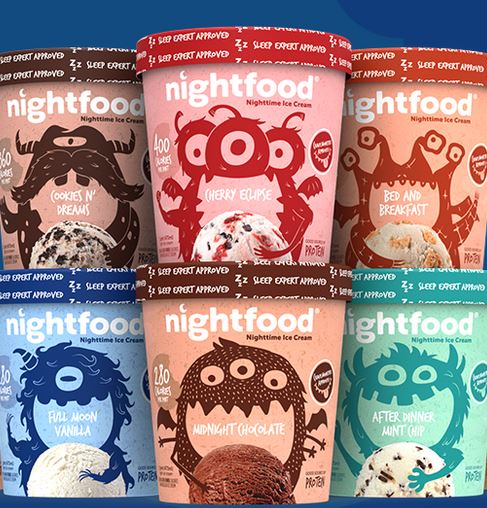
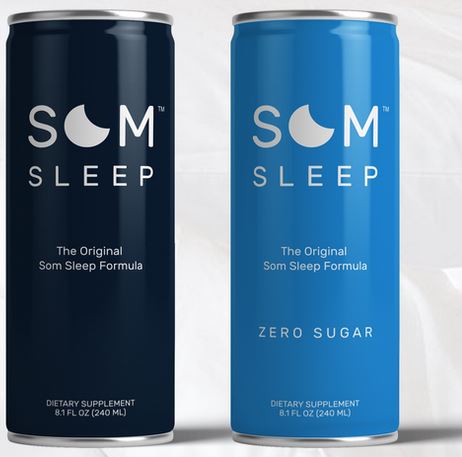
Meet the latest trend in sleep aids: “pre-bedtime” snacks!  Choose from a pint of ice cream, a handful of chocolates, a creamy drink, and others.  They’re all concocted to show you the way to better sleep.  Nightfood’s ice-cream pints are carefully advertised as “sleep-friendly”.  Nestle’s “Goodnight” candies subtly recommend you “enjoy… 30-45 minutes before you’d like to drift off to dreamland”.  Som Sleep’s products innocently ask you to “drink 30 minutes before you are ready to sleep”.

Am I the only one in the room with a terrified look on his face?  I can hear myself already.  “Time to go to bed, honey…. oh wait!  You forgot your delicious pre-bedtime snack.  Don’t you want a good night’s sleep?”  After reading a little about these “foods”, my first thought was not, “how do they taste?”  My first thought was not even, “I wonder if they work?”  NO; my first thought was, “won’t they become psychologically addicting?”  Think about it.  Doesn’t really matter what’s included in the ingredients (i.e. melatonin, magnesium, glycine).  Doesn’t even matter how much you consume.  Rather, if you decide you’re suddenly getting a better night’s sleep, won’t your pre-sleep snacks turn into pre-sleep dependence?  Snacks.  Every night.  For the rest of your life.

For sheer entertainment value, visit the websites and peruse the product claims.  Nightfood says they’ve “removed/minimized stuff that in most other ice creams can be sleep-disruptive” (namely sugar and fat).  Nightfood also says their product “… does not contain sleep-aid substances or drugs.”  Finally, Nightfood does not suggest people eat ice cream as a sleep-aid.  O-kay, anyone else utterly confused?  I can get past an ice cream with no sugar or fat (not that I’d ever eat one), but if Nightfood doesn’t contain sleep-aids and I’m not even supposed to eat Nightfood as a sleep-aid, doesn’t it kinda-sorta lose its purpose in life?

The sad reality is that one-third of us get less than the recommended daily minimum of sleep.  Probably another third is too attached to their handheld devices; brains revving day and night.  The rest of us – save those few quality-sleepers – are getting something else wrong.  But if that’s the truth, instead of snacking on chemicals (er, “food”), why not just adjust a sleep factor or two and see if you can do better?

Despite my soapbox, maybe you’re still looking for the quick fix (to take up pantry space beside your 5-Hour Energy Shots).  Guilty as charged?  Go ahead then; buy into the hype.  As Nightfood jingles, “…turn on TV, grab spoon, do your thing, sweet dreams!”  You can almost see the company’s founders sleeping – er, laughing, all the way to the bank.

Some content sourced from the Wall Street Journal article, “A Late-Night Snack to Help You Snooze?”

Toasty of the Town

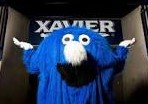
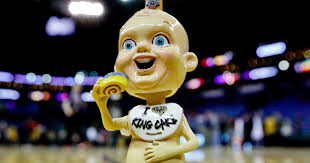
College and professional sports offer the perfect environment for several strange team mascots. Here in the U.S. of A, a bear or tiger or some other animal just doesn’t make the cut anymore. Instead, we have a wide assortment of weirdos: “The Tree” (Stanford University), “Blue Blob” (Xavier University), “The Phillie Phanatic” (Philadelphia pro baseball), and “Whatizit/Izzy” (Atlanta 1996 Summer Olympics). If you prefer downright creepy, look no further than “King Cake Baby” (New Orleans pro basketball). The Pelicans just won the #1 pick in this year’s NBA draft. They should keep King Cake in the closet ’til they sign Zion Williamson.


I’m an avid sports fan, so coming up with these examples was a no-brainer. I could add another dozen without too much thought. But even the weirdest of these characters – take your pick – couldn’t prepare me for a local newcomer, debuting next month alongside our minor league baseball team, the Rocky Mountain Vibes. Meet “Toasty – the fun-loving S’more“. You heard that right – a dancing, cheering S’more.

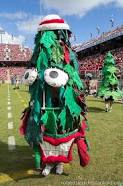
“Toasty”

Salmon and maple syrup?  Incompatible.  Grounds for divorce?  Irreconcilable.  Oil and vinegar?  Immiscible.  But a S’more and baseball?  Super-duper immiscible!

The Rocky Mountain Vibes – formerly the Helena Montana Brewers – must have a twisted front office.  I’d like to meet one or two of their decision-makers.  Consider the five finalists in their “name-the-team” contest:

  1. Colorado Springs Happy Campers
  2. Colorado Springs Lamb Chops
  3. Colorado Springs Punchy Pikas
  4. Colorado Springs Throttle Jockeys
  5. Rocky Mountain Oysters

If these are the finalists, I don’t want to see the rest of the entries. Happy Campers and Lamb Chops?  What the heck is a Punchy Pika?  And for those of you unfamiliar with a Throttle Jockey or Rocky Mountain Oyster, click the links at your own risk.  I repeat, at your own risk.  Don’t say I didn’t warn you.

With a passing degree of intelligence, the Vibes nixed all five finalists and came up with their own choice.  They claimed “Vibes” was something of a spin on “Happy Campers”; that euphoric feeling experienced in the Colorado outdoors.  Whatever.  Even without the reference, it’s a pretty good name.

Otherwise, this baseball team goes off the rails.  The Vibes’ major-league affiliate is the distant Milwaukee Brewers (not the Colorado Rockies right up the road in Denver).  They have five team colors – can’t wait to see those perky uniforms – “rubine” red, navy, gold, sky blue, and tan.  They’ve never, ever won a minor league title.  And then there’s that mascot.  I can’t get past it; a dancing, cheering S’more?  And then you had to go and name him “Toasty”?

If we’re just talking S’mores as a dessert – remove the Vibes – we’d be having a whole different conversation.  I love a good S’more.  Er, qualify that; I love a good S’more for about ten minutes.  Then I’ve had enough for the next six months.  It’s like those plate-sized German apple pancakes you gorge on at carnivals and amusement parks.  They sound good and smell good, but you pay too much for one and you’re feeling sick after just a couple of bites.  Don’t forget to wipe all that powdered sugar off your face.

S’mores are a basic, fun dessert.  Like the wheel or the hamburger, the origin of the S’more is debatable.  The most credible story in my book: a recipe published by the Campfire Marshmallow company back in the 1920’s.  Since then S’mores have been a favorite of the Boy Scouts and Girl Scouts (or just about anyone with graham crackers, marshmallows, chocolate bars, and a nearby campfire).  You can order a S’mores Frappuccino at Starbucks. You can even purchase an “Electric S’mores Maker” on Amazon.

With no lack of embarrassing small-town flair, Colorado Springs has completely embraced Toasty’s upcoming debut.  A handful of local diners want you to “Vote for Your Favorite ‘S’more'”, with the following choices (restaurant names omitted in a desperate attempt to save their reputations):

  1. S’mores cheesecake bar (“healthier” with GF graham crackers!)
  2. “Sweet Victory” Tableside S’mores (including mini-campfire!)
  3. Smoky S’mores Cannoli (apologies to Italy)
  4. Savory S’mores Lamb Chops (no comment)
  5. S’mores Pancakes (i.e. dessert for breakfast)
  6. S’mores Florentina (with rum flambé, naturally)

Mark your calendar – August 10th is National S’mores Day.  You’ll probably get a free one if you’re watching the Vibes at the ballpark that day.  As for me, I’ll be sitting at home lamenting our former minor-league baseball team, the Colorado Springs Sky Sox.  I’ve already forgotten the Sox mascot. Pretty sure it wasn’t a dessert.


Some content sourced from the Springs Magazine article, “Toasty S’mores Tasting Contest”, and Wikipedia, “the free encyclopedia”.

Poultry Par Excellence

Among its endless and varied topics, Wikipedia includes a list of “notable chicken restaurants” (just about all of them U.S.-based). In the fast-food subcategory alone, you find over 75 fowl food-stops. I recognized about one in ten as I scanned the list, including Bojangles’, Bush’s, Church’s, El Pollo Loco, KFC, Popeye’s, Raising Cane’s, Wild Wings, and Zaxby’s. That’s a lot of drive-thru chicken. Yet put ’em all in the back seat, because I side with those clever Holstein dairy cows, begging me to “Eat Mor Chikin”.  And I do eat more – at Chick-fil-A.

As the kids morphed from teenagers to adults, fast food pretty much disappeared from our eating-out options.  Starbucks aside (because coffee is the elixir of life), we stopped navigating the circuitous drive-thru’s of McDonald’s and the like.  Our palates demanded better and healthier.  More appealing sit-down options beckoned on every street corner.  But Chick-fil-A stubbornly persisted in the mix, as if waving a banner with the words, “Exception To The Rule”.

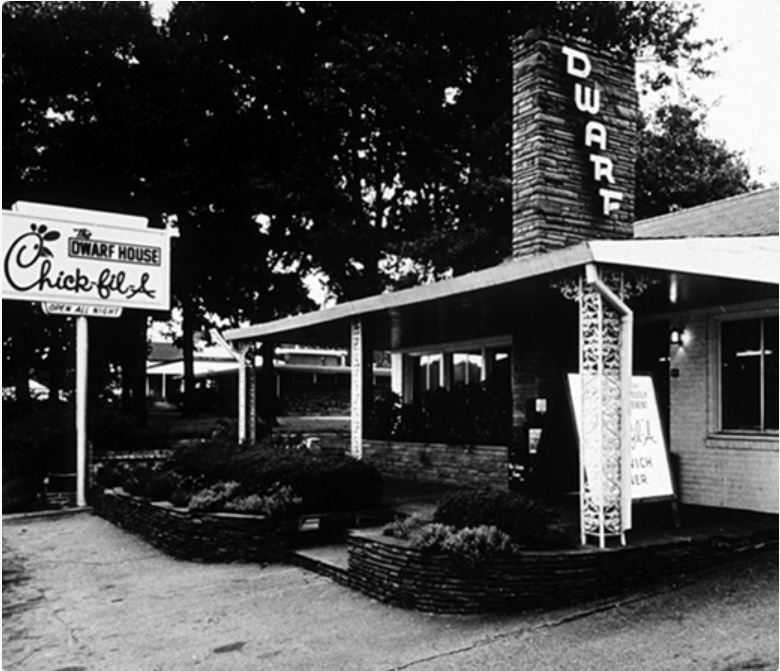
Dwarf House – Hapeville, GA

No matter how you label it, there’s a lot to like about Chick-fil-A.  For one, it’s the great American success story.  Its origins trace back to founder S. Truett Cathy, and a 1960’s-era restaurant near Atlanta called Dwarf House.  Its popularity swelled through twenty years of growth in shopping mall food courts. Its first free-standing restaurant opened in 1986.  Today, you’ll find more than 2,400 Chick-fil-A’s scattered across the continent, including a prominent three-story location in mid-town Manhattan, and several in Toronto, Canada.

It’s all about the food, of course.  Chick-fil-A’s most-ordered entree – the classic chicken sandwich (breaded, with pickles and a butter-toasted bun) – is a recipe unchanged since its inception fifty years ago.  The signature waffle fries accompanying the entrees are the most popular item on the entire menu.  And Chick-fil-A’s lemonade and milkshakes have a devoted following all by themselves.  Some patrons cruise the drive-thru for nothing but the drinks.

The Chick-fil-A’ “classic”

There’s more to like about Chick-fil-A.  Their brand of customer service is exceptional.  Chick-fil-A is the only restaurant I know where you’ll hear the words “my pleasure” in exchange for your “thank you”.  Between your order, payment, and the window itself, you’ll probably get “my pleasure'” three times in a single drive-thru.  That kind of courtesy never gets old.

American Customer Satisfaction Index (ACSI)

How about the numbers?  Chick-fil-A is the third-biggest U.S. restaurant chain ranked by sales (behind only Starbucks and McDonald’s).  Their sales have quintupled in the last ten years, to over $10.2 billion.  Chick-fil-A’s market share among fast-food chicken restaurants hovers around 33%.  Their nearest competitor – KFC – is a distant 15.3%.

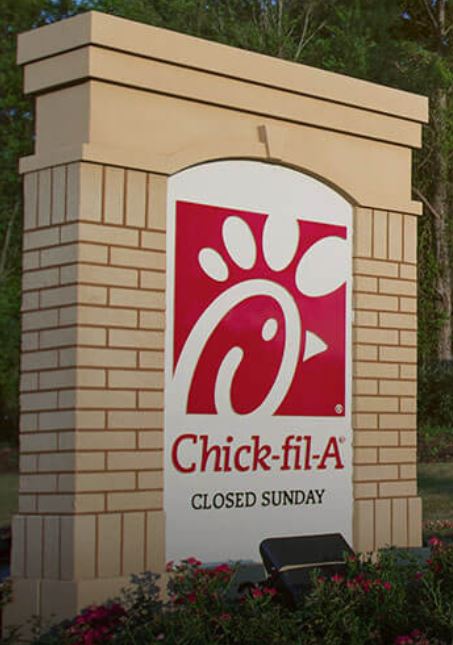
Here’s one more reason to love Chick-fil-A: they’re closed on Sundays (as well as Thanksgiving and Christmas).  In the company’s own words, “Our decision to close on Sunday was our way of honoring God and of directing our attention to things that mattered more than our business.”  No matter the faith angle, you have to respect a restaurant giving its entire workforce the day off once a week.  Not to mention, a closed Chick-fil-A just makes the heart grow fonder.

A recent Wall Street Journal (WSJ) profile on Chick-fil-A shows they don’t mess with success.  McDonald’s regularly tests its patrons with trendy offerings (“Bacon Smokehouse Burger”).  Burger King reinvents itself with its upcoming “Impossible” (veggie) Whopper.  Meanwhile, Chick-fil-A maintains a little-changed menu of what’s been selling for decades: responsibly sourced, domestically produced, no-filler-no-preservative chicken.

At the conclusion of the WSJ article, I found one hundred reader comments about Chick-fil-A.  I scanned half of them, and every last one was positive.  That’s a first for me.  In today’s cynical world, 100% positive feedback may be the most telling statistic of all.

Final factoid.  For all my allegiance to Chick-fil-A, I must admit I didn’t know the origin of the name – until now.  Go figure, it’s just a mash-up of “chicken fillet”.  And the “-A”?  “Grade A”, a subtle nod to the quality of the Chick-fil-A product.  No wonder those cows push you to lay off beef.  They’re offering chicken par excellence instead.

Some content sourced from the official website of Chick-fil-A.

Hot Little Numbers

Yesterday, I became reacquainted with “hack” – a harsh bit of a word.  On the one hand, hack is when you take big chops into a tree with your ax.  Nothing wrong with that. Hack is also whether you can cope with a given situation (i.e. “can you hack it?”).  Nothing wrong with that either.  But then again, hack is uncontrollable coughing caused by a bad cold.  Or even worse, hack is breaking into a computer or account, with not-so-nice intentions.

I experienced not-so-nice hack yesterday.  My wife and I are waging war with a cold we’ve had since Easter.  Together we’re coughing up a storm (sounds of thunder).  More to the subject at hand, our bank left a tidy little message on our answering machine last night. “…do we have reason to suspect fraudulent charges on our Visa card?”  So, I logged onto our account and scrolled down to the last couple of days of activity.  There the little devils hid – six small charges, all for the food-delivery service “DoorDash“.

Have I ever used DoorDash? (No.) Do I even know what DoorDash is? (I do now.) I have no use for DoorDash, nor them for me.  We live in the country; wide, open spaces in every direction.  The only way we get pizza delivery is to agree to meet the driver halfway.  The only way we get trash service is to pay “fuel surcharges” on top of the monthly bill.  We’re too far out for DoorDash.  Just for grins, I entered our address into DoorDash’s website and up popped my options.  Cool!  For thirty days I get free service on delivery orders above $10.  Not cool – I have zero nearby restaurants offering DoorDash.  Guess its pizza for dinner again tonight.

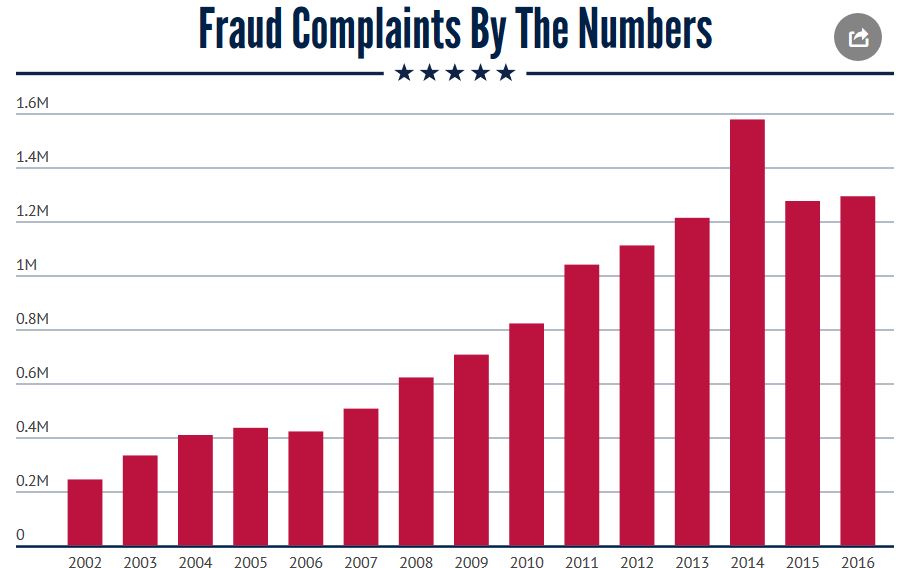
Data Source: FTC Consumer Sentinel Network Data Book 2016

But I digress.  Back to the hack.  To my bank’s “credit”, they handle minor fraud efficiently.  They noticed the hack before I did (bless their computer algorithms).  Once I called back and denied any knowledge of DoorDash, they blocked my card and promptly dropped a new one into the mail.  A few days from now, I’ll be off and charging again, the only real inconvenience being to update my linked accounts.

I wish I could leave it at that.  After all, this incident won’t cost me a penny.  Those who pay annual fees and interest charges unknowingly pay the cost of credit card fraud as well ($40 billion every year).  I just can’t get past the fact someone out there enjoyed six free DoorDash deliveries courtesy of my credit.

The scammers are winning this game hands-down. A physical credit card allows crazy-easy access to its critical information.  Take your pick as you regularly surrender your data: 1) through your phone, 2) through your computer, 3) through self-service devices (i.e. gas pump, ATM), and 4) by simply handing over your card at a place of business.

Left: actual card slot. Right: Skimmer data-collection “cover”.

My DoorDash friend picked up my numbers through one of the last two ways – I’m sure of it.  I never give out my credit card over the phone, and the websites I use have some form of verifiable security.  Alas, self-service devices and handing over cards are no-win situations.  With the former, you encounter skimmers (discrete data-collection devices placed over card readers).  With the latter, you risk the merchant or waitstaff copying your numbers when out of sight.  They probably use a skimmer as well.

The only real solution to credit card fraud – sad to say – is not using the card at all.  Pay for your gas with cash.  Write a check for the cash you would’ve taken out of the ATM.  Technology is improving the situation (i.e. Apple Pay, table-side pay systems), but until these approaches become the norm, you’ll continue to deal with situations where your card goes out-of-sight.

Frankly, I’m not asking for much here.  All I want is my bank to collar my DoorDash friend and let me know he/she faces the consequences of their actions.  But I know my little scammer is not worth their time.  Instead, he/she keeps getting free food, and annual fees and interest rates tick up a little bit more.

My brand new Visa card arrives later in the week.  I’ll activate it and update my linked accounts.  The inconvenience to me amounts to less than thirty minutes.  But the annoyance of it all – well – that feeling lasts a whole lot longer.  I just hope, by the time DoorDash gets to my neighborhood, I’m no longer perturbed and willing to give it a try.

Hope they’ll take cash.

Some content sourced from the March 2019 Upgraded Points article, “The Best Ways to Prevent Credit Card Fraud & Theft”.

Crushed Rock

Checked the tires lately? No, no, no – not the air pressure – the treads. Take a good look the next time you grab the car keys. Besides pebbles in the grooves or nicks in the rubber, your tires might sport a bright swipe of yellow on the sidewall. That, my friends, is the calling card of the local police, tracking your parking habits.  You could say you’re a “marked man”.  But sadly – at least for me – the time has come for that chalk to go back to just being rock.

The Sixth Circuit U.S. Court of Appeals sits in Cincinnati, with a jurisdiction of Michigan, Ohio, Kentucky, and Tennessee.  Recently, a disgruntled Michiganite, possessor of fifteen parking tickets in three years (all issued by the same enforcement officer – creepy), decided she’d had enough and filed suit.  Just this week, the Sixth decided yes, in fact; chalking tires is unconstitutional.  By definition, chalking is somehow “a search of personal property”.  By ruling of the Sixth, that search is considered unreasonable under the Fourth Amendment.  Whoa.  All because of a little chalk?

I’m trying to decide if “trivial” or “ludicrous” is the better word for this little story (see news article and twelve-page ruling here).  Clearly, I don’t understand the fuss.  Is chalking an invasion of our personal space?  Are we channeling our inner little kid and crying, “don’t touch my stuff”?  Have we arrived at the Land of Ridiculousness, where issuing a parking citation requires a search warrant?

In my Mayberry world, chalking tires is kind of charming.  It’s a mark of a small town.  Perhaps the council didn’t like the look of parking meters.  Perhaps they couldn’t afford them.  Whatever the reason, they released parking enforcement by foot (or bicycle), to cruise up and down the blocks “swiping tires”.  Two hours later, those marks sometimes become parking citations.

College campuses are common ground for chalking tires, so the mixed opinions of students on this week’s ruling came as a surprise.  Some worry new technology (camera shots?  microchips?) will be more intrusive.  Others are simply glad parking enforcement will be hands-off.  Still others will miss the opportunity of “clever” ways to beat the system (a. Spray tires with a non-stick coating.  b. Cover tires completely with chalk.  c. Take tires with you after you park.)

I feel bad for chalk factories.  Parking enforcement was a significant, high-profile use of their product, and now that’s been taken away.  A substance of little more than calcium carbonate just lost some major press.  The rest of chalk’s uses – by comparison – are downright banal.

White Cliffs of Dover, England

When was the last time you encountered chalk?  Probably been awhile.  Unless you’re a teacher at the blackboard, a tailor marking clothes, a gymnast, rock-climber, weightlifter, or cuing up a game of pool, it’s safe to say you haven’t used chalk lately.  Unless you’ve sailed in front of the White Cliffs of Dover, you probably haven’t even seen chalk lately.

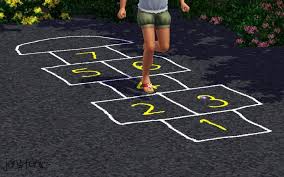
How about chalk memories?  My earliest comes from the playground of my elementary school.  Before the days of painted lines, girls would chalk out hopscotch squares on the asphalt, doing their skips as they collected items from the squares (we boys were too cool for hopscotch).  My favorite chalk memory comes from college, when my engineering professor laid out equations on the blackboard, then turned to talk to the class.  As he spoke, he’d subconsciously hold the chalk aside his nose.  By the end of the lecture his face was fairly covered in chalk dust.

A few weeks ago, my wife and I took a trip to Charleston, SC, and to nearby Folly Beach.  The (now defunct) Morris Island lighthouse stands several hundred yards off the coast.  A mile-long asphalt trail takes you from the parking lot to the beach, as close as you can get to the lighthouse.  That trail is the photo below.  Hundreds of pictures and sayings; bold, colorful sidewalk art.  You literally walk the chalk.

The next time I get a parking ticket (and there will be a next time), I’ll be tempted to check my tires.  No longer.  Instead, I’ll just chalk it up to days-gone-by, when marking tires was simply a good intention, not a violation of the U.S. Constitution.

What a world.

Boston Long

Durgin-Park, the venerable restaurant inside of Boston’s Faneuil Hall, recently closed its doors after almost two hundred years of operation. You read that right; D-P opened for business a few decades after the Revolutionary War, but served its last patron this year, citing “an inability to turn a profit”. For America at least, that’s some serious history. For Beantown on the other hand, that’s par for the course. After all, this week the Boston Marathon completed its 123rd consecutive running.
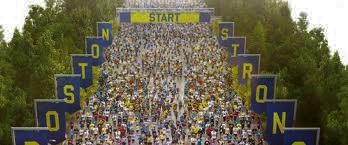
I am in awe of runners who qualify for – let alone run – the Boston Marathon.  It’s daunting enough to compete for 26.2 miles, but you can’t join the “fun” in Boston unless you complete a qualifying marathon in under 3 hours (men, ages 18-34), or 3.5 hours (women).  Consider, 3 hours is an average pace of 7 min./mile.  To appreciate that, go to the gym, crank up the treadmill to eight or nine miles/hour, and see how long you can maintain it.  Now imagine running that fast for three hours straight, up and down the city streets of Boston.  It’s superhuman.

The Boston is the world’s oldest annual marathon.  Simply achieving the age-specific qualification time is the goal of most elite long-distance runners.  But if that’s all you know about New England’s most-spectated event, you’re missing out on some fascinating race-related trivia.  Here’s a sampling:

  1. The Boston is run every “Patriots’ Day” (the third Monday in April), a holiday to commemorate the start of the American Revolutionary War.  Effectively, the marathon is a nod to freedom.
  2. The Boston was first run in 1897, one hundred years after the first Olympic marathon in Athens, Greece.  That marathon, as most know, was inspired by the fabled run of the Greek soldier Phillipides from Marathon to Athens, announcing a battle victory over the Persians.  Effectively, Phillipides’ run was also a nod to freedom.
  3. The Boston Red Sox play every Patriots’ Day in Fenway Park.  The game finishes in time for the fans to walk a mile east along the Charles River, arriving in Copley Square as the marathon runners are crossing the finish line.
  4. Until 1986, the men’s and women’s winners received a wreath of olive branches and a trophy; no cash prize.  Today?  First place: $150k, Second: $75k, Third: $40k, and Fourth: $25k.  Might want to dust off the running shoes and start training.
  5. Check out Derek Murphy’s “marathon investigation” blog here.  Derrick started his sleuthing five years ago and outed over 250 cheaters, including several who faked their race qualification times in order to run.  Too bad Derrick wasn’t around for the 1980 race, when Rosie Ruiz pulled off the marathon’s most famous heist (see her story here).
  6. In the 2011 race, Geoffrey Mutai of Kenya effectively broke the world marathon record (even though it wasn’t deemed official), finishing in 2:03:03.  Try that pace on a treadmill.  Set the speed at twelve miles/hour and… well… let it spin from a safe distance and just watch.
  7. The Boston draws an average of 30,000 participants each year, cheered on by 500,000 spectators.  The participants are divided into men’s and women’s categories of “elite runners” (i.e. pros), the remaining qualified runners (waves of 10,000), wheelchair-bound, and hand-cyclists.  The Boston even accommodates blind runners.
  8. The Boston is famous for Heartbreak Hill; the incline located a few miles from the finish where runners tend to hit an endurance “wall”.  Why the name? In the 1936 race, Johnny Kelley caught up with rival Tarzan Brown on that hill, giving him a pat on the back as he passed by.  Bad move.  Brown took the gesture as a challenge, found another gear, and went on to win the race.  Brown effectively “broke Kelly’s heart” and the hill gained a name forever.
  9. Halfway through the Boston, the lively women from nearby Wellesley College form a long “Scream Tunnel”, yelling and blowing kisses as the runners pass by.  These ladies are so loud, you’ll know the Scream Tunnel is coming a mile before you get there.
  10. And finally… the Boston Marathon is not really run in Boston; not until the final couple of miles.  Before that, you’re touring twenty-four miles of eight neighboring towns instead.

Remarkably, this year’s Boston Marathon included four finishers in the top hundred from right here in Colorado Springs.  The next day, my cycle instructor casually mentioned she’d run the race before.  Ditto my former boss at Hewlett-Packard.  And my sister-in-law has a good chance of qualifying in the next couple of years.  Superhumans.  As for me?  I do like to run, but I’d be happy enough just to spectate beside those hundreds of thousands of “Boston Strong”.  I’m just sorry I can’t have dinner at Durgin-Park afterwards.

Some content sourced from Wikipedia, “the free encyclopedia”; and the Mental Floss article, “11 Fast Facts About the Boston Marathon”.

Smile for the Camera

I could dedicate an entire blog to Americans and their deliberately awful driving habits. Think about the last time an impatient driver just about kissed your rear bumper – practically screaming you over to the slow lane (and how you stayed in the lane anyway just to make ’em madder).  Or how about merging onto a rushing interstate highway, only to be denied by drivers who want to “win” the right lane?  Lately, a new habit takes the checkered flag for most-annoying: drivers sneaking through intersections when the light just turns red.  You know these evaders; the car dashing through after the car sneaking through on the yellow.  For these drivers, it’s time to smile.  Colorado Springs has installed red-light cameras.

Red-light cameras have been around for years, but our fair city decided it’s finally time for the photo ops.  At two of our busiest intersections, the city just put the finishing touches on the cameras.  For the next thirty days they’ll kind of test the waters; see how much action they get.  No tickets, just photos.  To that I say: forget the thirty-day trial and begin the citations.  Eleven hours after the cameras started snapping last Tuesday, the city had already recorded sixty-two red-light violations.  Sixty-two!  Do the math and you amass 4,000 violations per month.  Do the math again – at $75 per violation – and you bank $300k.  That’s two cameras and only two intersections.

This photo shoot will get fun in a hurry.  After the thirty-day trial the city adds another two cameras at another two intersections, with another thirty-day trial, and so on and so on.  The entire program is easily funded by all those $75 fines.  I don’t know the cost of a red-light camera, but at the rate we’re going we’ll have the entire city camera’d in no time.

My opinion on red-light cameras is hardly below board.  I think they’re a wonderful use of technology.  Not a day goes by where I don’t witness an “extra” car in the intersection.  When it happens, two thoughts come to mind.  First, it’s a miracle we don’t have an accident.  Second, the violator bought into this opportunity long before it happened.  Think about it.  The light turns red at the same time the cross-light turns green.  There should be an accident.  But the red-light violator banks on the delayed reaction of the driver accelerating on the green.  He/she sneaks through before the opposing car really gets going.  It’s a gamble on human lives – every time.

Speaking of the $75 fine, a moving violation is supposed to set you back $150.  Yet getting caught by a red-light camera doesn’t count as “moving”.  Care to explain that?  Aren’t you “moving” as you deliberately break the law?  Regardless, they’re making this program as friendly as possible.  The police review the infraction and the photos in all cases.  You must enter the intersection after the signal turns red to be cited.  You don’t even get points on your driving record.

A few years ago, my son got a ticket from a red-light camera in another city.  He didn’t realize his infraction (or so he claims) until the citation arrived in the mail.  Conveniently, you get a URL for the photos so you can see exactly what happened.  The technology is remarkable; five or six pics, including the license plate on the vehicle (front and rear), a full shot of the vehicle in the intersection while the signal is red, and that smile-for-the-camera shot of the driver.  With photos from all angles, there’s no arguing the infraction.

As if to underscore the need for this program in Colorado Springs, last Friday a driver blew through a red light, collided with two other cars, and sent several people to the hospital with serious injuries.  Just happened to be one of the two intersections where the city installed the cameras.  I’d say they got this right.  I’d also say this program is long overdue.  No more “colorblind driving”, people. Red is red.

Sham Sandwich

Back in my high-school burger-flipping days at McDonald’s, I worked countless shifts at the “quarter-pounder” grill, which involved a whole lot of beef. McDonald’s standard hamburger was a little brown disc – barely a tenth of a pound – and you could grill fifty at once like a big array of domino dots. The quarter-pounder, on the other hand, was a real burger. Those big boys required higher temperatures and more real estate; hence their own grill. Even the ever-popular Big Mac – a double-decker of the smaller ones – couldn’t tip the scales like the quarter-pounder patty. But no matter the weight, at least we were cooking up beef (and hooking an occasional Filet-O-Fish). On today’s fast-food menus, beef is getting a little scarcer; nudged aside by… well, the “impossible”.

McDonald’s Quarter-Pounder

“Veggie” burgers have been around in one form or another for the past forty years – mostly a quiet nondescript option at the bottom of the menu. Lately however, they’re starting to crowd the stage alongside beef. Maybe they’re just the same ol’ veggie burger, and today’s consumer is more tolerant because he/she is more health-conscious. But that can’t be true, can it, or I wouldn’t bother covering this topic today. Hey, when the New York Times makes a headline out of Burger King’s latest offering, it’s hard not to notice.

Impossible Foods (IF) is a small but rapidly-growing “burger” maker headquartered in Redwood City, CA. IF’s production takes place in a single factory across the bay in Oakland. After their latest contract, IF executives may be looking for more factory locations. They just signed a deal to add their product to the home of the Whopper. As you should figure by now, the IF burger is anything but meat. Not a “moo” to be heard anywhere in the building.

The Impossible

If we were only talking about Burger King – and only a handful of pilot stores in Missouri and Illinois at that – the “Impossible Whopper” wouldn’t be such a big deal. But here’s what makes me pause. “The Impossible” is also about to appear on every Red Robin restaurant menu in the U.S. (over 500 locations). White Castle already sells an Impossible Slider in all of its restaurants (380). And Carl’s Jr – albeit with a competitor of IF – offers a veggie burger in 1,000 of its restaurants. Every one of these chains prides itself on beef burgers. Yet if the Burger King pilot is a success, we’ll see the Impossible Whopper in over 7,200 locations. What the heck is going on?

A reasonable alternative, and demand from a health/environment-conscious consumer – that’s what’s going on. We finally have a tasty veggie-competitor to the all-beef patty. The Impossible (also a great country song by Joe Nichols, by the way), has the endorsement of not only fast-food chains and the media, but food critics as well. Apparently, one cannot distinguish said imposter from beef. You don’t need so much as a sprig of lettuce on this one, because you’re already getting plenty of “vegetable”.

I could list the ingredients, technology, and environmental benefits of the Impossible, but it’s more fun to watch the company’s informational video. See if you aren’t inspired after spending a couple of minutes with Impossible Foods:

IF puts a lot of science into “beef taste”, and the numbers don’t lie (see below). Less cholesterol and saturated fat. Far fewer calories. And, consuming one Impossible instead of one Whopper saves the equivalent of a ten-minute shower in water. It also saves eighteen combustion-engine miles of greenhouse gases. Look at you, eating fast food with an empathetic nod to Mother Earth.

The Impossible

To play devil’s advocate – despite the healthier ingredients and gentler impact on the environment – the success (or demise) of the Impossible will surely come down to taste. On that topic, I am not yet an expert. In fact, I am a skeptic. On one regrettable visit to Red Robin, I opted for their salmon burger over beef, thinking I was doing my body (and Earth) a favor. Mistake. Is it any wonder Red Robin no longer offers that sandwich?

I can’t use salmon burgers as an excuse not to try the Impossible. We have a couple of Red Robins in the neighborhood, and a local organic foods cafe already has one on the menu. No reason I can’t go down and give it a go. Also, “ground Impossible” will appear in grocery stores later this year (alongside the meats?), so I can even make my own patties. In other words, watch out McDonald’s. This veggie burger is no impossible dream.
Some content sourced from the New York Times article, “Behold the Beefless ‘Impossible Whopper’, and the Impossible Foods website.

Not-o Lotto Reasons to Play

Ponder the number “6” for a minute and see what spins around in your brain.  A half-dozen eggs sitting neatly in their half-carton.  The perfectly-square sides of a cube.  Strings on a standard guitar.  A team of volleyball players.  The geese in “The Twelve Days of Christmas”?  A Star of David, a purchase of beer, or the largest roll of a die?  Forget ’em all; they pale in comparison to this week’s headlines.  Here in America – happening more and more frequently – “6” causes a nationwide frenzy for a wholly different reason: ping-pong balls.  Ping-pong balls?

Powerball, the American lottery game shared by 44 of the 50 states, has its jackpot blossoming into the stratosphere again this week. The five white + one red (Power)balls are spinning relentlessly into our hopes and dreams.  Local news is positively frothy over the $750,000,000 jackpot, the third-largest since Powerball began in 1992. Never mind the ridiculous odds of winning (1 in 292,201,338).  Never mind no one picked the winning numbers in twenty-six consecutive drawings since Christmas.  Also never mind not one of the 183 winning Powerball jackpot tickets has ever been sold in Colorado.  That’s 16 years + 1,664 drawings = 0 winners in the Centennial State.  Even tiny Rhode Island fared better than that (1 winner).  No matter; our broadcasters still push aside this week’s actual news to cry, “Get your tickets now, people – you could be the next Powerball winner!”  Yeah, right.

Powerball jackpot history does not favor Colorado

Admittedly, my wife and I have played Powerball – but only a handful of times.  It’s like we have an unwritten rule: no tickets unless the jackpot exceeds a half-billion dollars.  But it’s not the news alerting us to all that potential windfall; it’s my mother-in-law.  She follows the lottery like a hawk.  Whenever we step into her house, she always knows exactly where the jackpot stands.  Her tickets sit patiently on the kitchen counter, ready for that next biweekly drawing (as she unfailingly asks, “Have you bought yours?”)  Just this week my mother-in-law realized her winnings can be multiplied several times over if she’s willing to pay more.  That’s an important aspect of the game, Mom.  Not that I consider the woman a Powerball guru.  After all, she’s the one who holds up the convenience store line when she turns in her winning tickets… because she’s buying more tickets.  You have to wonder if she ever sees cash in hand, or if this drill is just an endless cycle of ping-pong balls.

Colorado wasn’t always a part of Powerball.  Our state came to the table late – in 2001 – almost a decade after the game began.  Before joining, I remember the “legendary” stories of Coloradans who would drive all the way to Kansas or Nebraska (hours) just to purchase Powerball tickets.  That mind-numbing trip to the east would cost you at least two tanks of gas, and the convenience stores at the borders would have hundreds of customers in line.  That’s a lot of effort for odds of 1 in 192,000,000.  A lot of gamble for a little game.  Too fortuitous a foray for me.

Speaking of “game”, Powerball really isn’t one, is it?  Yes, there’s a winner (and a whole lot of losers), but one can hardly claim to “play” Powerball.  There’s no rolling of the dice, no dealing of the cards, and no moving of the game pieces.  No strategy or rules.  Instead, it’s just plunk down a few dollars for a quick-pick ticket; then go home and watch the ping-pong balls roll.  “Fun”.

Admittedly (again), my wife and I play Powerball for those proverbial hopes and dreams.  We always start our conversation with, “What would you do if you won?”  That conversation alone is almost worth the cost of the ticket.  What would I do with $750,000,000? Well, let’s break it down.  The cash value of the jackpot (lump sum vs. 30 annual installments) is $477 million.  Federal/state taxes drop that number to an even $300 million.  Then I pay off the mortgage and any other debt.  Set up a fund to gift my three kids the maximum tax-free amount allowed.  Remodel the house and ranch.  Travel the world.  Give generously.  Orbit the earth in a SpaceX rocket.  The list does not go on and on.  That’s about all I can come up with, folks.

Roughly calculated, my fulfilled hopes and dreams leave me with about $250 million yet to spend.  This is exhausting.  I’d rather play ping-pong with the numbered balls.  Not that it matters – Powerball’s latest jackpot ticket was just purchased in Wisconsin.  (Called it – Colorado is now 0-184.)  That’s a lot of bread for a Cheesehead.

Let’s Do the Twist!

My Amazon order history says a lot about my purchasing habits. I am a buyer of needs vs. wants. Pet food. Printer ink. Humidifier filters. But every now and then, a little something nostalgic sneaks into My Shopping Cart. Favorite childhood books for my one-year-old granddaughter.  A balloon-launching catapult to make a Thanksgiving turkey fly (it didn’t).  Italian chocolates from Perugia, also discovered during a year abroad in college.  And just today – on total impulse – a Rubik’s Cube.

Rubik’s Cube – adding a few wrinkles to us baby boomers – celebrates its forty-fifth birthday this year.  Back in 1974 when it was invented (and originally dubbed “Magic Cube”), the 3x3x3 trinket earned our attention for its mechanical magic as well as its almost-impossible-to-memorize solution.

To be precise, there are 43,252,003,274,489,856,000 (that’s “quintillion”) possible positions of Rubik’s colorful squares.  The Cube comes with neither instructions nor answers.  Already solved in its packaging, you can’t help twisting it up into a mess of color.  In our pre-Internet world, Rubik’s Cube required endless gyrations in search of the answer (instead of just, “Hey Alexa”).  But there was something immensely satisfying about the resulting nine squares of single color on each of its six sides.  There was also something tempting about peeling off the colored stickers and rearranging them instead.

Erno Rubik (courtesy of Wikipedia)

Erno Rubik, a Hungarian inventor, was an architect and architecture professor “searching to find a good task for his students” when he completed the Cube’s first working prototype – a mess of wood blocks and rubber bands.  A small plastics company took a chance on its manufacture and the rest is history.  In the first four years alone, two hundred million Cubes were produced and sold.

I was in college (and also an architecture student) when Rubik’s Cube first hit the shelves.  Its perfect symmetry and twisting ability to reinvent its colorful look went hand-in-hand with my interest in building design.  I remember keeping a Cube on my dorm room desk – at first for mindless manipulation; later for successful solving.  Not that I could solve it quickly, mind you.  The world record – an average of five solves – is six seconds.  The world record with one hand (???) is nine seconds.  The world record using only your feet (again, ???) is twenty-two seconds.  My solve is expressed in minutes, if not hours.


Few puzzles compete with Rubik’s Cube for sheer “can’t put it down”.  But there are a few.  One of my favorites was the wooden double maze, the box-like puzzle with the Etch-A-Sketch dials on the side, maneuvering the steel ball through the walled maze without dropping it through one of several holes.  I devoted hours and hours to that puzzle, always sweating those final tricky turns to the finish.  Another favorite: Marble Solitaire, where you hop-eliminated marbles in search of the perfect solution: a single marble standing proudly in the board’s center divot.  Finally (courtesy of Cracker Barrel restaurants), how about “Triangle Peg Solitaire”, the hop-elimination puzzle with the colored golf tees?  Thanks to that little game, my kids were supremely patient after the dinner order was placed.

With somewhere near four hundred million sold, Rubik’s Cube is considered the best-selling toy of all time.  Its inventive design landed the Cube in the permanent collection of the Museum of Modern Art (MoMA) in 1982.  The Cube also garnered “Toy of the Year” in eight countries, including Germany, France, and the U.S.

GoCube

Inevitably, there were attempts to advance Rubik’s design, such as a 4x4x4 version (“Rubik’s Revenge”), or pyramid, dodecahedron, and hexahedron shapes.  But going completely off the rails, look no further than GoCube – a thoroughly high-tech update to Rubik’s.  GoCube is also 3x3x3, but rimmed with LED lights, and contains wireless smart sensors, an embedded gyro, and an accelerometer.  Download the GoCube app to your phone (of course there’s an app), and watch your twists on-screen instead of on the cube itself.  The app guides you to the solution (if you so choose), creates alternative mosaic-looking puzzles, and run reports on solving speed and efficiency.  You can even wage virtual head-to-head competitions.  All for “only” $119.

“The Pursuit of Happyness” (courtesy of Warner Brothers)

I’m sure Erno Rubik (and Will Smith) would pooh-pooh GoCube as too much of a good thing.  I would agree.  The app-driven, light-up, hundred-dollar GoCube is over the top, with zero nostalgia to boot.  On the other hand, Rubik’s Cube cost me $4.59 on Amazon.  That’s a sweet deal, and a cheap way to learn how to do the twist all over again.

Some content sourced from Wikipedia, “the free encyclopedia”, and the Wall Street Journal article, “Never Solved the Rubik’s Cube?…”