Sphere Elegance

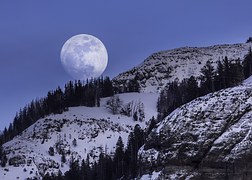
I love full moons.  They look a little too perfect to be one of nature’s essential elements and too large for the vast universe that surrounds them.  Yet there they are, perched silently above the horizon every month or so, beckoning to be plucked out of the night sky.

62-astronomic-1

We had a full moon last Friday and the next will be in mid-October.  But September’s stands alone, as it is rises closest on the calendar to the “Autumnal Equinox”.  It signals the end of the longer summer days, earning the nickname “Harvest Moon”.

The Autumnal Equinox (AE) takes place on September 22nd.  In fact, I timed the publishing of this post to the exact minute of the AE: 8:21am MDT.  The AE is the instance the earth’s axis is exactly perpendicular to its rotational axis around the sun.  When the axis is straight up and down you have equal amounts of “day” and “night” in that twenty-four hours.  That’s a pretty cool slice of astronomy.

As long as we’re in the classroom, the AE also signals the transition from summer to fall in this part of the world.  Yet anywhere in the earth’s Southern Hemisphere the AE signals the transition from winter to spring.  That fact brings a moment of confusion when you consider the Summer Olympics were just hosted in Brazil, doesn’t it?  At least they had a full moon last Friday, same as everywhere else.

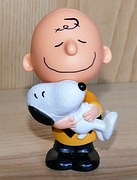
Growing up in a narrow winding canyon, a full moon was a rare sight.  Back then I should’ve thought to wake up in the middle of the night, stand out on the lawn, and stare straight up into the sky to see one.  Maybe I saw a few fulls when I was camping in the Boy Scouts.  Or maybe I just remember them from several of the animated Peanuts specials.  (Charles Schultz was a fan of full moons.  Just watch “It’s the Great Pumpkin, Charlie Brown” next month on TV; or “Snoopy, Come Home” on NetFlix).

62-astronomic-2

As much as I enjoyed our Harvest Moon, it turns out I have an even bigger lunar event around the corner.  On November 14th we get a “Super Full Moon”.  A Super is the one full moon each year where the orbit of the moon is closest to the center of the earth.  So the Harvest may be big but the Super should be astronomic!

No discussion of full moons would be complete without a nod to the “Blue Moon”.  They say, “once in a blue moon”, and that means not very often.  A Blue is a second instance of a full moon in a calendar month.  There were no Blue Moons in 2016 (except the several I purchased for my own consumption of course).

62-astronomic-3

Thankfully I no longer live in a narrow winding canyon but instead in wide open spaces.  No fulls can slip by me anymore.  And I assure you, on that Tuesday in November the week before Thanksgiving, I’ll be hanging out in my family room window at dusk gazing east into the sky.  My Super will be on the rise.

Note: Portions of this post are credited to the research found at timeanddate.com.

Sentimental Utensil

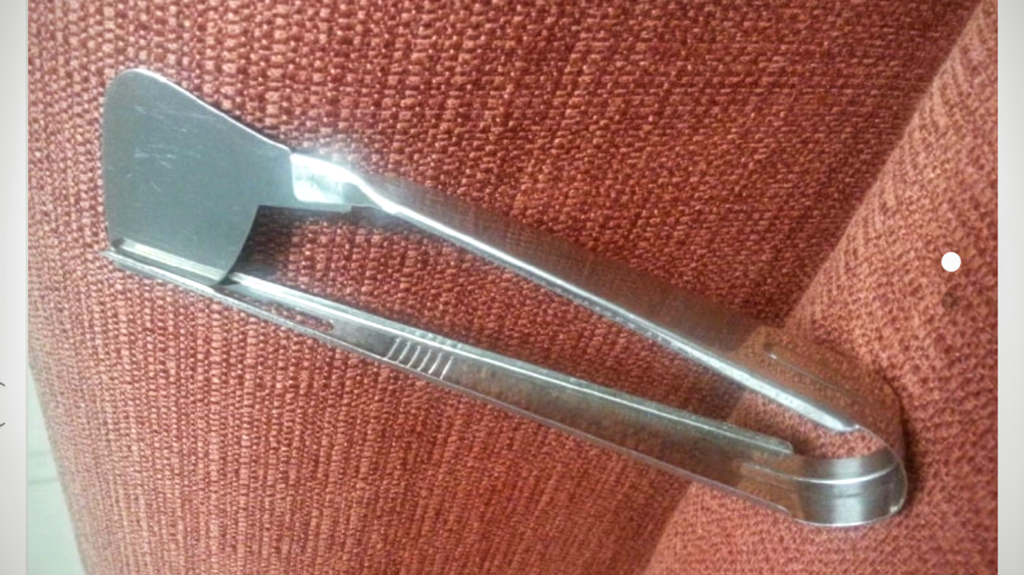
My wife and I were cleaning out the kitchen a few weeks ago when we came across a rather strange-looking device. It could be described as a combination between a small pair of metal tongs and some kind of slicer. We racked our brains trying to figure out what it was for.  Eggs?  Nuts?  Ice?  Bewildered, we wondered if it even belonged in the kitchen.

I showed our gadget to a couple of friends but they were as confounded as I was.  Then I turned it over to my ever-resourceful sister-in-law. She took it to a a couple of kitchen stores and asked several friends, all to no avail. Finally she showed the device to her hair stylist – who sent a phone video to his girlfriend – and voila! – mystery solved.  Turns out our little mechanical metal friend is a butter cutter.

I don’t blame you if you’re still confused.  Not only did I wonder why (as in, why do you need a butter cutter?) or how (as in, how do you use the darned thing?), but also when (as in, when did people ever use one of these?).

I’ll get to the why in a minute.  As for the how, a butter cutter is used by holding the blade perpendicular to a stick of butter, pressing the base down into the stick, then pushing down on the blade.  The push down and spring back of the blade produces the “pat” of butter you sometimes get with a dinner roll at restaurants.  Move on down the stick and you can churn out butter pats to your heart’s content.

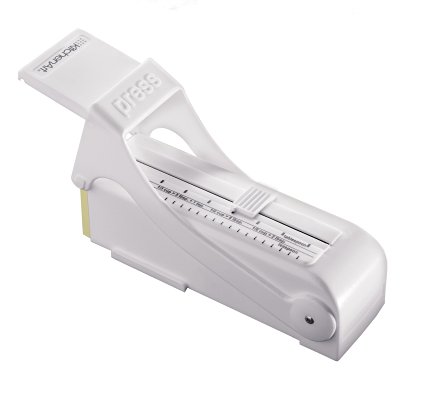
As for the when, it turns out our butter cutter is vintage.  It was popular back in the 1950’s.  If you simply must have one for your kitchen, go here.  But my research also led me to ask which, as in which one?  It turns out there are several butter cutters for your consideration:

61-vintage-2Here’s another vintage model – a bunch of pats all at once!

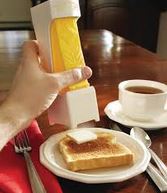
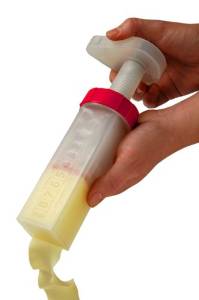
     61-vintage-3        An updated model – regurgitates pats one at a time.

61-vintage-4The Rolls-Royce of cutters.  How thick do you like your pats?

   61-vintage-5      No comment.  This one is simply disgusting.

Remarkably, there are lots of butter cutters out there if you search long enough.  Some claim to also work on rolls of cookie dough.  Others claim to also cut potatoes into chips.  But the more models you find, the more you’re inclined to ask why?  Why go to so much trouble to cut butter when a perfectly ordinary kitchen knife will do just fine (and with far less mess?).  That earth-shattering question is actually covered at unclutterer.com, a blog about “getting and staying organized”.  Check out the hot debate and the wealth of reader comments here (from people who clearly have too much time on their hands).

My own take on why is more satisfying.  The more I thought about our butter cutter, the more I realized I probably inherited it from my mother.  Along with other kitchen items, she probably tossed it into a box as I was heading off to my first apartment so many years ago.  And thinking about it even more, I can picture my mother using her butter cutter when I was a kid, leaving a perfect little pat beside the crescent roll that was positioned carefully on the bread plate beside each place setting at the dinner table.  Because that was my mother.  She was all about the dinner table.  Everything had its place, even the pats of butter.  And there’s an element of grace that comes with the butter cutter that would not be found in simply using a knife.

Laugh at the pointlessness of a butter cutter if you must.  But I will cherish mine instead, as well as the vintage memories that spring back every time I use it.

American Pastime

Over the next three months, on any given Saturday, the spotlight of college athletics will shine brightly on football. Millions of fans will flock to stadiums (or in one instance, a motor speedway) to witness this most American of sports. Tailgate parties will crop up hours before kickoff.  Team-branded merchandise will fly off shelves to the tune of millions of dollars.  Broadcasters will endlessly debate one team’s merits versus another’s shortcomings.  It’s fair to say college football will be a more consuming topic than the presidential election.

60-indelible

Last weekend my family and I experienced the unique opportunity to attend two college football games in Texas on consecutive days. UCLA played Texas A&M in College Station on Saturday, where A&M’s Aggies won in thrilling fashion in overtime. Then Notre Dame played Texas in Austin on Sunday, where UT’s Longhorns also won in thrilling fashion in double overtime. On Friday we could’ve added yet another game, passing through Waco as Baylor opened its season against Northwestern State.

Here are a few college football statistics for your consideration:

  • There are well over 100 NCAA Division 1 college football teams competing on any given Saturday of the season.
  • The combined attendance to last weekend’s games involving at least one team in the Associated Press (AP) Top 25 was over 1.5 million fans. That included UCLA-Texas A&M (100,443) and Notre Dame-Texas (102,315 – an all-time record for a Texas home game).
  • The face value of a major college football game ticket is around $100 this year.  Accordingly last Saturday’s AP Top 25 games alone generated $150 million (not counting merchandise, concessions, and parking).
  • There are eight college football stadiums in the U.S. with more than 100,000 seats, and another twenty-two stadiums with more than 75,000 seats.  The largest NFL football stadium has 82,500 seats.
  • Next Saturday’s college football game between Tennessee and Virginia Tech will be held at Bristol Motor Speedway (TN).  The 150,000 fans expected in the grandstands will shatter the all-time record for college football single-game attendance.

Sure, college football has some impressive numbers.  The game will only get more popular.  Yet last weekend also reminded me there are more indelible memories than the game or the venue itself.  Consider:

  • The heart-warming spirit of hometown Texas A&M.  As a fan of the opposing team, the reception in College Station is akin to a stranger inviting you into his living room for sweet tea and cookies.  I lost track of how many Aggies welcomed us to campus, wished our team well, or simply thanked us for making the trip.  Their politeness is downright 1950’s-sitcom.  With that in mind, add See a football game in College Station to your bucket list.
  • A&M’s Fightin’ Texas Aggie Band.  Also known as the Corps of Cadets, the four hundred musicians comprise the largest military marching band in the world.  Their movements are so coordinated and precise you’d swear you were looking at a computer-generated equivalent.  One Aggie actually apologized to me for the “old-fashioned” feel of the Corp.  On the contrary; it was one of the most impressive halftime shows I’ve ever seen.
  • The Littlest Fans.  Texas A&M and Texas alike draw a healthy number of families to their games.  My favorites are the little ones: those fans between the ages of 5 and 15.  They’re decked out in their team colors and face paint, with shiny hair ribbons and pom-poms.  We had several of them sitting right in front of us at the Notre Dame-Texas game.  Their innocence and unabashed enthusiasm were priceless.

My advice after my mega-weekend of college football?  Ditch the television.  GO to a game and see what you’re missing.  There happens to be one this Saturday, and not far from where you live.

Benevolence at the Ballpark

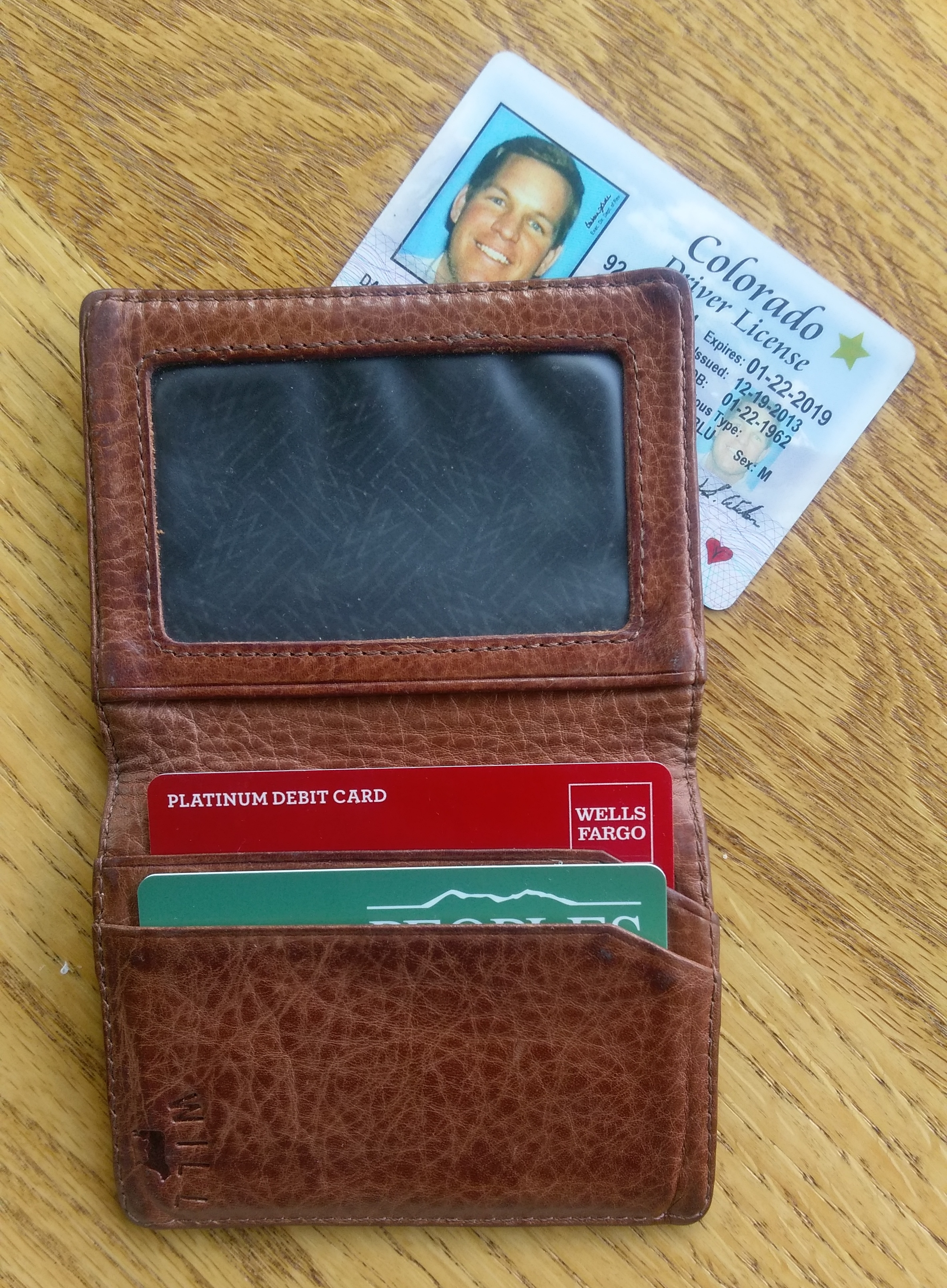
A man losing his wallet is akin to a woman having her purse stolen, even though a wallet is typically so much smaller.  The same level of angst and helplessness ensues when you realize this most personal of belongings is gone.  I should know, since I lost my wallet last Sunday at a baseball game in Denver.  But it was returned to me sooner than I expected, and that simple act of charity will leave an imprint far deeper than the carelessness of my actions.

59 - angst 1

Ironically, I made a deliberate effort to protect my wallet from the game-day crowds.  I put my cell phone in the same front pocket, making my wallet more difficult to “lift”.  It would take some real effort to bring one or the other item out into the open.

But that’s exactly what I did.  Unbeknownst to me, when I took out my phone after the game my wallet was pulled along with it, dropping unnoticed onto the gravel of the parking lot.  And off we sped for home, none the wiser.  Three or four blocks later that moment of angst kicked in when my hand grazed my now empty front pocket.  A frantic glance around the driver’s seat revealed the obvious: my wallet was really, truly gone.  Even though we were back to the parking lot minutes later (where we wondered whether this was a “loss” or a “lift”), our search through the gravel was fruitless.

Now I’d like you to meet Karen, my new friend. Karen lives here in Colorado Springs, maybe on the south side of town. She enjoys going to baseball games on Sunday afternoons. That’s all I know about her (and may ever know), but let’s add one more thing. Like the fellow from the Bible parable, Karen is a good Samaritan.

59 - angst 2

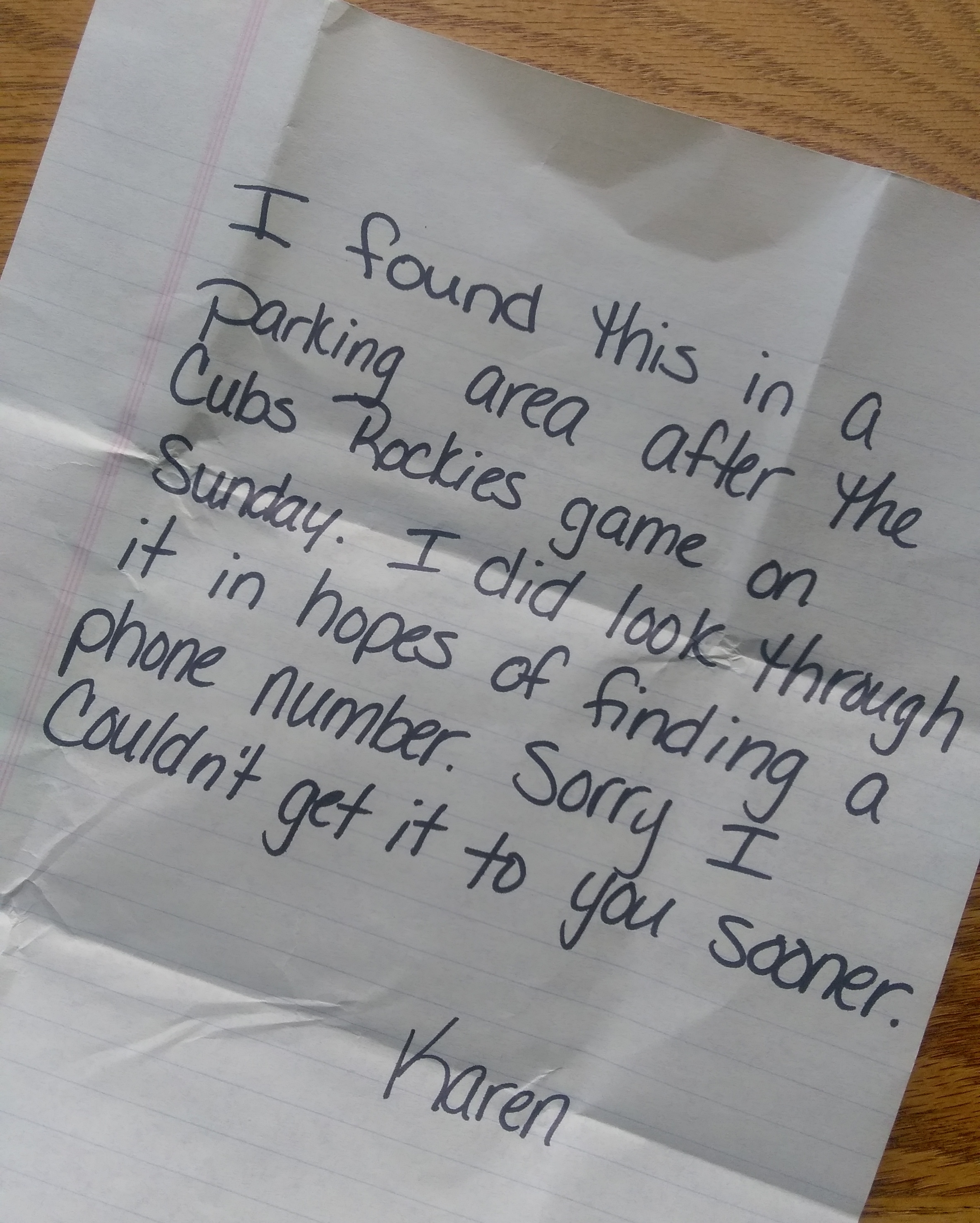
My wallet showed up in my mailbox last Thursday – intact and virtually untouched – wrapped in the note you see above.  What struck me immediately about Karen’s actions was the following: 1) she spent $2.50 or more for the envelope and postage; 2) she apologized for not getting my wallet back to me sooner; and 3) she chose to remain anonymous.  There was no return address on the envelope and the USPS tracking number protected Karen’s contact information.  In this day and age I am somewhat in awe of her decent, anonymous gesture.  My wallet may have fallen to the parking lot but it also fell into the right hands.

The same day my wallet showed up in my mailbox our local newspaper reported a nearby incident involving a stolen wallet from an unlocked car.  The thief is still at-large, and he/she attempted a purchase with one of the credit cards immediately after the steal.  I can’t help but think this is more than just a coincidence of events.

So thank you Karen – whoever and wherever you are.  I may not be able to repay your actions but I can certainly follow your lead.  After all, the world needs more good Samaritans like you.

What’s ‘appening with Dining Out?

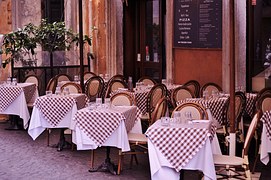
After moving our daughter into her college apartment last Saturday, we offered to take a group of her friends out to a local restaurant to celebrate the beginning of the school year.  The place we chose did not allow for table reservations but did offer call-ahead seating.  Thus did our party of ten arrive during the busy dinner hour and was seated less than ten minutes later.  It’s fair to say this call-ahead experience was entirely pleasing to the palate.

58 - palate

Call-ahead seating is an interesting concept to me.  It’s somewhere between a full-on reservation and simply showing up for dinner.  The restaurant puts you on a list when you call ahead, and then you’re given the next available table after you arrive.  In essence, call-ahead mitigates the restaurant’s risk of the no-show reservation.

Call-ahead feels entirely dated if you use OpenTable, of course  With OT you’re limited to the restaurants supported by the app, but you’re also given the convenience of choosing cuisine, location, menu, and time; right up to the moment you walk through the door.  OT’s website boasts “seating more than 20 million diners per month… across more than 38,000 restaurants”.  Clearly the new-age approach to restaurant reservations has arrived.

But is OpenTable also dated?  With a little research I was amazed to discover several other companies changing our approach to dining out.  Consider the following:

NoWait allows you to add yourself to the wait list of a restaurant that doesn’t take reservations.  NoWait is like having someone stand in line for you, with the convenience of knowing when that person gets to the front of the line.  Hence you can shop or have a drink nearby instead enduring the crowding and impatience of the restaurant’s waiting area.

Rezhound and TableSweep are boosters for OpenTable.  They scan OT for newly-released (cancelled) reservations, then notify you by text or email with what they find.  You have to jump over to OT to actually book the reservation (be quick!), but it’s a great concept if you’re in the habit of waiting for last-minute seats at popular restaurants.

Table8 is designed for the more upscale dining experience.  Table8’s restaurants set aside a fixed number of peak-time tables every night.  You can reserve any available table at a Table8’s restaurant for free, or reserve one of the “set-aside” tables for a fee if there are no other tables.  Again, last-minute seats at popular restaurants, as long as you’re willing to pay a little extra.

Settle allows you to book a table, pre-order your food, and pay for your meal on your phone.  I’m not a fan of Settle’s time-saving tactics.  I think the moments perusing and discussing the menu is part of the fun of dining out, not to mention the brief relationship with your waiter.  If saving time is your objective, just get your food to-go.

Shout borders on the absurd.  Shout is the ticket-scalper’s approach to restaurant reservations.  For a fee negotiated with the “seller”, you the “buyer” can purchase a hard-to-get restaurant reservation, or pay the seller to wait at a given restaurant until your name is called.  Really?  Is the restaurant that good and your time that important?

To end on a humorous or horrifying note (take your pick), Happy is marketed as the do-it-yourself happy-hour app.  Walk into a bar, cue the Happy app, and a timer starts a 60-minute countdown: to enjoy whatever 2-for-1’s or other specials the bar has to offer.  So now you can get extra drinks any time of day.  Just remember, you only have an hour.  On your marks… get set… DRINK!

Just Beyond the Spotlight

34.9 million people (including most of Jamaica) watched on Monday night as Usain Bolt claimed track and field legend at the Olympics by winning the Men’s 100m.  It was Bolt’s third straight gold medal in the event; remarkable considering he is eight years older now than when he won it the first time.  Like Michael Phelps and swimming, the hype leading up to Bolt’s latest victory was justified.  NBC covered every one of Bolt’s qualifying heats in prime-time, and delivered a good twenty minutes of back story before the final.  Bolt will be a household name if he is not already.

runner-311737__340_edited

The 100m run is one of several Olympic events I never miss.  It is a wondrous display of athletic power, and I’m always on edge to see who will become the “world’s fastest human”.  However, the prime-time Olympic spotlight need also shine on lesser known events and athletes.  Herein lies the oft-overlooked beauty of the Olympics: it is these “others” that emerge with the most inspiring stories.  They are not so much superstars, yet are still among the best at what they do.  A few examples for your consideration:

57 - wondrous 1

Charlotte Dujardin of Great Britain rode to a gold-medal performance in Individual Dressage.  Show Jumping may be the more popular Olympic equestrian event but Dressage is the more difficult (and defined as “the highest expression of horse training).  Dujardin and her Dutch Warmblood horse “Valegro” floated through an almost magical routine, completing one spectacular movement after another.  Dujardin and her mount were graceful, elegant, and significantly better – at least on points – than the silver medalist.  And her story became even more poignant when I learned Dujardin was engaged to be married shortly after receiving the gold medal, while Valegro has earned his last championship (of many) and will be retired from the sport.

57 - wondrous 2

Sanne Wevers of the Netherlands leaped to a gold-medal win on the balance beam in Women’s Gymnastics.  It was the first women’s gymnastics medal of any kind in her country’s history.  Wevers’ routine featured several jaw-dropping maneuvers I’d never seen before, including several spins while balanced precariously on one foot.  The judges were won over by Wever’s creativity and skill.  American television tried desperately to keep the spotlight on our own athletes (who were favored to win), but Wevers was clearly the humble star this night.  And her story was made even more poignant when the cameras turned to her twin sister Leika in the stands – also a member of the Dutch gymnastics team – as she reacted to Sanne’s upset win with tears of disbelief.

57 - wondrous 3

Molly Huddle of the United States ran what should have been a gold-medal performance in the Women’s 10,000m run.  Except she didn’t win the gold medal.  When a group of eight women broke away from the pack after several laps – most of them Kenyans and Ethiopians – Huddle broke away with them.  After twenty-five laps Huddle crossed the finish line in sixth place, breaking the American record for the event by almost nine seconds.  And her story was made even more poignant when I learned Huddle’s finishing time would have been good enough for the gold medal in three of the last four Olympics.

The Games continue for several more days.  More superstars will be at their best on prime-time television.  Just remember to look around and see what else is going on.  There are wonderful stories just beyond the spotlight.

Beckons the Printed Word

I have a reading problem. Perhaps you can help me with it. I blame my mother of course. She was a voracious reader (feasting on those 700+ page romance novels) and raised my brothers and I to be readers too. Thus newspapers and magazines; hard-covered tomes and soft-covered easy reads; coffee-table books and cookbooks; news feeds, emails, texts; my ever-present Kindle e-reader; even instruction manuals for God’s sake – vie for my reading time and attention. Books reach out to me with invisible hands, fluttering their crisp pages and silently screaming “READ ME!!!”.

56 - voracious

Once upon a time I had this under control.  You see, in those first childhood visits to the school library you could only check out one book at a time.  Read and return.  Read and return.  Eventually you earned the right to check out several at once.  Small piles of books began to accompany me home.

Newspapers already lived in my house.  My dad read the newspaper and nothing else, but in his day you had the morning paper and the evening paper.  Then one day I noticed Time and Sports Illustrated arrived every week in our mailbox.  More reading.  And the ever-present World Book Encyclopedia (WBE) flew off the shelf for the many school assignments that demanded it.  Here’s an early warning sign: sometimes I found myself leafing through the WBE for no reason at all.

Those innocent resources of yesteryear cemented the multi-tentacled reading monster that dwells in my house today.  Our family room is loaded with coffee table books and the complete works of Dickens (which I really need to finish someday).  Our kitchen cabinets are weighted down with ten cookbooks for every one that we actually use.  Our bedroom has a wall full of books we simply can’t bear to part with – kind of like the clothes you swear will come back into fashion someday.  Our nightstands have several put-you-to-sleep choices in their top drawers.  And our home office is so loaded I’ve resorted to “stack” instead of “display”.

It’s a delicate balance, this fanaticism for reading.  You have to limit your resources and then limit the time you give them.  Thus do I only subscribe to one magazine and one newspaper.  I follow 10-12 blogs and only those that publish weekly or less.  At any given time I’m only reading one book of fiction and another of non-fiction.  But beware that book of fiction.  If it’s really good, all other reading is kept at bay until I’ve consumed the very last page.  And then I have to scramble to catch up.

Amazon has created the ultimate temptation.  Not only can you purchase unlimited free “sample reads”, but you can subscribe to a dozen newsletters advertising new authors or popular reads or “we think you might like this” options.  It can turn into a feeding frenzy.

If there’s a rehab program to harness too much reading, I suggest the following as the first step.  Stay out of bookstores.  Keep battling the monster that has taken over your house instead.

Rings of Summer

Over the next two weeks, the world will be witness to the greatest gathering of athletes and sports mankind has to offer. The XXXI Olympiad -that’s 31st for you non-Romans – will be hosted by the city of Rio de Janeiro.  (Just saying “Rio” reminds me of “FedEx” – it’s simply not the whole enchilada).  I must admit I didn’t realize “Olympiad” refers to the four-year period between Olympic Games – not the Games themselves.  Count backwards by fours and you’ll realize the first modern Olympic games was held way back in 1896.

55 - Olympiad

You may say, non-sports-fan that you are, there is nothing seventeen days of sports competitions can do to stir your soul. But I urge you, put away the electronics and have a look, even if only for an hour or two. A moment will be there and you don’t want to miss it.

The first Olympic Games I remember well was 1976 in Montreal.  As a fourteen-year old, I was captivated watching Nadia Comaneci – also fourteen (!) – as she won three gold medals and scored seven perfect 10.0’s in women’s gymnastics.  I love this trivia item: the gymnastics scoreboard could only hold three digits, so Comeneci’s perfect scores were expressed as “1.0”.  For anyone who watched, it was one of the most electrifying performances in any sport and in any Olympics.  It was a moment to remember.

The second Olympic Games I remember well was 1980, but only because the United States boycotted the events due to Russia’s invasion of Afghanistan at the time (which is ironic given America’s involvement in that country today).

That brings us to 1984: the XXIII Olympiad in Los Angeles.  I was a senior in college, working a summer internship in Southern California.  I was witness to a city transformed.  The Games were hosted in a revitalized Coliseum (the same venue where the Olympics were held in 1932).  Ronald Reagan was President and opened the Games in person.  Sports venues were spread across the city, and the coincidence of several competitions on Fridays caused most businesses to shift to 4×10 workweeks.  American flags were everywhere.  The Olympic spirit was alive and well in the City of Angels.

I distinctly remember the torch relay at the L.A. Games, passing through the neighborhood where I grew up; John Williams’ glorious musical composition at the opening ceremonies (where dozens of white grand pianos were played simultaneously); Mary Lou Retton’s golds in women’s gymnastics; and Carl Lewis’s golds in track and field.  I also remember the women’s 3,000 meter run, highly-anticipated because America’s Mary Decker was racing South African sensation Zola Budd.  The two collided mid-race, Decker went down, and she never finished the race (Decker’s anguished face as she lay on the track is one of the Olympics’ classic photos).  There were moments in L.A.

Here’s one more Olympic moment which may surpass any I’ve mentioned above.  It was the women’s marathon.  I don’t even remember the city or the year or the woman who won the gold.  But I do remember the woman who won the bronze.  As she entered the stadium for the final meters of the race, she looked over her shoulder and saw… no one.  The bronze was hers.  She raised her arms in triumph as she finished that final lap, crying in apparent disbelief.  The unbridled joy and tears on her face as she crossed the finish line is a moment I’ll never forget.

The Olympics.  Rio de Janeiro.  Starting tomorrow.  Watch.  A moment will be there and you don’t want to miss it.

The Aging of Independence

Ten years from now – this month – the U.S. will celebrate its 250th birthday. That’s remarkable to me considering I still have vivid memories of America’s bicentennial back in 1976.  To put it another way, I’ve been witness to more than 20% of the entire history of the United States.  We really are a young country, aren’t we?

54 - sesquicentennial

Earlier this week my wife and I were driving back to Colorado from California, after a week of vacation at the beach. Passing through Utah we reached a small town called Cedar City. There’s nothing remarkable about Cedar City. It’s the home of Southern Utah University and almost 30,000 residents. But the name stirred a memory in the deep recesses of my brain. And then it hit me. Cedar City was part of a contest the Los Angeles Times newspaper sponsored when I was a teenager – a creative way of celebrating the nation’s big birthday.

The contest (if my vague memories serve me correctly) took place over fifty of the fifty-two weeks that year. Each week The Times published a trivia puzzle consisting of a jumbled American city name and a couple other facts you had to figure out about the locale or surrounding state. As the contest went on you realized The Times was picking one city from every state in the union. You cut out and completed each puzzle by hand, and at the end of the contest submitted the whole pile to The Times, to be included in a cash drawing. Our family’s World Book Encyclopedia – not the Internet that was still twenty years from reality – helped me with the research.

I didn’t win The Times contest but I know I learned a lot about our country in the process – including a few details about little Cedar City, Utah.  Needless to say we are a remarkably diverse collection of states, towns and people; especially for a country so young.

America’s 150th birthday – the “sesquicentennial” – was honored back in 1926 when Calvin Coolidge was president.  You can find Coolidge’s celebratory address to the people here.  One passage in particular resonated with me: “Amid all the clash of conflicting interests, amid all the welter of partisan politics, every American can turn for solace and consolation to the Declaration of Independence and the Constitution of the United States with the assurance and confidence that those two great charters of freedom and justice remain firm and unshaken.”  Powerful words then, but I wonder if today’s leaders would be so bold as to make the same statement?  Look no further than the current presidential election: the Constitution and the Declaration are being called into question like never before.

Ten years from now the U.S. will celebrate its “sestercentennial” – fully 250 years of glorious independence.  Philadelphia is already campaigning to be the host city for the national celebration.  2026 won’t be a presidential election year nor an Olympic year, but the fireworks and pageantry will surely be brighter.  Let’s hope another decade brings not only renewed pride and optimism in America, but also a sense that we are – states, towns, citizens – “united” once more.

Some Kind of Wonderful

I was skimming the headlines yesterday when I noticed Anne Hathaway paying tribute to director Garry Marshall for her acting breakthrough in The Princess Diaries movies. Then I realized the tribute was because Marshall had died recently, at 81 from pneumonia. Something about Marshall resonated with me but I couldn’t put my finger on it (okay, I may have watched the Diary movies with my daughter). When I checked his credits it made more sense. I’ve been drawn to Marshall’s work longer than I ever realized.  This guy was prolific.

53 - prolific

In the 1980’s, a burst of coming-of-age films hit the big screen.  Today they’d still be considered cult-classics. I was particularly drawn to Sixteen Candles (1984), The Breakfast Club (1985), Pretty In Pink (1986), and Ferris Bueller’s Day Off (1986). The characters were about my age and dealing with the kind of teenage angst I could really relate to. As it turns out, John Hughes wrote every single one of these movies.  He also wrote one of my all-time favorites (still to this day): Some Kind of Wonderful (1987). If you’re a guy and you’ve seen the movie perhaps you made the same connection.  Like Eric Stoltz’s character I was madly in love with Lea Thompson, until I realized I was really in love with Mary Stuart Masterson.

In my obsession with John Hughes (and director Howard Deutch), apparently I overlooked Garry Marshall.  Marshall entered my life early with The Lucy Show, The Dick Van Dyke Show and The Odd Couple in the mid-’70’s.  My brothers and I watched what my dad wanted to watch in those days, so Marshall gets the credit for some fond father-son memories side-by-side on the family room couch.

By the early ’80’s Marshall had moved on to Mork & Mindy, Laverne & Shirley, and Happy Days.  I’m sure I didn’t miss many episodes (and I can still hum the theme songs).  Along with The Brady Bunch those were my go-to shows.  Bit of trivia: Garry Marshall directed his sister Penny Marshall to fame in Laverne & Shirley.

Marshall solidified his influence on my life when he directed Pretty Woman in 1990.  I was so taken by the movie in fact, that I mimicked a few scenes for my wife’s birthday a few years later.  I woke her up with a handful of hundred-dollar bills, told her to go out and buy a nice dress for dinner; then showed up later in a limousine, standing through the sunroof in a tux with a bouquet of flowers.  It was fun to play the part, but alas I am no Richard Gere.

Trivia again: Garry Marshall played a small role as a tour guide in Pretty Woman.

My wife and I took a chance on the movie Mother’s Day this past May – a light comedy with Jennifer Aniston and Jason Sudeikis (and Pretty Woman star Julia Roberts).  Was it a great movie?  No.  But as it turns out it was the last film directed by Garry Marshall.  That little fact gave the movie more substance.  With Mother’s Day, Marshall managed to give me more than fifty years of television and movie memories.

Rest in peace Garry.  Thanks for so many kinds of wonderful.