
On the other side of the planet they like to build things bigger, taller, and longer. In Saudi Arabia you’ll find the world’s largest airport, covering an area of 300 square miles. In the UAE you’ll find the world’s highest skyscraper, at a dizzying height of 163 floors. And who isn’t familiar with China’s Great Wall – the world’s longest at over 13,000 miles. Now China can make another lengthy claim, with the Goddess Escalator in the city of Wushan. The Goddess might as well be the stairway to heaven.

The mundane escalator you remember from your local department store whisked you from one floor to the next in about twenty seconds. China’s Goddess will take you on an escalator ride for twenty minutes. In that time you ascend 800 feet, which doesn’t elevate you just one floor but more like eighty. Wushan is built on the side of a mountain, and the Goddess snakes from the lower regions to the upper housing district, saving the residents what used to be a strenuous one-hour hike.

Technically the Goddess is not a single escalator. She’s twenty-one of them one after another – and 8 elevators – resulting in a continuous network that qualifies her to be the world’s longest. I can’t blame the Chinese for calling her a goddess. Heck, I’d travel all the way to Wushan just to experience her “uplifting” twenty minutes.
There are times I think I should’ve been an engineer instead of an architect. Like when I’m riding an escalator. Something about the mechanics, organization, and precision really appeals to me. There’s wonder in still not understanding how it all works. And that moment you step on or step off is a bit of a thrill as you surrender your mobility to a machine. It’s the same feeling you get when you’re trying to catch the chair lift at a ski resort.
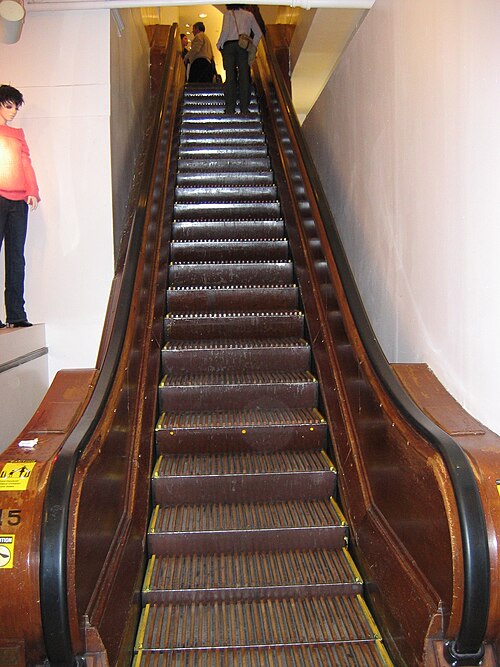
The escalator was patented in 1889 (a lot earlier than you would’ve guessed, right?), with the first working version installed at Coney Island ten years later. Original escalators were made of wood, and early models required a hand-crank mechanism before motors became commonplace. Today’s versions – where the stairs flatten and slip seamlessly under the surface only to reappear again at the bottom – came along much later. You can still ride one of world’s oldest escalators (a 1920s model) at Macy’s in New York City.

I have fond and not-so-fond memories of escalators. At the rental car center at San Diego’s Lindbergh Field, a single escalator takes you from ground level to the Avis cars three stories higher. It’s kind of a thrill-ride sensation ascending and elevating through that many floors. You actually have time to enjoy the view.
On the other hand I’ll never forget the narrow escalators on the outer edge of the football stadium at the University of Texas in Austin. You ride several of them to ascend to the nosebleed seats, turning ninety degrees from one escalator to catch the next. Those in-between landings are small, so small so that any pause of the patrons means no space for those still moving up the escalator. It’s the closest I’ve ever felt to being crushed by a surge of humanity.
 Moving walkways go “step in step” with escalators and elevators; devices that make short journeys easier on the feet. In airports moving walkways make sense because your destination is more horizontal than vertical. They may be convenient, but only if those who choose to just “go for the ride” step aside for those who are late for the plane. Hats off to the frustrated person who came up with signage like “STAND to the right, WALK to the left”. Also, they should hold a contest to give moving walkways a more creative name. Escalators sound cool. Moving walkways not so much.
Some day I hope I see Wushan, China. Okay, let’s get real – I could care less about Wushan. I just want to ride the Goddess. Twenty minutes up and twenty minutes down. Over and over and over. I’m too old for the amusement parks but I’ll never turn down another ride on an escalator.
Some content sourced from the Futurism.com article, “China Built the World’s Largest Outdoor Escalator…”, and Wikipedia, “the free encyclopedia”.


