Patent PeopleMovers

On the other side of the planet they like to build things bigger, taller, and longer. In Saudi Arabia you’ll find the world’s largest airport, covering an area of 300 square miles. In the UAE you’ll find the world’s highest skyscraper, at a dizzying height of 163 floors. And who isn’t familiar with China’s Great Wall – the world’s longest at over 13,000 miles. Now China can make another lengthy claim, with the Goddess Escalator in the city of Wushan.  The Goddess might as well be the stairway to heaven.
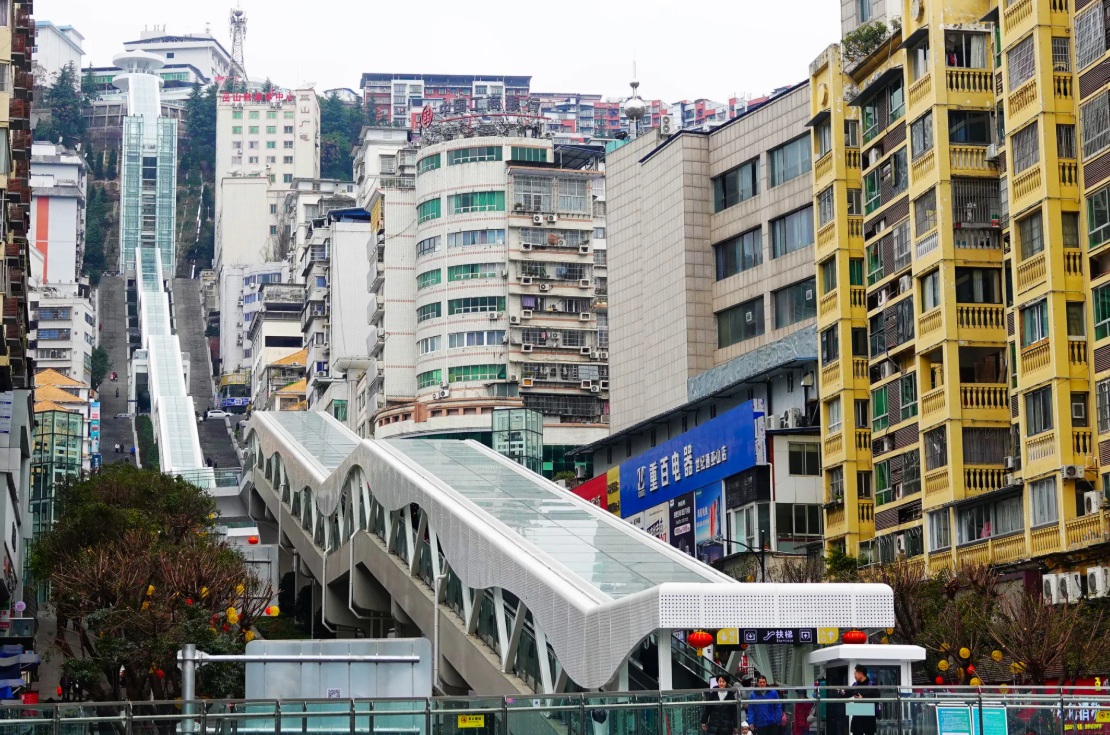
China’s “Goddess”

The mundane escalator you remember from your local department store whisked you from one floor to the next in about twenty seconds.  China’s Goddess will take you on an escalator ride for twenty minutes.  In that time you ascend 800 feet, which doesn’t elevate you just one floor but more like eighty.  Wushan is built on the side of a mountain, and the Goddess snakes from the lower regions to the upper housing district, saving the residents what used to be a strenuous one-hour hike.

She’s longer than she looks!

Technically the Goddess is not a single escalator.  She’s twenty-one of them one after another – and 8 elevators – resulting in a continuous network that qualifies her to be the world’s longest.  I can’t blame the Chinese for calling her a goddess.  Heck, I’d travel all the way to Wushan just to experience her “uplifting” twenty minutes.

There are times I think I should’ve been an engineer instead of an architect.  Like when I’m riding an escalator.  Something about the mechanics, organization, and precision really appeals to me.  There’s wonder in still not understanding how it all works.  And that moment you step on or step off is a bit of a thrill as you surrender your mobility to a machine.  It’s the same feeling you get when you’re trying to catch the chair lift at a ski resort.
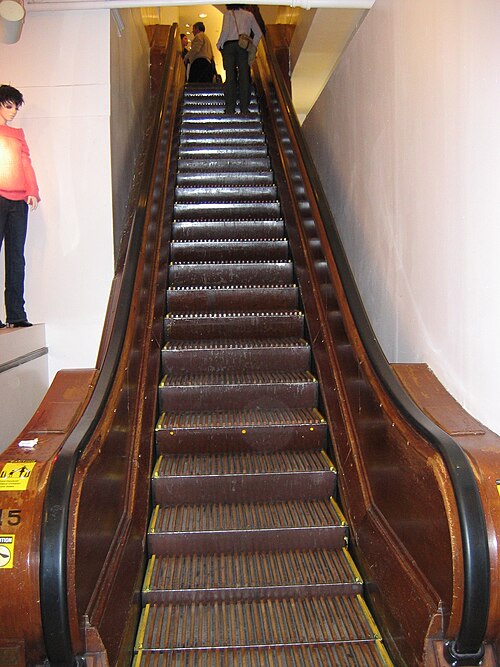
Old-school people-mover in Macy’s

The escalator was patented in 1889 (a lot earlier than you would’ve guessed, right?), with the first working version installed at Coney Island ten years later.  Original escalators were made of wood, and early models required a hand-crank mechanism before motors became commonplace.  Today’s versions – where the stairs flatten and slip seamlessly under the surface only to reappear again at the bottom – came along much later.  You can still ride one of world’s oldest escalators (a 1920s model) at Macy’s in New York City.

New-school escalator in San Diego

I have fond and not-so-fond memories of escalators.  At the rental car center at San Diego’s Lindbergh Field, a single escalator takes you from ground level to the Avis cars three stories higher.  It’s kind of a thrill-ride sensation ascending and elevating through that many floors.  You actually have time to enjoy the view.

On the other hand I’ll never forget the narrow escalators on the outer edge of the football stadium at the University of Texas in Austin.  You ride several of them to ascend to the nosebleed seats, turning ninety degrees from one escalator to catch the next.  Those in-between landings are small, so small so that any pause of the patrons means no space for those still moving up the escalator.  It’s the closest I’ve ever felt to being crushed by a surge of humanity.
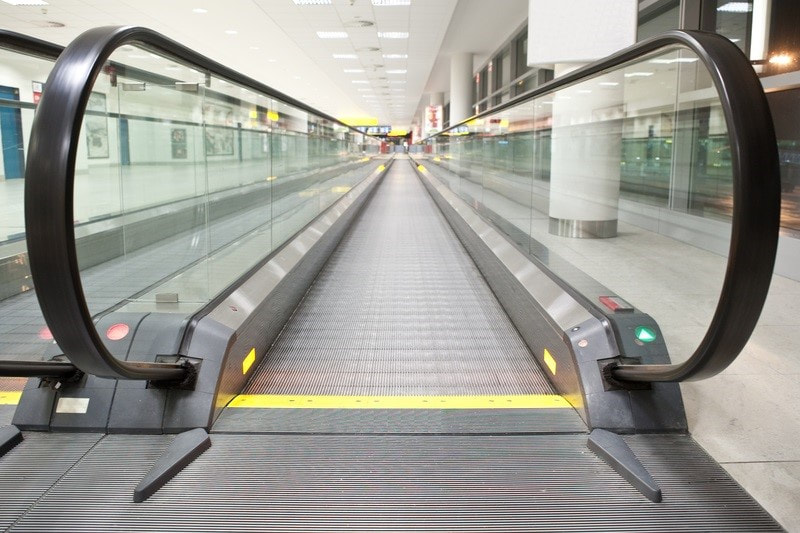
Moving walkways go “step in step” with escalators and elevators; devices that make short journeys easier on the feet.  In airports moving walkways make sense because your destination is more horizontal than vertical.  They may be convenient, but only if those who choose to just “go for the ride” step aside for those who are late for the plane.  Hats off to the frustrated person who came up with signage like “STAND to the right, WALK to the left”.  Also, they should hold a contest to give moving walkways a more creative name.  Escalators sound cool.  Moving walkways not so much.
Disneyland’s (long ago) “PeopleMover”

Some day I hope I see Wushan, China.  Okay, let’s get real – I could care less about Wushan.  I just want to ride the Goddess.  Twenty minutes up and twenty minutes down.  Over and over and over.  I’m too old for the amusement parks but I’ll never turn down another ride on an escalator.

Some content sourced from the Futurism.com article, “China Built the World’s Largest Outdoor Escalator…”, and Wikipedia, “the free encyclopedia”.

Worthless Wardrobe Boxes

I’ve always liked the play on words of Men’s Wearhouse. If you’re familiar with MW you know they cover more ground than just formal wear. They’ve set aside an area for tuxedos and such, but they have other sections for dress shirts, accessories, and even shoes. It’s like walking through a miniature department store… which is probably why MW is destined for the dust bin sometime in the coming year.

Just eighteen months after Saks Fifth Avenue acquired bankrupt Neiman-Marcus (for the “bargain” price of $2.65 billion) Saks itself filed for bankruptcy; just yesterday.  The 2024 merger of these big-box luxury retailers (which included Bergdorf Goodman) never really came to fruition. Chalk it up to biting off more than they could chew, or more likely to the impact of the changing habits of consumers.  Today’s shoppers want smaller, more specific brick-and-mortar options; that is, whenever they can drag themselves away from online purchasing.

The shuttering of department stores is not limited to the high-end verions, of course.  Macy’s is in the process of closing 150 “underperforming locations”.  JC Penny, Kohl’s, and Marshall’s are closing outlets here and there.  Even Carter’s, the popular option for children’s clothing, is calling it quits on 150 locations.  And Sears, which had almost 3,000 locations just fifteen years ago, is down to a mere five.  Frankly, I didn’t know Sears had any locations anymore.

Chicago’s Sears Tower

Sears (or the Sears, Roebuck and Co I remember as a child) was my family’s go-to-department store for just about anything.  My brothers and I were outfitted in Sears-brand clothing.  My mother purchased all kinds of items for her kitchen.  My father built up his workshop with dozens of Craftsman tools.  And of course, the Sears catalog was not only a kid’s dream-book of Christmas wishes, but its arrival in the mailbox was a sign Santa was on his way… not to your house but to the toy department at Sears.

Like many other things in the States, department stores were based on the originals in Europe.  Harrods of London has been around since 1849 and boasts of 1,100,000 square feet of selling space, making it the largest department store on the continent.  Paris hosts several stores I’ve never heard of yet many have been around as long as Harrods.  And Australia’s David Jones is considered the world’s longest continuously operating department store (since 1838!)

As you read this post – and if you’re Millennial or older – I’m sure a department store of your own experience comes to mind.  Towards the East Coast: Gimbels, Hudson’s, or Wanamaker’s.  Towards the West: May Company, Bullock’s, or Robinson’s.  In Chicago alone: Marshall Field’s, Carson Pirie Scott, or Wieboldt’s.  In Canada: Eaton’s.  The list is endless, even as most of them are downsizing or closing altogether.

In deference to my former department store habits, I also prefer more specific retail these days.  My shoes come from shoe stores.  My shirts come from stores of particular name brands.  But with shopping malls closing along with their aforementioned “anchors”, my stores of choice are now stand-alones or in outlet malls.  Now that I think about it, outlet malls are kind of like outdoor department stores, aren’t they?

I may be nostalgic for the department stores of my past, but I certainly understand why the concept has come and is about to be gone.  We have more convenient, more tailored options these days.  Which has me wondering about supermarkets.  Supermarkets are also under the threat of the changing habits of consumers.  No, I don’t expect a return to those wonderful merchant-driven street markets you find all over Europe.  But we are getting more comfortable with placing orders ahead of time and having groceries delivered to our car or front door.  In other words, enjoy shopping in “food warehouses” while you still can, because department stores are about to become nothing more than worthless wardrobe boxes.

Some content sourced from the CNN Business article, “Saks Global files for bankruptcy protection…”, and Wikipedia, “the free encyclopedia”. 

Floral Fire

Billboard ranks “Firework” as Katy Perry’s best-selling single, with millions of downloads since its 2010 release. The self-empowerment tune “skyrocketed” to #1 on Billboard’s Top 100 at the time and ranked in the top five on twenty other charts worldwide. “Firework” also “sparked” an award-winning music video, and Katy has since performed the anthem live at two presidential inaugurations and during the halftime show of the Super Bowl.  Searching Wikipedia for “firework”, therefore, it comes as no surprise to be asked, “Do you mean the song or the low-explosive pyrotechnic device?” Today, I choose the latter.

For the first time in countless July 4th celebrations I can’t speak to having seen a single overhead firework display this year. No giant “willows” with their graceful descending trails of sparks; no “peonies” where those same trails radiate in straight lines from the center; and no “horsetails” (my favorite) where each trail bursts a second time, followed by a crackling, glittering shower of fire.  Also, no “grand finale” where it looks like the entire sky is splitting open to some fiery furnace beyond.

“Chrysanthemums”

From the vantage point of our house, we used to count on the fireworks show from the nearby U.S. Air Force Academy. That show has been canceled for the last ten years because of budget cutbacks.  We also used to bring blankets to the shore of a nearby lake, where we were treated to a “small-town” fireworks display funded by donations from the public.  Today, that display has been swallowed up by a bigger all-day “Festival on the Fourth”, where you pay for parking and walk a mile or two just to secure a spot on the lake several hours ahead of the fireworks.  Even so, we thought we’d see bits and bursts from one of the other nine shows scattered around nearby Colorado Springs.  Nope, not so much as a snap, crackle, or pop.

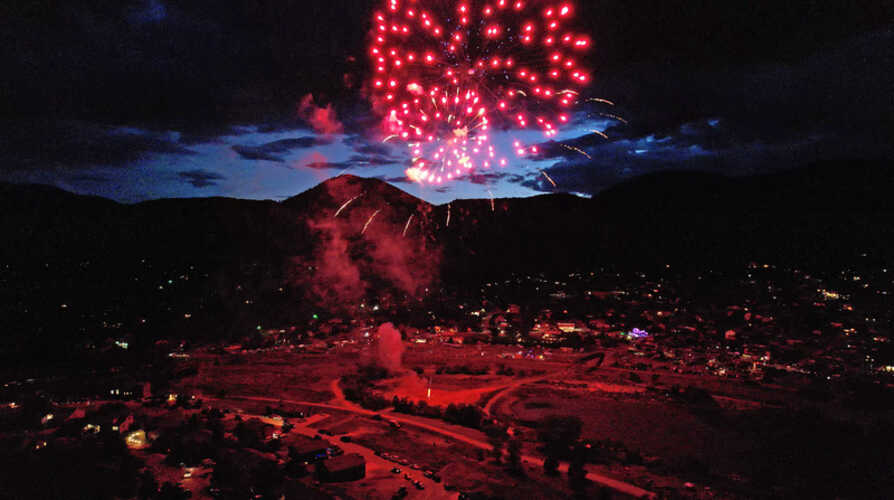
Palmer Lake, CO 2022 fireworks display (photo courtesy of local resident Bartley Willson)

Fireworks are nostalgic for me, with two distinct memories from childhood.  The first, in the 1970s, brings me back to the beach of the Pacific Ocean in Los Angeles.  Back then the only commercial displays seemed to be over the ocean.  My parents would grab a bucket of Kentucky Fried Chicken and several blankets, and the whole family would find a place on the beach where for several hours, we’d eat and play as twilight became dark, in anticipation of the late, late fireworks show from the end of the nearby pier.

The second memory, a decade later, also brings me to the Pacific Ocean but to a beach further south near San Diego, where we’d shoot off our own fireworks (from the “Safe and Sane” boxed collections my dad brought home every year), followed by an overhead display from the nearby county fair.  Every childhood July 4th was the same: food, fun, and fireworks; lots and lots of fireworks.

“Waterfall”

In 1976 – America’s bicentennial year – the firework display in New York City included an unforgettable “waterfall” effect off one of the bridges.  This year, that same July 4th display (sponsored by Macy’s) ballooned to a two-hour televised extravaganza with over 2,000 blasts and effects per minute.  I’d say Macy’s department stores and their profit margins are doing just fine, wouldn’t you?

I shouldn’t be surprised to learn fireworks were invented by the Chinese (well over a thousand years ago) but here’s a less-obvious bit of floral fire trivia: Disney is the largest consumer of fireworks in the world.  It used to be – back when their single amusement park was California’s “Disneyland” – you’d only catch a Disney firework show on summer evenings (directly above Cinderella’s castle), and only if you stayed until just before the park closed.  Today you’ll find displays at any one of the twelve Disney parks, in any month of the year.  For the record, only the U.S. Department of Defense purchases more explosive devices than Disney.

There’s more firework trivia, of course.  The very first iterations were empty bamboo shoots, creating a mild popping sound when ignited because of natural air pockets.  Seeking more pyrotechnics, the Chinese added explosive chemicals to the shoots to create firecrackers”.  Eventually they figured out how to launch and propel their creations, and the overhead fireworks display was born, in an impressive rainbow of chemical colors. But take note; you won’t see a blue firework very often.  Blue requires an infusion of copper at just the right temperature, and the “cool” color tends to get lost next to the “hotter” reds and yellows.

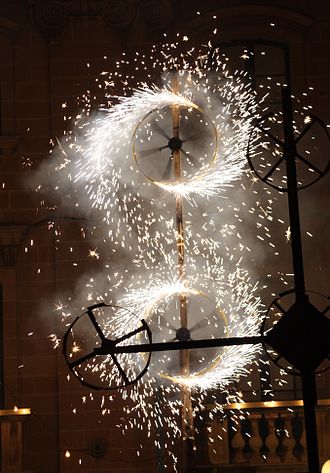
“Catherine wheels”

I’m still puzzled why I didn’t hear so much as a “BOOM! BOOM! BOOM” aftershock (to quote Katy Perry) of a firework display this year.  Maybe most of my fellow Coloradoans kept the bursts and blasts to the ground instead, from what they purchased at the local firework stand. Those of you living in New Jersey, Massachusetts, or Delaware can’t relate because consumer fireworks are illegal in your states.  Not so much as a sparkler in your hand. (Which may be a good thing since sparklers can heat up to 2000 ºF)  So you probably did what I did this year – simply watch a recap of the Washington D.C. grand finale on your smartphone.  It was the only floral fire I could find.

Some content sourced from the BuzzFeed article, “17 Things You Probably Never Knew About Fireworks”, the Macy’s Fourth of July Fireworks website, and Wikipedia, “the free encyclopedia”.