Mighty Fine Print

Whenever a season of sports comes down to the last couple of teams, I pay extra attention whether it’s the Super Bowl, the World Series, or college basketball’s March Madness. A championship is the culmination of an entire season, so the final game puts the stakes at their highest. Just last week I made it to the finals of a competition myself. The thing is, I didn’t even know I was playing.

“I win!”

We’ve all received one of these flyers at one time or another, haven’t we?  A bold, colorful announcement suggesting we’ve won something big.  In this case, a Viking River Cruise (red capital letters, top left) suggests a tapped mailing list because I’ve cruised with Viking twice.  Regardless, this flyer almost went into the trash before I read some all of the fine print.  And I must say, whoever came up with the nuts/bolts of this particular contest deserves the Academy Award for Best Producer.

To begin with, notice the element labeled “Combination Box”.  This little device is ingenious for two reasons.  First, it stretches the envelope the flyer came in beyond a flat piece of paper, tempting the recipient to wonder what’s in there?  And second, the device is “activated” by pulling a tab to reveal the “5-digit VIN number” you see here.  Then you scratch off the gold circle further down the page to reveal another 5-digit number and – “how about that?” – they’re the same number, which makes me a “Grand Prize Winner”.

The flyer also contains utterly random stuff that has no bearing whatsoever on the contest.  I am “cordially invited to ‘The Great America Cruising Expo'” (a fictitious event).  Just below the black box is a “VIP Winning Number 5508738” (also useless).  Finally, when I call the toll-free number at the bottom (which, to be clear, I will never call), I’m supposed to mention “Code AKSC”.  Pretty sure anyone could call the toll-free number, mention the code, and discover they’re also a “Grand Prize Winner”.

Now for the good stuff.  Here’s the lower right corner of the flyer.  Call Within 48 Hours…?  Within 48 hours of what, exactly?  How do they know I’m calling within 48 hours of anything?  More importantly, look at the four “gifts” below; one of which is apparently mine.  Take a guess – which trip do you think I won?

Credit to the contest producers; I guessed wrong.  I would’ve thought the 7-Night Resort Stay at Worldwide Destinations was my prize.  After all, how much vaguer can a trip description be?  If I called the toll-free number they’d probably go, “Yes you won but you can only take the trip on these 7 nights”.  And “worldwide destination” technically means anywhere in the world so maybe I’ve won seven nights in the middle of Iowa.

In fact, the prize I “won” is the Caribbean Cruise for Two for Up to 7 Nights.  The more I think about it, that one makes more sense.  Any ship in Caribbean waters could be considered a “cruise” (even a foreign freighter with an empty cargo hold).  “Up to 7 nights” could mean just two nights or even an overnight.  And however I actually get to this cruise ship is on my own dime.

Mighty fine print

The pièce de résistance is on the back of the flyer: the fine print.  The five hundred words you see above include the odds of winning (which is how I know I won the Caribbean cruise).  Out of every 2,000,000 mailed flyers, 1,999,997 will win the Caribbean cruise, while just three people will win the three trips of any real value.  In other words, one person wins a free Viking River Cruise.  Okay, enough already; now this flyer goes into the trash, where it should’ve gone in the first place.

———————————————————–

LEGO Neuschwanstein Castle – Update #2 (read about the start of this project in Fit for a (Fairy Tale) King)
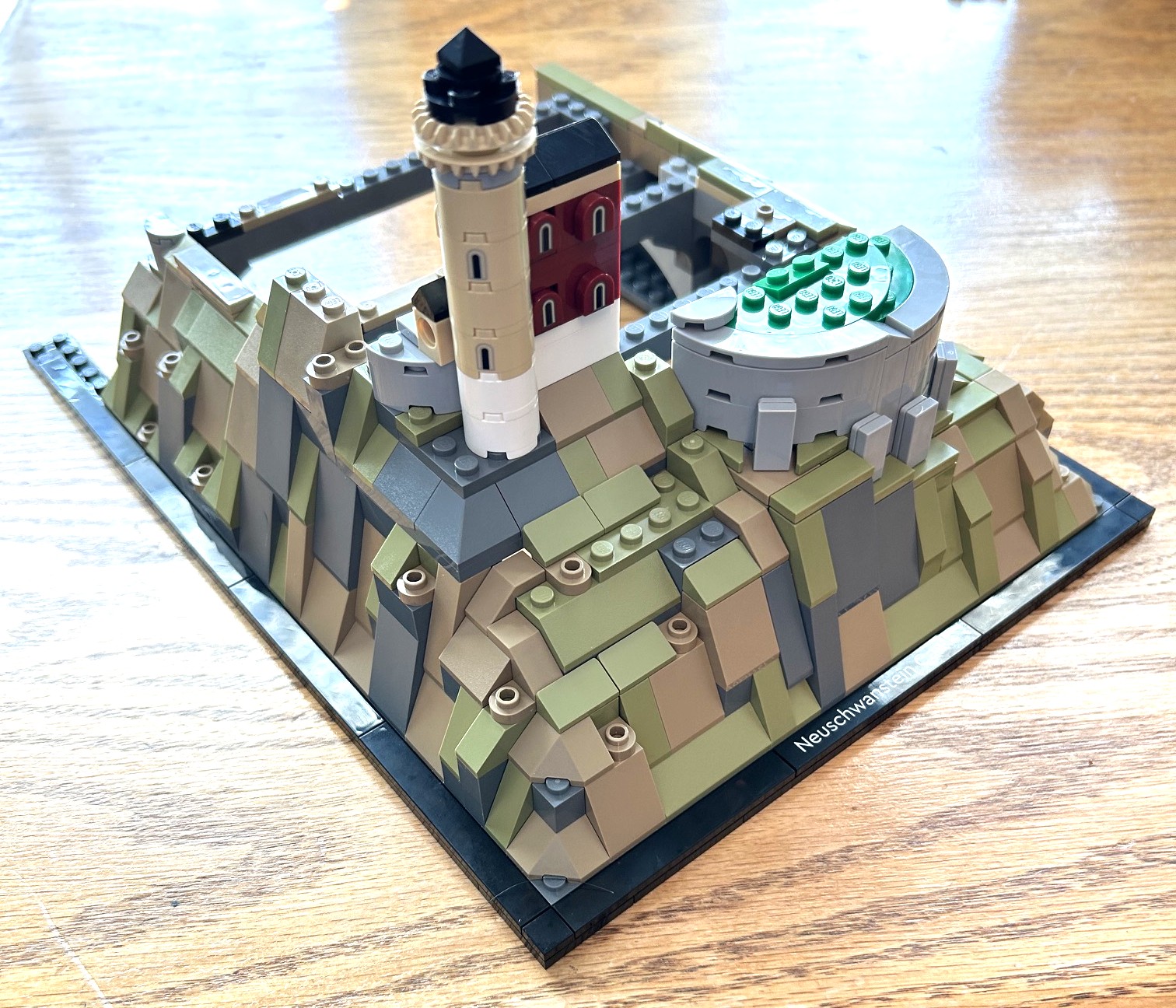
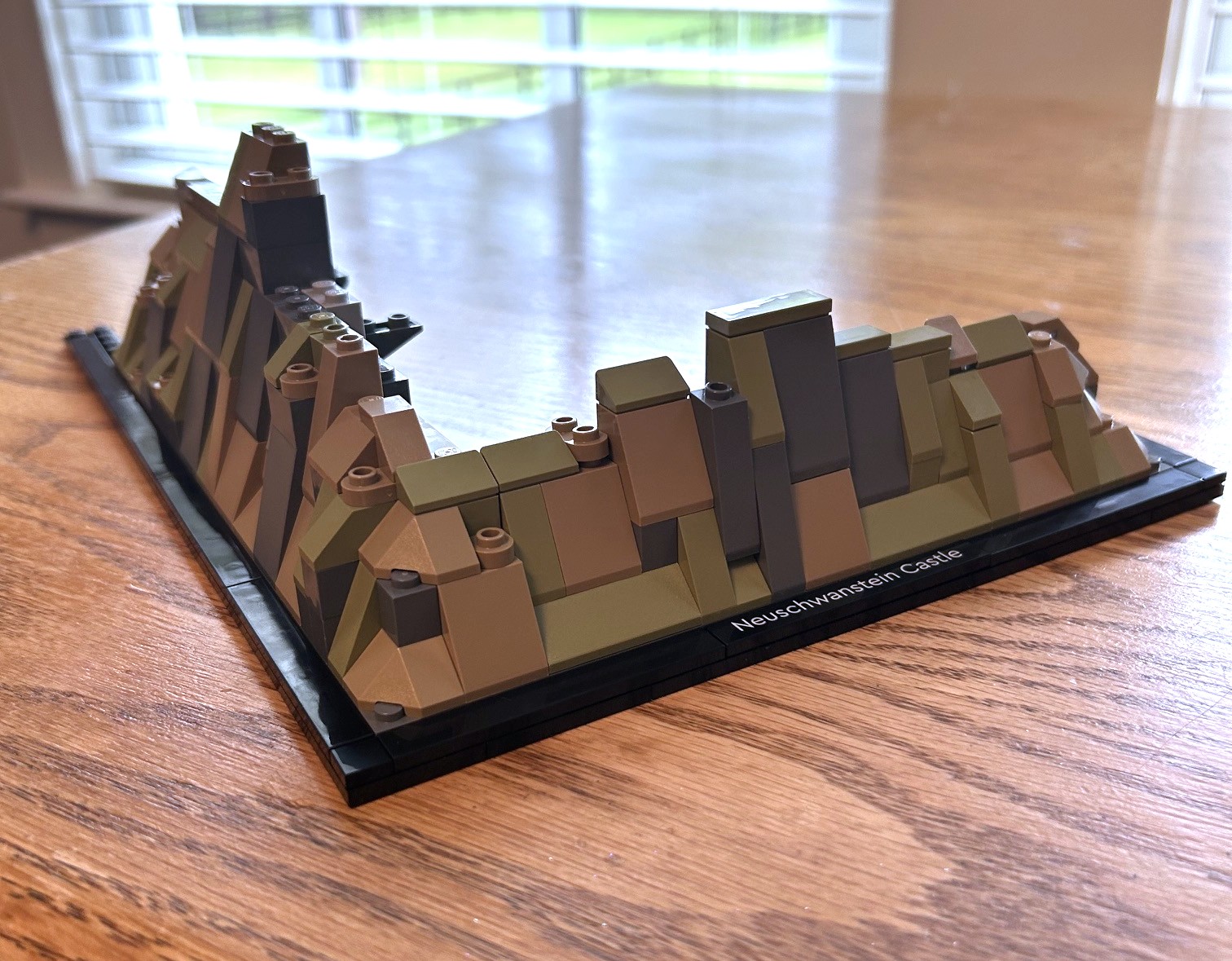
We continued to move mountains this week (as expected) but I was delighted to see bits of the castle starting to rise up already.  Apparently I need to bring in cranes in addition to my earth-moving equipment.  Bags 3 and 4 (of 23 bags of pieces) contained a lot of tiny, interesting, colorful bits.  I had to be careful those little guys didn’t run down the mountains and try to escape.
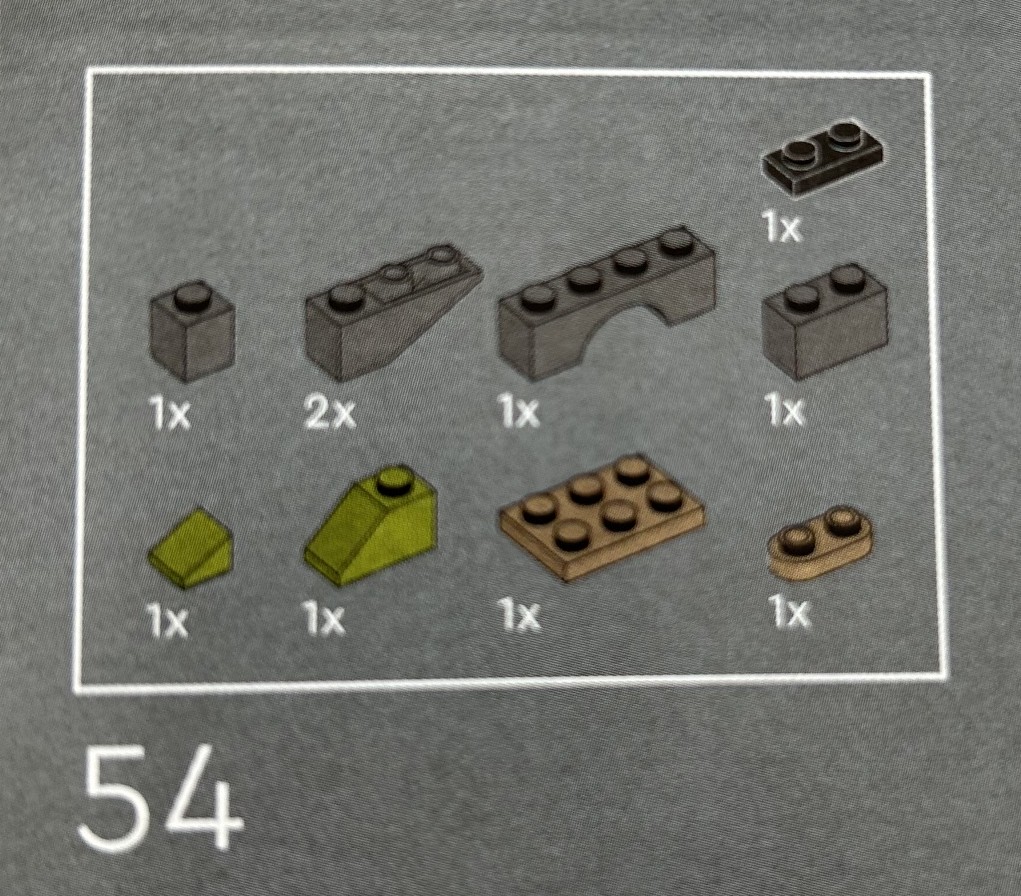
For the first time in a half-dozen models I’m here to tell you… LEGO left out a piece.  They really did.  If you look at this step in the process (and yes, I’m already through 50+ steps), that little two-dot middle-row-right was AWOL.  I checked the bags a dozen times thinking he was still in there.  I scanned the piles of parts another dozen times.  No two-dot.  Maybe he’ll show up in another bag further into the build but by then it’ll be too late.  The good news is, his location is buried inside the mountains and is not structural.  You will never see the small cavity created by his absence.

Tiny, interesting, colorful bits

What you see in the first photo is only about half the size of the completed model.  It will be a full rectangle of Bavarian Alps when it’s done.  Of course, by then you won’t even notice all the earthmoving I’ve accomplished, because Neuschwanstein Castle will utterly lord over the (LEGO) land.

Running build time: 1:52.

Total leftover pieces: 17.

Accompanying movie soundtrack: Leap Year (2010).  I could use the excuse of the lovely Amy Adams to justify this favorite, but this so-so rom-com came out when she was hardly a name.  However, Randy Edelman’s score is wonderful. It’s so much larger than the movie itself.  “Anna’s Theme” – which the score returns to again and again – is a calming tune using a lot of piano and guitar.  Elsewhere traditional Irish instruments make their inevitable appearance.  Maybe the movie is forgettable but the music most definitely is not.  Have a listen here.

Note: Life In A Word will be taking a vacation break for the next few weeks.  Join me for the next chapter of the castle construction on August 20th!
What’s the Score?

Among the televised game shows I remember watching as a kid was one called Name That Tune.  The version I watched wasn’t the original but it was the most successful, running from 1974-1981.  Contestants competed for cash prizes by guessing the name of a song from a sound bite performed by the live band.  The appeal of Name That Tune was the ability to play the game yourself while you watched (like you can with Jeopardy).  But there was one genre of music Name That Tune didn’t tap into very often: film scores.

Here’s my question of the day.  Name the last movie you saw where you also remember the music that accompanied the film.  Titanic?  Okay, but I’m not talking about soundtracks made up of popular songs you’d hear on Spotify (sorry, Celine) but rather instrumental scores where the music is tied to particular scenes of the story.  Here, listen to the following sound bite and see if you can name the movie.  Bonus points if you can picture the scene where the music was played. (scroll to the bottom for the answer)

Maybe your brain doesn’t associate movies with music the way mine does, but to demonstrate this acuity it took me no time at all to come up with a dozen of my favorite film scores; instrumentals so memorable I instantly recall the movie.  Some, like the one I teased above, won Academy Awards (for “Best Original Score”).  Others on my list weren’t even nominated… but maybe should have been.

Speaking of Academy Award winners, perhaps examples will help you “hear that tune”.  The Best Original Score in 1965 was for The Sound of Music, primarily original songs with lyrics but several instrumental turns as well.  The winner in 1973 was for The Sting, in which Scott Joplin’s ragtime piano tunes played the major role.  The winner in 1975 was for Jaws, and I wonder who can’t hear that threatening theme whenever they picture a man-eating shark.  The 1977 winner?  Star Wars, scored by John Williams, who created the music for dozens of blockbuster films. 1990? Dances With Wolves by John Barry, another giant of the world of film scores. The list goes on and on.

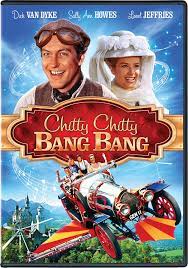
As for my own list of favorites you’ll have to be a little more patient.  I’ll include them – one at a time – as I give updates on the construction of my LEGO Neuschwanstein Castle over the next several months.  If you’re wondering what movie soundtracks and a German castle have in common, I refer back to Chitty Chitty Bang Bang of course, with scenes filmed at Neuschwanstein.  The story is a vivid childhood memory start to finish but so is the music.  Trust me, for the number of times I’ve seen the film I can “name that scene” for just about every piece of the score.


LEGO Neuschwanstein Castle – Update #1 (read about the start of this project in Fit for a (Fairy Tale) King)

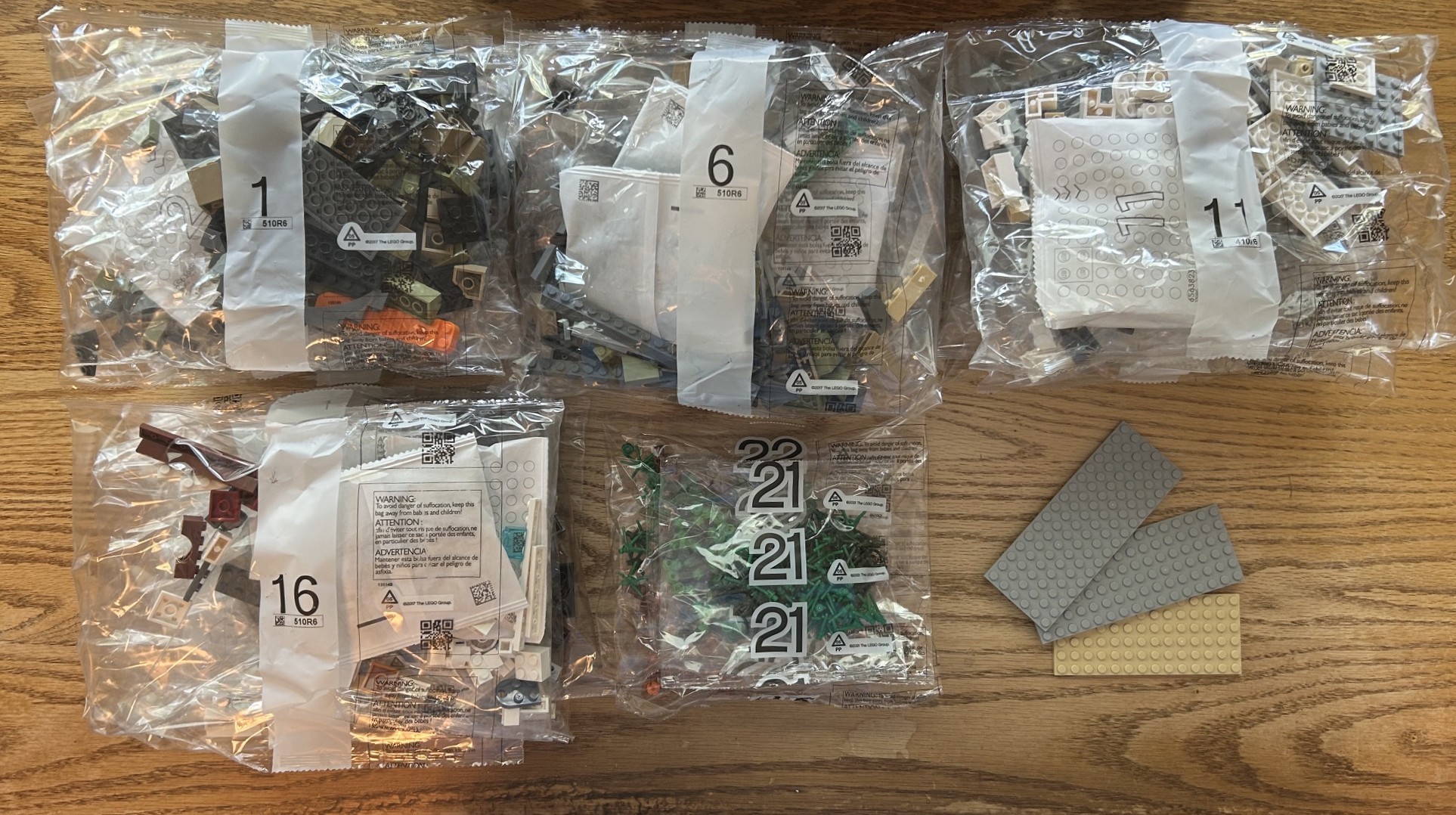
23 bags of pieces + 3 “orphans”

You’d think the construction of a castle would begin with the cornerstone.  With the LEGO model you’d be wrong.  We’re moving mountains instead.  King Ludwig already had the Bavarian Alps at his disposal but we have build them from scratch before they’re crowned with his creation.  Good thing this structure isn’t full-size or I’d be renting some serious earthmoving equipment!

LEGO “Alps”

With Bags 1 and 2 (of 23 bags of pieces) we got our hands dirty piling up dirt, rock, and other rather undefined landscape to create a mountaintop.  Well, one-third of a mountaintop or so.  If the next few bags represent the other two-thirds I’m not gonna an exciting update for you next week. At least the pieces snapped together smoothly.  As with all LEGO models I’ve built, there were moments where I thought LEGO left out a piece, and other moments where I backed up a step or two to correct the construction.  One change I’ve noticed from previous models: LEGO puts the tiniest pieces into paper “baglets”, which I’m not a fan of.  Those little bags aren’t transparent, so you don’t always know when a piece gets stuck way down in the corner.

“Baglet” of the tiniest pieces

The model’s instruction manual – which henceforth shall be called the “tome of construction” – includes a few teasers about the real castle.  Neuschwanstein has secret passageways!  It also has “ingenious” inventions of its time, like modern toilets, central heating, and an electric call system for all of the servants who never spent a moment inside the walls.  If any of these details are worth seeing before I “close in” the castle, you can bet I’ll be snapping a few photos for your viewing pleasure.  Until next week!

Accompanying soundtrack: Mary Poppins .  Did the magical nanny really make my list of favorite film scores?  No she didn’t (not even for a spoonful of sugar), but I couldn’t find Chitty Chitty Bang Bang isn’t on Spotify and had Dick Van Dyke songs on the brain so… I went with Bert the chimney sweep instead.

Running build time: 44 minutes.  Leftover pieces: 4.  

“Name the movie” audio answer: Chariots of Fire (during the scene where several runners clad in white jog barefoot on the beach).

Some content sourced from, IMDb.com, “the Internet Movie Database”, and Wikipedia, “the free encyclopedia”.

Where’s Wendy?

The 96th edition of the Academy Awards came and went last Sunday without much fanfare. Mercifully, Monday’s reviews were more about who won, instead of tabloid headlines like wardrobe malfunctions or acceptance speeches gone wrong. I only watched the opening monologue, and not because I cared about what Jimmy Kimmel had to say. Rather, I wanted to see if I could spot a seat filler.

Back in my days as a mid-level manager in corporate America, dozens of resumes came across my desk for prospective employees.  Their sections on “previous experience”  sometimes caught my eye, if only for the really strange stuff people do with their time. Innovation Sherpa. Hacker. Direct Marketing Demigod. Happiness Hero.  I wouldn’t sign up for any of those “jobs” but hey, at least they come with a paycheck.  The only compensation a seat filler gets is a free ticket to the show.

Seat fillers are out there… somewhere…

If the title isn’t self-evident, a seat filler is someone who attends a televised event (like the Academy Awards) and stands in the shadows of the outside aisles until a “real” attendee gets up to get a drink, use the restroom, socialize, or whatever.  The seat filler then dashes over to occupy the seat until the person returns, so the panning cameras give the television audience the impression the event is always filled to capacity.

I could spend several hundred words talking about the myriad ways live TV manipulates a viewer’s perception (flashing “APPLAUSE!” signs come to mind) but seat fillers may be the most absurd of all.  Thousands upon thousands of people apply for these opportunities, with only a handful chosen for a given event.  As if remaining nameless among the Hollywood elite isn’t humbling enough, seat filling is last-minute employment with all expenses paid by… you.

Imagine opening the email.  Congratulations!  You’re going to the Grammy Awards!  There’s the good news.  The bad news is, now you have to book an expensive flight and hotel, buy or rent a dress-code-worthy tux or formal gown, and plead for last-minute approval from your employer for a few days off.  Assuming you do make it to the Grammy Awards, you’re subject to a strict set of behaviors.  Surrender your ID and smartphone.  DON’T walk on the red carpet.  DON’T talk to celebrities (unless they talk to you first).  And plan on being on your feet for hours, in a covert location where you can’t even see the show, waiting for the command from the Manager of Seat Fillers to “fill that seat!”

As one filler described the experience, maybe there really is a breathless kind of rush when you plop down next to someone like Taylor Swift or Beyoncé.  But let’s get real here; celebrities see a seat filler coming from a mile away.  How many of them are going to engage with a smile, let alone a word of acknowledgement?  Even if you did manage to exchange a sentence or two, you’re going to ask yourself, “Why did I say that to Taylor?” for the rest of your days.

HURRY!  She’s not in her seat!

Without your phone, you won’t be able to capture your seat-filling fifteen minutes of fame.  You’ll be lucky if you nab a copy of the event program (which can be purchased online anyway).  Seat filling is a the very definition of “anonymous”, and it’ll be hard to convince your friends and family you were even there.  Unless the TV camera points your way at just the right time, of course.

As for my careful study of the Academy Awards audience on Sunday night, it seemed like a fun game at the time.  Pause the picture when the camera pans the people, then walk up to the screen and play a sort of “Where’s Waldo?” (or Wendy) to spot the seat fillers.  But I quickly realized the error of my ways.  I can’t even recognize the actors.  They’re either the too-old versions of the ones I remember (sorry people, the Botox doesn’t help) or they’re the too-young versions of actors I’ve never seen in anything at all.

Suffice it to say, I will never be a seat filler.  If I ever go to an awards show it’s because I’m a “real” attendee who deserves to be there (in other words, another lifetime).  In this life, I’ll consider more appealing employment prospects for my retirement. Beverage Dissemination Officer. Golf Ball Diver. Professional Sleeper.  Hey, at least those pay.

Some content sourced from the Business Insider article, “I was a seat filler at last year’s Grammys…”, and Wikipedia, “the free encyclopedia”.

The Final Word

This time of year, we assemble our latest collection of “best-of’s” and “…of-the-year’s”.  On Monday, America crowned its national champion in college football (Alabama). In a few weeks we’ll get the NFL’s equivalent in the Super Bowl. Last month several magazines recognized 2017 of-the-year’s in photography and current events. Soon we’ll also have best-of’s in music (Grammy) and film (Oscar). In this spirit, did you know there’s an of-the-year for words?

To be clear, “word-of-the-year” doesn’t refer to the annual expansion of the Merriam-Webster (.com) Dictionary or the Oxford Dictionaries Online. With the former, over 250 words were added last fall; with the latter, over a thousand.  Instead, word-of-the-year is a single choice, representing “lasting potential as a word of cultural significance”.  That’s how the people at Oxford see it, and thus this year’s honoree is “youthquake”.  Huh?  Maybe if you’re in Britain you’re not shaking your head like me.  “Youthquake” means “a significant cultural, political, or social change arising from the actions or influence of young people.”  “Youthquake” has been around since 1965, but back then it was only a reference to the fashion and music industries.  Today, it could (and is) being used in reference to the myriad demonstrations of change commanded by the millennial generation.

With the Academy Awards – should you not agree with, “and the winner is…” – at least you might have a favorite in the list of nominees.  But the short list for 2017’s word-of-the-year is the following bunch of odd ducks: white fragility, unicorn, kompromat, broflake, newsjacking, gorpeore, milkshare duck, and antifa.  Okay, maybe “antifa” would’ve been a good choice, but I count at least four others I’m seeing for the first time.  More to the point, what happened to better choices like “hipster” or “pregame” or “alt-right”?  Did none of those even make it into the dictionary expansion?  They’re certainly more word-of-mouth than “youthquake”.

Perhaps “youthquake” will make it across the pond in the next year or two and enter America’s daily conversations.  But the word is not off to a good start, considering several in Britain – including the CEO of a youth leadership organization – claim they’ve never heard of it.  Maybe Oxford just has an affection for the word, so they throw it out there as an “of-the-year”.  But that’s kind of like being labeled “America’s Best City To Live In”.  The mere advertisement draws a bunch of tourists and other undesirables and next thing you know you’re no longer “best”.  By the time we Americans get right with “youthquake”, Oxford and Britain will have moved on to 2018’s word-of-the-year.

Merriam-Webster’s Peter Sokolowski claims their word-of-the-year (apparently the honor is shared) “…gives us insight into the collective curiosity of the public”. M-W took a more scientific approach to it’s recipient, looking at how often certain words were looked up online, and their context with respect to current events.  M-W’s 2017 word-of-the-year?  Feminism.  Look-ups of “feminism” increased 70% over 2016, and spikes in that activity were tied to comments made by politicians in Washington D.C., “The Handmaid’s Tale” and “Wonder Woman”, and the sexual harassment revelations of the past several months.  M-W gives “feminism” two definitions, but I prefer the second: “organized activity on behalf of women’s rights and interests.”

Two years ago, Oxford made a particularly clever word-of-the-year choice in “pictograph”.  Rather than show the word, Oxford showed an emoji.  If my spell-check is any indication, it takes at least two years to embrace the current word-of-the-year recipient.  “Emoji” did not underline.  “Youthquake” most definitely did.