
Hello, I’m Veronica
The sky is not completely dark at night. Were the sky absolutely dark, one would not be able to see the silhouette of an object against the sky.


-
Supply Chain Reaction
My neighbor to the north – the one with a mansion lording over the rest of the hood from the highest point around – hosts equestrian events on weekends. Whether reining or cutting competitions, or “quaint” social gatherings, his barn and surrounds burst with dozens of horses and riders just about every Saturday. His property is large enough we’re pretty far removed from the hubbub, except the convoy of horse trailers and trucks barreling down the street beforehand. The wheels rumbling over the washboardy dirt road and balloons of dust floating high overhead are hard to ignore.
 Maybe you don’t have a parade of horse trailers in your neighborhood (or a washboardy road), but guess what? You do have a procession of vehicles making their way to your driveway, and the list of participants is growing. Home delivery is the latest block party where everybody seems to have an invite.
In the 1970’s the only vehicles coming up our driveway were the red, white, and blue jeeps of the United States Post Office (USPS) or the brown, boxy trucks of the United Parcel Service (UPS). Then Federal Express vans (FedEx) joined in with a little purple and green, while DHL (the initials of the three founders’ last names) added a healthy dollop of yellow. Taste the rainbow!
 That’s a pretty good line-up right there, but in the last decade or so home delivery (or “last mile delivery”, to use the trendier term) picked up several more players. Amazon (black vans with a blue “swoosh” on the side) and WalMart (several colors) extended their supply chain by adding home delivery trucks. Your pizza guy has been joined by restaurant delivery of all kinds, like DoorDash, Grubhub, and UberEats. AmazonFresh is competing with your local grocery store to make sure you consider home delivery of products from Whole Foods.
 Here are a few of the more “colorful” entries coming soon to a driveway near you:
- Postmates – Pizza, prescriptions, shoes, and tech products, just to name a few Postmates delivery favorites. What makes Postmates unique? They’re not affiliated with any business or product line. If you need it, they’ll find it.
- LuggageForward – Boasts “doorstep pickup”, so all you worry about is transporting you from your home to your travel destination. LuggageForward guarantees your bags arrive before you do, and their “shipping experts” track your items every step of the way.
- Piggybee – Just like LuggageForward, except you’re entrusting your luggage or other item to a random person who happens to be traveling to your destination anyway. Sounds a little dicey, but isn’t the name great?
- Entrusters – The opposite of Piggybee, but the same concept. You find something you want to buy in a distant locale, and the random person who happens to be traveling to your city brings it to you.
- goPuff – A “convenience store caterer”, tempting you with products like that pint of Ben & Jerry’s you don’t really need. Perfect for college students? Yes, and the company was started by college students. “goPuff”? No clue.
- Drizly – Not only wine, beer, and liquor to your door inside of an hour, but also all the mixers, garnishes, and supplies you need to make your party tipsy. Hopefully you’re not the only one at the party. Hopefully your Drizly driver doesn’t partake in whatever he or she delivers.
- Stitch Fix – A competitor to Nordstrom’s Trunk Club, Stitch Fix offers a stylist and all the designer clothes you could ever want. Try them on and keep ’em or return ’em within three days. Might as well close the doors on your local shopping mall.
- Washio – Just what you would guess: home-delivery wash, dry, and dry-cleaning of your wardrobe. Your hamper just moved to the front door! Washio’s “ninjas” pick up and drop off inside of 24 hours, and even leave a cookie on top of the clean-clothes bag. Sadly, Washio lasted less than three years; it’s founders claiming, “sometimes you make it, sometimes you don’t”.
 As we speak, many of these deliverers are hopping the fence into each other’s domains. Postmates is test-marketing convenience store items in New York City, sourcing from 150+ Walgreens and Duane Reades. Doordash is trying out same-day grocery delivery in 22 states. AmazonFresh distinguishes itself as food delivery with its lime-green (not black) vans.
 With so many entrants in the home delivery circus, it’s fair to say the concept is still in its infancy. We’ll need several years to see who and what will ultimately come out in the wash (clearly, not Washio). But mark my words, you can always count on someone to rain on the parade. Amazon is already experimenting with “Prime Air”, a drone-service. In other words, home delivery may be a little less grounded in the future.
Some content sourced from the 10/2/19 Wall Street Journal article, “Postmates, DoorDash Want to Deliver Your Groceries, Too”.
-
Window Addressing
My wife and I just returned from a trip to Boston. On the flight home, we took our seats as usual: she at the window and me in the middle. It was a peaceful journey, save for the rather chatty woman across the aisle. But then, as we began our descent into Denver, behold an uncomfortable moment. A glare of sunlight through my wife’s window struck Chatty Woman in the eyes, who immediately turned and snapped, “CLOSE THAT WINDOW!” I just smiled from the middle seat and assured her the glare would move on momentarily (which it did). Chatty Woman gave me a stare and a huff, and turned away. Gee, nice to meet you too.

I’ve touched on the dynamics – er, politics – of airplane passenger seats before, in Flight of the Humble Bee (a taste of first-class), and Center Peace (life in the middle seat), but I always thought window-seat dwellers were far enough to the left or right to escape judgment. No longer. In fact, more than ever the spotlight shifts to them.
Let’s review the powers held by the different seats on the plane. The aisle seat, some would argue, commands the most power because a) the occupant controls the freedom of all others on his/her side of the row, b) the occupant has the easiest access to everyone else and everything else on the plane, and c) the occupant can lean or leg into the aisle as he/she pleases (a power move in itself, albeit a weak one).

The middle seat [or in larger planes, middle seats. To you, the occupant of the middle seat in a row of 5+, you have my utmost sympathy] has powers inversely proportional to the aisle and window seat occupants. That is, the more empathetic your seatmates with your middle-seatedness, the more likely you’ll get perks (i.e. the use of both armrests, requests to the flight attendants, the window shade setting to your preference).

Speaking of the shade, that my friends, is the power-play of the window seat. Whether the shade is up, down, or somewhere in the middle is entirely up to the occupant (or occasionally directed by the flight attendants). Once upon a time the window shade was a minor prop; only down when the shared overhead movie screens (or sleeping passengers) demanded dark. Today? Every mobile phone, tablet, reading device, laptop, and in-seat movie screen is photophobic. Light sensitivity abounds.

Here’s the change in dynamic you’re not aware of. The passenger in the window seat is not the person he/she once was. Before, people chose the window seat to enjoy the high-skies views, or more importantly, to keep their geographic bearings or avoid the claustrophobia of a closed-up cabin. Today, people choose the window seat to control the shade, for optimal lighting of all those handheld devices.
To further complicate the matter we have the Boeing 787 airplane, which replaced the window shade with electrified gel sandwiched between panes of glass. The gel darkens or lightens depending on the amount of applied current. Cool tech, but also a compromise of power for the window seat occupant. The flight attendants (as they deem necessary), can darken all of the windows during sleeping hours or movie time or even hot days. Might want to check the type of aircraft before you board your next flight.
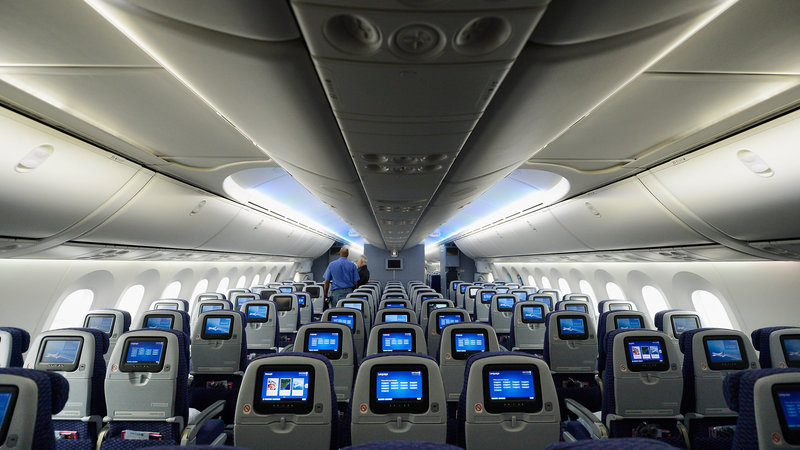
I suspect if “CLOSE THAT WINDOW!” persists, the airlines might jump at another opportunity for profit. Someday you’ll find yourself choosing a seat in the “light” or “dark” section of the plane, with a fee placed on one or both types of seats. Not a fan. Then again, if the airlines would sequester crying babies, cell-phone talkers and other audibles into a soundproofed section, I’ll be the first one on-board.
Some content sourced from the 9/18/19 Wall Street Journal article, “The Showdown at the Window Seat”.
-
Sign Me Up!
I have stubbornly maintained a subscription to Sports Illustrated (SI) – the U.S. weekly (now bi-weekly) magazine about the sporting world – for longer than I can remember. If I assume my SI subscription started in college (the first time I could afford such luxuries), I’ve been receiving SI in my mailbox every week for the better part of forty years. That’s a lot of magazines. More importantly, that’s quite a commitment to a subscription.
 Subscriptions are exploding. A purchasing mechanism once limited to newspapers and magazines has penetrated nearly every aspect of today’s spending opportunities. Without checking my credit card statements, I can list ten subscriptions I’ve picked up over the last several years: Amazon Prime (package delivery and more), Life Time Fitness (gym membership), Dish Network (satellite television), AT&T (wireless phones), the Wall Street Journal (electronic newspaper), Microsoft 365 (MS Office software), LifeLock (identity theft protection), Harry’s (shaving products), Isagenix (vitamins), and Chewy (pet products).
I’m sure I could come up with another ten subscriptions I’m paying for, but not keenly aware I’m paying for (Costco comes to mind). But that’s life in what the Wall Street Journal (WSJ) calls our “subscription economy”. We’re happy to sign up and pay the weekly/monthly/annual fee. But how much do we use the given product or service? Businesses don’t care about “use”. In fact, many of them bank on “no use” or their business model doesn’t work. Example: my monthly subscription to my gym seems modest in return for a first-class facility that often seems empty.
 With the explosion of technology, subscriptions can be listed in several “…as a service” categories. Software as a service (SaaS): Microsoft 365, Dropbox, and Google Apps. Hardware as a service (HaaS): Ring doorbells, Nest security cameras, and the vehicle you drive. Content as a service: Netflix, Spotify, and most of today’s magazines and newspapers. No matter how you classify these products and services, they’re still subscriptions. Often they lure you in with free short-term trials, which more often lead to longer-term subscriptions when a) you can’t live without the product or service, or b) you simply forget about the free trial, after which you’re automatically upgraded to a paid subscription.
 My SI subscription is not actually my longest. I opened a bank account in grade school; an account I maintain to this day. Do I pay a monthly fee for this account? No, but the bank invests the money I store in its accounts (until I need it) – for a profit. Sounds like a subscription, doesn’t it? They’re making money off me whether or not I use their services.
 A July 2018 report states the average American pays $237/month for subscriptions (which means I am “above average”). The same report claims eighty-four percent of Americans underestimate how much they spend on subscriptions. Finally, with the Millennial generation resistant to ownership of any kind, subscriptions have broad appeal – no real commitment to the product or service; just a fee for the subscription. In other words, take a dip in the pool or stay out of the water altogether. The company doesn’t really care.
Is there a conclusion to be made here? Not really; just observations. The WSJ article says all of us should engage in “subscription spring-cleaning” every year – a thrifty idea. Weed out the ones you don’t really use and hang on to those you do. I like to get exactly what I pay for, but I must concede subscriptions still make sense. They function quietly in the background to make sure products and services are always available, when and where you need them. And assuming you do need them enough, they are cheaper when calculated per-use.
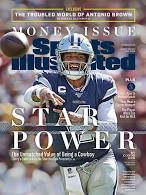 With that in mind, I’m off to the mailbox. The next issue of my Sports Illustrated subscription should be waiting for me… whether I choose to read it or not.
Some content sourced from the 5/8/19 Wall Street Journal article, “Stop Wasting Money on Unnecessary Monthly Subscriptions”.
-
Past Cards
Restaurants tend to leave advertising freebies at the host stand or on your table to remember them by. After paying the bill, you might grab a logo’d toothpick or a couple of plastic-wrapped mints on the way out the door. The fancier establishments offer books of matches (as if smoking remains the chic habit it once was). But every now and then I come across my favorite restaurant takeaway: the plain and simple postcard.
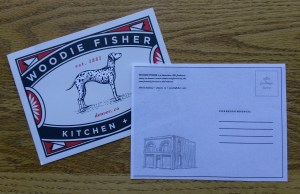 I’m almost afraid to ask a young person what he/she thinks of a postcard. They’d turn it over and over in their hands and wonder what purpose is served by a laminated photo on card-stock paper (“Just show me the photo on your phone!“) Then they’d flip the card to the back and realize it has something to do with snail mail (“Just send me a text!“) Finally, they’d wonder why anyone would go to the trouble of pen/paper just to let another someone know where they were having dinner (“Just add your location on Facebook!“)
Remove smartphone technology and postcards suddenly seem relevant again. Take a break from the dinner conversation, scribble a few sentences, add a mailing address, affix a stamp, and voila! A thoughtful bit of correspondence in mere minutes – the precursor to the Post-It Note. If you’re lucky, the restaurant pays the postage and mails the card. If you’re even luckier, your recipient still checks their physical mailbox.

A 1908 postcard… of a Chicago postcard factory! Postcards have more history than a modest rectangle of heavy paper would suggest. The very first postcard was sent in 1840, in London. (Someone who believed “very first” paid $40,000 for it in 2002.) In the later 1840’s, postcards began circulating in the United States, as printed advertising. Soon after, postcards became the Mini Cooper of personal correspondence; a quick letter sans envelope, but without images (because your personal note went on the front of the card back then). By the 1870’s, manufacturers were producing “picture postcards”, with the divided back you see today.

Risqué front image (at least for 1890) from the popular “seaside postcards” of the United Kingdom The advent of the picture postcard led to a little controversy in certain parts of the globe. Images sent from one country were not always deemed “proper” in another (i.e. sexual references in popular UK “seaside postcards”, or images of full or partial nudity from classical statuary or paintings). Accordingly, some countries refused to handle picture postcards. Those same images are clearly conservative by today’s standards.
Like baseball cards, postcards have become a collector’s item. The value of a given card is associated with the image on the front. Online resources include collector websites and clubs, catalogs, and trading platforms. When I was a kid in the 1970’s, I collected postcards – one summer – to document the stopping points on a month-long trip my family took to the American states in the northeast. Pretty sure none of my cards held value, but I still wish I kept them.
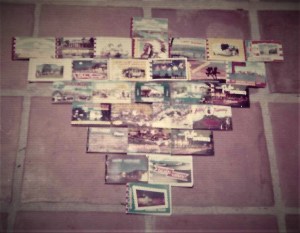
My “Northeast States” collection c. 1975 [Trivia pause: collecting postcards makes me a deltiologist. Aren’t you impressed?]
Postcards have their own terminology, as if to elevate their status among mailed items. A large letter postcard shows the name of a place in big letters (instead of a picture). An early postcard is any card issued before the era of divided backs. An installment card is one of a set, forming a single picture when placed in a grid. Postcardese is the short-sentence, abbreviated writing style of postcards. Finally, midget postcards – noticeably smaller than the standard 6″ x 4.5″ version – were issued as souvenirs and bound in sets. (If you look at my collection photo you’ll see several midgets).

“Large Letter” postcard c. 1940s The next time you come across a postcard, give the little guy a (first-class) ounce of respect. He’s been around a long time, and the post office – depending on country – may still send him for less than the cost of an enveloped letter. Remember, the postcard was the original format of brief long-distance correspondence. Think about that the next time you text.
Some content sourced from Wikipedia, “the free encyclopedia”.
-
Coffee Breakers
Every now and then I take this blogging habit out onto the road, so to speak. Instead of typing paragraphs from the home office, I’ll liberate my laptop from its cables, hop in the car, and head over to the local coffee house. Working in a caffeinated environment – especially one buzzing with grouplets of chatty patrons – brings out the creative juices in me (if not the ability to concentrate). Lately however, I’ve decided my little laptop show pales in comparison to some of the real road warriors out there. Apparently, I need to show up with more toys in hand. It’s time to go “Venti” instead of “Tall” and become one of the true coffee-breakers.
 Perhaps you’re familiar with the patron I’m talking about here. Coffee-breakers recreate their home office (or “office office”) on a table in the middle of Starbucks. They consume more than their fair share of coffee house real estate (but not their fair share of coffee relative to their extended stay). They arrange face-to-face meetings with colleagues, and interviews with prospective employees. They hold Bluetooth conversations as they stare at nothing in particular. Or FaceTime conversations as they have one-on-one’s with their phones.
I’ve come across several breakers in my coffee house stays. They demonstrate distinct behaviors to separate themselves from those of us who simply want laptop time with our lattes. First, breakers set up their workspaces, with enough time and attention to detail to announce, “Notice me!” Then they go to the counter to place their coffee orders, deliberately leaving their setups unattended (as if to say, “This space is reserved!”). Finally, they begin their “work”, which doesn’t really seem like work. I can’t help thinking coffee-breakers are more often show than substance.
 A few weeks ago at the local Starbucks, I left my laptop and Flat White to take a quick phone call outside the store doors (the polite thing to do). When I returned, I found I’d been joined by a coffee-breaker. She was carefully positioning two Bluetooth speakers on the table in front of her; then fiddling with her phone and a few other components from her oversized backpack. As soon as her speakers gushed music (clashing with the Starbucks music playing overhead), she put in her AirPods and simultaneously took a phone call. She operated as if she was in her own little world (i.e. I didn’t exist). Therein lies another distinct coffee-breaker behavior: virtual walls.
On another visit, I was party to a conversation between a commercial real estate broker and a prospective tenant. He sat his client (deliberately) adjacent to the counter queue, which (conveniently) put him in the center of the store. The broker was hawking lease space in the adjacent soon-to-be-opened retail center. No wonder he raised his voice as he spoke. This coffee-breaker’s sales pitch was as much for me and my fellow patrons as for the captive soul sitting right in front of him.
 The Wall Street Journal (WSJ) recently published a dozen rules for coffee-breakers; rules that should be laminated to every Starbucks building in the land. Examples: Work only where and when you’re wanted (i.e. ask first). Buy first, sit second. Buy more than one small black coffee during the day. Don’t take work calls – ever. And so on. Perhaps more enlightening was the reader comments in response to the rules. I perused four pages’ worth (30+ comments) and not one came to the defense of coffee-breakers. In fact, several comments added more rules to the list.
 To my earlier comment about going “Venti”, I talk – of course – tongue-in-cheek. A little attention is a good thing, but my hope is most of us would not deliberately choose to be a coffee-breaker (else this is the end of Western civilization as we know it). Nope, I think I’ll take my road show to the library instead.
Some content sourced from the 8/27/19 Wall Street Journal article, “How to Act Like a Human When Working From a Coffee Shop”.





About Me
The sky is not completely dark at night. Were the sky absolutely dark, one would not be able to see the silhouette of an object against the sky.
Follow Me On
Subscribe To My Newsletter
Subscribe for new travel stories and exclusive content.
 Life In A Word