Tryst With a Twist

I’m leaving my wife for another woman. There, I said it.

I never thought it would come to this; I really didn’t. My wife and I have been together for thirty-one bliss-filled years – as smooth and as satisfying a marriage as one could hope for. And yet, tomorrow afternoon, I’ll catch a ride to the airport, kiss my beloved goodbye, and board a one-way flight to Las Vegas. All my worldly possessions stay behind, save for the overnight bag in my hand and the wad of cash in my pocket. When I get there, I’ll dress up, head over to one of the finer restaurants on the Strip and reunite with a woman over thirty years my junior. We’ll smile at each other and raise our glasses in anticipation. A new adventure will commence.

Now then, let’s shed a little more light on my tryst, shall we? Yes, I’m leaving my wife (but only for a day and half). Yes, I’m going to Sin City on a one-way ticket (but then I’ll turn around and drive back home the next day). And yes, I’m meeting up with a woman thirty years my junior. She also just happens to be my daughter.

Here’s the detail. After a year of living and working in Los Angeles, our youngest has decided to return to Colorado to give Denver a try (the “new adventure” I refer to above). The drive between those cities – if you’ve ever done it – is Las Vegas and a whole lot of nothing else. Imagine a twenty-hour jaunt in a lunar rover on the moon, only somewhere along the way you get thirty minutes in Disneyland. That’s LA to Denver: no people (at least, no sane ones) and a whole lot of cactus, dotted with a single oasis of slot machines and casino-hotels. Come to think of it, I’d wager big money the moon is more interesting than LA-Denver, especially the never-ending portion of the drive known as southern Utah.

Anyhoo, (to use a word from my daughter’s unique vocabulary), I’m sharing the Vegas-to-Denver drive with her – responsible father that I am – fully fourteen of the twenty hours it takes from Los Angeles. Somehow the idea of my daughter and her cat all alone in the desert doesn’t sit well with me.

The more I ponder this little adventure, the more I wonder if I shouldn’t be worried more about my time in Vegas. Think about it. I’ll show up at the hotel, and the front desk will undoubtedly eye my much-younger companion from head-to-toe. “Oh!”, I’ll say with a sheepish grin, “she’s my daughter.” Yeah, right pal, your ‘daughter’. When I arrive at the restaurant for dinner, the maitre d’ will say, “Sir, if you and your – uh – ‘niece’ will follow me, I’ll show you to your table.” Or let’s say I get my daughter to blow on the crap table dice for luck. Stink eyes all the way around. Hey big spender; who’s your prom date?
This is a no-win situation. Short of a blood test and a doctor’s proclamation, “Holy cow, they’re actually related!”, I’m destined to a jackpot’s worth of dirty-old-man looks in the next few days. At least I won’t be mistaken for a gigolo.

What happens in Vegas, stays in Vegas. Sorry, I beg to differ. I’ll be pleased as punch to share the intimate details of my time with my “other woman” in Sin City. Heck, maybe I’ll even make it my next blog post. We checked into the hotel. We went to dinner. Dropped a few quarters into the slots. Went to bed early so we’d be rested up for the long drive head. Riveting reading, huh?

Dream Puffs

Last year, Starbucks surpassed Subway as America’s #2 restaurant, measured by gross sales (McDonald’s is still top dog).  I don’t consider Starbucks a place to “dine”, so second-place is impressive.  Then again, Starbucks’ bakery case has matured since its initial offerings.  There are temptations-a-plenty now, en route to the barista.  The traditional breakfast items share space with yogurt parfaits, fruit-and-cheese boxes, “fold-over” sandwiches, and entree-size salads.  But it’s the smaller offerings I want to talk about today.  Look closely through the glass – you’ll see sous vide egg bites and Bantam’s bite-sized bagels.  Those little guys could be the future of fast food.

egg bites

I haven’t tried the mini bagels, but Starbucks wins me over with its egg bites.  The first time I gave them a whirl, my wife and I were in the middle of Lent, trying to find alternatives to the foods we gave up.  Egg bites to the rescue.  The sous vide prep means cooked in water, with nothing but a bit of spinach, red pepper, and cheese mixed in for flavor.  Simply elegant (elegantly simple?), and the light, fluffy texture makes them as delicious as they are convenient.

Three Little Griddles
Æbleskiver

Now let’s talk about real breakfast foods.  Last weekend, my wife and I went to a nearby restaurant called Three Little Griddles.  Much to my delight, Griddles had Æbleskiver on the menu.  If you’re Danish, you already know what I’m talking about.  Æbleskiver is heaven-sent breakfast: puffy little balls of pancake with a sweet surprise in the middle, finished off with a delicate dusting of powdered sugar and a side of raspberry jam.  Æbleskiver is Danish for “apple slices”, but you’re more likely to bite into a strawberry or a fruit-compote filling instead.  Three Little Griddles also offers Æbleskiver with an egg/bacon filling, coated with a maple-syrup glaze and powdered sugar.  A complete breakfast!

NOT Æbleskiver

If you haven’t heard of Æbleskiver and the first thing you thought of was “doughnut hole”, shame on you.  Doughnut holes don’t even qualify as poor man’s Æbleskiver.  Doughnut holes are a clever product designed to get you to buy more when it appears you’re buying less (think “fun-size” candy bars).  I have two issues with doughnut holes.  One, they’re not actually the “hole” of a solid doughnut, but prepared and baked separately instead.  Two, they’re not shaped like a doughnut hole should be (picture it – something more like the hub of a wheel).  They should be called doughnut balls.  But enough of this talk; I’m wasting words.  Let’s keep the focus on Æbleskiver.

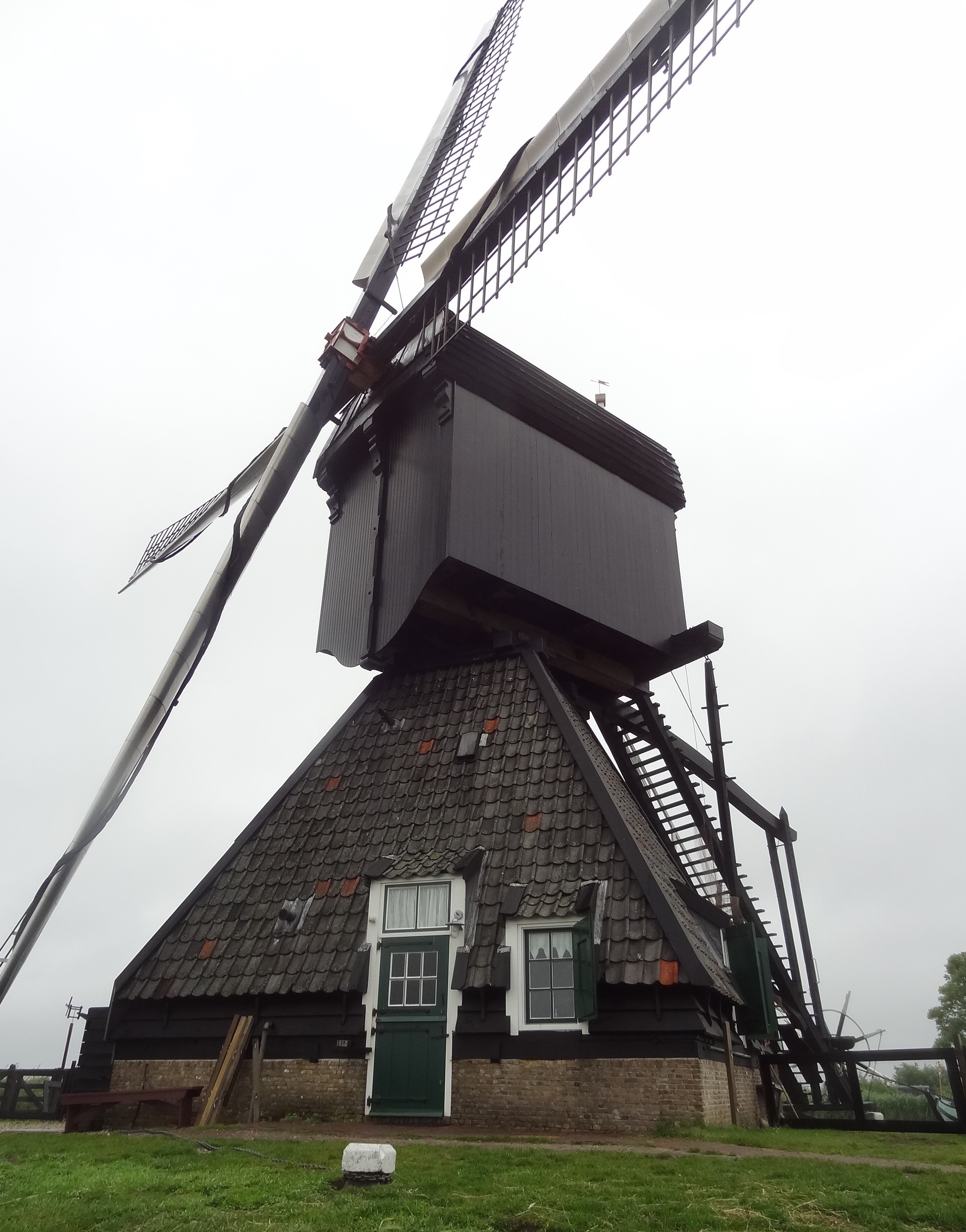
My first taste of Æbleskiver came when I was little, in the Central California village of Solvang.  Solvang is like, well, a kid’s “Little Denmark” – a town small enough to walk around, with an overabundance of shops selling toys, candy, and ice cream.  Several windmills spin slowly above Solvang’s high-pitched shingle rooftops.  A church sits prominently on the edge of town.  A small park serves as the town square, complete with a bandstand-sized gazebo.  All that’s missing is some water-filled canals and cobble-stoned streets.  But meanwhile, there’s plenty of Æbleskiver.  Some restaurants even bake them out on the sidewalk, rotating those little dream puffs to perfection in their unique iron skillets.

If you credit the Danes with the invention of ball-shaped food, the rest of the world takes a distant second with its imitations.  China makes a spherical egg-based fruit-filled waffle called Gai Daan Jai.  Japan makes a variety of savory ball-sized snacks called Takoyaki. (Savory? Yuck.)  And America makes doughnut holes called Munchkins.

As if Æbleskiver isn’t cool enough as a food, it’s also a cool word with a unique spelling (note the “letter” Æ).  Perhaps Starbucks will start carrying it, along with the egg bites.  I’d buy both and a coffee for a complete breakfast.

Finally, if Æbleskiver has you wondering what other delights Denmark has to offer, consider ÆblekageÆblekage is “apple charlotte” – stewed sweetened apples layered with butter-roasted bread crumbs and crushed makroner (an almond-flavored meringue), topped with whipped cream and red currant jelly.  Oh my; sounds like dream stuff.

Æblekage

Some content sourced from Wikipedia, “the free encyclopedia”.

Precisely Enchanting

If you watched any of the Winter Olympics the past couple weeks, you witnessed dramatic moments only the Games can deliver.  Some literally took my breath away: the edge-of-your-seat overtime shootout in the women’s hockey final (a 3-2 win by the Americans); the exquisite battle for gold between the highly-touted Russians in women’s figure-skating; and the first-ever victory for the U.S. in the team sprint of women’s cross-country skiing, where Jessie Diggins’ come-from-behind lunge at the finish line took the gold by 0.18 of a second.


Consider “0.18 of a second” (for a second).  The blink of an eye takes twice as long.  Now consider measuring 0.18 of a second.  Remarkably, we’ve had the technology to do so since the 1950’s.  For the Olympics, that precision was provided by Omega, the watch manufacturer from Switzerland.  Of course the timekeepers were Swiss.  What other country is so renowned for the keeping of time?  What other country coordinates forty-six individual railway companies on a single network of tracks, bringing its trains into the stations on-time every time?  Where else in the world would you feel more confident banking your cash?  Six years ago, Omega developed technology capable of measuring one-millionth of a second.  At the Pyeongchang Olympics they used a photo-finish camera capable of ten thousand snaps per-second.  The Swiss redefine “attention to detail”.

I’ve had an affection for Switzerland from a very young age.  As a kid, my introduction took place in subtle ways.  Shirley Temple’s “Heidi” was based in Switzerland. The Switzer brand of red/black licorice (still available in “vintage” candy stores) was a frequent purchase.  The cute little Swiss Miss in our pantry beckoned me to hot chocolate.  As a Boy Scout, I always carried one of the Victornox Swiss army knives.  At Disneyland I roller-coasted through a scaled-down replica of the Matterhorn – one of the Alps.  I had my first taste of fondue.  And for a Suisse exclamation point, I consumed a ton of that “holiest” of cheeses.  My ancestry test should’ve produced a little Swiss DNA, don’t you think?

As an adult, Switzerland’s products are no less present in my life.  Lindt is my favorite chocolate (and I’ve tried my fair share of chocolate). A Rolex watch is still the material equivalent of corporate-America success (though my tastes are more modest – perhaps a Swatch [Swiss-watch]?)  Velcro can be found on several items in my wardrobe.  Haagen Daz is my favorite brand of ice cream (a product of the Swiss company Nestlé).  And a lengthy search for “adult” Swiss licorice led me to Chateau D’Lanz, a family-run business in Washington state producing some of the best.

Speaking of Nestlé, the Toll House chocolate-chip cookie recipe is also one of my favorites. Here’s a bit of trivia: Toll House was an inn in Whitman, Massachusetts.  Ruth Graves Wakefield is credited with inventing the chocolate chip cookie (by mistake) somewhere nearby the Toll House.  The price Nestlé paid for the right to Ruth’s recipe? A lifetime supply of Swiss chocolate.

Now speaking of Velcro, here’s another bit of trivia.  George de Mestral was a Swiss engineer and amateur mountaineer from the 1940’s. Hiking in the Alps one day, George noticed seeds kept sticking to his clothes and to his dog’s fur. When he returned home, George developed a synthetic “sticking” technology like what he’d found in nature; a hook-and-loop zipper alternative eventually patented as Velcro. The clever name is a child of the French parents velours (velvet) and crochet (hook).

Okay, we’ve covered Swiss precision and some world-class products, but I haven’t addressed what makes Switzerland so fetching.  How’s this for starters: the entire country can fit within the greater Dallas/Ft. Worth area.  Bordered by France, Italy, and Austria, the Swiss are typically fluent in French, Italian, and German; as well as their home-country language of Romansh.  Switzerland produces some of the best in skiing, snowboarding, and mountain-climbing (of course), but also tennis? (hello, Roger Federer).


Here’s some more Swiss charm.  The colorful Guards in the Vatican City are the only foreign military service permitted to its citizens.  Switzerland’s “non-interference policy” dictates its only participation in foreign wars is typically through the high-profile benevolence of its Red Cross organization.  And citizenship in this fair country?  You’d better hope you have blood ties through birth or marriage.  Otherwise it’ll take twelve years of a special-residency permit, combined with a long-term work visa.

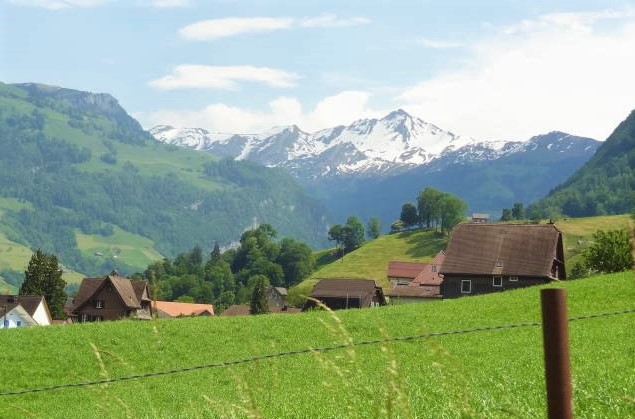
Despite my obvious affection, I should probably stay away from precisely enchanting Switzerland.  It’s a real country like any other after all, which means not everything comes up roses.  Perhaps I’ll cling to my snow-globe impression of the Suiss Alpenland instead: a gentle people living high on the Happiness Scale; the cleanest and quaintest cities imaginable; cobble-stoned streets and chalet-like houses.  The magnificent Alps serve as the backdrop, their slopes ascended by rickety cog railways and descended by skillful skiers.  Listen for an accordion or a little yodeling.  Look carefully enough into my globe and you might even notice the von Trapp family, marching down the mountain trail from Austria, singing their do-re-mi song.

Some content sourced from Wikipedia, “the free encyclopedia”.

Wait For It

Let’s wager a guess over something that happened to you in the past few days. It probably happened several times in the past few days. It wasn’t by choice, nor were you alone.  It might even be happening right now. What is this recurring, oft-maddening event in your daily world (and mine)? Somewhere, for some good reason, in person or in the car, deliberately or unintentionally, you found yourself waiting in line.

Call it a common courtesy or call it the primary by-product of consumer demand. Waiting in line is a timeless (or time-wasting) necessary evil with no satisfactory alternative.  While the world behaves efficiently with smartphones, computers and even data-consuming “IoT” appliances, those snaking, switch-backing, several-option, several-category lines of humans seem to grow ever longer.  Including traffic on the highways – another version of waiting – you’ll spend one to two years of your life in line.

Consider some of the common reasons why we wait in line:
– store cashiers
– airport security
– phone calls (on hold)
– amusement parks
– voting
– public restrooms

If I wrote this post fifty years ago, I would’ve listed the very same reasons why we wait in line.  We have options now, but let’s face it; those options are waiting-in-line in disguise.  Store cashiers now work side-by-side with an area of self-check-out machines (which draws its own line).  Airports promote pay-for lines like TSA Pre and CLEAR.  Telephone on-hold mechanisms offer callbacks instead of waiting (“for an additional $0.75”).  Disneyland installed “FastPass” lines; again, for a fee.  Voting can be done by mail (forcing your ballot to wait in line instead of you).  And public restrooms?  Okay, there’s no option to waiting for the potty.  Maybe reconsider that second beer.

The Brits refer to a line of people as a queue.  I like that (and not just because we need more words beginning with the letter “q”).  Leave it to those on the far side of the pond to class up the most mundane activity imaginable.  At least we have our phones as distractions when we “queue”.  But the old-fashioned distractions still work.  It’s why they put candy bars by the cashiers, magazines in the waiting room, mirrors by the elevators, and televisions in the airport.  Anything to help you forget you’re waiting in line.

Julio C. Negron

You’d think waiting in line is mindless – no-brainer science really – but I have experienced flaws in the system.  Recently in Lowe’s, waiting patiently in a single, central line at the self-check-out area, I was confronted by the person behind me, who demanded I “choose one side or the other” (as if logic demanded a separate line for each row of self-check-out machines).  My response to him was not one of my finer moments.  Another example – at the airport – my wife and I waited at the curb with a dozen others for the parking lot shuttle, only to discover the “front of the line” was a variable determined by the point on the curb where the driver chooses to stop his vehicle.  If you want to see what not waiting in line looks like, try to catch a parking lot shuttle at the airport.

In today’s world, we have new reasons why we wait in line:
– to purchase the latest iPhone
– at restaurants, with pagers (clever disguise for waiting in line)
on-line (i.e. for concert tickets or sports tickets at a specified time)
– Black Friday sales

Finally, we will always stand in line for our kids, whether to see Santa Claus at the mall or to buy something they simply must have.  Years ago, I remember taking my kids to the local bookstore for the latest “Harry Potter” (which they started and finished before the next sunrise).  It was the only time I’ve stood in line for the right to stand in line again.  The bookstore insisted on selling a limited number of tickets at noon, to be exchanged for the book later that same day, when the publisher allowed its release.

I believe the longest I’ve ever waited in line is five hours – to see the first Star Wars movie in 1977.  With no electronic devices to keep my friends and I company back then, five hours was even longer than it sounds, especially knowing two consecutive showings of the movie would run before I even entered the theater.  Then again, the truly morbid among us believe we are all simply waiting to die.  If that’s the case, let’s hope we’re in a really, really long line.

Bad Check

Last week I flew to Indiana for a conference, connecting briefly through Chicago O’Hare.  After finally touching down and exiting the tiny plane, I noticed a cluster of passengers right there in the jet bridge, waiting for luggage to be brought up the stairs.  I headed to the baggage claim area instead, where the rest of us watched the carousel lumber round and round.  The minutes passed interminably as the belt continued its relentless rotation; passengers leaving one-by-one with their bags.  Suddenly everything came to a grinding halt, and the carousel let out its big, mechanical sigh.  I found myself in the quiet and solitary confinement of an empty claim area.  My luggage?  Nowhere to be found.

The airlines advertise a ton of performance statistics, but here’s a new one on me: rate of mishandled bags.  For every passenger who files a lost-luggage report, the carrier gets a ding.  That ding is well-deserved, representing the stress of lost luggage, the hassle of filing a report in one of those stuffy little offices, and the inevitable delay reuniting with your bag.  Not that it happens very often.  According to the following chart – part of a Wall Street Journal article – American Airlines reports a mere 2.8 incidents of lost luggage per 1,000 passengers.  But hold the phone, folks – there’s more to the losing than meets the eye.  Turns out American (and most other airlines) avoid a lost-luggage ding if they alert you to the “mishandled” bag.  Today’s smart tags make it easy to track the bag (even if it’s heading in a different direction than you are).  So that bit of information – proactively communicated in a text or email – avoids a bad stat.  And that’s why the chart below shows a dramatic improvement in August.  American Airlines started its proactive notification process the month prior.

I don’t choose my airline according to “rate of mishandled bags” (or any other statistic for that matter – it’s all about the ticket price), but I have observed the adjusted behavior of others.  Carry-on baggage is all the rage now, in brand-new shapes and sizes.  Look around next time you board a plane and count how many passengers violate the airline’s carry-on policy.  The person with the roll-y suitcase and oversized backpack is probably one bag over the limit.  The person with the valise slightly larger than the space “under the seat in front of you” probably should’ve checked it.  But chances are the flight attendant won’t make a fuss, at the risk of negative publicity.

Speaking of backpacks, the oversized versions seem to be all the rage these days; far surpassing the number of “wheelies” and “over-the-shoulder’s” so common with past generations.  It’s like everyone’s back in high school again.

Here’s another trend.  Passengers carry-on instead of checking, knowing there isn’t enough room in the overhead bins.  Once the bins are full, they surrender their bags at the end of the jet bridge instead, for attendants to tromp down the stairs and into the belly of the plane.  After landing, the process works in reverse (thus the cluster of passengers on my recent flight).  But credit to these travel warriors; they avoid $50 of baggage fees, as well as smashing bags into overhead bins (which always brings to mind square pegs and round holes).

One more trend.  Airlines are shifting the baggage-check process into the hands of travelers.  At self-check-in, the kiosk now dispenses a bag tag along with the boarding pass.  You attach the tag to the bag.  You haul the bag to the belt, where – in some cases – you place the bag on the belt.  Congratulations – you’re an airline employee working free of charge.  You might even be helping the airline avoid a mishandled bag stat.

My own lost-luggage story had a happier-than-expected ending.  At the baggage service office, the attendant took my tag into the back, reappearing moments later with my bag.  Turns out my suitcase flew on another plane, arriving at my same destination before I did (explain that bit of magic, please).  Crisis averted, but instead I lost my excuse to go purchase a suitcase of new clothes.

Land of Flying Cars

My wife and I live in a rural area of Colorado known as the Black Forest.  The high density of Ponderosa Pines in our small geography gives us our name.  Remarkably, there’s only one other notable place on the planet named “Black Forest”: the region near Bavaria in southwest Germany.  As it turns out, I have personal ties to both places, though I’ve never been to the south of Germany.  Follow along as I connect the Forests.

Fill in the blank, “Best Childhood Movie: ________”.  Most of you would respond with an offering from Disney.  Including “Snow White…”, “Mary Poppins”, and “The Little Mermaid”, you’ve already covered sixty years of film-making, with countless other Disney classics in between.  I don’t think I missed a single Disney growing up in the sixties and seventies, yet – go figure – my favorite childhood movie doesn’t come from the Mouse.  It doesn’t even come from my home country.  My childhood choice?  The UK’s “Chitty Chitty Bang Bang”, based on the 1964 novel by Ian Fleming.

“Chitty Chitty Bang Bang” – the captivating musical about the inventor and his kids who lived in a windmill cottage; about those wonderful-though-not-always-perfect inventions (my favorite: the eggs-toast-sausage breakfast machine); about the candy-maker and the toy-maker and the captivating castle world of Vulgaria; and most importantly about the magical flying motorcar itself – created figments of my imagination like no other movie.  The lyrics to the title song (“…Bang Bang Chitty Chitty Bang Bang, our fine four-fendered friend…”) were burned into my brain.  Someday I vowed to visit the lands of Caractacus Potts and Baron Bomburst.


As it turns out, the Potts’ windmill cottage really does exist (and not on a movie set) – as the “Cobstone Windmill” in Buckinghamshire, England. The mansion where “Truly Scrumptious” lived is in the same area of the country.  And the Scrumptious Sweets Company was a working factory in Middlesex (today a steam-engine museum).  But it was the castle and village in Vulgaria I really wanted to see.  Not long after seeing the movie of course, I learned “Vulgaria” was a fictitious country.  Baron Bomburst didn’t actually lord over the land, nor did he ever keep all those children as slaves beneath his castle. But the castle and the village are based on actual places.  The village is Rothenburg ob der Tauber in Bavaria.  The castle is Castle Neuschwanstein, also in Bavaria.  And how ironic; both locations were inspirations for Disney as well: Rothenburg for the village in “Pinocchio”, and Neuschwanstein for the Cinderella castles in the theme parks.

To bring my journey full-circle, Rothenburg, Castle Neuschwanstein, and Bavaria sit in southwest Germany, adjacent to… the Black Forest.  Germany’s version of the Forest is a mountainous land of picturesque villages, castles, vineyards and spas.  This is the region that brought the world Black Forest Ham and “truly scrumptious” Black Forest Cake.  This is the land of glass-making and cuckoo clocks.  From the photos above, it looks every bit as charming as “Vulgaria”.


Colorado’s Black Forest barely amounts to a dot on Google Maps.  Within our pines, the “town” is a hodge-podge of nondescript businesses clustered around a couple of traffic signals, with nothing more alluring than a Subway, a post office, and a couple of coffee shops.  The terrain is fairly flat, with no windmill cottages or mountaintop castles or cuckoo clocks.  But it’s a great place to live, with its own unique charm.  And every now and then, when I’m deep in the pines, I’ll start humming that forever-familiar Chitty-Chitty tune, as I gaze up to the skies in search of a flying motorcar.

The Euphoria of Joe

Today I’m perched at one of my favorite Colorado coffeehouses, sipping the local version of a cafe latte.  The air is rich with the bitter aroma from the nearby roaster.  I’m surrounded by chatty patrons, each with their own coffee-based delight-in-a-cup.  If I had a handful of the crunchy chocolate-covered espresso beans they sell, I could say coffee’s hitting all five of my senses today (instead, I have a delicious apple fritter).  These days, coffee is as infused into American culture as baseball and Apple (pie).  And how far we’ve come from the cups of Joe former generations would brew with store-bought cans of Folgers.

How far have we come (besides the requisite latte foam-art)?  Consider this: my coffeehouse does not allow to-go orders.  You read that right: if you get your coffee here you’re drinking in-house.  According to the resident “roastmaster”, paper cups alter the flavor of the coffee and thus they won’t sell it to-go.  Hard for me to swallow (the cup thing, not the coffee), as my palate has never been very discerning.  Yet here I am, paying top dollar to drink real-cup coffee “in the house”.

It wasn’t always this way.  Not so long ago all you had on the menu was a “cup of coffee”.  Take it black or take it with sugar/cream, but that’s where your options ended.  And the reference to “Joe”?  That comes from a 1914 ban of alcohol on U.S. Navy ships by then Secretary of the Navy Josephus “Joe” Daniels.  The strongest alternative to a “real” drink on-board was black coffee.

Today’s kids get their first taste of coffee at Starbucks.  My own first taste took place in Italy, during the college year I lived there in the 1980’s.  Italians take their coffee very seriously.  Walk into an Italiano café, belly up to the bar, and order an espresso shot and sweet roll.  That’s your standard-brand Italian breakfast, and you take it standing up.  You’re in, you’re out, and you’re on your way again in less than a minute, sufficiently caffeinated.  Not many are baptized on straight espresso, but that was my experience.

My coffee journey continued after college, but it was quite a stumble.  I graduated from Italian espresso and regressed to the standard-brand Bunn coffeemakers of corporate America.  Starbucks and its kin would not arrive for another 5-10 years.  Office coffee was a mindless, characterless, tasteless experience.  A Styrofoam cup of black nothingness, with a few unbrewed grounds thrown in for texture.  It was like descending from the Golden Age of the Roman Empire to the Dark Ages.

Thankfully, my coffee habits persisted until coffeehouses became an American staple in the late 1980’s.  The houses themselves still aren’t the vision of Starbucks’ Howard Schultz: “comfortable, social gathering places away from home and work”, but at least we’re getting past the Frappuccino-this and macchiato-that, evolving back to straight coffee.

My one dedicated-cash phone app is for coffee.  I literally wake up and smell the coffee thanks to my Keurig; then structure my waking hours with the possibility of a drive-through cup of Joe later on.  To get really serious I could spend $200 on a Ninja’s home coffee bar, which claims to be a coffee system (“Variety of brew types and sizes!” “Built-in frother!” “Tons of delicious coffee recipes!)  Their tagline: “See what all the coffee buzz is about”.

Coffee buzz is no joke, as patrons of America’s 33,000 coffee shops will tell you.  The euphoria we desire – the blissful effects drawn from caffeine – actually has a name: “margaha”.  For that reason, whether your preference is a nitrogen-infused cold brew, a coconut-milk mocha Macchiato, or a take-it-straight cup of Joe, it’s safe to say coffee is here to stay.

Pan-Pacific Keepsake

A year ago I wrote a piece called Athens of the South, a reference to the city of Nashville and its remarkable full-scale replica of the Greek Parthenon in downtown Centennial Park.  The Nashville Parthenon is a leftover from the 1897 Tennessee Centennial and International Exposition.  If you ever visit the ruins of the real Parthenon, you might want to add Nashville to the itinerary to see how the structure looked in its full splendor.

Shortly after my trip to Nashville, I traveled to San Francisco for my niece’s wedding.  She chose a remarkable venue for her ceremony – outdoors under the dome of the elegant Palace of Fine Arts, near the Golden Gate Bridge in the Marina District.  The Palace, as it turns out, has much in common with the Nashville Parthenon.  Despite more popular attractions, both structures belong on the “must-see” lists of their respective cities.

The Palace of Fine Arts, like the Nashville Parthenon, is one of the few remaining structures from its World’s Fair; in this case San Francisco’s 1915 Pan[ama]-Pacific International Exposition.  Typical of a World’s Fair, the Pan-Pacific showcased products, inventions, and cultures of the day, and remained open to the public for almost a year.  The 600+ acres of San Francisco’s Marina District (where I rented my first post-college apartment) served as the Exposition’s central footprint, with the Palace on the west end and “The Zone” of amusements and concessions on the east (near Fort Mason).  Even though the Pan-Pacific’s structures were designed from plaster and burlap – to literally fall to pieces after a year, a few have been preserved to this day. The Civic (Bill Graham) Auditorium is a Pan-Pacific structure in its original location.  The Japanese Tea House was loaded onto a barge and shipped down the bay to the town of Belmont, where it still stands today as a restaurant.  Two of the Exposition’s state pavilions (Wisconsin, Virginia) were relocated to nearby Marin County.

The Pan-Pacific Exposition – like the Tennessee Centennial – brimmed with remarkable structures, including ten exhibition “palaces” and the 435-ft. tall Tower of Jewels.  Surely none of these were more elegant than the Palace of Fine Arts.  My first visit to the Palace was back in the 1970’s, when it housed the Exploratorium, a kid’s-dream hands-on maze of exhibits showcasing the wonders of mechanics, physics, and chemistry.  The Exploratorium filled the Palace’s Exhibition Hall for 44 years before moving to its current location in the Embarcadero.  The Exhibition Hall was all about art for the Pan-Pacific, but it’s had several creative uses since, including tennis courts, storage of military trucks and jeeps, and a temporary fire department.

Let’s be honest though – the Exhibition Hall is not why you visit the Palace of Fine Arts; at least not anymore.  You’ll be captivated by the glorious Roman/Greek-inspired structure of dome, rotunda, and adjoining pergolas instead.  Take a walk between the colonnades to get a sense of its monumental scale.  Have a picnic on the grassy shores of the lagoon.  The Palace’s best photo opp: on the east side of the water under the Australian eucalyptus trees.  Your view is uninterrupted, and mirrored in the water’s reflection.  It’s a popular spot for wedding photos, as my wife and I discovered thirty years ago:

Personal connections or not, I like to think of the Palace of Fine Arts as a large-scale keepsake; a reminder of those simpler-yet-somehow-more-elegant days and generations gone by.  Perhaps the Palace gazes forlornly to the east, seeking the grandeur and crowds of the 1915 Pan-Pacific International Exhibition.  Perhaps she’s content to just watch over the parade of newlyweds on the far side of the lagoon.  Either way, I’m glad she’s still around.  Like the Nashville Parthenon, the Palace of Fine Arts is fine art.

Some content sourced from Wikipedia, “the free encyclopedia”.


Refuge and Reassurance

When the world goes off the rails like it did this week in Las Vegas, the very human reaction is fight or flight. Fight as in help to those who were impacted.  Flight as in shelter; consolation from an incomprehensible tragedy. My own flight, in extreme instances like this one, sometimes takes the form of fond memories of a journey my wife and I made five years ago, to a remote village on the west coast of Ireland called Clifden.

For those who travel to Ireland, Clifden is rarely on the itinerary.  It’s a four-hour cross-country drive from Dublin, and the final ninety minutes meander along a two-lane road through the forested expanse of Connemara National Park.  Clifden has a modest history for all of its two hundred years on the map.  The town evolved from farmers and fishermen who lived in the region, its commerce bolstered by the heir of a nearby castle.  Like most towns in Ireland, Clifden suffered the blight of the potato famine and the onslaughts of rebels from the north.  Its only claim to fame is the location of Marconi’s first wireless telegraphy station to the near south, broadcasting messages across the Atlantic to Nova Scotia in 1905.  Today Clifden has 2,000 inhabitants, still looking the part of “two churches, two hotels, three schools, and 23 pubs” it boasted in the early 1800’s.

As my wife and I discovered, Clifden is the very definition of “off the beaten path”.  We stumbled upon its welcoming neighborhood very much by chance.  Our intended stop was Galway that day, but once in the city-center (and having survived a five-lane roundabout), we yearned for something smaller and less urban.  Heading north along the coast and with dusk turning to dark, we experienced the thrill of the uncertainty of locating our as-yet-unknown destination.

After a middle-of-the-road stop for a funeral procession (popular guy, judging from the dozens of people descending upon the nearby church), and then passing by the dignified Kylemore Abbey, little Clifden emerged from the coastal fog.  We stopped into the first bed-and-breakfast we could find, but there were no rooms at such a late hour.  Instead, we were directed to the larger/older Foyle’s Hotel a couple of streets away.  What a blessing in disguise.  Foyle’s was the perfect introduction to the charms of Clifden.  A turn-of-the-century grand dame with wide hallways, creaking stairs, and no elevator, we felt like we’d stepped back in time a century or more.  Dinner was served in an elegant main-level salon just off the reception area, soft music playing in the background.  Our spacious room looked down on the center of town from one of the second-floor windows you see here.

The next morning, we took to Clifden on foot, wandering its quaint, narrow, up-and-down streets.  We stopped in at Walsh’s Bakery for breakfast, walking away with a few of the more tempting choices from the case. We then stopped in at St. Joseph’s Catholic Church, one of the two spires accenting Clifden’s modest skyline. We climbed to the higher part of town for a look down to the lazy harbor activity along the quay.  More than any sight or sound, we simply embraced Clifden for what it was; a quiet seaside village; is inhabitants contentedly going about their business.  In contrast to bright and busy Dublin, Clifden summoned a much-needed deep breath and a moment of halcyon reflection.

Perhaps our travels will bring us back to Clifden someday.  But the more I consider the idea the less inclined I am to make it happen.  Our idyllic experience was predicated on the chance decisions making our visit happen in the first place, the wandering road leading us to its cobblestone streets, and the saving grace of vacancy at the Foyle’s Hotel.

In Gaelic, Clifden means “stepping stones”.  That’s a nice coincidence, since my fond memories seem to guide me back to a more content frame of mind.  I keep the following illustration in my home office.  With just a glance I can find reassuring refuge once again.

Some content sourced from Wikipedia, “the free encyclopedia”.

Carefree Highways

Here’s a connect-the-dots challenge, tapping what’s left of your road-trip driving fever from Labor Day weekend. Pull up Google Maps, pick two towns on opposite edges of the continental United States, and see if you can discover the longest driving trip. The only rules: you must start and end with U.S. cities, and your answer must be the blue line (not the grey line alternatives).

My first guess on Google Maps (above) is effectively the longest drive between the borders of Mexico and Canada.  San Ysidro in California wouldn’t exist if not for the busy border crossing just to the south.  Van Buren in Maine wouldn’t exist if not for a small group of Nova Scotia citizens exiled from Canada in 1785.  As you can see, my southwest to northeast traverse gets me 3,291 miles of driving and takes more than two days (including a wealth of bathroom stops).  In the process, I pass through ten U.S. states and three Canadian provinces.  Label this trip a long-distance segue from “Ole!” to “Eh?”

My second guess chooses a sun-starved soul north of Seattle, seeking some beach time in the Florida Keys (though someone named Irma would object right about now).  Our friend finishes his oyster stew in tiny Blaine, WA; points his car to the southeast, and arrives in Key West, FL two-and-a-half days later, just in time for a twilight margarita with Jimmy Buffett.  His drive also passes through ten states (like my first guess) but lasts 3,559 miles.  If our friend finished in Miami he’d drive the same distance as my first guess, but Highway 1 – further south through the Florida Keys – buys him a 160-mile tiebreaker.

A recent Wall Street Journal article asserts we Americans are endlessly romanced by the allure of the open road (a “four-wheeled traipse” if you will), and the Labor Day holiday conveniently marks the end of the summer travel season.  Thus, you get a lot of drivers on the first weekend in September – 600,000 in Colorado alone, or 11% of the state’s population.  That translates to over 3.5 million road-trippers across the entire United States.  Traffic jam, anyone?


In the prehistoric times of street-corner pay phones and folding road maps (read: 1970’s), the American Automobile Association (AAA) offered a service called “Triptik”.  Go to an AAA office, tell ’em where you want to go, and they’d hand you a step-by-step book of maps “prepared expressly for you”.  My parents gave me a Triptik – and all the station wagon gas I needed – as a high-school graduation present.  My buddy and I created a Western States round-trip starting in Los Angeles, driving as far north as Montana, as far east as South Dakota, and returning through the Southwestern states.  Our aim was to hit as many national parks as possible.  We spent a few nights in motels (on our own dime), but most nights in sleeping bags in the back of the station wagon.  No agenda, no worries – just a couple of teenagers making a ton of memories on the open road.

On the topic of road trips, I owe a nod to America’s beloved “Main Street” – U.S. Route 66.  Though nowhere close to the longest road trip in the U.S., Route 66 is certainly the most renowned.  Built in 1926, the “Mother Road” ran from Chicago to the Pacific Ocean west of Los Angeles – fully 2,448 miles.  Early 1900’s migration to the Western U.S. owes some of its success to 66, and all those road-trippers “got their kicks” at the hundreds of restaurants and motels born along the highway.  It wasn’t until 1985 – sixty years later – the last remnants of Route 66 were replaced by newer segments of the U.S. Interstate Highway System.

Now then; time to solve the Google Maps challenge (with a twist).  The winner of the point-to-point American road trip is some nearby version of my second guess above: Washington to Florida.  However, for my money I’d much prefer the drive from Oregon to Massachusetts (above).  The twist?  You can do it all on one ridiculously long highway!  U.S. Route 20 – “The Big Daddy” – starts in little Newport, Oregon (pop. 10,000) and ends in Boston (pop. 673,000).  You’ll cover 12 states and 3,154 miles before you hit the checkered flag.  It’ll take you almost two days without stopping, but please stop.  Along the way you’ll find the Idaho Potato Museum, Yellowstone National Park, “Carhenge” (a Stonehenge homage made entirely of autos!), Iowa’s Field of Dreams, Hall of Fame’s for RV’s/motor-homes, rock & roll, and baseball; and most importantly, the Jell-O Gallery Museum, your one-stop-shop + tribute to the jiggly dessert.  C’mon, how you gonna top that road trip (with a dollop of whipped cream?)

Some content sourced from Wikipedia, “the free encyclopedia”.