A Distant Third (cont.)

Last Tuesday in cycle class, pedaling through the five-minute recovery after an hour of torture, our instructor asked if we’d like a Christmas carol or two from her playlist.  The one rider with enough oxygen lashed out vehemently, “NO!  It’s too early!”  Well how about that; score a point for Thanksgiving.  The sun set on Halloween two weeks ago and mighty Christmas is already trying to muscle its way to the forefront.  But Thanksgiving has a thing or two to say first.  If you please, keep the sugar plums out of my turkey and stuffing.

In last week’s post, I compared popular aspects of Halloween, Thanksgiving, and Christmas (i.e. history, music, food).  The final tally: Christmas the clear winner – no surprise – with Halloween solidly in second.  But lest we relegate Thanksgiving to the bronze medal year after year, my blog-intent is to reinvigorate America’s late-November holiday, and remind readers why Turkey Day stands on its own merits.

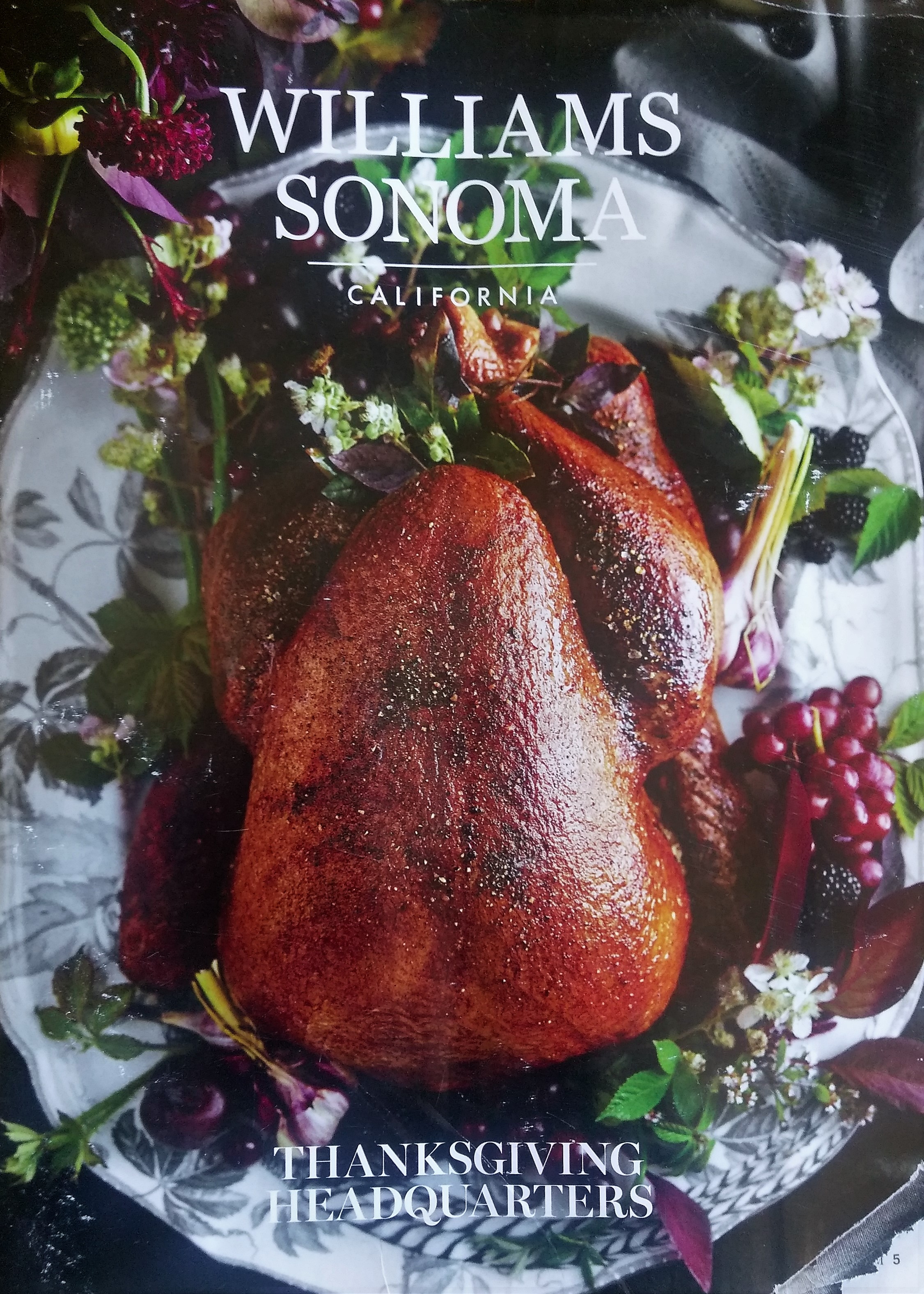
On that note, we’re starting November with promise.  My wife is getting endless mailbox catalogs, and I was delighted to find Williams-Sonoma’s “Thanksgiving Headquarters” edition: 180 pages of food, linens, kitchenware, and decor specifically designed for the holidays.  They even photo-profiled a barn-based “Friendsgiving” celebration in upstate New York.  Granted, the Thanksgiving section of the catalog ended on p.67, meaning the remaining 100 pages were all about Christmas.  No matter – 67 pages of Thanksgiving is impressive.  Way to go, Williams-Sonoma.

Starbucks also made a statement – albeit more feeble – putting their unique spin on Thanksgiving.  Right now, you can drive-thru and order a Turkey & Stuffing Panini (with cranberries and gravy!), perfectly nicknamed “a handheld turkey dinner”.  Then pair your panini with a Chestnut Praline Latte (“flavors of caramelized chestnuts and spices, topped with whipped cream and spiced praline crumbs”).  That combo speaks more to November than December in my book.  Not bad, Starbucks.

Retail aside, Thanksgiving plays out as more of an extended weekend than a single day.  Consider the before/after events.  Wednesday (“Thanksgiving Eve”) is routinely labeled “the single busiest travel day of the year”.  Well guess what?  It’s not.  Thanksgiving Day is the busiest travel day of the year, considering 90% of us drive our cars to the family gathering that morning.  Thanksgiving Wednesday (and Thanksgiving Sunday) only seem busiest because the chaos at the airports gets so much attention.

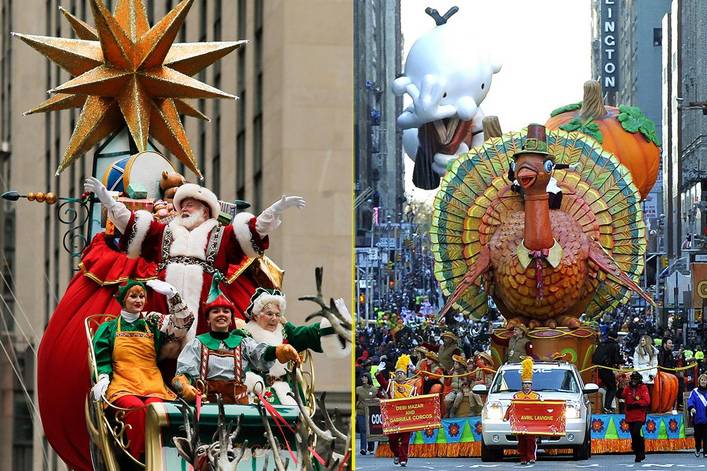
Now, on Turkey Day itself, besides the meal and the backyard football, we begin with the “Macy’s Thanksgiving Day Parade”.  My family always seems to miss the broadcast because we’re so busy in the kitchen.  Macy’s is three hours of marching bands, dancing Rockettes, Broadway singers, flying character balloons, and – as far as I can tell – one nod to Thanksgiving (the massive turkey in the photo above).  But hang on ’til the very end of the broadcast, because… here comes Santa Claus, here comes Santa Claus, wrapping up the parade the same way he’s done every year since 1924.  It’s like the Williams-Sonoma catalog – Thanksgiving on the outside but more “holiday season” in disguise.

Thanksgiving Friday is “Black”, of course – the so-called beginning of the Christmas shopping season.  We Americans spend over $50 billion that day (putting retailers “back in the black” with profits – hence the name).  It’s safe to say this bonanza of spending isn’t going away anytime soon.  By its very nature, Black Friday extinguishes Thanksgiving – almost before the pumpkin pie is served.  Black Friday sales begin as early as 5pm on Thursday evening (making the name obsolete, don’t you think?)  And if Thanksgiving isn’t early enough for you, some stores begin sales a week before Black Friday, with the teaser, “avoid the chaos of Black Friday – shop now!”  Uh, what’s the real meaning of Christmas again?

So there you have it – Christmas putting the squeeze on Thanksgiving like the Grinch on Whoville. Santa concludes the Macy’s parade at 12:00pm ET.  Christmas shopping begins five hours later.  In between, throw a meal on the table, mumble a blessing, and don’t forget to say thanks.  If we’re not careful, Thanksgiving Day will be reduced to Thanksgiving Hour.  It’s a phenomenon known as “holiday compression depression” (okay, I just made that up), but hey; it’s happened before.  In 1971, George and Abe got their standalone birthday celebrations mashed into a single holiday.  Even they feel Thanksgiving’s pain.

The Sweets Life

“Pagina Non Trovata” has the look of an elegant Italian phrase (or an opera title), until translation and context reveal its harsh reality. The phrase means “page not found”, which in my instance referred to a (former) on-line job posting for Italian candy company Ferrero. My punishment for seeking the advertisement two months after the fact? Ferrero, the second largest chocolate/confectionery company in the world, is (was) looking for sixty taste-testers – “sensory judges” if you will – to offer opinions on its products. O.M.Gee I wish I’d seen this sooner.  Instead, I won’t be one of the chosen few because, well, “page not found”.

Let’s ponder this (past) job opportunity for a paragraph, shall we?  Ferrero is (was) searching the world for several “average consumers”, who would (will now) get paid to eat chocolate.  “No experience necessary”, they claimed (otherwise by definition you aren’t an average consumer).  The only real requirement, absent food allergies, is (was) a willingness to move to northwest Italy, which darn-it-all means France and Switzerland are just as easy to visit.  Ferrero gives (gave) three months of paid training, followed by an offer to join the company as a part-time taster. “Part-time” in Italy translates to maybe a) second job, or probably b) la dolce vita (“the sweet life”, which definitely does not include a job).  Ferrero’s job is akin to unwrapping a bar of chocolate and finding a Wonka golden ticket.

If Ferrero created run-of-the-mill chocolates, searching late on their job opp wouldn’t be such a tragedy.  But Ferrero makes Ferrero Rocher (of course they do), those gold-foiled balls of decadent chocolate and hazelnuts.  They also make Mon Cheri, those pink-foiled chocolate cubes filled with cherries and sweet liqueur.  They even make Tic-Tac’s for gosh sakes, the boxed pill-like mints all-the-rage when I was a kid.  And finally, their pièce de résistance (or in Italy, “piu degno de nota”), on which the entire company was founded over sixty years ago, Ferrero makes Nutella.

Maybe it was half-hearted reading up to now, but mention Nutella and most people really sit up and listen.  I’m convinced Ferrero puts a secret something into Nutella to make consumers crave hazelnut chocolate spread all the more (bolstering the theory Starbucks does the same with its coffee drinks).  Why else would shoppers storm a small store – and engage in a brawl – when the Nutella stock was discounted 50% (see video here)?  Which leads to an even nuttier question: why have I never tried Nutella myself?

Nuts+chocolate equals killer-combination – I get that.  Give me a basket of Halloween candy and I’ll fish out all the Reese’s Peanut Butter Cups.  Offer me thirty-one flavors at Baskin-Robbins and I’ll easily short-list peanut-butter-and-chocolate.  Sell me M&M’s at the movie theater and I’ll always choose peanut over plain.  But in all my examples, I’m talking peanuts, not hazelnuts.  Nutella spread is new territory for me, which means I’m the perfect candidate for Ferrero’s job. I have no experience with hazelnuts.

The more I read about my future employer, the more I’m impressed with their credentials.  Ferrero buys 25% of the world’s hazelnut production (and fittingly, acquired the world’s largest hazelnut producer four years ago).  They employ 40,000 candy-men and women in a network of 38 trading companies and 18 factories.  Ferrero keeps its recipes under lock-and-key, never letting the press into its facilities nor hosting a press conference, and always engineering its own production equipment.  A recent survey labeled Ferrero “the most reputable company in the world“.

As if I need a clincher to make this decision, last January Ferrero acquired the Nestle’s company’s candy division.  Holy cowbells.  On top of Nutella, I get to taste-test Sweetarts and Butterfingers and Laffy Taffy and the decadent Nestle’s Crunch (silver-foiled chocolate with a generous helping of crisped rice)?  Why even pay me?

I could do this job.  The more I think about it the more I’m convinced Ferrero needs 61 sensory judges.  I’m just (fashionably) late to the party.  All I need to do is brush up on my college Italian (no joke; I spent a year in Rome back then), convince my wife that our dogs, cats, and horses would be next to heaven in northwest Italy, and promptly board the next Alitalia flight.  Sweet life – er, dolce vita – here I come!

Some content sourced from Wikipedia, “the free encyclopedia”, and the USA Today article, “Dream Job: Italy’s Nutella maker seeks 60 taste-testers…”

Almond Joy

Think about the last time you invited friends to your place, for dinner or some other get-together. Did they bring a little something – a gesture of their gratitude – or did they show up empty-handed?  The gesture, whether a bottle of wine or baked goods, is especially thoughtful because it was never really expected, right?  You invited your guests after all, presumably with no strings attached.

When my wife and I hosted friends from Germany a few months ago, they arrived with a plethora of German candies (an embarrassing amount, really). From their suitcases emerged boxes of chocolates and all kinds of licorice. There were German cookies and tempting little cakes. Finally, they placed a curious-looking black round metal tin on the counter.  The label proclaimed, “Mann Des Jahres”, or “Man of the Year” (???)  The tin looked more like an award than candy.  Later, I discovered it was filled with marzipan.

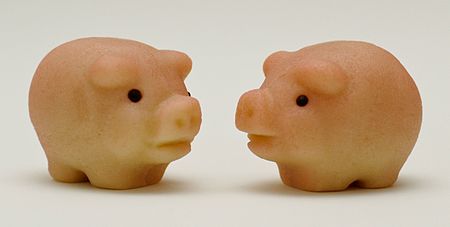
Marzipan translates to “March bread” by some and “a seated king” by others, but to me it is quite literally almond joy.  Sweetened with sugar or honey, marzipan derives its distinctive flavor from the paste, meal, or oil extract of almonds.  Marzipan is more popular in Europe than in the United States.  It is typically shaped into edible fruits, vegetables, or little animals – popular around Christmas and Easter.  Marzipan is also used in thin sheets as glazing for cakes.  The marzipan from my German friends was one big delightful chocolate-covered disc of almond cake.  In hindsight, I wish they’d brought a dozen “Man of the Year’s” and left everything else at home.

Marzipan was not my first introduction to the joy of almonds.  I fell for them back when chocolate bars like Almond Joy and Mounds were kings of the candy aisle (no Kit-Kat or Twix in my day).  Almond Joy was confection perfection: chocolate and coconut topped with whole almonds.  Then I discovered chocolate-covered almonds and realized I didn’t need the coconut.  Then I learned to appreciate almonds all by themselves – roasted and seasoned with sea salt – and realized I didn’t need the chocolate covering.  Today, I keep a bag of Marcona almonds in my car, to fend off less-healthy temptations.

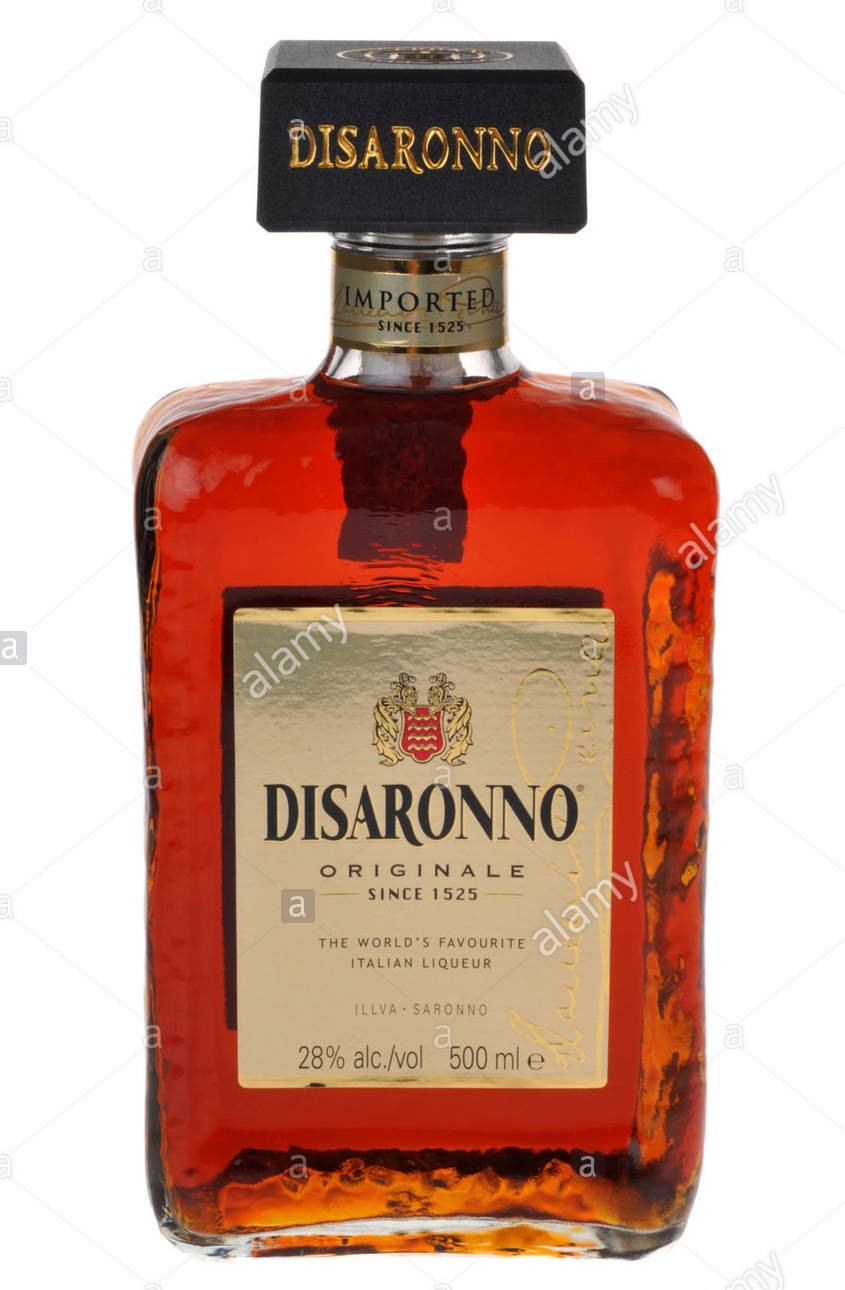
No discussion of almonds would be complete without a glass of amaretto.  In my junior year of college, studying abroad in Rome and not quite of drinking age, I was introduced to copious amounts of table wine, but also to Amaretto Disaronno, the elegant liquor from the northern part of Italy. The (supposed) origin of Disaronno is as colorful as the drink itself:

In 1525, a Saronno church commissioned artist Bernardino Luini, one of Leonardo da Vinci’s pupils, to paint its sanctuary with frescoes.  As the church was dedicated to the Virgin Mary, Luini needed to depict the Madonna, but was in need of a model.  He found his inspiration in a young widowed innkeeper, who became his model (and lover).  Out of gratitude and affection, the woman wished to give him a gift.  Her simple means did not permit much, so she steeped apricot kernels in brandy and presented the resulting concoction to a touched Luini. (from “A Brief History of Amaretto” – Shaw Media)

Saronno, Italy

Apricots still play a role in the making of amaretto, but its distinctive flavor comes from bitter almonds (amaretto translates to “bitter”).  Yet it’s still syrupy sweet – too sweet for me to drink straight.  Like most I “sour” mine with a shot or two of lemon juice.

Now that I think about it, we have almonds everywhere in our house.  Almond milk in the refrigerator.  Almond flour in the pantry.  Almond extract in the spice drawer.  Almond butter for our protein shakes and slivered almonds for our salads.  Amaretto in the liquor cabinet.

Still not enough.  I need to go find me some more marzipan.

Some content sourced from Wikipedia, “the free encyclopedia”.

Purple Mountain Majesties

Aspen – the upper-crust alpine village high up in the Colorado Rockies – is a beautiful place to visit. Make that a stunning place to visit, if you wipe away everything you find on the surface. Aspen is for the obviously-wealthy, whether a night at a hotel ($350 and up, just about anywhere), dinner for two ($250 and up – the finer restaurants), a slope-side condo rental ($2,000/night), or any purchase in any of the village shops; the kind of retail you only find in London-Paris-Rome-New York.  You won’t see any of Aspen’s residents (probably because they don’t care to see you).  Drive past the nearby airport and you’ll see an impressive line of commercial planes… er, make that private planes.  Aspen is made of money – no different than its silver-mining days of old.

Aspen, Colorado (photo courtesy of blog.whatahotel.com)

Now, as instructed, take the chalkboard eraser and wipe, wipe, wipe away all of that excess.  Dust off your hands and stand back.  What remains of Aspen is its incomparable natural beauty, whether the towering Rocky Mountains on all sides, the rushing Roaring Fork river through town, or the stately aspen and bristlecone pine trees forming an umbrella over most of the residential area.  Speaking of Mother Nature, let’s talk about her most majestic contribution, just on the outskirts of town.  No visit to Aspen is complete without a trek to Maroon Bells.

Maroon Bells

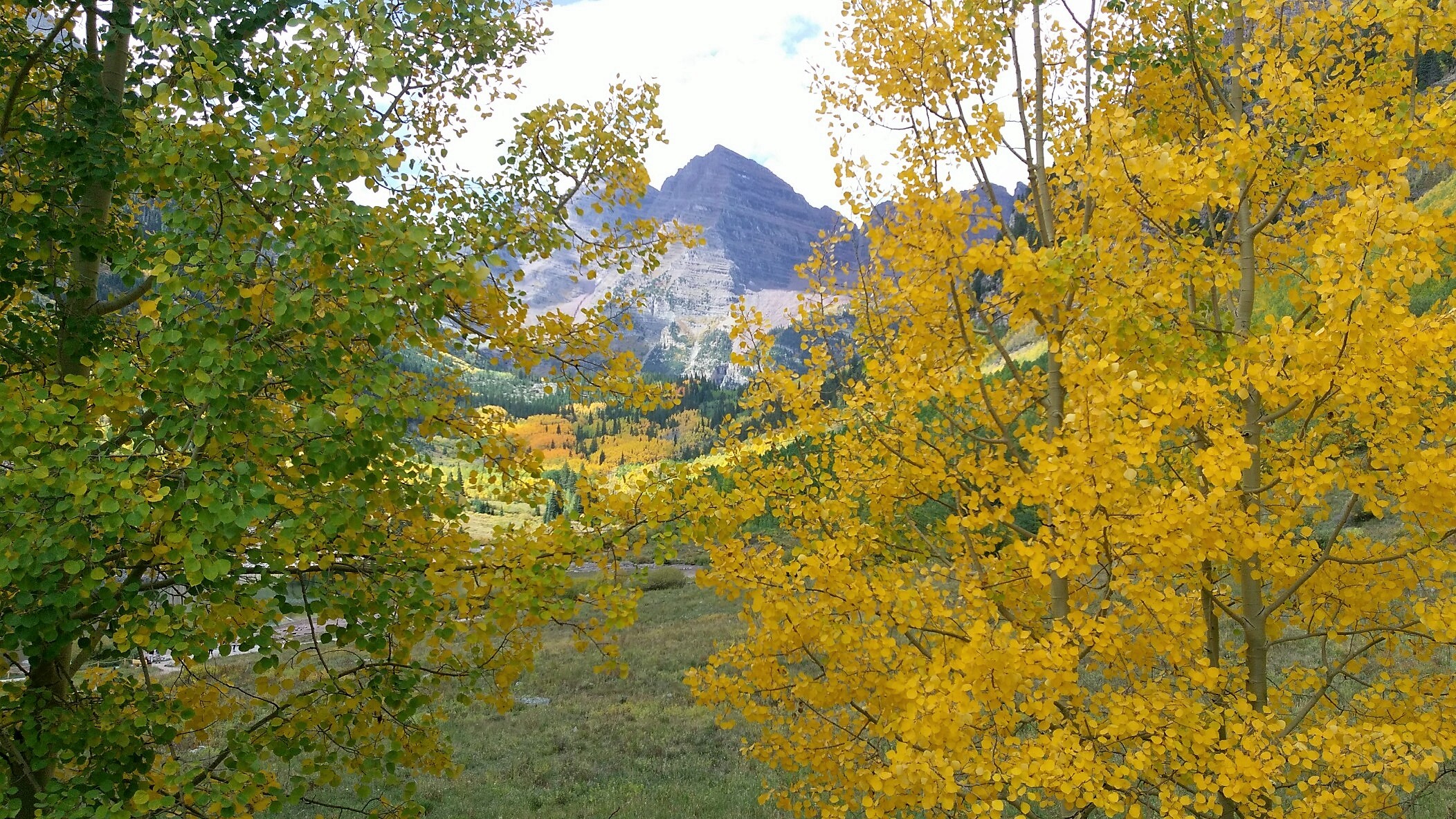
The Maroon Bells – common knowledge to us Coloradans – are twin peaks in the Elk Mountain range, fifteen miles to the west of Aspen.  They get their name from their mudstone composition (a bright purple when the light is right) and from their broad profiles.  The Bells are “fourteeners” – two of the fifty-three mountains in Colorado with elevations +14,000 feet.  The approach to the Bells, through the Maroon Creek Valley with Maroon Lake in the foreground, lays claim to one of the most photographed locations in North America; no matter which direction you look.

Maroon Creek Valley

Remarkably (or maybe not – we all do this), we’ve lived in Colorado twenty-five years and never been to nearby Maroon Bells – until this past weekend.  Despite the must-see endorsement of many friends, I was immediately suspicious when I learned we had to buy “tickets” for the place.  Why tickets?  Because the U.S. Forest Service (bless them) won’t allow cars – and their harmful exhaust – into Maroon Creek Valley.  Instead, $8 gets you a twenty-minute propane-fueled bus ride from Aspen to the valley.  The bus ride adds to the experience for two reasons.  One, your driver gives an overview of the place, with just the right amount of history and sightseeing to keep your interest.  Two, you don’t see the Bells – not even a passing glimpse of them – until just before you’re dropped off at Maroon Lake.


Photographs don’t do the Maroon Creek Valley justice, let alone words.  Breathtaking, jaw-dropping, heart-stirring – take your pick. Everywhere you turn looks like a doctored picture postcard.  Everything looks undisturbed and peaceful – almost a sanctuary where you don’t belong.  I lost count how many times I just stopped and stared.  Add to that the brief late-summer window when aspen tree leaves change from green to a fiery shade of yellow, orange, and red, and the whole scene becomes surreal.  The stuff of dreams.

Kudos to the Forest Service for getting this experience right (score one for the U.S. Government!)  As I was reflecting on the Bells, I couldn’t help but think of the very different approach to Mount Rushmore National Memorial in South Dakota.  As majestic as the carved-in-stone presidents may be, they’re compromised by the several “sights” on the highway up the mountain (“Reptile Gardens”!  “Very Berry Winery”!  “Big Thunder Gold Mine”!).  You won’t find any of those traps on the way to the Maroon Bells.  Only Mother Nature at her most impressive.

Someday you’ll visit Aspen, bypass all of her excesses (or at least most of them) and ride the bus through the White River National Forest and on up to the majestic Maroon Bells.  You’ll hike around the lake, pause on the bridge over the stream, stare up at the mountains in every direction, and take a gillion photos – every one of them worthy of a jigsaw puzzle on your coffee table back home.  Then you’ll climb back on the bus, poised to add a check mark to your bucket list.  But you won’t make that mark.  Instead, you’ll be thinking, “When can I come back?

Some content sourced from Wikipedia, “the free encyclopedia”.

When the World Stopped Turning

I was an infant when President Kennedy faced the threat of communism through the Cuban Missile Crisis. I was a kid when the Vietnam conflict dominated newspaper headlines. I was a young adult during the Persian Gulf War, when my only memory was Lee Greenwood’s God Bless the USA, the lyrics interspersed with tearful exclamations from family members. However, I was fully grown, married with children, alive and aware, on September 11, 2001. 9/11 stays with me; every anniversary observed with reverence.

Reminders weren’t necessary when Tuesday arrived this year (now dubbed Patriot Day), but I still got two. The first – from a fellow blogger – talked about Empty Sky, New Jersey’s memorial to its 700+ victims of the 9/11 attacks, in Liberty State Park directly across from Manhattan. The second – from my Windows lock screen – the day and date in a large font on my monitor: Tuesday, September 11. In 2001, September 11th also fell on a Tuesday.

“Empty Sky” – Liberty State Park, NJ

Lyric: “Where were you when the world stopped turning, that September day?” Alan Jackson

Anyone twenty or older in 2001 should remember exactly where they were “that September day”. I think a book of such accounts would lend meaningful perspective. Me, I was in Texas for a week at my company’s Houston offices. That Tuesday morning, I was listening mindlessly to the radio as I navigated my rental car from hotel to office. The local news was laughing about “some nut-job crashing his single-engine plane into one of New York’s World Trade Center towers”. By the time I got to work, there was no more laughing.

The rest of that week in Houston was a blur. Work pretty much came to a halt as people processed the horrific aftermath of the attacks. That Friday, it was apparent my return flight to Colorado wasn’t going to happen. With the blessing of my rental car agency, I pointed my car to the northwest and faced 1,000 miles of highway. Midway through my journey, in the middle of the West Texas desert, I picked up the broadcast of the memorial service from the National Cathedral in Washington D.C. I’ll never forget the words of President Bush (“We are here in the middle hour of our grief…”), and the choir’s rendition of “America the Beautiful”, bringing uncontrollable tears.

Fact: 25% of Americans living today were born after September 11, 2001.

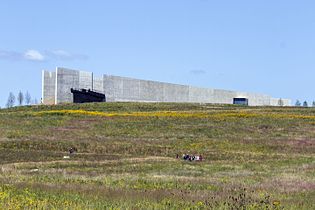
Add in Americans who were ten or younger back then (including two of my children), and four in ten Americans have no real memory of 9/11. Thus, we have the memorials, which laud and honor the departed. On Tuesday, President Trump spoke from Shanksville, PA, site of one of the plane crashes. The Flight 93 National Memorial includes a visitor’s center, a white marble “wall of names”, and a “Tower of Voices” – dedicated just this week – with 40 chimes; one for each man and woman killed in the crash.

Flight 93 National Memorial (photo courtesy of C-SPAN)

In Washington D.C., those 184 victims are commemorated with the Pentagon Memorial, outdoors and just southwest of the massive building. The memorial is park-like: an illuminated bench for each victim, arranged in a grid according to age (the youngest was 3, the oldest 71), and interspersed with trees. When you’re reading the name of a victim from the Pentagon, the bench is oriented so you face the south facade of the building. For a victim of the airplane crash itself, the bench is oriented so you face the flight path.

Pentagon Memorial

Question: Why did fate place me in our Houston offices that day, instead of high up in the World Trade Center alongside co-workers from my company?

Finally, the National September 11 Memorial & Museum opened ten years to the day after the attacks, on the site of the former World Trade Center towers. Perhaps I shouldn’t say “finally”. At last count, there were 700 9/11 memorials across the United States.

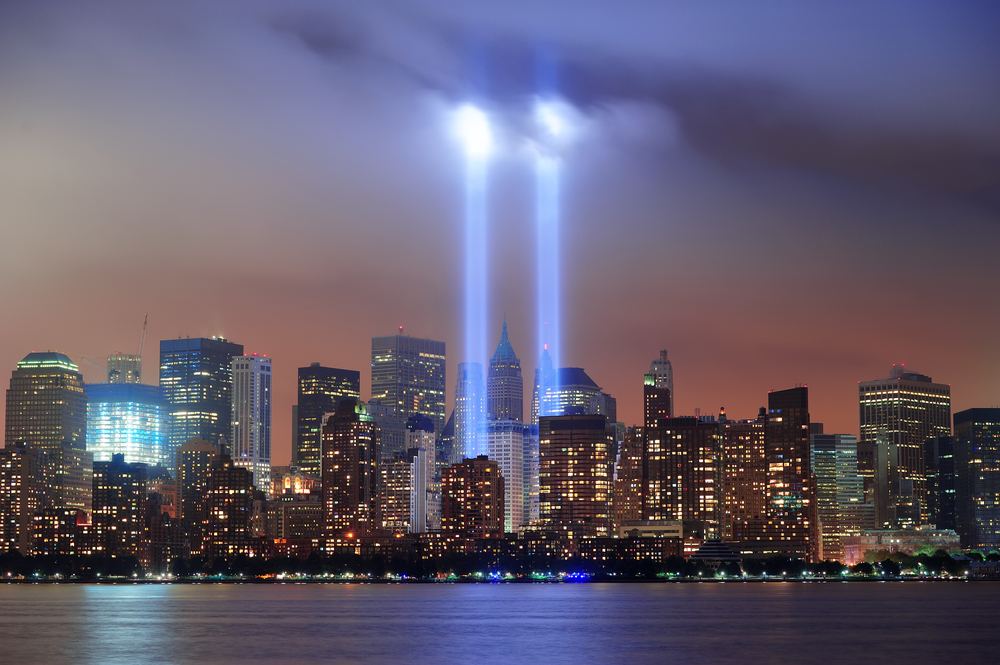
National September 11 Memorial & Museum

Tuesday night, my daughter and I took in a Colorado Rockies game in downtown Denver. The baseball was exciting, but the pregame ceremony took my breath away. 1) A color guard in a slow, solemn march, the flags borne by representatives of each military branch. 2) A trio of elementary-school choirs singing the national anthem. 3) The Stars-and-Stripes, gracefully unfurled by firefighters from across the state; a flag seemingly larger than the stadium itself. 4) The scoreboard, with it’s red-white-and-blue message of affirmation: “WE WILL NEVER FORGET.”

Some content sourced from Wikipedia, “the free encyclopedia”.

Sneakin’ Around

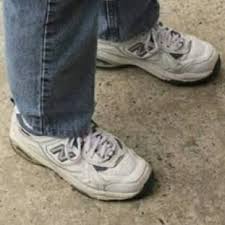
Six years ago, my wife and I visited Ireland for our 25th wedding anniversary. I remember the locals having this uncanny ability to figure out we were Americans, even before we uttered a word. They’d start with, “So where ya from in the States, the both of ya?”, or “What’s the weather like in America now?”, or “Traveled across the pond, did’ja?” It wasn’t until several years later I realized our feet had given us away. Our footwear – bright sneakers with white laces – effectively shouted, “Hello world! We’re from America!” We might have been the only rubber-soled couple in all of Dublin.

Funny people, those Europeans. They wear gym shoes when they’re going to the gym; running shoes when they’re going for a run. That’s about it. We Americans on the other hand (er, other foot), have a decades-long love affair with our “tennis shoes”. We have entire stores dedicated to the soft-soled shoe – Foot Locker, for example – though you’re more likely to find synthetics instead of rubber these days. Walk into a Foot Locker and say, “I need a good walking shoe”, and the salesperson will direct you to every single pair in the store. Americans and their gym shoes: where fashion trumps function.

“Gym shoes” is an awkward, dated description of America’s casual footwear, but we’ve yet to come up with a better name. Once upon a time we called them “tennis shoes”, but today that ask gets you a specialty shoe (for tennis, of course). As kids we wore “Keds”, “Converse” and “Vans”, because they were practical and cheap. 95% of my childhood plodded along in pairs of Keds (with the other 5% in bare feet, or the single pair of dress shoes my parents insisted for church). Today, Keds, Converse, and Vans have made a furious comeback, albeit as a pricey fashion statement.

More recently, Americans claim to be wearing “running shoes”, but how many of us run, really? Maybe we should side with the Brits and wear “trainers” instead. At least we could fib about being “in training”.

The Euros may be quick to judge footwear but trust me; that’s not all they’re looking at. American tourists give themselves away with a host of other fashion statements. If you’re partial to baseball caps, flip-flop sandals, or “athletic shorts” (another item demanding a name change), you’re an American. Speaking of shorts, any shorts in Europe labels you an American. Shorts are “children’s clothing” over there. Care to repack that suitcase? While you’re doing so, white “athletic socks” are a no-no. Euros match their socks to their pants (meaning skip the white pants too). Finally, leave the untucked, oversized, logo’d t-shirts in the drawer. Euro’s aren’t interested in poorly-fitting walking advertisements.

I may be guilty of several items on the “American Tourister” list, but I simply can’t give up my gym shoes. They’re too comfortable and practical, and they’ve become a lot more stylish than the Keds of old. That’s not to say I don’t feel self-conscious wearing them. A good friend – the author of the entertaining blog Brilliant Viewpoint – always insisted her husband wear “nice” shoes, no matter the occasion. Considering her Italian background (and his German), it makes a lot more sense now.

For the record, the American airport is a great place to catalogue footwear. On a recent visit, the traveler shoe pie was split into equal slices (whether males or females): gym shoes, sandals, and dark-soled. heeled, business-casuals. The irony of this airport visit – my wife and I were picking up two teenage visitors from Germany; students staying with us for awhile. As they walked out of the Customs area, my eyes dropped to their feet. What were they wearing? Gym shoes – both of them. Apparently there’s more to America’s global influence than fast food.

Wee Wardens of Wash

Let’s wage a debate where the arguments “against” easily beat the arguments “for”, but we’re so stubbornly “for” we wage the debate anyway. Sound like politics?  Not today. Race relations? No way, José. Pepsi vs. Coke? Maybe another time. Today we’re putting a much hotter topic on the table: shampoo. More specifically, hotel shampoo.

Last weekend my family and I stayed at a Fairfield Inn – a low-end entrée on the Marriott hotel menu.  Fairfield’s are fine by us – clean and basic overnight accommodations, (with a free breakfast that actually digests).  In this instance, we entered the lobby to the smell of freshly-baked help-yourself chocolate-chip cookies.  That was a nice surprise.  After check-in, we made our way around the corner to the elevators, and on up to our third-floor rooms.

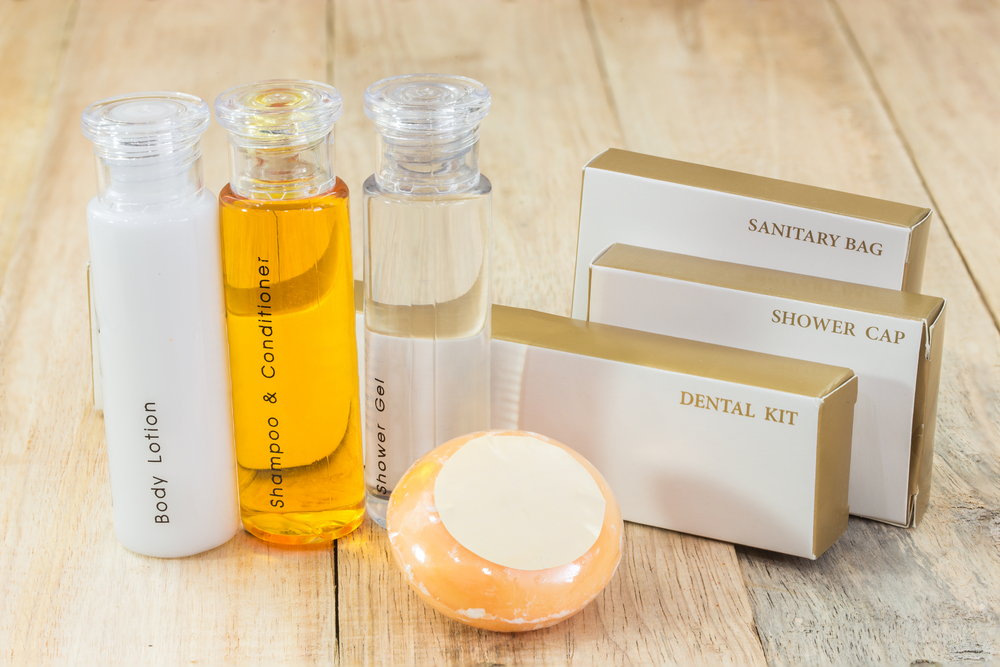
Let’s pause here for a quick survey.  What’s the first thing you do when you enter a hotel room – check out the view?  Channel-surf the TV?  Flop on the bed?  Not me. I head to the bathroom to check out the small “freebies” on the counter.  Chances are I’ll find (at a minimum) soap for the sink, soap for the shower, boxed tissues, makeup-remover wipes, and maybe even a tiny cloth to polish shoes.  Also for the taking: shampoo, conditioner, and body-wash bottles, lined up like little dominoes just waiting to take the plunge into the nearby shower.  But guess what?  Those little soldiers of sanitation are about to go MIA.

In the next few months, according to a Wall Street Journal article, many of America’s hotel bathrooms will drop “little bottles” in favor of shower-wall bulk dispensers.  In today’s environmentally-conscious world, you have to wonder why it hasn’t happened sooner.  Consider the arguments against these little grime-fighting gunners.  They create tons upon tons of plastic waste.  They get thrown away half-full – so effectively waste on top of waste.  The moment you need them is the moment you’re already wet in the shower (and they’re still over on the counter).  Finally, for anyone who requires reading glasses – hello, me – little bottle labels are impossible to decipher while you’re standing under shower spray. Raise your hand if you’ve ever put body wash in your hair.

More arguments against.  Bulk dispensers keep the shampoo in the hotel and the bottles out of the landfills.  They give you as much or as little product as you need.  Bulk dispensers can easily be refilled by housekeeping (though picture the short-straw employee who has to decant the contents of the leftover bottles into the dispensers).  Finally, bulk dispensers eliminate five billion little bottles a year.  Okay, that last argument is pretty much the only one you need.  And yet…

This change brings me pain.  Staying at hotels won’t be the same without my wee wardens of wash.  My singular argument for?  I’m all about personal touch; the little things that make you go, “wow, I feel special”.  Those little heroes of hygiene do that for me.  So do chocolate-chip cookies.

To add fuel to the fire, I expect hotels to eventually remove everything else from the bathroom counter.  You’ll find nothing but a faucet, towels, and TP.  While they’re at it, they’ll eliminate the logo pens, the paper pads, the stationery, and even the bedside clock-radio’s.  Cleanse the room of anything moveable.  Why do this?  Because hotels know they can condition you to bring your own stuff.  And before you say, “Dave, that’s a stretch”, consider the airlines.  It wasn’t that long ago the ticket agent checked you in, printed your boarding pass, and slapped the luggage tag on your suitcase.  Pretty soon you’ll be flying the plane.

Truthfully, I can do without my little defenders of disinfection, as long as hotels don’t take away my elbow room.  But that’s already happening, isn’t it? Blame Japan for the “little room” concept.  America is now a breeding ground for “capsule hotels”.  Capsules give you nothing more than a bed-closet and a down-the-hall community bathroom.  They’re described as “cheap, basic, overnight accommodations”.  Wait, wait, wait – isn’t that the same definition I gave our Fairfield Inn?  One of these days someone will say to me, “Wow, the Fairfield. Y’all stay nice.”

In the meantime, rest in peace little marines of clean.  Your work is done.  Time for the big boys to take over.

Tryst With a Twist

I’m leaving my wife for another woman. There, I said it.

I never thought it would come to this; I really didn’t. My wife and I have been together for thirty-one bliss-filled years – as smooth and as satisfying a marriage as one could hope for. And yet, tomorrow afternoon, I’ll catch a ride to the airport, kiss my beloved goodbye, and board a one-way flight to Las Vegas. All my worldly possessions stay behind, save for the overnight bag in my hand and the wad of cash in my pocket. When I get there, I’ll dress up, head over to one of the finer restaurants on the Strip and reunite with a woman over thirty years my junior. We’ll smile at each other and raise our glasses in anticipation. A new adventure will commence.

Now then, let’s shed a little more light on my tryst, shall we? Yes, I’m leaving my wife (but only for a day and half). Yes, I’m going to Sin City on a one-way ticket (but then I’ll turn around and drive back home the next day). And yes, I’m meeting up with a woman thirty years my junior. She also just happens to be my daughter.

Here’s the detail. After a year of living and working in Los Angeles, our youngest has decided to return to Colorado to give Denver a try (the “new adventure” I refer to above). The drive between those cities – if you’ve ever done it – is Las Vegas and a whole lot of nothing else. Imagine a twenty-hour jaunt in a lunar rover on the moon, only somewhere along the way you get thirty minutes in Disneyland. That’s LA to Denver: no people (at least, no sane ones) and a whole lot of cactus, dotted with a single oasis of slot machines and casino-hotels. Come to think of it, I’d wager big money the moon is more interesting than LA-Denver, especially the never-ending portion of the drive known as southern Utah.

Anyhoo, (to use a word from my daughter’s unique vocabulary), I’m sharing the Vegas-to-Denver drive with her – responsible father that I am – fully fourteen of the twenty hours it takes from Los Angeles. Somehow the idea of my daughter and her cat all alone in the desert doesn’t sit well with me.

The more I ponder this little adventure, the more I wonder if I shouldn’t be worried more about my time in Vegas. Think about it. I’ll show up at the hotel, and the front desk will undoubtedly eye my much-younger companion from head-to-toe. “Oh!”, I’ll say with a sheepish grin, “she’s my daughter.” Yeah, right pal, your ‘daughter’. When I arrive at the restaurant for dinner, the maitre d’ will say, “Sir, if you and your – uh – ‘niece’ will follow me, I’ll show you to your table.” Or let’s say I get my daughter to blow on the crap table dice for luck. Stink eyes all the way around. Hey big spender; who’s your prom date?

This is a no-win situation. Short of a blood test and a doctor’s proclamation, “Holy cow, they’re actually related!”, I’m destined to a jackpot’s worth of dirty-old-man looks in the next few days. At least I won’t be mistaken for a gigolo.

What happens in Vegas, stays in Vegas. Sorry, I beg to differ. I’ll be pleased as punch to share the intimate details of my time with my “other woman” in Sin City. Heck, maybe I’ll even make it my next blog post. We checked into the hotel. We went to dinner. Dropped a few quarters into the slots. Went to bed early so we’d be rested up for the long drive head. Riveting reading, huh?

Dream Puffs

Last year, Starbucks surpassed Subway as America’s #2 restaurant, measured by gross sales (McDonald’s is still top dog).  I don’t consider Starbucks a place to “dine”, so second-place is impressive.  Then again, Starbucks’ bakery case has matured since its initial offerings.  There are temptations-a-plenty now, en route to the barista.  The traditional breakfast items share space with yogurt parfaits, fruit-and-cheese boxes, “fold-over” sandwiches, and entree-size salads.  But it’s the smaller offerings I want to talk about today.  Look closely through the glass – you’ll see sous vide egg bites and Bantam’s bite-sized bagels.  Those little guys could be the future of fast food.

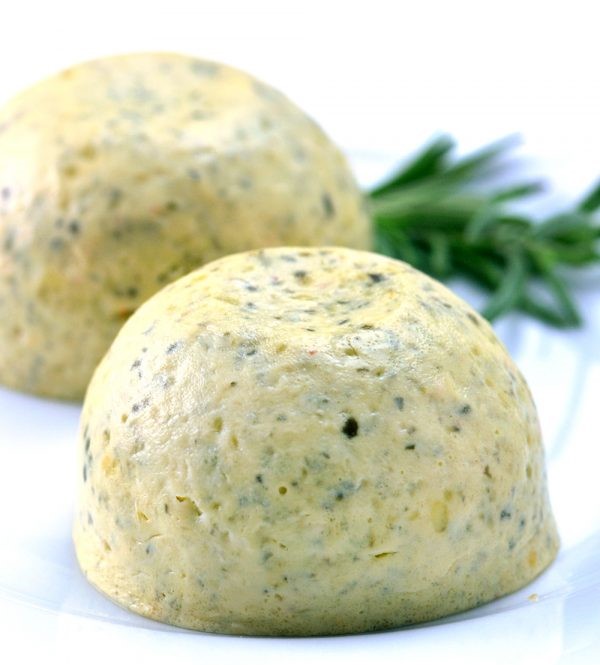
egg bites

I haven’t tried the mini bagels, but Starbucks wins me over with its egg bites.  The first time I gave them a whirl, my wife and I were in the middle of Lent, trying to find alternatives to the foods we gave up.  Egg bites to the rescue.  The sous vide prep means cooked in water, with nothing but a bit of spinach, red pepper, and cheese mixed in for flavor.  Simply elegant (elegantly simple?), and the light, fluffy texture makes them as delicious as they are convenient.

Three Little Griddles
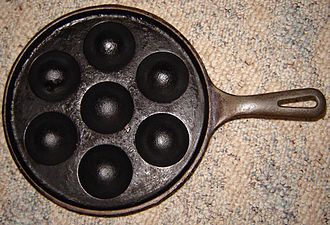
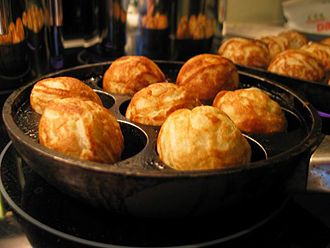
Æbleskiver

Now let’s talk about real breakfast foods.  Last weekend, my wife and I went to a nearby restaurant called Three Little Griddles.  Much to my delight, Griddles had Æbleskiver on the menu.  If you’re Danish, you already know what I’m talking about.  Æbleskiver is heaven-sent breakfast: puffy little balls of pancake with a sweet surprise in the middle, finished off with a delicate dusting of powdered sugar and a side of raspberry jam.  Æbleskiver is Danish for “apple slices”, but you’re more likely to bite into a strawberry or a fruit-compote filling instead.  Three Little Griddles also offers Æbleskiver with an egg/bacon filling, coated with a maple-syrup glaze and powdered sugar.  A complete breakfast!

NOT Æbleskiver

If you haven’t heard of Æbleskiver and the first thing you thought of was “doughnut hole”, shame on you.  Doughnut holes don’t even qualify as poor man’s Æbleskiver.  Doughnut holes are a clever product designed to get you to buy more when it appears you’re buying less (think “fun-size” candy bars).  I have two issues with doughnut holes.  One, they’re not actually the “hole” of a solid doughnut, but prepared and baked separately instead.  Two, they’re not shaped like a doughnut hole should be (picture it – something more like the hub of a wheel).  They should be called doughnut balls.  But enough of this talk; I’m wasting words.  Let’s keep the focus on Æbleskiver.

My first taste of Æbleskiver came when I was little, in the Central California village of Solvang.  Solvang is like, well, a kid’s “Little Denmark” – a town small enough to walk around, with an overabundance of shops selling toys, candy, and ice cream.  Several windmills spin slowly above Solvang’s high-pitched shingle rooftops.  A church sits prominently on the edge of town.  A small park serves as the town square, complete with a bandstand-sized gazebo.  All that’s missing is some water-filled canals and cobble-stoned streets.  But meanwhile, there’s plenty of Æbleskiver.  Some restaurants even bake them out on the sidewalk, rotating those little dream puffs to perfection in their unique iron skillets.

If you credit the Danes with the invention of ball-shaped food, the rest of the world takes a distant second with its imitations.  China makes a spherical egg-based fruit-filled waffle called Gai Daan Jai.  Japan makes a variety of savory ball-sized snacks called Takoyaki. (Savory? Yuck.)  And America makes doughnut holes called Munchkins.

As if Æbleskiver isn’t cool enough as a food, it’s also a cool word with a unique spelling (note the “letter” Æ).  Perhaps Starbucks will start carrying it, along with the egg bites.  I’d buy both and a coffee for a complete breakfast.

Finally, if Æbleskiver has you wondering what other delights Denmark has to offer, consider ÆblekageÆblekage is “apple charlotte” – stewed sweetened apples layered with butter-roasted bread crumbs and crushed makroner (an almond-flavored meringue), topped with whipped cream and red currant jelly.  Oh my; sounds like dream stuff.

Æblekage

Some content sourced from Wikipedia, “the free encyclopedia”.

Precisely Enchanting

If you watched any of the Winter Olympics the past couple weeks, you witnessed dramatic moments only the Games can deliver.  Some literally took my breath away: the edge-of-your-seat overtime shootout in the women’s hockey final (a 3-2 win by the Americans); the exquisite battle for gold between the highly-touted Russians in women’s figure-skating; and the first-ever victory for the U.S. in the team sprint of women’s cross-country skiing, where Jessie Diggins’ come-from-behind lunge at the finish line took the gold by 0.18 of a second.


Consider “0.18 of a second” (for a second).  The blink of an eye takes twice as long.  Now consider measuring 0.18 of a second.  Remarkably, we’ve had the technology to do so since the 1950’s.  For the Olympics, that precision was provided by Omega, the watch manufacturer from Switzerland.  Of course the timekeepers were Swiss.  What other country is so renowned for the keeping of time?  What other country coordinates forty-six individual railway companies on a single network of tracks, bringing its trains into the stations on-time every time?  Where else in the world would you feel more confident banking your cash?  Six years ago, Omega developed technology capable of measuring one-millionth of a second.  At the Pyeongchang Olympics they used a photo-finish camera capable of ten thousand snaps per-second.  The Swiss redefine “attention to detail”.

I’ve had an affection for Switzerland from a very young age.  As a kid, my introduction took place in subtle ways.  Shirley Temple’s “Heidi” was based in Switzerland. The Switzer brand of red/black licorice (still available in “vintage” candy stores) was a frequent purchase.  The cute little Swiss Miss in our pantry beckoned me to hot chocolate.  As a Boy Scout, I always carried one of the Victornox Swiss army knives.  At Disneyland I roller-coasted through a scaled-down replica of the Matterhorn – one of the Alps.  I had my first taste of fondue.  And for a Suisse exclamation point, I consumed a ton of that “holiest” of cheeses.  My ancestry test should’ve produced a little Swiss DNA, don’t you think?

As an adult, Switzerland’s products are no less present in my life.  Lindt is my favorite chocolate (and I’ve tried my fair share of chocolate). A Rolex watch is still the material equivalent of corporate-America success (though my tastes are more modest – perhaps a Swatch [Swiss-watch]?)  Velcro can be found on several items in my wardrobe.  Haagen Daz is my favorite brand of ice cream (a product of the Swiss company Nestlé).  And a lengthy search for “adult” Swiss licorice led me to Chateau D’Lanz, a family-run business in Washington state producing some of the best.

Speaking of Nestlé, the Toll House chocolate-chip cookie recipe is also one of my favorites. Here’s a bit of trivia: Toll House was an inn in Whitman, Massachusetts.  Ruth Graves Wakefield is credited with inventing the chocolate chip cookie (by mistake) somewhere nearby the Toll House.  The price Nestlé paid for the right to Ruth’s recipe? A lifetime supply of Swiss chocolate.

Now speaking of Velcro, here’s another bit of trivia.  George de Mestral was a Swiss engineer and amateur mountaineer from the 1940’s. Hiking in the Alps one day, George noticed seeds kept sticking to his clothes and to his dog’s fur. When he returned home, George developed a synthetic “sticking” technology like what he’d found in nature; a hook-and-loop zipper alternative eventually patented as Velcro. The clever name is a child of the French parents velours (velvet) and crochet (hook).

Okay, we’ve covered Swiss precision and some world-class products, but I haven’t addressed what makes Switzerland so fetching.  How’s this for starters: the entire country can fit within the greater Dallas/Ft. Worth area.  Bordered by France, Italy, and Austria, the Swiss are typically fluent in French, Italian, and German; as well as their home-country language of Romansh.  Switzerland produces some of the best in skiing, snowboarding, and mountain-climbing (of course), but also tennis? (hello, Roger Federer).


Here’s some more Swiss charm.  The colorful Guards in the Vatican City are the only foreign military service permitted to its citizens.  Switzerland’s “non-interference policy” dictates its only participation in foreign wars is typically through the high-profile benevolence of its Red Cross organization.  And citizenship in this fair country?  You’d better hope you have blood ties through birth or marriage.  Otherwise it’ll take twelve years of a special-residency permit, combined with a long-term work visa.

Despite my obvious affection, I should probably stay away from precisely enchanting Switzerland.  It’s a real country like any other after all, which means not everything comes up roses.  Perhaps I’ll cling to my snow-globe impression of the Suiss Alpenland instead: a gentle people living high on the Happiness Scale; the cleanest and quaintest cities imaginable; cobble-stoned streets and chalet-like houses.  The magnificent Alps serve as the backdrop, their slopes ascended by rickety cog railways and descended by skillful skiers.  Listen for an accordion or a little yodeling.  Look carefully enough into my globe and you might even notice the von Trapp family, marching down the mountain trail from Austria, singing their do-re-mi song.
Some content sourced from Wikipedia, “the free encyclopedia”.