Fantastic Plastic

On Christmas Day, any parent of small children will stifle a yawn, having built bicycles, dollhouses, and train sets the night before. After all, Santa doesn’t deliver unassembled toys. But hang in there a few years, Mom & Dad, because the building shifts from the giver to the receiver. Older kids want to create. In my generation it was Hot Wheels, Erector Sets, and Lincoln Logs. And one other toy surpassed all others for its ease of use and versatility. Lego.

This piano even plays!

My Christmas gift from my wife this year was a grand piano. Can you top that? Okay, so it wasn’t the kind worth five figures or special movers to get it across the threshold.  My piano measures a mere 12″ x 14″ and comes from the Lego “Ideas” collection.  When it’s finished it will have been built from 3,662 individual pieces.  I can’t wait to get started.

A grand piano made of Legos means the simple interlocking blocks I had as a kid have come a long, long way.  Lego Ideas sets are “products inspired by and voted for by Lego fans”.  The collection includes a typewriter, a ship in a bottle, the house from the Home Alone movies, and the apartment from the Seinfeld sitcom.  Every Ideas product involves thousands of Lego pieces to assemble.  Every Ideas product was also completely sold out for Christmas on the Lego website.

Fifty years ago, Lego was blessedly innocent.  All you had were small bricks in primary colors and if you were lucky, a paper set of instructions to create a simple house or a vehicle.  Otherwise, you just built whatever your imagination could come up with.  When my own kids were kids, Lego moved to product-specific sets like a T. Rex from Jurassic World or an X-wing Starfighter from Star Wars.  Sure, they looked cool when they were built, but I was always skeptical because the sets removed creativity from the experience.  You’d just follow the step-by-steps in the little booklet and voila – a T. Rex.  But call me a hypocrite because this sixty-year-old can’t wait to build his step-by-thousand-steps Lego Grand Piano.

Lego has an interesting history – too many chapters to cover here.  The numbers tell the story in a nutshell.  The Denmark-based company is considered the largest toy company in the world.  Their bricks have inspired movies, video games, building competitions, and eight amusement parks.  Their factories have been churning out little plastic pieces for almost 75 years.  And at last count, that pile of pieces surpassed 600 billion (or 75 Legos for every man, woman, and child on earth).

I didn’t expect to be a Lego fan as an adult but then came the Architecture series in 2008, cool buildings like the Taj Mahal, Eiffel Tower, and Empire State Building.  I just had to have one, so last Christmas my wife gifted me the 1,032-piece United States Capitol Building.  I didn’t clock how long it took to complete but I must’ve looked awfully confident in the assembly because now I’m staring down the more daunting Grand Piano.  Maybe my wife wants me locked down in my home office for the next several months?

To underscore the popularity of Lego these days, the Architecture series alone includes 50 buildings and cityscapes, with more coming out each year (the Taj Mahal was released just last summer).  These sets run anywhere from $50 to $250, with the discontinued ones setting you back three times as much.  Sure, I’d love a Lego version of Frank Lloyd Wright’s “Fallingwater” house, but I’m not going to pay $800 to a collector just to have one.

Lego “Church of Christ”

No discussion of Lego would be complete without a nod to custom creations.  Our local Scheels department store has a larger-than-life Denver Broncos football player made of Legos, posing front and center in the toy department.  The Church of Christ creation in the photo here didn’t forget seating for an 80-member choir (below the big yellow crosses).  And the biggest custom creation of them all?  A full-scale Lego replica of the previously-mentioned X-wing Starfighter, first displayed outdoors in New York’s Times Square.  Try to picture 5.3 million Lego pieces and 23 tons of “toy” in the shape of a fighter jet.  Or just check out the photos here.

Now that I’m done writing it’s time to break open the first bag of pieces to begin my Lego Grand Piano (and time for you to watch the ingenious stop-motion video below).  I’ll use the stopwatch on my iPhone to capture the hours I consume to complete it.  Er, days? Weeks?  I mean, Rome wasn’t built in a day.  Neither is a grand piano.  You might want to check in with me next summer to make sure I haven’t gone bats.

Some content sourced from Wikipedia, “the free encyclopedia” and the Lego.com website.

As the Wind Blows

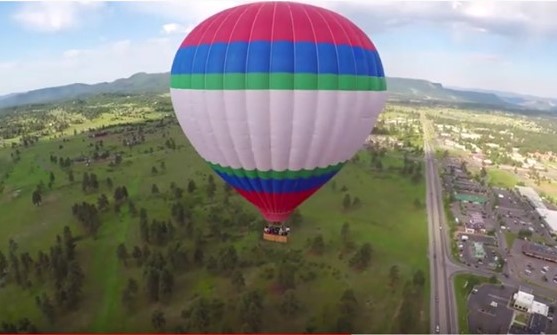
Pagosa Springs, a small town in Colorado’s San Juan Mountains, lies 7,100′ above sea level. It is locally known for its therapeutic hot springs. Pagosa also boasts a 35-year business called Rocky Mountain Balloon Adventures, which takes you an additional 3,000′ above sea level for “360° views of the beautiful valley [of Pagosa] below”. Maybe you’ll climb aboard their basket and go for a float someday.  If you do, my apologies for not joining you.  I’d rather spend my time in the terra firma of Pagosa’s hot springs than the “terror for-sure-a” of a balloon ride above.

Getting high, above Pagosa Springs

Logic says my fear of heights denies me the thrill of soaring up, up, and away.  Not true.  It’s more about the “gone with the wind” part (sorry for that, Scarlett).  Once the balloon reaches cruising altitude, the pilot extinguishes the fire and Mother Nature silently takes over.  Then your high-rise ride gets a little dicey unpredictable.  It’s the whole not-knowing-where-you’re-gonna-end-up moment that gets me.

Possible outcomes as follows.  You descend gracefully into a farmer’s field with the “chase vehicle” just minutes away.  You zip hundreds of feet up and then hundreds more down, depending on which fickle air stream you encounter.  Or, you float all the way to nearby New Mexico on the strong winds we have here in Colorado.  All while literally hanging by threads.

Albuquerque’s big balloon bash

Speaking of New Mexico, it wouldn’t be the worst destination for one of Pagosa’s rogue hot air balloons.  After all, the International Balloon Fiesta – the largest gathering of balloonists in the country – takes place every October in Albuquerque.  At least you’d have professionals on the ground eager to reel you in.  Also in Pagosa’s favor: small town = few power lines.  Hot air ballooning and power lines do not mix.  See here for what happens when they do (coincidentally, just weeks ago in Albuquerque).

Despite the occasional crash landing, ballooning fatalities are rare.  In fact, hot air ballooning has been designated “safest air sport in aviation” according to years of statistics, and a Swiss aeronautics organization whose name I can’t pronounce.  So maybe it’s not so bad if you never have a neatly paved runway to greet your touchdown.  Heck, Pagosa locals love it when a hot air balloon ends up in their backyard.  They come running out of their houses to greet you with coffee and cinnamon rolls.  Breakfast?  Hmmm.  Maybe I can do this ballooning thing after all.

I may not be a balloon flyboy but that doesn’t mean I’d rain on a parade of those big colorful inflatables.  After all, hot air balloons first appeared to me in favorite childhood stories, like L. Frank Baum’s The Wonderful Wizard of Oz, William Pène du Bois’s The Twenty-One Balloons, or Albert Lamorisse’s priceless (and wordless) The Red Balloon.  They show up as flying animals every Thanksgiving Day at the Macy’s parade in New York City.  As well, right here in my hometown we have an impressive showing of hot-air balloons every Labor Day weekend, including a “balloon glow” in the evenings.  Now that I think about it, there’s probably more ballooning going on in this part of the country than anywhere else.

Colorado Springs’ beautiful balloon glow

It’s not as if hot air ballooning is some new-fangled sport (hoverboarding, anyone?)  The first untethered hot-air balloon flight took place back in the eighteenth century.  Hundreds of commercial operators offer hot-air balloon rides in the United States, and hundreds more are private owners.  Add a little perspective and 3000′ above Pagosa Springs is nothing.  The world record for the flight height of a hot-air balloon is 64,980′ (like a Mt. Everest on top of a Mt. Everest).

Up, up, and seriously away

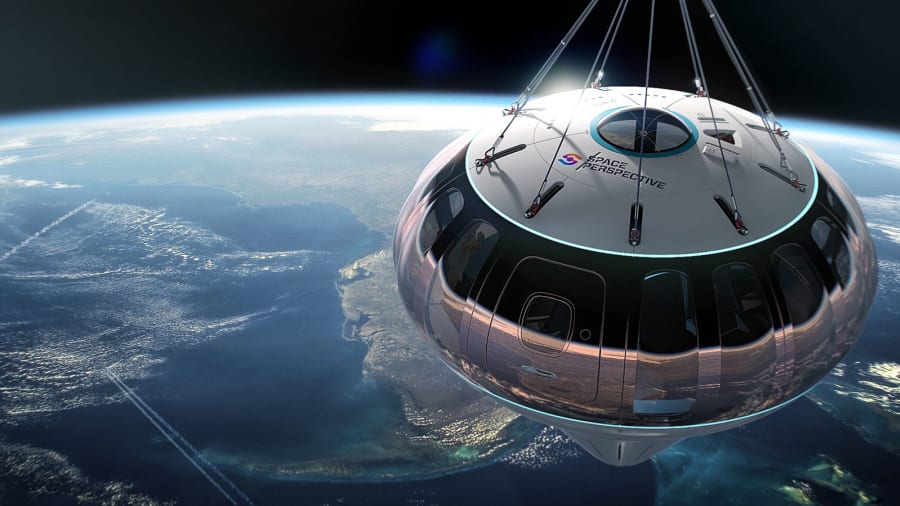
Strict definitions aside, the altitude record for hot air ballooning is about to topple, in a big way.  A company called Space Perspective is now taking reservations for its giant hot air balloon, launching in early 2024.  You, seven other passengers, and your pilot astronaut will take a six-hour ride in a pressurized capsule under a giant balloon… to the edge of the Earth’s atmosphere.  A seat on “Spaceship Neptune” costs $125,000.  Operators are standing by to take your payment…. for 2025, that is.  The 300 seats offered in 2024 are long gone.

Maybe 3000′ above Pagosa Springs doesn’t sound so bad after all.

Some content sourced from the CNN Travel article, “On sale: $125,000 balloon trips to the edge of space”, and Wikipedia, “the free encyclopedia”.

Gadgets… Be Gone!

The defining elements of the 1970s included disco music, bell-bottom pants, and really big sunglasses. You had block-long lines at gas stations thanks to the “Energy Crisis”, President Nixon’s resignation because of Watergate, and the long-overdue wrap of the Vietnam War. People preferred their clothes and cars in bright colors, their hair shaggy. I don’t remember much of this stuff, since I was only a budding teenager. But I’ll never forget my very first audio cassette tape deck.

90 minutes of songs in your pocket

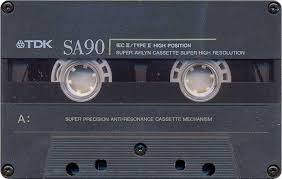
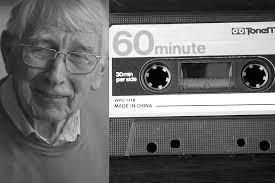
You’re seeing obituaries in the news these days for noteworthy people of the 1970s.  Fifty years ago these people were generally in their thirties or forties; a reasonable age to invent something.  So it didn’t surprise me to read about Lou Ottens, who died in March at the age of 94.  Ottens was an engineer for the Philips Corporation.  Never knew him, never heard of him, but I’m forever grateful he invented the compact cassette audiotape.

[Millennials, roll back the clock on music media.  From your digital subscriptions, pass through Blu-Ray and DVD, then compact disc (CDs), until you finally land in the 1970s and the compact cassette audiotape.  If you made it to long-play (LP) vinyl records you went a little too far.]

Cassette tapes were a sensation in the 1970s because not only were they pants-pocket-portable, they were recordable.  Me and my cassette deck spent many an afternoon capturing Top-40 hits off the local FM radio station (Barry Manilow!  Helen Reddy!)  Then I’d store my precious cassettes in their little suitcase, which could hold twenty or thirty inside plastic cases.  Add in the invention of the Sony Walkman at the end of the decade (the first handheld cassette player) and you’ve got a broad overview of 1970s music media.

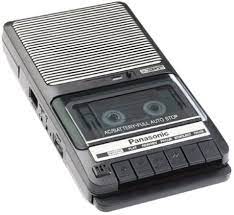
1970s chic

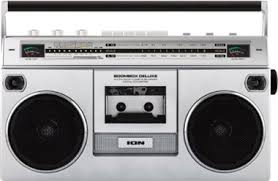
I did have a Walkman somewhere along the way, but the better memories come with my tabletop cassette deck (like the one shown here).  It lived on the desk in my bedroom, with its square speaker and giant pushbuttons, a precursor to today’s boom box.  It ate the occasional cassette tape with relish, and background noise always accompanied recordings off the radio, but my tape deck was still fairly state-of-the-art for the 1970s.  It only weighed a couple of pounds including the four C batteries.  The pop-out handle made for easy carry.

Lou Otten’s passing speaks to how many inventions, no matter how novel or cutting-edge, are sooner or later kaput.  Like the wax occupants of Madame Tussauds, you know your useful life has passed when you’d be better off in a museum.  So how about a few more inventions from my childhood years – once useful but now “almost gone”?

1960s

  • magnetic stripe card (smartphones are saying, “move over”)
  • plasma display panel (PDP)
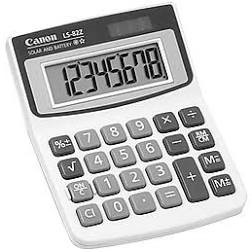
  • handheld calculator (just ask Siri now)
  • 8-track cartridge (whoa, that’s ancient history)
  • Liquid Paper
Soon to be kaput

1970s

  • Pong (one of the earliest arcade video games)
  • floppy disk (removable computer file storage)
  • portable GPS device
  • cell phone (audio calls, nothing else)
  • videocassette recorder/player (VCRs)
“Floppy” file storage

I was just as curious to check out the decades of my parents’ childhood.  What inventions from their formative years are no longer?

1930s

  • Polaroid photography (in its original form)
  • IBM electric typewriter
  • coin-operated parking meter (now accepts credit cards)
  • drive-in movie theater (making a COVID-era comeback, perhaps?)
  • twist-tie (now built into your kitchen trash bag)

1940s

  • aerosol spray can (can we at least agree, these need to go?)
  • Slinky and Silly Putty (not today’s child’s toy of choice)
  • atomic bomb (let’s just pretend these are obsolete, shall we?)
  • lp phonograph record
  • jukebox
Early-model boombox

Last summer I went through a few neglected boxes in the garage and found a few of my old audiocassette tapes.  I keep a still-kicking boombox in the garage (for AM radio baseball games), with a dusty cassette tape player in the middle.  One afternoon I popped in one of those old tapes, pressed PLAY, and behold: John Denver was alive and singing again.  The music was as crisp and clear as 1970.

So give it up for Lou Ottens.  Not only did he design audiocassette tapes, he designed those little guys to last!

Some content sourced from the Hackaday.com article, “RIP Lou Ottens, Developer of the Compact Cassette and More”, and Wikipedia, “the free encyclopedia”.

Polishing the Pearls

Twice a day, my toothpaste tube and I do battle.  When I take the tube out of the medicine cabinet and realize there’s only a little bit left, I can see it smirking as if to say, “You’re not getting any more out of ME!”  Yeah, right.  I just flatten it from one end to the other (I recommend a hairbrush here), forcing every last bit of paste to gather at the top, ready to launch.  Then I take off the cap and squeeze like crazy.  It’s a good workout for the hands, and a mindless challenge to extend the life of your toothpaste.

Speaking of toothpaste – yep, that’s my topic today – here’s a really good trivia question.  In the Roald Dahl classic, “Charlie and the Chocolate Factory”, what did Charlie’s dad do for a living?  He screwed the caps onto toothpaste tubes… before machines were invented to do the job for him.  (He also died before the first paragraph and was never part of the story, so it’s a little weird I remember that bit.  But I digress.)

Quick, name the first ingredient you think of in toothpaste.  Flouride?  Not a bad guess, but did you know fluoride makes up only a tenth of a percent of toothpaste?  That’s like a pinprick on the tip of your finger.  Flouride is potent, my friends.  Good for healthy enamel but only in itty-bitty doses.  Keep those chemicals close, but not too close.

Was your first ingredient surfactants?  A surfactant is basically a “foaming agent”, which helps distribute the paste around the inside of your mouth, which translates to better cleaning.  Surfactants remind me of those animated scrubbing bubbles you’d see in TV commercials, whirling around the bathtub surface.  You also find them in shampoos and conditioners.  Without surfactants, most of the hairs on your head would get clean and conditioned, but others would be left high and dry.

“Minty fresh!”

How about flavorants – you know, peppermint, spearmint, wintergreen, or cinnamon?  If flavorants were the first ingredient you thought about with toothpaste, go directly to Jail (i.e. do not pass GO, do not collect $200).  Flavorants do zilch for your teeth.  They just make brushing a more pleasant experience and fool you into thinking you have a fresher mouth when you’re done.  You might as well chew gum.  The sugarless kind, that is.

Okay, let’s cut to the chase.  The primary ingredient in toothpaste is abrasives (and if this was your answer, you win a free dental drill).  Abrasives make up 50% of what’s inside the toothpaste tube.  They’re “designed to help remove plaque” (remember that phrase).  Think of abrasive-laden toothpaste as liquid sandpaper.  Abrasives are the reason you don’t want to swallow toothpaste.  And don’t brush too hard either.  With enough pressure, these bad boys would be happy to remove your enamel.

Toothpaste also has grit

I could list even more toothpaste ingredients (ex. antibacterial agents, whiteners, re-mineralizers), but let’s just agree: there’s a big, diverse party going on inside the tube.  Now for the bad news.  Toothpaste has no significant impact on the reduction of plaque – so says certain clinical studies. That’s why abrasives are described as “designed to help remove”.  That’s a sneaky way of saying they just keep things in check until your next appointment with the dentist.  Sorry (Charlie), no amount of brushing can replace those nasty power tools your hygienist has so much fun using.

For all my talk about toothpaste ingredients, the brand I use has very few.  Earthpaste (“Amazingly Effective!”) has no fluoride, no foaming agents, and almost no flavor.  In fact, Earthpaste has only four ingredients – water, clay, salt, and essential oils.  It’s like brushing with mud.  Wait, it IS brushing with mud!  Just as effective, without the chemicals (subtle plug).  You’ll find it on Amazon.

So all this talk about toothpaste may be important, but so is getting every last bit out of the tube.  And there may finally be a solution to that battle.  The very smart peeps at Massachusetts Institute of Technology (MIT) have developed an edible product called LiquiGlide.  It’s invisible (which okay, is a little disturbing), and it’s designed to coat the inside of a container so the contents will completely empty with just gravitational pull.  Can you imagine?  No more flattening, squeezing, or hand workouts.  Just upend the tube and 100% of the product comes pouring out.  Get-your-money’s-worth people like me silently rejoice.

LiquiGlide’s proof is in the pudding, er – ketchup.  No more smacking or shaking the bottle.  No more “An-ti-ci-pay-yay-tion” (for those of you who remember the 1970s Heinz jingle).  Our future ketchup bottles and toothpaste tubes will be transparent – and empty – by the time they head to the recycling bin.

Unfortunately, I’d have to give up my Earthpaste and move to Europe if I want to experience the benefits of LiquiGlide.  (The company has no immediate plans to sell its products in North America).  That’s not gonna happen, so until further notice you’ll find me in the bathroom, doing battle with my toothpaste tube.  It’s not so much about getting my teeth clean.  It’s about getting my money’s worth.

Some content sourced from the CNN.com article, “How MIT could help you pour ketchup”, the CNN.com article, “Colgate’s new toothpaste tube…”, and Wikipedia, “the free encyclopedia”.

Whirlybird Wonder

“Ginny”

If you haven’t been following the dog-and-pony pony-and-dog show taking place on Mars the last couple of months, you might want to break out the telescope. Not that you’ll be able to see a car-sized rover or a toy-sized helicopter from millions of miles away. But you can see Mars itself, and then you can imagine “Percy” and “Ginny” sniffing around the red dirt and rocks up there. They’re just sampling things to see if Mars can roll out the welcome mat to humans someday.

The rover “Perseverance” is the pony in this show; “Ingenuity” the dog. I want to talk about the dog. Last July Percy hitched a nine-month ride to Mars, launching from Florida’s Cape Canaveral aboard a massive Atlas V rocket. Little Ginny hitched a ride on Percy; she the steadfast little soldier clinging to the rover’s underbelly. Considering Ginny measures only a few feet in all dimensions, it must’ve been a hang-on-for-dear-life E-ticket kind of adventure.

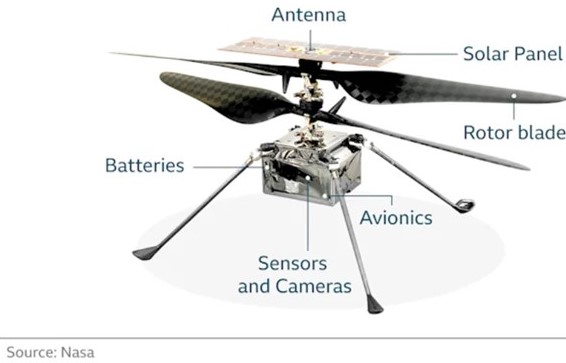
I’d love to make this a children’s story, but Ginny is anything but soft and cuddly. Have a look. She’s about as cute as a wasp. Consider Martian atmosphere is only 1/100th as dense as that of Earth, which means Ginny has virtually nothing to grab onto to sustain flight. But she whirls at five times the rate of a regular helicopter (2,400 rpm!), and then she rises.  Product safety warning: don’t go anywhere near Ginny’s rotor blades.

Ten days ago Ginny lifted off Mars to a skyscraping height of ten feet.  Then she hovered briefly before rotating about ninety degrees, kind of just observing the Mars-scape.  Finally, she landed.  The whole exercise lasted less than forty seconds.  Big deal, right?  Well, that little maneuver qualified Ginny as “the first powered controlled flight by an aircraft on a planet besides Earth”. Way to go, little wasp.  You just reserved a spot in the Smithsonian after you return home.

Will Ginny end up here?

When I picture Ginny clinging to the rover Percy, then hurtling through outer space for months on end, my middle-aged mind recalled the old Thunderbirds television show.  Thunderbirds featured the Tracy family (marionettes!) and their fleet of wicked-cool space vehicles.  The five Thunderbirds included a giant green supersonic carrier (“Thunderbird Two”), whose massive belly carried a yellow utility submersible (“Thunderbird Four”).  Kind of like Percy carried Ginny.  Trust me young(er) readers, Thunderbirds was awesome television in the 1960s… even if it was just puppets getting their strings pulled.

I’ve ridden in a helicopter exactly once in my life, on our honeymoon over the Napali Coast on the Hawaiian island of Kauai.  I turned to my bride mid-flight and probably uttered some not-so-nice words as I remembered how much I dislike heights.  The glass of champagne beforehand certainly helped.  For me, the fear has always been a toss-up between vertigo (physical) or the idea that terra firma is far, far below me (mental).  No matter the reason, heights just aren’t my cup of tea.

My acrophobia probably goes back to my first ride on a Ferris Wheel, with adolescent nightmares of slipping through the metal lap bar and taking an unplanned skydive.  Or ski lifts, where a little bit of fiddling with the lap bar latch could mean the end of everything.  Parasailing? (No).  Hang-gliding? (Never).  Hot-air balloons? (Why even ask?).  Sorry – airplanes aside, and only the bigger ones mind you – I prefer my thrills securely grounded.

For all the recent broadcast news on Percy and Ginny, I can’t seem to find the part of the story where Ginny returns to Percy, who then returns to the Atlas V rocket, who then returns to Earth.  I’m looking for the part about splashdowns and photo ops and ticker-tape parades – the happy-ending kind of stuff.  My earlier comment about a spot in the Smithsonian may have been a little premature (can you say, “Ginny replica”?).  Note to reader: if you do decide to make this a children’s story you might want to edit things a bit.  Just say our little pony and dog are now asleep on Mars, waiting for their human friends to get there someday.  It sounds much better than, “we just left them there”.

Some content sourced from Wikipedia, “the free encyclopedia”.

Pulling the Plug

Thirty years ago, the S. C. Johnson Company introduced a new member of their Glade line of fragrance products called the “PlugIn”. Maybe you have one in your bathroom. The PlugIn uses a small amount of electricity to warm up scented oil, which slowly diffuses into the nearby air. You can even get one that lights up. Ironically, the Glade PlugIn was my first thought when I read about this week’s National Day of Unplugging.

So this is what we’ve come to in the year 2021.  As a counter to our undying affection for our electronic devices, a portion of the next couple of days has been designated “National Day of Unplugging” (NDoU) by a non-profit organization called Unplug Collaborative.  The Collaborative started its membership early last year and is determined to “spread awareness about how to maintain a healthy life/tech balance”.  Theirs is a noble, if not impossible effort.

Should you choose to participate in the NDoU “24-hour respite from technology from sundown to sundown, March 5-6”, I ask, will your life necessarily change for the better?

It’s just an awareness campaign, I get it.  Unplugging phones, tablets, laptops, and whatever else you consider “tech” for one whole day is essentially raising the white flag on what each of us already admit: we spend too much time with our screens.  But let’s be honest – what exactly defines “healthy life/tech balance”?  I think the answer is highly personal, depending on your job, disposable income, place of residence, and the ways you choose to spend your downtime.

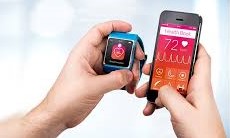
My wife is a wonderful example of “wired” (er, “wireless”); someone who twenty years ago tentatively navigated texting, apps, and what little else her basic cell phone had to offer.  Today, she sports the latest model Apple Watch, two iPads, and a MacBook, all of which seamlessly share information with each other and then with her.  She even sports a protective wristband to reduce her exposure to electromagnetic radiation.

I can’t imagine my wife “unplugging” for four hours, let alone twenty-four.  My conversation with her would go something like this:

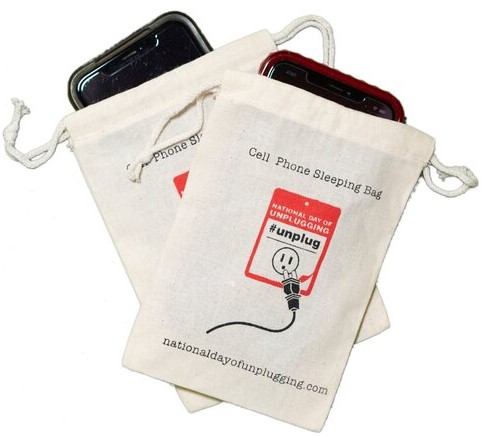
NDoU wants you to put your cell phone to bed – literally.

“Hey honey, so there’s this thing called ‘National Day of Unplugging’ where we get to shut down all of our electronic devices and work on making our life/tech balance better.  Just give me your watch and your tablets and your laptop and I’ll lock them in the closet until tomorrow night.  Sound good?” 

The response I’d get (if I did get a response from her) would be something like,

“Wait, WHAT???  National Day of WHAT?  Are you freaking kidding me?  Hahahahahahaha, good one, honey.  Yeah, let me think on that for just a second… um, NO WAY.  And keep your hands off my screens!”

I get it.  Not only does my wife fiercely track her 10,000 steps and her circles on her watch, she monitors a dozen or more daily feeds on her tablets, and countless emails and websites on her laptop.  It would be just as soul-sucking as taking my Amazon Kindle e-reader away from me (and let’s not even discuss that possibility).

This NDoU supporter doesn’t need screens… ever.

Unplug our gadgets and then what do we do… watch TV?  Sorry, if I’m really gonna play this game the TV also has to go.  The point of NDoU no doubt, is to reestablish face-to-face communication, prepare meals together, get outdoors, read books (what’s a “book”?), and so on.  Unplug Collaborative’s website lists fully one hundred ways to spend your time devoid of tech.  You can’t unlock the full list without signing up for their membership so I’m just speculating on examples.  [Hey, if you join, let me know if one of the hundred is “fool around in the bedroom”.  That one doesn’t take anything plugged in.  At least, nothing I have any experience with.]

If the NDoU campaign really gets momentum, I could see the unplugging moving beyond tech.  Perhaps next year we’ll give the washer and dryer a day’s rest too, as well as the home exercise equipment, the stereo speakers, and the kitchen appliances.  Now there’s a frightening image.  Imagine twenty-four hours in dirty clothes, with no workout, singing just to make a little music, and sandwiches and pretzels for dinner.  Okay, skipping the workout wouldn’t be so bad.

For the record, I’m a proponent of a healthy life/tech balance.  Taking away my screens for a day isn’t such a bad thing.  After all, we could be talking about my coffeemaker here.  Now don’t be talking about unplugging my coffeemaker.  You’re gonna have a fight on your hands and you don’t want to see me without my morning coffee.  Do that and I might have to think about unplugging you.

Fine Print

I’ll never forget the first time I saw the movie, Jurassic Park. I’d read the Michael Crichton novel so I already knew the story, but I still couldn’t wrap my mind around that first dino scene, where a brachiosaurus casually munches on the uppermost leaves of a forty-foot tree.  The gigantic creature was so lifelike I thought, “Where’d Steven Spielberg get a dinosaur?” In my defense, computer-generated imagery (CGI) was brand-spankin’ new back then.  A ferocious T-Rex looking and moving like the real thing was still jaw-dropping in the 1990s. And I’m having the same reaction to the stuff rolling off 3D printers right now.

A “printed” toy tugboat

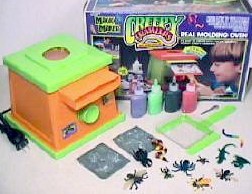
If you’re like me you haven’t paid much attention to 3D printing.  You see some of the items a 3D printer can generate and they seem like child’s play.  In fact, 3D printing reminds me of a 1970s toy called “Creepy Crawlers”.  You had these tubes of colored goop you squeezed into metal molds, and then the molds went into an electric oven.  The goop would grow from flat to 3D with heat, and suddenly the oven was spilling out all kinds of bugs and spiders you could drop on your friends.  (There was also consumable goop called “Incredible Edibles”; products to compete with whatever the girls were making in their Easy-Bake ovens).

But I digress.  Here’s my 3D printing naivete in a nutshell: I still think my 2D printer is the more impressive technology, cranking out high-resolution photos and perfectly addressed envelopes.  I mean, whatever would I need a third dimension for?

Yep, I am seriously naive about 3D printing.  The scope of this topic is mind-boggling if you really take the time to understand its potential. Here’s a good example.  Picture a printer as big as your living room.  Picture a printer cartridge of concrete instead of ink.  Now watch the printer build your living room, one horizontal layer at a time.  The printer can also build the rest of your house.  Just add plumbing and electric when it’s done.

“Printed” storage crates

Without getting too far into the weeds, let’s define 3D printing for what it really is: additive manufacturing (AM).  Here’s an easy way to picture the AM process.  When you build a log cabin you lay out the entire foundation of logs for the house – with breaks for the doors – before you add the next layer of logs.  You work your way up a layer of logs at a time, keeping those breaks for the doors, adding breaks for windows, pipes, and such, completing the structure with a sloping roof on top.  Perhaps you add a fireplace in the process; again, layering bricks on top of bricks until you’ve reached the top of the chimney.

That’s pretty much how a 3D printer works.  It “pictures” an object in horizontal layers and “prints” it from the ground up.  3D printing has been around longer than you think.  3D printers were developed as early as the 1970s (preceding your inkjet 2D printer!).  The early versions just had to be manually programmed.  Once we attached a computer and software, 3D printing really came into its own.

Watch the following video of a 3D printer confidently layering a basket weave – it’s mesmerizing:

https://upload.wikimedia.org/wikipedia/commons/transcoded/5/5d/Hyperboloid_Print.ogv/Hyperboloid_Print.ogv.360p.vp9.webm

The products speak for themselves, of course.  A shortlist of the more cutting-edge printed creations gives you an idea of where our world is heading:

  • Cakes and pastries – The “ink” is baked goods in one nozzle and frosting in another.  Design it on your computer screen and then “print”.  It’s like the Easy-Bake Oven on steroids.  Only you don’t need the oven.
    3D-printed confectionery from Ukrainian chef/architect Dinara Kasko
  • Bones – No, not some plastic or other polymer designed to replicate bones, actual bones.  It’s called bioprinting – the fabrication of natural tissue using cells and other building blocks, and it’s coming soon to a clinic near you.  Don’t worry how long a broken bone will take to heal; just replace it!
  • Buildings – Forget about building that log cabin one layer at a time.  Your 3D printer will do the whole job for you (and it’ll still look like a log cabin).  Your printer can also build sturdier houses out of concrete.  This one’s on the market in Riverhead, New York, for $300K.
  • Vehicles – 3D printers have already created boats, kayaks, and most of the makeup of cars and trucks.  Long ago I was impressed with the robotics of the Ford Motor Company, employed on a long assembly line to build cars one part at a time.  A 3D printer can essentially do the same job standing still, no assembly line required.
  • You – I could speculate on the potential for a full bioprint but let’s avoid that scary future for now and just say, a 3D printer can create a figurine to look exactly like you.  Think of it as printing a 3-D photograph.

If your mind is not blown by what you’ve just read, consider this: 3D is already passe.  That’s right, we’ve already moved on to 4D printing.  4D – at least with printing – refers to materials that can change shape with time, temperature, or some other type of stimulation.  A good example would be a printed window shade, sitting tight and virtually unnoticed at the top of the window in daylight but expanding to full cover as darkness falls.

Don’t know about you but this level of technology makes my head hurt.  When I’m done with this post I’m gonna push “print” and generate a nice 2D copy for my files.  Oh, and maybe watch Jurassic Park again.

Some content sourced from the 7/24/2020 Forbes article, “What Can 3D Printing Be Used For?”, and Wikipedia, “the free encyclopedia”.

Dots ‘n’ Dashes

Back in my days in the Boy Scouts, they had a merit badge called “Signaling”. To earn the badge you had to build a basic communication device (buzzer, blinker) and demonstrate a knowledge of Semaphore – visual signaling by flags – and Morse – audible signaling by “dots” and “dashes”. Today most people wouldn’t have a clue about Semaphore, and their only familiarity with Morse might be from the frantic telegraph typing in the movie Titanic.  Dots ‘n’ dashes have stepped down, more associated with the mundane pavement markings of the streets we drive.  Well hey, at least they’re still signaling devices.

“Dashing through the… street…”

Let’s talk about street dashes first.  The highway to our rural neighborhood was recently restriped, mostly dashes but occasionally a solid for safety’s sake.  Some lanes were shifted, and they just covered up the old stripes with blackish paint similar to the asphalt below.  But my car was not fooled, no sir.  It still sees the old striping.  Anytime I pass over those areas my car’s “lane-keeping assist” emits an audible warning and tries to bump me back onto the road, when in fact I’m just passing over covered-up stripes.  That’s annoying.  Either car tech needs to improve or road striping needs to come up with a better cover.  Until one or the other happens I’m all over the road.

Here’s an even better story about dashes.  Long ago, my parents were driving my brothers and me back from my grandparents’ house.  We were cruising along a paved winding road late at night when all of a sudden my dad gets to wondering about those highway dashes.  He starts to guess – if you measured one, how long would a dash be?  Talk about useless information, right?  But then, right in the middle of a darkened highway, no cars in the rear-view mirror, my father stops the car, gets out, and starts measuring a dash, foot-in-front-of-foot like he’s taking a sobriety test.  Then he gets back into the car and announces proudly, “six feet”.  Think about that the next time you pass those stripes at forty miles an hour.  (But please, don’t get out and actually measure one).

California highways are usually dotted, not dashed.

Now let’s talk about street dots.  You know, those round, non-reflective raised pavement markers used to designate lanes and borders and such?  They’re actually called Botts’ dots.  It’s a name I’ve known since childhood because I grew up in California where they were invented.  California has over 25 million of the little guys marking its endless streets.  And if you must know, Botts’ dots were named for their inventor, Elbert Dysart Botts (and how’s that for a mouthful?)

Kinda cute, right?

Botts’ dots might’ve never been a thing were it not for their total makeover.  At first they were glass discs attached to the road with nails. (How’d you like to have that job?  Whack, whack, whack!).  But then they started popping loose, and people got flat tires from the nails and the broken glass.  So Botts (or a coworker) devised a hard plastic to replace the glass and an asphalt-friendly epoxy to replace the nails.  Now the dots – and the speeding cars above them – stay where they’re supposed to.

But now Botts’ dots have a whole new challenge.  We face a future with self-driving cars.  Turns out, Botts’ dots mess with that technology.  The car may or may not recognize a dot as the border of a lane.  That’s not good when you put your steering wheel in the hands of a robo-chauffeur.  But can you imagine the task of removing 25 million Botts’ dots?  That’s worse than hammering them in one by one!

Botts’ dots may go the way of the telegraph.

Over here in rural Colorado, I got pretty excited about the prospect of California surrendering all of its Botts’ dots.  We can use ’em.  You see, out here we have mostly two-lane highways divided by dashes, or occasionally solid lines instead of the dashes (don’t pass!), or very occasionally the luxury of a defined left-turn lane.  But “dash-it-all” when it snows.  You not only lose the striping, you lose the road.  At least a Bott’s dot would make noise and give you a jolt to let you know you’re not about to cruise into somebody’s cow pasture.

Alas, my dream of millions of Botts’ dots flying over the Rocky Mountains died before it was born.  Turns out the asphalt epoxy of a Botts’ dot cannot compete with the combined weight and speed of a snowplow.  The dots’d go flying every which way from the snowplow blade, like hundreds of tiny shuffleboard discs.  Ping! Ping! Ping!

Signaling merit badge was retired by the Boy Scouts in 1992 (yet another reminder of my advancing age).  Looks like the Botts’ dot is headed for a similar scrap heap, at least if self-driving cars become more mainstream.  Meanwhile, you’ll find me out in my neighborhood navigating the painted dashes.  Even if I do prefer the dots.

Some content sourced from Wikipedia, “the free encyclopedia”.

It’s Raining DONUTS!

Pikes Peak, the majestic 14,000′ mountain nestled in the Colorado Rockies west of Colorado Springs, is getting a major makeover.  Okay, maybe not the mountain itself.  Her nine-mile Cog Railway reopens in 2021 with new train cars and tracks to carry visitors to the summit.  Her Manitou Incline, the one-mile ladder-like hiking trail up her eastern flank, has been improved for safer climbing.  Finally, her Summit House visitor center is being replaced – sixty years after the original – with a state-of-the-art glass jewel.

“America’s Mountain” in the Colorado Rockies

Local folks like me only have one concern with all this Pikes Peak activity: the donuts.  What’re they gonna do about the donuts?

You can drive, hike, or take the Cog Railway to the top of Pikes Peak, but you’ll always stop in at the visitor center once you get there.  It’s the only thing you’ll find on the tiny summit beside the stunning views of the world below.  Maybe you’ll purchase a supremely tacky, overpriced souvenir while you’re there.  Maybe you’ll need a bathroom break.  Whatever you do, you will buy a donut.  Pikes Peak’s “World Famous” treats are sort of a reward for making it to 14,000 feet.  Okay, so they’re not Krispy Kreme but they’re not terrible either.  Just eat them at altitude.  Once you begin your trek down the mountain they collapse into a mushy mess and they’re awful.

When I first realized the Summit House was getting demolished instead of remodeled my thoughts went straight to the donut machine.  What are they gonna do with the donut machine?  The “Belshaw Mark VI Donut Robot” delivered its final batch last week before someone pulled its plug.  The Mark VI is a mechanical marvel.  It can produce 700 donuts an hour (the summertime demand for Pikes Peak).  The Mark VI endlessly dispenses the raw dough, four rings in a row, and creates donuts through a conveyer system of automated frying, rotating, and dispensing.  Leave it on for twenty-four hours and it’ll pile up 17,000 of the little buggers.

Meanwhile, the new visitor center is getting a new donut machine.  Maybe it’s the latest model of Belshaw’s Donut Robot and makes 1,000 donuts an hour.  Maybe the donuts taste more like Krispy Kreme.  Whatever it can do, this machine is a beast.  It’s so big they had to use a crane to lift it into the building before they even closed up the walls.

If I’m the old Mark VI Donut Robot I’m not happy about being replaced, not at all.  I mean, c’mon! I faithfully produced thousands of donuts day in and day out for decades!  I’m not yesterday’s news just yet!  Why not let me keep my job instead of giving all the love to a newer model? No siree Bob, I’m not gonna take it.  I need to make some sort of statementY’know, demonstrate the extent of my discontent.

OH MAN, can’t you just picture it?  Standing down on the streets of Colorado Springs one morning you suddenly hear this massive BAH-BOOM from the direction of Pikes Peak.  Sidewalks start shaking and people start pointing.  You look up to the mountain and there’s a freaking volcano blowing its top.  A huge column of fire rises to the heavens.  The sky is instantly air-brushed with white smoke.  There’s ash raining down in every direction.  Except, wait, it’s not ash it’s…. it’s…. it’s donuts.

The rain of donuts, of course, is the Mark VI Donut Robot run amok.  In its desperate attempt not to be overlooked it starts making donuts like crazy.  Four at a time, plop-plop-plop-plop, fry, rotate, dispense.  Faster and faster and faster, until its conveyor builds up a big head of steam and starts to break apart.  Then the whole thing just blows up.  Boom

Down and further down come the donuts.  Rolling by the hundreds along the hiking trails.  Bobbing down the rivers and creeks like mini inner tubes.  Ricocheting off the pine trees as they come back to earth until they just go poof! in a cloud of powdered-sugar smithereens.  Decorating the rocks and trees with a cream-filling look of snow.  Piling up in the low spots like generous helpings of oversized Cheerios.  Clogging up the cog railway so the only way the train gets to the summit is for the riders to get off the train and start eating.

The Mark VI may have imploded but man what a way to get noticed, right?

Truth be told, there’s an aftermarket for Belshaw’s Mark VI Donut Robot.  Do the Google search if you don’t believe me.  A used one runs $15,899 plus $600 for shipping, and don’t look now; they take credit cards and toss in a limited warranty!  Just think what you could do with 700 donuts an hour. All you have to do is click the “Buy It Now” button on the website.  But one more thing before you do.  Ask the seller if their Mark VI has given them attitude lately.  Like it used to be on a majestic mountaintop or something wacky like that.

Note: This post would not even be a whisper of a thought were it not for Robert McCloskey and his wonderful children’s book, Homer Price.  In Homer’s short story “The Doughnuts”, a restaurant donut machine goes bonkers and starts dispensing hundreds upon hundreds.  How the town resolves this donut deluge makes for a great story.  Thanks, Robert.

Some content sourced from the KKTV 11 News story, “Final Batch of Pikes Peak Donuts…”, and the Thrillist.com article, “You Can Only Get These Incredible Donuts at the Top of a Mountain in Colorado”.

Is It Live or Is It Memorex?

It’s the wood chipper for you, buddy.

New Year’s Day has come and gone (and a warm welcome to you, 2021), which means it’s time my wife and I take down the Christmas tree. For some, taking down the tree means disconnecting the branches from the trunk, the trunk from the base, and packing the whole thing into a cardboard box to be used again next year. For us, taking down the tree means lifting it off the stand, hauling it outside to the truck, driving it over to the drop-off lot, and donating $5 to fund the recycling. Yes, this year – as with all of my years – the Christmas tree is real, not artificial.

I’m not here today to debate real vs. artificial Christmas trees.  They both have pros and cons and your choice rests on where you live, your budget, and assorted other reasons.  For me, a real tree is simply a tradition I refuse to give up.  Picking out a tree with my family was a big deal when I was young.  There was something magical about living in sunny Los Angeles and watching dozens of pine-scented snow-dusted trees being unloaded from Canadian railcars.  Never mind we paid a little extra to have our tree “flocked” (adding a touch of spray-painted artificial snow).  It was still a real tree.

Memorex: Sound that “blows you away”.

Real vs. artificial goes way beyond Christmas trees.  When I consider one next to the other, I always think of Memorex.  In the 1970s and ’80s the Memorex Corporation produced audio cassettes, the precursor to the compact disc.  In their TV commercials Memorex included singer Ella Fitzgerald belting out a note powerful enough to shatter a wine glass.  Then they’d play a recording of Ella’s performance and the wine glass would still shatter, begging the question, “Is it live, or is it Memorex?”

Real vs. artificial also recalls Milli Vanilli, the R&B duo from the late ’80’s.  Milli Vanilli made it big with the album “Girl You Know It’s True”, then won the Grammy Award for Best New Artist.  But years later the world would find out Milli Vanilli never sang anything.  Instead they lip-synced their way to fame; their albums the voices of studio performers.  Milli Vanilli returned the Best New Artist Grammy shortly after that.

Let’s visit real vs. artificial a little closer to home; say, the kitchen.  As much as my wife and I seek whole, organic, locally produced foods, we can’t help including a few outliers.  I just went through our pantry and came up with a few good examples:

  1. Aunt Jemima syrup.  This pancake topper – destined for rebranding in the name of racial equality – is nothing but high fructose corn syrup, water, and a whole lot of chemicals.  The “Natural Butter Flavor” variety blatantly advertises “contains no butter”.  You’ll find all the pure maple syrup you want in Vermont but you won’t find a drop in a bottle of Aunt Jemima.
  2. Kellogg’s Pop-Tarts.  A long time ago Pop-Tarts contained real ingredients (else my mother wouldn’t have put ’em on the pantry shelf as kid snacks).  Today’s Pop-Tarts are enriched flour and a bunch of scary-sounding ingredients developed in a lab.  It takes half the height of the box to list everything that goes into a Pop-Tart.
  3. Kraft Mac & Cheese.  Make a bowl of pasta, top it with melted cheddar, and Voila! you have macaroni & cheese in two ingredients.  Kraft Mac & Cheese needs twenty-one to accomplish the same dish.  But man, don’t it taste great?
  4. Ritz Crackers.  More enriched flour plus lab ingredients.  (Maybe every food can be made from enriched flour?)  The Ritz Crackers box includes a warning, “Contains wheat, soy”.  Ha, if only that was all it contained.
  5. “Real” Bacon Bits.  My mother-in-law left this bottle of horror behind when she brought a salad for Christmas dinner.  But guess what?  It really is made of bacon (okay, and chemicals).  I must’ve been thinking of other brands, where the bits are actually “flavored textured soy flour”.  Oh ick.

Back to our real Christmas tree.  After the gifts were passed around and opened, we discovered one more, looking a little embarrassed behind the branches.  It was a brightly colored basket, the kind all dressed up with a cute wooden box and Christmas bow, overflowing with food items and protected in plastic wrap.

But here’s the rub.  We opened the basket and found a whole lot of nothing.  Generic cookies, coffee, candy, and a couple of cheap Christmas mugs, arranged carefully so as to suggest the basket contained much more.  To add insult to injury, none of the food items were name-brand (except for a handful of Lindor truffles).  The cookies and candy were made with a ton of artificial ingredients.  The coffee was so generically packaged it had me wondering if it was even coffee.  The whole basket made me think “Memorex”.

This is where I jump to a discussion about artificial intelligence, but your real brain needs a rest so that’s a topic for another day.  Meanwhile, my wife and I will keep heading out every Christmas to tree lots (or the woods) to find the perfect one.  “Artificial” may sneak into other parts of our lives now and again but at Christmas, we’ll always be keeping it real.

Some content sourced from Wikipedia, “the free encyclopedia”.