Christmas-Colored Glasses

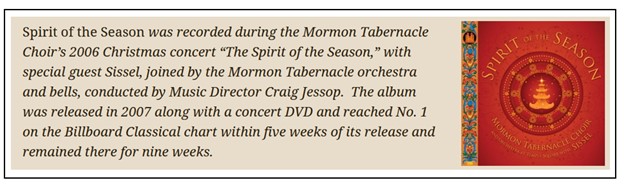
The twenty-minute drive from my house to the gym is fairly nondescript. The streets are two-lane straight with a few turns and traffic lights along the way. Not much to look at on a winter’s morning. But the month of December brings about a miraculous change. With the car stereo belting out songs of the season there’s suddenly a lot to see through the windshield.  It’s as if I’m viewing the world through Christmas-colored glasses.

Maybe you’re like me when you’re on the morning drive.  You’re half-asleep, a little bit late, and the slightest miscue by another driver puts you in a bad mood.  I try to blank out the world around me by toggling my radio presets between news and sports.  It’s a wonder my lack of focus gets me to the right destination.  But Christmas music changes all that.  The happy tunes bring everything back to the crystal and clear.  They’re like a gift for the spirit.


Two radio stations in this part of Colorado switch over to Christmas music in December.  An adult contemporary station runs an endless loop of about thirty “holiday favorites” from Thanksgiving to New Years Day.  I’ll bet they play the Boston Pops’ version of “Sleigh Ride” and Mariah Carey’s “All I Want for Christmas” four or five times a day.  It gets old.  But they also play the best of Nat King Cole, Frank Sinatra, and Andy Williams so I forgive them. Then we have our Christian contemporary station.  Their round-the-clock Christmas playlist keeps it fresh, with more carols than pop songs.  They’re a little more in tune with the reason for the season.

Earlier this week I absentmindedly tuned back to one of my regular music stations.  Mistake. Their version of celebrating the season had people calling in to say why they deserved to be on “Santa’s naughty list”.  One caller said she babysat recently and told the misbehaving child Santa died of COVID.  Another said he slept with his ex’s sister and a week later slept with the sister’s best friend.  Seriously?  This is the spirit of the season?


Spotify plays its part on my drive, especially when radio stations bend to the inevitable commercials.  But not playlists.  Albums.  Spotify Christmas playlists just don’t cut it for me.  I have yet to find the perfect mix – you know, not too much of this, not too little of that.  I think Christmas albums by individual artists or groups do a better job of a “just right” playlist, which is why I’m peppering this post with three of my favorites.


Now then, let’s get back to those Christmas-colored glasses.  Exactly what did I see on my twenty-minute drive?  A lot more than I did before I tuned in to the season’s songs…

  • Children headed to school, laughing and singing as they walked.  I think we can agree; Christmas is all about children.  Or at least, one child.
  • Signs in front of churches advertising Christmas Eve services.  Most offer a 5pm, 7pm, and 9pm option, meaning lots of people are heading to church on Christmas Eve.  As we should be this year.
  • A lone tree at the end of a driveway decorated with just two ornaments.  What to make of it?  Maybe a senior citizen lives here, and two ornaments are all he or she can manage.  A reminder to gift to our local “Christmas for Seniors” program.
  • A third-story apartment and its tiny balcony decorated with garlands, wreaths, and lights.  Yes, all walks of life celebrate Christmas no matter the look of their “house”.
  • The sign at the gas station advertising today’s fuel prices.  Unleaded is advertised in red numbers, diesel in green.  How’s that for impromptu Christmas decor?
  • Our little town’s myriad Christmas decorations, covering trees, buildings, and lampposts, I may not always agree with the spending of our tax dollars but with this investment, they get it right year after year.

This is my personal mandate for the 2021 holiday season.  Take the rest of the month and listen to nothing but carols whenever you’re in the car.  You’ll don a pair of Christmas-colored glasses and be amazed at what you’ve been missing around you.  Believe it or not, the world looks pretty good right now.

Some content sourced from Wikipedia, “the free encyclopedia”.

Going Home

Last Friday, my family and I hosted – at long last – an in-person service of thanksgiving for my mother, who passed away in late 2020 at the age of 92. Travel restrictions denied us the opportunity to gather sooner but this year’s Thanksgiving weekend seemed most appropriate. The service program included hymns, Bible readings, a biographical homily, and reflections from my four brothers and me. But it was another element – a solo of “Going Home” – which brought a flood of tears and took my breath away, all at once.


As if the singing of “How Great Thou Art” or the reading of Psalm 23 wasn’t moving enough, “Going Home” brought my emotions to an entirely new level.  Sure, the song’s lyrics speak beautifully – to the peaceful transition from a life well-lived to what lies beyond – but it was the music that made my heart skip a beat.  “Going Home”, you see, borrows its instrumentals from the Largo movement of Antonin Dvorák’s “New World Symphony”.  And Dvorák’s symphony is one of my very favorite pieces of classical music.

I alluded to classical music when I spoke at my mother’s service.  I took piano lessons for several years as a child, and it was my mother who pushed me to practice when I would’ve much rather been playing outdoors.  It was my mother who faithfully attended my many recitals and competitions.  And it was my mother, as a result, who I credit for my lifelong love of classical music.

The New World Symphony’s (NWS) Largo movement is instantly recognizable to anyone who knows classical music (listen to the first two minutes above if you don’t believe me).  It may be the most beautiful solo ever written for the English horn; a short, meandering melody backed by soft strings.  I can’t think of a more appropriate instrument for the Largo, even though the English horn is an orchestra oddball with its distinctive wail.  Now layer the “Going Home” lyrics on top, as with the crystalline voice of Sissel Kyrkjebo above, and you wonder if music can get any better.

Following the English horn solo, the NWS Largo shifts to a minor chord passage which “evokes a nostalgic and desolate mood”, sometimes perceived as a funeral march.  But let’s be clear; my mother’s service was no funeral.  Rather, it was a blessed celebration attended by those who loved and admired her.  I think Dvorák knew this because the NWS Largo leaves the funeral march behind and concludes with another round of the peaceful English horn solo.  For me, this music brings a cleansing sigh, and a feeling of calm and content.  Just as my mother would want it to be.

I’ve saved the best for last here.  After my brothers and I finished our remembrances, my father spoke.  He said – to my utter amazement – my mother had effectively written her own service, picking the hymns, readings, and solos.  In other words, “Going Home” was no random choice; it was my mother’s preference.  Just as the New World Symphony Largo movement is my own preference.  Maybe she was aware of the connection?  Maybe not but it doesn’t really matter.  What matters is I’ll always remember her, especially when I hear the English horn.

I miss you, Mom.

Some content sourced from Wikipedia, “the free encyclopedia”.

Coup de Grâce

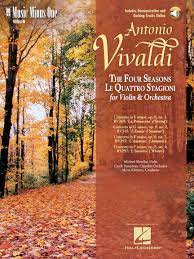
On my green and pristine back lawn, a solitary fallen leaf lies captive among the blades, a sure sign of the coming fall. A summer lengthened by oppressive heat is mercifully at its end. Fellow bloggers eagerly write about crisp mornings, cool nights, and college football games. But here’s a better nod to the upcoming season, a beckoning more sublime than anything “pumpkin spice”. Have a listen to Antonio Vivaldi’s violin concerto “Autumn”, from his best-known work, “The Four Seasons”.

Sure, I could bore you with the details of a classical composition written over four hundred years ago. “The Four Seasons” was cutting edge for its time because the music reflected real-life events: singing birds (“Spring”), soft breezes (“Summer”), and icy paths (“Winter”).  But today’s post is not really about “Autumn” and its drunken dancers.  It’s about the performance of the piece by Frederieke Saeijs.

Ms. Saeijs

I’d never heard of Frederieke Saeijs before I watched the eleven minutes of her violin solo in the video above but I must confess, I’m absolutely smitten.  Frederieke (pronounced exactly like it reads, unlike her last name), is Dutch by birth but worldly in every other respect, including her education, performances, and teaching.  Her list of accomplishments and awards suggests there is nothing further she can achieve with her instrument… and she’s only forty-two.

But I digress (and can you blame me after seeing her photo?)  Let’s get back to this performance of “Autumn”.  Here is what I found so captivating.  First, Frederieke’s eyes and her movements with her violin are unabashedly expressive as she plays, clearly one with the music.  She is a picture of grace with her slender frame, elegant hairstyle, and striking purple gown.  In other words, you could watch this video on mute and still be impressed.  But please don’t.  You need to hear the music, even just a few minutes of it.  I admit to distraction by some other things on my computer screen yet I kept coming back to this performance until I’d completed all eleven minutes.

If I haven’t yet persuaded you to spend a few minutes with Frederieke, consider this.  She plays the entire piece from memory (which, in ‘Autumn’s more furious moments, is mind-boggling).  Also, her performance – as well as those of the smallish orchestra around her – is captured from a dozen different angles.  This was a busy production, both in front of and behind the camera.

I kept waiting for something – anything – to bring this performance back to earth so I could describe it as less than perfect.  Except for a cough in the audience minutes from the end, I don’t see how the concerto could’ve been purer.  Seriously, have you ever wondered how a soloist of this caliber avoids a sneeze or a cough, or even slips a little on her high heels?  Perhaps this explains why Frederieke is a world-class violinist and I am not.

Finally, if you made it to the end of this performance like I did, you’ll find it interesting the video concluded before the audience applause (and standing ovation, no doubt).  I say “good call” to whoever posted the video.  The silent fade-to-black conclusion only makes the performance more powerful.

Mr. Vivaldi

A coup de grâce is defined as “a decisive blow”, and further, “one delivered mercifully to end suffering”.  I love the double meaning here.  The season of autumn delivers a merciful end to the suffering of a hot summer.  More to today’s topic, Ms. Saeijs’ violin performance speaks of force and grace as one.  In other words, she offers you a most sublime welcome to fall.

The poem which inspired Vivaldi’s “Autumn” concerto includes the line, “… And (by) the season that invites so many, many…”  After watching today’s video I feel very much invited.  I suggest you raise a glass of hot cider to the calm of fall.  While you’re at it, give thanks for the breathtaking talent of Frederieke Saeijs.

Some content sourced from Wikipedia, “the free encyclopedia”.

Do YOU Know the Muffin Man?

I have a hodgepodge of baked goods on the kitchen counter right now. A loaf of sourdough sliced and ready for sandwiches. Brioche buns to cradle the bratwurst I barbecued over the weekend. Angel food cake for dessert topped with berries and whipped cream. And tortillas (which, okay, are “fried goods”) by the bagful. But we’re not done here. There’s one more option, one where my starchy carb willpower goes flying out the window. English muffins.

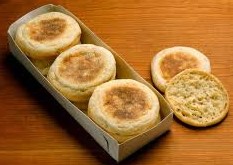
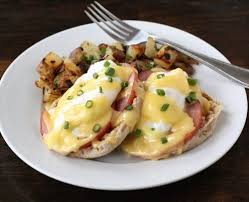
Who among us doesn’t love a warm, toasty English muffin?  The little round breakfast breads give us so many reasons to choose them.  They’re delicious, whether with butter, jam, or as an ingredient in Eggs Benedict.  They’re satisfyingly circular.  They’re usually fork-split so they break apart easy for the toaster.  You feel like you get two-for-one instead of a single piece of boring toast.  And as if to boast of their popularity, McDonald’s bakes millions of them into their Egg McMuffins.

Here’s another appeal of English muffins.  They have all those nooks and crannies to secure the melted butter.  You’re familiar with the term “nooks and crannies” (I know you are).  It’s the primary descriptor in Thomas’ English Muffins advertisements.  But you probably don’t know the backstory.  Thomas – as in Samuel Bath Thomas – created the “American” English muffin in 1880, after moving to the United States from England.  He brought with him a griddle-baking process for the muffins, which results in the signature crunchy outside and soft inside.  140 years later, I’m hard-pressed to come up with another manufacturer of English Muffins.  Okay, maybe Bays.  That’s it.

Ironically, English muffins are a more popular breakfast item in North America, Australia, and New Zealand than in England.  But you can’t just call them “muffins”, at least not in America.  Muffins (coming from the German muffen for “little cake”) refer to blueberry or corn or some other muffin with a more specific taste than the sourdough of English.  Not sure about you, but my consumption of English muffins to blueberry or corn is probably 100:1.

Eggs Benedict

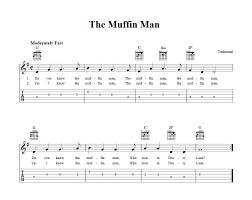
You think you “know the muffin man”, but I’ll bet you’re just singing the children’s song (and you’re welcome for getting it stuck in your head).  There really were muffin men, you see, way back in the mid-1800’s.  They’d walk the streets selling their fresh-baked muffins, ringing bells like an ice cream truck.  In Britain there used to be so many muffin men ring-ring-a-ringing, Parliament passed a law to ban the bells.  But people still bought their fresh-baked muffins (at least until houses started getting this new invention called a “stove”).

When Mr. Thomas first sold his muffins in America he called them toaster crumpets, described as a “more elegant alternative to toast” to appeal to finer hotels.  Over time he changed the description to “English muffins” to better serve the masses.  The company bearing his name has been making them ever since, and the griddle-baking approach is the secret to all those nooks and crannies.

Crumpets, aka “English muffin imposters”

While we’re on the subject, let’s settle the debate on crumpets (and scones, for that matter) vs. English muffins.  Crumpets look like English muffins.  They’re about the same size.  But that’s where the similarities end.  Crumpets are only cooked on one side.  They have a milder taste.  And there’s a good explanation for the popularity of English muffins over crumpets in America.  Muffins go better with coffee, which Americans drink a lot more of than tea.  Can’t tell you when I’ve ever seen someone having a crumpet with their coffee.

“The Muffin Man” song includes the lyric, “… who lives on Drury Lane?”  Turns out, Drury Lane is a real street; a thoroughfare bordering Covent Garden in London.  But I prefer to think the Muffin Man lives right here on my street.  The Muffin Man is me, because not a week goes by where I don’t include the English rounds in my breakfast.

Some content sourced from Wikipedia, “the free encyclopedia”.

Gadgets… Be Gone!

The defining elements of the 1970s included disco music, bell-bottom pants, and really big sunglasses. You had block-long lines at gas stations thanks to the “Energy Crisis”, President Nixon’s resignation because of Watergate, and the long-overdue wrap of the Vietnam War. People preferred their clothes and cars in bright colors, their hair shaggy. I don’t remember much of this stuff, since I was only a budding teenager. But I’ll never forget my very first audio cassette tape deck.

90 minutes of songs in your pocket

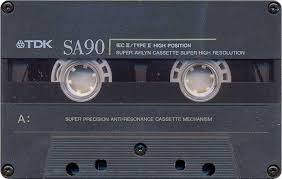
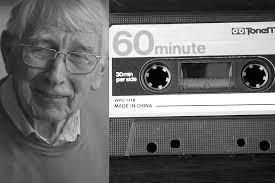
You’re seeing obituaries in the news these days for noteworthy people of the 1970s.  Fifty years ago these people were generally in their thirties or forties; a reasonable age to invent something.  So it didn’t surprise me to read about Lou Ottens, who died in March at the age of 94.  Ottens was an engineer for the Philips Corporation.  Never knew him, never heard of him, but I’m forever grateful he invented the compact cassette audiotape.

[Millennials, roll back the clock on music media.  From your digital subscriptions, pass through Blu-Ray and DVD, then compact disc (CDs), until you finally land in the 1970s and the compact cassette audiotape.  If you made it to long-play (LP) vinyl records you went a little too far.]

Cassette tapes were a sensation in the 1970s because not only were they pants-pocket-portable, they were recordable.  Me and my cassette deck spent many an afternoon capturing Top-40 hits off the local FM radio station (Barry Manilow!  Helen Reddy!)  Then I’d store my precious cassettes in their little suitcase, which could hold twenty or thirty inside plastic cases.  Add in the invention of the Sony Walkman at the end of the decade (the first handheld cassette player) and you’ve got a broad overview of 1970s music media.

1970s chic

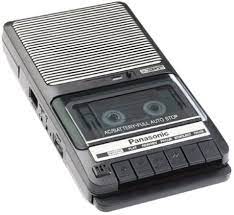
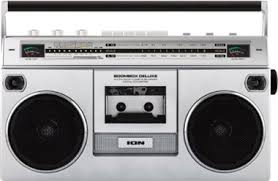
I did have a Walkman somewhere along the way, but the better memories come with my tabletop cassette deck (like the one shown here).  It lived on the desk in my bedroom, with its square speaker and giant pushbuttons, a precursor to today’s boom box.  It ate the occasional cassette tape with relish, and background noise always accompanied recordings off the radio, but my tape deck was still fairly state-of-the-art for the 1970s.  It only weighed a couple of pounds including the four C batteries.  The pop-out handle made for easy carry.

Lou Otten’s passing speaks to how many inventions, no matter how novel or cutting-edge, are sooner or later kaput.  Like the wax occupants of Madame Tussauds, you know your useful life has passed when you’d be better off in a museum.  So how about a few more inventions from my childhood years – once useful but now “almost gone”?

1960s

  • magnetic stripe card (smartphones are saying, “move over”)
  • plasma display panel (PDP)
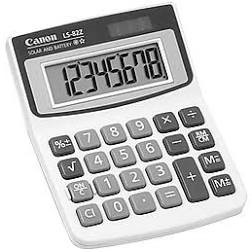
  • handheld calculator (just ask Siri now)
  • 8-track cartridge (whoa, that’s ancient history)
  • Liquid Paper
Soon to be kaput

1970s

  • Pong (one of the earliest arcade video games)
  • floppy disk (removable computer file storage)
  • portable GPS device
  • cell phone (audio calls, nothing else)
  • videocassette recorder/player (VCRs)
“Floppy” file storage

I was just as curious to check out the decades of my parents’ childhood.  What inventions from their formative years are no longer?

1930s

  • Polaroid photography (in its original form)
  • IBM electric typewriter
  • coin-operated parking meter (now accepts credit cards)
  • drive-in movie theater (making a COVID-era comeback, perhaps?)
  • twist-tie (now built into your kitchen trash bag)

1940s

  • aerosol spray can (can we at least agree, these need to go?)
  • Slinky and Silly Putty (not today’s child’s toy of choice)
  • atomic bomb (let’s just pretend these are obsolete, shall we?)
  • lp phonograph record
  • jukebox
Early-model boombox

Last summer I went through a few neglected boxes in the garage and found a few of my old audiocassette tapes.  I keep a still-kicking boombox in the garage (for AM radio baseball games), with a dusty cassette tape player in the middle.  One afternoon I popped in one of those old tapes, pressed PLAY, and behold: John Denver was alive and singing again.  The music was as crisp and clear as 1970.

So give it up for Lou Ottens.  Not only did he design audiocassette tapes, he designed those little guys to last!

Some content sourced from the Hackaday.com article, “RIP Lou Ottens, Developer of the Compact Cassette and More”, and Wikipedia, “the free encyclopedia”.

Whistle Work

Last weekend my wife and I drove north a couple hours to visit our granddaughters.  The last time we saw them was in the pre-pandemic days of yesteryear.  We spent most of Saturday afternoon in the backyard playing little-kid games in the makeshift pool and breaking out a plastic Tee-Ball set.  Later on after a barbeque, it was time to clean up the toys.  My son and his wife promptly requested the “The Clean Up Song” from Alexa, and my granddaughter hopped to it.  Watching her I caught myself thinking, can’t I help with the clean up too?

Google The Clean Up Song and you’ll find several dozen versions to choose from.  Cleaning-to-music for kids has been around a little while now.  I wish we’d used this approach more often when our own children were little.  It’s a song!  It’s a game!  It’s almost whistling while you work.

For me, household chores morphed to something more therapeutic as the kids grew up and out of the house.  Taking out the trash became extra steps towards my ten thousand (we have a long driveway).  Washing dishes became a mini-spa of warm water and soap bubbles.  Making the bed and arranging its pillows channeled my inner Marie Kondo.  Folding clothes was how to avoid lazing on the couch while watching TV.  (On that note, an ironing board should be called a “clothes-folding board”, if you go by my folding minutes (100%) vs. ironing minutes (0%).

Lest you think me compulsive, a recent Wall Street Journal study comes to my rescue.  During these stay-at-home times – locked-down residents find similar stress relief in housework.  Washing windows allows the slow, deliberate wax-on-wax-off zen of “The Karate Kid”.  Cleaning countertops tempts flowing dance, like Julia Stiles in the diner in “The Prince and Me”.  Ironing doubles as light weightlifting. And vacuuming?  Nah, I got nothing there.  Vacuuming’s still just a chore.

The lovely Ms. Stiles and her diner dance

Headspace

Headspace, a software company focused on meditation and better sleep, includes housecleaning exercises on its app.  They recommend “quiet housework in dim lighting” just before bed (but then how do you see what you’re cleaning?) They want you to sweep the floor and wipe the counter in smooth, restorative motions.  Laugh all you want but the use of their “cleaning-related content” is up 20% since mid-March.

Household products are trending the same way.  Swiffer wants you to mop with “a clean home and a clear mind” and suggests a facial treatment while you’re at it.  They switch “clean the counter” to “give your surfaces a little TLC” (as if your surfaces are close friends).  Proctor & Gamble fortifies its “Gain” laundry detergent with essential oils like lavender and eucalyptus, touted for their calming effects. “Clear Your Mind with a Cooling Clean!  A Soothing Scent with a Mindful Twist!”

Call me one-in-five (not compulsive) because P&G research claims 20% of us clean to relax or reduce stress.  Sure, but we also clean to clean.

I never thought about laundry this way but the Journal article likens clothes-cleaning to problem-solving (which we guys are all about).  Sort the clothes, dose the detergent/softener, fold according to best-fit in drawers, and then put everything away.  It’s a process, and it’s a new puzzle every time.

To take it one step more spiritual, household chores are considered seva – a form of selfless-service.  Says one yogi about dirty dishes, “You’re reminding yourself you’re washing for the divine grace that flows through your husband, your wife, your children, or your parents.”  Whoa now.  Me, I’m just washing dishes.

I’ve neglected to mention another household chore: cleaning bathrooms.  It can be “healing” sponging the porcelain to a sparkling-white shine, conducting the bowl brush in large, lazy circles, or returning to nature in the gentle flow of the sink (waterfall) or toilet (whirlpool).  No, no, NO.  I don’t do bathrooms.  Not even if you ask Alexa to play “The Clean Up Song”.

Some content sourced from the 5/27/2020 Wall Street Journal article, “Sick of Cleaning?  Turn It Into Meditation”.

(Not) Paying the Piper

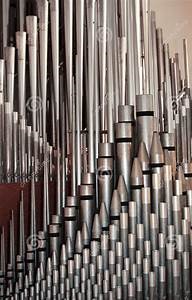
One player, many pipes

Our church is weighing creative approaches to conducting in-person services next month. Pastor Bob sent out a survey recently asking we-the-congregation to consider options like outdoor church, weekday church, and evening church – all in the name of social distancing.  We’ll also be shaking up the service “touchpoints”, like sharing the peace, passing the (offering) plate, and partaking in communion. The Big Guy doesn’t care about the where’s, when’s, and how’s, of course – just that we have church.  On the other hand, He (She?) might have something to say about the music. After all, how does a church organ sound after a three-month absence from tuning?

It’s bad enough our congregation is gloriously inharmonious when we bellow out the hymns (no choir of angels are we), but add in a fully discordant church organ and you have a complete mess. Organs need tuning like the human back needs a chiropractor: maintenance is key. When dust accumulates and seasons change, organ pipes sound noticeably different than they’re supposed to (hence the term “off-key”).  Imagine the pitch-perfect tones of a bass saxophone, but instead you get more of a sour wail.  That’s an organ pipe sans “tune-up”.

Every one needs tuning

Tuning organ pipes is serious business and can run thousands of dollars per visit.  Consider, the biggest organs have as many as 25,000 pipes.  The booming bass pipes can be thirty feet long and two feet in diameter, while the little pixie sopranos look more like metal soda straws. Each pipe must be individually tested and tuned no matter how big or small.  Tuner A presses a key on the (up to four) keyboards down below, while Tuner B adjusts the pitch of the pipe up above (sometimes on a ladder, sometimes on a suspended platform).  It’s hours and hours of monotonous – and in the case of cathedrals, death-defying work, one demanding pipe at a time.  Better love what you do.

Here’s another reason organ tuners deserve hazard pay.  Imagine you’re suspended hundreds of feet above the sanctuary floor on a swaying rope-suspended platform (I’m already saying “no”), virtually floating like the angels, and as you reach over to adjust the pitch of a mid-sized pipe, bats fly out.  Yep, that’s the kind of critters tuners encounter when an organ wants for too long (or a single pipe sounds suspiciously out-of-tune).  Squirrels even make their homes in the pipes – though don’t ask me how they don’t go plummeting to their death the moment a note is blasted from the keyboard.  Maybe they’re flying squirrels?

The view from above

In the land of COVID-19 there are no organ tuners (or very few).  Those Peter Pipers are being denied access to their church-bound “patients” because a) COVID may reside on a surface like, say, a keyboard, and b) no congregation means no offering plate means precious few payments to the Piper.  So what do stay-at-home tuners do instead?  Why, they tune their pianos of course!  Then they play those pianos hours on end.  We may come out of COVID with a whole new genre of classical music called “tuner tunes”.

Talk about a sprint from feast to famine.  An organ tuner’s busiest weeks are those leading up to Easter, often requiring extra staff and longer hours.  COVID downpoured on that parade.  Demand for pre-Easter tuning disappeared faster than Mr. Bunny himself.  In the case of one tuner – profiled in the Wall Street Journal – 100 contracts withered to less than a dozen inside of two weeks.  He furloughed his entire workforce, worried instead over simply paying the rent on his shop.

One day soon, we faithful will walk away from our laptops and wander back into church sanctuaries instead.  We’ll spread out over more services.  We’ll wave hands instead of shake hands.  We’ll drop the offering into the plate from a “safe height”.  We’ll bypass communion servers and help ourselves to the bread and wine instead.  The organist will play and the congregation will sing; both noticeably off-key.  And when that happens give a nod to the organ tuners, who will someday get the pipes pitch-perfect again. 

Just hope they don’t need an exterminator as well.

Some content sourced from the 3/25/2020 Wall Street Journal article, “As Coronavirus Shutters Churches, an Organ Whisperer Changes Key”, and Wikipedia, “the free encyclopedia”.

A Baker’s Half-Dozen

If you’ve ever been to an IKEA home furnishings store, you know the shopping experience is more about navigating a vast warehouse than a cozy “store”.  IKEA retail covers several football fields worth of showrooms and merchandise, with clever navigation arrows projected onto the floor so you don’t lose yourself in the maze.  Before or after your purchases, IKEA offers a spacious sit-down cafeteria, so you can fuel or restore your energy levels as needed.  And it is here – in the IKEA cafeteria – where I can’t help but picture the Swedish Chef from the The Muppet Show.

You remember Swedish Chef, don’t you?  Even if you only occasionally glanced over the shoulders of your children as they watched The Muppet Show, Swedish Chef left an indelible impression.  Chef had those big, bushy brows completely covering his eyes.  He always had a handful of utensils, inevitably launched into the air of his kitchen as his gibberish songs ended with “… BORK, BORK, BORK!”  Chef sported a colorful bow tie, a white apron, and the distinctive toque blanche (white hat) on his head.  Swedish Chef was always my favorite Muppet.

Chef could be working behind the counter of the IKEA cafeteria, because naturally; IKEA serves Swedish food.  My favorite entree (as if I dine at IKEA regularly) is the Swedish meatballs in brown sauce (köttbullar), served with a side of the crepe-like potato pancakes (raggmunkar) and a dollop of lingonberry jam (Sweden’s famous “food freshener”).

There’s another fellow in the States who reminds me of Swedish Chef, and he doesn’t work in the IKEA cafeteria.  Ever heard of Mimal, “the Man in the Middle of the USA”?  Mimal lives in the Midwestern states, and he’s a big boy.  In fact, Mimal’s so big he barely fits between Canada’s border to the north and Mexico’s to the south.

Have a look at the map.  Mimal (sometimes called “the Elf”) is a silhouette of a chef, represented by the outlines of seven American states.  MIMAL is quite literally (M)innesota, (I)owa, (M)issouri, (A)rkansas, and (L)ouisiana.  He holds a pan (Tennessee) of fried chicken (perfectly represented by Kentucky).  Mimal can thank the west bank of the Mississippi River for the shape of his five-state body.  He also looks like he’s about to march his chicken right off the map, over the Atlantic Ocean, and on into Europe.  Maybe he’s headed to Sweden?

Whoever discovered Mimal hiding in America came up with a clever way for children to memorize a handful of states.  Appropriately, Mimal the chef is made up of a baker’s half-dozen of them.  A baker’s dozen (13) began in the 11th century, when an extra loaf was added to the bread basket to guarantee the minimum sales weight.  A baker’s half-dozen then – rounded-up – is seven loaves.  Or seven American states.

Leave it to Americans to deny Mimal his innocence.  Based on one or more unsolved mysteries in the MIMAL states, the elf-chef was once connected with a real-life kidnapper/murderer.  The legend claimed if you drove straight from Minnesota to Louisiana – through each of Mimal’s five “body” states, you’d be abducted (never to be seen again) once you crossed Louisiana’s northern border.  My logical brain asks how said abductor knows you made it through all five states?  But this is legend we’re talking about, much like the monster in Scotland’s Loch Ness.  Tabloid fodder at best.

Educators expanded on Mimal’s seven-state profile, including all fifty American states in a story designed to help students memorize names and locations (would’ve been helpful back in my school days, when I’d confuse Wyoming with Colorado).  Still, I prefer to limit the game to Mimal’s baker’s half-dozen.  I can’t help but see a big chef every time I look at a map of the United States.  I also can’t help hearing him sing, “…BORK, BORK, BORK!”

Some content sourced from Wikipedia, “the free encyclopedia”, and the Laughing Squid blog.

Ever Eat a Pine Tree?

If I ask you to recall a catchphrase – a word or statement you heard repeatedly and probably won’t forget – you could come up with several examples. Movie quotes, for instance. (“I’m the king of the world!”)  Song lyrics. (“I get by with a little help from my friends.”)  And television commercials; where the product or “jingle” yields a branded catchphrase. Just this week I learned a new one: bindle stiff, which describes a homeless person through the bag of personal items (bindle) on the end of his/her stick. I’m no hobo, but Euell Gibbons once was. And Gibbons once uttered one of the most famous catchphrases ever.

Who the heck is Euell Gibbons?  Any American kid growing up in the 1970’s would know.  Gibbons was the spokesperson for Post Grape-Nuts cereal, made instantly famous by a single television commercial where he uttered, “Ever eat a pine tree?  Many parts are edible.”  That statement was so bizarre – and laugh-out-loud to us kids – it spread like wildfire (and sold a ton of Grape-Nuts cereal). But it was only recently I learned Gibbons wasn’t just a hired bindle stiff, but a man ahead of his time.  He had a lifelong interest in foods foraged from “nutritious-but-oft-neglected plants” (surely learned from an impoverished and transient childhood).  He wrote several successful whole-foods cookbooks, including “Stalking the Wild Asparagus” (1964) and “A Wild Way to Eat” (1967).  In his later years, Gibbons and his wife joined a community of Quakers in Philadelphia, where he cooked the daily shared breakfast (of course he did).

“Many parts are edible.”

I love Grape-Nuts cereal, back to when I was a kid.  I’m not sure if Gibbons gets the credit, or because Grape-Nuts just tastes good (“…reminds me of wild hickory nuts…”, as Gibbons also said).  Admittedly, Grape-Nuts was a little off the beaten path of children’s cereals.  Very low in fat and sugar, Grape-Nuts looked and crunched like a bowl of light brown gravel.  Add in milk as a softener and sugar as a sweetener however, and something about the cereal just clicked with me.  After college I forced myself to give up Grape-Nuts, because I developed jaw pain from too many hard foods.  Maybe that’s why Post developed Grape-Nuts “Flakes” cereal, or Grape-Nuts “Trail Mix Crunch Cranberry Vanilla”.

GORP

Speaking of trail mix (convenient segue), Euell Gibbons comes back to the conversation.  Trail mix was introduced about the time Gibbons was born (1910), as a combination of dried fruit and nuts.  Trail mix was lightweight and therefore easy to carry on long hikes.  The carbs and fat created a quick energy source and an ideal snack food, and the mix became immensely popular to outdoors-people, especially sugared up with a few M&M’s or yogurt coverings (which Gibbons never would’ve approved of).  Yet it wasn’t always called “trail mix”.  In another word familiar to 1970’s kids, Gibbons coined the acronym GORP, which either meant “good ol’-fashioned raisins and peanuts”, or “granola, oats, raisins, and peanuts”.  Yep, I ate a lot of GORP in my childhood.  Might’ve even had my first taste at Hadley Fruit Orchards, a place in the California desert my parents like to frequent.  Hadley – alongside others – claims to be the “inventor” of trail mix.

Euell T. Gibbons

As if “Euell Gibbons” is not unique enough for an American, his middle name was “Theophilus”.  The only Theophilus I’m aware of lived in biblical times, when Luke wrote his Gospel (and the book of Acts) as letters to an individual by the same name.  Perhaps Gibbons should’ve lived in biblical times.  As God’s people sought the Holy Land he could’ve helped them with his foraging skills.  Or at least introduced them to Grape-Nuts.

Some content sourced from Wikipedia, “the free encyclopedia”.

Cruise (out of) Control

Ever since the Ferris wheel debuted (at the 1893 World’s Colombian Exposition in Chicago), there’s been an unofficial competition to design and build a taller version.  The original topped out at 80.4 meters all those years ago, while today’s leader – the “High Roller” in Las Vegas – rotates over twice that high.

The “High Roller” in Las Vegas

To complicate the matter, there’s great debate about what defines a Ferris wheel.  The tallest wheels for example – including the High Roller and the London Eye – are labeled “observation wheels” because they’re more than just an amusement.  Newer designs eliminate the spokes and hub to give the illusion of a free-wheeling ring.  Whatever.  Thanks to my acrophobia, even a kiddy amusement park Ferris wheel is thrill-ride enough for me.

Go figure – I enjoy the highest, fastest roller coasters anywhere, but I wimp out when it comes to a standard Ferris wheel.  Why?  Because Ferris wheel gondolas are neither enclosed nor replete with safety bars.  You’re just sitting up there in the open air, 250 feet off the ground, realizing nothing is preventing you from falling (a peek into the mind of an “acrophobe” – you’re welcome).  Conversely, when the roller coaster safety bar ratchets down to the waist, almost taking your breath away, there’s a sense of being one with the coaster, like you can’t possibly fall out.  Much better.

I will never be this guy

Let’s change the channel and focus on big ships.  If you’ve ever taken a cruise, you should be able to name one or more “amusements” you didn’t expect to find in a floating hotel.  Golf driving ranges.  Skeet-shooting.  Water slides.  Again, it’s an unofficial competition.  But what about a roller-coaster, traveling up to 37 mph, with an elegant sweep out over the ocean?  Yep; coming soon to a Carnival Cruise Line ship near you.

I hereby retract my earlier statement about tolerance for roller coasters.  Riding the rails, plunging down towards the ocean and back up to the sky, two hundred feet above the keel of a moving ship – Carnival’s “Bolt” is too much for me and my acrophobia.  Almost a little too much for the coaster’s engineers, too.  They faced a pile of challenges with the design.  What would be the impact of a moving vessel on the gravitational requirements of a roller coaster?  Will the weight of seven hundred feet of track twenty stories above the water tip the ship?  How will the vessel’s structure tolerate the forces of heavy cars speeding here and there?  And what about all that noise?

Put the cart before the horse – as Carnival did – and things get easier.  First design the coaster; then design the ship.  Make the roller coaster cars self-propelled so they don’t depend on gravity.  Eliminate the chains and sprockets in favor of small booster engines to reduce the noise.  Then design a ship keel three football fields in length.  Reengineer the structural elements – from the water up – to accept the distributed forces of the coaster.  Overweight the whole thing so coaster cars can go almost vertical and still not tip the ship.  Behold Carnival’s Mardi Gras – a virtual floating amusement park – breaking the champagne bottle next winter.

I still think a roller coaster on a ship is nuts, but I seem to be out of touch with the latest amusements.  You can already partake in “Sky Pad” – also on Carnival – a bungee-jumping-trampolining-virtual-reality mash-up.  Or Royal Caribbean’s “RipCord”, a column of air for skydiving simulation.  Or Norwegian’s “Ultimate Abyss”, a four-story sort-of toilet bowl, where you’re flushed in circles and dropped down a 200-foot water slide.

If you’ve ever seen Katy Perry’s music video, “Chained to the Rhythm”, you probably laughed at the outlandish amusement park rides, like the coaster with the heart-shaped loop-the-loop, or the pseudo Ferris wheel catapulting riders out into the air.  But considering Carnival’s “Bolt”, maybe Katy’s got a keen eye on the future after all.  As for me, I’ll stay grounded in my local kiddy amusement park.

The future of amusement?

Some content sourced from the 1/8/2020 Wall Street Journal article, “They’re Putting a Roller Coaster on a Cruise Ship”, and Wikipedia, “the free encyclopedia”.