Once in a Red Moon

I try to keep my blog topics timely, inspired by the come-hither headlines of my news feed, shouting, Click me! or No, click ME!  But it’s not often – once in a blue moon, in fact – where I talk about what happened last week and what happens next week inside of the same topic. The calendar positions us perfectly today to do just that. So let’s talk rubies.

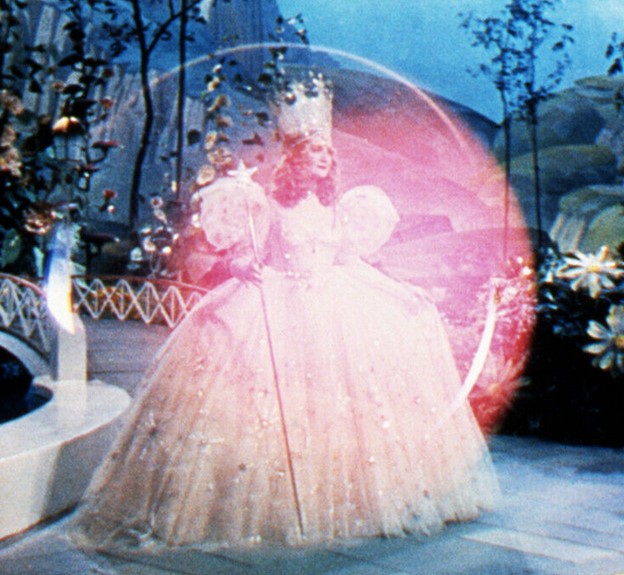
My first introduction to the four “precious gems” was probably when I started going to the movies.  Diamonds Are Forever was as much about the title jewels as it was about James Bond.  Romancing the Stone – the first movie my wife and I ever saw together – was a swashbuckling pursuit of a giant emerald in South America.  The “Heart of the Ocean” pendant from Titanic was the biggest sapphire I’d ever seen (until someone reminded me it was actually a blue diamond).  And rubies, of course, became something magical through Dorothy’s red slippers in The Wizard of Oz.

The “Star of Fura” ruby

Last week, the largest ruby ever mined – 55.22 carats – came to the auction block at Sotheby’s.  For a cool $35 million it could’ve been yours.  Named the Estrela de Fura – Portuguese for the Mozambique mine where it was discovered – the “Star of Fura” was twice as big in its native form a year ago, then cut down and polished to the glistening red rock you see here.

Rubies aren’t made to be broken but world records are, and this one was shattered.  The previous largest ruby, known as  The Sunrise, was “only” half as big (25.59 carats).  To me, The Sunrise looks about as big as a red M&M.  The Estrela de Fura looks like a strawberry.  The most expensive strawberry in the world, that is.

Green?  Make that red!

If rubies are your thing, keep an eye on Mozambique.  Ruby mining is relatively new to this country in the south of Africa, with the first significant discovery of the gems made in 2009.  Less than fifteen years later we have the record-setting Estrela de Fura.  Surely an even bigger ruby can’t be far behind.

Moving on.  This week begins the month of July (and the second half of 2023) which means we have several reasons to see red.  America’s Independence Day includes a lot of red, whether the flag or the fireworks.  Sunbathers will see the color on their skin more often than they’d care to.  Strawberries are ripe and in abundance.  The month’s zodiac sign is cancer (the crab) and crabs are often red.  And July’s birthstone is, of course, the ruby.

Now’s a good time for some ruby trivia, the fun facts you most likely don’t already know.  The first one is my favorite for your next social gathering:

  1. Rubies are actually sapphires by definition (all mined from  the same crystalline form of aluminum oxide known as “corundum”).  In other words, rubies are simply rarer, red-colored sapphires.
    Don’t touch!
  2. Rubies have symbolized power and protection throughout human history, as with decorated warriors in battle (or slippered Dorothy in the Land of Oz).
    “The Hope”
  3. You’ve heard of the (blue) Hope Diamond but how about the (red) Hope Ruby?  The Hope is 32 carats, cradled in a ring and highlighted with just a few diamonds.  Same name, yes, but different gem, color, and setting.
  4. The most desirable (read: costly) rubies have a hint of blue in them, which contributes to the rich deep color known as “pigeon’s blood” red.
  5. A 10-carat ruby is typically more expensive than a comparably sized diamond.  Why?  Supply (and demand).  You just don’t find as many large rubies as you do diamonds.
Red sapphires, aka “rubies”

So there you have it: everything you need to know about rubies just in time for the month we celebrate them.  I’d be remiss (translation: “in trouble”) if I didn’t mention my wife’s birthday, which is next week as well.  Yes, her birthstone is the ruby, and “darn it all” I had the perfect gift idea if I’d only known about last week’s Estrela de Fura auction sooner.  These opportunities come along but once in a red moon.  Sorry honey, I need to be a little more on the ball.  Guess I’ll hang onto our $35M for next year’s birthday present.

Some content sourced from the CNN.com article, “Largest ruby ever to come to auction sells…”, and Wikipedia, “the free encyclopedia”.

Rolling in the Isles

With the world “opening up” again, my wife and I often talk about places we’d like to visit. Some of them are more accessible now that we live near the East Coast. One in particular is further away. But coincidence or not, the five locales tempting the travel bug in me have one thing in common.  Every one of them is an island.

#16 at The Masters in Augusta, GA

Let’s get my first choice out of the conversation straight away, because it kind of stretches the definition of “destination” and “island”.  I want to go see a round of The Masters golf tournament in Augusta, Georgia.  If you’re not into golf you won’t understand the fuss, but trust me, when you’ve watched this competition on television every April since you were a kid, the place becomes a shrine of sorts.  The Masters never played into our decision to move to South Carolina, but the course is suddenly only forty-five minutes from my new front door.  So why is it an “island”?  Have you been to Augusta?  The Masters is like finding a bright green emerald in a bowl of gravel.  Let’s just say it would be complimentary to describe the rest of Augusta as “plain vanilla”.

There are no bad photos of Hawaii

Now for the real islands.  The first two fall on a lot of must-see lists: Hawaii and Ireland.  Hawaii is no less appealing even though South Carolina makes it three hours further than from where I used to live.  I’ve only seen “The Islands” on my honeymoon and on family trips (decades ago) so I know this time around would be decidedly more adventurous.  Not that I want to bungee-jump into a volcano or anything; rather just take a closer look at all Hawaii has to offer.

Ho-hum… just another town in Ireland

As for Ireland, it feels a lot closer when you live up against the East Coast.  If I had x-ray vision I might see the Blarney Stone from these parts.  My wife and I celebrated our 25th wedding anniversary with our first trip to the Emerald Isle, where we saw a lot of Dublin and only a wee bit of everything else.  We tossed a coin into the Trevi Fountain to be sure we’d go back, and… oh wait, right… that’s Rome.  Anyway, something we did in Ireland back then – whatever it was – instilled the yearning to go back someday.  And we will.

Mackinac Island’s Grand Hotel

Island #4 – Mackinac – sits neatly between the two peninsulas of the state of Michigan. The “Crown Jewel of the Great Lakes” has been on my must-see list ever since I watched Somewhere in Time in college in the 1980s.  Yeah the movie’s a little corny, but it’s utterly romantic and it stars Jane Seymour, so cut me some slack.  More importantly, Somewhere in Time shows off Mackinac’s Grand Hotel in all of its past/present glory.  No, I can’t afford the stay at the Grand (rooms start at $500/night) but I’ll settle for one of the B&B’s on the island and spend my money on other stuff instead.  Like a horse-drawn carriage tour with my wife (Mackinac has no cars).  Or a round of golf on the only course in the country where the trek between the front nine and the back is, again, by horse-drawn carriage.  Or a brick of Mackinac’s famous fudge.  Whatever the draw, I’ll endure two connecting flights, a couple hours of driving, and a quick ferry ride, just to experience Mackinac’s throwback delights.

I’ve saved the best for last (well, at least, I think it’s the best).  If I ever make it to France, I’m heading straight to Mont-Saint-Michel.  “St. Michael’s Mountain”, which I’ve blogged about here, first captured my imagination when professional sandcastle builders (yes, there are such people) built a replica on the beach where I grew up, and again when I studied architecture in college. 

Mont-Saint-Michel
The beach-sand version

The whole island setup is just so remarkable: nothing but a walled village of shops, restaurants, and other structures, connected by cobblestone streets ascending up, up, up to the Romanesque church and abbey at the pinnacle.  Only 29 residents at last count.  The surrounding tides ebb and flow, so at times Mont-Saint Michel is an island and at other times not so much.  And about that abbey on top.  The first cornerstone was laid in 1023, making Le Mont 1,000 years old this year.  All that time and I’ve never ever seen it?  Mon dieu.

One of Ireland’s many Aran Islands

If I make it to my five “islands”, I might have to add just one more.  Ireland is paying people almost $100k for the “gift” of an island off the western coast of the country.  There are twenty such islands.  The catch: you have to refurbish whatever structures you find and you have to live there.  Shelter yes, but food, water, power, and fellow humans are maybe’s.  Yeah, I won’t be rolling with any of those isles.  Let’s just start with that golf course down the street from me, shall we?

Some content sourced from the CNN Travel article, “Ireland will pay you $90,000 to move to a beautiful island home”

Lifeless Buds

I have a Venus flytrap named Frankie. He lives alone in a plastic cup on the patio table, happy in the humid air as he nabs the occasional bug. My wife’s nearby garden is boasting fruit, vegetables, and colorful blooms but I’m content to just watch my little tabletop carnivore do his thing. I’ll get to why I named my bud “Frankie” in a minute but let me just say this: At least he’s a live little bud. That’s more than a lot of people can say about their more imaginary friends.

“Frankie”

Here’s a morsel of self-discovery for you, extracted from my several years of blog posts.  I have a habit of referring to inanimate objects with terms of endearment.  My most recent example: two weeks ago when I discovered the SpaceX satellites launching into outer space.  I referred to those technological marvels as “little guys who talk to one another”, and, “when their time is done they’ll return home for a proper burial”.  Whether this is just cheap entertainment or an effort to elicit empathy from you readers, I regularly inject life into the lifeless (or in this case, a soul into the metal and mechanical).

“Little Caesar”

I didn’t have to scroll back very far to find other examples.  My post a week before the satellites, Hail, Caesium, endeared of all things, a lost capsule of nuclear waste.  First, I nicknamed the capsule “Little Caesar”.  Then I re-nicknamed it “LC” and noted how detection equipment ultimately “…led the search team right to our little friend”.  Were you more relieved to know the waste had been contained or that our little lost friend had finally been found?

Pine cone “sororities”

Conifer Confetti, a post from last fall, lamented the hours I sacrifice to contain the untold number of pine cones on our property.  I referred to the cones as “females” (because biologically, they really are) and in one frustrated burst of endearment, said “It’s like having the world’s biggest sorority row above my backyard, and every house is about to disgorge its girls for a giant party on the ground”.  So which is it Dave, a whole lot of “yard waste” or thousands of “little ladies”?

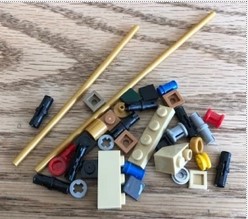
The “poor” leftover pieces from the LEGO Grand Piano

Finally, my series of posts on building the LEGO Grand Piano and LEGO Fallingwater were rife with terms of endearment.  All those plastic pieces were like little families bagged up in a single box; couples waiting to be married.  At times I thought I lost “one of the little guys”, and I felt sorry for the leftovers who’d never realize their destiny of being a part of the completed model.

“Cassini” (image courtesy of NASA/JPL)

This topic was inspired by an article in The Atlantic about the spacecraft Cassini.  Six years ago, Cassini completed a 13-year data-gathering cruise around Saturn and its moons.  Utterly alone and running out of fuel, Cassini turned towards the planet, eventually burning up in the atmosphere.  As NASA described the final moments, Cassini “fought to keep its antenna pointed at Earth as it transmitted its farewell”.  An entire room of scientists at Pasadena’s Jet Propulsion Laboratory fell into tears.  Cassini is the perfect example of – big word here  – anthropomorphism.  In simpler terms, the more “alive” a machine appears to be, the more empathetic the response from humans.  Some robots are deliberately anthropomorphic, a subtopic we just don’t have enough words for today.

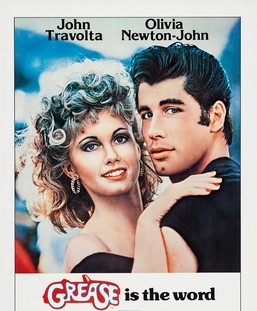
As I watch Frankie ingest another insect, it’s time to reveal the genesis of his name.  Maybe you don’t remember Frankie Avalon in his prime but you do remember the 1970s movie Grease.  Avalon showed up in a memorable scene, descending a staircase dressed in white while singing “Beauty School Dropout” to Didi Conn’s “Frenchy”.  Guess what?  Avalon had an even bigger hit: VenusThat song is a plea to the goddess of love to bring him romance; someone pretty and very much alive.  Okay, so my Frankie isn’t pretty, but at least he’s alive.  That’s more than I can say about all those other little buds who keep showing up in my blog posts.

Some content sourced from The Atlantic article, “How to Mourn a Space Robot”, and Wikipedia, “the free encyclopedia”.

Phantom Farewell

Tonight, hours after this post goes public, my wife and I will attend a local stage production called Lovesong.  It’s our first foray into the offerings of our community theater so we’re really looking forward to it.  Lovesong has a run of five evening performances and one Sunday matinee while it’s in town.  A check of the theater website indicates about 20% of Thursday’s seats have been sold.  By my calculation, that’s about 80% less than any Broadway performance of Phantom of the Opera.

Maybe you heard.  After 35 years and 14,000 performances, last Sunday the curtain dropped for good on Phantom of the Opera.  Its creator, Andrew Lloyd Weber, was on hand at New York City’s Majestic Theater to offer the cast and crew a personal farewell.  He claimed their final performance as the best he’d ever seen.  You’ll forgive Andrew for being a little sentimental after all these years.

Theater District, Midtown Manhattan, NYC

Whether the stage production, the 2004 movie, the glorious soundtrack, or even the books on which it was based, you’re familiar with Phantom.  It’s a captivating story; part haunting and part romantic, with a lead character who has you wondering, “Is he real or imagined?”.  Reading Phantom’s synopsis (which you can do here), I realize I overlooked some details of the story the one and only time I saw the show. No matter.  The sets and the songs will stay with me for life.

Phantom took my admiration of stage performances to an entirely new level.  The one time my wife and I saw the show, in San Francisco in 1997, it literally took our breaths away.  The only shows we’d seen prior were the “off-off-off Broadway” offerings; the kind where they recruit locals just to fill out the cast.  Phantom left us yearning for more of the best, including seeing something on Broadway (which we did years later with Les Miserables, deserving of its own blog post).

Phantom was also a technical marvel.  What other show boasted a giant chandelier swinging out over the audience and threatening to fall?  Or a staircase giving the optical illusion of descending several levels as the Phantom dragged Christine downward?  Or the subterranean lake the Phantom rowed across, where you swore you were looking at a giant body of water right there on the stage?

Every Broadway production seems to have three or four unforgettable songs.  Phantom was no exception.  The show kicks off with an orchestral version of “Phantom of the Opera”, turns sweet with Christine’s solo “Think of Me”, and overwhelms with the duet All I Ask of You and especially The Music of the Night.  The latter includes one of the most powerful notes I’ve ever heard, when the Phantom sings, “Close your eyes… and let music set you… FREE-E-E-E-E-E-E-E-E…!”

Deservedly, Phantom won the “Laurence Olivier Award” for Best New Musical in 1986, the Tony Award for Best Musical in 1988, and pretty much everything else it was nominated for.  Besides the London and Broadway productions, Phantom enjoyed nine worldwide tours and one revival.  Over its 35 years, Phantom employed 6,500 people and played to over twenty million theater-goers.  Phantom even had a short-lived sequel, Love Never Dies, debuting in London but never making it to Broadway.

Sadly, Phantom’s closing can be considered a casualty of the pandemic.  The show was suspended from March 2020 to October 2021 (when all Broadway productions ceased).  After reopening, attendance was sporadic because patrons were still hesitant.  Meanwhile, Phantom’s production costs continued at a staggering $1M/week, which eventually became unsustainable.

Phantom was originally slated to close in February but once theatergoers found out, the show experienced a brief resurgence and lasted another two months.  I don’t expect Lovesong to extend its little run at our community theater.  Thanks to Phantom of the Opera however, I’m simply excited for the potential of a wondrous stage performance.

Some content sourced from the CNN.com article, “Final curtain comes down on ‘Phantom of the Opera'”, and Wikipedia, “the free encyclopedia”.

This Gamble Pays Off

In the movie Back to the Future, there’s a memorable scene shortly after Marty McFly time-travels back to 1950s California. Marty looks up Doc Brown in the phone book and heads over to his house. Doc doesn’t recognize Marty when he opens the door but he drags him inside anyway.  The scene is memorable because Doc’s house (the exterior, at least) is recognizable to any student of American architecture. Welcome to Pasadena’s Gamble House.

Greene and Greene’s Gamble House

Maybe you guessed this Gamble wasn’t won in a wager (although it would’ve been a handsome payoff!)  Rather, it was built for a member of the (Proctor &) Gamble family who liked the look of his next-door neighbor’s place.  That house, and many others on the same street, was designed by sibling architects (Charles) Greene and (Henry) Greene.  The Gamble House is perhaps their most famous design.

Front doors and foyer

The Greene brothers, who studied architecture at MIT, made a significant stop on their journey to the West Coast.  They spent time at the 1893 Columbian Exposition in Chicago.  While there, they picked up design influences from the temple look of the Japanese pavilion (wood construction, tiled roofs, open verandas).

Dining area

The Greene and Greene “ultimate bungalow” look, with its liberal use of dark wood slats and panels, became known as the Craftsman style of architecture.  This label was all the more fitting because the Greene brothers also studied furniture design, and incorporated many custom pieces into their houses.  Even more impressive, the finished look relies on elegant leather straps and wooden pegs as fasteners; not a nail or screw in sight.

Main staircase

The Gamble House is 6,000 square feet of indoor/outdoor living, in concert with California’s mild temperatures.  You can tour the house courtesy of the USC School of Architecture students who get to live there every school year (luckies!)  A separate tour walks you through the neighborhood to see other Greene and Greene designs.  But the Gamble remains their masterpiece.  And if you ever see this inviting residence, you may wish you owned a time-traveling DeLorean to take you back to its heyday in the early 1900s.

Courtesy of Universal Pictures

Now for the latest on LEGO Fallingwater…

____________________

LEGO Fallingwater – Update #3  (Read how this project got started in Perfect Harmony)

I find it funny how this Fallingwater model is “rising” off of its foundation at the same time the water below is “falling”.  It’s like I’m going in opposite directions at the same time.  20 pages (or 22%, or 83 minutes) into the build, this is what we have.

As you can see, the stream is now “built” from the front of the house all the way to the back, with the modest waterfall front and center.  We also have our first piece of “landscape”, that dark green strip you see on the left.  Otherwise, we’re still at the foundation level.  I expect the house to rise dramatically in the next few chapters of the build.

LEGO “wrench”

Here’s something unnerving about this model.  You don’t really understand what you’re building as you go.  You’re putting together very small pieces which look like, well, LEGO blocks, until you stand back and take the whole model in.  For this reason, you have to build very, very carefully.  I still got the location of a few pieces wrong and had to utilize my handy-dandy wrench to yank them out.  It’s like pulling teeth.

Tune in next Thursday as construction continues!  Now for another nod to Frank Lloyd Wright…

Pettit Memorial Chapel

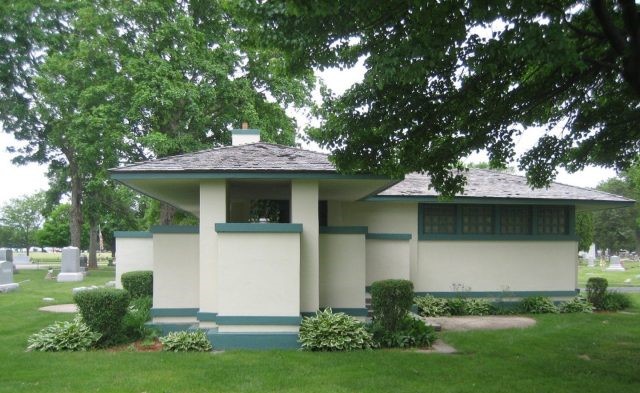
Over five hundred structures were built from the designs of Frank Lloyd Wright, but only one of those five hundred is in a cemetery.  That would be the Pettit Chapel in Belvidere, Illinois.  Dr. Pettit was a beloved physician of his time, and his sudden passing prompted his wife to hire Wright to design a graveside chapel as a memorial to the man.

Pettit Chapel

The design of the “petite” Pettit is very much in line with Wright’s signature Prairie Style.  The low roof lines, broad eaves, and high horizontal bands of glass are typical.  Wright used the shape of a cruciform – common in medieval cathedrals – to house the smallest of sanctuaries, as well as two open-air porches and a central fireplace.  He then added storage, restrooms, and a furnace so the chapel could be used for public functions.

The Pettit Chapel has survived since its construction in 1906, thanks to restorations in 1977 and 2003.  The chapel is open to the public, and, like many structures designed by Wright, included on America’s National Register of Historic Places.

Some content sourced from The Museum of Lost Things website article, “The Real ‘Back to the Future’ House”, and Wikipedia, “the free encyclopedia”.

Get Your Feet Wet!

I love urban plazas where water jets through an array of holes at ground level, creating fountains and arcs at random. Watching kids run and play in the midst of these unpredictable showers brings a smile. It’s also a creative way to cool off. Down in Texas, where it always seems to be hot, they’ve created an entire garden of water, where you can get your feet wet in all sorts of ways. Welcome to Fort Worth’s Water Gardens.

Fort Worth Water Gardens

Maybe you don’t think of an outdoor venue as “architecture” but the fact is you don’t need walls and a ceiling to define space.  The Water Gardens are a perfect example.  This city block oasis pops up (er, down), unexpectedly as you pass through the urban grid of Fort Worth.  Most of the park is hidden below street level but you can’t miss the rising mist and symphony of moving water.  It’s a celebration of sorts, urging you to join in on the fun.  The few photos I share here don’t begin to do it justice.

The Water Gardens challenge my logical brain because there’s no rhyme or reason to their haphazard design.  Maybe that’s the point.  Wander, gaze, and “soak in” their five acres.  The Gardens are a multi-faceted experience of water.  Phillip Johnson (one of America’s foremost architects), and John Burgee (a graduate of my own university) designed the Water Gardens to include “… pathways, wayside stops, events, and hideaways to draw out the experience, to convey more of the sense of a Central Park… than its limited acreage would’ve suggested possible.”  That may be saying a lot about a little, but consider the Gardens’ offerings:

Quiet Pool

The “Quiet Pool” sits at the base of twenty-foot walls.  Water descends almost silently down the stone from a trough above.  Deep in the Gardens by the pool itself, you’re so far below ground level it’s as if the city has somehow been relocated far, far away.

Aerated Pool

The “Aerated Pool” is a nod to the water jets I mentioned above.  Forty nozzles create an “orchard” of water in this smaller pool, the tops of the “trees” reaching back to the ground level of the city above.

The “Mountain” is a series of stepped concrete terraces, descending to a corner of the park removed from the water elements.  Sitting on the Mountain is almost like being blindfolded.  You can hear the rush of the Water Gardens nearby; you just can’t see them.

Active Pool. Watch your step!

The “Active Pool” is the largest and most distinctive feature of the Water Gardens, literally a canyon through which the water streams and falls, terminating in a pool thirty-eight feet below the ground.  A series of open steps dares you to descend through the water from top to bottom (check out this video for a sense of the experience).  The Active Pool gained notoriety in the final scene of the movie Logan’s Run, as the inhabitants of the dystopian city climb into the outdoors for the very first time.

The major elements of the Water Gardens are tied together by a central plaza, where you can experience everything from one location.  But to do so would betray the Gardens’ intent.  They’re meant to be a moving experience, much as the water itself rushes, mists, and pools throughout.

Architecture is structured, while landscape is unstructured.  Blend the two and the result can be unlike anything you’ve seen before.  The Water Gardens beckon you to escape, to wander, to contemplate, and most importantly, to get your feet wet.  Will you accept their invitation?

Now for the latest on LEGO Fallingwater…

____________________

LEGO Fallingwater – Update #2  (Read how this project started in Perfect Harmony)

The instruction manual for LEGO Fallingwater includes about ninety pages for the assembly, so I figured I’d divide the build into nine equal parts.  In the spirit of today’s topic, I proceeded to “dive in”.

Heaven help me.

You see, the 3,000+ pieces of the LEGO Grand Piano were separated into twenty-one numbered bags.  Build one bag at a time – easy-peasy.  On the other hand, the 800+ pieces of the LEGO Fallingwater model are separated arbitrarily into nine bags, with no indication of what piece is where.  It’s like opening a jigsaw puzzle and realizing every piece looks almost exactly the same.

This scene is even scarier when you click to zoom in…

I took a photo of my desk so you could see how much chaos I created on my first day.  Did I open all nine bags in search of pieces?  Yes, I did.  Did I consider just dumping all of the pieces into a big pile so I could search in one place? Yes (but I was afraid there was good reason they’re separated into nine bags).  Did I build part of the model wrong and have to backtrack?  Absolutely (and thank goodness for that little orange wrench you see next to the scissors.  It came with the LEGO Grand Piano and unsnaps pieces that are snapped together incorrectly).

Ten pages (or 11%, or 49 minutes) into the build, this is what we have.  We’re looking at Fallingwater from the same angle as the photo above, only all we’ve got is the lowest perimeter foundation wall and a spill of waterfall and creek emerging from the front corner.  Not very exciting.  Tune in next Thursday as the construction continues.  Now for another nod to Frank Lloyd Wright…

Romeo and Juliet Windmill

For all of his famous residential and commercial projects, Frank Lloyd Wright had plenty of lesser-known designs, such as the Romeo and Juliet Windmill in Wyoming, WI.  The tower was commissioned by Wright’s aunts, to pump water to a nearby school where they taught.  You might describe its shingle-clad look as quaint but in fact, the design is intentional.  The taller piece in the rear (“Romeo”) serves as structural support to counter the prevailing winds of the area.  Romeo also contains the mechanics of the windmill and water pump.  The cupola-topped octagonal piece in front (“Juliet”) is largely ornamental and softens the look of the tower when observed from further down the hillside.  Neither part of the tower can really stand on its own, hence the name “Romeo and Juliet”.

Some content sourced from the website for Fort Worth Parks and Trails, and from Johnson/Burgee: Architecture, and Wikipedia, “the free encyclopedia”.

Bread, Salt, and Wine

As the endless loop of Christmas-cookie-cut Hallmark movies beckons yet again this year, the tried-and-true season classics struggle for air time and our time.  If it weren’t for streaming you might not be able to watch A Charlie Brown Christmas anymore.  You’ll have an easier time finding Miracle on 34th Street (but maybe not the 1947 original).  On the other hand, you should find It’s A Wonderful Life right there in your online library or movie collection.  You do have a copy of the greatest Christmas movie of all time, don’t you?

CNN Entertainment recently posted a list of “Hollywood’s stars’ favorite Christmas movies”, which is wrong on so many levels.  I’m not saying an actor can’t be an authority on movies.  Some of those interviewed have been in Christmas movies themselves.  No, it’s more about the concept of ranking Christmas movies.  It’s a futile attempt to place one above another, when the truth is each of us already has a favorite.  I may be trying to sway you to my favorites today, but deep down I know you have yours and they’ll never change.  Until a better one comes along, that is.

CNN’s list – or anyone’s for that matter – includes movies I struggle to associate with Christmas.  Home AloneThe HolidayYou’ve Got Mail?  Sure, each of these takes place during the season but they’re not really Christmas movies.  Strike them from the list, please.

How about The Santa Clause, Rudolph the Red-Nosed Reindeer (the 1964 stop-motion original), or How the Grinch Stole Christmas (Boris Karloff or Jim Carrey, you choose).  Okay, now we’re starting to get somewhere.  With each of these films you can at least claim a story about Christmas.  They even include pretty good messages about the spirit of Christmas.  Just not THE message.

A Charlie Brown Christmas still gets me at the end when the Peanuts gang sings, “Hark! The Herald Angels Sing”.  The Polar Express asks us to just “Believe”, which I would if I could get past its creepy animation technique.  And Love Actually is a collection of feel-good rom-com stories where viewers tend to choose just one as their favorite (again with the rankings).  But none of these films dig much below the surface of the reason for the season. 

[For the record, I’ve never been a fan of “A Christmas Story”.  I think it’s a cult classic with a bizarre sense of humor.  One or more of you will disagree, which means you’ll be happy to know about HBO Max’s follow-up film featuring Peter Billingsley (again) as very grown-up Ralphie.]

Okay, I’ve stalled long enough.  I could take on another dozen so-called classics and explain why they don’t belong on any “best list” of the season’s movies.  Instead, let’s cut to the chase and cover the three films whose stories illustrate the meaning of Christmas:

A Christmas Carol.  The Charles Dickens classic has been recreated on film more times than I can count (and most versions are pretty good) but it’s hard to top the 1938 original.  Maybe it’s because Dickens’ ghosts really scared me the first time I saw them (even in black-and-white).  More likely it’s because Reginald Owen so perfectly portrays the remarkable transformation of Ebenezer Scrooge from mean and miserly to giddy and grateful.

Miracle on 34th Street.  Again we have several versions here, but none better than Edmund Gwenn’s turn as Kris Kringle in the 1937 original (for which he won an Academy Award).  Also, I’ll watch any movie with the lovely Maureen O’Hara, and Natalie Wood is adorable as sweet, innocent Susan Walker.  But above all, “Miracle…” is about believing.  C’mon, you remember the scene… all those bags of letters to Santa being dragged into the courtroom…

It’s A Wonderful Life… is, simply put, in a Christmas class all by itself.  When critics describe this film as, “The holiday classic to define all holiday classics…”, you know you’ve got something special.  If you’ve never seen It’s A Wonderful Life, kindly put down your electronic device and spend the next two hours with George Bailey in his little town of Bedford Falls.  Talk about the meaning of Christmas.  I won’t give it away, but the final scene where Mary drags George down the stairs to see “the miracle” is the message of the entire movie.

Maybe you don’t agree with my top Christmas movies (comments, please!), but you should at least admit to an underlying concern.  All three of my choices were produced over fifty years ago.  Fifty years!  Am I suggesting there hasn’t been a more meaningful Christmas movie made in the last half-century?  YES, I AM!  Seriously, Hollywood, you can do a whole lot better than Elf.

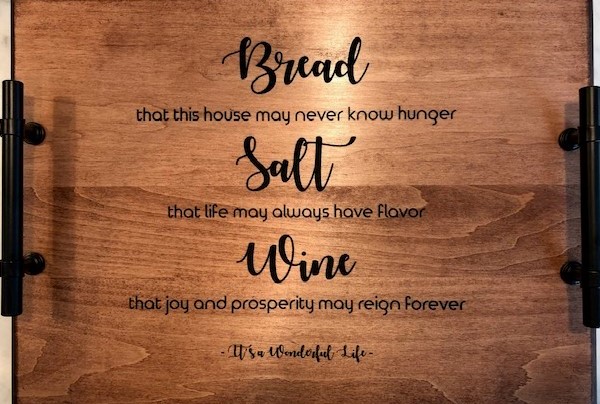
If you’ve spent any time watching the Hallmark Channel this season (and… sigh… a ranking of those Christmas movies can be found here), you owe it to yourself to also watch at least one of the three movies I highlight above.  Hopefully you’re watching them again, not for the first time.  After all, as we learn in It’s A Wonderful Life, there’s much more to bread, salt, and wine than just the title of a blog post.

Some content sourced from the CNN Entertainment article, “Tom Hanks and more stars share their favorite Christmas movies”, and IMDb, the Internet Movie Database.

P.S. I Love You

When it comes to snack foods, I’m not a fan of variations on a theme. Kellogg’s Pop-Tarts debuted in the 1960s with just four flavors: strawberry, blueberry, apple, and brown sugar cinnamon. Today you choose from more than twenty Tarts, including “Hot Fudge Sundae”. The original Triscuit cracker was a baked whole wheat square with a little salt. Today you’ll find a dozen Triscuit flavors on the shelf, including “Fire Roasted Tomato & Olive Oil”. Then we have the Oreo cookie. The original, of course, was two chocolate wafers sandwiching just the right amount of vanilla cream filling. Now Oreo flavors are too numerous to count.  But there’s one you can be sure is a whopping success: pumpkin spice.

 Welcome to mid-September, Americans, and the beginning of our pumpkin spice delirium.  For the next two months you can expect an endless parade of “P.S.” product advertisements.  My wife & I, we’ve already caved to the obsession.  We have a package of “Pumpkin Spice Snaps” sitting on the counter.  We have two leftover pieces of this year’s first homemade pumpkin pie sitting in our frig.  And it’s only a matter of time before my car veers off the road and right through a Starbucks drive-thru for one of their classic P.S. lattes.  (I’ll take a grande, if you please).

My daughter just reminded me Starbucks also brings back their pumpkin cream cold brew this time of year.  That’s a good one too but let’s be real: none of Starbucks’ P.S. offerings should be considered “coffee”.  We buy them for the spice and the sweet, not for the taste of the beans underneath.

Lest you think Starbucks gets the credit for our pumpkin spice mania, the record must be set straight.  McCormick and Company, they of the little red-capped spice bottles, debuted their “Pumpkin Pie Spice” in 1934.  At least three of the following are in the bottle: cinnamon, ginger, allspice, cloves, and nutmeg.  Do I have this spice blend?  Yes.  Do I use it?  Heck, no.  My wife’s family recipe for pumpkin pie contains a different proportion of the individual spices than McCormick’s, which may be the secret to its delectable flavor.  Plus, pumpkin pie is easy enough to make without having the spices combined for you. Dump the ingredients into a bowl and mix well. Pour into a pie shell.  Bake. My kind of dessert.

Starbucks can’t even take the credit for the first P.S. latte.  That accolade goes to Mexico’s Candle Company in 1995.  The Starbucks version debuted eight years later.  But you could argue Starbucks kicked off the forever-trend where we infuse P.S. into everything imaginable, including the good (Krispy Kreme doughnuts, Cheerios, candles) and the ridiculous  (lip balm, deodorant, beer).  As of 2016, “pumpkin spice consumables” accounted for an annual market of over $500M. Yep, we’re hooked.

The “Pumpkin Spice Flavored Creme Oreo” is not even an Oreo, at least not in my pantry.  Nabisco attached the word “Oreo” but c’mon, let’s just admit it’s a seasonal wolf in sandwich cookie clothing.  “Golden” Oreo cookies… with “festive pumpkin spice flavored cream” (and is it cream or creme?)  Nope, the only Oreos in my book are black and white, though I will allow shelf space for the “Double Stuf” variety.

I’m not sure why this topic caught my eye because I haven’t had an Oreo in years.  The last time I did I realized the taste was different from the Oreo of my youth.  The cookies are not as soft, and there’s less cream filling in between (which is like messing with the ratio of chocolate and peanut butter in a Reese’s, a sin for all mankind).  Like the misfortune of many other snack foods though, size and ingredients change for the sake of profit.  And new varieties pop up to keep consumers buying.  At least we’re not talking about the Lady Gaga Oreo.  You’ll need your sunglasses for that one.

Now you’ll excuse me as I head off to a doctor’s appointment.  My drive will take me past several Starbucks, which means I could be caving to my first P.S. latte of the season.  Not that I’m worried about missing out.  As soon as the P.S. season is over I can look forward to Starbucks’ Chestnut Praline latte all the way through New Year’s Day.  Now we’re talking!

Some content sourced from the CNN Business article, “Oreo is bringing back this flavor after a 5-year hiatus:, and Wikipedia, “the free encyclopedia”.

Lost in a Dense Fog

When I first learned to play the piano, it was a challenge to master the weight of the keys. Weighted keys allow the piano’s sound to be louder or softer depending on how hard you press them down. Since fingers vary in size and shape it takes practice before the index and ring fingers (for example) generate the same volume on the keyboard. In hindsight, if I’d chosen the theremin over the piano I could’ve developed the technique much faster because this instrument makes its music without weighted keys. In fact, the theremin makes music without any touch at all.

I should’ve posted about the theremin closer to Halloween because it produces one of the eeriest sounds you’ll ever hear.  Click the red preview button on this list of Theramin Sound Effects and tell me if you disagree. Doesn’t your mind conjure up a ghostly apparition floating in the darkness of a haunted house?  The theremin provides the perfect soundtrack for all things scary. New York Times critic Harold C. Schonberg once described the theremin’s wail as “a cello lost in a dense fog, crying because it does not know how to get home.”  I like that (and it’s much classier than “pig squeal”).

How the theremin creates its unique sound involves too much science to keep your attention today (and more words than I want to type).  Suffice it to say, the instrument has two antennae; a looped one to control volume and an upright one to delineate pitch.  The player’s darting hand/finger movements – touching nothing but the air in between – create its spooky music. 

Now watch the following performance.  Seeing the theremin played is almost as jaw-dropping as listening to it.

I find the theremin to be a fish out of water next to traditional orchestra instruments, yet there are several other weirdos out there.  The bassoon features a tiny mouthpiece attached to a massive piece of black pipe and requires a deliberate overbite to create its nasal tones.  The glockenspiel (which gets points for a fancy name) is really nothing more than a metal xylophone.  The tam-tam is a giant gong, lucky to be struck more than once in a performance.  And the hand saw doubles as a musical instrument when you warp and release the blade (and sounds pretty darned close to the theremin).  But each of these outliers requires physical touch to make their sounds.  The theremin sings with mere jabs of the air.

[Author’s aside:  Every time I write theremin my brain wants to override with Theraflu, the over-the-counter cold and flu medicine (“Discover the Powerful Relief!”)  You don’t find many thera- words in the English language – therapy being the only other one I can come up with.  I’m happy to announce I need neither Theraflu nor therapy at the moment.]

The theremin was invented in the 1920s by Russian physicist Leon Theremin (whose life story involved a lot more than science).  RCA picked up the commercial production rights but the musical instrument never really developed a following.  Instead, its soprano voice showed up randomly in music and movies.  If you recall the Beach Boys’ hit, “Good Vibrations” you should also recall the theramin solo at the end of the song.  You’ll also hear its moan in the opening bars of Fleetwood Mac’s “Little Lies”.  But the theramin seems a more logical fit in the soundtracks of horror and science fiction movies like The Spiral Staircase, The Day the Earth Stood Still, The Thing from Another World, and more recently, Monster House.

My favorite account of the theremin (and with this I close) is a collection of melodies recorded and blasted into outer space back in 2001.  The effort was an attempt to communicate with other worlds, including Gershwin’s Summertime and Vivaldi’s The Four Seasons.  The name of this collection? First Theremin Concert for Extraterrestrials.  Seriously?  We chose the theremin?  Wouldn’t these classics have sounded a whole lot smarter on the instruments they were originally written for?  No wonder the (more intelligent) races out there haven’t stopped by our little planet to say hello.

Some content sourced from Wikipedia, “the free encyclopedia”.

Adding Fire to the Fuel

When I step up to the counter at Starbucks for my favorites (hot: Grande Flat White, cold: Grande Cold Brew w/ a splash of cream), I find it interesting how accepting I am of the high price of my purchase. By nature I’m a penny-pincher, monitoring the family budget with a fully-focused microscope. But the scan-and-go Starbucks app makes it easy to overlook the five dollars for a single cup of coffee. On the other hand, a gallon of gasoline for the same price is literally headline news.

I don’t wonder if you’re just like me at the gas station these days because you are. When you pull up to the pump you try to ignore the unbelievable digits on the station sign and on the pump itself.  The tank in your vehicle is probably closer to “E” than usual (though my wife still refuses to go below the quarter mark).  You may even shop around now before choosing your station.  Finally, the price of your favorite octane has you considering a cheaper option, even though none of them are really “cheap”.  Just like the Starbucks menu, purchasing gas is no longer the mindless decision it used to be.

$5.00/gallon. Ten days ago the U.S. hit that preposterous average for the first time in its history.  Just two months ago the average was $4.00; two years before that, less than $2.00.  Forecasters say we’ll see a nationwide average of $6.00 before the end of the summer.  No wonder our fiery conversations are all about fuel these days.

When my car’s “low fuel” light pops on (with an annoying “DING!”) I know it’s going to take eighteen gallons to get the needle pointing back to “F”.  That’s $90 in June 2022 math.  When a stop at the gas station sets you back almost $100, you start to think about what else you could buy with the money.  Four or five dinners out.  Ten months of Netflix.  Twenty Starbucks Flat Whites.

If it’s any consolation, at least we’re talking about self-service gasoline here.  Some of you are too young to remember when a “gas station” was a “service station”.  Prior to 1980, it was all about full service.  I can still hear the ding-ding as the wheels of my parents’ car passed over black hoses, triggering the bell to let the attendant know they needed a fill-‘er-up.  Then he (yes “he” because I never remember a “she” working at service stations back then) would run over to the pump, ask what octane and how many gallons, and start the filling.  He’d also ask you to “pop the hood” so he could have a quick look at the oil, washer fluid, and engine.  Finally, he’d give your front windshield a wash, take payment (in cash, of course), and off you’d go.  For all that service, you simply rolled down the driver’s-side window and paid the man.

Full-service is still a thing of course but it’s a lot harder to find these days.  Unless you live in Oregon or New Jersey.  In those states, self-service is rarely an option.  Attendants are still the norm.  It sounds like an alternate reality for 2022 (or the scene from Back to the Future below) but two out of the fifty states stubbornly refuse to allow self-service.  They stand by the well-worn concerns: fire hazards, difficulties for the elderly or disabled, and loss of station attendant jobs.  They also charge a few pennies more per gallon because they can’t make a profit the way they used to – by offering services beyond the gas itself.  For the most part, those under-the-hood services moved to car dealerships a long time ago.

Just this week our politicians proposed a three-month “holiday” on gas taxes (and taxes on gasoline should be the subject of its own blog post).  The holiday won’t happen, though.  Our politicians won’t allow the sacrifices made by not collecting those taxes.  Or activists will wonder if gas companies will maintain the high prices and generate additional profit.  And if gas is on its way to $6/gallon anyway, it’s kind of like adding a new lane to the highway, where by the time it’s finished the traffic has increased too much to notice any difference.

Not speaking for other countries but Americans won’t be driving less in the next several months.  The travel forecast calls for more vehicle miles than even in the summers before COVID.  Our lack of efficient mass transit and our woes at the airport (can you say, “canceled flight”?) will, uh, drive us to drive.  In other words, we’ll pay $5, $6, maybe even $7 before we’ll pull back on our stubborn habits.  Just like I will, admittedly, at Starbucks.

Some content sourced from the CNN Business article, “Why New Jersey and Oregon still don’t let you pump your own gas”, and Wikipedia, “the free encyclopedia”.