Behind Bars

Every now and then I crave a Kellogg’s Frosted Brown Sugar Cinnamon Pop Tart. You can debate the matter and say the fruit Tarts are better – Strawberry, Cherry, and Blueberry – and I’ll give you those, but I stand by my boring-looking Brown Sugar Cinnamon. Maybe that’s because I consumed hundreds of them as a kid, piping hot from the toaster.

Somehow Pop Tarts eluded the otherwise healthy content of my mom’s pantry.  You’d walk in to dozens of those little red boxes of raisins, a pretty good assortment of nuts (which were more meant for recipes than snacking), and the occasional graham cracker.  The fruit and veggie drawers in the frig were loaded and there was always a gallon of milk on hand.  Yet there they were, in foil-wrapped packages of two: Kellogg’s Pop Tarts.  I wish I could see the ingredients list from the 1970’s versions versus those of today’s Tarts.  Surely the former leaned more towards “real food” and less towards chemicals, or my mom would’ve never gone for them.

Pop Tarts now come in twenty-seven varieties, which by any standard is ridiculous. Who wouldn’t be happy with the four I already mentioned? (Okay, let’s add Frosted Chocolate Fudge and call it good).  Do we really need options like “Wildlicious Wild! Cherry”, or “Confetti Cupcake”? Apparently so, because that’s where our demand for choices has taken us. The new approach to snacks: invent one, sell enough to get them into everyday conversation, then evolve to twenty-seven varieties.  Have you seen your options with Oreo’s these days?  I rest my case.

The other day I traveled down the cereal aisle of our grocery store for the first time in a long time (we have house guests). I was shocked to discover the “healthy cereal” section is just as big as the space reserved for regular cereals. Even more interesting, the overhead signs on the aisle first announce “Cereals”, followed by “Granola” a little further down, followed by “Diet and Fitness” a little further than that.  The entire aisle feels like the same kind of food, only you start with boxes, morph to bags, and end up with little bars.  I’d love to know the combined total grams of protein in the products in the “Diet and Fitness” section.  Gotta be ten thousand or more.

Fun facts: Americans now choose from over 400 brands of “healthy” bars, in 4,000 varieties.  At $6 billion in 2012, the healthy bar market was only 17% as big as that of savory snacks ($34 billion) but growing in a hurry.  American children consume almost 500 calories a day in snacks.  The routine starts when we’re young.

Snack bars seem to be almost-entirely carbs or almost-entirely protein. I won’t comment on the first variety because I don’t eat them (I’ve moved on from Pop Tarts), and I don’t even see the carb variety because our store puts them over in the cookie aisle. But protein bars are a challenging enough decision. For starters, are protein bars a “snack” or a “meal”? Many are advertised as “meal-replacements”. Others look small enough to be snacks. Even the ever-present “Nutrition Facts” label doesn’t really lend a hand, except to confirm you’re taking in more calories and sugar than you’d hoped.

I belong to Lifetime Fitness here In Colorado, a gym which stresses “healthy lifestyle” in everything they offer, whether personal training sessions, workout classes, spa treatments, or a cafeteria full of healthy choices. The mantra I hear like a broken record: “carb-up” at least an hour before the workout; “protein-up” within 45 minutes after. I’m sure some would dispute that approach, but regardless, it suggests a “snack” before AND after a workout.  And as I stand in “Diet and Fitness”, I ask myself, “Is that snack half of a “meal-replacement” bar?  Two or three of the “fun-size”?  Scrap the whole aisle and go with fruit and cheese instead?”

For my money, snack bars before and/or after a workout neither benefit the short run nor ease the long run. It’s kind of like my daily multi-vitamins: no clue whether they help me either (but I still take them). This much I know: I need to have a somewhat full stomach before I work out. On that note, maybe I’ll just skip the “Diet and Fitness” aisle from now on and go back to Pop Tarts.

Some content sourced from the Wall Street Journal article, “Our Misplaced Mania for ‘Healthy’ Snacks”.

Creatures of Habit

WHAT IF Starbucks decided to close its stores for a whole day? Imagine, you’re driving to work with early-morning brain fog, you pass by the most convenient Starbucks, and from the street you see a big “CLOSED” sign behind the glass.  Not to be denied, you head for the drive-thru, but your access is blocked by green cones (everything matches at Starbucks).  You’re still in denial, so you pull into a parking space, get out of the car, and peer through the darkened windows. Horrors. Your 7×24 caffeine-addiction fixer-upper (well, almost 7×24, but who craves coffee at 3am?) has taken the day off.  Are you getting a case of the jitters just reading this paragraph? Is this a Catch-22, because you can’t think up another coffee option until you’ve actually had your morning coffee?

We had a little “sip” of this scenario earlier this week, didn’t we?  For reasons that were relevant-today gone-tomorrow (maybe), Starbucks took the high road and delivered several hours of anti-bias training to its employees, closing 8,000 locations in the process.  For one interminably-long afternoon and evening on Tuesday, you had to search a lot harder to find your grande no-whip Caramel Macchiato.  When Starbucks’ announcement lit up the front-page headlines last week, my first thought wasn’t, “the lines are about to get longer at the bathrooms” (though admittedly, it’s a legitimate concern since I’m a man of frequent visits), nor was my first thought, “we’re about to see a lot of, uh, interesting people at Starbucks now” (because we already do, don’t we?)  Rather, my thought was, “how the heck are we gonna cope with several hours of no-Starbucks, when 100 million patrons – you read that right – frequent their stores every week?”

In a related headline, an economist claimed this one-time Starbucks shutdown would cost the company $12 million and be a boon for “coffee competitors” like McDonald’s and Dunkin’ Donuts.  Laughable.  I know those restaurants have their fair share of coffee allegiance these days – if you consider “fair share” less than 1%.  No, the world didn’t rotate off its axis on Tuesday, but I also won’t promise patrons didn’t line up at the Starbucks drive-thru hours before the open on Wednesday morning.  Our Starbucks habit was ingrained at an early age, well before the competition stepped up.  Howard Schultz is a genius.

More likely, the impact of Tuesday’s shutdown is what I refer to as the “Chick-fil-A effect”.  If you’re a fan of CFA, you’ve known from the get-go their stores close on Sundays.  It’s a simple building block of the founder’s philosophy: CFA employees should spend their Sundays resting and at worship, with family and friends.  Now, you might pass Chick-fil-A on a Sunday and think, “Closed.  What a nice gesture – more companies should do that.” But I’m pretty sure you’re actually thinking, “Damn – I was really craving a #1 meal, hold the pickle, w/ lemonade”.  And that thought will stay with you until Monday. And Tuesday, And Wednesday, or whatever day you next pass by Chick-fil-A.  Maybe their alt-slogan should be, “Closure Makes the Heart Grow Fonder” or something like that.  It’s as much a business strategy as a thoughtful benefit for CFA employees.  On that note – trust me – Starbucks will make up Tuesday’s lost business by the time I hit the “publish” button on this post.

Nothing Bundt Cakes (“Home of the Most Delicious Bundt Cakes Ever!”) is kinda sorta the same animal as Chick-fil-A.  For reasons suspiciously vague, NBC allows its franchisees the option to close on Sundays.  Google your NBC’s hours before you head over for a white chocolate raspberry bundt or a lemon bundtlet.  The next time you find their doors unexpectedly locked, I predict your dreams will be relentlessly invaded by dozens of little flying bundtinis – at least until you satisfy your craving with a purchase.  Don’t say I didn’t warn you.

Here’s the irony about today’s musing: I’m typing my post from a Starbucks.  I’m sitting quietly at a table, enjoying a grande cold brew with a touch of cream.  The baristas are unusually perky (surely a side effect of their recent training).  The restaurant feels quiet and “inclusive”.  In other words, I didn’t cry over spilt coffee on Tuesday. Instead, I just proved my theory.  a) Tuesday afternoon I couldn’t go to Starbucks.  b) I wasn’t even planning to go.  c) The store closures were in the headlines, which inserted “caffeine denial” into my brain.  d) Here I am, just two days later, getting my Starbucks on again.

Touché, Mr. Schultz.

The Life of Spice

“Mikey’s Late Night Slice” in Columbus, Ohio, offers a pizza called “Fiery Death with Hate Sausage”, topped with three of the world’s hottest peppers: Carolina Reapers, Trinidad Moruga Scorpions, and Bhut Jolokias.  You must sign a waiver before Mikey’s serves you a slice of Death, acknowledging, “you’re an idiot”, and absolving the restaurant of any responsibility for the unpredictable aftereffects.  According to one taster, “It was pretty miserable.  My eyes welled up, my nose ran, and no drink could wash away the pain.”  Sounds like my kind of heat.

Photo by “Mikey’s Late Night Slice”

It all started with the tabletop pepper shaker. Salt’s brother-of-another-color stood quietly to the side in my childhood, hoping for the same constant attention given to his savory companion. If pepper was used at all in my day, it was nothing more than an obligatory shake; a decoration of the food versus a yearning of the taste buds.

Forty-odd years later, the pepper mill has become the king of the spice rack – my go-to final flourish before deeming a meal ready-to-eat. My pepper mill is always cranked to the furthest setting to the left, so the dozens of corns fall out of the bottom virtually intact. When I refill my pepper mill and spill a few of the little guys onto the counter, I scoop them up and pop ’em into my mouth like candy.  My family has learned to pass the pepper before I even ask for it.

I blame my parents, of course (something I seem to do with increasing frequency these days). My dad peppered everything on his plate – still does – and kept shaking away until his food literally disappeared under a blanket of black. My dad was the guy at restaurants who mercilessly trapped the poor fellow who politely asked, “would anyone like ground pepper”? My dad would always add, “you can be generous…”, and several minutes of grinding ensued.  My dad also had violent (but apparently enjoyable) fits of sneezing, sometimes seven or eight in a row.  I never made the association with pepper, but now I wonder.  I can still hear him concluding a sneezing session with the word “marvelous“.

My mom, who graduated from the Emily Post School of Etiquette with honors, commanded a family dining table to rival the tightest ships.  Every placemat, utensil, plate and bowl were in perfect symmetry.  The meal began with a table grace, and concluded with “please may I be excused?” In her world, “please pass the salt” meant passing the salt along with the pepper shaker, and with two hands instead of one so you couldn’t eat at the same time. Thus, the pepper arrived at my plate whether I wanted it to or not.

Sometimes I think my hankering for pepper is borderline-addictive.  Eventually the “shaker” no longer sufficed, as the pepper only came out in little bits.  Once I discovered the “mill”, there was no going back.  A handful of turns became ten, then fifteen; my food turning as dark as my father’s.  As it turns out, pepper was my gateway spice.  In the last several years I’ve discovered “red pepper flakes”; a significant leap in heat from peppercorns.  I used to shy away from those little plastic vials they include with pizzas.  Now I ask for two or three more.

Lucky for me, pepper (and all things spicy) appears to be a healthy habit.  According to an article by Dr. Joseph Mercola – an osteopath and proponent of alternative medicine – a full ounce of pepper provides most of the manganese, Vitamin K, and potassium we need in a given day, and even a good dose of iron or fiber.  Mercola then missteps when he acknowledges “…it’s true one would not have that much pepper in a day…”  Apparently, he hasn’t met me.

Pepper is described as a “stealth antioxidant”, discourages intestinal gas from forming (no wonder my wife peppers my food), and somehow aids in the breakdown of fat cells.  Finally, black pepper has much in common with cannabis, with aroma molecules functioning as “cannabinoids”.  To be clear, we’re talking about the therapeutic benefits of cannabinoids here.  Pepper isn’t playing with my brain cells (I don’t think), but it does help to reduce inflammation.

My children are destined to a life of pepper – I’m sure of it – and not because I turn my food black like my father or pass the shakers as a pair like my mother.  In high school, my daughter prepped for her team’s volleyball matches by “peppering” with another player (hitting the ball back and forth to warm the hands).  Now, she carries pepper spray in her purse.  One of my sons went to college in Waco, TX, where Dr. Pepper was invented in 1885 and vended on campus without a Coke or Pepsi in sight.  More recently, I’ve seen my children reach for the hot sauce (instead of the mild) at Mexican restaurants.  You see, it creeps up on you quietly.  Next thing you know they’ll be asking me to take them to Mikey’s Late Night Slice.

Dream Puffs

Last year, Starbucks surpassed Subway as America’s #2 restaurant, measured by gross sales (McDonald’s is still top dog).  I don’t consider Starbucks a place to “dine”, so second-place is impressive.  Then again, Starbucks’ bakery case has matured since its initial offerings.  There are temptations-a-plenty now, en route to the barista.  The traditional breakfast items share space with yogurt parfaits, fruit-and-cheese boxes, “fold-over” sandwiches, and entree-size salads.  But it’s the smaller offerings I want to talk about today.  Look closely through the glass – you’ll see sous vide egg bites and Bantam’s bite-sized bagels.  Those little guys could be the future of fast food.

egg bites

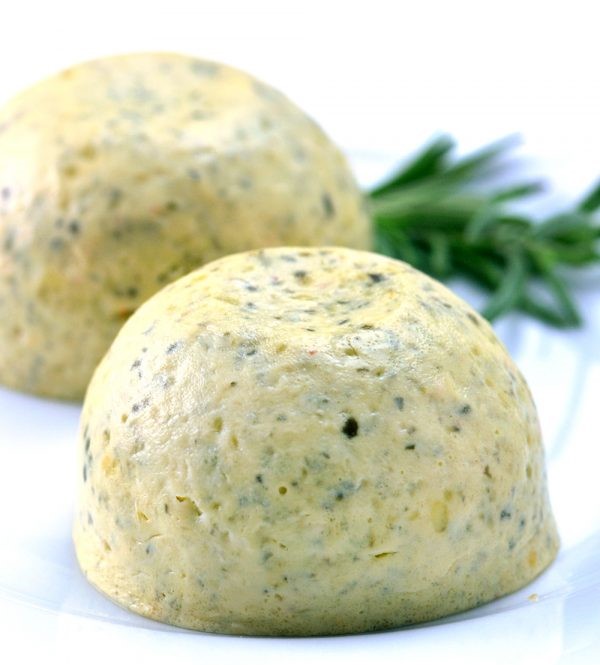
I haven’t tried the mini bagels, but Starbucks wins me over with its egg bites.  The first time I gave them a whirl, my wife and I were in the middle of Lent, trying to find alternatives to the foods we gave up.  Egg bites to the rescue.  The sous vide prep means cooked in water, with nothing but a bit of spinach, red pepper, and cheese mixed in for flavor.  Simply elegant (elegantly simple?), and the light, fluffy texture makes them as delicious as they are convenient.

Three Little Griddles
Æbleskiver

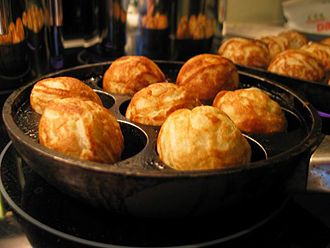
Now let’s talk about real breakfast foods.  Last weekend, my wife and I went to a nearby restaurant called Three Little Griddles.  Much to my delight, Griddles had Æbleskiver on the menu.  If you’re Danish, you already know what I’m talking about.  Æbleskiver is heaven-sent breakfast: puffy little balls of pancake with a sweet surprise in the middle, finished off with a delicate dusting of powdered sugar and a side of raspberry jam.  Æbleskiver is Danish for “apple slices”, but you’re more likely to bite into a strawberry or a fruit-compote filling instead.  Three Little Griddles also offers Æbleskiver with an egg/bacon filling, coated with a maple-syrup glaze and powdered sugar.  A complete breakfast!

NOT Æbleskiver

If you haven’t heard of Æbleskiver and the first thing you thought of was “doughnut hole”, shame on you.  Doughnut holes don’t even qualify as poor man’s Æbleskiver.  Doughnut holes are a clever product designed to get you to buy more when it appears you’re buying less (think “fun-size” candy bars).  I have two issues with doughnut holes.  One, they’re not actually the “hole” of a solid doughnut, but prepared and baked separately instead.  Two, they’re not shaped like a doughnut hole should be (picture it – something more like the hub of a wheel).  They should be called doughnut balls.  But enough of this talk; I’m wasting words.  Let’s keep the focus on Æbleskiver.

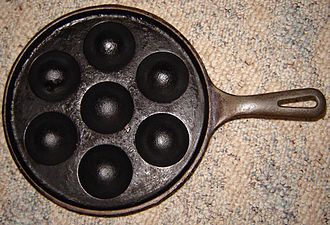
My first taste of Æbleskiver came when I was little, in the Central California village of Solvang.  Solvang is like, well, a kid’s “Little Denmark” – a town small enough to walk around, with an overabundance of shops selling toys, candy, and ice cream.  Several windmills spin slowly above Solvang’s high-pitched shingle rooftops.  A church sits prominently on the edge of town.  A small park serves as the town square, complete with a bandstand-sized gazebo.  All that’s missing is some water-filled canals and cobble-stoned streets.  But meanwhile, there’s plenty of Æbleskiver.  Some restaurants even bake them out on the sidewalk, rotating those little dream puffs to perfection in their unique iron skillets.

If you credit the Danes with the invention of ball-shaped food, the rest of the world takes a distant second with its imitations.  China makes a spherical egg-based fruit-filled waffle called Gai Daan Jai.  Japan makes a variety of savory ball-sized snacks called Takoyaki. (Savory? Yuck.)  And America makes doughnut holes called Munchkins.

As if Æbleskiver isn’t cool enough as a food, it’s also a cool word with a unique spelling (note the “letter” Æ).  Perhaps Starbucks will start carrying it, along with the egg bites.  I’d buy both and a coffee for a complete breakfast.

Finally, if Æbleskiver has you wondering what other delights Denmark has to offer, consider ÆblekageÆblekage is “apple charlotte” – stewed sweetened apples layered with butter-roasted bread crumbs and crushed makroner (an almond-flavored meringue), topped with whipped cream and red currant jelly.  Oh my; sounds like dream stuff.

Æblekage

Some content sourced from Wikipedia, “the free encyclopedia”.

Save the Bowl

Back in the 1980’s, Hollywood produced an awful movie called “The Stuff”.  The story began with a couple of miners discovering a pasty-white goo pouring forth from the earth.  Giving it a taste, they realized it was not only edible, but the more you ate the more you seemed to want.  So, they package the goo, brand it “The Stuff”, and begin selling cartons to the masses.  Turns out – besides tasting good – “The Stuff” melts your brain, turns you into a zombie, and leaves you with nothing but an insatiable appetite for more.  That’s the entire comedy-horror plot, save for an FBI agent and a teen trying desperately to rescue the planet.  “The Stuff” was like a light/airy “Invasion of the Body Snatchers”: no taste and little substance.

Even a “distasteful” movie can be a prophecy, however.  Maybe you’re craving “The Stuff” after reading that paragraph.  Guess what?  It just may exist, disguised as the pint-sized “ice cream” products from Halo Top, Arctic Zero, Enlightened, and others.  All available this very minute at your local grocery store!  What are you waiting for?

Halo Top (HT) is – in one aspect – the dream dessert.  Halo Top is a full pint of ice cream (per the label – four servings), engineered to be consumed straight from the container in one sitting, but with none of the guilt/gluttony associated with full-fat competitors.  HT can’t hide its pride – the biggest lettering on the container is the calories (just 280 for the whole pint; 25% of Ben & Jerry’s), while elsewhere the packaging promotes immediate and total consumption with slogans like “save the bowl” and “stop when you hit the bottom”.

On the other hand, Halo Top is not dream-tasty.  Some describe HT as “shaved ice” while others say it leaves a chalky aftertaste (hello, stevia).  The chocolate-chip cookie dough has very little “dough”, and the cookies-and-cream has no cookies.  Every review I found recommends time at room temperature to achieve a more ice-cream-like consistency.  On a recent visit to the grocery store, I “hefted” one of these pints.  It was hard as a rock, yet somehow so light/airy it felt like a little helium balloon, ready to ascend from my grasp.

Here’s the real wonder to me: none of the above gotchas stop consumers from filling their baskets with Halo Top pints.  Last year’s sales were over $350 million, a 500% increase from the previous year.  In the same time, “regular” ice cream sales increased less than 10%.  As one consumer declares, it’s a brave new world of ice cream – quantity over quality.

What I find most disturbing about Halo Top and its peers is the manufacturer’s intent.  They’re effectively encouraging you to clean your plate by design.  Four servings make more sense than one because you should eat the whole pint.  Whether you’ve already quenched your appetite is irrelevant; it’s about getting to the bottom of the container.  Arctic Zero claims “…our love of ice cream runs deep, like eat-the-entire-pint-deep.”  Enlightened even offers how-often guidelines.  In their website FAQ’s, we’re told ice cream is not just for dessert: “Not at all! Low in calories, fat, and sugar, and packed with protein and fiber, Enlightened Ice Cream is truly good for you. It can be enjoyed at breakfast, lunch, and dinner… or anytime in between!”

Let’s translate the “more is better” concept to the movie theater.  If we drop the guilt factor from junk-food concessions, we could sell popcorn in containers the size of trash cans.  Soda could be hosed to each theater seat for hours of non-stop slurping (restroom logistics aside).  String licorice could be coiled on floor-mounted reels.  M&M’s could be the size of hamburgers.

We’ve just about come full-circle here.  If all of us binge on Halo Top, honing our full-container consumption habits for breakfast lunch, dinner, “and anytime in between”, haven’t we created a modern-day version of “The Stuff”?  All that’s missing is the magic ingredient in Starbucks and Chinese food that triggers “I want more”.  As for me, I’ve never tried any of the products I’ve talked about today, nor do I intend to.  I’d rather not become a zombie.

Some content sourced from the Wall Street Journal article Can’t Stop, Won’t Stop…“.

Precisely Enchanting

If you watched any of the Winter Olympics the past couple weeks, you witnessed dramatic moments only the Games can deliver.  Some literally took my breath away: the edge-of-your-seat overtime shootout in the women’s hockey final (a 3-2 win by the Americans); the exquisite battle for gold between the highly-touted Russians in women’s figure-skating; and the first-ever victory for the U.S. in the team sprint of women’s cross-country skiing, where Jessie Diggins’ come-from-behind lunge at the finish line took the gold by 0.18 of a second.


Consider “0.18 of a second” (for a second).  The blink of an eye takes twice as long.  Now consider measuring 0.18 of a second.  Remarkably, we’ve had the technology to do so since the 1950’s.  For the Olympics, that precision was provided by Omega, the watch manufacturer from Switzerland.  Of course the timekeepers were Swiss.  What other country is so renowned for the keeping of time?  What other country coordinates forty-six individual railway companies on a single network of tracks, bringing its trains into the stations on-time every time?  Where else in the world would you feel more confident banking your cash?  Six years ago, Omega developed technology capable of measuring one-millionth of a second.  At the Pyeongchang Olympics they used a photo-finish camera capable of ten thousand snaps per-second.  The Swiss redefine “attention to detail”.

I’ve had an affection for Switzerland from a very young age.  As a kid, my introduction took place in subtle ways.  Shirley Temple’s “Heidi” was based in Switzerland. The Switzer brand of red/black licorice (still available in “vintage” candy stores) was a frequent purchase.  The cute little Swiss Miss in our pantry beckoned me to hot chocolate.  As a Boy Scout, I always carried one of the Victornox Swiss army knives.  At Disneyland I roller-coasted through a scaled-down replica of the Matterhorn – one of the Alps.  I had my first taste of fondue.  And for a Suisse exclamation point, I consumed a ton of that “holiest” of cheeses.  My ancestry test should’ve produced a little Swiss DNA, don’t you think?

As an adult, Switzerland’s products are no less present in my life.  Lindt is my favorite chocolate (and I’ve tried my fair share of chocolate). A Rolex watch is still the material equivalent of corporate-America success (though my tastes are more modest – perhaps a Swatch [Swiss-watch]?)  Velcro can be found on several items in my wardrobe.  Haagen Daz is my favorite brand of ice cream (a product of the Swiss company Nestlé).  And a lengthy search for “adult” Swiss licorice led me to Chateau D’Lanz, a family-run business in Washington state producing some of the best.

Speaking of Nestlé, the Toll House chocolate-chip cookie recipe is also one of my favorites. Here’s a bit of trivia: Toll House was an inn in Whitman, Massachusetts.  Ruth Graves Wakefield is credited with inventing the chocolate chip cookie (by mistake) somewhere nearby the Toll House.  The price Nestlé paid for the right to Ruth’s recipe? A lifetime supply of Swiss chocolate.

Now speaking of Velcro, here’s another bit of trivia.  George de Mestral was a Swiss engineer and amateur mountaineer from the 1940’s. Hiking in the Alps one day, George noticed seeds kept sticking to his clothes and to his dog’s fur. When he returned home, George developed a synthetic “sticking” technology like what he’d found in nature; a hook-and-loop zipper alternative eventually patented as Velcro. The clever name is a child of the French parents velours (velvet) and crochet (hook).

Okay, we’ve covered Swiss precision and some world-class products, but I haven’t addressed what makes Switzerland so fetching.  How’s this for starters: the entire country can fit within the greater Dallas/Ft. Worth area.  Bordered by France, Italy, and Austria, the Swiss are typically fluent in French, Italian, and German; as well as their home-country language of Romansh.  Switzerland produces some of the best in skiing, snowboarding, and mountain-climbing (of course), but also tennis? (hello, Roger Federer).


Here’s some more Swiss charm.  The colorful Guards in the Vatican City are the only foreign military service permitted to its citizens.  Switzerland’s “non-interference policy” dictates its only participation in foreign wars is typically through the high-profile benevolence of its Red Cross organization.  And citizenship in this fair country?  You’d better hope you have blood ties through birth or marriage.  Otherwise it’ll take twelve years of a special-residency permit, combined with a long-term work visa.

Despite my obvious affection, I should probably stay away from precisely enchanting Switzerland.  It’s a real country like any other after all, which means not everything comes up roses.  Perhaps I’ll cling to my snow-globe impression of the Suiss Alpenland instead: a gentle people living high on the Happiness Scale; the cleanest and quaintest cities imaginable; cobble-stoned streets and chalet-like houses.  The magnificent Alps serve as the backdrop, their slopes ascended by rickety cog railways and descended by skillful skiers.  Listen for an accordion or a little yodeling.  Look carefully enough into my globe and you might even notice the von Trapp family, marching down the mountain trail from Austria, singing their do-re-mi song.

Some content sourced from Wikipedia, “the free encyclopedia”.

Crafts of the Hand

Several months ago, my wife and I went to dinner at one of our favorite Mexican restaurants – a place we frequent every few weeks.  As we pondered margarita options, we asked the waiter for an order of table-side guacamole, a delicious specialty and a great way to kick off the meal.  Much to our disappointment, our waiter informed us we could no longer get guac table-side; rather, it would come already prepared and straight from the kitchen.  Sigh.  Add another item to the demise of handmade food and beverages.  Rekindle the pour-over argument.

What’s the “pour-over argument”?  It’s perhaps the most contemporary example of the struggle between handicraft and automation.  At your local coffee bar, most drinks are poured-over, meaning individually-prepared using a single paper filter, adding the coffee grounds and finishing with a slow pour of the water.  If your coffee arrives with foam-art, consider it a pour-over.  The argument asks whether it’s worth the wait for an individually-prepared coffee, when a large-batch machine can produce the same result in a fraction of the time.  One estimate claims large-batch can produce 100 coffees in an hour, while a barista creates less than ten.

I’m not here to defend the pour-over, but simply to discuss it.  In fact, my first thought when I heard “pour-over” is what you see in the photo above.  Admittedly, I love the speed and consistency of Keurig’s K-Cup’s, and I’m an unashamed frequent-flier at Starbucks.  But that’s not to say there’s not a chair at the table of life for pour-over’s.  Even if the quality of handmade can’t be distinguished from large-batch (taste test, anyone?), what about the calm of watching “drink-art” creation, and the opportunity to socialize with the barista?  Perhaps it’s the fringe-benefits making pour-over’s the healthier option.

Table-side guac is just one example of “pour-over’s” threatened by today’s demand for speed and efficiency.  If I ask you to think of a product previously handmade but now produced by automation, I’m sure you can name several.  Milkshakes. Beer. Even pizza, which can now be prepared start-to-finish by a robotic chef.  But the flip-side of robots is advertisement focused on food-prep the old-fashioned way.  “Handmade” milkshakes.  “Craft” beers.  “Fresh-squeezed” lemonade.  And pour-over coffee.

Business’s bottom line loves the idea of automation.  Labor is typically your most expensive line-item, so who would argue with removing it?  Well, maybe those willing to pay for the experience.  At your finer restaurants, you can still find table-side salads (Caesar), entrees (Chateaubriand or Steak Tartare), and flaming desserts (Baked Alaska, Bananas Foster, Cherries Jubilee).  At Sunday brunches you can still enjoy made-to-order omelettes and waffles.  With those examples, I’d argue you’re not just paying for the food.  You’re also paying for a slow-down moment: a chance to enjoy a chef-artisan do his/her thing while engaging in a little conversation. As a recent Wall Street Journal article puts it, “[pour-over]… is more about delivering peace in a fast-paced time”.

Here’s my plea.  The next time you’re having something prepared in front of you – whether a simple burrito at Chipotle or an elegant Steak Diane adjacent to your white-clothed table, put away the phone, take a deep breath, and just enjoy the moment.  Have a chat with whomever is preparing your meal.  It’s an experience worth poring over.

Sweet Charity

Several times during the recent year-end holidays, I passed through the drive-thru at Starbucks, and as I paid, I asked the cashier to include the purchases of the car behind me. I’ve been participating in this Starbucks-wide trend for several Christmases now, and it brings me an inexplicable feeling of goodwill and satisfaction.  The goal of the effort is anonymity. Or to put it more comprehensively, blind faith.

Blind faith is defined as “belief without true understanding, perception, or discrimination”.  That’s powerful.  “Faith” is a spectrum that starts with basic trust and ends with the highest forms of religion.  But add on “blind” and it elevates the meaning.

Buying a free cup of coffee at Starbucks is the easiest form of blind faith, like handing over a dollar to a beggar.  No judgment as to “what happens next” allowed.  But the intention behind an act of blind faith is worth a bit of exploring here.  Dissecting my Starbucks gesture, I note the key components.  First, I don’t waffle over the amount of the purchase I’m covering.  That’s the blind faith in choosing to pay in the first place – it shouldn’t matter how much.  One time I looked in the rear-view mirror and saw a car with four passengers.  Their bill was well over $20.  But my decision had been made before the car even pulled up behind me, so the point was to stick with it.  Another time my recipient was a well-dressed woman wearing sunglasses and driving a recent-model BMW.  Again, no judgment.  Pay for her coffee and move on.

The second component concerns my “getaway”.  As I’m waiting for my own purchases I’m considering my escape route – the path that gets me away from Starbucks as quickly as possible, with enough turns and traffic lights to deter my beneficiary.  My goal is to remain anonymous, and unless the person behind me memorizes my license plates (or something else unique about my vehicle), I’ve achieved a moment of goodwill and will never see them again.  Frankly, it would spoil the whole effort if the car pulled up next to me at a nearby red light.  They might offer their gratitude, or they might offer to pay me back.  They might even be annoyed, as if I had no business intruding on their “personal life”.  I’d rather not know.  I prefer to lean on blind faith that I brought an unexpected smile, or delivered a tiny give-me-a-break in an otherwise trying day.  Maybe they’ll even “pay it forward”, as a string of 374 consecutive cars did at a Starbucks in Florida back in 2014.

Come to think of it, there’s a third component in the Great Coffee Giveaway.  Never expect the gesture in return.  In the countless times I’ve driven through Starbucks during the holidays, I’ve never thought to myself, “I hope the car in front of me picks up the tab”.  If I knew this was happening, I might just order a half-dozen breakfast sandwiches and several cake-pops to go with my Flat White.  Just kidding, of course.  I hope the thought never crosses my mind.

This week and last – no surprise here – I’ve read dozens of blogs about resolutions for the New Year.  Allow me to contribute my one-and-only.  I’m going to lean on blind faith in the coming year, whenever I have the chance to give someone a break.  Remember the rules: 1) No conditions on the amount (read: cost) of the help.  2) Keep it anonymous, as a) recognition defeats the spirit, and b) giving simply for the sake of giving might inspire “pay it forward”.  3) Don’t expect a similar gesture in return.  That’s not to say you won’t be pleasantly surprised when someone buys your Starbucks coffee one of these days.  You’ll just know there were no hidden agendas.


Your True Love’s a Nut Job

Each Christmas season (which translates to every waking moment from Thanksgiving to the New Year), I’m fascinated we still sing “The Twelve Days of Christmas”. I feel like a character in the Dickens world of Scrooge and Tiny Tim as I labor through the verses (ditto “Here We Come A-wassailing”).  I should sing with an English accent.  More to the point, I question the TDoC lyrics.  What other context do we have for turtle doves and calling birds?  What’s with the gold rings?  Don’t we owe it to ourselves to understand more about a carol we’ve been singing for over two hundred years?

Depending on the source, “The Twelve Days of Christmas” was either a) written as a children’s book – which eventually morphed into a song, or b) “code” for memorizing elements of Christian religion at a time when faith could not be openly practiced.  I prefer the latter.  For example, the two turtle doves represent the New and Old Testaments of the Bible, while the four calling birds represent the gospels of Matthew, Mark, Luke, and John.  The six geese represent the days of creation (“and on the seventh day He rested”), while the eleven pipers represent the faithful disciples of Jesus Christ.  “My True Love” is Jesus himself.  Clever, no? (see here for the full “code”).

Wikipedia claims “the exact origin and meaning of the Twelve Days song are unknown…” so perhaps we should just leave it buried in the past.  But I can’t do that.  TDoC is so much more fun if you take the literal approach to the words.

The title is innocent enough.  “The Twelve Days of Christmas” equals Christmastide, a season of the liturgical calendar in most churches.  Christmastide begins on December 25th and lasts until January 5th (the day before the season of Epiphany).  Twelve days.  That’s even more celebrating than Hanukkah.  Fine with me – our family likes to drag out Christmas as long as possible.

Beyond the title however, “The Twelve Days of Christmas” descends into total chaos.  Consider the structure of the carol.  TDoC is a “cumulative” song, which means you add the previous verse to the one you’re singing – just like all those animals in “Old MacDonald Had a Farm”.  By the twelfth verse you’re singing about everything, and you’re totally exhausted.  Some people solve the length by having a different voice for each gift.  That’s great for the partridge in a pear tree singer, but kind of sucks for the drummers drumming singer (who only gets one chance to shine).  Make sure you have a solid voice for the partridge in a pear tree.

Speaking of the gifts, let’s do some analysis.  Other than the rings, your true love has an obsession with birds.  He or she is gifting you an aviary on six of the first seven days.  Doves, hens, swans, and more.  Not only that, you’re getting pear trees and God knows how many eggs from those a-laying geese. (Note: pears and eggs make great Christmas gifts).

The final five days, your true love gifts you a bunch of workers and merrymakers for the estate you apparently have.  You’ll gain a herd of cows (what else are those maids a-milking?) and you’ll have a some dancers and a band making quite the ruckus on your front lawn.  The neighbors may complain.  C’mon, you say: how much noise can eleven pipers make?  Eleven?  So you forgot about the aggregate of a “cumulative” song, did you?  Your true love actually gave you twenty-two pipers by the time January 5th arrives… and twelve drummers, thirty-six dancers and thirty guys who like to jump.  And don’t look now, but your twelve pear trees are swarming with 184 birds.  Maybe you don’t have any pears after all.

Sorry, but if this is your true love’s idea of Christmas giving, he or she is a nut job (or at least an animal hoarder).  Here’s my advice: run.  Take your forty gold rings and date one of those lords or ladies instead.

Getting My Juice GONE (p.2)

“Survivor” is reality TV’s longest-running program. “Survivor” is also my new middle name after a vicious three-day juice cleanse last weekend. For my pre-cleanse (sane) state of mind, refer to last week’s Getting My Juice On. For my current (questionable) state of mind, proceed with caution. The words that follow may be the equivalent of the movie scene you wish you never saw; the one still burned into your brain.

The quick recap: my daughter recently coerced my wife and I into trying Pressed Juicery, a hard-core player in the world of retail cold-pressed juice products. PJ offers gentle confections like coconut water with cinnamon, but for the truly gullible (me), they suggest a “cleanse”, where you down 336 ounces of liquid in three days (assuming you include the recommended twenty-four glasses of water). In those torturous seventy-two hours you get nothing else on the menu – no snacks, no bars; no solid food whatsoever. It’s just bottle after bottle of sickly-green liquefied vegetables (with an occasional fruit thrown in, which might as well be a lamb tossed into a pride of lions).

Considering I knew everything in the above paragraph before I took the first sip labels me as some kind of (raving lunatic)? But add my daughter to the equation and my voice goes rogue with, “sounds great, honey!”. Thus last Friday morning at zero-eight-thirty, I took my first sip of the PJ Kool-Aid. Let’s set the table with the scrumptious ingredients. Kale. Cucumber. Romaine. Spinach. Parsley. Lemon. I’d list the rest but I’m about to toss my cookies just thinking about them again (and believe me I’ve had a few cookies since that last fluid ounce).

In the beginning (this is a tale of biblical proportions), I assumed remarkable confidence staring down Cleanse Bottle #1. I consumed its contents in two or three gulps. Not so bad, I thought. Utterly vegetable with a sickly fungal aftertaste, but nothing a glass of water wouldn’t kill. But two hours later (which is a short 120 minutes on a juice cleanse), Bottle #2 came a-calling. This time I’m not so fast. It takes me a good half-hour to drain the contents. Now I’ve got thirty-two ounces of liquified vegetables in my system, which PJ claims is eight pounds of the real produce. That’s rough(age) on a body, and the body doth protest. After Bottle #3 the burps started. After Bottle #4 I enjoyed the occasional dry heave. By Bottle #5 I was asking for Mommy so I could tell her I didn’t want to do this anymore.

Unbeknownst to me (remember, I am gullible), I had created the perfect storm of stomach acids and vegetable puree deep down in my digestive system. Perhaps that’s why Bottle #6 is all almond milk and vanilla. It’s like dumping two cups of Pepto-Bismol over the whole mess (“Coats!” “Soothes!”). Okay fine, but try sleeping on that stomach. Your dreams are technicolor and downright scary.

Somewhere during Day 2, I looked in the mirror and saw a cucumber with a tomato head and broccoli-stalk arms. I stifled a scream. I put my hands on my hips and tried a “Ho-Ho-Ho” to see if I should audition for those Jolly Green Giant commercials. But there’s no time for auditions when a bottle beckons every two hours. Furthermore, deep into a juice cleanse you stop stop tasting the vegetables. That is, even when you’re not drinking, you’re tasting the green. Every gulp of air is tainted with chlorophyll. No breath mint is strong enough to conquer the stench. It’s like somebody threw your backyard garden into a giant blender, then filled your swimming pool with the resulting green muck, then threw YOU into the deep end. You’re six feet under in vegetable quicksand.

Enough of the madness – let’s cut to the merciful end of my story. Somehow I burped and lurched Day 3 away.  On Day 4, the clouds cleared, the sun rose, and I awoke to the promise of solid food. Bless my soul – a full-course breakfast awaited me. No longer would I spend as much time in the bathroom as I would in the free world. Life was good again. Or so I thought. As PJ smartly warns you, one cannot just return to normal eating/drinking immediately after a juice cleanse. One must slowly reintroduce the finer things in life. Choose carefully. Chew slowly. Limit thy portions. Rome was not built in a day.

Would I recommend a juice cleanse? No. (unless you’re gullible – then you don’t have a prayer anyway). Do I feel healthier after my three days in the garden? No, but I feel different, as if a vegetable alien is growing inside my stomach and may someday rip its way out.  Do I have any advice after the fact?  Yes. Damn, I could’ve had a V-8!