Slipping Away

Every time we travel to California – this past weekend, for example – I have to be reminded about their statewide ban on single-use plastic carryout bags.  You think I’d remember – Cali put the kibosh on the bags three years ago.  Still, we fill our basket with groceries, head to the check-out, and the cashier goes, “want to purchase bags?”  Argh.  I should store a couple of reusables in my suitcase; the very ones I keep in my car in Colorado.

Plastic straws followed plastic bags, of course.  Four months ago, the Golden State placed “discouragement” on the plastic variety (you must ask for them now).  We sat down to a meal and our waitress brought glasses of water – with paper straws (argh again).  Admittedly, “legal” sippers are pretty good.  No reduction to mush like breakfast cereal sitting too long in milk.  Other than the cost (several times more than plastic), and the fine ($25/day for un-requested plastic), paper straws are hardly inconvenient.

Now then, the real topic for today.  California is looking to “strike up the ban” yet again – on paper receipts; the little critters we receive after credit card transactions.  Say it isn’t so, West Coasters!  Bags and straws I can deal with, but a ban on paper receipts?  That’s just stealing another book from my old-school library.

According to a Wall Street Journal op-ed, the facts are these: paper receipts generate 686 million pounds of waste per year. (Can someone please quantify 686 million pounds – say, number of filled swimming pools?)  Paper receipts also generate 12 billion pounds of carbon dioxide. (Again, quantify – number of breathing humans?)  Also, paper receipts contain Bisphenol A (BPA); not exactly an appetizing compound.  In other words, don’t eat your receipts just because the food was lousy.

Without paper receipts, my personal budget maintenance takes a blow.  I keep everything in Quicken, so give me points for electronic accounting.  But I also use paper receipts – an old-fashioned double-check mechanism.  I enter the transaction from the receipt; then cross-check against the Visa statement (Jacob Marley reincarnated?)  Why do I do this?  Because once upon a time a waiter decided to triple my tip after I’d signed the bill and left the restaurant.  Later, my paper receipt didn’t reconcile with my Visa statement.  Busted.  I promptly called the manager, who investigated and lo-and-behold, discovered a pattern of gouging.  The waiter was fired.  More points for me!

Now here’s the irony in my triple-the-tip story.  What if the restaurant didn’t use paper receipts?  What if I processed my transaction through Square or an iPad, self-swiping my card and choosing the percentage tip?  For starters (and finishers) there wouldn’t have been gouging because there wouldn’t have been a waiter.  It would be like standing over the shoulder of the processor at Visa – instant reconciliation.  In effect, my story is a vote for no paper receipts.

Truth be told, I’m already evolving – slowly – from paper receipts.  When given the choice (Home Depot comes to mind), I select “email receipt” or “no receipt” more often than “paper”.  Unlike robo-calls, I accept the unsolicited side effects of electronic commerce (i.e. email spam).  In a nod to maintaining control, I select self-check-in at airports and self-check-out at markets.

More likely, I’m caving on paper receipts because I’ve already done so with a laundry list of other paper products.  My written letters have (d)evolved into email.  My paper-printed books have dissolved into bits/bytes on my Kindle e-reader.  My to-do lists now reside in a phone app.  Bills arrive in my online inbox instead of my streetside mailbox.

Phil Dyer, one reader of the Wall Street Journal piece, commented, “California will soon attempt to regulate earthquakes”.  49 of 50 U.S. states just LOL’d.  Me, not so much.  After all, I never thought I’d see the day where I’d give up my paper receipts.

Super Dough

The beauty of the Super Bowl is its broad entertainment value.  There’s something for everybody in the five hours between The Star Spangled Banner and the Vince Lombardi trophy. For sports fans, there’s a highly-anticipated football clash. The Super Bowl is not football at its best or most dramatic, but this year’s coast vs. coast, old coach+QB vs. young coach+QB match-up creates more than the usual intrigue.

If you’re not into football, you’re at least enjoying the musical entertainment.  Maroon 5 will be there after all (rumor had it they were pulling out), and the band acknowledges “… it’s the biggest stage you could ever play…”  Even if you’re not a fan of the 5, you get Gladys Knight (but no Pips) singing the national anthem before kick-off.

If neither live sports nor live music is your bag (and that’s a small rock you live under), you’re watching the commercials instead.  I admit – especially as a sports fan – there’s as much press for the Super Bowl ads as there is for the Super Bowl itself.  It’s the only sports broadcast I know where viewers fast-forward through the game to get to the commercials.

Courtesy of Anheuser-Busch InBev

No wonder advertisers are so worked up for this Sunday.  The Super Bowl is routinely the single-most tuned-in-to entertainment of the year.  Viewership has quadrupled over the last fifty years.  The 2018 Super Bowl drew over 100 million viewers; 25% more than second-place.  And what came in second?  The Super Bowl post-game show, of course (74 million viewers).  Say what you will about the NFL; people watch.  The four most-watched television shows in 2018 were NFL games, followed by a “This Is Us” episode… airing immediately after the Super Bowl.

Courtesy of Frito-Lay

Sunday’s line-up of Super Bowl commercials includes the usual products: cars, drinks (alcoholic), more drinks (non-alcoholic), foods (snack), more foods (fast), even more foods (avocados), and technology.  Of course, they’re all designed to get you to remember, long after the game is over.  Whether it’s a celebrity, a laugh, or a cute animal, it’s all about permanent placement of the product in your brain.  But even if you don’t remember, consider this: the commercials will be watched millions more times on YouTube.  Add in the Internet and the considerable cost of Super Bowl advertising is a little easier to swallow.

Speaking of cost, this year’s commercials will set producers back $5 million a spot, for a mere thirty seconds of air time.  That’s just the bill to CBS.  Production costs run as much as another $5 million.  Try counting “one-one-thousand, two-one-thousand” every time you watch a commercial this year.  You’re squandering $333,333 for every “-one-thousand” you utter.  That’s what I call super dough, and it’s only rising (ha).  The car companies account for 25% of the take (remember that the next time you negotiate the purchase of a vehicle), but Anheuser-Busch InBev is the “King of Advertising”, spending over $600 million on Super Bowl commercials since 1995.  Yes, Clydesdale horses are cute.  More importantly, they sell a lot of beer.

Courtesy of Anheuser-Busch InBev

To pique your ad anticipation, Town & Country Magazine’s website includes a list of the “50 Best Super Bowl Commercials” (including the videos).  The ads are listed chronologically, starting a-way, way back in 1967.  It’s entertaining to see what products and companies paid big for Super Bowl advertising fifty years ago.  Some are no longer around.  I’m guessing their advertising agencies aren’t either.

Courtesy of Apple

Mark my words.  Monday morning after the Super Bowl the water-cooler talk will not be about the game.  It will be about the commercials.  Which one was your favorite?  Which one left you scratching your head?  Which one was $5 million up in flames?  And most importantly, which one will still be talked about years from now?  Even this sports fan has to admit: the game will soon be forgotten, but not the ads.

Some content sourced from the Wall Street Journal article, “Why Advertisers Pay Up for  a Super Bowl Spot”; and from Wikipedia, “the free encyclopedia”.

Center Peace

Let’s admit to one of the unspoken axioms of commercial air travel, shall we?  When it comes to flying, we do everything we can to avoid sitting next to a stranger. In an open-seating approach like Southwest Airlines, it’s all about the aisles and windows, pinning our hopes on that almost-extinct creature known as the open middle seat. Turning the corner from the jetway and gazing down the narrow aisle, our brains simply erase the middles from the seating plan. We’ll go all the way to the last row before we’re forced to sit beside a stranger. It’s like boarding the big yellow bus in elementary school, forced to choose a seat next to a kid you don’t already know.  Haven’t changed much as adults, have we?

Call me a lost cause, but I’m here today to extol the virtues of the middle seat.  There really can be peace in the center.  Thanks to my wife (who prefers the window seat for all kinds of reasons), I’ve chosen the middle seat for countless flights in our marriage.  Used to be, we’d take the aisle and window and leave the middle open, with decent odds for extra storage and elbow room.  These days?  An open middle is about as likely as getting bumped to first class.  It just doesn’t happen.

I know what you’re thinking.  A middle seat forces you to sit next to a stranger (assuming you’re traveling alone or as a couple).  Not a problem, as long as you drive the situation.  After your stranger joins you, you have about fifteen seconds to engage them in a conversation.  Those fifteen seconds are your one chance where a meet-and-greet feels natural, because you’re both still settling in and probably making a little eye contact.  Sixteen seconds in however, you’ve lost your chance.  I can’t tell you how many times I’ve waited until the tail end of the flight (that “safe” moment when you realize you’ll be off the plane and gone in fifteen minutes anyway), only to find out I was sitting next to one of the nice/normal ones out there.

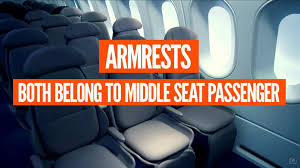
Here’s another rule about middle seats.  You need to find your comfort zone with the armrests.  There’s not a lot of real estate on those babies, so inevitably you’ll be jockeying with your neighbor to figure out how to share.  Just make sure you don’t let your neighbor take the whole armrest from the get-go.  If you do, your middle-seat space will feel super-cramped. (Why did a ’70’s rock band just come to mind?)  In other words, you’ll experience “armrestlessness” the remainder of your flight.

Strangers and armrests aside, let’s acknowledge some of the hidden positives of sitting center.  First, you have the easiest access to all the ceiling gadgets.  Adding light or air or a flight attendant to your environment requires nothing more than a casual reach overhead.  Your seatmates have it more difficult.  They’ll often add an “excuse me” to their movements, or even ask you to do it for them.  Sometimes that means bodily contact. Ick.

Second positive: you avoid the shortcomings of the window and aisle seats.  What are those?  The window seat personal space is noticeably smaller than other seats (including the storage space below the seat in front of you).  The window seat is also be noisy if you’re near the engines.  The aisle seat personal space is constantly interrupted by the happenings in the aisle itself: roving flight attendants, drink carts, and all those other strangers on the plane.  And here’s the ultimate penalty for sitting in the aisle seat:  you’re sitting between your seatmates and their freedom (i.e. the lavatory).  Every time they’re up and out of their seats, so are you.

Speaking of airplane lavatories, I avoid them until my bladder pulses me into levitation.  It’s not an issue of cleanliness or claustrophobia, but rather the journey to get there from your seat.  Here’s my ultimate nightmare: I get past the aisle seat and head to the front lav.  I find it occupied, which means I head to the back (no lines allowed in front).  On my way to the back, the seat belt sign dings and flight attendants guilt me into returning to my seat.  Mission unaccomplished.  Hold please.

Final though: be bold and choose the middle seat on occasion.  You might enjoy it as much as I do.  Then again, in-between comes more naturally to me. I was a middle child growing up.  I live in a middle state in the U.S.  I like to think of myself as slightly above average.  In other words, fair-to-middling.

Lovely Are Thy Branches

Christmas prep – at our house – starts the weekend after Thanksgiving and goes all the way thru December 24th.  I like to think it’s deliberate – taking a month or more to drag out the “getting ready”.  Some years we’re rushed but the house always seems to get decorated, the cookies baked, the presents wrapped, the cards sent, and the food shopped.  There’s always a dinner reservation on Christmas Eve; always room in the pews at the late, late church service.  But what if – some year – we dispensed with all of that prep?  December 25th would still come, of course.  But it wouldn’t be Christmas, unless we had a tree.

I can’t think of a single Christmas in my fifty-plus years when we haven’t had a fully-decorated tree.  Whether the lights or the ornaments or the angel on top, the tree to me is the ultimate expression of the holiday season.  Christmas trees have been standing since the 1500’s (proved by a sculpted image at an estate in France).  In the late 1700’s, Christmas trees hopped the pond to America.
My affection for decorated trees dates to my early childhood in Los Angeles.  Late on a mid-December day, my mother would pack my brothers and I into the station wagon, drive downtown, and meet up with my father after work.  Near his office, hundreds of Christmas trees were being unloaded from boxcars in the train yard; some of them still fresh with snow.  You may prefer the convenience of your neighborhood tree lot, but sorry; nothing beats the childhood nostalgia of picking a tree straight from a boxcar.

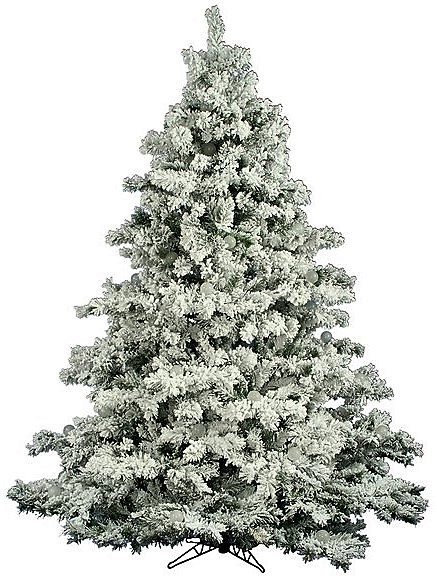
Flocked tree

Since we never had snow in Los Angeles, we often had our Christmas tree “flocked” before taking it home.  Flocking means placing a tree on a spinning stand and covering it with a product I can only describe as spray Styrofoam.  As tacky as that sounds, the result is remarkably “snow-like”.  Flocking even comes in colors (but I never understood why anyone would want pink or green snow).

As for tree ornaments, they’ve been around since Christmas trees themselves.  What were once apples, candy canes, and pastries (elegantly simple, if you ask me) have now evolved into everything imaginable.  On my childhood tree, I only remember those delicate, shiny, colored balls and bells; the ones which shattered on the slightest impact.  We also had tinsel; endless garlands of thin strips of colored foil, and tinsel is a great word, don’t you think?

Christmas lights became a staple of tree decor in 1882, when an Edison Electric VP first added them to his family tree.  The lights on my childhood tree – the multi-colored “C9” incandescent standard of the time – were connected to an illuminated star at the very top.  A few strands contained transparent-colored “blinkies”.  In hindsight, blinky lights sound as tacky as flocking but somehow, they worked alongside everything else on the tree.

Here’s a little Christmas tree trivia for you.  The carol, O’ Christmas Tree, is sometimes sung in German, starting with “O’ Tannenbaum, O’ Tannenbaum…”.  Guess what?  You’re actually singing, “O’ Fir Tree, O’ Fir Tree…”.  If you’re looking for the correct translation, go with, “O’ Weihnachtsbaum…” instead.

Christmon tree

One more bit of trivia.  If you find a tree decorated with nothing but white and gold Christian symbols, you’re looking at a Christmon tree.  Blend the sounds and meanings of “Christ” and “monogram” and you come up with the portmanteau “Christmon”.  Sounds (and looks) beautiful to me.

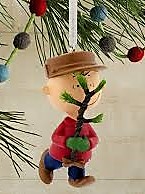
I don’t think I’ll ever have to worry about finding a Christmas tree.  Over 35 million are produced in the U.S. each year; another 60 million in Europe.  The average cost of a live-cut Christmas tree last year was $73, and that includes a lot of really tall ones.  Someday, I won’t be able to erect a nine or ten-foot tree in my living room anymore.  No worries; I’ll just go with a table-top instead (a “Charlie Brown”, if you will).  Her branches will be just as lovely.

Some content sourced from Wikipedia, “the free encyclopedia”.

Dusting Off Dumbo

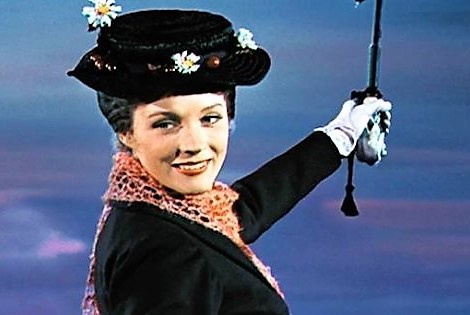
In March, Disney will release a remake of the children’s classic “Dumbo”, almost eighty years after the original. An intriguing story (Tim Burton directs), and the wonders of computer animation suggest the new version will be pretty good; standing on its own the way Jim Carrey managed with his version of the Grinch. “Mary Poppins” also Returns next week after a fifty-year absence. Emily Blunt looks supercalifragilistic in the previews, but with all due respect, there’s only one Mary Poppins and her name is Julie Andrews (there is also only one Maria Von Trapp and her name is also Julie Andrews).

Movie remakes are blog-worthy, but that’s not my mission today.  I’m here to talk about Dumbo.  Even though his modern-day movie doesn’t come out for a few more months, you’ll find him at any one of the six Disney parks.  He’ll fly you in dizzy circles with his big ears and colorful cap; as happy an elephant as he’s ever been.  But on closer inspection, you may find your Dumbo needs a little dusting off.  That grey may be his (plastic) skin perhaps, but – brace yourself – it may also be the scattered remains of deceased Disney devotees. Apparently some souls choose to be interred in an urn known as The Happiest Place On Earth.

Okay, I know some of you were anticipating a jolly-holiday post this time of year, with visions of chestnuts roasting on an open fire (“pop! pop! pop!”) or a “Baby It’s Cold Outside” fire (romantic embers) but sorry; today we’re talking about a cremation fire.  Doesn’t the topic make you just a little curious?  Did you know for instance, we humans spread our ashes (or I should say, have our ashes spread) at sea, in woodland groves, into volcanoes, over sports stadiums and on golf courses, and yes – all over the Disney parks, but “at sea” is the only legal option on the list?  Or, did you know, if you spread an entire urn’s worth, you’re talking about five pounds of ashes?  Not exactly a spoonful of sugar, Mary.

I never knew Disney had this sort of problem in its parks (although at The Happiest Places On Earth, there are no “problems”).  Scattered ashes are reported at least once a month.  Disney handles these incidents the way they do other “real-world” stuff: with complete discretion.  First, an employee notices said “pixie dust” (maybe with help from Tinker Bell?).  Then a “HEPA” text – high-efficiency particulate air – is sent to maintenance, because that’s the kind of vacuum you’re gonna need.  Then the ride or area of the park is closed off and the deceased is sucked up “spit-spot”.  You can almost see the maintenance guy whistling while he works.

HEPA vac

Scattering ashes (other than at-sea) is a misdemeanor, but in true Disney fashion no charges are pressed if you’re caught.  Instead, your mouse ears are removed and you’re escorted out the nearest gates, back to the real world.  Any patrons inconvenienced by your actions get reimbursed with a Fast Pass or a store voucher.  Having said that, plan on a few extra minutes getting screened at the entry gates.  Besides knives, bombs, and alcohol, they’re looking for urns.  Or, in the backpacks of the more determined: plastic pill bottles and makeup compacts.

Disney’s Dumbo ride is a common place to scatter ashes (specifically, the moat under the flying elephants), as is Cinderella’s Castle (flowerbeds) and It’s A Small World (anywhere near the delirious singing dolls) but where do most scatterings take place?  Why, the Haunted Mansion of course.  It’s the only truly morbid location at Disney.  As your “ghost host” says over and over, “we have 999 happy haunts here, but there’s room for 1,000 – any volunteers?”  I guess some people take their ghost host seriously.

On a related topic, several years ago Disney sold personalized hexagonal pavers at its Florida park.  You could put anything you wanted on the tiles, except the words “In Memory Of…” Why?  Disney didn’t want people to have death on their minds at The Happiest Place On Earth.  As Mary Poppins would say, they’re just trying to be practically perfect in every way.  But clearly, some people have death on their minds anyway.  Or at least, ashes in their backpacks.

Some content sourced from the Wall Street Journal article, “Disney World’s Big Secret…”.

Supreme Without Cream

Over Thanksgiving, my daughter commented how she missed the Tibetan food she used to enjoy in Los Angeles.  Not that Colorado doesn’t have Tibetan food (she relocated to Denver six months ago), but perhaps not as easy to find as in LA.  The only thing I associate with Tibetan food is yak, which is more of an animal than a food in my book.  But no doubt there’s also butter tea on that restaurant menu.  Butter tea is made with yak butter.  And if it’s anything like butter coffee, it’s better than it sounds.

Ever wonder at what point a fad becomes mainstream?  That’s my musing with butter coffee today.  I thought it was a come-and-go kick, until a recent Wall Street Journal (WSJ) article suggested it may be here to stay.  Butter coffee is exactly as advertised: blended coffee with butter (and a little coconut oil); hold the cream and sugar.  It sounds like a bizarre combination, but don’t judge until you try.  Unless you prefer the sweet side of the Starbucks coffee menu, you’ll probably agree – butter coffee’s not that far removed from the taste of a standard latte.

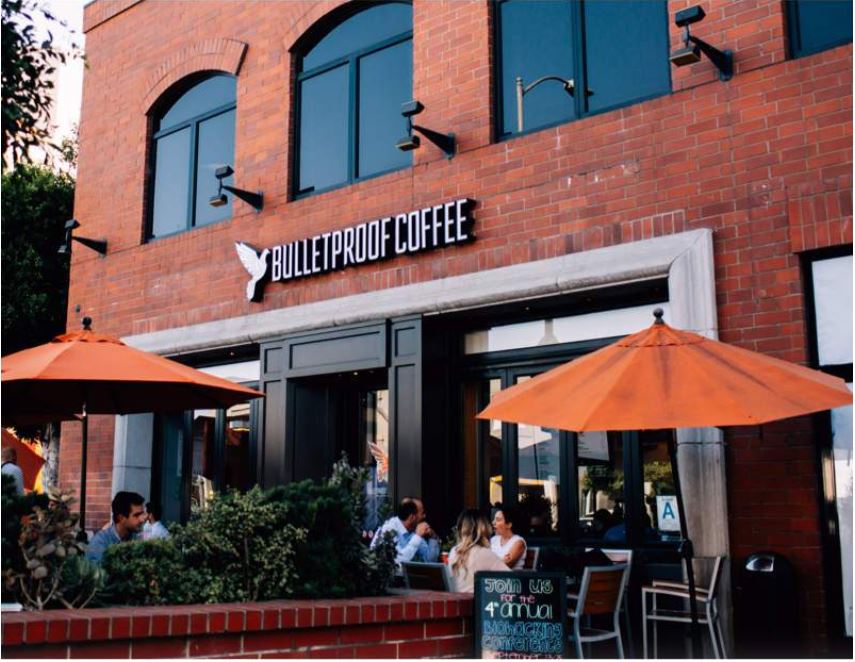
Without sounding like an advertisement, I have to give cred to Dave Asprey and the Bulletproof brand.  Until somebody challenges his claim, Asprey is the standalone founder of the butter coffee trend.  No surprise, his concoction is based on butter tea, which he first tasted not in a restaurant in LA, but on a mountainside in Tibet.  Once Asprey formalized his invention into Bulletproof Coffee, he dropped his Silicon Valley ties and headed his career in a whole new direction.

Though I ordain Asprey the butter coffee king, it’s been several years since I’ve actually read anything about the product.  I was sure it was a here-today/gone-tomorrow health kick (if you’re a ketogenic diet fan, butter coffee’s for you).  Then here comes the Wall Street Journal this week, touting “the latest coffee craze” and talking about enough recipes, products, and retail stores to make me think butter coffee is here to stay.  I can even mail-order my butter coffee (at Picnik’s website).  In the ultimate test of staying power, Starbucks may add butter coffee to its menu one of these days.  If that happens, I’ll quit saying “fad” and promote the mixture to on-trend – which is how Google Maps already labels the Bulletproof Cafes you can visit in Seattle and Los Angeles.

Lest you think this post is a promotion for butter coffee, let me back up the barista a bit.  Butter coffee purists (snobs?) assert the real deal can only be achieved with the highest-quality ingredients (“no crap, no yeast, no gluten”): certified-clean French-pressed coffee beans, medium-chain triglyceride oil (MCT), and grass-fed ghee (“non-dairy” butter).  Who the heck has those items just sitting around their pantry?  Furthermore, the ingredients need to be whipped up in a blender (oil and water – they don’t mix).  That’s a lot of prep – and a few extra dishes in the sink – for a single cup of coffee.

Butter coffee’s fringe-benefits claim is “excessive productivity, limitless energy, and mental clarity” (with a large helping of fat).  Maybe, but I’ll still take my no-brainer-mass-produced-K-cup coffee with a small pour of cream (instructions: press Start).  That’s about all I can manage first thing in the morning anyway.

If you’re still curious about butter coffee, check out the entertaining BuzzFeed post: I Drank Butter Coffee For A Month And It Was More Magical Than I Expected.  The authors gave it better chance than I did (even though they also retreated to standard coffee afterward).  As for me, it’s K-cups over yaks every time.

A Distant Third (cont.)

Last Tuesday in cycle class, pedaling through the five-minute recovery after an hour of torture, our instructor asked if we’d like a Christmas carol or two from her playlist.  The one rider with enough oxygen lashed out vehemently, “NO!  It’s too early!”  Well how about that; score a point for Thanksgiving.  The sun set on Halloween two weeks ago and mighty Christmas is already trying to muscle its way to the forefront.  But Thanksgiving has a thing or two to say first.  If you please, keep the sugar plums out of my turkey and stuffing.

In last week’s post, I compared popular aspects of Halloween, Thanksgiving, and Christmas (i.e. history, music, food).  The final tally: Christmas the clear winner – no surprise – with Halloween solidly in second.  But lest we relegate Thanksgiving to the bronze medal year after year, my blog-intent is to reinvigorate America’s late-November holiday, and remind readers why Turkey Day stands on its own merits.

On that note, we’re starting November with promise.  My wife is getting endless mailbox catalogs, and I was delighted to find Williams-Sonoma’s “Thanksgiving Headquarters” edition: 180 pages of food, linens, kitchenware, and decor specifically designed for the holidays.  They even photo-profiled a barn-based “Friendsgiving” celebration in upstate New York.  Granted, the Thanksgiving section of the catalog ended on p.67, meaning the remaining 100 pages were all about Christmas.  No matter – 67 pages of Thanksgiving is impressive.  Way to go, Williams-Sonoma.

Starbucks also made a statement – albeit more feeble – putting their unique spin on Thanksgiving.  Right now, you can drive-thru and order a Turkey & Stuffing Panini (with cranberries and gravy!), perfectly nicknamed “a handheld turkey dinner”.  Then pair your panini with a Chestnut Praline Latte (“flavors of caramelized chestnuts and spices, topped with whipped cream and spiced praline crumbs”).  That combo speaks more to November than December in my book.  Not bad, Starbucks.

Retail aside, Thanksgiving plays out as more of an extended weekend than a single day.  Consider the before/after events.  Wednesday (“Thanksgiving Eve”) is routinely labeled “the single busiest travel day of the year”.  Well guess what?  It’s not.  Thanksgiving Day is the busiest travel day of the year, considering 90% of us drive our cars to the family gathering that morning.  Thanksgiving Wednesday (and Thanksgiving Sunday) only seem busiest because the chaos at the airports gets so much attention.

Now, on Turkey Day itself, besides the meal and the backyard football, we begin with the “Macy’s Thanksgiving Day Parade”.  My family always seems to miss the broadcast because we’re so busy in the kitchen.  Macy’s is three hours of marching bands, dancing Rockettes, Broadway singers, flying character balloons, and – as far as I can tell – one nod to Thanksgiving (the massive turkey in the photo above).  But hang on ’til the very end of the broadcast, because… here comes Santa Claus, here comes Santa Claus, wrapping up the parade the same way he’s done every year since 1924.  It’s like the Williams-Sonoma catalog – Thanksgiving on the outside but more “holiday season” in disguise.

Thanksgiving Friday is “Black”, of course – the so-called beginning of the Christmas shopping season.  We Americans spend over $50 billion that day (putting retailers “back in the black” with profits – hence the name).  It’s safe to say this bonanza of spending isn’t going away anytime soon.  By its very nature, Black Friday extinguishes Thanksgiving – almost before the pumpkin pie is served.  Black Friday sales begin as early as 5pm on Thursday evening (making the name obsolete, don’t you think?)  And if Thanksgiving isn’t early enough for you, some stores begin sales a week before Black Friday, with the teaser, “avoid the chaos of Black Friday – shop now!”  Uh, what’s the real meaning of Christmas again?

So there you have it – Christmas putting the squeeze on Thanksgiving like the Grinch on Whoville. Santa concludes the Macy’s parade at 12:00pm ET.  Christmas shopping begins five hours later.  In between, throw a meal on the table, mumble a blessing, and don’t forget to say thanks.  If we’re not careful, Thanksgiving Day will be reduced to Thanksgiving Hour.  It’s a phenomenon known as “holiday compression depression” (okay, I just made that up), but hey; it’s happened before.  In 1971, George and Abe got their standalone birthday celebrations mashed into a single holiday.  Even they feel Thanksgiving’s pain.

A Distant Third

America’s Election Day finds us one week post-Halloween, fifty days pre-Christmas, and still adjusting to that pesky hour gained from the loss of Daylight Savings Time (got all that?) Fittingly, I’m working through a small pile of candy corn and M&M’s while placing a couple of online orders for holiday gifts. And that, my friends, is the perfect lead-in to today’s topic. With Halloween fading fast as the sun, and Christmas approaching like Starbucks’ holiday cups (just when did those show up already?), where in God’s name is the love of Thanksgiving?

Of course, Thanksgiving gets steamrolled every year between the other two loudmouths – just seems the real estate on either side is getting bigger. Our neighborhood’s professional haunted houses, pumpkin patches, and corn mazes opened gates in early September. Then Christmas’ onslaught of decor, music, and retail made its entrance the moment front-porch lights switched off on trick-or-treating. In short, Holiday 1 and Holiday 3 officially overlapped each other, suffocating Holiday 2 onto life support. It’s the classic case of middle-child syndrome – “exclusion caused by the more specific attention to the others”. Poor Thanksgiving.

To be fair, ranking the standard aspects of holidays puts Thanksgiving in third place in just about every category.  Let’s review a few:

ORIGIN: Halloween dates to 2,000 years ago; the ancient Celtic festival of Samhain (in present-day Ireland), when people lit bonfires and wore costumes to ward off ghosts. That’s pretty cool.  Thanksgiving dates a mere 400 years, mimicking the harvest meal shared by the Wampanoag Indians and English Pilgrims. Christmas – at least to us Christians – dates over 2,000 years ago to the birth of Christ. Measured by the calendar then, Christmas (C) takes first place, Halloween (H) second, and Thanksgiving (T) a distant third.

CELEBRATION: Halloween used to be just children’s trick-or-treating. Now we’ve evolved to a month of the aforementioned haunted houses, pumpkin patches, and corn mazes; then costume contests, themed drinks, and increased cover charges at the bars; and a plethora of scary movies at the theater. Thanksgiving?  One day preparing one meal to be consumed in (more or less) one hour.  Christmas has its December 25th, but it also has a season’s worth of caroling, parties, movies, concerts, parades, church services, craft shows, decorations, temporary ice-skating rinks, and on and on and on.  Again – First Place: C, Second: H, (Distant) Third: T.

MUSIC: Halloween: “Werewolves of London”, “The Time Warp”, “The Monster Mash”, “Ghostbusters”, “Thriller”. Christmas: You-pick-’em – a dozen of your favorites (from hundreds if not thousands of carols). Thanksgiving: Not one.  Not one single, solitary tune comes to mind. First Place: C, Second: H, Late-to-the-party: T.

COLORS: Halloween: Red, Orange, Yellow (and every shade in between). Thanksgiving: brown. Christmas: Red, Green, White. Let’s call it a first-place tie between C and H.  In third place (and looking awfully uncolorful): T.

APPAREL – Let’s give this category about five seconds. Halloween is all about apparel, so anything goes and everything works. Christmas allows for – at least once in the season – your Sunday best, or getting all dolled up for some special occasion. Thanksgiving? All I come up with is stretch pants to ease the digestion of the meal.  First place: H, Second place: C, Absent-From-The-Podium: T.

FOOD – Halloween brings forth every imaginable candy, with a side of bobbed apples and witch’s brew. Christmas explodes with candy canes, decorated cookies, the Grinch’s roast beast, and those wretched fruit cakes. But here comes Thanksgiving for the kill – turkey, stuffing, potatoes, cranberries, dinner rolls, salads, vegetables, two-maybe-three kinds of pie, and whatever else you can cram onto the table. Assuming this carb-crazy feast is your cup of tea, Thanksgiving wins in a runaway. First place: T, Second place: C, Third Place (+ Sugar Coma): H.

Let’s tally the results.  In five of six categories, Thanksgiving gets the beat-down from Halloween and Christmas.  The mega-holidays appear to be reducing Turkey Day to a trifle.  But lest you think it’s a dying bird, I’m here to convince you Thanksgiving isn’t down for the count.  Stay tuned: there’s more to discuss about the little holiday that could.

Candy-Crunching the Numbers

If you sift through your kids’ trick-or-treat bags today, you may be in for a surprise. When it comes to Halloween candy, we Americans are a fickle bunch. “Best” and “Worst” lists kick into high gear this time of year – with fierce debate – and the results are likely reflected in what gets handed out at the front door. Would you agree – Reese’s Peanut Butter Cups are hands-down America’s most popular Halloween candy?  By the same analytics, would you agree Circus Peanuts are the worst?  Do you even know what Circus Peanuts are?

CandyStore.com recently assembled the candy list of lists – the current bests and worsts. Check out the details in their blog post here (and buy some candy while you’re at it).  CandyStore combed the Web for best/worst candy lists from a dozen publications, then mixed in the opinions of 40,000 of their own shoppers. How they sifted all that data into a single list is a worthy advertisement for Excel.  Here are the results:

BEST Halloween Candy
10. Hershey Bars
9. Skittles
8. Sour Patch Kids
7. Butterfinger
6. Nerds
5. M&M’s
4. Kit-Kat
3. Twix
2. Snickers
1. Reese’s Peanut Butter Cups

WORST Halloween Candy
10. Mary Jane
9. Good & Plenty
8. Licorice
7. Smarties
6. Tootsie Rolls
5. Peanut Butter Kisses
4. NECCO Wafers
3. Wax Coke Bottles
2. Candy Corn
1. Circus Peanuts

Some comments (er, opinions) about the BEST list.  I can’t argue with Reese’s in the #1 spot, since I adore peanut-butter-and-chocolate, and a Reese’s cup is a convenient size somewhere between “full-size” and “fun-size” for the trick-or-treat bag.  Reese’s also happen to have an orange wrapper, so no adjustment needed for Halloween. The top five on the BEST list are solid choices, though I wonder where Snickers has the edge over Milky Way, Mars, or Almond Joy.  Three of the remaining five reflect candies joining the party well after I was a kid.  To this day, I’ve never had a “Sour Patch Kid”.

The WORST list is a little more interesting.  I’m surprised some of these earned a spot (even on a “worst” list), considering they were popular way back in the 1960’s.  But Smarties, Wax Coke Bottles, and Candy Corn bring a smile to my face, as each of them screams “Halloween” to me.  They seem to appear in October, then disappear for the next eleven months.  Wax Coke Bottles were the thought-we-were-cool 2-in-1 candy.  Bite off the bottle top for the drink, then put the wax in your mouth for a chewing-gum sensation.  In hindsight, ewwwww.

Candy corn, no surprise, is a polarizing confection.  You either love the little kernels or you simply can’t stand them.  They’re essentially corn syrup + sugar doused with a little food coloring.  Jelly Bean Candy Company has been making candy corn for over a century and sells hundreds of thousands of pounds of kernels each year, most in October.  Yet candy corn almost snagged the top spot on the WORST list.  Go figure.

On the other hand, Circus Peanuts deserve the WORST trophy.  I’m old enough to remember enjoying a real bag of peanuts at the circus, so why go and “candi-fy” my memory?  CP’s are peanut-shaped orange marshmallows (orange I suppose, because brown would not be an appetizing look for marshmallows).  Remarkably, CP’s have been around as long as candy corn, and you can still find them on your supermarket shelves.  Careful – some of those bags may have been manufactured in the late 1800’s.

Here’s another angle on the BEST list.  CandyStore took their analysis one step further and figured out, based on purchases August through October, which candy is most popular by state.  The methodology is not quite as scientific but the results are amusing.  You’ll find most of the BEST list represented, but you’ll also find a few head-scratchers.  Kentucky’s “favorite candy” is Swedish Fish.  Montana and Oklahoma prefer Double Bubble Gum.  West Virginians prefer Blow Pops.  As for my own state of Colorado?  Twix.  I can live with that.

CandyStore may take pride in its BEST/WORST lists, but let’s all just agree to disagree, shall we?  IMHO, licorice (of any kind) belongs nowhere near a WORST list – and that includes Good & Plenty, while 3 Musketeers is embarrassingly absent from the BEST list.  Not a fan of chocolate-covered, fluffy, whipped nougat?  Pick one up sometime and reconsider.  3 Musketeers almost feels lighter-than-air, a clever ruse to offset the guilt as I add one to my shopping cart.

Some content sourced from the Wall Street Journal article,”Americans are Divided – About Candy Corn”.

Tipsy-Turvy

Emily Post’s Etiquette is surely an authority on its topic, considering the book was first published in 1922 and is now into its nineteenth edition. I would’ve enjoyed meeting Ms. Post, as Etiquette remains “the most trusted resource for navigating life’s every situation”. The advice never veers from its original premise, simply adapting to times as they change.  Of course, it’s all about manners – good ones at that. And were Emily Post alive today, she’d have us flip to Chapter 13, for a review of a practice of growing concern (and confusion).  Chapter 13 talks about tipping.


I’ve written about tipping before.  Three years ago (!) I told the story of my family’s visit to New York City, and the cabbie who crammed the six of us into one vehicle, then demanded a bigger tip than I gave, as a reward for saving the cost of a second cab.  I disagreed with him, because I believed – still do – a tip reflects the service itself (which was marginal).  More importantly, the recipient should never expect the tip, let alone argue over the amount.

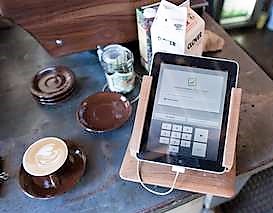
Square’s POS

So-o-o, why is tipping such a hot topic now?  Because restaurants and coffee shops are moving to point-of-sale (POS) technology at the counter, allowing the customer to complete the transaction through an iPad, no cash required.  POS software (like Square) includes a tipping screen, offering suggested percentages/amounts, or no tip at all.  It’s a change to the social dynamic.  Before POS, you could discreetly add (or not add) a tip to your receipt before signing, or perhaps throw a few coins into the jar.  With POS, the tipping decision is forced on you at the front of the line (hurry up!).  And don’t be surprised if the person behind you sneaks a peak while you choose your tip.

My issue is not with the POS technology itself.  I like the security of completing a transaction (i.e. the credit card never leaves the hand), and I don’t mind navigating a couple of iPad screens to do it.  What I do mind is “tipping manipulation” as I’m standing at the counter.  The suggested amounts are the first thing you see, and beckon in LARGE FONTS.  To leave a smaller amount requires additional screens.  The “No Tip” option sits at the bottom like an afterthought.  Behavioral science says you’ll almost always choose from the top row, whether the service deserves it or not.

POS software gives the merchant the option to remove the tipping screen altogether, but I’m not suggesting they go back to a jar of coins.  Instead, before the tipping screen, why not insert a common courtesy (channeling Emily Post here): a screen simply asking, “Would you like to leave a tip?”

If your habit is to always (or never) leave a tip, consider the variables behind the curtains.  Some businesses adjust employee pay down if the position receives tips.  Other businesses pool tips, then divide the pot between all service positions (did you really intend to tip the dishwasher)?  The American Restaurant Association claims some states allow service businesses to pay less than minimum wage, because tips are legally considered wages.  Finally, minimum wage varies by state, so a nice tip in one state might be an insult in another.  Yet you, the tipper, have no idea if one or more of the above applies as you’re about to pay.  Messy, no?

Timeout for a favorite tipping story.  After years of one-on-one sessions, my personal trainer decided to resign my athletic club and pursue another career.  Knowing she was leaving, I asked if I could leave a tip with my final payment.  She declined, saying club policy did not allow tips.  However, she said, I could give her a positive review through the club’s on-line survey, and then she would likely receive a bonus in her paycheck.  Money and acknowledgement by her manager?  I completed the survey.

Someone once said, “Tips are like hugs, without the awkward body contact.”  I like that, except we’re starting to get awkward again.  POS screens allow for invasion of personal space, bringing tipping into the open.  Maybe Square should take a “tip” from Starbucks.  Use the Starbucks app to pay with your phone at the counter, and the tipping comes later, in the privacy of your own whatever.  You’re given several hours to consider if and how much you should tip.  I think Etiquette Chap. 13 would agree with that approach.

I’ll continue to be a savvy tipper, no matter what I’m faced with.  If I use a POS iPad, I’ll go with a “Custom Tip Amount” if I need to.  If I sign a credit-card slip, I’ll always tip on the pre-tax amount and I’ll never blindly choose 15%.  If it’s cash in hand, I’m at the mercy of the denominations I have in my pocket.  And in every case, I’ll ask myself the same question Emily Post would pose: “Did I receive notably good service?”

Some content sourced from Wikipedia, “the free encyclopedia”,  from the Wall Street Journal article, “You Want 20% for Handing Me a Muffin?”, and from the USA Today article, “How Much to Tip…?”