Love Thee, Notre Dame

I used to love “back-to-school” nights in my elementary school days. My brothers and I would lead my parents through the gates of our asphalt-paved campus on the west side of Los Angeles, eager to show off the classroom projects and displays we prepared for their annual visit.  Mom & Dad would cram into our child-sized desks for talks from our teachers while we’d join friends for playground fun under the lights. Finally, we’d enjoy a KFC picnic dinner at the outdoor tables where we kids would have lunch during the day. Back-to-school night was equal parts adventure and pride, returning to campus at a time when we didn’t have to be students.
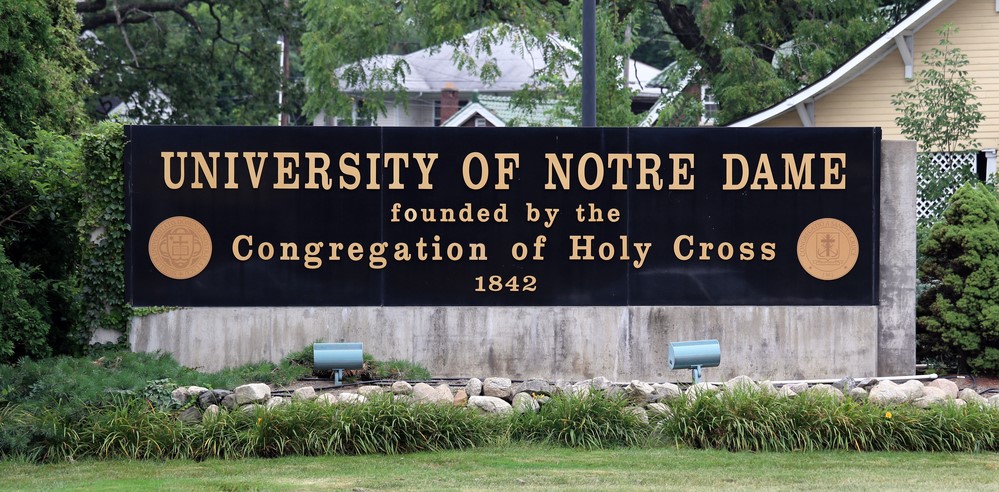
Such was the feeling this past weekend, visiting my alma mater in northern Indiana.  Notre Dame, that most Catholic of universities located near the south bend of the St. Joseph River – founded by Fr. Edward Sorin and his band of Holy Cross brothers in the mid-1800’s – drew me away from more convenient West Coast options like UCLA or Stanford (neither of which accepted me… details). Who was I, a Methodist from California, to attend a smallish Catholic school over 2,000 miles from home? Notre Dame’s admissions counselor did a heckuva sales job. Rather than own up to the humid months of the first semester or the penetratingly-cold months of the second, he focused instead on the promise of an outstanding faith-based education, coupled with small-dorm camaraderie, nationally competitive sports teams, and Midwestern hospitality.  When I graduated in 1985, it’s fair to say Notre Dame delivered on all of those.
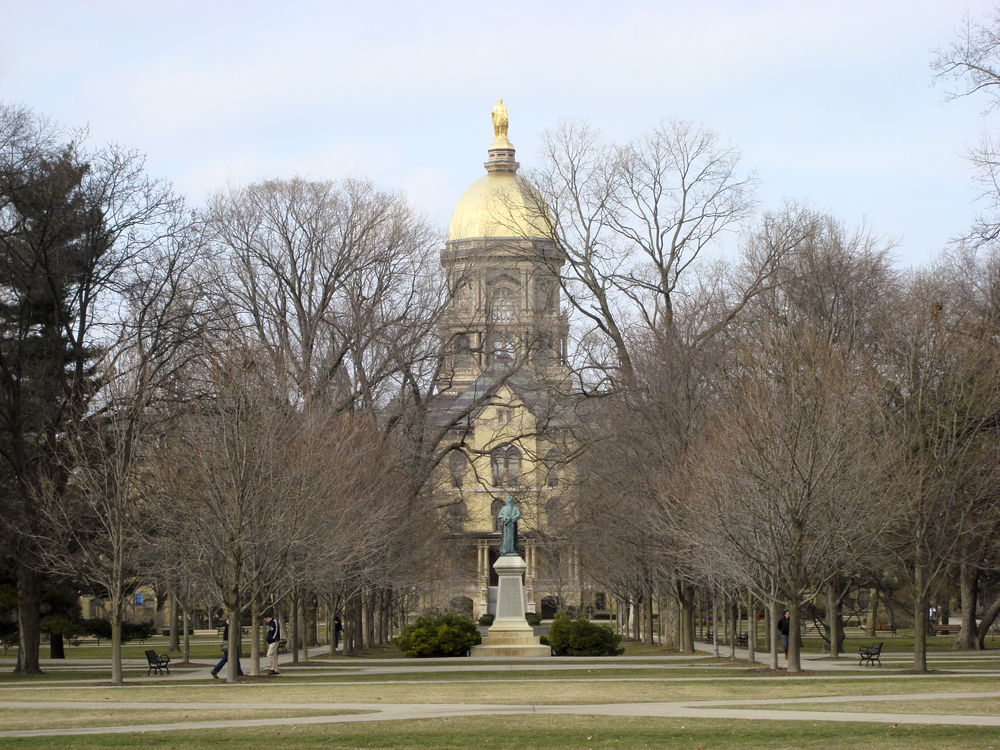
Administration Building aka “The Golden Dome”, Central Quad

Thirty years later – this past weekend – I set foot on campus again, adding to only a handful of visits since my long-ago commencement. I won’t lie – returning to my college roots was a little daunting.  The Notre Dame of my years was by all definitions smaller, more modest, and less prestigious than the globally-renowned multi-campus university of today. My Notre Dame was an intimate cluster of buildings surrounding just three quads, one end of campus seemingly a stone’s throw from the other.  The student union was as small as a cracker box.  Two dining halls offered the modest sort of food – cafeteria style – I recognized from elementary school.  Diplomas were issued in just twenty fields of study. Four percent of the student body claimed a faith other than Catholic.  The clear majority of students came from Midwestern states, and only a handful chose to study abroad.

O’Shaughnessy Hall, South Quad

Thirty years later, my Notre Dame of yesteryear has been consumed by a property twice the size.  New quads and facilities cover the open fields that once hosted tailgaters before football games.  Another one hundred buildings have been added to the eighty or so of my day.  The new student union – opening just weeks ago – is the length of a football field (and in fact, co-located with the football stadium).  Today’s undergraduates choose from countless degree programs, with another fifty masters, doctoral, and professional programs to follow.  Add to the options, fifty foreign study-abroad opportunities in forty countries.

“Only” 80% of students are Catholic now (diverse by Notre Dame’s standards), and – speaking of diverse – almost 20% of the student body comes from outside the U.S.  Visiting one of the dining halls for lunch, it wasn’t the broad choice of foods (organic, ethnic, made-to-order) that impressed me, but rather the students themselves.  I witnessed a pretty good slice of the global pie at the tables around me.

Stairway to The Grotto and St. Mary’s Lake

Notre Dame’s mission statement includes the following: “In all dimensions of the University, Notre Dame pursues its objectives through the formation of a human community graced by the Spirit of Christ.”  Clearly that objective is reflected in the Notre Dame of today.  A school once known for little more than football is now an academic behemoth, built on an unwavering foundation of faith and service to God and fellow man.

“In Celebration of Family”

Notre Dame’s alma mater concludes with the following sentence: “…and our hearts forever, love thee Notre Dame.”  There may be a lot of “new” on campus today, but I still find the pathways of “my” years.  The Golden Dome, the Basilica of the Sacred Heart, and the Grotto will always form the heart of campus.  I maintain ties with only a handful of those who were in school with me, but we’ll always be proud members of the Fighting Irish family.  And every time I set foot on campus, I never fail to sense the memories of old, the encouragement of new, and the presence of the Spirit.  Indeed, Notre Dame is in my heart forever.

Tingling the Spines

When Amazon began opening bookstores a couple years back, I wondered why an uber-successful online enterprise would turn to brick-and-mortar, especially after sales of more than fifty million Kindle e-readers through its website. Turns out Amazon’s walk-in shopping experience is worth the walls. It’s retail at its most relaxing – and it has a place in the equation.  As CEO Miriam Sontz (Powell’s Books in Portland, OR) puts it, “something special occurs in a physical bookstore that is not replicable online”.

I’ve been to an Amazon Books just once (fewer than twenty locations in the U.S.), but vividly remember what made my shopping experience so compelling.  First, the manager greeted me with, “Welcome to Amazon, and what was the last book you read?”  When I told him (Kristin Hannah’s “The Nightingale”), he replied, “Oh, that’s a wonderful book.  Wasn’t it so interesting to read an account of the war in France instead of in Germany?  Have a look on Aisle 3 – you’ll find some other great WWII fiction.”

As I indeed had a look on Aisle 3, the manager moved on to other customers, prompting similar conversations.  Suddenly I realized the whole interaction was intentional.  Personalize/focus my shopping experience by discovering what I’m reading.  Pique my curiosity by allowing me to overhear what other people are reading.  A + B = Increase the odds I’ll make a purchase.

What really sets Amazon Books apart from the others is the displays.  The books are laid flat and on angled shelves, so you’re looking right at the cover as you’re standing in the aisle.  Below each book, an easy-to-read card delivers a crisp synopsis of the book, as well as a smattering of the ratings and reviews you’d find online.  Think about that tactic.  You peruse the entire colorful cover.  You take in the book title and author without cocking your head ninety degrees to the left or right.  And you know a little about the book (and whether it’s a recommended read) without turning a single page.  It’s almost like those moments in front of paintings in an art gallery.  “Displayed flat” sounds counter-intuitive in the per-square-foot world of retail, but damned if it isn’t a great way to shop.

Photo by Natasha Meininger

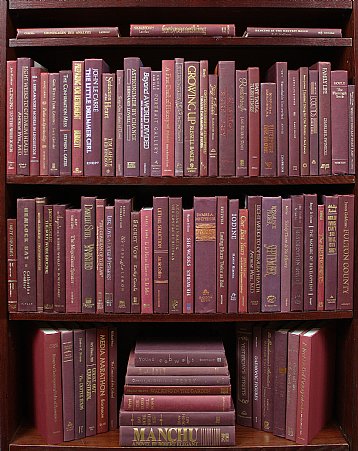
Amazon isn’t the only spine-tingler these days.  In a truly baffling trend, interior decorators and collectors are shelving books with the spines… facing the walls.  That’s right: take a book off the shelf, turn it all the way around, and place it back on the shelf.  Why?  Because “eggshell” – the typical color of the pages themselves – is aesthetically pleasing, instead of that rainbow of bright, colorful book jackets.  The linen texture is uniform, blending more confidently with whatever else is going on in the room.  Really?  Is this Feng shui on steroids?

Alas, as the Wall Street Journal reports, backward-bookshelving is no fad, .  You can purchase books on the cheap specifically for this approach.  Check out the goods at booksbythefoot.com.  BBTF sells you reclaimed books, covers removed, of various shapes and sizes, and yes; purchased “by the foot”.  You can even purchase your tomes in a color scheme (i.e. “burgundy wine” or “earth tones”).  Arrange them any way you want: facing in or out, flat or standing up, in piles or as standalones.  Any way you stack ’em they’ll look fully nondescript, suggesting you’d never go so far as to – gasp! – read them.  As Chuck Roberts (BBTF President) puts it, “Some people don’t want to have the literature as a distraction… they want books as objects on a shelf.”  You mean, like lobotomizing the intellectual meaning from the aesthetic?  Weird, just weird.

Or maybe not.  Now that I think about it, I own the complete works of Charles Dickens, painstakingly acquired years ago, one book at a time through the Franklin Press or some other mail-order rag.  My Dickens collection (above photo) sits neatly on the shelf gathering dust, just waiting for me to crack the first spine or read the first page.  But no matter; don’t they look pretty?

Some content sourced from Wikipedia, “the free encyclopedia”.


Land of Flying Cars

My wife and I live in a rural area of Colorado known as the Black Forest.  The high density of Ponderosa Pines in our small geography gives us our name.  Remarkably, there’s only one other notable place on the planet named “Black Forest”: the region near Bavaria in southwest Germany.  As it turns out, I have personal ties to both places, though I’ve never been to the south of Germany.  Follow along as I connect the Forests.

Fill in the blank, “Best Childhood Movie: ________”.  Most of you would respond with an offering from Disney.  Including “Snow White…”, “Mary Poppins”, and “The Little Mermaid”, you’ve already covered sixty years of film-making, with countless other Disney classics in between.  I don’t think I missed a single Disney growing up in the sixties and seventies, yet – go figure – my favorite childhood movie doesn’t come from the Mouse.  It doesn’t even come from my home country.  My childhood choice?  The UK’s “Chitty Chitty Bang Bang”, based on the 1964 novel by Ian Fleming.

“Chitty Chitty Bang Bang” – the captivating musical about the inventor and his kids who lived in a windmill cottage; about those wonderful-though-not-always-perfect inventions (my favorite: the eggs-toast-sausage breakfast machine); about the candy-maker and the toy-maker and the captivating castle world of Vulgaria; and most importantly about the magical flying motorcar itself – created figments of my imagination like no other movie.  The lyrics to the title song (“…Bang Bang Chitty Chitty Bang Bang, our fine four-fendered friend…”) were burned into my brain.  Someday I vowed to visit the lands of Caractacus Potts and Baron Bomburst.


As it turns out, the Potts’ windmill cottage really does exist (and not on a movie set) – as the “Cobstone Windmill” in Buckinghamshire, England. The mansion where “Truly Scrumptious” lived is in the same area of the country.  And the Scrumptious Sweets Company was a working factory in Middlesex (today a steam-engine museum).  But it was the castle and village in Vulgaria I really wanted to see.  Not long after seeing the movie of course, I learned “Vulgaria” was a fictitious country.  Baron Bomburst didn’t actually lord over the land, nor did he ever keep all those children as slaves beneath his castle. But the castle and the village are based on actual places.  The village is Rothenburg ob der Tauber in Bavaria.  The castle is Castle Neuschwanstein, also in Bavaria.  And how ironic; both locations were inspirations for Disney as well: Rothenburg for the village in “Pinocchio”, and Neuschwanstein for the Cinderella castles in the theme parks.

To bring my journey full-circle, Rothenburg, Castle Neuschwanstein, and Bavaria sit in southwest Germany, adjacent to… the Black Forest.  Germany’s version of the Forest is a mountainous land of picturesque villages, castles, vineyards and spas.  This is the region that brought the world Black Forest Ham and “truly scrumptious” Black Forest Cake.  This is the land of glass-making and cuckoo clocks.  From the photos above, it looks every bit as charming as “Vulgaria”.


Colorado’s Black Forest barely amounts to a dot on Google Maps.  Within our pines, the “town” is a hodge-podge of nondescript businesses clustered around a couple of traffic signals, with nothing more alluring than a Subway, a post office, and a couple of coffee shops.  The terrain is fairly flat, with no windmill cottages or mountaintop castles or cuckoo clocks.  But it’s a great place to live, with its own unique charm.  And every now and then, when I’m deep in the pines, I’ll start humming that forever-familiar Chitty-Chitty tune, as I gaze up to the skies in search of a flying motorcar.

Crafts of the Hand

Several months ago, my wife and I went to dinner at one of our favorite Mexican restaurants – a place we frequent every few weeks.  As we pondered margarita options, we asked the waiter for an order of table-side guacamole, a delicious specialty and a great way to kick off the meal.  Much to our disappointment, our waiter informed us we could no longer get guac table-side; rather, it would come already prepared and straight from the kitchen.  Sigh.  Add another item to the demise of handmade food and beverages.  Rekindle the pour-over argument.

What’s the “pour-over argument”?  It’s perhaps the most contemporary example of the struggle between handicraft and automation.  At your local coffee bar, most drinks are poured-over, meaning individually-prepared using a single paper filter, adding the coffee grounds and finishing with a slow pour of the water.  If your coffee arrives with foam-art, consider it a pour-over.  The argument asks whether it’s worth the wait for an individually-prepared coffee, when a large-batch machine can produce the same result in a fraction of the time.  One estimate claims large-batch can produce 100 coffees in an hour, while a barista creates less than ten.

I’m not here to defend the pour-over, but simply to discuss it.  In fact, my first thought when I heard “pour-over” is what you see in the photo above.  Admittedly, I love the speed and consistency of Keurig’s K-Cup’s, and I’m an unashamed frequent-flier at Starbucks.  But that’s not to say there’s not a chair at the table of life for pour-over’s.  Even if the quality of handmade can’t be distinguished from large-batch (taste test, anyone?), what about the calm of watching “drink-art” creation, and the opportunity to socialize with the barista?  Perhaps it’s the fringe-benefits making pour-over’s the healthier option.

Table-side guac is just one example of “pour-over’s” threatened by today’s demand for speed and efficiency.  If I ask you to think of a product previously handmade but now produced by automation, I’m sure you can name several.  Milkshakes. Beer. Even pizza, which can now be prepared start-to-finish by a robotic chef.  But the flip-side of robots is advertisement focused on food-prep the old-fashioned way.  “Handmade” milkshakes.  “Craft” beers.  “Fresh-squeezed” lemonade.  And pour-over coffee.

Business’s bottom line loves the idea of automation.  Labor is typically your most expensive line-item, so who would argue with removing it?  Well, maybe those willing to pay for the experience.  At your finer restaurants, you can still find table-side salads (Caesar), entrees (Chateaubriand or Steak Tartare), and flaming desserts (Baked Alaska, Bananas Foster, Cherries Jubilee).  At Sunday brunches you can still enjoy made-to-order omelettes and waffles.  With those examples, I’d argue you’re not just paying for the food.  You’re also paying for a slow-down moment: a chance to enjoy a chef-artisan do his/her thing while engaging in a little conversation. As a recent Wall Street Journal article puts it, “[pour-over]… is more about delivering peace in a fast-paced time”.

Here’s my plea.  The next time you’re having something prepared in front of you – whether a simple burrito at Chipotle or an elegant Steak Diane adjacent to your white-clothed table, put away the phone, take a deep breath, and just enjoy the moment.  Have a chat with whomever is preparing your meal.  It’s an experience worth poring over.

The Final Word

This time of year, we assemble our latest collection of “best-of’s” and “…of-the-year’s”.  On Monday, America crowned its national champion in college football (Alabama). In a few weeks we’ll get the NFL’s equivalent in the Super Bowl. Last month several magazines recognized 2017 of-the-year’s in photography and current events. Soon we’ll also have best-of’s in music (Grammy) and film (Oscar). In this spirit, did you know there’s an of-the-year for words?

To be clear, “word-of-the-year” doesn’t refer to the annual expansion of the Merriam-Webster (.com) Dictionary or the Oxford Dictionaries Online. With the former, over 250 words were added last fall; with the latter, over a thousand.  Instead, word-of-the-year is a single choice, representing “lasting potential as a word of cultural significance”.  That’s how the people at Oxford see it, and thus this year’s honoree is “youthquake”.  Huh?  Maybe if you’re in Britain you’re not shaking your head like me.  “Youthquake” means “a significant cultural, political, or social change arising from the actions or influence of young people.”  “Youthquake” has been around since 1965, but back then it was only a reference to the fashion and music industries.  Today, it could (and is) being used in reference to the myriad demonstrations of change commanded by the millennial generation.

With the Academy Awards – should you not agree with, “and the winner is…” – at least you might have a favorite in the list of nominees.  But the short list for 2017’s word-of-the-year is the following bunch of odd ducks: white fragility, unicorn, kompromat, broflake, newsjacking, gorpeore, milkshare duck, and antifa.  Okay, maybe “antifa” would’ve been a good choice, but I count at least four others I’m seeing for the first time.  More to the point, what happened to better choices like “hipster” or “pregame” or “alt-right”?  Did none of those even make it into the dictionary expansion?  They’re certainly more word-of-mouth than “youthquake”.

Perhaps “youthquake” will make it across the pond in the next year or two and enter America’s daily conversations.  But the word is not off to a good start, considering several in Britain – including the CEO of a youth leadership organization – claim they’ve never heard of it.  Maybe Oxford just has an affection for the word, so they throw it out there as an “of-the-year”.  But that’s kind of like being labeled “America’s Best City To Live In”.  The mere advertisement draws a bunch of tourists and other undesirables and next thing you know you’re no longer “best”.  By the time we Americans get right with “youthquake”, Oxford and Britain will have moved on to 2018’s word-of-the-year.

Merriam-Webster’s Peter Sokolowski claims their word-of-the-year (apparently the honor is shared) “…gives us insight into the collective curiosity of the public”. M-W took a more scientific approach to it’s recipient, looking at how often certain words were looked up online, and their context with respect to current events.  M-W’s 2017 word-of-the-year?  Feminism.  Look-ups of “feminism” increased 70% over 2016, and spikes in that activity were tied to comments made by politicians in Washington D.C., “The Handmaid’s Tale” and “Wonder Woman”, and the sexual harassment revelations of the past several months.  M-W gives “feminism” two definitions, but I prefer the second: “organized activity on behalf of women’s rights and interests.”

Two years ago, Oxford made a particularly clever word-of-the-year choice in “pictograph”.  Rather than show the word, Oxford showed an emoji.  If my spell-check is any indication, it takes at least two years to embrace the current word-of-the-year recipient.  “Emoji” did not underline.  “Youthquake” most definitely did.


Sweet Charity

Several times during the recent year-end holidays, I passed through the drive-thru at Starbucks, and as I paid, I asked the cashier to include the purchases of the car behind me. I’ve been participating in this Starbucks-wide trend for several Christmases now, and it brings me an inexplicable feeling of goodwill and satisfaction.  The goal of the effort is anonymity. Or to put it more comprehensively, blind faith.

Blind faith is defined as “belief without true understanding, perception, or discrimination”.  That’s powerful.  “Faith” is a spectrum that starts with basic trust and ends with the highest forms of religion.  But add on “blind” and it elevates the meaning.

Buying a free cup of coffee at Starbucks is the easiest form of blind faith, like handing over a dollar to a beggar.  No judgment as to “what happens next” allowed.  But the intention behind an act of blind faith is worth a bit of exploring here.  Dissecting my Starbucks gesture, I note the key components.  First, I don’t waffle over the amount of the purchase I’m covering.  That’s the blind faith in choosing to pay in the first place – it shouldn’t matter how much.  One time I looked in the rear-view mirror and saw a car with four passengers.  Their bill was well over $20.  But my decision had been made before the car even pulled up behind me, so the point was to stick with it.  Another time my recipient was a well-dressed woman wearing sunglasses and driving a recent-model BMW.  Again, no judgment.  Pay for her coffee and move on.

The second component concerns my “getaway”.  As I’m waiting for my own purchases I’m considering my escape route – the path that gets me away from Starbucks as quickly as possible, with enough turns and traffic lights to deter my beneficiary.  My goal is to remain anonymous, and unless the person behind me memorizes my license plates (or something else unique about my vehicle), I’ve achieved a moment of goodwill and will never see them again.  Frankly, it would spoil the whole effort if the car pulled up next to me at a nearby red light.  They might offer their gratitude, or they might offer to pay me back.  They might even be annoyed, as if I had no business intruding on their “personal life”.  I’d rather not know.  I prefer to lean on blind faith that I brought an unexpected smile, or delivered a tiny give-me-a-break in an otherwise trying day.  Maybe they’ll even “pay it forward”, as a string of 374 consecutive cars did at a Starbucks in Florida back in 2014.

Come to think of it, there’s a third component in the Great Coffee Giveaway.  Never expect the gesture in return.  In the countless times I’ve driven through Starbucks during the holidays, I’ve never thought to myself, “I hope the car in front of me picks up the tab”.  If I knew this was happening, I might just order a half-dozen breakfast sandwiches and several cake-pops to go with my Flat White.  Just kidding, of course.  I hope the thought never crosses my mind.

This week and last – no surprise here – I’ve read dozens of blogs about resolutions for the New Year.  Allow me to contribute my one-and-only.  I’m going to lean on blind faith in the coming year, whenever I have the chance to give someone a break.  Remember the rules: 1) No conditions on the amount (read: cost) of the help.  2) Keep it anonymous, as a) recognition defeats the spirit, and b) giving simply for the sake of giving might inspire “pay it forward”.  3) Don’t expect a similar gesture in return.  That’s not to say you won’t be pleasantly surprised when someone buys your Starbucks coffee one of these days.  You’ll just know there were no hidden agendas.


Your True Love’s a Nut Job

Each Christmas season (which translates to every waking moment from Thanksgiving to the New Year), I’m fascinated we still sing “The Twelve Days of Christmas”. I feel like a character in the Dickens world of Scrooge and Tiny Tim as I labor through the verses (ditto “Here We Come A-wassailing”).  I should sing with an English accent.  More to the point, I question the TDoC lyrics.  What other context do we have for turtle doves and calling birds?  What’s with the gold rings?  Don’t we owe it to ourselves to understand more about a carol we’ve been singing for over two hundred years?

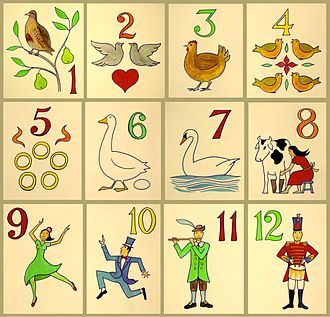
Depending on the source, “The Twelve Days of Christmas” was either a) written as a children’s book – which eventually morphed into a song, or b) “code” for memorizing elements of Christian religion at a time when faith could not be openly practiced.  I prefer the latter.  For example, the two turtle doves represent the New and Old Testaments of the Bible, while the four calling birds represent the gospels of Matthew, Mark, Luke, and John.  The six geese represent the days of creation (“and on the seventh day He rested”), while the eleven pipers represent the faithful disciples of Jesus Christ.  “My True Love” is Jesus himself.  Clever, no? (see here for the full “code”).

Wikipedia claims “the exact origin and meaning of the Twelve Days song are unknown…” so perhaps we should just leave it buried in the past.  But I can’t do that.  TDoC is so much more fun if you take the literal approach to the words.

The title is innocent enough.  “The Twelve Days of Christmas” equals Christmastide, a season of the liturgical calendar in most churches.  Christmastide begins on December 25th and lasts until January 5th (the day before the season of Epiphany).  Twelve days.  That’s even more celebrating than Hanukkah.  Fine with me – our family likes to drag out Christmas as long as possible.

Beyond the title however, “The Twelve Days of Christmas” descends into total chaos.  Consider the structure of the carol.  TDoC is a “cumulative” song, which means you add the previous verse to the one you’re singing – just like all those animals in “Old MacDonald Had a Farm”.  By the twelfth verse you’re singing about everything, and you’re totally exhausted.  Some people solve the length by having a different voice for each gift.  That’s great for the partridge in a pear tree singer, but kind of sucks for the drummers drumming singer (who only gets one chance to shine).  Make sure you have a solid voice for the partridge in a pear tree.

Speaking of the gifts, let’s do some analysis.  Other than the rings, your true love has an obsession with birds.  He or she is gifting you an aviary on six of the first seven days.  Doves, hens, swans, and more.  Not only that, you’re getting pear trees and God knows how many eggs from those a-laying geese. (Note: pears and eggs make great Christmas gifts).

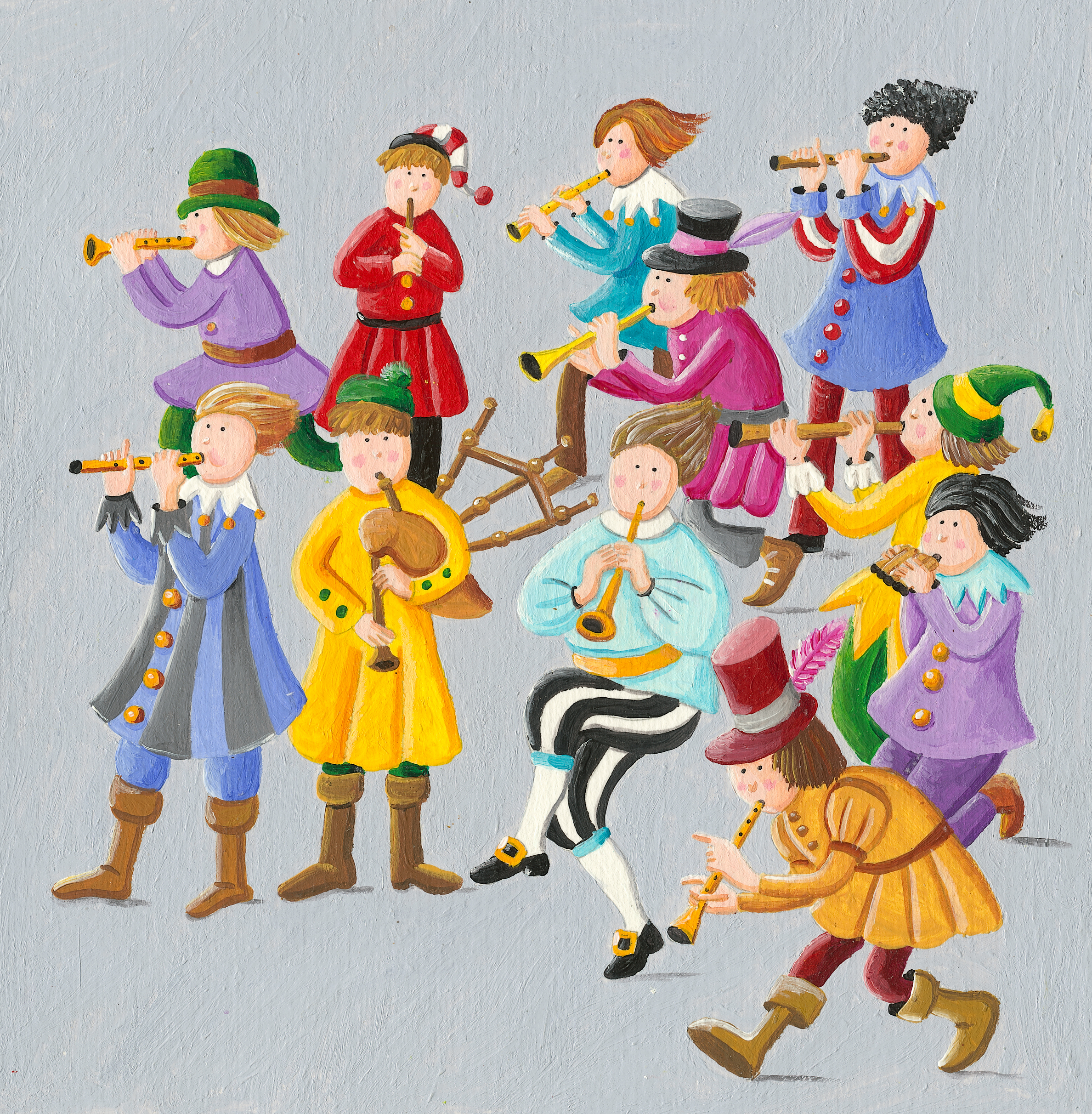
The final five days, your true love gifts you a bunch of workers and merrymakers for the estate you apparently have.  You’ll gain a herd of cows (what else are those maids a-milking?) and you’ll have a some dancers and a band making quite the ruckus on your front lawn.  The neighbors may complain.  C’mon, you say: how much noise can eleven pipers make?  Eleven?  So you forgot about the aggregate of a “cumulative” song, did you?  Your true love actually gave you twenty-two pipers by the time January 5th arrives… and twelve drummers, thirty-six dancers and thirty guys who like to jump.  And don’t look now, but your twelve pear trees are swarming with 184 birds.  Maybe you don’t have any pears after all.

Sorry, but if this is your true love’s idea of Christmas giving, he or she is a nut job (or at least an animal hoarder).  Here’s my advice: run.  Take your forty gold rings and date one of those lords or ladies instead.

Getting My Juice GONE (p.2)

“Survivor” is reality TV’s longest-running program. “Survivor” is also my new middle name after a vicious three-day juice cleanse last weekend. For my pre-cleanse (sane) state of mind, refer to last week’s Getting My Juice On. For my current (questionable) state of mind, proceed with caution. The words that follow may be the equivalent of the movie scene you wish you never saw; the one still burned into your brain.

The quick recap: my daughter recently coerced my wife and I into trying Pressed Juicery, a hard-core player in the world of retail cold-pressed juice products. PJ offers gentle confections like coconut water with cinnamon, but for the truly gullible (me), they suggest a “cleanse”, where you down 336 ounces of liquid in three days (assuming you include the recommended twenty-four glasses of water). In those torturous seventy-two hours you get nothing else on the menu – no snacks, no bars; no solid food whatsoever. It’s just bottle after bottle of sickly-green liquefied vegetables (with an occasional fruit thrown in, which might as well be a lamb tossed into a pride of lions).

Considering I knew everything in the above paragraph before I took the first sip labels me as some kind of (raving lunatic)? But add my daughter to the equation and my voice goes rogue with, “sounds great, honey!”. Thus last Friday morning at zero-eight-thirty, I took my first sip of the PJ Kool-Aid. Let’s set the table with the scrumptious ingredients. Kale. Cucumber. Romaine. Spinach. Parsley. Lemon. I’d list the rest but I’m about to toss my cookies just thinking about them again (and believe me I’ve had a few cookies since that last fluid ounce).

In the beginning (this is a tale of biblical proportions), I assumed remarkable confidence staring down Cleanse Bottle #1. I consumed its contents in two or three gulps. Not so bad, I thought. Utterly vegetable with a sickly fungal aftertaste, but nothing a glass of water wouldn’t kill. But two hours later (which is a short 120 minutes on a juice cleanse), Bottle #2 came a-calling. This time I’m not so fast. It takes me a good half-hour to drain the contents. Now I’ve got thirty-two ounces of liquified vegetables in my system, which PJ claims is eight pounds of the real produce. That’s rough(age) on a body, and the body doth protest. After Bottle #3 the burps started. After Bottle #4 I enjoyed the occasional dry heave. By Bottle #5 I was asking for Mommy so I could tell her I didn’t want to do this anymore.

Unbeknownst to me (remember, I am gullible), I had created the perfect storm of stomach acids and vegetable puree deep down in my digestive system. Perhaps that’s why Bottle #6 is all almond milk and vanilla. It’s like dumping two cups of Pepto-Bismol over the whole mess (“Coats!” “Soothes!”). Okay fine, but try sleeping on that stomach. Your dreams are technicolor and downright scary.

Somewhere during Day 2, I looked in the mirror and saw a cucumber with a tomato head and broccoli-stalk arms. I stifled a scream. I put my hands on my hips and tried a “Ho-Ho-Ho” to see if I should audition for those Jolly Green Giant commercials. But there’s no time for auditions when a bottle beckons every two hours. Furthermore, deep into a juice cleanse you stop stop tasting the vegetables. That is, even when you’re not drinking, you’re tasting the green. Every gulp of air is tainted with chlorophyll. No breath mint is strong enough to conquer the stench. It’s like somebody threw your backyard garden into a giant blender, then filled your swimming pool with the resulting green muck, then threw YOU into the deep end. You’re six feet under in vegetable quicksand.

Enough of the madness – let’s cut to the merciful end of my story. Somehow I burped and lurched Day 3 away.  On Day 4, the clouds cleared, the sun rose, and I awoke to the promise of solid food. Bless my soul – a full-course breakfast awaited me. No longer would I spend as much time in the bathroom as I would in the free world. Life was good again. Or so I thought. As PJ smartly warns you, one cannot just return to normal eating/drinking immediately after a juice cleanse. One must slowly reintroduce the finer things in life. Choose carefully. Chew slowly. Limit thy portions. Rome was not built in a day.

Would I recommend a juice cleanse? No. (unless you’re gullible – then you don’t have a prayer anyway). Do I feel healthier after my three days in the garden? No, but I feel different, as if a vegetable alien is growing inside my stomach and may someday rip its way out.  Do I have any advice after the fact?  Yes. Damn, I could’ve had a V-8!

Getting My Juice ON (p.1)

My daughter has a knack for making me do things I wouldn’t choose to do myself. Perhaps it’s because she was unexpected at birth (I came from a family of five boys and already had two sons of my own). Perhaps because as a kid, she could scrunch up her face and use her best sweet-little-girl voice whenever she wanted something. Maybe it really began by relenting to little Girl Scouts and their boxes of cookies at my front door.  Whatever the reason, my daughter still finds a way, even as an adult in her mid-twenties.  And that is why I’m commencing a three-day juice cleanse tomorrow morning.

Cleanse. The word scares me a little. I think of those whirly scrubbing-bubble characters on TV, dashing around the bathtub disinfecting away soap scum.  Or I think about SOS pads and their steel-wool grittiness.  Is this simply a short-term liquid diet, or am I on the verge of a full-on purge?

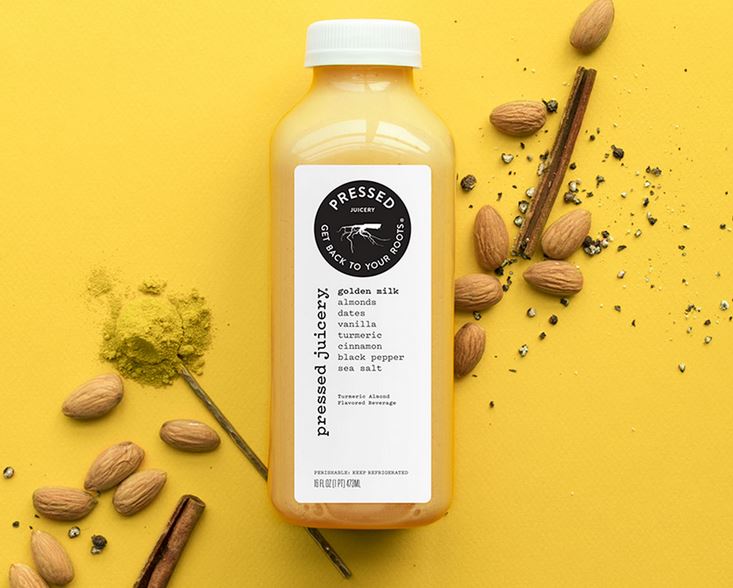
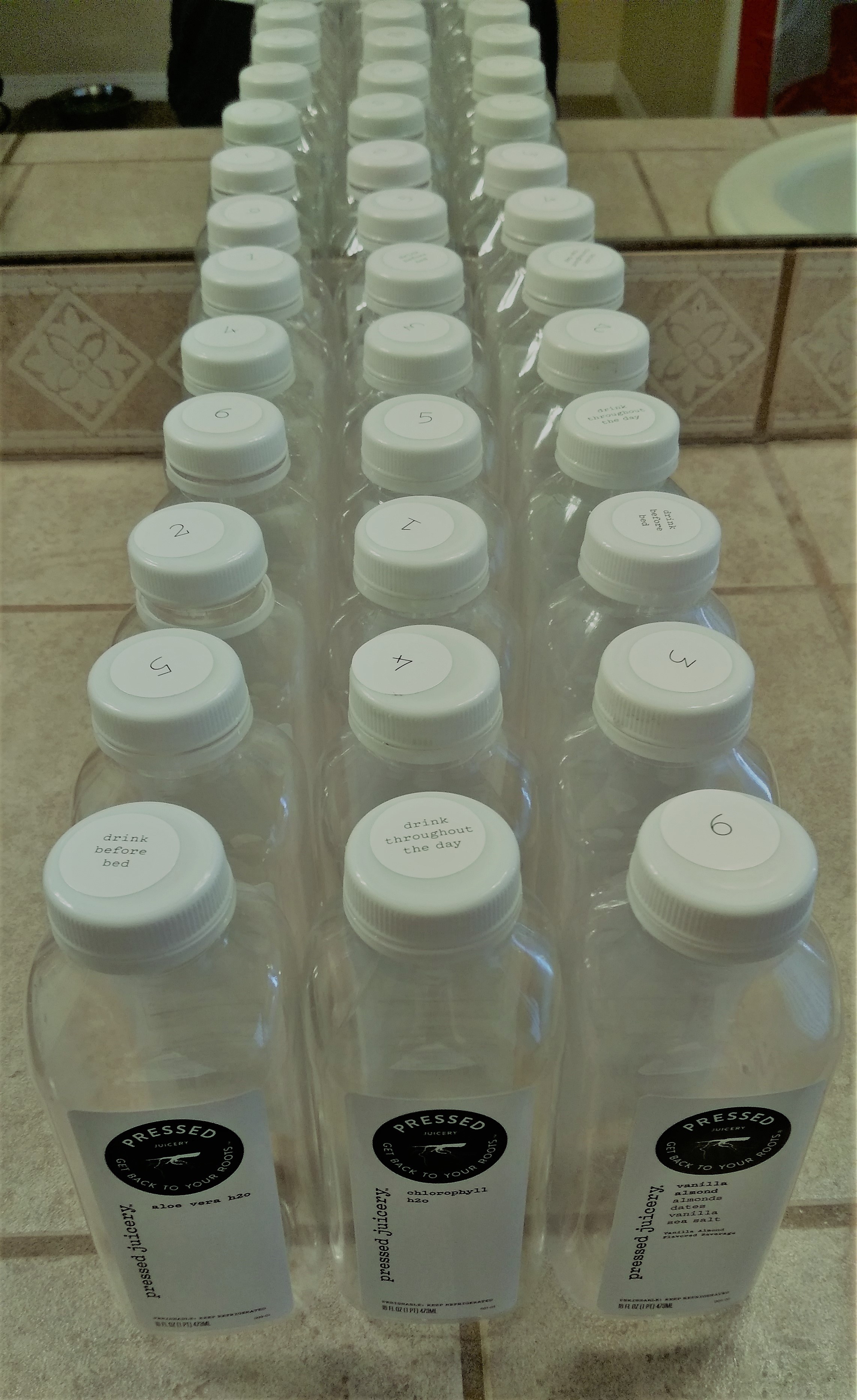
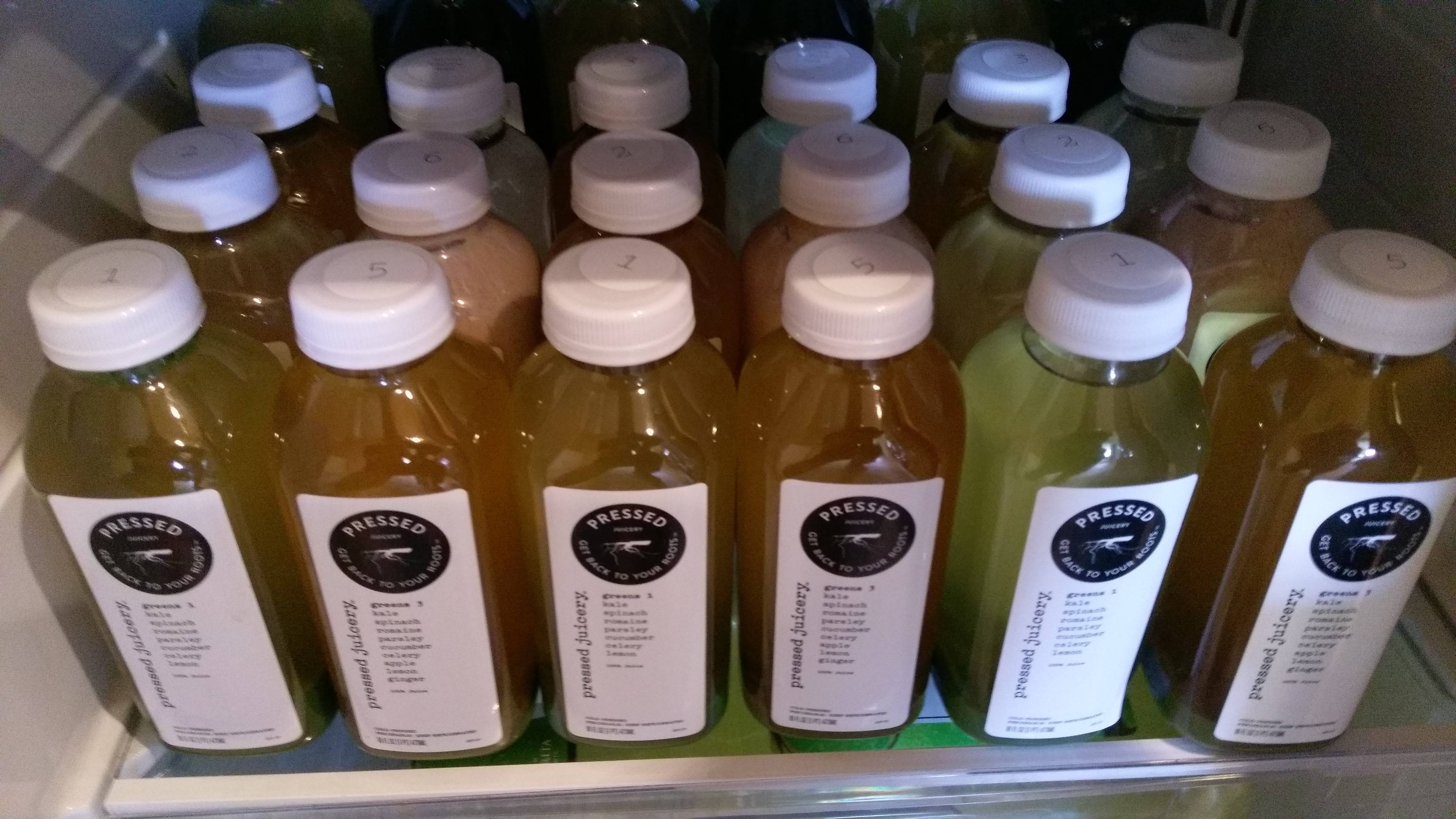
My box-o-cleanse arrived last night; a liquid-brick wrapped carefully inside a foil space blanket. I opened the container to find twenty-four intimidating 16 oz. bottles staring up at me. I swear they were grinning. They looked like they couldn’t wait to get out of their box, sprout their scouring brushes, and commence the cleaning. Each bottle contains a different colored concoction, labeled rather impersonally.  Greens 3.  Roots 1.  Citrus 2.  I’ll drink one of these little guys every two hours in the waking hours of the next three days, chasing their green goop with a similarly-sized bottle of “Chlorophyll” water or “Aloe-Vera” water. Chlorophyll? Aloe Vera?  I feel like a plant already.

I can’t claim to be surprised by the contents of my box-o-cleanse. Just last week I visited one of the labs – er, retail outlets – for a sample of these products. Pressed Juicery, with locations close to the coasts and Hawaii, sells cold-pressed, 100% fruit & vegetable concoctions; all ingredients non-GMO. I tried one of their delicious coconut-cinnamon drinks… and that was my mistake. P.J. lures you in with mild, decent-tasting options like coconut and cinnamon. Then they gently suggest you consider a cleanse.  My daughter wanted to try one, and I was only too happy to foot the bill (these drinks ain’t cheap).  I figured Colorado was a safe distance from the cleansing craze, so my only involvement would be with my wallet. Wrong-o. P.J. is happy to overnight their products to just about anywhere.  Thus my twenty-four cleanse bottles mock at me today, anticipating tomorrow’s cleaning kick-off.

If I stepped back and gave Pressed Juicery a hard look, I might have used my better judgement, turned, and fled.  The retail outlets abound with stark-white surfaces and plate glass.  The employees dress in uniforms intimidating enough to double as lab coats.  The products emerge from a dark, back wall refrigerator, pre-assembled and ready to consume.  For some reason “drinking the Kool-Aid” just came to mind.  Gulp.

P.J. describes their juice cleanses with a selection of unnerving words. Reboot. Fresh Start. Body Do-Over. Cue a bout of mild nausea. Am I going to be more intimidated by a) the taste of “four pounds of fresh produce in every juice” or b) what those four pounds will do to my insides? Will my body a) turn green and sprout shirt-ripping muscles like “The Incredible Hulk”, or b) reduce to a puddle (think “Wicked Witch of the West”) through non-stop visits to the toilet?

My daughter is already halfway through her own three-day P.J. cleanse.  She claims she’s never hungry, feels really healthy, and only misses “the act of chewing”.  But she also admits to gagging trying to get a bottle of “Roots 2” down (she recommends shot-glassfuls).

If I’m still around next week, you can count on a post-cleanse blog report.  If I’m not, Lord help me for never saying no to my daughter’s ideas.

The Euphoria of Joe

Today I’m perched at one of my favorite Colorado coffeehouses, sipping the local version of a cafe latte.  The air is rich with the bitter aroma from the nearby roaster.  I’m surrounded by chatty patrons, each with their own coffee-based delight-in-a-cup.  If I had a handful of the crunchy chocolate-covered espresso beans they sell, I could say coffee’s hitting all five of my senses today (instead, I have a delicious apple fritter).  These days, coffee is as infused into American culture as baseball and Apple (pie).  And how far we’ve come from the cups of Joe former generations would brew with store-bought cans of Folgers.

How far have we come (besides the requisite latte foam-art)?  Consider this: my coffeehouse does not allow to-go orders.  You read that right: if you get your coffee here you’re drinking in-house.  According to the resident “roastmaster”, paper cups alter the flavor of the coffee and thus they won’t sell it to-go.  Hard for me to swallow (the cup thing, not the coffee), as my palate has never been very discerning.  Yet here I am, paying top dollar to drink real-cup coffee “in the house”.

It wasn’t always this way.  Not so long ago all you had on the menu was a “cup of coffee”.  Take it black or take it with sugar/cream, but that’s where your options ended.  And the reference to “Joe”?  That comes from a 1914 ban of alcohol on U.S. Navy ships by then Secretary of the Navy Josephus “Joe” Daniels.  The strongest alternative to a “real” drink on-board was black coffee.

Today’s kids get their first taste of coffee at Starbucks.  My own first taste took place in Italy, during the college year I lived there in the 1980’s.  Italians take their coffee very seriously.  Walk into an Italiano café, belly up to the bar, and order an espresso shot and sweet roll.  That’s your standard-brand Italian breakfast, and you take it standing up.  You’re in, you’re out, and you’re on your way again in less than a minute, sufficiently caffeinated.  Not many are baptized on straight espresso, but that was my experience.

My coffee journey continued after college, but it was quite a stumble.  I graduated from Italian espresso and regressed to the standard-brand Bunn coffeemakers of corporate America.  Starbucks and its kin would not arrive for another 5-10 years.  Office coffee was a mindless, characterless, tasteless experience.  A Styrofoam cup of black nothingness, with a few unbrewed grounds thrown in for texture.  It was like descending from the Golden Age of the Roman Empire to the Dark Ages.

Thankfully, my coffee habits persisted until coffeehouses became an American staple in the late 1980’s.  The houses themselves still aren’t the vision of Starbucks’ Howard Schultz: “comfortable, social gathering places away from home and work”, but at least we’re getting past the Frappuccino-this and macchiato-that, evolving back to straight coffee.

My one dedicated-cash phone app is for coffee.  I literally wake up and smell the coffee thanks to my Keurig; then structure my waking hours with the possibility of a drive-through cup of Joe later on.  To get really serious I could spend $200 on a Ninja’s home coffee bar, which claims to be a coffee system (“Variety of brew types and sizes!” “Built-in frother!” “Tons of delicious coffee recipes!)  Their tagline: “See what all the coffee buzz is about”.

Coffee buzz is no joke, as patrons of America’s 33,000 coffee shops will tell you.  The euphoria we desire – the blissful effects drawn from caffeine – actually has a name: “margaha”.  For that reason, whether your preference is a nitrogen-infused cold brew, a coconut-milk mocha Macchiato, or a take-it-straight cup of Joe, it’s safe to say coffee is here to stay.