Sphere Delight

My wife’s sister and her husband just wrapped up a visit here in South Carolina. On the drive down from Colorado they made several sightseeing detours, but the trip back was pedal-to-the-metal… with the exception of one stop: the Moon Marble Company in Bonner Springs, Kansas. Moon Marbles stocks beautiful handmade wooden games and toys but c’mon, who braves the barren wastelands of Kansas for those? Marbles on the other hand, would draw me in like a bee to nectar.
A marble is the perfect example of a sphere, isn’t it?  I love spheres (including the word itself; much more elegant than “ball” or “orb”).  Take a semicircle, revolve it a full loop around its diameter and voila! – a sphere.  Calculating the volume of a sphere involves cubing its radius but let’s stop right there with the math lesson.  Cubes and spheres just don’t belong in the same conversation.

Lemons can be oblate spheroids

Most of you readers are tuned in from the Northern Hemisphere, the half of our planet above the Equator.  I find it cool to think of Earth as a sphere (with “big blue marble” a close second).  It’s the biggest sphere we humans know (or have you been to Jupiter?)  At your next party, wow your friends by telling them Earth is actually an oblate spheroid: flattened at both poles and bulging at the Equator.  Ewwwww.  Not a very pretty sphere, now is it?

Here’s the paragraph where I cop out and simply list a bunch of spheres, like oranges, Christmas ornaments, eyeballs, pearls, and the moon, but that’s just so three-hundred-blog-posts ago.  Spheres can be much cooler.  For instance, picture an atom (I’ll pause for those who need a microscope).  An atom is a spherical cluster of neutrons and protons (which are also spheres) encircled by whizzing electrons (more spheres).  Did you know your body is made up of over 7 octillion atoms?  That’s a lot of spheres.  You might want to lose a little weight.
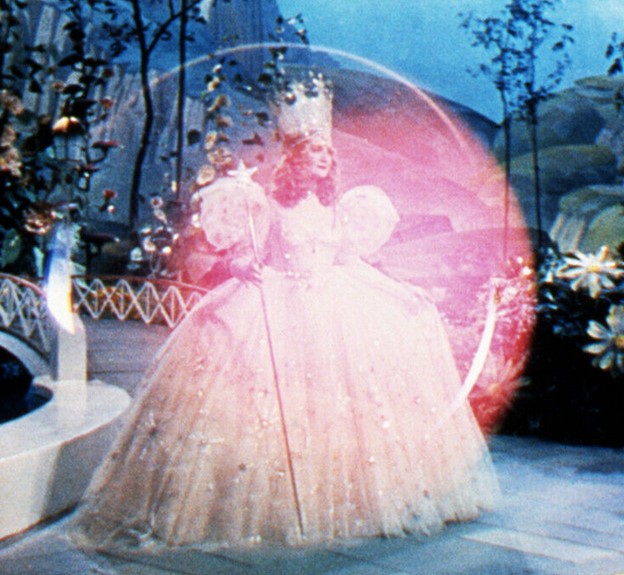
Glinda traveled to Oz in a sphere (photo courtesy of MGM)

Soap bubbles are spheres.  Sure, you aim to create those giant wibbly-wobbly monsters but for the most part you generate a cloud of perfectly spherical transparent globes, born on a whisper of air and extinguished seconds later.  I’m guessing soap bubbles have the shortest lifespans of all spheres.

When a college buddy visited several years ago, he brought a paperweight made by an artist near his hometown in New Jersey.  It’s a glass sphere with just the slightest bit of the bottom lopped off so it doesn’t roll off my desk.  I’ve picked up a lot of tchochkes over the years but I’m not letting this one go.  Did I mention spheres are cool?

Three years before he wrote Jurassic Park, Michael Crichton authored a novel called Sphere.  It’s about a group of scientists exploring a giant spacecraft sunk to the bottom of the Pacific Ocean.  In the spacecraft’s cargo hold: a mysterious sphere, determined to be extraterrestrial and literally mind-blowing.  Mark my words; spheres can be as terrifying as dinosaurs.  Read it.
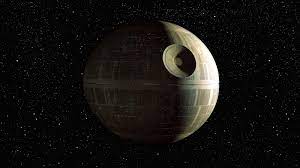
Dimples can be cute.  Not this one.

Star Wars focused on a giant spherical colony – the Empire’s “Death Star” – but the air went out of my perfectly round balloon as soon as I saw the giant divot on its side, not to mention all those channels and openings pierced by the X-wing starfighters.  In other words, the Death Star was a decidedly less-than-perfect orb.  So I applauded alongside everybody else when Luke Skywalker blew this sphere to kingdom come.

Here’s a place you wouldn’t expect to find a sphere: a Christian hymn.  In the first verse of This Is My Father’s World we have, “All nature sings and round me rings, the music of the spheres”.  The plural throws me off, because more than one sphere suggests more than just Earth (the entire solar system?)  Or maybe we aren’t singing about the planets at all.  A quote from August Rush seems relevant; the final line in the movie: “The music is all around us… all you have to do, is listen.”

Coming soon to Sin City

We’re starting to go round and round here (heh) so let’s conclude with the world’s largest sphere.  The Guinness Book writers will deem it so once the “MSG Sphere” opens in Las Vegas in a few months.  At 300 feet tall and 500 feet wide, the Sphere will dramatically change a skyline that’s already pretty dramatic, especially with 1.2 million LEDs on its surface generating all sorts of images and animation.  For concerts, sports, and the like, the Sphere can seat up to 18,000 spectators.  I plan to be one of them…  just as soon as I make it to Moon Marbles in Kansas.

Some content sourced from the CNN Travel article, “This futuristic entertainment venue is the world’s largest spherical structure”, and Wikipedia, “the free encyclopedia”.

Royal Beauty Bright

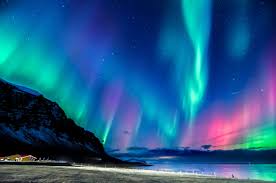
If I were more organized a couple of weeks ago I could’ve seen the Aurora Borealis. Maybe you’re familiar with this magnificent natural artwork: the waving colorful “northern lights” spreading across the sky like a wind-ruffled pastel blanket. The best seats for the AB are always to the north, like Alaska or the Arctic, but this year we had a similar instance just driving distance from our house in northern Wyoming. I missed it, darn it.  I’ll have to settle for a look at this week’s Christmas Star instead. Er, make that this week’s “Jupiter/Saturn overlap”.

The view from my house (directly above Pikes Peak!)

I’ve always been something of an astronomer wannabe. We have beautifully clear skies where we live and on most nights we can see more stars, constellations, and galaxies than we could possibly count. I’ve even invested in tripod-mounted high-power binoculars to get a better look at all things extraterrestrial. So I certainly didn’t miss the recent headlines about Wyoming’s “southern northern lights”, nor the nighttime blast of this week’s Christmas Star. Any astronomical event visible to the naked eye is worth noting in my iPhone calendar.

Courtesy of CBS News

Jupiter and Saturn aren’t really overlapping, of course (talk about an abundance of gas). They just look like they’re a single celestial object as seen from our Earthling vantage point. They’re still millions of kilometers apart in space, the same way stars in constellations aren’t all the same distance away from us. This blog post is a little late, as the best days to see “Jupiturn” were Sunday, Monday, and Tuesday, just after sunset and looking to the west.

Speaking of a little late, let’s talk about the Real Christmas Star (RCS). Surely you’re familiar with RCS, the singularly bright beacon from biblical times guiding the Magi to the birthplace of the baby Jesus (editor’s note: lots of “b’s” in that sentence, Dave). This star moved in a westerly path – as noted in the third verse of “We Three Kings” – like the oversized laser pointer of an invisible tour guide. This star was purported to have stopped directly over Bethlehem close to the events we celebrate on Christmas Day.  This star “with royal beauty bright” was…, was…, (spoiler alert) – well, this star wasn’t a star either.

Also not a star…

I know, I know.  We’re talking about events from over two thousand years ago.  Outside of the Bible and pure faith, how can we know the true identity of the RCS?  Well, we know because we have astrophysicists.  I’m never one to blend science and religion but I’m about to make an exception.

To keep this simple let’s address the basic questions:

  1. When did the RCS occur?  During the reign of King Herod and Emporer Tiberius.  Roman historians (and the Bible’s Book of Luke) give the approximate timeframe as 8-4 B.C.
  2. Who saw the RCS?  The Magi according to the Bible, but also Chinese astronomers according to their own records… which go back to (gulp) before 1000 B.C.
  3. What did the RCS look like?  A morning star, because it was rising.  Not a comet, not a nova, not even a supernova.  In ancient times those three were seen as indicators of negative events.  The Magi certainly wouldn’t have followed something negative.
  4. What was the RCS?  Ah, now there’s the question for the Powerball jackpot.  And that’s where our astrophysicists come to the rescue.  The RCS – like this year’s Jupiturn – was also the convergence of Jupiter and Saturn, only amplified by light from the sun, moon, and at least three other planets.  That’s putting a lot of “balls” into play, isn’t it?  Celestial alignments happen regularly over time so astrophysicists were able to project backward and offer this likely explanation of the Real Christmas Star.

The RCS alignment from two thousand years ago seems recent compared to its next occurrence.  You won’t get that kind of planet-star-satellite party again until the year 16213.  That’s fourteen thousand years from now.  You won’t be around by then.  Maybe Earth won’t be either.

I did look to the west after sunset to see the convergence of Jupiter and Saturn earlier this week.  It was bright – sure – but not as if looking directly at the sun.  And knowing it wasn’t a “star” took some of the shine off of it (ha).  Meanwhile, the Aurora Borealis is out there a little more often.  At least I’ll be alive to see its next performance.


Some content sourced from the University of Notre Dame article, “Royal Beauty Bright”.

Smallest and Innermost

Mercury

Last month, I spent an entire post lavishing love and affection on Earth’s beautiful space neighbor, the planet Venus (see here). I was quick to point out – from Earth – you can occasionally see the planets Mars, Jupiter, and Saturn as well. Turns out that list is, ahem, incomplete by at least one planet. Clearly miffed by my post, our solar system’s Mr. Smallest and Innermost – the planet Mercury – decided to speak up this week.

Don’t burn yourself, little one (image courtesy of NASA)

For those of you who missed it, Mercury passed in front of the Sun on Monday.  For five hours or so, Mercury looked like a little black mole on the bright cheek of a much larger creature.  His orbit took him almost directly across the center of the Sun.  You may think Mercury’s show is no big deal; after all, he circles the Sun every 88 Earth days.  However, consider Earth, Mercury, and the Sun must be exactly lined up (put a ruler on it) for humans to witness a Mercury “Sun transit”.  We only get fourteen Mercury transits every Earth century.  The next one won’t happen until 2032.

I missed Monday’s Mercury transit myself, because a) I wasn’t up at sunrise in the Northern Hemisphere (when it happened), and b) I didn’t have the necessary eye protection to give it a direct look.  Instead, I enjoyed the online photos and videos from NASA and the world’s other space agencies (like this one).

Mercury’s the tough little guy on the left

The truth is, you don’t have to wait for a Mercury transit to observe the first rock from the Sun.  On several early mornings last month, you could’ve seen Mercury rising in the east (same as Venus), and you’ll see him again early next year – no telescope required.  Guess I got caught up in the allure of Venus and completely ignored her nearby brother.

If Mercury and Earth were side-by-side

Mercury – like all the planets – has some interesting facts.  He completes three rotations about his axis (days) for his every two orbits of the Sun (years).  Pretty slow for the smallest orbit in the solar system.  He has no moons.  He’s only about a third the size of Earth.  He’s pretty beat up, with the most craters of any planet, and “wrinkles” caused by the cooling and contracting of his iron core.  Only two of Earth’s spacecraft have ever visited Mercury, and even those stayed far away from the surface for obvious reasons (800.6°F on the sunny side; -279.4°F in the shade).

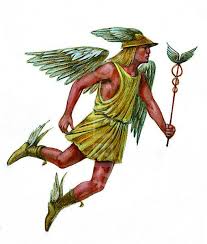
The Roman god for which Mercury is named is a lot “cooler” than the planet itself (ha).  Young Mercury wears a lot of hats, including (god of) financial gain, eloquence, and divination.  (Side note: perhaps Mercury should’ve been my blog mascot.  “Eloquence” was the theme of my very first post).  He also serves as the guide of souls to the underworld. Curiously, all these responsibilities take a back seat to Mercury’s most commonly known role – as speedy messenger to the other gods.  This role explains the naming of the planet, the fastest of the eight to circle the Sun.  Maybe we should also consider Mercury as messenger to the other planets, in case something gets weird with the Sun.  After all, Mercury will be the first to know.

I can’t talk about Mercury without a reference to the late, great Ray Bradbury.  Of all his wonderful science-fiction short stories – and there have been at least a hundred – my Bradbury top five includes “The Golden Apples of the Sun”.  “Apples” followed an exploratory rocket ship heading past Mercury to the Sun.  The crew is tasked with collecting a sample of the Sun’s golden fire.  I can still imagine the ship’s giant scoop as it extends from the hull and grabs a bit of the Sun.  The story’s real drama comes just after the collection, as the ship overheats and the life-support systems begin to shut down.  With respect to Bradbury, I won’t give away the ending.

Well then, enough about Mercury (probably too much).  I’ll conclude with a great tweet from Katie Mack, who was quick to note about Monday’s Mercury transit: “The official song of #TransitOfMercury is, obviously, ‘King of Pain’ by the Police.  But please note that the ‘little black spot on the Sun today’ referenced in the song is a ‘sunspot’, not Mercury, since ‘it’s the same old thing as yesterday,’ and (Mercury) transits only last a few hours.”

Keep on a-circling the Sun, Mercury.  I won’t forget ya next time.

Some content sourced from the BBC.com article, “Planet Mercury passes across the face of the Sun”, the Space-Facts.com article, Mercury Facts – Interesting Facts about Planet Mercury, and Wikipedia, “the free encyclopedia”.

Girl Crush

The Goddess

Last Sunday, our corner of the night sky was graced with a full moon called a “Tiny Hunter”. Tiny, because the moon was at the furthest point in its elliptical orbit. Hunter, because this time of year harvested fields leave few places for animals to hide. (Add a full moon and the hunting’s even easier). When our Tiny Hunter rose in the east that night, it was as if a giant flashlight switched on in the heavens, blotting out a typically starry night. But I know it didn’t blot out everything. Venus, beckoning brightly to the west, was saying hey, this is my party too.

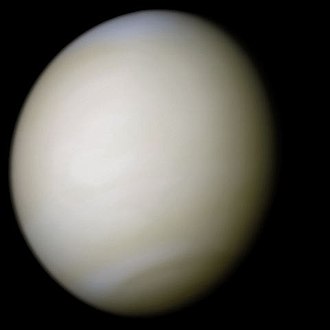
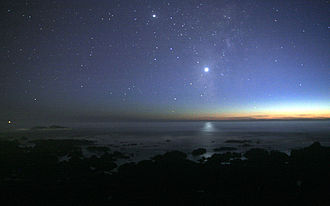
Next to the moon, Venus is the brightest bulb in the night sky. Even if you don’t know where she sits, you can find her by simply scanning the western horizon at dusk or eastern at dawn for the most brilliant pinpoint of light. As if outshining all of the stars isn’t enough, Venus is also the most vivid planet. Mars, Saturn, and Jupiter occasionally make an appearance, but Venus always seems to be there. Even in broad daylight.

“Morning Star” or “Evening Star” – take your pick

I’m not gonna lie; Venus gives me a bit of a girl crush. After all, she’s the Roman goddess of love and beauty. Now consider her other “outstanding” attributes:

  • She’s the only planet in our solar system to identify as female.
  • She’s referred to as our “sister planet”, not only because she’s our closest neighbor, but because she’s virtually the same size.
  • She rotates in the opposite direction of seven of the eight planets (including Earth).
  • She hosts two continents: Ishtar Terra (named after the Babylonian goddess of love), and Aphrodite Terra (named after the Greek goddess of love).
  • Her rotation is so slow, a day in her world is longer than a year in ours. But, a year in her world is shorter than that same day. Say what? You read that right: Venus completes a trip around the sun faster than she completes a rotation on her own axis.
  • Her orbit is closer to the shape of a circle (vs. an ellipse) than all other planets.
  • She has no moons or rings. Naturally, why would the goddess of love and beauty need adornments?

No wonder the Babylonians referred to Venus as “bright queen of the sky”, eh?

Given her allure, it’s a wonder our earthly culture hasn’t done more to embrace her. I went in search of homage to Venus and here’s all I could come up with:

  • Sandro Botticelli’s iconic “The Birth of Venus” (top left), with our girl posed unashamedly naked on a seashell.
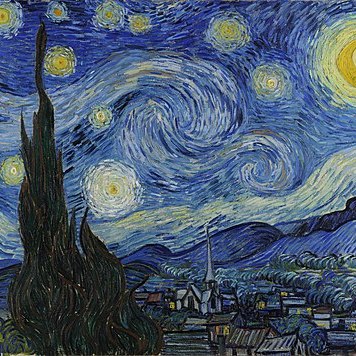
  • Vincent van Gogh’s post-impressionist “The Starry Night” (top center), with Venus as the bright “star” just to the right of the cypress tree.
  • The Bible’s Song of Songs (fitting, if you know the book’s subject matter), Chapter 6, Verse 10.
  • John Gray’s bestselling relationship guide, Men are from Mars, Women are from Venus.
  • Gillette’s “Venus” line of women’s shaving products.
  • The “Venus” women’s clothing line (catalog arrived for my wife just last week).
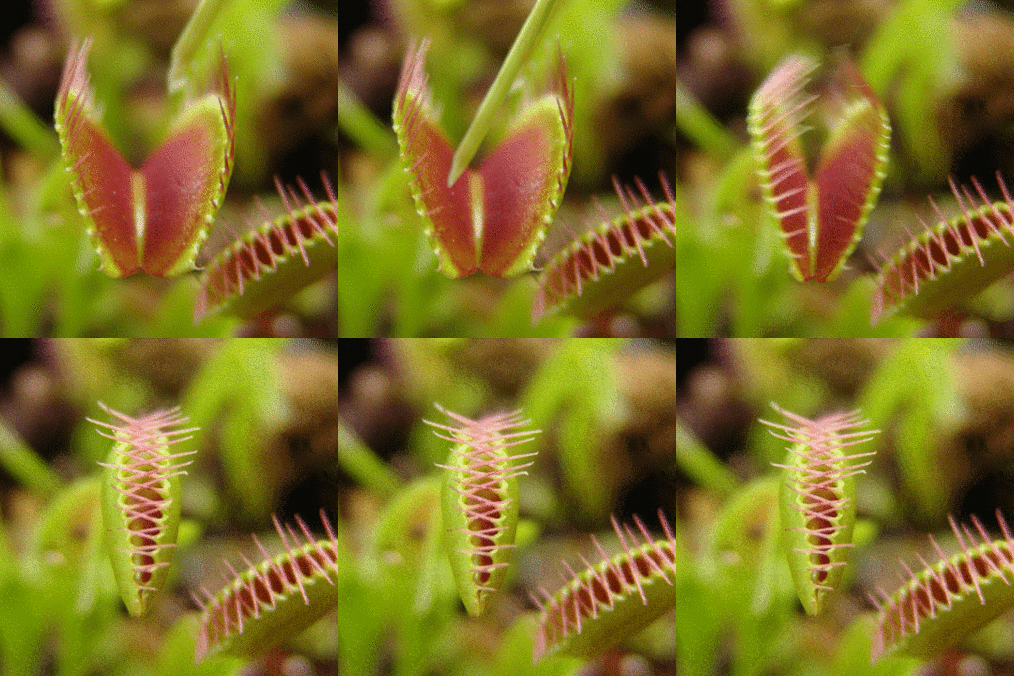
  • A nasty-looking fly-trapping plant.
  • Frankie Avalon’s adoring anthem “Venus” (Hey, Venus… oh, VENUS…).
  • Shocking Blue’s psychedelic rock hit “Venus” (I’m your Venus… I’m your fire, at your desire…).

If that’s the extent of our tribute to Venus, no wonder we have the phrase “hell hath no fury like a woman scorned”. Venus shows her not-so-lovely side if she wants to. She’s the hottest planet in the solar system (including Mercury), with an average surface temperature of 863 degrees F (462 C). Her atmospheric pressure is 92 times stronger than Earth’s (which is why her surface is beautifully crater-free). She’s covered in a thick layer of sulfuric acid clouds. Her wind speeds are extraordinarily high. And she’s explosive, with a long history of volcanic activity.

The second rock from the Sun… and the brightest of all eight.

Scientists believe – 700 million years ago under drastically different conditions – Venus was temperate enough to host oceans of water and life itself. So…, what in God’s name happened to make her so nasty now? Whatever it was, even our most advanced spacecraft can’t land on her surface today (though we’re working on it).

Considering this brief education on Venus, I suggest you ignore her siren song and simply admire her from afar. Even if you could speed your car along an interstellar highway, you’d need over forty years to get to Earth’s twisted sister. No; stay on her good side lest she show her surface temperatures and atmospheric pressures. That wouldn’t go well for you. I’d rather look Medusa in the eye and be turned to stone.

Some content sourced from the 9/22/19 Phys Org article, “Could Venus have been Habitable?”, “Venus Facts:…” from The Planets website, and Wikipedia, “the free encyclopedia”.
Of Rings and Romans

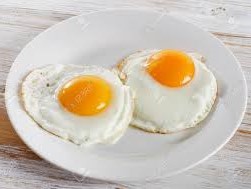
Eggs are a favorite food of mine.  A breakfast plate is hardly complete without a couple of the fried, scrambled, or omelette-d variety. They’re delicious for lunch in an egg salad sandwich, or for dinner in a chef’s salad or a quiche. Don’t forget deviled eggs for a tempting appetizer. Nothing’s unusual about these egg-zamples, but here’s where it gets borderline obsessive. Earlier this week I imagined two sunny-side-up eggs placed flat-side to flat-side (don’t ask me why; I just did). What do you get when you do that? SATURN!


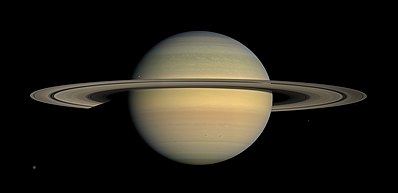
Perhaps you missed it on Tuesday, but the planet Saturn made a pageant-worthy appearance in our night sky.  Saturn “came to opposition” (sounds political), meaning Earth made its annual passage directly between the ringed world and the sun; at precisely 11am Colorado Time.  Saturn was closest to Earth at that very moment.  Ten hours hence, when Colorado’s sky was dark enough for stars and such, Saturn was already well above the horizon to the southeast.  At least I think it was Saturn.  Without a telescope, I channeled my most amateur inner-astronomer using handheld binoculars.  All I got was a shaky image of a bright, white pinprick in an otherwise fabric of black.  But I must say, it was a pretty big pinprick.

Saturn is certainly the most distinctive of the eight planets in our solar system (take that Pluto, you dwarf-pretender you).  Stage a planet beauty pageant and Saturn would simply flaunt her colorful rings to win ten out of ten times.  The distant runner-up, Mercury, would get a few sympathy votes for her steadfast “cool under fire”.  Mars would get no votes for her perpetual look of embarrassment.  Earth would be disqualified for serving as pageant host.  It’s Saturn with the sash every time.

There’s more to this heavenly body than meets the naked eye (WHOA; that may be the most risqué sentence I’ve ever written).  Saturn is a big ball of gas – hydrogen, helium – and less dense than water, which means if you threw her in the pool, she’d bob around like a big ol’ beach ball.  She completes a full rotation in ten hours; so fast in fact, her equator bulges enough to make her look like a flattened ball (not very becoming of you, Saturn).  Her glorious rings are circular masses of ice crystals, over sixty feet thick.  Her surface temperature is -300 degrees Fahrenheit, a reward for sitting sixth place from the sun.

All of which paints a not-so-rosy picture (but at least there are rings around the not-so-rosy – ha!).  If you could travel to Saturn (no spacecraft headed that way anytime soon), could stand on her surface (you can’t), and could withstand her “balmy” temps (one helluva spacesuit there), you’d still fly off into space on account of that zippy rotational speed and global shortage of gravity.  You’d probably splat into her pristine rings like a useless little bug. Ick.

Saturn

Saturn gets her name from the Roman god – not goddess – of agriculture and time.  Which begs the question, why am I calling him a her?  (Crud, I have to start this blog all over again.)  Even better, Saturn was also the god of wealth (now we’re talking).  In ancient Rome, the Temple of Saturn housed the town treasury.  And this same Roman god is why we call the first day of the weekend Satur(n)day (you’re welcome for that).  So, let’s review.  One of eight planets is named after you.  One of seven days is also named after you.  You must be one important dude.

And yet, Saturn (the planet or the god – you pick) doesn’t get much love in Earthly culture.  I scoured the web for references (okay; no I didn’t – I just looked up “Saturn” on Wikipedia), and all I came up with was a) a Sega video-game console, b) a discontinued brand of automobiles, c) a rocket booster (just the booster, not the rocket itself), and the annual trophies presented by the Academy of Science Fiction, Fantasy, and Horror Films.  Oh yeah, and a small, unincorporated community in Whitley County, Indiana.  Oh yeah again, and one of the primary characters in the “The Three Investigators” children’s books.  Er, wait, that was Jupiter Jones. Dang it!

Even if Earthly culture dresses down her sexy rings (again with the risqué), I still say Saturn wins the pageant (only now it’s a male pageant and that doesn’t work for me).  If you’re not convinced “he’d” win, consider this last fact.  Saturn has sixty-two moons.  Sixty-two!  Maybe Earth’s moon should head on out and join the party.  Can you imagine the night sky if you lived on Saturn?  The fabric would be loaded with pinpricks (including Titan, the second-largest moon in the entire solar system).  Moons, rings, Roman Gods, weekend days; what’s not to like?  As I said, it’s Saturn with the sash every time.  Now stop playing with your breakfast and get back to work.

Some content sourced from Wikipedia, “the free encyclopedia”, and the Universe Today article, “Ten Interesting Facts about Saturn”.