Minuscule Marvels

For Christmas this year I’m putting a small ornament into my wife’s stocking. It’s a miniature of… well… let’s just leave it at “a miniature” in case she reads this post. But I know she’ll love this ornament and promptly hang it on our tree for the remainder of the season. Why will she love it? Because it’ll spark fond, romantic memories. But she’ll also love this ornament because she can’t help loving something that’s a little, well, little.

Ornaments are little

One of my bucket list items – still to be fulfilled – is a trip to the south of France for a taste of those wonderful wines created from Burgundy or Bordeaux grapes.  Maybe you hope to make the same trip some day so I’ll let you in on a little secret.  If your trip only allows a visit to Paris, you can still visit a vineyard… right in the middle of the city.  Most people visit the neighborhood of Montmartre to see the Sacre Coeur cathedral but most don’t know about the tiny vineyard just steps away.  Clos Montmarte produces wine on a single acre, from 2,000 vines forging a connection to the long-ago rural times of the region.  Compare an acre to the wineries in Bordeaux, with vines covering an average of fifty times that much property.

Harvesting the grapes at little Clos Montmartre

Clos Montmarte wines probably aren’t award-winning.  Who knows if I’d even care for the taste of their reds or rosés.  But does it really matter?  I love the thought of a teeny-tiny field of grapes right in the middle of Paris.  I love how the grapes are harvested by locals and transported to the cellars of the nearby Town Hall to be pressed and turned into wine.  The whole operation is appealing to me because it’s quaint and because it’s small.
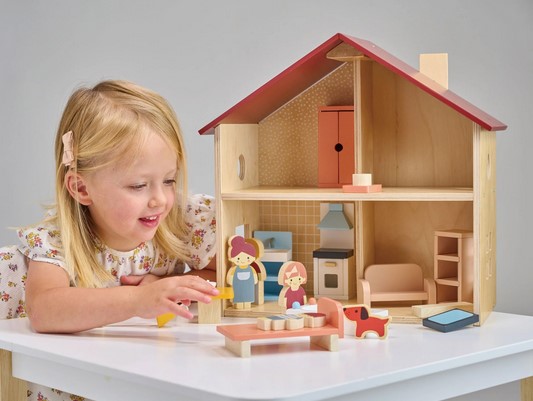
This affection for itty-bitty things must hearken back to our childhoods.  Who among us didn’t spend countless hours of playtime with (take your pick) little dolls, little cars, little houses, or scaled-down trains?  When we played at the beach we built little castles.  When we played in creeks we made little boats out of sticks or leaves and watched them flow with the water.  Tea parties meant tiny cups and plates on tiny tables.

My granddaughter’s little favorites

In today’s world the toys might be different but the attraction to small things remains.  It fascinates me to watch my (little) granddaughter choose her favorite toy from among dozens: a set of ten two-inch high Sesame Street characters.  She stands them up all over the house.  She hides them and then finds them.  She always seems to have one or two in her hands.  Even though my granddaughter doesn’t speak in complete sentences yet, she probably has complete thoughts as she considers tiny Big Bird.  You are a lot smaller than me and that’s why I like you so much.

Wee little cube

If you include Japanese toymaker MegaHouse in this year’s Christmas purchases, maybe you’ll go for their world’s smallest operational Rubik’s cube.  You can’t get one until next April, but picture this: the minuscule marvel is one 1,000th of the size of the original.  Pull out your metric measure to confirm it; a single face of the wee cube measures only 5mm from side to side.  Best throw a pair of tweezers into the Christmas stocking along with the cube.  There’s no way you’ll be able to rotate the Rubik’s colors with fingers alone.

Would I want the world’s smallest operational Rubik’s cube, you ask?  Heck yeah!  Consider, the faces of a traditional Rubik’s cube contain a 9×9 grid.  Then someone went and created a miniature Rubik’s cube with 2×2 grids.  I thought, how very cute.  I just had to have one so my original would have a little buddy.  My cubes are hanging out together on my home office shelf as we speak.  And they’re asking for an even littler buddy for Christmas.

Rubik’s “Mini”

So let’s summarize the pint-sized products we’ve covered today.  I already have the ornament for my wife in-hand (soon to be in-stocking).  I won’t put a bow on a bottle of Montmartre wine this year because I want the chance to see the tiny Paris winery for myself first.  And you probably thought I sprung for one of MegaHouse’s pee-wee Rubik’s cubes (and a pair of tweezers). Sadly, no.  I don’t have the $5,300 it costs to buy one (minuscule marvels aren’t cheap!) Thankfully, my wife will be happy with an adorable little ornament for $15 instead.

Some content sourced from the CNN Travel article, “The secret vineyard in the middle of Paris…”, and the CNN Style article, “This is the world’s smallest Rubik’s cube…”
Game, Set, Matches

The LEGO Eiffel Tower is the tallest of its model kits and undoubtedly the largest of its Architecture Series. At a deliberate count of 10,001 pieces, this behemoth is a whole lot more detailed than LEGO’s 2014 original, which clocked in at a mere 321 pieces. So imagine my awe (okay, and shock) when I learned about another Eiffel Tower model; one with a staggering 700,000 pieces. Suddenly 10,000 seems like a nice, reasonable number.

Matchstick model

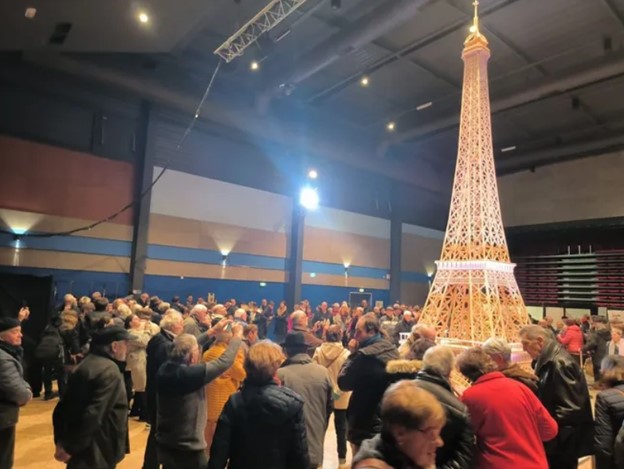
It’s true, of course.  A Frenchman recently converted 700,000 matches into a model of the Eiffel Tower, in an attempt to break the world record for, naturally, “tallest matchstick Eiffel Tower”. (Is there a world record for everything these days?)  I suppose I can get past the 700,000 matches – even if I can’t picture that many in one model – but what I can’t fathom is the eight years Richard Plaud sacrificed to build his creation. I’m picturing Monsieur Plaud waking up each morning, bidding adieu to his wife after a croissant and some French press coffee, and heading off to his studio to play with matches, a giant bottle of glue in hand.  Day after day after day.

Our Frenchman’s accomplishment wouldn’t be so interesting if there weren’t a little drama thrown in for spice.  Turns out his 23.6-foot model may not earn the world record after all.  Why?  Because Plaud cut the heads off the matchsticks as he built.  When he got tired of cutting, he contacted a French “matchmaker” (ha) and asked if he could place a massive order of headless matches.  And there’s the rub, fellow model builders.  Guinness is disputing Plaud’s claim of the world record because the materials used can’t be purchased by you or me, should we try to build our own matchstick Eiffel Tower (but would we?)

Meanwhile, a 21.6-foot Eiffel Tower model built by Toufic Daher (coolest name ever) retains the world record.  Daher’s model was completed in 2009 using six million (headed) matches.  I have no idea how long it took him to build, but seriously, how long does it take to simply pick up six million little sticks, let alone shape and glue them into a replica of the Eiffel Tower?

“La Dame de fer”

Gustave Eiffel (another cool name) surely had no idea people like Plaud and Daher would be obsessed with his tower 135 years after the fact, in pursuit of world records.  Frankly (“France-ly?”) Eiffel’s “Iron Lady” is impressive enough to stand on her own wrought-iron feet.  After all, she’s among the most recognizable structures in the world.  She surpassed the Washington Monument when she opened to the public in 1889, as “tallest human-made structure” (sadly, seventy years before Guinness started tallying world records). Today she still merits an entry in the world record book, albeit for a different reason:”Most Visited Monument with an Entrance Fee”.

There’s a touch of iron-y to this post.  As much as I’m making blog fodder of these Eiffel Tower model builders, I’m tempted to become one myself.  Not with headless matchsticks; the LEGO version.  Several years ago I completed the LEGO U.S. Capitol Building (1,032 pieces), followed by the LEGO Grand Piano (3,662 pieces), and more recently, LEGO Fallingwater (811 pieces).  I keep an eye on the LEGO catalog for other models of interest but not one calls to me… except La Dam de fer.  But then I pause to ask myself, am I really willing to dive into a project that’s effectively one hundred bags of one hundred pieces each, where ever single piece dark grey?  Stay tuned.

LEGO’s version

As for our French ami Richard Plaud, his eight years of pick-up sticks may not have been in vain after all.  Guinness admits they might’ve been a little quick to dismiss his claim.  In their words, they wanted to make sure “the playing field is level for everyone”.  Playing field?  Ah, so this Eiffel Tower model-building is a game, is it?  For Plaud at least, I’d call it game, set, matches.

Some content sourced from the USA Today article, “8 years down the drain?…”, and Wikipedia, “the free encyclopedia”.

Keeping Score at the Grocery Store

In the chaos of the supermarket a few days before Christmas, milk, eggnog, and a package of those Li’l Smokies sausages fell into our shopping cart. These items don’t usually find their way into our frig but the year-end holiday meals somehow demanded them. If the market wasn’t so frantic I would’ve also whipped out my phone to see if these purchases deserved my dollars. After all, just about everything we use in the kitchen (and bathroom) these days has a little numeric value lurking just below the surface.

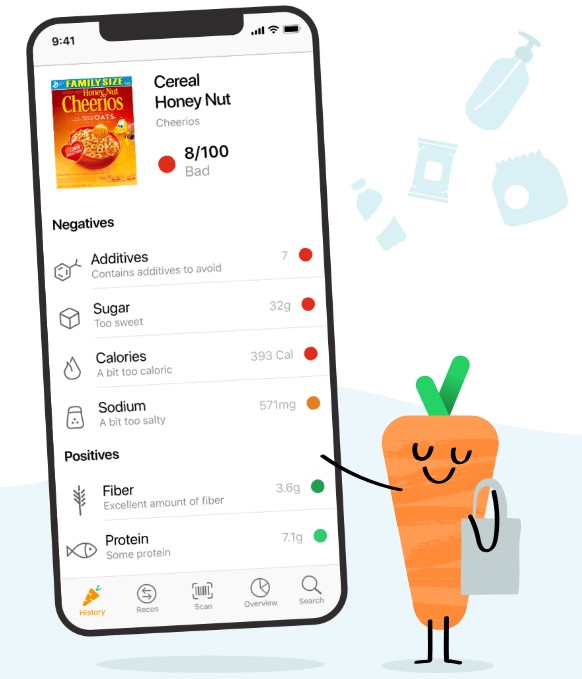
Nacho Cheese Doritos are now a “5” in my world.  You might say pretty good! until I tell you that’s on a scale of 1-100.  But let’s say you choose Blue Diamond’s Almond Nut-Thin Crackers instead.  The number skyrockets to 84.  A roll of Wint-O-Green Life Savers earns a 28 while a box of Tic Tac Freshmints doubles the number.  Nature Valley Granola Bars? 51. Heinz Ketchup? 33.  And in the ultimate insult to products considered “food”, perfectly round Nabisco Oreos earn a perfectly round 0/100.

What’s with all the tallying, you ask?  The numbers are simply the output of a little smartphone app called Yuka, which joined my personal parade of subscriptions last May.  In the words of its young French founders (Julie, and brothers Francois and Benoît), Yuka “deciphers product labels and analyzes the health benefits of foods and cosmetics”.  Plain English: Scan the barcode of anything in the supermarket and Yuka tells you whether to buy it or not.

Candidly, it wasn’t the numbers that sold me on Yuka.  Rather it’s this: the app is completely ad-free because brands cannot pay Yuka to advertise their products.  In other words, the numerical ratings I’ve shared are generated objectively, using common perceptions of the health benefits of ingredients.  Yuka has rocked the small space known as my kitchen pantry.

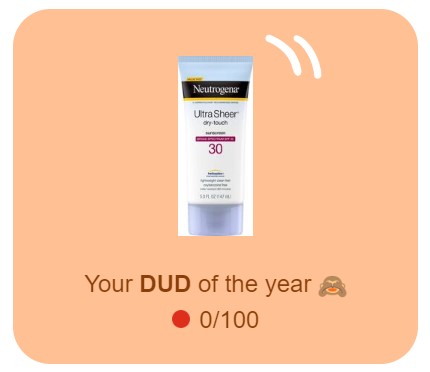
Never is this overhaul more evident than with “cosmetics”, Yuka’s catch-all for everything you find in the bathroom.  In the last eight months I’ve swapped out my deodorant, mouthwash, shaving cream, shampoo, and face wash for items with better Yuka numbers.  Five products I used every day and purchased for years just went flying off my medicine cabinet shelves, replaced by other products that are healthier on and in me (including Aveeno’s facial cleanser, which earns a perfect 100).

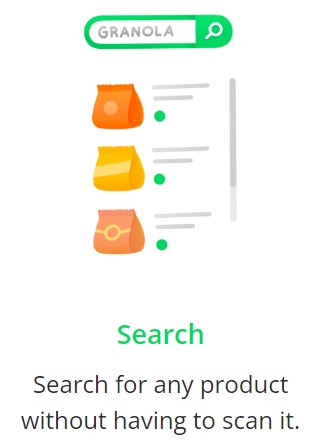
Yuka (the name is a nod to Yucatán) is about more than scan-and-score.  You can also simply search on products, mining a database of five million entries.  Even if a product isn’t in the database you can enter the ingredients from the label and Yuka will give it a number.  And if that number is lousy (like it is for your Oreos or my L’il Smokies) Yuka will point you to a list of alternatives with better numbers.  Again, Yuka doesn’t recommend one product over another; it just presents the numbers for you to consider.

In a nod to the healthy habits of Europeans (who favor fresh foods), Yuka’s founders realized its app was most popular in America, where we are so fond of packaged products.  So they packed up their French offices and French families and moved to the middle of Manhattan – temporarily – to better connect with their target audience.  Eventually they’ll head back home but not before Yuka is sure to land on the smartphones of millions of Americans.

Here’s one more aspect of Yuka I appreciate: the founders take time to communicate with their users.  In the eight months I’ve subscribed, they’ve sent me twelve emails with interesting articles about healthy eating, healthy “cosmetics”, and the entertaining evolution of their little company (which includes a dog as an employee).  They also sent me a fun video of their first few days in New York City.  And just last week I received a year-end recap of my app use (93 products scanned with an average score of 46).  No advertisements and no product pushes.

The subscriber version of Yuka is $15/year (you can try a more limited version for free), which includes the convenient scan-for-a-score feature.  Furthermore, your subscription dollars are what keeps Yuka in business, instead of funding manufacturers who’d like nothing more than to push their products on you.  That’s just one of the reasons I now keep score at the grocery store.

Rolling in the Isles

With the world “opening up” again, my wife and I often talk about places we’d like to visit. Some of them are more accessible now that we live near the East Coast. One in particular is further away. But coincidence or not, the five locales tempting the travel bug in me have one thing in common.  Every one of them is an island.

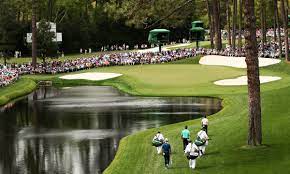
#16 at The Masters in Augusta, GA

Let’s get my first choice out of the conversation straight away, because it kind of stretches the definition of “destination” and “island”.  I want to go see a round of The Masters golf tournament in Augusta, Georgia.  If you’re not into golf you won’t understand the fuss, but trust me, when you’ve watched this competition on television every April since you were a kid, the place becomes a shrine of sorts.  The Masters never played into our decision to move to South Carolina, but the course is suddenly only forty-five minutes from my new front door.  So why is it an “island”?  Have you been to Augusta?  The Masters is like finding a bright green emerald in a bowl of gravel.  Let’s just say it would be complimentary to describe the rest of Augusta as “plain vanilla”.

There are no bad photos of Hawaii

Now for the real islands.  The first two fall on a lot of must-see lists: Hawaii and Ireland.  Hawaii is no less appealing even though South Carolina makes it three hours further than from where I used to live.  I’ve only seen “The Islands” on my honeymoon and on family trips (decades ago) so I know this time around would be decidedly more adventurous.  Not that I want to bungee-jump into a volcano or anything; rather just take a closer look at all Hawaii has to offer.

Ho-hum… just another town in Ireland

As for Ireland, it feels a lot closer when you live up against the East Coast.  If I had x-ray vision I might see the Blarney Stone from these parts.  My wife and I celebrated our 25th wedding anniversary with our first trip to the Emerald Isle, where we saw a lot of Dublin and only a wee bit of everything else.  We tossed a coin into the Trevi Fountain to be sure we’d go back, and… oh wait, right… that’s Rome.  Anyway, something we did in Ireland back then – whatever it was – instilled the yearning to go back someday.  And we will.

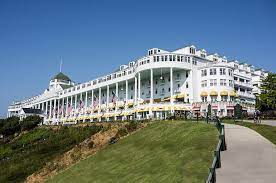
Mackinac Island’s Grand Hotel

Island #4 – Mackinac – sits neatly between the two peninsulas of the state of Michigan. The “Crown Jewel of the Great Lakes” has been on my must-see list ever since I watched Somewhere in Time in college in the 1980s.  Yeah the movie’s a little corny, but it’s utterly romantic and it stars Jane Seymour, so cut me some slack.  More importantly, Somewhere in Time shows off Mackinac’s Grand Hotel in all of its past/present glory.  No, I can’t afford the stay at the Grand (rooms start at $500/night) but I’ll settle for one of the B&B’s on the island and spend my money on other stuff instead.  Like a horse-drawn carriage tour with my wife (Mackinac has no cars).  Or a round of golf on the only course in the country where the trek between the front nine and the back is, again, by horse-drawn carriage.  Or a brick of Mackinac’s famous fudge.  Whatever the draw, I’ll endure two connecting flights, a couple hours of driving, and a quick ferry ride, just to experience Mackinac’s throwback delights.

I’ve saved the best for last (well, at least, I think it’s the best).  If I ever make it to France, I’m heading straight to Mont-Saint-Michel.  “St. Michael’s Mountain”, which I’ve blogged about here, first captured my imagination when professional sandcastle builders (yes, there are such people) built a replica on the beach where I grew up, and again when I studied architecture in college. 

Mont-Saint-Michel
The beach-sand version

The whole island setup is just so remarkable: nothing but a walled village of shops, restaurants, and other structures, connected by cobblestone streets ascending up, up, up to the Romanesque church and abbey at the pinnacle.  Only 29 residents at last count.  The surrounding tides ebb and flow, so at times Mont-Saint Michel is an island and at other times not so much.  And about that abbey on top.  The first cornerstone was laid in 1023, making Le Mont 1,000 years old this year.  All that time and I’ve never ever seen it?  Mon dieu.

One of Ireland’s many Aran Islands

If I make it to my five “islands”, I might have to add just one more.  Ireland is paying people almost $100k for the “gift” of an island off the western coast of the country.  There are twenty such islands.  The catch: you have to refurbish whatever structures you find and you have to live there.  Shelter yes, but food, water, power, and fellow humans are maybe’s.  Yeah, I won’t be rolling with any of those isles.  Let’s just start with that golf course down the street from me, shall we?

Some content sourced from the CNN Travel article, “Ireland will pay you $90,000 to move to a beautiful island home”

Crescents and Con Artists

Every Christmas without fail, my family enjoys croissants as part of the morning meal. We pop them into the oven after seeing what Santa left in our stockings (but before unwrapping anything under the tree). So last week, as I loaded our Easter ham into the garage frig, a tantalizing thought occurred to me: the leftover Christmas croissants are parked right next door in the freezer. Could they possibly be as light and flaky as they once were, four months after their initial rise-and-shine?

If you know anything about authentic croissants, “rise and shine” is a fitting description.  Thanks to some seriously active yeast, croissants rise to a soft, pillow-y consistency.  Thanks to a whole lot of butter (and a little egg yolk), croissants finish with a pleasing sheen on their delicate, crispy crust.  If there’s a more decadent baked good on the planet, my crescent-shaped ears are open and listening.

Austrian kipferi

Croissants have been around a long time.  They got their start centuries ago in France Austria as the more pedestrian kipferi yeast bread roll.  Eventually the French stepped up the game using leavened laminated dough and butter, ending up as the light, flaky, many-layered version you know and love today.

Croissant means “crescent” of course (which is why I get hunger pangs whenever I gaze at the moon).  Croissant also has an elegant pronunciation.  Turn the “roi” into a “weh”, drop the final “t”, and keep the sound a little inside the nose.  Cweh-saw.  Congratulations!  You speak French.

Even “crescent” has a dignified definition: a shape resembling a segment of a ring, tapering to points at the ends.  Can you picture it?  Sure you can, because now you’re thinking of Pillsbury Crescent Rolls.  They’re so “American”, aren’t they?  We take a centuries-old, meticulously refined shoo-in for the Baked Goods Hall of Fame and reduce it to sticky, doughy, fast food; vacuum-packed into a can you open with a spoon.

The Poppin’ Fresh family

[Speaking of Pillsbury, here’s something you didn’t know about the Dough Boy, otherwise known as “Poppin’ Fresh”.  He has a family!  His wife is Poppie Fresh, his kids are Popper and Bun-Bun, his grandparents Granpopper and Granmommer, and his Uncle Rollie.  Don’t forget the dog (Flapjack) and the cat (Biscuit).  In the 1970s you could purchase the entire clan as a set of dolls.]

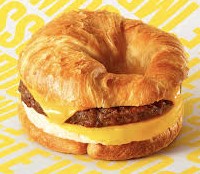
BK’s “Croissan’wich”

Pillsbury isn’t the only crescent con artist out there.  Burger King made a name for itself with its popular Croissan’wich breakfast entrees.  And Galaxy, the Williams-Sonoma mail-order croissants my family and I enjoy at Christmas, start out as frozen minis, rise impressively overnight on the kitchen counter, and bake to an excellent knock-off of the bakery-made originals.

The preparation of authentic croissants requires time and attention we Americans don’t have the patience for.  Watch the following video (which is thirteen minutes long so… maybe not) and you’ll learn what it takes.  At the least, you’ll understand why I pay almost $4.50 for a single croissant from Galaxy/Williams-Sonoma.

Most of us wouldn’t make it past  the initial “pre-dough” step in the video, let alone the labor-intensive lamination (folding/flattening), forming, fermentation, baking, cooling, and storage.  We’re talking hours and hours in the kitchen here, and that’s assuming you have the right equipment.  No wonder we’d rather just whack a Pillsbury tube on the counter edge and produce “crescent rolls” hot out of the oven 9-11 minutes later. 

Still, I implore you to watch the cweh-saw video.  The star of the show is Frédéric from Boulangerie Roy Le Capitole, narrating the process in his beautiful native language.  This man could be saying … and then we drag the smelly garbage out to the back alley for the cats to dig through and I’d still be glued the sound of his words.  Or, listen to our lovely video host and her delightful French accent (with the occasional incorrect word sprinkled in).

Lamination = Layers

I was so mesmerized by the French voices I really don’t remember much about the croissant-making itself.  But it’s hard to forget the facts.  Making an authentic batch takes three days.  A croissant is 30% butter and can have as many as fifty layers.  French bakeries have “bread laws” to protect their artisan products.  Finally, you can “hear” the sound of an authentic croissant by pushing through the crispy crust to the softer layers inside.

To the matter of my Christmas… er, Easter croissants, I’m happy (and satisfied) to report they tasted just as good last week as their holly, jolly predecessors a while ago.  Apparently four months isn’t too long to wait for good croissants.  But three days is too long to make them from scratch so I’ll keep buying from con artists.

Some content sourced from Wikipedia, “the free encyclopedia”.

Blue-Blood Spuds

As I was digging into dinner last night, I surveyed the contents of my plate and decided the food was looking rather pedestrian. Yes, I’d topped the roast pork with a tasty sour cream and onion sauce. I added lemon zest and shredded cheese to the broccoli. But the potatoes were run-of-the-mill, simply diced and baked with nothing but salt and pepper. I could’ve done more there; a lot more. Starting with potatoes from La Bonnotte.  It’s just, I don’t want to spend $300 for a pound of them.

$300 for potatoes – yikes.  It sounds ridiculous unless you’re British royalty or the finest restaurants in Europe.  A couple of medium-sized Russets – the ones we bake – weigh a pound, but the Bonnotte potato is more like the small red ones you cut up and season. 10-12 Bonnottes in a pound; so like, $30 each.  That’s a pricey bite (and not exactly “small potatoes”).  But if you’re willing, you can purchase your share of this delicacy; that is if you’re quick.  They’re only on the market ten days a year.

What makes the Bonnotte the aristocrat of spuds?  Here’s the meat and potatoes of it:

  1. La Bonnotte potatoes are found on a small island off the Atlantic coast of France, and nowhere else.  It’s as if they’re grown in some fortified castle, surrounded by a wide moat.
  2. The potato field is limited to fifty square meters, so they’re not even using the entire island.  You could walk the perimeter of the entire crop in about five minutes.
  3. Even though the island soil is ideal for growing La Bonnottes, the “secret sauce” is nearby seaweed and algae, mixed into the dirt by hand.  This is perhaps the first time I’ve heard of a good use for seaweed.
  4. Every Bonnotte is harvested by hand, then treated, cleaned, and sold by a small cooperative of local farmers.  Talk about an exclusive club.
  5. As I said, the harvest is only available for purchase ten days a year.  Mark your calendars for May 1-10, 2023.
The island of Noirmoutier-en-l’ile has a church, a chateau, and very expensive potatoes.

Here’s my favorite reason to buy this hot potato (and for heaven’s sake, don’t drop one): you don’t peel them.  You shouldn’t peel them.  Their unique flavor – tastes of lemon, earth, “the sea”, and chestnut – is most concentrated in the skin.  You eat them just the way they come out of the ground.

Luxuo is an online news portal whose mission is “to uncover the values which permeate the fiber of the world’s most recognizable luxury brands” (Got all that?) The Luxuo website has a dropdown menu for timepieces, yachting, motoring, properties…. and now you’ll find potatoes, because La Bonnottes (you don’t even call them “potatoes” at this price) are the most expensive potatoes in the world.  By some measures they’re one of the most expensive foods in the world.  Saffron, macadamia nuts, Beluga caviar, and white truffles are the top four, followed by La Bonnottes.  Blue-blood spuds indeed.

[Author’s Note: I just had to know why we refer to things as “blue blood”.  The term originated in Spain.  It was used to differentiate between people with light skin from those with darker complexions. The veins of southern Europeans appeared bluer due to their pale and translucent skin. Wealthy landowners or their descendents were part of an upper class in Spain, and somewhere along the line the veins were associated with wealth.  Not a look I prefer, but the money is tempting.]

Couch potato fare

After the La Bonnotte harvest and sell, a small number of the potatoes are reserved for a local festival, where they’re served plain, just as you see them in the entertaining video below (because no other ingredient deserves to share the pan).  Who can blame the farmers for throwing a party?  They’ve convinced the world to purchase potatoes for $300/pound yet again, just as they’ve done for decades before.

Some content sourced from Wikipedia, “the free encyclopedia”.

Amending Fences

We’re keeping a close eye on our new neighbor these days.  You see, he’s building a fence on his property.  In most cases the only discussion neighbors have about fences is who pays for what, or how the fence will look on either side.  But this situation’s more complicated.  Our neighbor doesn’t realize the driveway separating he and me is not right on the property line.  If his new fence line marches down his side of the driveway, he’s actually claiming several square yards of our property.

Better left alone

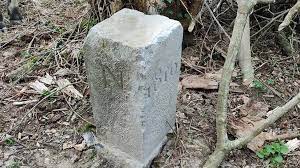
Here’s a story you never hear, certainly not in the United States.  A Belgian farmer was working on his property and decided to move a giant rock in one of his fields.  Several days later, federal authorities knocked on his front door.  Turns out, moving that rock adjusted the border of Belgium.  Our farmer moved one rock (as it turns out, a 300-year-old stone marker) and singlehandedly increased the size of his country by 1,000 square meters.  The very sovereignty of his nation was called into question.  Neighboring France was not thrilled.

So it is with my neighbor.  Unless he has a plot plan on hand he’ll unknowingly increase the size of his property while decreasing mine.  But that’s why we put up fences, right?  A fence specifies property; a literal landmark to indicate, “this is mine”.  That’s just for starters because we use fences for a lot of other reasons.

If I’m guessing right, my neighbor needs a fence to keep horses (or other livestock) between his house and the edges of his property.  His animals will be shut in from adjacent roads and lands.  Good luck with that, friend.  Most people around here seem to have breaks in their fences (if they have fences at all).  Not a day goes by where someone doesn’t post a notice on our neighborhood’s electronic newsletter about animals on the loose.  This morning’s alert concerned a bunch of cows grazing peacefully… on the wrong property.  You can’t blame ’em if “the grass is greener on the other side”, right?

Last week on our vacation to Charleston, South Carolina, we drove down streets full of the town’s characteristic row houses, with tasteful pastel colors and two-story side “piazza” porches.  We also walked by stately antebellum mansions in the waterfront “south of Broad” neighborhood.  Each of these estates was surrounded by high gates and brick walls, an obvious nod to security.  Yes, these palaces were beautiful, but their surrounding “fences” seemed to declare, “keep out”.  So we did.

Here’s another need for fences.  At last Saturday’s Triple Crown Belmont Stakes in New York, the eight thoroughbreds were guided – and in one case pushed – into the starting gate before the race began.  In the split second where the horses were all in a row, each standing in a sort of starting cage, there was structure.  Once they burst out of the gate, all horses and riders shifted to the left, jockeying chaotically for prime position on the rail.  Imagine the start of that race without that starting “fence”.  Disorder with a capital “D”.

Some fences don’t even need a physical definition.  Picture your city streets without lane markings (as if you lived in India).  All cars would tend to compete for the best position, just like those Belmont Stakes horses.  Horns would honk and road rage would rise to new levels.  Roll down your window and throw out any sense of safety.

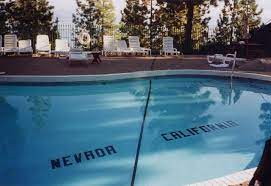
I leave you with one final fence.  The shuttered Cal Neva Lodge and Casino overlooking Lake Tahoe straddles the border between California and Nevada.  A solid line on the floor splits the dining room and then the swimming pool, to indicate which state you’re dining or soaking in.  Drink on one side of the line; drink and gamble on the other.  I just hope the hotel’s current remodel doesn’t include relocating the pool.  California might become even bigger!

Some content sourced from the CNN Travel article, “Belgian farmer moves border with France by mistake”.

Vicious Circles

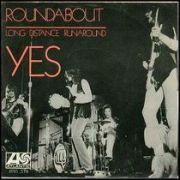
When I was ten years old, the progressive rock band “Yes” released an unforgettable song called “Roundabout”. The lyrics included trippy phrases like, “… mountains come out of the sky and they stand there…”, and, “… go closer hold the land feel partly no more than grains of sand…” The words made no sense but the melody hooked me with its driving beat and wandering synthesizer. “Roundabout” and “Stairway to Heaven” – both released in 1971 – are perfect examples of my rock music baptism.
Turns out, “Roundabout” was not a metaphor for the song’s underlying message nor even a made-up word. The lyrics really were spawned from an overdose of traffic circles. Yes was on tour and traveling from Aberdeen to Glasgow when its lead singer Jon Anderson says their van passed through “maybe 40 or so” roundabouts. Anderson promptly teamed up with guitarist Steve Howe to produce one of Yes’s biggest hits.  Wikipedia dedicates an entire article to “Roundabout” here.

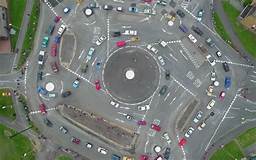
A “roundabout” (in the UK, of course)

Fifty years forward, roundabouts are more prevalent than ever on our city streets – and in some setups, as mind-boggling to navigate as a Yessong lyric. In a neighborhood near my house, I pass through three consecutive roundabouts to get to a friend’s house.  Each has two lanes entering and exiting the circle from four directions.  If I’m not conscious of the lane I’m in when I enter a circle, I’ll find myself going round and round before I remember it’s safe to exit from both lanes.  If I lose track of which circle I’m in (all three look entirely alike), I’ll exit onto a street nowhere near my friend’s house.

A “rotary”

You’d think we’d have them figured out by now since roundabouts first appeared in 1966 and have proliferated ever since.  (By definition, we’re talking about circles tight enough to induce centrifugal force, not the more leisurely curves of an urban “rotary”.)  The Wall Street Journal reports traffic authorities still toy with public awareness campaigns, signage, and modified roadway designs in an almost desperate effort to reduce roundabout fender-benders.

Here are two lingering oversights with the rules of roundabouts.  First, drivers entering the circle sometimes assume they have the right-of-way over drivers already in the circle.  Second, drivers approaching a two-lane roundabout don’t check signage to see whether one or both lanes also exit the roundabout.  On the latter problem, I admit to several instances where I had to quickly change lanes while circling, just to exit where I needed to.  Changing lanes in a roundabout ranks among the scariest driving maneuvers of them all.

Not in this lifetime

Roundabouts really do make a lot of sense, even if drivers never, ever figure them out.  They eliminate electronic signal systems or stop signs.  They create a safer environment for pedestrians (who only have to look one direction for oncoming traffic instead of three).  They force vehicles to slow down, and statistics show a dramatic reduction in the number of T-bone and head-on collisions.  Finally, roundabouts require less asphalt to create a new intersection, and are sometimes enhanced with an eye-pleasing landscaped island in the center.

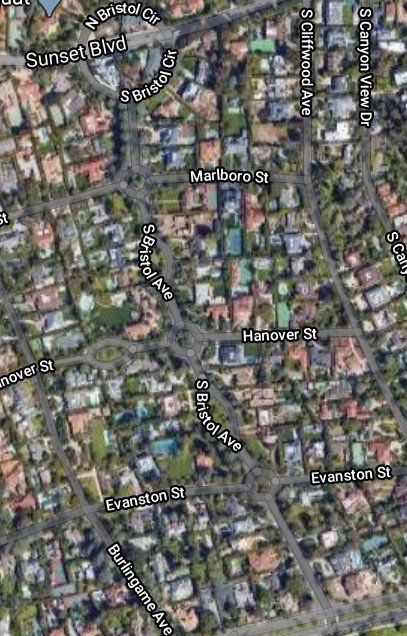
Look closely and you’ll see (all four) Bristol Circles

The first time I ever drove in circles was in West Los Angeles.  A street known as “Bristol Avenue” earned the nickname “Bristol Circles” by teenage drivers in the neighborhood.  That’s because Bristol’s four rotaries allowed for a lively game of “car tag”, where my friends and I would zoom around trying to “tag” each other with the headlights of our cars.  If we were really daring (i.e stupid), we included the topmost of Bristol’s four circles, which is bisected by busy, unpredictable Sunset Blvd.

Cities in the northeastern states of the U.S. have some pretty good-sized rotaries these days but for the really daring, it’s hard to beat the giant urban circles in France or the tighter many-tentacled roundabouts in the UK.  Paris’s Arc de Triomphe rotary may deserve the title “most vicious circle”.  Watch the following video and see if you don’t agree.  This rotary may be the genesis of the term “distracted driving”.  Note to viewer: no lanes.  Note to self: no thanks.

Some content sourced from the 3/14/2020 Wall Street Journal article, “Car Crash Mystery: Why Can’t Drivers Figure Out Roundabouts?” and Wikipedia, “the free encyclopedia”.

Iced Coffee

Place Dauphine

In the airy but over-aired romantic comedy Me Before You (2016), the dashing but damaged Will Traynor (Sam Claflin) laments bygone times when he refers to, “Paris. Place Dauphine, right by the Pont Neuf. Sitting outside the cafe with a strong coffee, a warm croissant with unsalted butter and strawberry jam.” Place Dauphine is not just a scene in Me Before You; it’s a real square in the heart of Paris.  And it probably has Will’s cafe, thanks to the nearby river and central views of the city.  Yet French cafes are growing scarcer every year.  In fact, these quaint little gathering places are disappearing in droves.

Painting by Vickie Wade

If someone asked me to paint a scene from a French country village, I’d surely highlight a charming cafe on a cobbled central space, bursting with patrons.  In the cafe, the proprietor would serve incomparable pastries alongside fine, pressed coffee.  The room would swell with music and chatter; the locals swapping their work-day adventures before heading home to supper.  The evening stopover in the cafe seems to me a staple of French culture.

So it pains me to read about closed doors on France’s rural cafes, according to a recent report of the Wall Street Journal.  Sixty years ago, you would find over 200,000 of them liberally dotting the country.  Today, there are less than 40,000.  “Progress” – in its various forms – has forced the rural worker out of traditional French industries and into the big cities.  Time once spent in the cafe is now given over to the workday commute.  Adds a village mayor, “Without a cafe, a village is pretty much dead”.

A “French cafe” in Ireland

Even though I’ve been to Paris, I can’t claim to have spent time in any of its cafes, not even the famed Les Deux Magots, where writers like Hemingway and Joyce were said to have gathered.  And yet, I’ve still experienced authentic “cafe culture” (and I don’t mean Starbucks).  On a trip to Ireland several years ago, my wife and I concluded our first day of sightseeing by ducking into what we thought was a small pub in downtown Dublin.  Turns out the place was more “French cafe”, complete with black-and-white prints on the walls, candle-lights on the tables, and coffee, tea, and pastries to beat the band.  We were so taken by the place we stopped in every afternoon for the better part of a week.  Perhaps the most showstopping memory of all: we never saw a phone, tablet, or laptop.  Patrons were there to gather and chat, or at least – in the case of a few loners – to lose themselves in a good book.

van Gogh’s “The Starry Night”

The French cafe is made all the more romantic thanks to the artist Vincent van Gogh.  In 1888 in the southern town of Arles, van Gogh observed the play of a cafe’s lights against the nighttime sky, which inspired his painting Cafe Terrace at Night, the precursor to his unequaled The Starry Night

“Yellow vest” protestors

Perhaps you recall France’s “yellow vest movement” a year or so ago, when protestors took to the streets to battle aggressive economic policies.  Turns out the French cafes played a part in the melee.  The government sought to impose an increased fuel tax to reduce the number of cars on the road.  The protesters interpreted the tax as an impolite shove, to get more people to move to the big cities.  In other words, less people in French country villages.  And no people in French country cafes.  Remarkably, one of the government’s concessions following the yellow-vest protests was subsidies towards small businesses.  Perhaps the French country cafe is not dead after all.

Had I written this post two weeks ago, I wouldn’t have come up with much positive spin on this topic.  But let’s face it, those of us “sheltered in place” right now yearn for social interaction (not social distancing).  We want face-to-face again, not Facetime.  We want the congregation, not just the church service.  So perhaps there’s a silver lining to the current pandemic after all.  When we return to “new normal”, my hope is we’ll have a newfound appreciation for gathering, instead of hiding behind our electronic devices.  As well, my hope is my next visit to France will find the doors of French country cafes wide open again, just beckoning me inside for “strong coffee and warm croissant”.

Bon Voyage!

Every now and then I come up with a topic for my blog, and then the topic somehow surfaces in the natural course of conversation later the same week. It’s a little unnerving – perhaps divine intervention – to watch someone bring up something you hadn’t thought about in years, or at least until a few days earlier.

85-bon-voyage-1

Such was the case this week when I opted for a (virtual) visit to Mont Saint-Michel, the majestic island commune and fortified abbey just off the coast of Normandy, France. Mont Saint-Michel came to mind because I received a mailer from my alma mater advertising a ten-day trip to the region next summer. The itinerary includes a stopover in Paris, a base hotel in the historic seaport village of Honfleur, extensive tours of Normandy focusing on the events of World War II, and finally, a full day exploring the island of “St. Michael’s Mount.” Mon dieu, what an adventure!

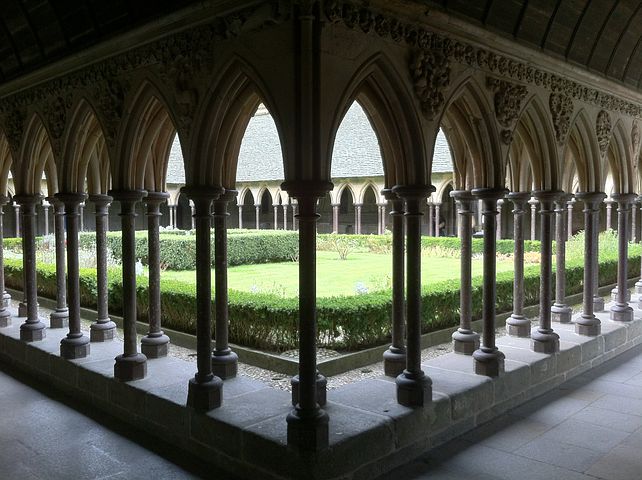
Mont Saint-Michel has a remarkable history on top of its dramatic architectural elements (which you can read about here).  Its buildings date to the 8th century, with the Romanesque abbey and monastery at the very top (“closest to God”), literally supported by a vast network of halls for stores and housing, and finished elegantly at the bottom – outside the walls – with individual houses for the handful of fishermen and farmers who live there.  The church inside the abbey is partnered with an open-air cloister (a square covered walkway for reflection).  A statue of the archangel Michael watches over the land from the very top of the church spire.  Magnifique, no?

85-bon-voyage-2      85-bon-voyage-3

Here’s an interesting bit of trivia about Mont Saint-Michel.  You may think the following photo is a distant view of the island.  Au contraire.  The Mont has a “sister” across the channel near Cornwall.  England’s island of “St. Michael’s Mount” is much smaller, but it still shares the characteristics of Mont Saint-Michel, including the significant rise/fall of the surrounding tides, the conical shape of the island, and a chapel at the top.

85-bon-voyage-5

In today’s world Mont Saint-Michel is a little touristy for my tastes, so perhaps it’s just as well I’ve never made the pilgrimage.  2.5 million visitors descend upon the island every year, hosted by only 25 full-time inhabitants (monks, nuns, and shopkeepers).  Tourism is literally the only source of income.  Besides a walk through the abbey and the spiraling streets, you’re channeled into the requisite shopping area, for food (including the famous to-go omelettes), and for purchases that can only be labelled as “tacky”. I actually have one of these souvenirs (below photo). Sacre’ bleu!  Maybe if they’d left off the sailboat…

85-bon-voyage-4

To further detract from the mystique of the Mont Saint-Michel, a permanent walking bridge was built three years ago, allowing round-the-clock access from the mainland car-park.  Once upon a time you had to wait until low tide and then quickly walk across the natural spit of land before the water returned.  Now you just cross whenever you want.  Too bad, but apparently the channel was filling in with silt and a bridge was the only way to keep the island an island.  C’est la vie.

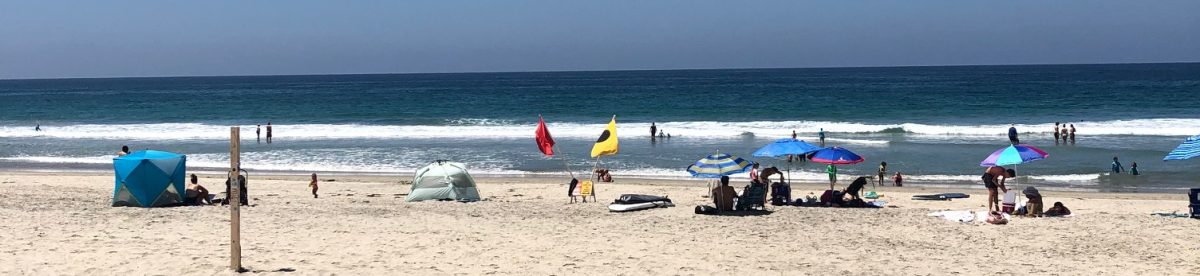
My first introduction to Mont Saint-Michel was forty-odd years ago on the shores of California, not France.  San Diego County hosts elaborate sand-castle building competitions on its beaches, and one year I snapped the following photo of the winner.

86-bon-voyage-6

To visit Mont Saint-Michel, you’ll need to drive four hours to the west of Paris, all the way to the coast of the English Channel.  Unless you have a hankering for WWII history, there isn’t much else to draw you to the region.  Which brings me back to the start, and my comment about topics resurfacing later in the week.  Three days after I wrote this post, I was having a beer with some older friends and we got talking about the movie “Saving Private Ryan”.  One of the guys said his dad served in WWII and he’d taken him back to the beaches of Normandy, where he’d spent part of his time as a medic.  “Normandy?”, I said.  “Yes”, he said. “You know, in the northwest of France near Mont Saint-Michel?” To which I almost said, “excusez-moi?”

Some content sourced from Wikipedia, “the free encyclopedia”.