There’s Something About Mary

Mary Tyler Moore passed away over a week ago and I’ve been thinking about her ever since.  Countless actresses come and go, but then you have those who make indelible impressions with one or two jaw-dropping performances.  Audrey Hepburn, Julie Andrews and Maureen O’Hara, just to name a few.  Meryl Streep.  And Mary Tyler Moore.

81-indelible-1

There’s something about Mary. I read her filmography from start to finish – a span of sixty years of television and movies – and came up with two roles of any significance to me: Mary Richards in The Mary Tyler Moore Show (1970-1977), and Beth in the film Ordinary People (1980).  But I think most people would agree – those performances alone land Mary Tyler Moore in an acting class by herself.

Moore first became a familiar name as Laura Petrie in The Dick Van Dyke Show in the 1960’s, but that was a little before my time.  On the other hand, The Mary Tyler Moore Show was a weekend staple in my house.  At an age when my father still controlled the TV remote (er, TV channel – no remotes back then), my brothers and I were treated to CBS’s Saturday night “killer lineup”, which included The Mary Tyler Moore Show, The Bob Newhart Show, and The Carol Burnett Show.

81-indelible-2

The Mary Tyler Moore Show included memorable opening credits, if only because the theme song was so infectious (“…you’re gonna make it after all…”), as was the final scene where Mary spins and smiles and throws her hat into the air at a busy Minneapolis intersection.  That throw – and Mary Tyler Moore herself – is immortalized in a bronze sculpture you can find at that very same intersection today.

81-indelible-3

In 1980, just as I was heading off to college, Robert Redford directed the Best Picture winner Ordinary People, one of the most gut-wrenching, powerful, “real-life” dramas I have ever seen.  Timothy Hutton burst onto the Hollywood scene with an Oscar-winning performance as Conrad, the younger of two sons in a tormented Chicago family.  Judd Hirsch was also nominated for an Oscar (losing to Hutton) for his portrayal of the determined therapist who counseled Conrad back to stability.  But it was Mary Tyler Moore’s turn as the heartless and unforgiving mother Beth that stole the show.  Her performance was so counter to the sunny demeanor of Mary Richards, I wondered if she was tapping the energy of some real-life bout of depression.  That was the breadth of Mary Tyler Moore’s acting talents.  I’ve only seen Ordinary People a couple of times but the scene where Donald Sutherland tells Beth he no longer loves her still haunts me.  Moore’s silent, crestfallen reaction to that statement could’ve coined the phrase “verbal slap in the face”.

I am even more taken by Mary Tyler Moore when I read some of the details of her life.  Clearly, she tried to embody the positive demeanor and “independent woman” of Mary Richards, but she did so in the face of significant personal tragedy.  She dealt with alcoholism and smoking addiction, drug overdose (her sister), suicide (her son), and years of diabetes.   She took up the baton to promote diabetes awareness and animal rights.  Moore was even tougher and more outspoken than her little/big screen roles would suggest.

81-indelible-4

The theme song of The Mary Tyler Moore show begins with “Who can turn the world on with her smile?” Scroll back up to that first photo.  Talk about ear-to-ear!  And I can’t help but smile back, even as we now say goodbye to Mary.

Some content sourced from IMDb.com.

Band of the Leader

Last week at church I was pleasantly surprised to see a brass quintet accompanying the organist.  Trumpets, tubas and French horns are typically reserved for the Christmas season services but there they were – a small group of our members – playing along with the hymns of the day.  It somehow made the service more meaningful.

80-credence

At President Trump’s inauguration I was pleasantly surprised to see a small band accompanying young Jackie Evancho as she performed America’s national anthem.  It was the first time I’d heard Jackie sing, and I thought her performance of “The Star-Spangled Banner” was flawless.  Perhaps some of you know Jackie as the singer from “America’s Got Talent”.  For me, her most recent performance lent credence to her status as “the youngest solo artist ever to go platinum”.  Jackie also performed for former President Obama at the Lighting of the National Christmas Tree, suggesting a refreshing lack of political persuasion in her decision to sing.

But back to the band – the “band of the leader” as it turns out.  Shortly after Jackie finished America’s anthem one of the inauguration commentators labeled the accompanying musicians “The President’s Own”.  That phrase stuck with me the rest of the day.  Thanks to my curiosity and an in-depth article on Wikipedia I now know more about this talented group.  In brief:

  • “The President’s Own” is formally called the “United States Marine Band” (USMB).  It is the oldest of the United States Military Bands, established in 1798.
  • The USMB became “The President’s Own” in 1801, after a performance for then president John Adams.  Later that year Thomas Jefferson requested a performance at his own presidential inauguration, and the USMB has performed at every inauguration since.  Counting President Trump’s that’s a total of fifty-three inaugurations.
  • The USMB has 130 members but typically performs with only 42.
  • The USMB performs about five hundred times a year, including state funerals and dinners, and arrival ceremonies for visiting heads of state.
  • The USMB’s most common performance is fifteen-minute “patriotic openers” for large events, including the playing of “Marine’s Hymn” (official hymn), “Semper Fidelis (official march), and “The Star-Spangled Banner”.
  • The USMB’s most famous director – back in the late 1800’s – was John Phillip Sousa, who composed “Semper Fidelis”, “The Stars and Stripes Forever”, and other famous march music.
  • USMB members serve a four-year contract as active duty enlisted Marines.  They are not required to complete the training of a typical Marine and are therefore never involved in combat missions.
  • Without a musical instrument in his/her hands, you could still recognize a USMB member by the lyre on their uniform rank insignia (replacing the normal crossed rifles).

I love the historical significance of “The President’s Own”, one of many uniquely American elements linking our current leaders to our Founding Fathers.  I also love the pomp and circumstance – bands, parades, fireworks and other “fuss” designed to accentuate our country’s most important moments.

Speaking of President Trump’s inauguration and the unquestionable divide of the people over his first week of actions, I found the words of the following quote spot-on.  Perhaps you can imagine “The President’s Own” playing in the background as you read, somehow making the words even more meaningful:

“We were a country that has been snoozing. Now we are alert. Whether it’s negative or positive, energy has risen. People are engaged. They’re studying. They are thinking more. And I think that’s good. You can’t get that without someone being bold enough to say things people don’t agree with.” —Hall of Fame running back Jim Brown to the Wall Street Journal.

Some content sourced from Wikipedia, “the free encyclopedia”.

Have You Lost Your Marbles?

Nestled quietly amid the several headlines for the Presidential Inauguration and the Women’s March on Washington last week, the Associated Press (AP) reported an incident of marble madness near Indianapolis: “… a truck carrying 38,000 pounds of marbles lost its trailer… the marbles were on the shoulder and in the median… there were no injuries, but a lane of traffic in that area was affected by the cleanup during much of the day.”

I was lucky to catch the marbles story on my news feed.  It rolled in and rolled out (ha) in the space of about twenty minutes, making way for the more important headlines of the day.  A spill of 38,000 pounds of marbles!  That’s a whole lot of little glass orbs, people. Your average marble weighs 0.16 ounce (proving once again you can find anything on the Web), so with sixteen ounces to the pound you have a nice “round” estimate of 3,800,000 marbles commanding chaos on that Indiana highway.

79-convex-1As short as the AP article was (you’re reading just about all of it in the quotes above), I love the handful of details. One, the marbles were “on the shoulder and in the median”. In other words, they cleaned up themselves by rolling both directions off the convex surface of the asphalt. Two, “there were no injuries”. My first thought was the image of windmilling arms and dancing feet caused by a pail of marbles thrown in front of someone (I guess cars don’t react the same way). Finally, we have “… the cleanup during much of the day.” How the heck do you clean up 3.8 million marbles? My first choice would be a gigantic ride-on monster vac, preferably something designed by Dr. Seuss.

79-convex-2This story resonates with me because I had a childhood obsession with marbles – and marble games.  In the 1960’s the toy company Ideal came out with “Mousetrap”, one of the first mass-produced three-dimensional games.  Mousetrap was a fascinating contraption which – when completed – moved marbles and other game pieces in a start-to-finish process attempting to trap another player’s mouse.  When I first saw Mousetrap in action I became an instant marble enthusiast.

Mousetrap surely inspired the Matchbox game “Cascade” (which I was lucky enough to own).  Cascade consisted of three small trampolines arranged in a row between a tower and a scoring tray.  The tower included a clever “marble elevator” – a corkscrew raising the marbles to the top – only to dump them down a chute where they would bounce one-two-three on the trampolines and land in the scoring tray.  I’m not sure where in this endless loop you have a “game” but Cascade was sure fun to watch (see video here).  A more advanced version of Cascade came out the same year in Ideal’s “Bing-Bang-Boing”.

79-convex-3Countless marble contraptions have been designed since the games of my youth (the Web is full of fun videos), and let’s not forget Nintendo’s famous video game “Marble Madness”.  But as an adult I prefer the more elegant applications like Chinese checkers and marble solitaire (above photo), and the wooden box mazes I write about in Back in the Sandbox.

79-convex-2In the spirit of storm-chasers, I’d love to race down the highway to watch the next truck to lose its marbles somewhere in this country.  But maybe I’ll just stick to the marbles I own myself.  After all, what’s the saying?  A marble in the hand is worth 3.8 million on the road?  Or something like that.

Horsing Around

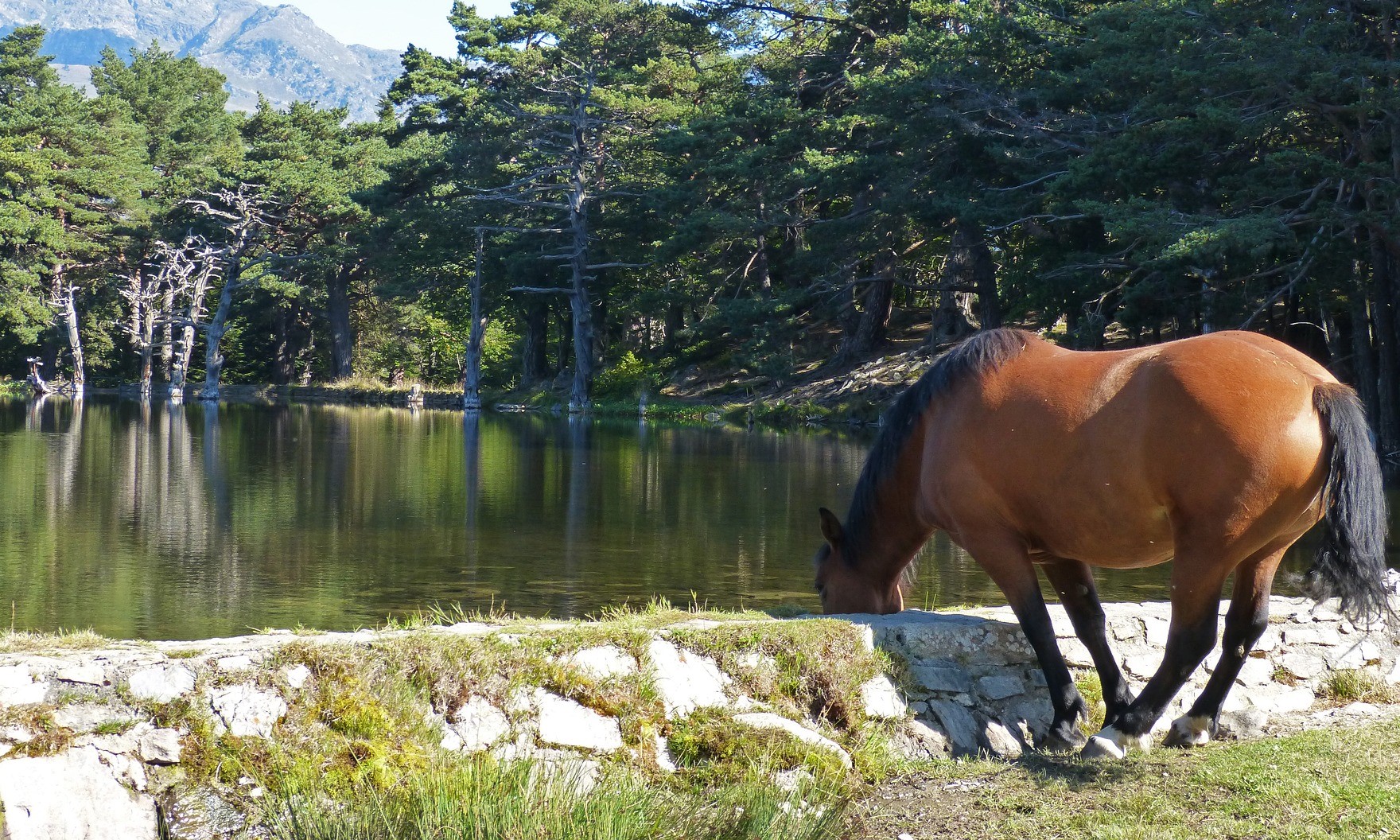
My wife runs an equestrian facility on our property – boarding, training, therapy and recreational riding for those who enjoy horses.  It’s a lot of activity and it’s a whole lot of work to maintain.  When our barn help doesn’t show up, that’s where I come in.  I don’t ride but I can do the work.  I suppose you could say I’m a horse of a different color.  My wife and I knock out the myriad chores in about four hours (morning and evening combined), and I get a kick (hoof?) out of all of the terms and phrases that are uniquely “equine”.  Consider the five essential aspects of daily horse care:

78-myriad-1

Grain – Are you “feeling your oats” today?  That’s a reference to horses (of course!) and the boost of energy derived from their daily dose of grain.  “Grain” means a lot more than “oats” these days.  Grain is a general barn term to include the endless supplements for the specific needs of a horse (i.e. fiber boost, joint care, digest assist, immune system boost, metabolic stimulation).  Solid, liquid or “mash” (something in between the first two), grain is measured in bins, sacks, and baggies; scoops, cans, and cups, and even tiny bits like pinches, eye-droppers, and capfuls.  When all is measured and done – voila! – your horse has a complete pan to feast on.  So remember – grain is not just grain.  That’s putting the cart before the horse.

78-myriad-2

Grass – Have you ever been the recipient of a “haymaker”?  That’s a powerful, forceful punch (which means someone must’ve been really mad at you).  But a haymaker is also a machine that dries grass, thus creating “hay”.  And horses need a lot of hay.  You could start with a handful but your horse will probably demand a flake or a cube, and if he’s really hungry he will devour an entire bale.  But I’m talking the 50 lb. bale you see stacked in the fields.  If you want to seriously hay your horses (and take a two-week vacation), opt for large bales – round or square – which can weigh up to a ton.  Your horse will think he’s found an all-you-can-eat-buffet.

78-myriad-5

Water – You can lead a horse to water but you can’t make him drink.  When a horse does drink however, he’ll take in a gallon or more at a time; a glassful simply won’t do.  Watering horses requires everything from a hose to a pan to a pail to a bucket to a tank to a trough.  If you want to get really crazy you can even install a cistern (or a water tower) and then you never have to worry where your water’s coming from (even if your well dries up).  Finally, don’t forget the fishnet to keep the water clean.  Horses muck it up while they’re munching on hay.

78-myriad-3

Cleaning – Speaking of mucking it up, are you a “muckety-muck”?  I hope not because that means you’re an arrogant, self-important person.  But come join me in barn chores and I’ll show you all the “muck” you could ever want.  A horse processes grain, hay, and water into a mountain of manure, and unfortunately for me a horse does his business wherever he pleases.  That means a lot of cleaning.  You’re going to need a muck rake for starters (and a hoe if it’s cold enough outside because then manure sticks to the ground).  You’re also going to need a muck cart – the wheels underneath the muck tub where you’ll deposit all of that manure.  Lastly your manure needs a final destination.  That would either be a manure pile (which is eventually removed by a manure hauler), or your pastures themselves, by means of a manure spreader.  Not to beat a dead horse, but your goal is to get all those “apples” as far away from the barn as possible.

78-myriad-6

Enclosures – If it came straight from the horse’s mouth, y0ur equine would demand to be put out on pasture and never ever brought in.  That’s because he wants to graze all day and night, which is almost never a good idea.  So a horse “comes in”, which means he retires to a pen or a stall.  If he’s really lucky, his stall has a run, and sometimes he can hang with other horses in a paddock before he’s moved back to pasture.  If he wants a place to go when he needs some alone time or gets tired of the rain he goes into a loafing shed.  And when he’s actually ridden he goes to an indoor or outdoor arena, or perhaps for a trail ride (which is sometimes just called “down the road”).

78-myriad-4

There’s a lot more equine-speak where that came from but it’s time I got off my high horse.  If you’re in the market for a horse I hope everything I’ve talked about here is enlightening.  To me it’s just horse sense.

Demise of the Department Store

In today’s headlines the Wall Street Journal turns to Sears – the aging department store chain – which will close 150 locations in the next several months. Sears will also sell its iconic Craftsman tool brand (to competitor Stanley/Black & Decker) in a longer-term “fix-it-and-return-it” strategy intended to strengthen the company. Clearly these events feel like the beginning of the end for Sears, and the end has been coming for a long time. The day Sears shutters its last store will be a sad one – as if a slice of the proverbial American apple pie is lost forever.

77-senescent-1

In the defining years of baby-boomers Sears was the retail destination (and catalog) of choice.  Sears Roebuck and Company – as it was originally known – bridged the gap between America’s small-town general stores and today’s elaborate shopping malls.  As recently as 1989 Sears was still the largest retailer in the United States.  In a world dominated by Wal*Mart, Target, and The Home Depot it’s hard to picture Sears atop the department store heap just a few decades ago.

The Sears store where I grew up – on the west side of Los Angeles – is not one of the 150 due to close its doors this year.  That makes me happy.  My Sears store is forever embedded in my childhood memories.  It was where my mother clothed me and my four brothers.  It was where my father bought appliances and a workshop full of Craftsman tools (most of which I’m sure he still has today).  It was the brick-and-mortar embodiment of the Sears “wish book” – the wonderfully large and colorful catalog filled with 1960’s kids’ Christmas dreams.  Last and perhaps most significantly, Sears was the location of the “Portrait Studio”, for which my family dutifully dressed up and posed every Christmas.  One of my all-time favorite photos has all of my brothers standing smartly around the Sears-store Santa Claus, while I’m sitting in his lap bawling my two-year-old eyes out.

Sears would enter my life again somewhat unexpectedly, when I was in college studying to be an architect in the 1980’s.  On several trips to Chicago my classmates and I visited the Sears Tower, the distinctive stair-stepped black skyscraper in the center of the Windy City.  The Sears Tower was completed in 1973 as the tallest building in the world, and the first to use a “bundled-tube” structural design.  Forty-three years later it is still the second-tallest in the Western Hemisphere (behind the recently-completed One World Trade Center in New York City).

77-senescent-2

Today’s Wall Street Journal article about Sears – which you can find here – includes dozens of reader comments more insightful than the article itself.  The comments yearning for Sears’ glory days are clearly written by my peers.  The comments blaming Sears’ demise on Amazon and other on-line retailers are largely from younger writers.  In one particularly stinging but accurate account, Wade Harshman writes, “I still like the brand.  I just don’t like waiting in line 20 minutes to buy a wrench because the one Sears rep is wrestling with a 1980 IBM machine and trying to sell an extended warranty on a $5 extension cord.”

If you Google “Sears Department Store”, you get the following up top:

77-senescent-3

It’s a sad statement when all four sub-links of the initial hit point to marked-down prices as the way to get you to buy at Sears.  Then again this is senescent brick-and-mortar shopping we’re talking about.  Montgomery Ward disappeared in 2001.  K-Mart and J.C. Penny hang by a deteriorating thread.  Even Macy’s reports “dreary” holiday sales, poised to close (another) 68 stores this year.  Could Bloomingdale’s or Saks really be next?

Think about Sears and the disturbing/inevitable (take your pick) headlines of retail closings the next time you click your way to another on-line purchase.  Future generations of shoppers may not even understand the meaning of “department store”.

Back in the Sandbox

76-zen-1       76-zen-2

Draw a line in the sand.

Therein lies the allure of the most unique Christmas gift I received this year.  The before/after photos above depict a modern-age spin on a Zen garden, only the “gardening” is done automatically; almost magically.  Place the ball where you feel the magnetic pull, spin a couple of dials underneath, and sit back and watch.  The ball is pulled invisibly around the sand, creating beautiful designs like the one in the second photo.  My “Sandscript” (which can be found here if you want one of your own) reminds me of “Spirograph”, the geometric drawing toy I had as a kid.  But my Zen garden is so much more than cool drawings.  It’s about finding calm within the daily chaos, or perhaps just a different way of looking at things.

Here’s what’s really Zen about my Sandscript.  First, you determine when the drawing is done by turning off the dials – the ball doesn’t just come to a stop on its own.  Second, the line drawings are random, and rarely symmetrical.  That’s my own brand of Zen right there.  I like things a little too neat and organized, so anything never really finished or never really perfect is my kind of therapy.

I always thought Zen gardens – one of countless cultural contributions from the Chinese and Japanese – were a little out there.  Authentic Zen gardens are the size of basketball courts and have you shuffling around the gravel and rocks, raking and rearranging as you seek your higher self.  Several years ago we bought my mother-in-law a tabletop Zen garden and I found myself drawn to the “gardening”, not really understanding why.  There is an undeniable calming effect when you draw lines in the sand.

The same can be said for mazes.  I loved mazes as a kid, especially the books you could draw in or the tabletop box where you turn the dials and tilt the maze to get the ball from start to finish.  Mazes are purported to have the same calming affect as Zen gardens.  I always thought mazes were limited to the hedge or cornfield variety but there are all sorts, including a chain of amusement parks throughout America.  We have a maze right here in our neighborhood, fashioned from painted lines on the asphalt surface of a cul-de-sac.  I’ve walked a few mazes in my lifetime but I’m still in search of the Zen in the experience.  I think I’m too preoccupied with finding my way out to discover any calming effect.

Zen is a great word, by the way.  There’s something about the sound of the “Z”.  Zen.  Or maybe I just like words starting with “Z” because they’re not used all that often.  Quick, name ten words off the top of your head starting with “Z”.  I gave myself sixty seconds and could only come up with seven.

If you don’t think Zen goes hand-in-hand with American culture, check out the following photo from a visit to a local retailer:

76-zen-3

My posts on Life In A Word will continue to run the gamut of topics, including personal experiences and humor for added zest (ha).  As you read you may find unexpected comfort in my words.  That’s not by chance – it’s probably just me playing with my Zen sandbox before I sat down to the keyboard.

Sourcing the Christmas Spirit

The holiday season often feels like a sprint to the finish.  From the moment the Thanksgiving table is cleared, my brain shifts to the list of “essential tasks” preceding Christmas Day.  In no particular order I know we will a) put up a tree, b) hang the lights,  c) decorate the house, d) write and mail greeting cards, e) send packages to distant family members, f) shop for the Christmas dinner, g) bake cookies, and of course, h) purchase gifts for the family.  We don’t always get everything done.  Some years – like this one in fact – no lights get hung.  Other years no cookies get baked.  There’s never enough time, the calendar mercilessly counts down the days, and just forget about intentions of healthy eating at any point in the process.

75-provenance-1

Thankfully all of this Christmas prep includes a few heartwarming activities.  My family and I always seem to find time to drive around the neighborhood to see the lights.  We don’t trim the tree until the week before Christmas, choosing from more ornaments than we have branches.  We watch several of those cheesy Hallmark Channel movies, with the formula love stories and terrible acting and without-fail-happy-endings.  We keep egg nog in the frig and candy and cookies on the kitchen counters.  We tune our car radios to round-the clock holiday music stations.  We never miss Christmas Eve church.

More than twenty-five Christmases celebrated with my immediate family leads me to this conclusion: the spirit of Christmas is not born from the “prep list” I talked about above, nor even from the heartwarming activities I know will take place year after year.  Rather, the provenance of the spirit is moments that become memories, and memories that last far longer than the Christmas season itself.

I have a favorite Christmas memory from my childhood.  A neighborhood near where we lived staged an annual decorating contest between its several streets.  Not only were the houses fully adorned with lights and ornaments, but the streets themselves had Christmas themes, so decorating was consistent from sidewalk to sidewalk.  I remember one street decorated primarily with candy canes, another with bells, and still another with angels.  They even changed the street names for the season (i.e. “Candy Cane Lane”).  You always knew which street won the competition by the huge blue ribbon hanging from the first lamppost.  After touring every last street of this neighborhood, my brothers and I spent several hours at a nearby mall, purchasing gifts with the precious-few dollars we’d saved as kids.  Finally we’d join up with my parents for a late-night dinner out.  This memory of an evening of family fun stands the test of time – more than forty years ago by my estimate – and always brings a smile to my face.  This memory seems uniquely mine, as if dozens of other families didn’t tour those decorated streets or shop at that busy mall.

I have an equally favorite Christmas memory from recent years.  To slow down the events of Christmas morning, my wife and I created a trivia contest for our kids.  They stand at the top of the staircase outside their bedrooms and we start the questions.  Correct answers earn them a step down the staircase (closer to the gifts). Incorrect answers cost them a step backwards.  The trivia delayed the inevitable, but the first to reach the bottom stair won the privilege of opening the first gift.  It’s a tradition we’ve carried on for years, and a memory that will stay with me long after children stand at the top of our stairs on Christmas morning.

75-provenance-2

Let’s not kid ourselves.  The Christmas season will always be hectic as long as there are gifts to buy and greeting cards to write and family members to visit.  But there will also be moments – some planned and some not.  And memories – some fleeting and some longer-lasting.  It is those memories that without fail bring you comfort, joy, and Christmas spirit.

De-lightful December

The Broadmoor Hotel, the five-star luxury resort here in Colorado Springs, boasts a Christmas season display including over a million twinkly white lights. The weekend after Thanksgiving crowds gather on the grounds to witness the illumination, which starts with a countdown and ends with the flip of a big switch.  Instantly the Broadmoor is delivered into the Christmas season. It’s a spectacular sight and a tradition that’s been carried on for thirty years.  I can’t imagine how long it takes to put it all together.

74-luminous-1

Christmas lights are one of my favorite expressions of the season. I marvel at the time and energy some of my neighbors invest to produce a display that – like the one above – can probably be seen from the space shuttle.  Surely you have a similar house where you live (or a hotel) where the lights and the decorating borders on the ridiculous.  Or maybe you just tune in to “The Great Christmas Light Fight” (Mondays on ABC), where “decorating to the extreme” can win you a cash prize and the coveted Light Fight trophy.

We have a house in our neighborhood covered in nothing but purple lights.  It’s actually quite appealing but I question the choice of color.  Most people still use strands of multi-colored lights of course – more LED than incandescent these days.  Sometimes you see animals or trains or colorful scenes.  Those always remind me of Lite-Brite, a toy I had as a kid.  Lite-Brite was a simple light box fronted by color-by-letter templates.  You plugged colored plastic pegs into the template and when you were done, you turned off the lights and switched on the box to display a glowing, colorful picture.  My more artistic friends would forego the templates and make their own creations in the dark.

I see Christmas lights everywhere this time of year; not just on houses.  Traffic signals blink red and green.  Ditto airport runway demarcations.  And how about those overhead lights your drive-thru bank uses to indicate which lanes are open or closed?

It shouldn’t surprise you to learn the first Christmas “lights” were candles, glued with melted wax to tree branches in the wealthier homes of late-nineteenth-century Germany.  Electric strands came along several years later (Great Britain claims their invention); originally referred to as “fairy lights”.  Finally, several cities – San Diego, New York City, and Appleton, Wisconsin among them – claim to have originated the outdoor Christmas light display, which only seem to get bigger and more elaborate by the year.

Perhaps you’re like my family.  Other than the tree itself we’re lucky if we string one hundred (let alone one million) lights on the outside of our house.  I like to decorate a tree or two in the yard instead, but the house itself stands in the shadows.  Perhaps it’s because I fell off a ladder one year reaching across the top of the garages. Perhaps it’s because I prefer the look of the “candle in the window” (so much easier to put up!)

74-luminous-2

Less is more in my opinion.  One of my favorite decorated houses in our neighborhood combines a simple outline of white lights on the house with a few colored trees in the yard.  That works for me.  Even a single white light will do as long as it’s bright enough.  So goes the Methodist hymn There’s A Song In The Air: “Ay! the star rains its fire while the beautiful sing…”  Referring of course, to the star of Bethlehem.  The one true and luminous Christmas light.

The Best Branch on the Tree

Gracie lay quietly and perfectly still for what seemed like forever. Her snow hat tickled her auburn hair. Her dress, with the oversized snowflake front and center, felt worn and wrinkled, though she couldn’t be sure with her surroundings so dark. Something sharp was poking her in the back.  Above her, below her, to the right and to the left, Gracie sensed the color and glitter and shine of nearby objects.  She couldn’t move to see them but Gracie knew they were there. After all, when you’re a Christmas tree ornament you know what it’s like to spend a year in a cardboard box.

73-qualmsSuddenly and without warning, a door opened.  Gracie held her breath, as this basement closet was home to more than just Christmas things.  But then she heard happy voices and boxes being shuffled about.  There was a quick trill of sleigh bells followed by a friendly clack-clack of Christmas lights.  Then there was a jolt – a bit of an earthquake really! – and the sensation of being lifted and moved.  But it wasn’t until Gracie felt she was going up the stairs one at a time she knew for sure.  Yes, YES – it was time!  December was here again!  Gracie smiled (though she always smiled no matter how she felt).  In all her excitement she tried to push back the qualms; the uneasy feelings that entered her mind every year at this moment.  Would she make it to the best branch on the Christmas tree?  Would she make it to the Christmas tree at all?

Other ornaments slowly came to life around her, yawning and stretching (those that could move, closer to the top of the box).  There was the excited chatter of anticipation.  Who would be chosen first?  Who would face the fireplace with its brightly decorated garlands and stockings?  Who would hang from the lowest tree branches, where you could almost reach out and touch the presents below?  And which lucky ones would journey highest, standing guard on branches just below the Christmas angel?  “Oh, hurry, please hurry,” thought Gracie. “Let us out into the light!”

Suddenly all of the movement stopped.  The box top was removed.  Bright light filtered all the way down to the bottom, where Gracie lay impatiently.  As the ornaments above her were removed, Gracie’s thoughts still wandered.  Was the tree big enough?  Did it have good, solid branches?  Did her family still love her enough to include her?

At long last Gracie saw hands reaching down and removing the ornaments close by.  Away went the Star of David.  Away went the little wooden rocking horse.  Away went the gingerbread man with one eye missing.  Finally, the whole box was upended, and Gracie and the remaining ornaments came tumbling out into a messy pile on the table.  “This is awkward,” she giggled, sprawling almost upside down.  It would take some untangling if she hoped to get noticed.

To the sound of Christmas carols and laughter, Gracie watched from the table as one after another of the ornaments were carried to the tree and placed carefully on the branches.  She had only just arrived yet the tree was already looking complete!

“Oh no”, she worried, “I’m a little girl but I am pretty big for an ornament.  Will there be any branches left to hold me?”

Then Gracie heard the most dreaded words. “Okay, kids,” an adult said, “I think that’s enough for this year.  Let’s stand back and have a look.”  And sure enough, the children danced in front of the tree, so happy and clapping.  The tree was complete and with the best of the ornaments.  Gracie felt a tear form on her cheek.  She spied Tin Man, Scarecrow, Cowardly Lion, and Dorothy hanging together halfway up the tree; the perfect view of Christmas everything.  Her Wizard of Oz friends made it to the best branch on the tree this year.

Gracie felt so sad, so very neglected.  She wished she’d never even seen the tree.  Why hadn’t they remembered her this year?  Christmas could be so cruel!  She watched helplessly as leftover ornaments were placed one by one back into the box.  But just as she was scooped up along with a tangle of other ornaments, a wee voice cried out from somewhere below the table, “No, Mommy, NO!  Snow Angel needs a place on the tree, doesn’t she?”

Gracie held her breath.  Was she really a “Snow Angel”?

There was a long pause; nothing but silence really.  Mommy looked down at the ornaments in her hands, pondering.  And then she smiled.  With a little bit of untangling, Gracie was lifted gently from the pile.  She was placed in a little girl’s hands, who promptly marched to the tree and determinedly searched for an open branch.  Seeing none, she slid around to the back of the tree, facing the windows and the snow-covered fields outside.  “Here is where she belongs, Mommy,” the little girl said proudly.  “Snow Angel will be the very first ornament to know when Christmas comes!”

And so, there would be a Christmas for Gracie after all this year.  She smiled as she glanced at the branch above her and kept watch through the windows for the coming of Christmas (though Gracie always smiled no matter how she felt).  Thanks to the little girl, Gracie made it to the tree after all.  Come to think of it, she also made it to the best branch of all.

Sundance Man

Two weeks ago we had a little excitement on the west side of town.  A street and two houses were borrowed for a Netflix production called Our Souls At Night.  For ten days cast and crew were hard at work while a few locals kept watch from lawn chairs across the street.  Maybe I too would have grabbed a lawn chair if I’d known the film’s stars were Robert Redford and Jane Fonda.

72-sardonic

I claim to be a Jane Fonda fan but really only for a handful of films; all between 1979 and 1981.  In those years you had The China Syndrome, The Electric Horseman, On Golden Pond, and 9 to 5.  On the other hand Robert Redford won me over for virtually every film he has acted in, produced, or directed.  I would be hard-pressed to come up with a Redford movie I didn’t care for (and he’s made well over a hundred of them).

Robert Redford has worked with many of Hollywood’s greats.  He made several films with Paul Newman for instance, including Butch Cassidy and the Sundance Kid, the earliest of Redford’s performances I can remember.  When I consider how many Redford movies I’ve seen since his turn as the Sundance Kid, it’s remarkable I somehow missed The Sting – also with Newman and considered one of Redford’s best.  Perhaps The Sting should be my “homework” for writing this blog.

Redford acted with Barbara Streisand in The Way We Were, with Dustin Hoffman in All The President’s Men, with Meryl Streep in Out of Africa, and with Brad Pitt in Spy Game.  His leading ladies included Glenn Close in The Natural, Demi Moore in Indecent Proposal, Kristin Scott Thomas in The Horse Whisperer, Debra Winger in Legal Eagles, and Fonda in several other movies (including Barefoot in the Park, one of Redford’s first films).

Remarkably, three of my favorite Redford films are ones where he’s behind the camera instead of in front of it.  in 1980 Redford directed Ordinary People, which won him the Oscar for Best Director (as well as Best Picture).  In 1992 Redford directed A River Runs Through It and also narrated a good portion of the film.  And in 2000 Redford produced The Legend of Bagger Vance, which proves that golf occasionally does make for good entertainment.

Redford is described as an “intelligent, reliable, sometimes sardonic good guy”.  Nice to know he can laugh at himself.  I also find it interesting he grew up in Van Nuys, CA (15 miles from my childhood home) and attended the University of Colorado (90 miles from my current home).  Redford now lives near Park City, Utah, on several hundred acres he calls Sundance Ranch (home of the film festival by the same name).  Redford once said, “I often feel I’ll just opt out of this rat race and buy another hunk of Utah”.  I can relate to that.

Last week Robert Redford was awarded the Presidential Medal of Freedom, the nation’s highest civilian award.  When asked to describe his body of work Redford said, “storytellers broaden our minds: engage, provoke, inspire, and ultimately, connect us.”  Redford will soon be done with acting, but thankfully he will continue to direct.  With that in mind I eagerly anticipate Our Souls At Night, and any other stories the man has yet to tell.

Some content sourced from Wikipedia, “the free encyclopedia” and IMDb.com