Running for Roses

On the treadmill this week, surrounded by dozens of others tackling their workouts, an idea formed in my head. Whether it’s running, sprinting, or even dancing on the treadmill (the new trend these days), there’s a subconscious sense of competition with those around you.  Someone wants to leave the room believing they “won” their workout.

Flash back to state fair or neighborhood carnival memories for a second. Those light-bright terror-filled rides drew me in as a kid, but how about the midway games?  That’s where I dropped some serious cash. Ring toss. Shooting galleries. Fishing pond. Skee ball.

In my book, the most memorable of the midway games was the Roll-A-Ball horse race. A larger-than-average booth with a dozen open stools invited you to have a seat. Along the back was a massive tote-board with horses lined up top to bottom. You had a brief sense of mounting a thoroughbred and trotting into the starting gate. The game began (with an obnoxious bell), and each “jockey” rolled a ball up a small wooden board and into holes.  The further away the hole the faster your horse galloped across the board.  The closer the hole the less the gallop but also the quicker the ball came back to you.  First horse across the finish line won (another obnoxious bell).  Some versions of the game had you shoot targets with water guns instead of Roll-A-Ball.

Here’s a video of the Roll-A-Ball horse race in action.

There’s a ton of frantic energy with Roll-A-Ball.  You play while nervously glancing at the tote-board to see how your horse is coming along. Whenever someone hits a high-score hole their horse surges to the lead. Towards the end you’re aiming for the further holes in a desperate attempt to make up furlongs.  As if the distraction of carnival sounds isn’t enough, thundering hoof beats blare every time a horse makes a move.

With Roll-A-Ball in mind, let’s go back to the gym.  I propose we combine the horse-race concept with the treadmill workout.  Place a big tote board at the front of the room. Assign each treadmill to a runner on the board.  Then create several competitions as everyone works out simultaneously. Who has been running the longest? Who is running the fastest? Who is covering the most distance?  The runners advance across the tote-board according to the individual efforts on the treadmills.  Tote-board results change constantly as runners join or leave the game.

Would people “play”?  You bet they would.  Runners are competitive by nature as they vie to “medal” or win their age category or even just improve their “personal best”.  Runners are entering 5K’s and 10K’s, half-marathons and marathons in record numbers.

Me?  I run because it makes me feel good.  But don’t think I don’t notice the results of my workout spelled out in big, bold numbers on the treadmill display. Total Time. Total Miles. Average Speed. Calories Burned.  Sometimes I race against my former self.  Sometimes I increase my pace to match the faster runner three treadmills over. Sometimes I run longer to outlast the creeper who chose the treadmill right next to me when several others were open.

Competition leads to better workouts so the racing element is a slam-dunk.  Add a “join” option to the treadmill display and you instantly pop up on the tote-board.  Quit whenever your workout is done.  Even if you don’t “win” I’d bet dollars to doughnuts you’d get a better workout than if you were running in isolation.

Mark my words, someone more innovative than me will take this idea and “run with it”.  Gyms will cough up the purchase price because racing games would attract more memberships.  And maybe, just for a moment, runners will feel like they’ve stepped off the treadmill and back into the carnival of their childhood.

Happy Days Aren’t Here Again

Last week included a holiday and you probably didn’t know it. On March 20th the world celebrated “International Day of Happiness” for the fifth consecutive year. The United Nations adopted a resolution in 2012 to establish the holiday, seeking “a more holistic approach to development” and recognizing “the pursuit of happiness is a fundamental human goal”.  Ladies and gentlemen, the UN is trying to bring more joy to the world.


I’ll admit, the first time I read about a holiday for happy I had to wonder what really goes on behind closed doors.  Maybe the UN reps spend their days on Facebook liking/loving posts like the rest of us.  Maybe they’re happy and they know it and clapping their hands.  Maybe they ask each other “aren’t you glad you use Dial and don’t you wish everyone did?” Then 0ne day someone decided a celebration of all that happiness was in order.

On the other hand, maybe the UN’s daily agenda is so depressing someone insisted 1 out of every 365 days should be set aside just to feel better. A don’t-worry-be-happy moment.


To go together with March 20th, the UN also publishes the “World Happiness Report” (WHR), an annual measure of happy in each of 155 countries.  The recipe: the combined measures of income, healthy life expectancy, having someone to count on in times of trouble, generosity, freedom and trust (trust defined as absence of corruption in business and government).  The WHR then crunches the numbers and tells you how close you are to the happiest place on earth.

Again I had to ask myself – is the UN for real?  I mean, I’m usually as merry as the day is long, and I assumed the same was true of my fellow Americans.  “Not so fast”, says the WHR.

The 2017 top ten: 1) Norway, 2) Denmark, 3) Iceland, 4) Switzerland, 5) Finland, 6) Netherlands, 7) Canada, 8) New Zealand, 9) Australia, 10) Sweden.

Look at that list again.  See any patterns?  Five of the ten are the Nordic countries.  Another two are in close proximity.  Another two are side-by-side way down in the Southern Hemisphere.  And finally you have Canada (which feels like a party-crasher).  But the ingredients don’t lie – everything’s coming up roses in all ten.   The Nords, the Swiss, the Dutch, the Canucks, the Kiwis, and the Aussies are walking on sunshine.

If the happiness formula is to believed, Norway has it all figured out.  Consider the following excerpt from the WHR Executive Summary (p. 1): Norway moves to the top of the ranking despite weaker oil prices.  It is sometimes said that Norway achieves and maintains its high happiness not because of its oil wealth, but in spite of it.  By choosing to produce its oil slowly, and investing the proceeds for the future rather than spending them in the present, Norway has insulated itself from the boom and bust cycle of many other resource-rich economies.  To do this successfully requires high levels of mutual trust, shared purpose, generosity, and good governance, all factors that help to keep Norway and other top countries where they are in the happiness rankings.

And how about the Americans?  We come in at #14.  That’s happy-happy-joy-joy compared to most others, but consider this: we’ve never hit the top ten and we’ve been dropping since the first year the WHR was published.  The U.S. gets high marks for income and life expectancy but falls short in the other four categories.  To add an exclamation point: this year’s WHR includes a chapter by Jeffrey D. Sachs titled “Restoring American Happiness”.  As Sachs puts it:

The predominant political discourse in the United States is aimed at raising economic growth, with the goal of restoring the American Dream and the happiness that is supposed to accompany it. But the data show conclusively that this is the wrong approach. The United States can and should raise happiness by addressing America’s multi-faceted social crisis— rising inequality, corruption, isolation, and distrust—rather than focusing exclusively or even mainly on economic growth, especially since the concrete proposals along these lines would exacerbate rather than ameliorate the deepening social crisis. (WHR, p. 179)

Take note, Washington D.C.

The World Happiness Report is a 5MB, 188 pg. report available here, if you want all the details on where everything’s coming up roses (or not so much).  For me, the message was clear enough from the top ten.  If Americans want to live happily ever after, we need to study our neighbors to the north (as do our counterparts in Europe) or delve deeper into life “down under”.  Extreme temperatures be damned, all of these people are as happy as clams (at high water) and whistling while they work.

Cheer up, Yanks; it’s not the end of the world (as perhaps it is in #155 Central African Republic).  At least the U.S. claims a spot in the top ten percent of the WHR.  That’s happy landings on my runway.

Famous Dave’s

In church a few weeks back, the congregation sang “A Mighty Fortress Is Our God”, the popular Methodist hymn with such confident, faith-building lyrics. I’ve heard “A Mighty Fortress…” a hundred times over, yet try as I might to focus on the words I only ever seem to think: “Davey and Goliath”.

Davey and Goliath was an American clay-animated children’s television series produced by the Lutheran Church in the early 1960’s.  The show was created by Art Clokey (better known for his characters on Gumby and Friends), and focused on childhood life lessons born out of Davey’s experiences alongside his dog Goliath.  Davey always found himself in conscience-testing situations and Goliath brought the wisdom to steer him the right direction.  Davey and Goliath aired on Sunday morning television for the better part of five years and I didn’t miss many episodes.  So why the connection to “A Mighty Fortress…?”  Because the hymn trumpeted behind the closing credits of every Davey episode.  I can’t get that association out of my head.

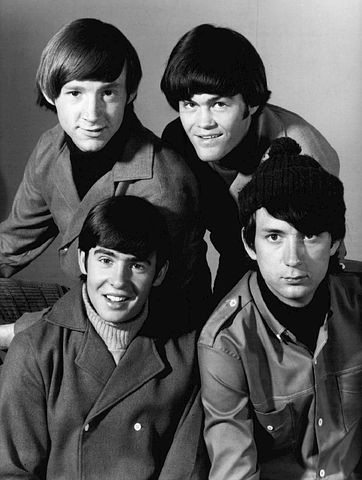
Memory association is a strange bird, as if there are kindred thoughts floating around out there just waiting to be connected.  I associate a Methodist hymn with an old children’s television show, whereas your association might go down a wholly different path.  Take it a step further for example.  With Davey and Goliath on the brain what comes to mind next?  You might think of the Bible story – the young and future king David bringing down the Philistine warrior Goliath with one pull of the slingshot.  Me, I think of The Monkees – the manufactured American rock band of the 1960’s.  The Monkees had the only other Davey I can think of – singer Davey Jones (lower left in the photo below).

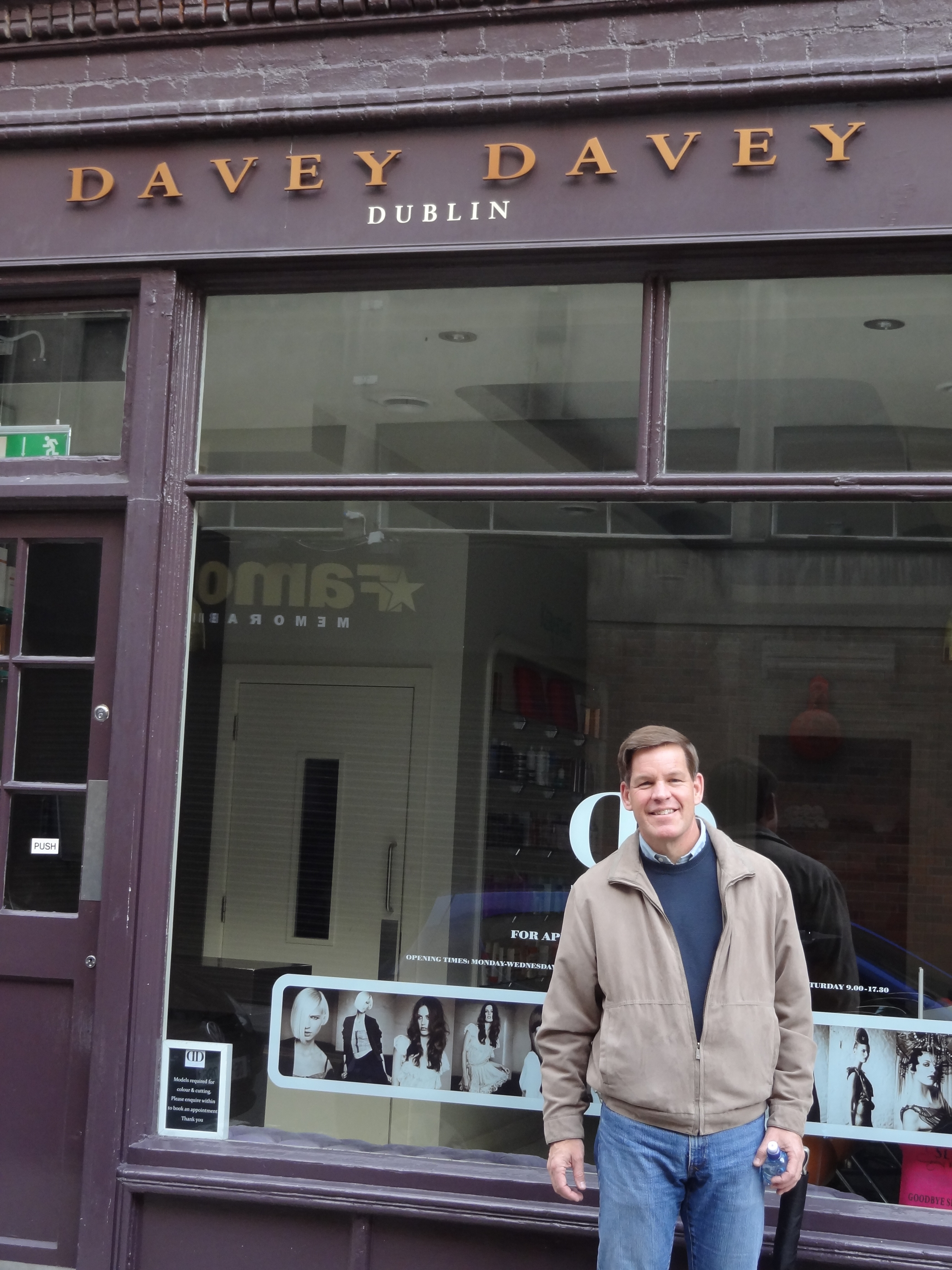
Now that I think about it (memory association at work again), I do have another Davey in mind, which you see in the below photo (not me – the shop).  Davey Davey is a “top hair salon” smack dab in the middle of Dublin, Ireland.  The owners – presumably brothers – have the surname Davey.  That’s a rare find: a surname more commonly used as a given name.

The Monkees always make me think of The Beatles, and just this week The Beatles associate to “sensational” (intentional) misspelling: “Beatles” vs. “Beetles”.  I never thought about it until my son brought it up but the “Beetles” became the “Beatles”, changing their name early on to associate more with musical beats than insects.  How’s that for useless trivia?

The Monkees are also a memory-association “cul-de-sac” for me; that is, I came back to Davey Jones shortly after I left him.  Davey Jones then memory-associates to several other David’s who made small but significant appearances in my life, as follows:

  • David Cassidy – Alongside the Partridge Family (and The Brady Bunch), Cassidy occupied several years of my Friday night childhood television.  Not one of my better life choices.
  • David Lee Roth – Alongside Van Halen, helped develop my appreciation for American rock in the 1970’s (if not the current fashion trends).  As Roth would say, “might as well jump!”
  • David Robinson – Alongside his Navy teammates, helped develop my appreciation for the best in college basketball post players.  Imagine, a class athlete and a class act.  That was “The Admiral” in a nutshell.
  • David Letterman – Reinvented late-night talk show for me and my fellow baby-boomers.  In college I didn’t miss a single Letterman opening monologue (or Top Ten list).
  • “David” – Michelangelo’s most famous sculpture, on display in Florence’s Galleria dell’Accademia near the Piazza della Signoria.  (How “the David” came to be is a remarkable story – read Irving Stone’s biographical novel “The Agony and the Ecstasy”.)
  • David Koresh – Alongside his Branch Davidian cult followers, showed me the horrors of brainwashing amidst the famous 1993 standoff with government officials in Waco, TX.  (There had to be at least one “shame-the-name” on this list.)
  • David Copperfield – Elevated magic to jaw-dropping larger-than-the-stage performances.  My family and I saw him perform in Colorado Springs in the 1990’s.  Copperfield was unquestionably one of the legends of his profession.
  • David Schwimmer – Still can’t get “I’ll Be There For You” (or Rachel) out of my head.

The list goes on and on – dozens of David’s making their mark out there.  Incidentally, the literal association of “David” is “beloved”, which also dates back to the Bible.  Nice.  But that’s not how my mind works.  I just keep coming up with famous Dave’s instead.

Some content sourced from Wikipedia, “the free encyclopedia”.


Reinstating the “Swoosh-Curl”

The Associated Press (AP) recently posted an article: “Cursive Writing Makes a Comeback in U.S. Schools”. That caught my eye, because I didn’t know cursive writing went anywhere in the first place. I assumed most everyone – regardless of age – can sign their name in cursive. Turns out the broad adoption of Common Core curriculum standards in 2010 removed “handwriting” as an essential skill.  The teaching time once used for cursive now goes to learning the keyboard.  Ask today’s student for a signature and you’ll probably get block letters instead of “continuous flow”.

I still remember my grade-school days spending hours on paper, forming my upper and lower-case letters.  Then I graduated to cursive, and the “swoosh-curl” of the loops as I progressed across the page without lifting the pencil.  Cursive evolved from block-letter writing as a way to speed up handwriting.  If speed were the only criteria, no wonder today’s generation prefers the keyboard.  In the race between my cursive on paper and my daughter’s thumbs on the smartphone, she wins by a landslide.

Speaking of cursive, here’s an example of my very own.  Hopefully you can read it.

That’s right:  The quick brown fox jumps over the lazy dog – a sentence I wrote over and over in cursive practice.  It’s a pangram – a sentence using all the letters of the alphabet.  The quick brown fox… is the most famous pangram but there are several others, including: Pack my box with six dozen liquor jugs!

The shortcoming of my own cursive writing is my speed – or lack thereof.  It took me almost sixty seconds to write the sentence above.  You could probably write the same sentence in half the time.  But I have a couple of challenges working against me.  One, I’m left-handed, which means I’ve developed a curious writing style where I curl my hand around the point where pen meets paper.  This forces my hand to stay higher on the page and avoids ink smears, but I can’t go very fast.  Two, I have essential tremor, where my hands shake slightly when held in certain ways (like writing).  If I don’t go s-l-o-w, my cursive is downright illegible.

If cursive writing was born of block letters, then block letters were born of calligraphy.  Calligraphy is writing elevated to a visual art, where the lettering is created with wide and narrow strokes and requires the use of a special pen.  Today’s computer fonts try very hard to simulate calligraphy but there’s nothing quite like the handcrafted version.  The finest examples – using the Latin script – are found in early copies of the Bible; the so-called “illuminated manuscripts” created before the advent of the printing press.  Today you’re more likely to find calligraphy on wedding invitations, college diplomas, and other formal documents.  I have an aunt who mastered calligraphy and I wish I’d kept some of her letters and thank-you notes.  That kind of penmanship suggests a certain level of elegance and refinement noticeably absent in today’s writing.

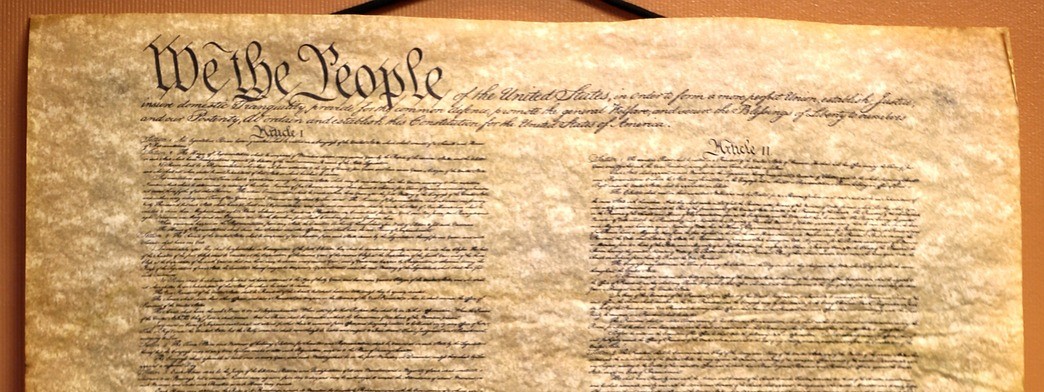
The AP news article claims fourteen states have reinstated cursive writing into their grade-school curriculum, so here’s hoping for more continuous flow signatures.  But there’s still plenty of debate about the “usefulness” of the swooshes and curls when keyboarding is clearly king.  To those who don’t see the value, consider this: our nation’s most important documents were written in cursive.  If you can’t write the U.S. Constitution in cursive you probably can’t read it in cursive either.  That would be a shame if you were ever lucky enough to see the original in the National Archives.

Some content sourced from Wikipedia, “the free encyclopedia”.

Bon Voyage!

Every now and then I come up with a topic for my blog, and then the topic somehow surfaces in the natural course of conversation later the same week. It’s a little unnerving – perhaps divine intervention – to watch someone bring up something you hadn’t thought about in years, or at least until a few days earlier.

85-bon-voyage-1

Such was the case this week when I opted for a (virtual) visit to Mont Saint-Michel, the majestic island commune and fortified abbey just off the coast of Normandy, France. Mont Saint-Michel came to mind because I received a mailer from my alma mater advertising a ten-day trip to the region next summer. The itinerary includes a stopover in Paris, a base hotel in the historic seaport village of Honfleur, extensive tours of Normandy focusing on the events of World War II, and finally, a full day exploring the island of “St. Michael’s Mount.” Mon dieu, what an adventure!

Mont Saint-Michel has a remarkable history on top of its dramatic architectural elements (which you can read about here).  Its buildings date to the 8th century, with the Romanesque abbey and monastery at the very top (“closest to God”), literally supported by a vast network of halls for stores and housing, and finished elegantly at the bottom – outside the walls – with individual houses for the handful of fishermen and farmers who live there.  The church inside the abbey is partnered with an open-air cloister (a square covered walkway for reflection).  A statue of the archangel Michael watches over the land from the very top of the church spire.  Magnifique, no?

85-bon-voyage-2      85-bon-voyage-3

Here’s an interesting bit of trivia about Mont Saint-Michel.  You may think the following photo is a distant view of the island.  Au contraire.  The Mont has a “sister” across the channel near Cornwall.  England’s island of “St. Michael’s Mount” is much smaller, but it still shares the characteristics of Mont Saint-Michel, including the significant rise/fall of the surrounding tides, the conical shape of the island, and a chapel at the top.

85-bon-voyage-5

In today’s world Mont Saint-Michel is a little touristy for my tastes, so perhaps it’s just as well I’ve never made the pilgrimage.  2.5 million visitors descend upon the island every year, hosted by only 25 full-time inhabitants (monks, nuns, and shopkeepers).  Tourism is literally the only source of income.  Besides a walk through the abbey and the spiraling streets, you’re channeled into the requisite shopping area, for food (including the famous to-go omelettes), and for purchases that can only be labelled as “tacky”. I actually have one of these souvenirs (below photo). Sacre’ bleu!  Maybe if they’d left off the sailboat…

85-bon-voyage-4

To further detract from the mystique of the Mont Saint-Michel, a permanent walking bridge was built three years ago, allowing round-the-clock access from the mainland car-park.  Once upon a time you had to wait until low tide and then quickly walk across the natural spit of land before the water returned.  Now you just cross whenever you want.  Too bad, but apparently the channel was filling in with silt and a bridge was the only way to keep the island an island.  C’est la vie.

My first introduction to Mont Saint-Michel was forty-odd years ago on the shores of California, not France.  San Diego County hosts elaborate sand-castle building competitions on its beaches, and one year I snapped the following photo of the winner.

86-bon-voyage-6

To visit Mont Saint-Michel, you’ll need to drive four hours to the west of Paris, all the way to the coast of the English Channel.  Unless you have a hankering for WWII history, there isn’t much else to draw you to the region.  Which brings me back to the start, and my comment about topics resurfacing later in the week.  Three days after I wrote this post, I was having a beer with some older friends and we got talking about the movie “Saving Private Ryan”.  One of the guys said his dad served in WWII and he’d taken him back to the beaches of Normandy, where he’d spent part of his time as a medic.  “Normandy?”, I said.  “Yes”, he said. “You know, in the northwest of France near Mont Saint-Michel?” To which I almost said, “excusez-moi?”

Some content sourced from Wikipedia, “the free encyclopedia”.


You Can’t Walk and Chew Gum

In the local news this week, we learned Amy Wilson and her newborn – residents of our fair city – are in critical condition in a Salt Lake City hospital as victims of a head-on collision. Wilson and her newborn suffer brain injuries as they struggle to survive, while two of three teenagers from the at-fault car are dead. The heartbreaking interview with Wilson’s husband here in Colorado included loss of words as he tried to reconcile the happiness of a birth with the tragedy of the accident.

My reaction to this story – besides donating to the “Amy and Baby Wilson Support” GoFundMe campaign – was the teenagers must have been texting at the wheel.  I wonder if they even left skid marks.  Prayers be with them, Amy Wilson and her newborn will survive and their injuries will be short-lived.  But the same cannot be said for the kids in the other car.  As it turns out they were street-racing when they jumped the median.  They might as well have been texting.

84-chastise-1

The victims on both sides of this accident will join the rising morbid statistics tied to “distracted driving”, which includes use of smartphones. We just can’t put them down, even with risk of life staring us in the face.  By no coincidence, the Wall Street Journal published an article this week about rising insurance rates tied to use of smartphones while driving.  36% of State Farm customers admitted to texting while driving, up 5% from five years earlier.  20% admitted to taking a photo while driving; another 10% take videos.  In those same five years smartphone ownership among drivers increased from 50% to 90%.

I will never understand the urgency to check a text while driving.   Apparently I’m not as addicted as most.  If I’m “late” in responding to a message, I can’t think of a better excuse than “I was behind the wheel”. When my phone rings or a text message dings, I will find a safe place to pull over if I can.  More often I’m not going to answer until I get where I’m going.

84-chastise-2

Perhaps I’m more motivated than most, because my son caused a distracted driving accident several years ago in high school.  As he fiddled with the car stereo leaving campus, he braked too late when he saw the red light in front of him, causing a chain-reaction fender-bender involving five cars.  Thankfully no one was hurt, but even at school-zone speeds my son caused a lot of damage.  Because of that incident I chastise my children any time I receive a text from them and realize they are driving.

Technology is trying to improve things, of course.  Voice-activated control is a lot better than it was just a few years ago.  But we’re not there yet.  Until it is commonplace to conduct a stream of communication from start to finish hands-free, the senseless accidents – and the insurance rates – will continue to rise.  Even if you perfect the technology, you still have the distraction.

84-chastise-3

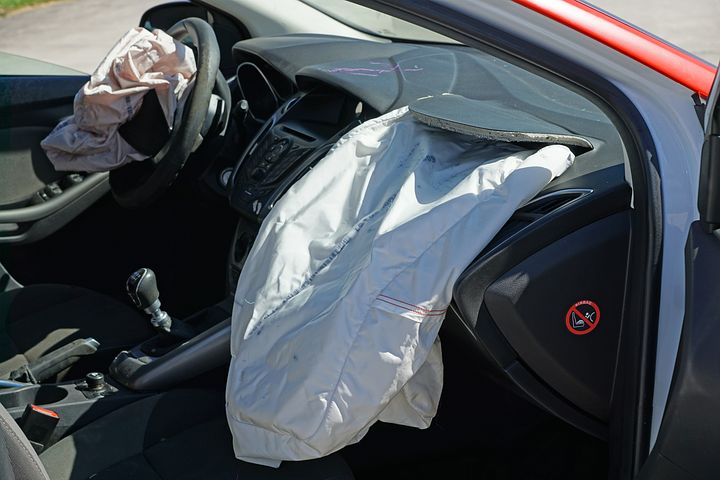
Sure, you can walk and chew gum at the same time, but not so texting and driving.  I looked at the photo above and thought, “what if you saw that through the windshield of the car coming towards you?”

The next time you’re on the road and you get that familiar ding, just keep going where you’re going.  No matter the message, it’s infinitely less important than the safety of those around you.

Something Wicked This Way Comes

This April, a movie called The Circle will arrive in theaters, and it just might generate enough buzz to displace political headlines.  The previews start innocently enough: a wide-eyed young woman “Mae”, who can’t believe her good fortune at being hired into the thoroughly glamorous Internet company “Circle” (a super-hybrid of Apple, Google, and Facebook).  Predictably, things take a turn for the not-so-good when Mae realizes her new employer seeks a singularly “true” Internet identity for its consumers, revealing all there is to know about a person.

The previews for The Circle intrigued me enough to give the book a try, even though the reviews were mediocre at best.  But no matter; the premise draws me in and keeps me reading.  What resolution can possibly exist in a not-so-distant future where an individual’s “privacy” goes completely out the window?  The Circle proposes an all-knowing (and therefore) all-exploiting Internet service; a corporate version of totalitarianism.  I can’t imagine a happy ending, can you?  As Ray Bradbury would say, something wicked this way comes.

83-prescient

Ray Bradbury authored countless short stories placing believable humans in not-quite-so believable circumstances, yet seeking a peek into a probable future.  “Fahrenheit 451” is perhaps his most famous example, but I have my own favorites, including “The Golden Apples of the Sun”, “A Sound of Thunder”, “Skeleton”, and “The Veldt”.  I own a collection of Bradbury’s “hundred best”, and find them just as compelling as when I first read them forty years ago.  Why?  Because they still aren’t quite believable.  The presumptions and technologies and societies of Bradbury’s stories are still somewhere around the corner of the world of today.  But I have no doubt they’re coming.

The same case can be made for the cult-classic neo-noir film Blade Runner, produced in 1982 but based on a book written decades earlier.  Blade Runner made several far-reaching assumptions about a dystopian Los Angeles of the future: a) climate change, creating an environment dominated by darkness and rain, b) culture change, where its inhabitants, language, and food are decidedly Asian, and c) technological change, where “replicants” (robots) perform the mundane tasks humans no longer care to do.  Blade Runner’s mystique is in the depiction of a familiar place transformed by radical changes; the kind that aren’t so unbelievable.  Not now perhaps, but they’re coming.  (Also coming: a sequel to Blade Runner later this year).

Here’s another example from Hollywood.  Logan’s Run (which was an on-screen disaster just begging to be remade thirty years later), depicted a completely controlled, pleasure-filled world inside a giant, sterile dome – but only until age thirty, when its inhabitants were ceremoniously put to death (to conserve the resources of a supposedly dying planet).  By default, Logan’s world is a society where everything is new and clean, everyone is “young”, and a day in the life is controlled by some behind-the-scenes, largely technological presence.  “Logan 5” and “Jenny 6” (a delightful nod to the loss of individualism) are too dependent on the comforts of their world to ever acknowledge its limitations. Considering how technology shapes our actions and decisions today, perhaps Logan’s world is not so far-fetched anymore.

The appeal of Ray Bradbury, Blade Runner, and Logan’s Run – even today – is stories about worlds that are (still) not believable.  We can enjoy them yet keep them at arm’s length, comforted by the thought “can’t really happen”.  And that’s what makes The Circle a serious conversation piece (even if it’s a box-office flop): a taste of an all-powerful, all-knowing Internet – if governments and corporations let it get that far.  Once we reach that point is there any turning back, or will “drones” more aptly describe humans than cool little flying machines?  Terrifying foresight for sure, but hopefully not prescient thinking.

Okay, you’re done reading now.  Back to your Facebook feed.

For Heaven’s Snakes!

On a recent jog along the dusty unpaved roads of my neighborhood, I heard – and then saw – a couple of energetic dogs intent on chasing me down. They leaped off the front porch of a nearby house, tore across the wide-open acreage adjacent to the street, and came to a halt just inside what must have been an invisible fence. Barking and jumping, they made it clear I was intruding on their space. Not that I really noticed. I was scanning the road and the shoulder where I was running instead, looking for snakes.

82-indigenous-2

Perhaps you’re wondering why I’m on the lookout for snakes in the dead of winter, when wildlife should be hibernating.  Or maybe you’re wondering why I’m even running in an area where I might step on one.  Truth be told, it’s highly unlikely I’d come across a snake in my neighborhood, even in the middle of a hot summer running deep into the weeds.  Colorado has plenty of the slithery ones, but they prefer the rocky habitat of the foothills to the west (up against the Rocky Mountains).  Yet I still look for them out of a long-enforced habit.

Does my snake-dislike qualify as a phobia?  Probably.  It was my earliest face-to-face with a rattler that turned me to the dark side.  Summertime, backyard of our house – living in the close confines of a narrow canyon – and I whacked a tennis ball into the neighbor’s yard.  Didn’t mean to do that and needed the ball back.  Nobody was home next door but a side gate meant I could sneak around unnoticed.  As I moved beyond the house and into an unkempt grassy area, I spied the tennis ball and made a beeline for it.  What I didn’t see was the five-foot snake nestled in my path, coiled and ready to strike.  Peripheral vision or his rattle made me leap and hurdle at the last second.  I landed on the other side of him and kept running.  Someone came to my aid and the rattler was caught soon after, but the damage to my psyche was done.  Snakes = not good.

There are four species of poisonous snakes indigenous to the United States: copperhead, coral, cottonmouth, and rattlesnakes (of which there are several sub-species).  I’ve had the “pleasure” of encountering two of these four up close and personal.  In California I came across several more rattlesnakes after my tennis ball adventure, including those big, nasty diamondbacks on desert hikes with the Boy Scouts.  Then, years later, while visiting my wife’s family in North Carolina, I played a round of golf and discovered copperheads are fond of the short grass out there.  I approached my ball on one of the fairways and just about left my shoes when a long, black snake sprinted across my field of vision.  One of the locals I was playing with just laughed and said, “copperheads; get used to ’em kid!”  Whether that was sage advice or mind games, golf in North Carolina lost all appeal.

Snakes have been in their share of films.  I’ve never seen snakes on a plane and I never saw Snakes on a Plane so I’m still okay to fly.  A friend dragged me to Anaconda, which killed any interest in seeing the Amazon.  And in Raiders of the Lost Ark of course, Harrison Ford is asked “Indie, why does the floor move?”  The following scene with all those snakes is a close-up I wish they’d left on the editing room floor.

82-indigenous-2

Some say you’ve got to get your nightmares out in the open to get past them.  Maybe I’m doing that by writing about them.  Doesn’t mean I won’t keep looking for slithery ones when I run.

There’s Something About Mary

Mary Tyler Moore passed away over a week ago and I’ve been thinking about her ever since.  Countless actresses come and go, but then you have those who make indelible impressions with one or two jaw-dropping performances.  Audrey Hepburn, Julie Andrews and Maureen O’Hara, just to name a few.  Meryl Streep.  And Mary Tyler Moore.

81-indelible-1

There’s something about Mary. I read her filmography from start to finish – a span of sixty years of television and movies – and came up with two roles of any significance to me: Mary Richards in The Mary Tyler Moore Show (1970-1977), and Beth in the film Ordinary People (1980).  But I think most people would agree – those performances alone land Mary Tyler Moore in an acting class by herself.

Moore first became a familiar name as Laura Petrie in The Dick Van Dyke Show in the 1960’s, but that was a little before my time.  On the other hand, The Mary Tyler Moore Show was a weekend staple in my house.  At an age when my father still controlled the TV remote (er, TV channel – no remotes back then), my brothers and I were treated to CBS’s Saturday night “killer lineup”, which included The Mary Tyler Moore Show, The Bob Newhart Show, and The Carol Burnett Show.

81-indelible-2

The Mary Tyler Moore Show included memorable opening credits, if only because the theme song was so infectious (“…you’re gonna make it after all…”), as was the final scene where Mary spins and smiles and throws her hat into the air at a busy Minneapolis intersection.  That throw – and Mary Tyler Moore herself – is immortalized in a bronze sculpture you can find at that very same intersection today.

81-indelible-3

In 1980, just as I was heading off to college, Robert Redford directed the Best Picture winner Ordinary People, one of the most gut-wrenching, powerful, “real-life” dramas I have ever seen.  Timothy Hutton burst onto the Hollywood scene with an Oscar-winning performance as Conrad, the younger of two sons in a tormented Chicago family.  Judd Hirsch was also nominated for an Oscar (losing to Hutton) for his portrayal of the determined therapist who counseled Conrad back to stability.  But it was Mary Tyler Moore’s turn as the heartless and unforgiving mother Beth that stole the show.  Her performance was so counter to the sunny demeanor of Mary Richards, I wondered if she was tapping the energy of some real-life bout of depression.  That was the breadth of Mary Tyler Moore’s acting talents.  I’ve only seen Ordinary People a couple of times but the scene where Donald Sutherland tells Beth he no longer loves her still haunts me.  Moore’s silent, crestfallen reaction to that statement could’ve coined the phrase “verbal slap in the face”.

I am even more taken by Mary Tyler Moore when I read some of the details of her life.  Clearly, she tried to embody the positive demeanor and “independent woman” of Mary Richards, but she did so in the face of significant personal tragedy.  She dealt with alcoholism and smoking addiction, drug overdose (her sister), suicide (her son), and years of diabetes.   She took up the baton to promote diabetes awareness and animal rights.  Moore was even tougher and more outspoken than her little/big screen roles would suggest.

81-indelible-4

The theme song of The Mary Tyler Moore show begins with “Who can turn the world on with her smile?” Scroll back up to that first photo.  Talk about ear-to-ear!  And I can’t help but smile back, even as we now say goodbye to Mary.

Some content sourced from IMDb.com.

Band of the Leader

Last week at church I was pleasantly surprised to see a brass quintet accompanying the organist.  Trumpets, tubas and French horns are typically reserved for the Christmas season services but there they were – a small group of our members – playing along with the hymns of the day.  It somehow made the service more meaningful.

80-credence

At President Trump’s inauguration I was pleasantly surprised to see a small band accompanying young Jackie Evancho as she performed America’s national anthem.  It was the first time I’d heard Jackie sing, and I thought her performance of “The Star-Spangled Banner” was flawless.  Perhaps some of you know Jackie as the singer from “America’s Got Talent”.  For me, her most recent performance lent credence to her status as “the youngest solo artist ever to go platinum”.  Jackie also performed for former President Obama at the Lighting of the National Christmas Tree, suggesting a refreshing lack of political persuasion in her decision to sing.

But back to the band – the “band of the leader” as it turns out.  Shortly after Jackie finished America’s anthem one of the inauguration commentators labeled the accompanying musicians “The President’s Own”.  That phrase stuck with me the rest of the day.  Thanks to my curiosity and an in-depth article on Wikipedia I now know more about this talented group.  In brief:

  • “The President’s Own” is formally called the “United States Marine Band” (USMB).  It is the oldest of the United States Military Bands, established in 1798.
  • The USMB became “The President’s Own” in 1801, after a performance for then president John Adams.  Later that year Thomas Jefferson requested a performance at his own presidential inauguration, and the USMB has performed at every inauguration since.  Counting President Trump’s that’s a total of fifty-three inaugurations.
  • The USMB has 130 members but typically performs with only 42.
  • The USMB performs about five hundred times a year, including state funerals and dinners, and arrival ceremonies for visiting heads of state.
  • The USMB’s most common performance is fifteen-minute “patriotic openers” for large events, including the playing of “Marine’s Hymn” (official hymn), “Semper Fidelis (official march), and “The Star-Spangled Banner”.
  • The USMB’s most famous director – back in the late 1800’s – was John Phillip Sousa, who composed “Semper Fidelis”, “The Stars and Stripes Forever”, and other famous march music.
  • USMB members serve a four-year contract as active duty enlisted Marines.  They are not required to complete the training of a typical Marine and are therefore never involved in combat missions.
  • Without a musical instrument in his/her hands, you could still recognize a USMB member by the lyre on their uniform rank insignia (replacing the normal crossed rifles).

I love the historical significance of “The President’s Own”, one of many uniquely American elements linking our current leaders to our Founding Fathers.  I also love the pomp and circumstance – bands, parades, fireworks and other “fuss” designed to accentuate our country’s most important moments.

Speaking of President Trump’s inauguration and the unquestionable divide of the people over his first week of actions, I found the words of the following quote spot-on.  Perhaps you can imagine “The President’s Own” playing in the background as you read, somehow making the words even more meaningful:

“We were a country that has been snoozing. Now we are alert. Whether it’s negative or positive, energy has risen. People are engaged. They’re studying. They are thinking more. And I think that’s good. You can’t get that without someone being bold enough to say things people don’t agree with.” —Hall of Fame running back Jim Brown to the Wall Street Journal.

Some content sourced from Wikipedia, “the free encyclopedia”.