Highest Chair

When we babysit our granddaughters here at the house, we tap into several items to make the job easier. A big basket of toys and stuffed animals sits in the corner of our living room. A dozen children’s books line the lowest shelf just waiting to tell their stories. Sesame Street is easily streamed on the nearby television. And at dinner time we roll out the high chair so everyone’s on the same level. So who would’ve thought a high chair would be my blog topic for today? Maybe you, if you know anything about cathedrals.

Notre-Dame de Paris

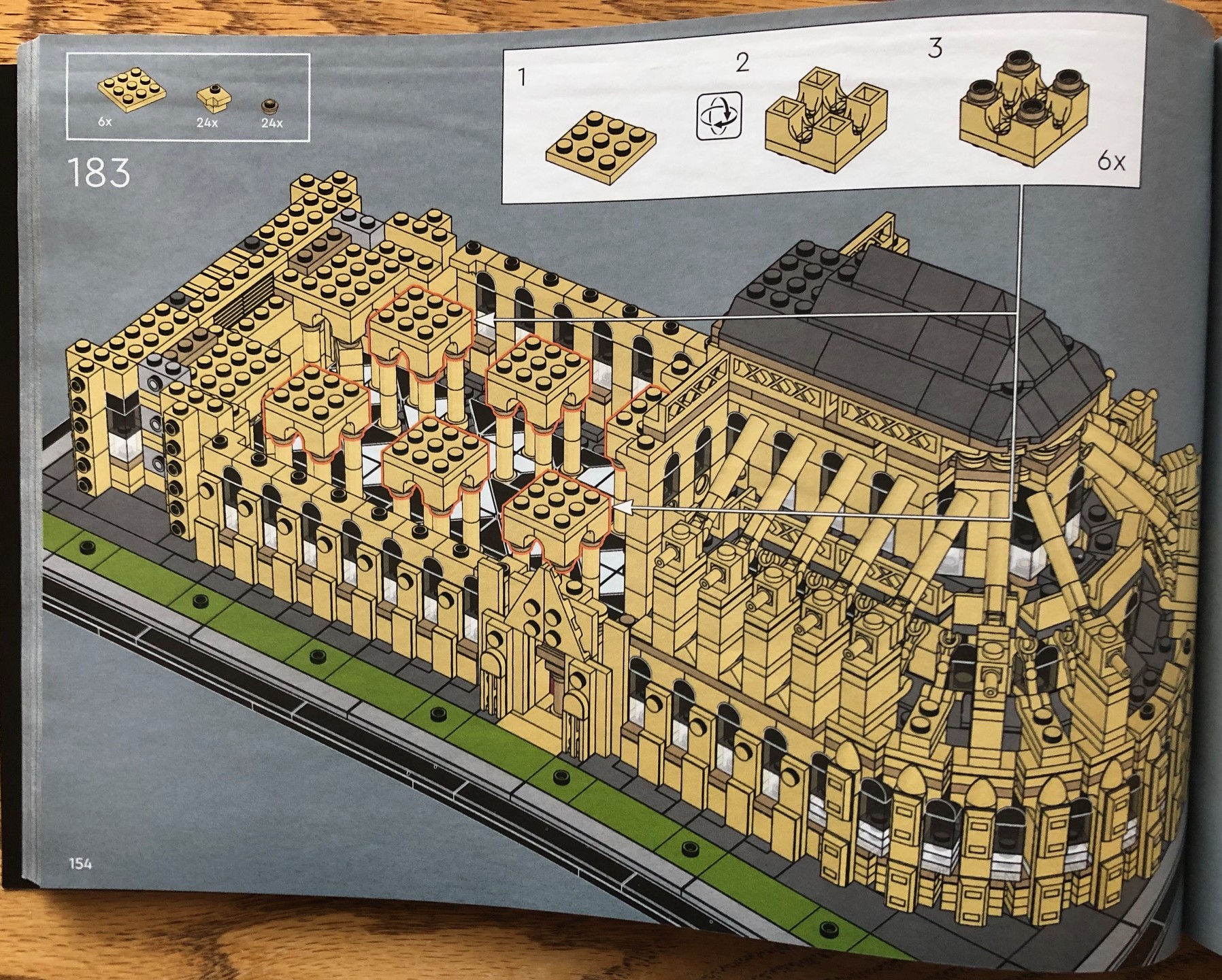
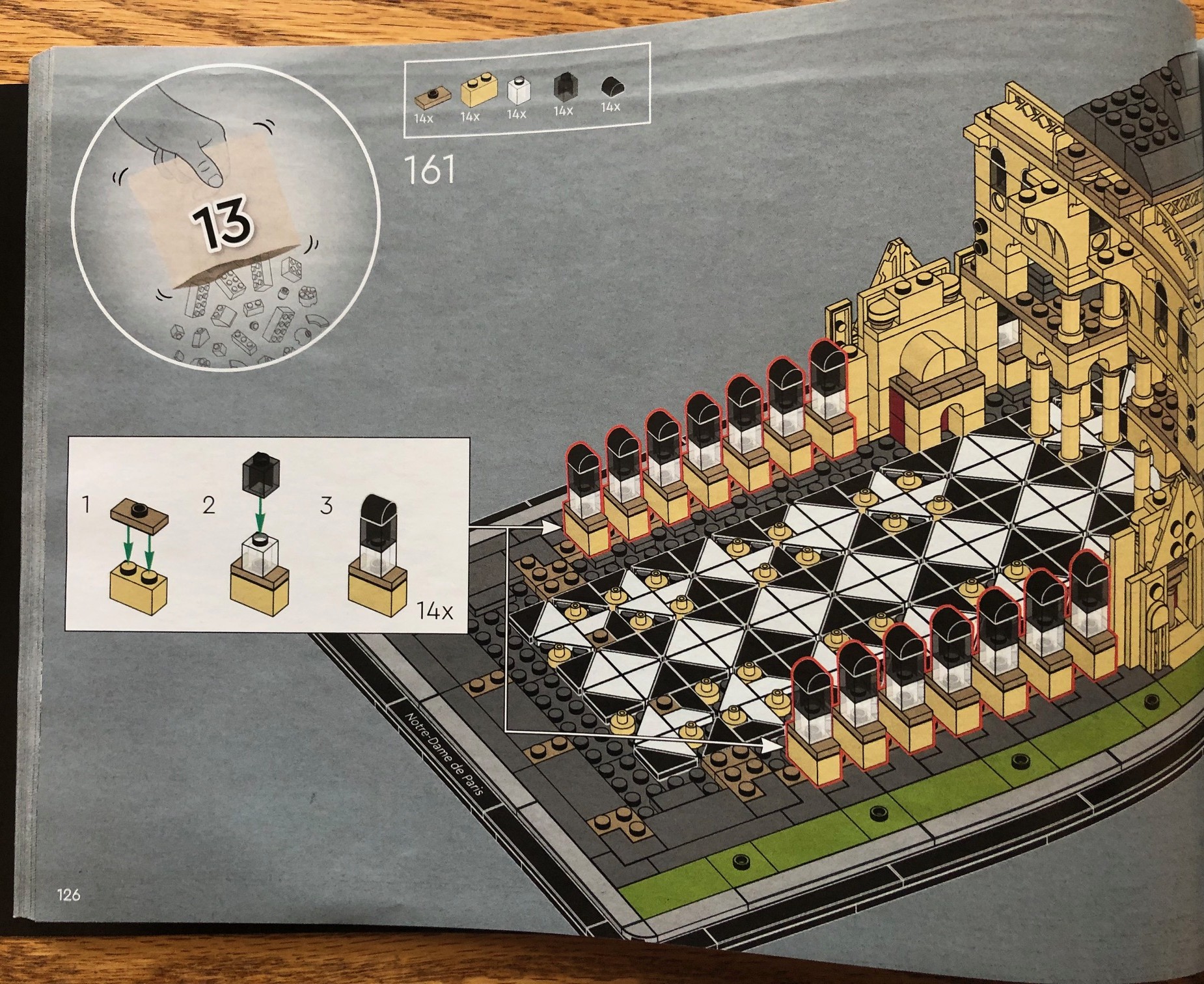
We’re almost there, loyal readers.  I will lay the corner-block of my LEGO model of Notre-Dame de Paris next week.  Why not this week, you ask?  Because before we crack the seal on the giant box of pieces, we need to pay a little respect to the real Cathedral.  I want you to know a few things about the stone and glass Notre-Dame before you witness the rising of the plastic one.

West facade

It’s a cathedral in the middle of Paris, Dave… what more do I need to know?  Uh, a LOT more.  To begin with, do you even know what a cathedral is?  I didn’t (and I have a background in architecture, for gosh sake).  It’s a big, giant church with stained glass and chapels and a raised altar, you say.  Well yes, you’re right, but what makes a church a cathedral?  Interestingly, it has nothing to do with the building itself.  Instead, a cathedral is the seat of a bishop (the ordained clergy-person who presides over the surrounding parishes). For lack of a church this person could just as easily be in a small house and it would still be considered a cathedral.

Cathedrals really do have “high chairs” on their altars for the bishops (cathedra in Latin means “seat”) but Notre-Dame de Paris is much more than a place for furniture.  First and foremost, it took a hundred years to construct (1163-1260).  In that era the building evolved from the common Romanesque style of the period to the more elegant French Gothic.  Notre-Dame feels unusually vertical and airy for a structure of its time and there’s a novel reason for this: flying buttresses.

Flying buttresses

Imagine Notre-Dame’s architect – Eugène Viollet-le-Duc – talking to the Paris city council in the twelfth century and saying, “Look guys, let’s think outside the box here… literally.  The structural support for this church ought to be outside of the building instead of inside”.  Why would the architect want this?  Because the flying buttresses assume the structural load that was previously handled by short, thick interior walls.  The result is taller, more dramatic spaces, filled with the light of high-up stained glass windows.  In other words, flying buttresses allow Notre-Dame to “reach for the heavens” much better than its Romanesque predecessors.

North rose window

There’s also more to this French “grande dame” than structure, of course.  Notre-Dame has twenty-nine chapels surrounding the main sanctuary (that’s gonna take a lot of LEGO).  It features three spectacular stained glass “rose” windows that would not be as large or as high were it not for those flying buttresses.  Notre-Dame’s twin towers host ten massive bronze bells and they each have first names.  “Emmanuel” (listen to his sound bite below) and “Marie” are so big they take up the entire south tower, while their eight ringing siblings all fit into the north tower.

Notre-Dame also has a central flèche, a spire not unlike the ones you see on more modest churches.  This spire, however, is topped by a bronze rooster, which is not only the symbol of the French state but also a container for (supposedly) a small piece of the Crown of Thorns, worn by Jesus leading up to his crucifixion.

Rooster-topped “flèche”

As you would expect, Notre-Dame de Paris hosts countless works of art, whether paintings or sculptures.  Many of the sculptures are biblical scenes intended to educate the illiterate parishioners of the twelfth century.  But my favorite sculptures may be those of the twelve apostles, way up high surrounding the base of the flèche and looking outwards towards Paris… all except one.  St. Thomas – patron saint of architects – faces Notre-Dame itself, and was given the facial features of Viollet-le-Duc.

Okay, so now you know more about Notre-Dame de Paris than just the LEGO model.  Considering there are over 500 Gothic cathedrals in Europe, it’s impressive to see Notre-Dame at the very top of at least one “Top Ten Cathedrals” list.  We’ll visit some of those other “high chairs” in future posts, to add even more life to my pile of plastic pieces. In the meantime, my LEGO “church service” begins promptly at 10am next Thursday.

Some content sourced from Wikipedia, “the free encyclopedia”.

You Can Say That Again

When I was a kid, I remember (or was told) I used creative pronunciations for common words. Instead of cinnamon I’d say cimm-anin. Instead of spaghetti it was bis-ketti. The library was the lie-berry. Maybe back then my excuse was in just learning to talk but I can’t play that card as an adult. So when someone says Feb-YOU-air-ee instead of Feb-ROO-air-ee, or Shur-BERT instead of Shur-BET, I tend to wince.

We’ve made it to the time of year where we reflect on the previous one, and we do so in year-in-review lists. “Most Influential People of 2024”. “Best Television Shows of 2024”.  “Significant World Events of 2024”.  And how about this one?  Most Mispronounced Words of 2024.  Thanks to Babbel, maker of language-learning platforms, the hard audio evidence doesn’t lie.  Babbel came up with ten words people mispronounced over and over last year.

I could print Babbel’s list here, but it’d be a waste of your time so I’ll just hyperlink it instead.  Eight of the words I never ever used in 2024 (and never will), and the only reason I spoke the other two was because they’re the last names of politicians featured in 2024 headlines.  To be honest, the list made me question Babbel’s approach to learning languages.  Are these the words promoting a budding English speaker’s proficiency?

Babbel also listed mispronounced words from other languages, including one of my favorites: espresso.  Not sure how we Americans get that one wrong time after time, but we do.  Maybe the myriad “ex-” words in the English language have us saying EX-presso but the concentrated coffee drink sounds exactly as it reads: ES-presso.  Keep that in mind and your next Italian barista will be happy to serve you.

As long as we’re speaking Italiano let’s get another one right – al dente.  When you want your pasta cooked just right; “not too soft but firm to the bite”, you describe it as ALL den-tay, not ALLA dawn-tay.  I only know this because I learned Italian when I was in college.  If I didn’t know better myself I’d probably go with AL dent.

Notre-Dame de Paris

As long as we’re talking foreign language mispronunciation, let’s correct another one.  Notre-Dame de Paris, the medieval Catholic cathedral in the middle of Paris (and the middle of the River Seine), can be mispronounced so many ways it’s almost as devastating as the fire from which it was resurrected.  On the surface it sounds something like NOH-tur daym day PEAR-iss, which is “English-French” at its absolute worst.  In actual French it sounds like this: NOH-tr dam due PAH-ree, where the two “r”s almost sound like “l”s.

You never saw it coming but today’s language lesson is a segue to the topic I’ll be covering for the next several weeks and months.  Notre-Dame de Paris is a magnificent structure and a renowned work of architecture.  It’s also a new model created by the good people at LEGO.  And speaking of good people (great, actually), my wife put that LEGO model under the Christmas tree for me this year.

For those who enjoyed the long journey of my building the LEGO Grand Piano (which I chronicled in Let’s Make Music!), and the shorter journey of the LEGO Fallingwater House (Perfect Harmony), I’ll be at it again as I attempt to rise Notre-Dame de Paris from the “ashes” of 4,383 plastic pieces.  Won’t you join me on this foray into all things FRON-says?  (That’s “French” for those of you who mispronounce it.)  You’ll learn about the world’s cathedrals along the way, many of which took hundreds of years to construct.  Let’s hope my own build of Notre-Dame de Paris is a whole lot shorter than that.

Some content sourced from the CNN World article, “These are the most mispronounced words of 2024”, and Wikipedia, “the free encyclopedia”.

Recycled Airbags

As I build the beginnings of this week’s blog post (three “b”s already for those keeping count) my screen distracts me with alerts for Cyber Monday deals. Laptops at 30% off retail. E-readers at 25% off. DNA tests at 70% off (which begs the question: do we really care about our ancestry anymore?) Cyber Monday is a sort of second chance for those who shunned the big box stores the Friday after Thanksgiving (good decision). But here’s what I wonder today. Why endure Black Friday or get distracted by Cyber Monday when you can shop through lost luggage any day of the year instead?

I’ve finally found a reason to visit Alabama.  A six-hour drive due west of my keyboard puts me in the little town of Scottsboro, of which an entire block is consumed by a business known as Unclaimed Baggage.  UB is exactly what you think it is: deep-discounted personal belongings made available to you by the traveling misfortunes of others.  Think of UB as one person’s trash becoming another person’s treasure only, of course, the original owner had no intention of throwing it away.

“Where’s my owner?”

Unclaimed Baggage is the kind of entrepreneurial enterprise I wish I’d thought up myself.  Consider the end-to-end process.  You and your luggage start at Point A, but sadly one of you doesn’t make it to Point B.  The airline (or the bus or the train) spends several months trying to reunite the two of you.  Failing that, they compensate for the loss (sometimes).  But what of your bag if it turns up later?  Dump it into a “Dead Luggage” office?  Actually, yes, and then Unclaimed Baggage comes a-calling.

Here’s an encouraging stat: 99.5% of lost luggage is reunited with its owner.  You wouldn’t think Unclaimed Baggage could make a business of the leftovers.  But those leftover are, on average, 7,000 items every day.  No wonder Unclaimed Baggage needs a city block to house all that it sells.  And the best part of the business?  UB never knows what it’s going to get because the airlines don’t (or aren’t allowed to) open the bags.  It reminds me of the show where bidders vie for contents of storage lockers without being able to raise the roll-up doors beforehand.

The most expensive item UB ever sold was a Rolex watch for $32,000 (50% of retail).  Visit the store today and you can purchase a diamond ring for $20,000 that surely appraises for more.  Some items are so strange they’re relegated to an area known as the “Museum Gallery”.  Wigs. Shark teeth.  A funeral casket key (?)  Items considered “unsaleable”, and items where you have to wonder why they were on an airplane in the first place. 

Treasures from chests suitcases

When I first learned about Unclaimed Baggage I thought, they have something of mine and I want it back!  No, I’ve never lost luggage.  Rather, I’m the passenger who keeps forgetting the little things in the seat back pocket right in front of him.  Reading glasses.  E-readers.  A rather expensive pair of noise-cancelling headphones.  Somehow my stuff gets left behind despite the pointed announcement from the flight attendant: “Please check in and around your seat for personal belongings, as you will not be allowed back on the aircraft after you deplane.”  Sigh…

Unclaimed Baggage has at least one example of an item unintentionally returned to its original owner.  At UB’s annual ski sale (which earned an LOL from me; I mean, just how many skis are left at baggage claim?), a shopper purchased ski boots for his girlfriend.  When he brought them home, she discovered initials on the inside of the boots – hers.  The airline had already compensated her for the lost boots so effectively, she re-owns her boots at a deep discount.

Time is cheap at Unclaimed Baggage

As you might expect, a good percentage of shoppers at Unclaimed Baggage are the same ones who troll garage sales and eBay for items they have no intention of owning.  They simply relist their wares online for purchase (and profit) from others.  It’s another enterprising way to make a buck but it’s not my cup of tea.  I’m the shopper who shows up at sales well after the best items have been picked over.

Unclaimed Baggage has cornered a lucrative market.  I don’t think they have any competition for the business of repurposing lost luggage.  I will say this: I’m less likely to leave my stuff on airplanes now that I know about UB.  I mean, do I really want some stranger buying my stuff for way less than I paid for it myself?

Final thought for the day.  Why don’t they call it Unclaimed Luggage?  Baggage?  Luggage?  Bag?  Lug?  Who the heck added two words into the English language when we only needed one?  The Oxford English Dictionary estimates we use 170,000 words these days.  I’m here to say that’s one too many.

Some content sourced from the CNN Travel article, “US travelers lose millions of suitcases every year…”, and Wikipedia, “the free encyclopedia”.

Minuscule Marvels

For Christmas this year I’m putting a small ornament into my wife’s stocking. It’s a miniature of… well… let’s just leave it at “a miniature” in case she reads this post. But I know she’ll love this ornament and promptly hang it on our tree for the remainder of the season. Why will she love it? Because it’ll spark fond, romantic memories. But she’ll also love this ornament because she can’t help loving something that’s a little, well, little.

Ornaments are little

One of my bucket list items – still to be fulfilled – is a trip to the south of France for a taste of those wonderful wines created from Burgundy or Bordeaux grapes.  Maybe you hope to make the same trip some day so I’ll let you in on a little secret.  If your trip only allows a visit to Paris, you can still visit a vineyard… right in the middle of the city.  Most people visit the neighborhood of Montmartre to see the Sacre Coeur cathedral but most don’t know about the tiny vineyard just steps away.  Clos Montmarte produces wine on a single acre, from 2,000 vines forging a connection to the long-ago rural times of the region.  Compare an acre to the wineries in Bordeaux, with vines covering an average of fifty times that much property.

Harvesting the grapes at little Clos Montmartre

Clos Montmarte wines probably aren’t award-winning.  Who knows if I’d even care for the taste of their reds or rosés.  But does it really matter?  I love the thought of a teeny-tiny field of grapes right in the middle of Paris.  I love how the grapes are harvested by locals and transported to the cellars of the nearby Town Hall to be pressed and turned into wine.  The whole operation is appealing to me because it’s quaint and because it’s small.

This affection for itty-bitty things must hearken back to our childhoods.  Who among us didn’t spend countless hours of playtime with (take your pick) little dolls, little cars, little houses, or scaled-down trains?  When we played at the beach we built little castles.  When we played in creeks we made little boats out of sticks or leaves and watched them flow with the water.  Tea parties meant tiny cups and plates on tiny tables.

My granddaughter’s little favorites

In today’s world the toys might be different but the attraction to small things remains.  It fascinates me to watch my (little) granddaughter choose her favorite toy from among dozens: a set of ten two-inch high Sesame Street characters.  She stands them up all over the house.  She hides them and then finds them.  She always seems to have one or two in her hands.  Even though my granddaughter doesn’t speak in complete sentences yet, she probably has complete thoughts as she considers tiny Big Bird.  You are a lot smaller than me and that’s why I like you so much.

Wee little cube

If you include Japanese toymaker MegaHouse in this year’s Christmas purchases, maybe you’ll go for their world’s smallest operational Rubik’s cube.  You can’t get one until next April, but picture this: the minuscule marvel is one 1,000th of the size of the original.  Pull out your metric measure to confirm it; a single face of the wee cube measures only 5mm from side to side.  Best throw a pair of tweezers into the Christmas stocking along with the cube.  There’s no way you’ll be able to rotate the Rubik’s colors with fingers alone.

Would I want the world’s smallest operational Rubik’s cube, you ask?  Heck yeah!  Consider, the faces of a traditional Rubik’s cube contain a 9×9 grid.  Then someone went and created a miniature Rubik’s cube with 2×2 grids.  I thought, how very cute.  I just had to have one so my original would have a little buddy.  My cubes are hanging out together on my home office shelf as we speak.  And they’re asking for an even littler buddy for Christmas.

Rubik’s “Mini”

So let’s summarize the pint-sized products we’ve covered today.  I already have the ornament for my wife in-hand (soon to be in-stocking).  I won’t put a bow on a bottle of Montmartre wine this year because I want the chance to see the tiny Paris winery for myself first.  And you probably thought I sprung for one of MegaHouse’s pee-wee Rubik’s cubes (and a pair of tweezers). Sadly, no.  I don’t have the $5,300 it costs to buy one (minuscule marvels aren’t cheap!) Thankfully, my wife will be happy with an adorable little ornament for $15 instead.

Some content sourced from the CNN Travel article, “The secret vineyard in the middle of Paris…”, and the CNN Style article, “This is the world’s smallest Rubik’s cube…”

Overblown Air

When you travel to Colorado, you should pack a few things you might not think to bring. A reusable water bottle will be your constant companion since it’s high and dry in the Centennial State. Lip balm will be your pocket pal. Your wardrobe should be designed in layers since Colorado’s weather is so unpredictable. And finally, for the lack of air in the Rockies, don’t forget to bring a can or two of oxygen.

Canned oxygen?  For the longest time I thought this was the biggest scam on earth.  There was a time you could find “oxygen bars” at Colorado ski resorts – high altitude establishments where you’d pull up a stool and choose from a menu of “airs” to augment your oxygen intake.  Watching those suckers – heh – with their mouths attached to transparent hoses had me picturing a guy on the other side of the wall furiously working the plungers of bicycle pumps.  But forget oxygen bars.  Now you can take a hit from your very own can instead.

Boost , a popular brand of canned oxygen, has been around for a while since its humble beginnings through Shark Tank.  In Colorado you’ll find Boost products in every market, drug store, gas station, and airport concession.  Boost is  advertised as “95% Pure Supplemental Oxygen in lightweight, portable, and affordable canisters for health, recovery, natural energy, and athletic performance”.  That’s an impressive string of words to describe nothing but canned air.

First-timers will react to Boost with a well-defined smirk.  Gag gift for the relatives back home?  Stocking-stuffer?  After all, you’re paying $10 for a can of… well, nothing.  Yes, Boost comes in flavored varieties like lavender or eucalyptus menthol but in the end, it’s just air.  And watching someone take a hit of Boost is just like the goofball in your kitchen who tips the can of whipped cream directly into his mouth.  Even the sound of escaping compressed air is the same.  Just no whipped cream.

Naturally this is the point where I admit I’m a canned-air convert.  Never thought I’d see the day I’d actually need a “boost”.  But last January as I was moving belongings out of our Colorado house, I came to a breathtaking realization: I was no longer acclimated to the thin air of the Rocky Mountains.  Climbing a set of stairs had me huffing and puffing.  Lifting a box made my heart go pitter-patter.  For some reason I’d thought to add a can of Boost into my suitcase, so what do you know?  Compressed air to the rescue.  Every now and then I’d blast the can into my mouth and darned if it didn’t clear my head and help me breathe.  I was no whipped-cream junkie but rather a bold astronaut, seeking the occasional hiss of his supplemental oxygen.

For all its success, the legitimacy of a product like Boost is sullied by similar products having no health benefits whatsoever.  On your next trip to Italy, head up to Lake Como in the far north for a look at the pristine waters and nearby snow-covered Alps.  While you’re there you can purchase a can of “Lake Como Air” for $11.  Lake Como Air claims no value other than “something original, provocative, and fun”, or “… a tangible memory you carry in your heart”.  Really?  I have lots of tangible memories from Italy and they didn’t cost me a dime.

On your next trip to Israel (which best not be anytime soon), head over to the Dead Sea for a look at the biggest, saltiest resource of natural minerals in the world.  You can float in the Dead Sea without even treading water.  And no surprise, you can “purchase” the Dead Sea in small containers.  The so-called manufacturer claims its consumption “contributes measurably to feeling better and to looking wonderful and healthy”.  Huh.  Not sure about you but I like to think I feel better and look healthy just by drinking from the tap at my kitchen sink.

The list goes on and on.  Holy dirt from New Mexico.  Healing waters from right here in western South Carolina.  Rocks from outer space.  I mean, seriously, when are we going to stop paying for natural elements we can help ourselves to just by stepping outside our front doors?  Yeah, probably never.  That train left the station for good the day someone decided to bottle water.  Now we have canned air as well… and it’s a good thing.  Turns out, I’ll never take another trip to Colorado without a little Boost in my suitcase.

Some content sourced from the CNN Travel article, “Cans of ‘fresh air’ from Lake Como on sale to tourists in Italy”.

Flop O’ the Mornin’

Parked prominently within my wife’s impressive collection of teas are colorful boxes of English Breakfast and Irish Breakfast. The first is described as “expertly blended… a smooth classic” (strength: 4 tea leaves) while the second is “brilliantly blended… bold & robust” (3 tea leaves). Maybe those descriptions are right on the money but I’m a coffee drinker so what do I know? What do I know? I know I’d never let English breakfast or Irish breakfast anywhere near my dining table.

Sorry to disappoint but we’re not talking about tea at all today.  Instead, we’re talking about the food that goes with the tea.  Or rather, the food that should go with the tea.  In my world, the sanctity of breakfast is second only to the cornucopia of the Thanksgiving meal.  There’s a certain well-defined menu of dishes that screams BREAKFAST!!! and nobody in the Western Hemisphere (or at least, in the New World) would disagree.  Even so, I must acknowledge the “illegal aliens”; the dishes that try to crash the morning party when they really belong on the lunch or dinner table.  Or in the trash.  Or at least on the other side of the Atlantic.

The “Full English”

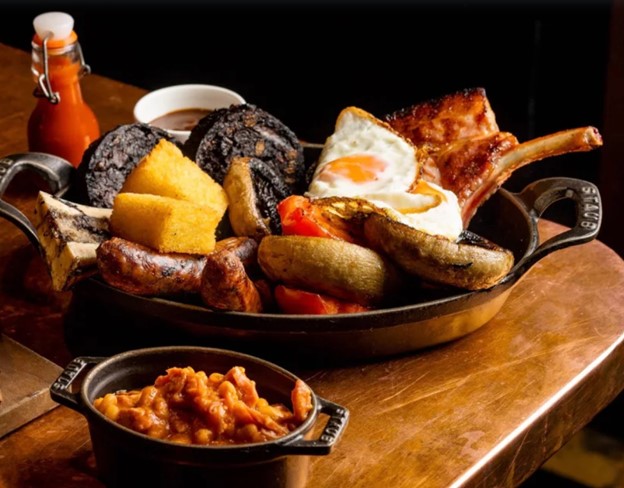
In its various forms, the full English breakfast starts out promising.  You’ll find eggs, bacon, and sausage almost without fail; even hash browns on occasion.  But the plate shatters after that.  You have a tomato, cut in half, fried, and doused with salt and pepper.  You have baked beans in tomato sauce (which aren’t even sweet the way Americans think of VanCamp’s or Bush’s). Finally, you have the horror known as black pudding, which can only be described through the hyperlink above instead of the words of this post, for fear I’ll lose my lunch – er, breakfast.

Unlike the teas, the full Irish breakfast is virtually identical to the full English, with the singular exception of white sausage instead of black.  Again, the definition will remain behind hyperlinked for the sake of a clean keyboard.  I was in Dublin on business years ago and took the “try anything once” approach with white pudding.  Bad, bad, very bad decision.

White pudding (not for the faint of stomach)

If I were born in England or Ireland I probably wouldn’t rain on the breakfast parade on the other side of the pond.  But here’s the thing: even if you like a savory tomato or “pudding” for breakfast, the entire plate is greasier than the wheel bearings in your car.  There’s not even anything to mop up said grease (like the slices of dry toast we Americans prefer).  I can’t imagine having much pep in my step after a weighty meal like this.

Denny’s is very helpful to reestablish breakfast order. If you walk into one of their restaurants and order the “Build Your Own Grand Slam”, you can construct your plate from four of the following: Eggs (7 different ways), pancakes (9 different), bacon (2), sausage, potatoes (3), toast (countless), muffin, biscuit, ham slice, or seasonal fruit.  With all those combos you could eat breakfast at Denny’s every day of the year and no version would be the same as another.  But more to the point, Denny’s offers breakfast items decidedly “All American”.  Add in waffles, hot/cold cereal, baked goods, and hash browns, and you’re looking at everything deserving of the list.

Where real “full breakfast” is served

American breakfast menus do include a few trendy alternatives these days (even at Denny’s).  You can keep it simple with a fruit smoothie, breakfast sandwich, or avocado toast.  These all-in-ones strike me more like convenience foods than full breakfasts.  Yes, you paint yourself a little healthier just for ordering them.  But let’s hang in there a few generations and see if they still show up on breakfast menus.  More likely they’ll just be memories the way porridge or salted meats have become breakfast history.

For the record, my wife’s English and Irish tea boxes sit largely untouched, except for the few bags she’s brewed.  They’re untouched for good reason.  Just the words on the box have me thinking of tomatoes, baked beans, and pudding.  Someone bring me a blueberry waffle stat.

Some content sourced from the CNN Travel article, “The Full English: How a greasy feast came to define and divide a nation”, and Wikipedia, “the free encyclopedia”.

Parts Party

I’ve always been fascinated – mesmerized even – by the mechanics of assembly line manufacturing. A product takes form from a single part, then moves down the line to where another part is added. Then another part, another, and another, until at long last the completed product presents itself at the very end for packaging. Assembly lines are becoming more and more automated, which begs the question: When will humans be removed from the process altogether?

“The Rouge”

On a recent trip to Detroit with my brothers, we were lucky enough to snag tickets to a tour of the Ford River Rouge Complex, where the F-150 truck (gas engine) is mass-produced. Ford has over 65 manufacturing plants worldwide but I think “The Rouge” is the only one you can tour. And boy is it worth it. You walk away with a lot more admiration for a fully-built F-150 than when you first set foot in the building.

The tour begins on the bridge at the lower left

Ford doesn’t allow you to take photos inside The Rouge (and they keep a close eye on visitors) else I’d include a few here. The tour starts with a couple of promotional videos in comfortable theaters, followed by an elevator trip to the top of the visitors center for a look down at the vast campus. Then things get serious. You put away your phones, listen to the rules and regulations about behaving inside the factory, and off you go.

Ford F-150

Here are the eye-popping numbers. The F-150 travels the length of a four-mile assembly line as it grows from parts to finished product. That line includes over two hundred stops to add parts (which aren’t really stops because the truck is always being pulled along). A fully-functioning F-150 rolls off The Rouge assembly line every 52 seconds, which translates to a remarkable 650 new vehicles per ten-hour working shift. And finally, the whole process is far from automated. 6,000 workers assemble the vehicles, each a specialist in the given part, calibration, or inspection the truck demands.

Of course, an F-150 has far more than two hundred parts. Some of those assembly line stops are for the installation of major components. The entire dashboard, for example, or most of the engine are installed in a single stop. But you also have workers who do nothing more than take a rubber mallet and pound on rear taillight covers. Think about it.  Can you imagine hammering on taillight covers 650 times a day?  It’s mindless, it’s repetitive, and you have to wonder about the toll it takes on the human body.

Cereal-making “back in the day”

Assembly line work can be more fun and less repetitive than building cars.  My family and I visited the Kellogg’s (cereal) factory in Battle Creek, Michigan in the early 1970s.  The smell of cooked corn flakes might’ve turned a kid’s nose but the tour was the next best thing to Willy Wonka’s.  You’d don a Kellogg’s paper hat and read the colorful brochure story about how “this little kernel went to Kellogg’s… first it was milled… then it was flavored…”.  Then you’d walk the assembly line of breakfast cereal, from cooking all the way to box filling.  The best part was at the very end, where you’d get free samples of all your Kellogg’s favorites, and postcards so you could brag about the place to your friends.  Alas, like many manufacturing facilities, safety and espionage concerns brought an end to the Kellogg’s tours in the mid-1980s.

At least I could watch assembly lines on TV after that.  How It’s Made was my kind of show.  The Canadian documentary spent years creating virtual factory tours so viewers could see the ins and outs of manufacturing processes.  In a single episode you’d watch the dizzying mechanics behind the creation of everything from candies to clothing to cars.  How It’s Made kind of gave you access where access wasn’t allowed.

Speaking of no access, the electric-engine version of the Ford F-150 – the “Lightning” – is produced in a plant where no tours are permitted (back to the espionage thing).  Instead, you watch a short video of the process after you’ve completed The Rouge tour.  How are the two F-150 assembly lines different?  Several thousand humans.  The Lightning production is almost entirely automated, with robotic machines hovering over the vehicles as they come together.  Our tour guide said the assembly line is eerily quiet, since a robot doesn’t require a banging mallet to add on a taillight cover.

For all my fascination with assembly lines and automation, I wonder whether “loss of humanity” is really the way to go.  All those jobs at The Rouge would disappear.  Machines would be one step closer to taking over the world.  Suddenly “handmade” sounds better than ever.

Some content sourced from the Michigan Blue article, “Visiting the Kellogg’s Factory”, and Wikipedia, “the free encyclopedia”.


Apple Pie meets Maple Syrup

On a visit to Detroit with my brothers last weekend, I was surprised to discover just how close the city streets are to the edge of the United States. Walk out of Detroit’s downtown Renaissance Center through the south doors (yes, I did just say “south”), cross Atwater Street, and you’ll find yourself standing on the edge of the Detroit River staring at Canada on the other shore.  Almost has you thinking in metric, “eh?”

Canada is south of the U.S. – who knew?

Here’s something I probably learned in middle school and promptly forgot: the border between Canada and the U.S. runs right through the middle of Lake Erie (and the Detroit River). It’s as if Americans and Canucks had a long drawn-out discussion about who deserved the lake more, and then clinked glasses of Budweiser and Molson with, “Okay, you get half and we get half”.  The same thing happened with three of the other four Great Lakes (America somehow got all of Lake Michigan) and that’s why – at least in Detroit – Canada lies to the south.

The view of Canada from Detroit

Not that you’d know it’s Canada, mind you.  Aside from the giant red and white flag billowing on the far shore, the streets, buildings, cars; everything looks exactly the same as America.  You might as well be looking at Saint Paul from Minneapolis.  And Windsor (the Canadian town you see) is so close you might as well swim for it.  The Detroit River is only a mile wide at this juncture.  I kind of wondered what would happen if I did swim for it.  Would a flurry of border patrol boats appear out of nowhere to haul me in?

Instead, my brothers and I kept it legal and drove across the Ambassador Bridge (there’s the Detroit-Windsor tunnel if you prefer).  It felt a little strange to hand over passports just to go to dinner.  And once we sat down at our Windsor table we were greeted with a hearty “Happy Thanksgiving!”  Thanksgiving?  Had we gone through some sort of time warp?  Oh, right – Canada celebrates Thanksgiving in October.

The view of Detroit from Canada

Naturally we asked our server how Canadians celebrate Thanksgiving.  She thought about it for a moment and said, in her wonderful Inland North accent, “Oh, y’know, we gather with our families and have the meal.”  That’s it?  Not even an embarrassingly-large, dozens-of-dishes, eat-’til-you-burst meal?  Just food with family?  But in fact, Canadian Thanksgiving is pretty much the same as “down south”.  Explorers crossed the ocean, landed safely in the New World, established a settlement, held a feast of thanks, blah-blah-blah.

Pumpkins make sense for Canadian Thanksgiving

Despite our server’s succinct description, the Canadian Thanksgiving meal includes most of the dishes we enjoy on this side of the Detroit River (including turkey).  Canucks also celebrate with parades, Oktoberfests, and other festivals.  There’s even a “Thanksgiving Classic” courtesy of the Canadian Football League.  Makes me wonder if the Detroit Lions somehow found a way to play that football game along with every (U.S.) Thanksgiving Day game since 1934.

Ambassador Bridge

As we crossed back over the bridge after dinner, two thoughts entered my mind.  One, the waterfront houses on the Canadian side of the Detroit River have a view of the United States all day long instead of seeing their own country.  That seems a little odd.  And two, I wondered whether goods and services in Windsor (or beyond) would be worth leaving the U.S. for, instead of just purchasing the same in Detroit.  You’d have to pay the bridge/tunnel toll both ways for a little Canadian Bacon (or backbacon), which might compromise the benefit.  You’d most certainly run out of pages for the stamps on your passport.

Earlier I said something about “almost” thinking in metric.  No, you really do have to think in metric in Canada.  As soon as we crossed over the Detroit River, our car’s GPS changed directions into kilometers (clicks) and meters.  Suddenly the next turn was “100 meters” away instead of “300 feet”.  Believe me, it’s a little disorienting watching the meters count down (slower) than the feet you expect.  After several bottles of wine at dinner (liters?), at least we could still navigate back to the bridge.  Otherwise this post might be coming to you from “up north”.

Some content sourced from Wikipedia, “the free encyclopedia”.

It’s (Not) Just a House

Let’s agree to disagree today (one of my favorite catchphrases). You see things one way while I see them another. Perspective, angle, viewpoint – choose your word – we all come to our conclusions on different roads. Which is ironic, because four of us came to Frank Lloyd Wright’s Fallingwater on the same road three weeks ago.

I blogged about Fallingwater in Perfect Harmony a couple of years ago.  The post was meant to be a primer on what makes the house an iconic work of American architecture.  At the time I was also building LEGO’s version, which is as close as I thought I’d ever get to the real thing.  Today I can say I’ve checked an up close and personal visit off my bucket list.

Fair warning: there’s no convenient route to travel to Fallingwater, which shouldn’t surprise you about a house hidden in the forest.  You’ll drive ninety minutes southeast of Pittsburgh on two-lane roads, some in desperate need of repair. And watch carefully for the driveway entry; it kind of pops up out of nowhere.

You won’t get to see Fallingwater without booking a reservation beforehand.  Despite my dismay in last week’s post about required reservations in Rome they make a ton of sense with Fallingwater.  It’s a small house after all, so it’d be overwhelming if visitors just showed up and walked in.  We took the final tour on a Saturday and our guide said 600 others had already been through the house earlier in the day.

Fallingwater’s Visitors Center

Thanks to the resources of the Frank Lloyd Wright Conservancy (which is still buying up property around Fallingwater), the experience begins before you ever see the house itself.  The driveway wanders past a guard house to a modest parking lot.  From there you walk to a beautiful Visitors Center nestled in the trees.  A central outdoor seating area is surrounded by a small museum of Wright’s work, a cafe, and a gift shop that offers much more than shirts and postcards.  Frankly, the Visitors Center is a nice little work of architecture all by itself.

The walk to the house begins down a kind of woodsy nature trail, so you can see the rocks, trees, and other materials used to construct Fallingwater in their native forms.  What impressed me most about the tour is how you never see the house until you’re practically at its front door, making for a dramatic reveal.  Your walk descends through the canyon of Bear Run (the river over which Fallingwater is perched) until the house’s signature cantilevered forms emerge from the dense forest.

As I described it in Perfect Harmony, Fallingwater looks like it was “constructed entirely offsite and dropped gently within the forest by pushing aside a few tree branches”.  After seeing the house in person, I wouldn’t change a word of that statement.  The design is a marvel, not only in how the indoor/outdoor spaces integrate with their natural surroundings, but also in how it was built as if floating over the waterfall below.

Enough with the fawning over Fallingwater, am I right?  After the four of us took the tour we had a chance to process what we’d seen, and my wife’s and brother’s reactions were clear: it’s just a house.  It’s not even a nice house, with its low ceilings, dark spaces, and anything-but-cozy use of rock, concrete, and glass.  Fallingwater is hard to get to, and it’s in the middle of nowhere.  And with its hundredth birthday not far off, everything about the house has a decidedly dated feel.

I did my best to explain why I love Fallingwater.  My sister-in-law, who appreciates everything about the arts, understood the significance of the house.  She “got” what Frank Lloyd Wright was conveying in the design, and allowed the sacrifice of comfortable living for the sake of the indoor-outdoor interplay.  She probably took in the house the way she would a painting at the Louvre.  My wife and my brother, not so much.  For them the ninety minute tour was probably sixty minutes too long.

Fallingwater promotes the thought: “one person’s junk is another’s treasure”.  My treasure is architecture (so much so I studied it in college).  Yours is probably something entirely different.  It fascinates me how my brother spent years and years of research, consulting, and money to restore a 1960s vintage Ferrari in his back garage.  To me, cars get you from Point A to Point B; a mere convenience.  My brother could spend hours explaining why his Ferrari goes worlds beyond that statement.

Still lingering on my bucket list is a visit to Paris, where among the city’s many wonders stands the Eiffel Tower.  I want to see this engineering/architectural masterpiece from far and near, and of course, ascend it’s many levels to fully experience the structure itself.  For now however, I’ll have to settle for building LEGO’s version.  As with Fallingwater, we can all agree to disagree. The Eiffel is (not) just a tower.

Some content sourced from Wikipedia, “the free encyclopedia”.

Too Many Roads Lead to Rome

I’ve wanted to take my wife to Italy pretty much since the day we met. After a memorable college year in Rome in the 1980s I knew I’d go back one day, especially since I tossed a few coins into the famous Trevi Fountain before I left. Today however, I sit wondering if I really will set foot in the Eternal City again. Thanks to overwhelming numbers of tourists, Rome might as well put a “sold out” sign on its city gates. Blame it on the Catholics?

Trevi Fountain, Rome

2025, less than four months from now, is a Jubilee Year for the Catholic Church.  Maybe your idea of a jubilee is a celebration, much like Britain’s in 2022 when they honored Queen Elizabeth’s unprecedented seventy years of service to the Crown.  Not so the Catholics.  They define a jubilee – every 25 or 50 years – as a “marked opportunity for the remission of sins, debts, and of universal pardon”.

Catholic jubilees traditionally include a pilgrimage to Rome.  I’d love to know who runs the calculations (and how) but the forecast for next year in Rome has Catholic pilgrims at around 32 million… in addition to the 50 million tourists who normally pass through.  To put that total in perspective, the population of Rome is only 3 million.  That’s a whole lot of extra pepperoni on the pizza (or piazza, if you will).

[Side note: 1983, the year I lived in Rome, was an out-of-cycle Catholic jubilee known as the Holy Year of the Redemption.  Do I remember millions of Catholics “roaming” through the city streets?  I do not.  Then again I’m a Methodist, so maybe I have an excuse for missing the obvious…]

You call this a crowd? Just wait ’til 2025.

Thanks to next year’s jubilee, officials are clamping down on a visitor’s ability to see or tour the city’s most famous attractions.  The Fontana di Trevi is a good example of how things will change.  In the 1980s I could stand in front of the Baroque fountain to my heart’s content.  In 2025 I will need a ticket through a reservation system.  That ticket gets me entry through one side of the piazza and exit through the other, at a specific time and for a specific (amount of) time.  Hired “stewards and hostesses” make sure I don’t linger, and collect a 2-euro fee for the experience.

If I really wanted to be herded like sheep I’d join a flock on the green, green grass of Ireland, instead of paying for the privilege in Rome.  And speaking of paying, the Trevi already collects over $1.5M in coins voluntary thrown into its waters (the money then donated to local charities).  Add in the new 2-euro fee, and even if just 10% of next year’s visitors make it to the Trevi, Rome will nab an additional $18M.  Jubilee indeed.

St. Peter’s Square, Rome

If I sound jaded about Rome’s forced hand, it’s only because I have the perspective of a time when everything seemed so much easier.  In the 1980s I could wander through St. Peter’s Square without photo-bombing dozens of iPhones.  I could also wander without encountering a random protest about a religious war or climate change.  I still remember plunking down on the cobblestones of that grand piazza to paint a watercolor of the Basilica, and nobody bothered me.  I also remember Frisbee with a fellow student in another piazza, while the local Italians watched the spinning disc in wonder.  Innocent times indeed.

Roman Forum

In 2024, a guided tour of the Vatican (the only way to see it) – including the sublime Sistine Chapel – will set you back $50.  A tour of the Colosseum and Roman Forum will cost you twice that much.  I’m sure next year’s pilgrims will pay these fees without blinking a sin-forgiven eye.  I just can’t get past my free-and-easy days as an architecture student, when each of the city’s wonders was as wide open and come-on-in accessible as you can imagine.

The truth is I’d go back to Rome in a heartbeat, even if I knew untold millions of pilgrims would be standing alongside me.  The Eternal City is worth the look even if you never step inside any of its buildings.  On the other hand, if I’m patient and wait until 2032, it’ll be the 50th anniversary of my college year.  That calls for a jubilee!  I’ll be the only pilgrim of course (er, two of us counting my wife) but at least we’ll have no hassles dropping coins into the Trevi.

Some content sourced from the Skift Newsletter article, “Rome Tourism Chief Says There’s ‘Total Chaos’ at Trevi Fountain…”, and Wikipedia, “the free encyclopedia”.