Not-o Lotto Reasons to Play

Ponder the number “6” for a minute and see what spins around in your brain.  A half-dozen eggs sitting neatly in their half-carton.  The perfectly-square sides of a cube.  Strings on a standard guitar.  A team of volleyball players.  The geese in “The Twelve Days of Christmas”?  A Star of David, a purchase of beer, or the largest roll of a die?  Forget ’em all; they pale in comparison to this week’s headlines.  Here in America – happening more and more frequently – “6” causes a nationwide frenzy for a wholly different reason: ping-pong balls.  Ping-pong balls?

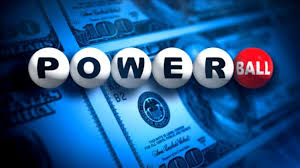
Powerball, the American lottery game shared by 44 of the 50 states, has its jackpot blossoming into the stratosphere again this week. The five white + one red (Power)balls are spinning relentlessly into our hopes and dreams.  Local news is positively frothy over the $750,000,000 jackpot, the third-largest since Powerball began in 1992. Never mind the ridiculous odds of winning (1 in 292,201,338).  Never mind no one picked the winning numbers in twenty-six consecutive drawings since Christmas.  Also never mind not one of the 183 winning Powerball jackpot tickets has ever been sold in Colorado.  That’s 16 years + 1,664 drawings = 0 winners in the Centennial State.  Even tiny Rhode Island fared better than that (1 winner).  No matter; our broadcasters still push aside this week’s actual news to cry, “Get your tickets now, people – you could be the next Powerball winner!”  Yeah, right.

Powerball jackpot history does not favor Colorado

Admittedly, my wife and I have played Powerball – but only a handful of times.  It’s like we have an unwritten rule: no tickets unless the jackpot exceeds a half-billion dollars.  But it’s not the news alerting us to all that potential windfall; it’s my mother-in-law.  She follows the lottery like a hawk.  Whenever we step into her house, she always knows exactly where the jackpot stands.  Her tickets sit patiently on the kitchen counter, ready for that next biweekly drawing (as she unfailingly asks, “Have you bought yours?”)  Just this week my mother-in-law realized her winnings can be multiplied several times over if she’s willing to pay more.  That’s an important aspect of the game, Mom.  Not that I consider the woman a Powerball guru.  After all, she’s the one who holds up the convenience store line when she turns in her winning tickets… because she’s buying more tickets.  You have to wonder if she ever sees cash in hand, or if this drill is just an endless cycle of ping-pong balls.

Colorado wasn’t always a part of Powerball.  Our state came to the table late – in 2001 – almost a decade after the game began.  Before joining, I remember the “legendary” stories of Coloradans who would drive all the way to Kansas or Nebraska (hours) just to purchase Powerball tickets.  That mind-numbing trip to the east would cost you at least two tanks of gas, and the convenience stores at the borders would have hundreds of customers in line.  That’s a lot of effort for odds of 1 in 192,000,000.  A lot of gamble for a little game.  Too fortuitous a foray for me.

Speaking of “game”, Powerball really isn’t one, is it?  Yes, there’s a winner (and a whole lot of losers), but one can hardly claim to “play” Powerball.  There’s no rolling of the dice, no dealing of the cards, and no moving of the game pieces.  No strategy or rules.  Instead, it’s just plunk down a few dollars for a quick-pick ticket; then go home and watch the ping-pong balls roll.  “Fun”.

Admittedly (again), my wife and I play Powerball for those proverbial hopes and dreams.  We always start our conversation with, “What would you do if you won?”  That conversation alone is almost worth the cost of the ticket.  What would I do with $750,000,000? Well, let’s break it down.  The cash value of the jackpot (lump sum vs. 30 annual installments) is $477 million.  Federal/state taxes drop that number to an even $300 million.  Then I pay off the mortgage and any other debt.  Set up a fund to gift my three kids the maximum tax-free amount allowed.  Remodel the house and ranch.  Travel the world.  Give generously.  Orbit the earth in a SpaceX rocket.  The list does not go on and on.  That’s about all I can come up with, folks.

Roughly calculated, my fulfilled hopes and dreams leave me with about $250 million yet to spend.  This is exhausting.  I’d rather play ping-pong with the numbered balls.  Not that it matters – Powerball’s latest jackpot ticket was just purchased in Wisconsin.  (Called it – Colorado is now 0-184.)  That’s a lot of bread for a Cheesehead.

Let’s Do the Twist!

My Amazon order history says a lot about my purchasing habits. I am a buyer of needs vs. wants. Pet food. Printer ink. Humidifier filters. But every now and then, a little something nostalgic sneaks into My Shopping Cart. Favorite childhood books for my one-year-old granddaughter.  A balloon-launching catapult to make a Thanksgiving turkey fly (it didn’t).  Italian chocolates from Perugia, also discovered during a year abroad in college.  And just today – on total impulse – a Rubik’s Cube.

Rubik’s Cube – adding a few wrinkles to us baby boomers – celebrates its forty-fifth birthday this year.  Back in 1974 when it was invented (and originally dubbed “Magic Cube”), the 3x3x3 trinket earned our attention for its mechanical magic as well as its almost-impossible-to-memorize solution.

To be precise, there are 43,252,003,274,489,856,000 (that’s “quintillion”) possible positions of Rubik’s colorful squares.  The Cube comes with neither instructions nor answers.  Already solved in its packaging, you can’t help twisting it up into a mess of color.  In our pre-Internet world, Rubik’s Cube required endless gyrations in search of the answer (instead of just, “Hey Alexa”).  But there was something immensely satisfying about the resulting nine squares of single color on each of its six sides.  There was also something tempting about peeling off the colored stickers and rearranging them instead.

Erno Rubik (courtesy of Wikipedia)

Erno Rubik, a Hungarian inventor, was an architect and architecture professor “searching to find a good task for his students” when he completed the Cube’s first working prototype – a mess of wood blocks and rubber bands.  A small plastics company took a chance on its manufacture and the rest is history.  In the first four years alone, two hundred million Cubes were produced and sold.

I was in college (and also an architecture student) when Rubik’s Cube first hit the shelves.  Its perfect symmetry and twisting ability to reinvent its colorful look went hand-in-hand with my interest in building design.  I remember keeping a Cube on my dorm room desk – at first for mindless manipulation; later for successful solving.  Not that I could solve it quickly, mind you.  The world record – an average of five solves – is six seconds.  The world record with one hand (???) is nine seconds.  The world record using only your feet (again, ???) is twenty-two seconds.  My solve is expressed in minutes, if not hours.


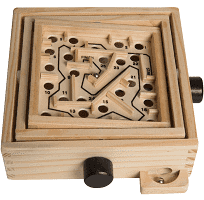
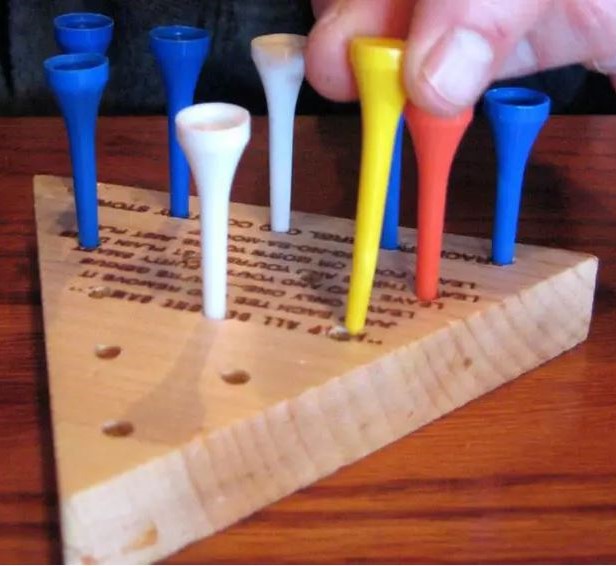
Few puzzles compete with Rubik’s Cube for sheer “can’t put it down”.  But there are a few.  One of my favorites was the wooden double maze, the box-like puzzle with the Etch-A-Sketch dials on the side, maneuvering the steel ball through the walled maze without dropping it through one of several holes.  I devoted hours and hours to that puzzle, always sweating those final tricky turns to the finish.  Another favorite: Marble Solitaire, where you hop-eliminated marbles in search of the perfect solution: a single marble standing proudly in the board’s center divot.  Finally (courtesy of Cracker Barrel restaurants), how about “Triangle Peg Solitaire”, the hop-elimination puzzle with the colored golf tees?  Thanks to that little game, my kids were supremely patient after the dinner order was placed.

With somewhere near four hundred million sold, Rubik’s Cube is considered the best-selling toy of all time.  Its inventive design landed the Cube in the permanent collection of the Museum of Modern Art (MoMA) in 1982.  The Cube also garnered “Toy of the Year” in eight countries, including Germany, France, and the U.S.

GoCube

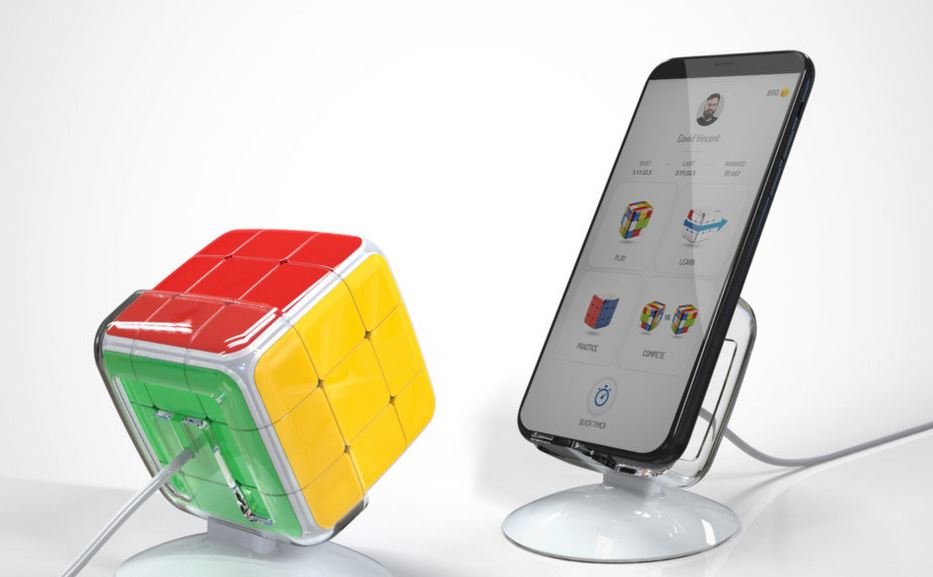
Inevitably, there were attempts to advance Rubik’s design, such as a 4x4x4 version (“Rubik’s Revenge”), or pyramid, dodecahedron, and hexahedron shapes.  But going completely off the rails, look no further than GoCube – a thoroughly high-tech update to Rubik’s.  GoCube is also 3x3x3, but rimmed with LED lights, and contains wireless smart sensors, an embedded gyro, and an accelerometer.  Download the GoCube app to your phone (of course there’s an app), and watch your twists on-screen instead of on the cube itself.  The app guides you to the solution (if you so choose), creates alternative mosaic-looking puzzles, and run reports on solving speed and efficiency.  You can even wage virtual head-to-head competitions.  All for “only” $119.

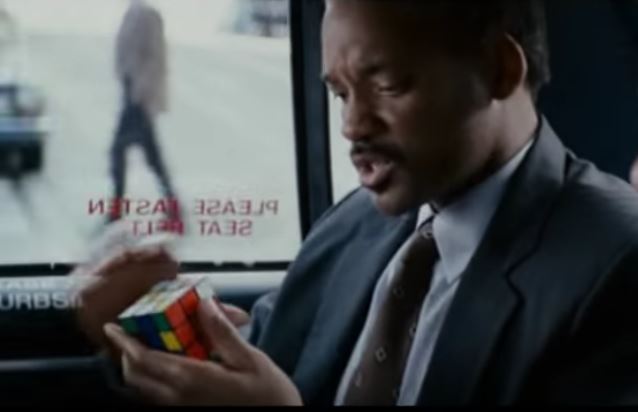
“The Pursuit of Happyness” (courtesy of Warner Brothers)

I’m sure Erno Rubik (and Will Smith) would pooh-pooh GoCube as too much of a good thing.  I would agree.  The app-driven, light-up, hundred-dollar GoCube is over the top, with zero nostalgia to boot.  On the other hand, Rubik’s Cube cost me $4.59 on Amazon.  That’s a sweet deal, and a cheap way to learn how to do the twist all over again.

Some content sourced from Wikipedia, “the free encyclopedia”, and the Wall Street Journal article, “Never Solved the Rubik’s Cube?…”

Beyond Repair

Most days, we leave our homes to spend time in other kinds of buildings. We park our cars in the front lot, approach the doors, pass over the threshold, and join the unique subculture within the structure before us. If we work in an office building, we navigate a maze of hallways and elevators before our final destination.  If we traverse an airport, we draw on the stress and frenzy of countless others.  If we worship in church, we assume the quiet reverence of the congregation. And if we enter a hospital for surgery, as I did last Thursday, we expect… we expect… well, we don’t know what to expect in a hospital, do we?

My recent hospital visit deserves a few words.  After all, the only other time I donned the peek-a-boo gown was a-way back in my teens.  This time around (and with medicine advanced another forty years), I was keenly interested in the start-to-finish experience.  My surgery – a routine out-patient procedure – took less than an hour, during which I was entirely unconscious.  You’ll be spared the details since I can’t remember a single one of them.  Let’s just say I’m beyond (the) repair now and recovering nicely.

The hospital experience itself actually began at the doctor’s office, a week prior.  In that “consult”, not only did I learn what I didn’t want to know about my procedure (i.e. worst-case scenarios), I also learned I’d be checking into the hospital at 6am.  Cock-a-doodle-doo, that meant the alarm clock buzzed at 5am.  Remarkably, I wasn’t my surgeon’s first procedure of the morning.  Call me grateful – he warmed up on somebody else instead.

I almost forgot to mention the hospital’s “pre-surgery phone call”, which they calendar between the consult and the surgery.  I thought this conversation was going to be a financial beat-down (as in, “You are able to pay what your insurance doesn’t, yes?”).  Instead the nurse went through a list of do’s and don’t’s in the forty-eight hours leading up to my hospital visit.  Mostly don’t’s.  Don’t use anything in the shower besides antibacterial soap.  Don’t take your vitamins.  No more nightly bottle glass of wine.  No food or water after 10pm the night before.  She might as well have said, “Just come to the hospital now; you can wait in the lobby for the next three days”.

Colorado Springs’ stylish UCHealth Memorial Hospital North

Emergency rooms aside, hospitals are surprisingly low-key at 6am.  My wife and I staggered down the dark sidewalk into the main lobby (after finally locating a parking space not labelled, “For Doctors Only”). The only movement in the vast space was a couple of bleary-eyed attendants at the registration desk and the barista getting the coffee stand warmed up.  Thanks to the “pre” phone call, registration was a breeze.  The guy didn’t even ask for ID (though who would “steal” an out-patient procedure?).  He just confirmed why I was there, slapped on the plastic bracelet, and sent me down the elevator to the “surgery reception area” one floor below.  For the record, I’d like all my future surgeries to be above ground.  The basement is way too close to the morgue.


“Surgery reception” is where things get interesting.  After they scan your bracelet (my every move now tracked) they escort you to the pre-op room where you receive the following: 1) A surprisingly comfortable and non-peek-a-boo hospital gown, 2) A stack of six antibacterial wipes each the size of a paper towel, 3) A laminated card with a diagram of the body, 4) A plastic bag for clothes/valuables, 5) A disposable shower cap, 6) A “blanket” (basically a large square of space-age tin foil), and – brace yourself – 7) Two oversized cotton swabs with a generous gob of red goo on each.

The wipes serve as a do-it-yourself bath without the water.  The laminated card points each wipe to a different part of your body.  The shower cap ensures you look your Sunday-best for surgery (photo below).  Finally, the swabs are for your nostrils.  Who knew – your best chance of infection comes from the nose?  The red goo creates a barrier, and… right… too much information.

Dad! You got a tattoo!

Thanks to a generous dose of the happy gas (a beautiful thing), the remainder of my start-to-finish hospital experience is hazy recollections.  I remember a quick visit from the surgeon, and the tattoo he drew on my arm. (I never thought I’d be thankful for a tattoo.  That check mark and initials remind Doc which side of me he’s cutting into!)  Soon after I was wheeled into surgery and shifted onto the table beneath the white lights.  As for the happy gas, it went into my IV (no mask), so I never saw it coming.  One instant I’m lobbing a few questions at the anesthesiologist, and the next it’s, “nighty-night, Dave”.  I may remember chatting up the nurse in the recovery room.  I may remember fresh coffee and a scone (I love my wife).  I definitely don’t remember getting dressed, heading down the corridor in a nurse-powered wheelchair, and dropping into the passenger seat of my car.  Mission – er, surgery – accomplished.

If this were a Yelp review, I’d give my hospital visit five stars.  I can’t come up with criticisms but then again, the happy gas conveniently dissolved a good chunk of the experience.  Let me just say this instead.  I now have a small, high-tech mesh installed, making me better, stronger, and faster the rest of my days.  The hospital bill won’t be six million dollars, but my new body just might.  In other words, Steve Austin reborn.

Dressed for success

Clothes Shrink

On our 25th wedding anniversary, my wife and I crossed the Atlantic for an unforgettable first trip to Ireland. We wanted a few keepsakes to bring back with us, so we shopped carefully as we went about our travels. She found a gold necklace with a St. Brigid’s cross (her namesake), and a few ceramic Christmas ornaments. I opted for a few logo items from the Guinness Brewery, and a coffee table book on the village of Kildare. We also purchased music from a lovely harpist, playing outdoors just steps from the Cliffs of Moher.  Last week, I came across one more Ireland item I forgotten about: the sweater you see below.  It’s colorful and it’s Celtic… and I think I’ve worn it once.

Don’t know about you, but the new year is always my opportunity for “spring cleaning”.  Maybe it’s because I’m already in the mode as I take down and box up the Christmas decorations.  Or maybe it’s because my office files burst with paper after a year of accumulation.  Whatever the reason, by mid-January I manage to a) empty my office of anything irrelevant to the coming year, and b) conduct something akin to an inventory reduction sale on my clothes.  The office files are easy, but the wardrobe; that takes a little more judgment.

When it comes to decisions about clothes, it’s safe to say guys have it easier.  We’re more utilitarian – by definition “designed to be useful or practical rather than attractive”.  Yep, that’s us guys – if the shoe fits, so to speak.  Of course, women flip the definition around and put the premium on “attractive”.  For them it’s more about fetching than fitting.  In fact, I’d venture to say a woman’s closet is 75% “attractive” and 25% “utilitarian”, while a man’s is the reverse.  And trust me; “utilitarian” is easier to shift to the giveaway pile.

Destined for Goodwill

My annual wardrobe shrink is always nostalgic.  Some items – particularly suits and sweaters – survive several years before reluctantly leaving the nest.  Others – admitted impulse buys – fly the coop having been worn just a handful of times.  I’ll never forget one year, when I brought eight suits to Goodwill.  Why so many?  I moved from California to Colorado and changed jobs in the process.  My CA job required the suits; my new CO job did not.  Even so, I had to swallow hard on that donation.  Those suits had plenty of mileage left in them.

Illustration: James Gulliver Hancock

Here’s a mistake I make all too often with my wardrobe.  I’ll buy a shirt or a pair of pants at a store.  Weeks later, I realize I really like what I purchased, so I go online and buy another half-dozen; same style in various colors.  That’s the mistake.  Not only am I a poor color-chooser through the Web, but I don’t wear that shirt or those pants as often as I think I will.  In other words, I over-shop (and I’m a guy!)  Then comes wardrobe shrink time, and my giveaway pile includes that shirt or those pants.  Not good.

The more common mistake – at least for us guys – is to buy something last-minute for a single occasion.  Sure we may need it, but do we take a moment to project whether we’ll ever wear that item again?  If not, that shirt or tie or sweater is reduced to a keepsake, sitting quietly on the closet shelf just yearning for another wear.  That’s my Ireland sweater.  Kinda sad, isn’t it?

Admittedly, I have other keepsake clothing.  I buy shirts from favorite destinations (hello Guinness), and can’t bear to part with them.  I buy shirts with my college’s logo on them, and can’t bear to picture someone else wearing them.  I still have an Aloha shirt from our honeymoon in Hawaii (probably the last time I wore it too).  No matter – there’s plenty of room in the closet when 25% just went to Goodwill.  The purge is not completely pure.  My Ireland sweater will live to see another year.

Some content sourced from the Wall Street Journal article, “The Case for Buying Less Clothing”.

Putting the Kettle On

Kacey Musgraves is a blossoming country music artist whose recent album “Golden Hour” will compete with heavy-hitters at this year’s Grammy Awards for Album of the Year. She’s released only four albums (through major labels), so the nomination is remarkable. And yet – despite the acclaim heaped on “Golden Hour” – my favorite Kacey song remains a track from her second album, “Pageant Material”. In her words, it’s “a little, tiny, music-box-of-a-song” called “Cup of Tea”.

The message in “Cup of Tea” (have a listen here) – is simple: no matter who you are or what you stand for, you’re never going to appeal to everybody.  There will always be haters out there no matter how you present yourself.  My favorite lyrics in “Cup of Tea” are the refrain itself:

You can’t be, everybody’s cup of tea
Some like it bitter, some like it sweet
Nobody’s everybody’s favorite
So you might as well just make it how you please

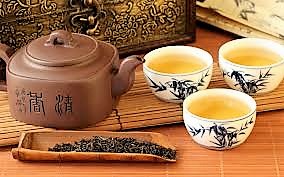
Kacey wouldn’t mind if I told her “Cup of Tea” gets me thinking just as much about tea as about how well I mesh with other people.  Not that I’ll be steeping anytime soon, mind you.  I can’t seem to acquire tea-taste, no matter how many times I put the kettle on.  Go figure – half my DNA originates from England, so you’d think my instincts would have me setting out the fine china and doilies every afternoon.  I’d nibble on the cakes or scones or whatever comes with, but no tea, please.  I much prefer my morning coffee.

Ironically, tea brews with some of my earliest childhood memories.  My parents used to take my brothers and I downtown in Los Angeles, to restaurants on the streets of Chinatown – probably as much for the cultural experience as for the food. I can still picture those dark, quiet dining rooms, with the strange music and gaudy decor.  The meal always began with a pot of tea, including the little round cups that seemed to have misplaced their handles.  Tea was a cool experience back then. Listen, when all you drank was milk or water (or the occasional soda), tea was pretty sweet no matter how it tasted.  It was like having a “grown-up” drink before being grown up.

Forty-odd years later, I notched another tea-riffic memory.  My wife and I took a cruise on the Baltic Sea a few summers ago (“six countries in eight days”), and chose Oceania, one of the nicer cruise lines.  Good decision.  As much as we enjoyed the excursions off the ship, we enjoyed the return even more, because every day we were treated to “afternoon tea”.  Oceania’s tea was the perfect respite between the early morning touring and the evening dinners/dancing.  “Tea” included tableside service from tuxedoed waitstaff, countless cakes and petit fours, and those little triangle sandwiches with the crusts removed.  “Tea” even included a string quartet; their soft music adding to the ambiance.  I suppose I could’ve asked for coffee instead, but that would’ve tainted the experience.  Not to say I enjoyed the tea itself.  Just “afternoon tea”.

The culture, history, and preparations of tea could generate a week’s worth of posts.  (See the Wikipedia article here).  What I find more interesting is how tea has become the daily routine of several global cultures.  The Chinese and Japanese consume tea in the morning “to heighten calm alertness”.  The Brits serve tea to guests upon arrival (or in the mid-afternoon), for “enjoyment in a refined setting”.  The Russians consider a social gathering “incomplete” without tea.  Not sure about all that, but I can at least agree with the moment of pause tea provides; the respite from the faster pace.  It’s just… my “cup of tea” is coffee.

Nature’s Constant Call

It wasn’t supposed to be this difficult.  Merely tweaking a former New Year’s resolution to create a new one should be the proverbial walk in the park.  But clearly, I wasn’t prepared for the, uh, “inconveniences” of my particular undertaking.  So it goes when you commit to drinking a dozen glasses of water a day instead of ten.

(Hey, give me a sec’… I’ll be right back.)

Are you a New Year’s resolution kinda person?  Do you sit down towards the end of the holidays and pen (or pencil, for you not-so-brave) a list of gonna-do’s for the coming year?  Me, I’m on the fence with the whole promises-promises thing.  Sure, turning the calendar from December to January evokes a fresh start; I’m just not convinced I must be “resolute” in the process.  I prefer casual, undocumented, safe-zone agreements.  Gonna eat better. Gonna get to the gym more. Gonna read a bunch of new books.  Whether I blow them out of the water or just achieve slightly better than last year, I win!

The water thing, though.  Why-oh-why did I read my latest fitness club newsletter and choose to drink their Kool-Aid?  (Wait, hang on… the phone’s ringing… it’s Nature again.)

Can you hear it? Does it make you want to…?

Forget the glittering generality of eight-glasses-per-day.  Not only is the rule passé, it holds no water.  Eight glasses is simply too generic for the myriad human bodies out there.  Ditto downing “half your weight in ounces of water” – too generic.  On the other hand, a pile of research and scientific evidence in my newsletter suggested the following: Men should consume 15.5 cups (3.7 liters) of fluids per day, while women should consume 11.5 cups (2.7 liters).

Now then, “fluids” includes all liquids swallowed in a day, so right away we have an appealing math problem.  Fluids from foods = 20% (just go with it), so my 15.5 cups instantly evaporate to 12.4.  A cup of coffee in the morning and a glass of wine in the evening can also be subtracted (don’t believe the dehydration claims – they don’t hold water).  However – and here we pause the calculator – I can’t escape the negative impacts of a) regular exercise (I sweat like a baby rainstorm), b) environment (Colorado = high altitude = dehydration), and c) breathing.  Those three moisture-robbers elevate me back to 12.4 cups.  Maybe I should stop breathing – that’s worth at least the 0.4 cup.

12 cups = 3/4 gallon

Ten cups a day – now that’s navigable waters in my book.  I start the morning with two (supposedly a good habit) as I wash down my multi-vitamin.  I drink another two mid-morning, another two at lunch, another two or three in the afternoon, and one at dinner.  But twelve cups?  How the heck do I jam another two into my schedule?  More importantly, where to I find the extra time to uh, um… (a little patience here, I need to talk to a man about a horse).

Time to get personal (as if we haven’t been already).  When I morphed from child to teenager to full-grown adult, my body parts grew accordingly, EXCEPT my bladder.  That little balloon remains the same size as when I was born – I’m sure of it.  The bladder is a remarkable organ, “capable of expanding from 2 to 6 inches with a capacity of 16 to 24 ounces”.  MY bladder is capable of expanding to 2 inches (a guess) with a capacity of 16 ounces (another guess).  And here’s the best part.  The urge to urinate comes when the bladder is one-quarter full. Whose idea of a cruel joke is THAT?  Do the math on me and I’m only halfway through cup #1 before I’m scheduling time with the porcelain goddess. Speaking of the goddess, uh… (hold tight while I go water the flowers).

About these down-the-hall interruptions: is it just me or does the sound of running water “accelerate” the process?  In my twelve-cups-a-day world, I continue to brush my teeth, make a cup of coffee, refill the dog bowl, refill the bedroom humidifier, and refill water bottles every time I go to the gym.  You’d better believe every one of those tasks has me wanting to go powder my nose – and I really don’t powder my nose if you know what I mean.  Gee whiz (for God’s sake, don’t say WHIZ!), can’t a guy catch a break that doesn’t have the word “bathroom” in front of it?

My fitness newsletter also claimed, “women who are pregnant or are breast-feeding need additional fluids to stay hydrated”.  Bless my stars, I am not a woman. But seriously, twelve cups?  I’ll be moving my laptop into another “office” in my house before I know it.  There’s more to say on this topic but it’s gonna have to wait because… (I need to make a pit stop).

Lovely Are Thy Branches

Christmas prep – at our house – starts the weekend after Thanksgiving and goes all the way thru December 24th.  I like to think it’s deliberate – taking a month or more to drag out the “getting ready”.  Some years we’re rushed but the house always seems to get decorated, the cookies baked, the presents wrapped, the cards sent, and the food shopped.  There’s always a dinner reservation on Christmas Eve; always room in the pews at the late, late church service.  But what if – some year – we dispensed with all of that prep?  December 25th would still come, of course.  But it wouldn’t be Christmas, unless we had a tree.

I can’t think of a single Christmas in my fifty-plus years when we haven’t had a fully-decorated tree.  Whether the lights or the ornaments or the angel on top, the tree to me is the ultimate expression of the holiday season.  Christmas trees have been standing since the 1500’s (proved by a sculpted image at an estate in France).  In the late 1700’s, Christmas trees hopped the pond to America.

My affection for decorated trees dates to my early childhood in Los Angeles.  Late on a mid-December day, my mother would pack my brothers and I into the station wagon, drive downtown, and meet up with my father after work.  Near his office, hundreds of Christmas trees were being unloaded from boxcars in the train yard; some of them still fresh with snow.  You may prefer the convenience of your neighborhood tree lot, but sorry; nothing beats the childhood nostalgia of picking a tree straight from a boxcar.

Flocked tree

Since we never had snow in Los Angeles, we often had our Christmas tree “flocked” before taking it home.  Flocking means placing a tree on a spinning stand and covering it with a product I can only describe as spray Styrofoam.  As tacky as that sounds, the result is remarkably “snow-like”.  Flocking even comes in colors (but I never understood why anyone would want pink or green snow).

As for tree ornaments, they’ve been around since Christmas trees themselves.  What were once apples, candy canes, and pastries (elegantly simple, if you ask me) have now evolved into everything imaginable.  On my childhood tree, I only remember those delicate, shiny, colored balls and bells; the ones which shattered on the slightest impact.  We also had tinsel; endless garlands of thin strips of colored foil, and tinsel is a great word, don’t you think?

Christmas lights became a staple of tree decor in 1882, when an Edison Electric VP first added them to his family tree.  The lights on my childhood tree – the multi-colored “C9” incandescent standard of the time – were connected to an illuminated star at the very top.  A few strands contained transparent-colored “blinkies”.  In hindsight, blinky lights sound as tacky as flocking but somehow, they worked alongside everything else on the tree.

Here’s a little Christmas tree trivia for you.  The carol, O’ Christmas Tree, is sometimes sung in German, starting with “O’ Tannenbaum, O’ Tannenbaum…”.  Guess what?  You’re actually singing, “O’ Fir Tree, O’ Fir Tree…”.  If you’re looking for the correct translation, go with, “O’ Weihnachtsbaum…” instead.

Christmon tree

One more bit of trivia.  If you find a tree decorated with nothing but white and gold Christian symbols, you’re looking at a Christmon tree.  Blend the sounds and meanings of “Christ” and “monogram” and you come up with the portmanteau “Christmon”.  Sounds (and looks) beautiful to me.

I don’t think I’ll ever have to worry about finding a Christmas tree.  Over 35 million are produced in the U.S. each year; another 60 million in Europe.  The average cost of a live-cut Christmas tree last year was $73, and that includes a lot of really tall ones.  Someday, I won’t be able to erect a nine or ten-foot tree in my living room anymore.  No worries; I’ll just go with a table-top instead (a “Charlie Brown”, if you will).  Her branches will be just as lovely.

Some content sourced from Wikipedia, “the free encyclopedia”.

A Distant Third (cont.)

Last Tuesday in cycle class, pedaling through the five-minute recovery after an hour of torture, our instructor asked if we’d like a Christmas carol or two from her playlist.  The one rider with enough oxygen lashed out vehemently, “NO!  It’s too early!”  Well how about that; score a point for Thanksgiving.  The sun set on Halloween two weeks ago and mighty Christmas is already trying to muscle its way to the forefront.  But Thanksgiving has a thing or two to say first.  If you please, keep the sugar plums out of my turkey and stuffing.

In last week’s post, I compared popular aspects of Halloween, Thanksgiving, and Christmas (i.e. history, music, food).  The final tally: Christmas the clear winner – no surprise – with Halloween solidly in second.  But lest we relegate Thanksgiving to the bronze medal year after year, my blog-intent is to reinvigorate America’s late-November holiday, and remind readers why Turkey Day stands on its own merits.

On that note, we’re starting November with promise.  My wife is getting endless mailbox catalogs, and I was delighted to find Williams-Sonoma’s “Thanksgiving Headquarters” edition: 180 pages of food, linens, kitchenware, and decor specifically designed for the holidays.  They even photo-profiled a barn-based “Friendsgiving” celebration in upstate New York.  Granted, the Thanksgiving section of the catalog ended on p.67, meaning the remaining 100 pages were all about Christmas.  No matter – 67 pages of Thanksgiving is impressive.  Way to go, Williams-Sonoma.

Starbucks also made a statement – albeit more feeble – putting their unique spin on Thanksgiving.  Right now, you can drive-thru and order a Turkey & Stuffing Panini (with cranberries and gravy!), perfectly nicknamed “a handheld turkey dinner”.  Then pair your panini with a Chestnut Praline Latte (“flavors of caramelized chestnuts and spices, topped with whipped cream and spiced praline crumbs”).  That combo speaks more to November than December in my book.  Not bad, Starbucks.

Retail aside, Thanksgiving plays out as more of an extended weekend than a single day.  Consider the before/after events.  Wednesday (“Thanksgiving Eve”) is routinely labeled “the single busiest travel day of the year”.  Well guess what?  It’s not.  Thanksgiving Day is the busiest travel day of the year, considering 90% of us drive our cars to the family gathering that morning.  Thanksgiving Wednesday (and Thanksgiving Sunday) only seem busiest because the chaos at the airports gets so much attention.

Now, on Turkey Day itself, besides the meal and the backyard football, we begin with the “Macy’s Thanksgiving Day Parade”.  My family always seems to miss the broadcast because we’re so busy in the kitchen.  Macy’s is three hours of marching bands, dancing Rockettes, Broadway singers, flying character balloons, and – as far as I can tell – one nod to Thanksgiving (the massive turkey in the photo above).  But hang on ’til the very end of the broadcast, because… here comes Santa Claus, here comes Santa Claus, wrapping up the parade the same way he’s done every year since 1924.  It’s like the Williams-Sonoma catalog – Thanksgiving on the outside but more “holiday season” in disguise.

Thanksgiving Friday is “Black”, of course – the so-called beginning of the Christmas shopping season.  We Americans spend over $50 billion that day (putting retailers “back in the black” with profits – hence the name).  It’s safe to say this bonanza of spending isn’t going away anytime soon.  By its very nature, Black Friday extinguishes Thanksgiving – almost before the pumpkin pie is served.  Black Friday sales begin as early as 5pm on Thursday evening (making the name obsolete, don’t you think?)  And if Thanksgiving isn’t early enough for you, some stores begin sales a week before Black Friday, with the teaser, “avoid the chaos of Black Friday – shop now!”  Uh, what’s the real meaning of Christmas again?

So there you have it – Christmas putting the squeeze on Thanksgiving like the Grinch on Whoville. Santa concludes the Macy’s parade at 12:00pm ET.  Christmas shopping begins five hours later.  In between, throw a meal on the table, mumble a blessing, and don’t forget to say thanks.  If we’re not careful, Thanksgiving Day will be reduced to Thanksgiving Hour.  It’s a phenomenon known as “holiday compression depression” (okay, I just made that up), but hey; it’s happened before.  In 1971, George and Abe got their standalone birthday celebrations mashed into a single holiday.  Even they feel Thanksgiving’s pain.

Candy-Crunching the Numbers

If you sift through your kids’ trick-or-treat bags today, you may be in for a surprise. When it comes to Halloween candy, we Americans are a fickle bunch. “Best” and “Worst” lists kick into high gear this time of year – with fierce debate – and the results are likely reflected in what gets handed out at the front door. Would you agree – Reese’s Peanut Butter Cups are hands-down America’s most popular Halloween candy?  By the same analytics, would you agree Circus Peanuts are the worst?  Do you even know what Circus Peanuts are?

CandyStore.com recently assembled the candy list of lists – the current bests and worsts. Check out the details in their blog post here (and buy some candy while you’re at it).  CandyStore combed the Web for best/worst candy lists from a dozen publications, then mixed in the opinions of 40,000 of their own shoppers. How they sifted all that data into a single list is a worthy advertisement for Excel.  Here are the results:

BEST Halloween Candy
10. Hershey Bars
9. Skittles
8. Sour Patch Kids
7. Butterfinger
6. Nerds
5. M&M’s
4. Kit-Kat
3. Twix
2. Snickers
1. Reese’s Peanut Butter Cups

WORST Halloween Candy
10. Mary Jane
9. Good & Plenty
8. Licorice
7. Smarties
6. Tootsie Rolls
5. Peanut Butter Kisses
4. NECCO Wafers
3. Wax Coke Bottles
2. Candy Corn
1. Circus Peanuts

Some comments (er, opinions) about the BEST list.  I can’t argue with Reese’s in the #1 spot, since I adore peanut-butter-and-chocolate, and a Reese’s cup is a convenient size somewhere between “full-size” and “fun-size” for the trick-or-treat bag.  Reese’s also happen to have an orange wrapper, so no adjustment needed for Halloween. The top five on the BEST list are solid choices, though I wonder where Snickers has the edge over Milky Way, Mars, or Almond Joy.  Three of the remaining five reflect candies joining the party well after I was a kid.  To this day, I’ve never had a “Sour Patch Kid”.

The WORST list is a little more interesting.  I’m surprised some of these earned a spot (even on a “worst” list), considering they were popular way back in the 1960’s.  But Smarties, Wax Coke Bottles, and Candy Corn bring a smile to my face, as each of them screams “Halloween” to me.  They seem to appear in October, then disappear for the next eleven months.  Wax Coke Bottles were the thought-we-were-cool 2-in-1 candy.  Bite off the bottle top for the drink, then put the wax in your mouth for a chewing-gum sensation.  In hindsight, ewwwww.

Candy corn, no surprise, is a polarizing confection.  You either love the little kernels or you simply can’t stand them.  They’re essentially corn syrup + sugar doused with a little food coloring.  Jelly Bean Candy Company has been making candy corn for over a century and sells hundreds of thousands of pounds of kernels each year, most in October.  Yet candy corn almost snagged the top spot on the WORST list.  Go figure.

On the other hand, Circus Peanuts deserve the WORST trophy.  I’m old enough to remember enjoying a real bag of peanuts at the circus, so why go and “candi-fy” my memory?  CP’s are peanut-shaped orange marshmallows (orange I suppose, because brown would not be an appetizing look for marshmallows).  Remarkably, CP’s have been around as long as candy corn, and you can still find them on your supermarket shelves.  Careful – some of those bags may have been manufactured in the late 1800’s.

Here’s another angle on the BEST list.  CandyStore took their analysis one step further and figured out, based on purchases August through October, which candy is most popular by state.  The methodology is not quite as scientific but the results are amusing.  You’ll find most of the BEST list represented, but you’ll also find a few head-scratchers.  Kentucky’s “favorite candy” is Swedish Fish.  Montana and Oklahoma prefer Double Bubble Gum.  West Virginians prefer Blow Pops.  As for my own state of Colorado?  Twix.  I can live with that.

CandyStore may take pride in its BEST/WORST lists, but let’s all just agree to disagree, shall we?  IMHO, licorice (of any kind) belongs nowhere near a WORST list – and that includes Good & Plenty, while 3 Musketeers is embarrassingly absent from the BEST list.  Not a fan of chocolate-covered, fluffy, whipped nougat?  Pick one up sometime and reconsider.  3 Musketeers almost feels lighter-than-air, a clever ruse to offset the guilt as I add one to my shopping cart.

Some content sourced from the Wall Street Journal article,”Americans are Divided – About Candy Corn”.

The Sweets Life

“Pagina Non Trovata” has the look of an elegant Italian phrase (or an opera title), until translation and context reveal its harsh reality. The phrase means “page not found”, which in my instance referred to a (former) on-line job posting for Italian candy company Ferrero. My punishment for seeking the advertisement two months after the fact? Ferrero, the second largest chocolate/confectionery company in the world, is (was) looking for sixty taste-testers – “sensory judges” if you will – to offer opinions on its products. O.M.Gee I wish I’d seen this sooner.  Instead, I won’t be one of the chosen few because, well, “page not found”.

Let’s ponder this (past) job opportunity for a paragraph, shall we?  Ferrero is (was) searching the world for several “average consumers”, who would (will now) get paid to eat chocolate.  “No experience necessary”, they claimed (otherwise by definition you aren’t an average consumer).  The only real requirement, absent food allergies, is (was) a willingness to move to northwest Italy, which darn-it-all means France and Switzerland are just as easy to visit.  Ferrero gives (gave) three months of paid training, followed by an offer to join the company as a part-time taster. “Part-time” in Italy translates to maybe a) second job, or probably b) la dolce vita (“the sweet life”, which definitely does not include a job).  Ferrero’s job is akin to unwrapping a bar of chocolate and finding a Wonka golden ticket.
If Ferrero created run-of-the-mill chocolates, searching late on their job opp wouldn’t be such a tragedy.  But Ferrero makes Ferrero Rocher (of course they do), those gold-foiled balls of decadent chocolate and hazelnuts.  They also make Mon Cheri, those pink-foiled chocolate cubes filled with cherries and sweet liqueur.  They even make Tic-Tac’s for gosh sakes, the boxed pill-like mints all-the-rage when I was a kid.  And finally, their pièce de résistance (or in Italy, “piu degno de nota”), on which the entire company was founded over sixty years ago, Ferrero makes Nutella.

Maybe it was half-hearted reading up to now, but mention Nutella and most people really sit up and listen.  I’m convinced Ferrero puts a secret something into Nutella to make consumers crave hazelnut chocolate spread all the more (bolstering the theory Starbucks does the same with its coffee drinks).  Why else would shoppers storm a small store – and engage in a brawl – when the Nutella stock was discounted 50% (see video here)?  Which leads to an even nuttier question: why have I never tried Nutella myself?

Nuts+chocolate equals killer-combination – I get that.  Give me a basket of Halloween candy and I’ll fish out all the Reese’s Peanut Butter Cups.  Offer me thirty-one flavors at Baskin-Robbins and I’ll easily short-list peanut-butter-and-chocolate.  Sell me M&M’s at the movie theater and I’ll always choose peanut over plain.  But in all my examples, I’m talking peanuts, not hazelnuts.  Nutella spread is new territory for me, which means I’m the perfect candidate for Ferrero’s job. I have no experience with hazelnuts.

The more I read about my future employer, the more I’m impressed with their credentials.  Ferrero buys 25% of the world’s hazelnut production (and fittingly, acquired the world’s largest hazelnut producer four years ago).  They employ 40,000 candy-men and women in a network of 38 trading companies and 18 factories.  Ferrero keeps its recipes under lock-and-key, never letting the press into its facilities nor hosting a press conference, and always engineering its own production equipment.  A recent survey labeled Ferrero “the most reputable company in the world“.

As if I need a clincher to make this decision, last January Ferrero acquired the Nestle’s company’s candy division.  Holy cowbells.  On top of Nutella, I get to taste-test Sweetarts and Butterfingers and Laffy Taffy and the decadent Nestle’s Crunch (silver-foiled chocolate with a generous helping of crisped rice)?  Why even pay me?
I could do this job.  The more I think about it the more I’m convinced Ferrero needs 61 sensory judges.  I’m just (fashionably) late to the party.  All I need to do is brush up on my college Italian (no joke; I spent a year in Rome back then), convince my wife that our dogs, cats, and horses would be next to heaven in northwest Italy, and promptly board the next Alitalia flight.  Sweet life – er, dolce vita – here I come!

Some content sourced from Wikipedia, “the free encyclopedia”, and the USA Today article, “Dream Job: Italy’s Nutella maker seeks 60 taste-testers…”