The Time of My Life

Yesterday I was sitting at my desk thinking, “Hey Dave, time’s a-ticking. Gotta come up with a topic for tomorrow’s post”. I stared at the clock, considering a few interesting ideas. The slender second-hand edged ever closer to the next minute, to the next hour, time literally passing before my eyes. Suddenly it hit me. My topic. Time.  More to the point, clocks.  To which I lob an interesting question your way: analog or digital?

The Seth Thomas “Promise”

My house is full of inanimate objects screaming for attention. When I’m lost in thought and staring into space, a certain something in the room starts to say, “Pick me! PICK ME!” in a desperate attempt to become a blog post. Today my desk clock actually pulled it off. I was dead set on a couple other topics until my clock somehow ticked its way to the top of the list.  Perhaps today’s title should’ve been, “A Moment in Time”.

We’re not talking about just any desk clock, mind you. The little guy you see here (all of 2.5″ wide by 3″ high) is a Seth Thomas “Travel Carriage Alarm Clock”, a quartz analog model made by the hundreds of thousands in China. You can find one online for $14.99, the affordability belying its simple elegance. I chose this clock as a gift from Hewlett-Packard (HP) on the fifth anniversary of my employment back in 2002.

I had better choices than an analog clock, but the Seth Thomas somehow captivated me. Even twenty years ago when I got it, a desk clock waxed nostalgic, especially with arrow-capped hands and Roman numerals. The “Promise” model also makes a pleasing little tick-tock-tick-tock sound as the second-hand sweeps the minutes away.

German AND Swiss-made…

If my four-year-old granddaughter were reading this post she’d ask her dad what analog means.  Let’s face it; my granddaughter’s growing up in a wholly digital world.  Her watch, her smartphone, her computer, and the clocks she displays in her future house will exhibit squarish lifeless numerals instead of graceful minute and hour hands.  She’ll “tell time” the way McDonald’s cashiers push the hamburger key instead of entering the amount.  No interpretation required.

I took a stroll around my house and counted three analog clocks, each with sentimental value.  Besides my Seth Thomas, we have an intricate cuckoo clock we purchased in Germany (with the mechanics made in Switzerland), and a horse-head clock we’ve had forever (which no longer works but still graces our bedroom wall).  Our digital timepieces are many more in number yet I still prefer the soothing tick-tick of analog hands, as well as the lazy swing of the cuckoo clock pendulum.

When I was a kid, I grew up in the presence of a formal grandfather clock, standing guard in the curve of our entryway staircase.  I can still hear its chimes, with a higher pitch than you’d expect from its heavy-framed stature.  My bedroom was close enough to hear the bells of the hour in the middle of the night, a gentle reminder it was time to get some sleep.  Whenever I wind our cuckoo clock today, I remember my dad doing the same thing with the grandfather all those years ago.

Since we’re talking about analog, I owe my wristwatches a few words.  I have eight of them and most stopped ticking a long time ago.  Two are also from HP anniversaries (What the heck, were timepieces my only choices?) but three others have more significance.  One carries the logo of my father’s seafood restaurant.  I still have the Snoopy watch I believe was my very first timepiece (my granddaughter wouldn’t know Snoopy either, sigh).  I also have my first “big-boy” watch; a gold Pulsar with matching hands on a cream-colored face.  Yes, I may be wearing a sleek digital Fitbit as I type but I always wear one of my analog watches on special occasions.  At least, one that still works.

[Author’s Note: I’m a little unnerved to see each of my wristwatches in the above photos is stopped at the exact… same… time. I didn’t do this! Why would I do this? Either someone’s been playing in my watch drawer or my house is haunted. Maybe both.]

Prague’s Astronomical Clock

I can’t decide if my granddaughter will miss out with the lack of analog in her life.  She’ll take trips where she’ll see quaint clocks high up in the steeples of New England churches.  She’ll take a hop-on-hop-off double-decker bus through London, passing under the shadow of Big Ben.  She may even make it to the Old Town Square in Prague to see the famous Astronomical Clock, still operating since 1410.  But will she know how to tell the time?  Time will tell (ha).  More likely, her grandfather will teach her how.

Some content sourced from Wikipedia, “the free encyclopedia”.

——————–

Lego Grand Piano – Update #5
Last week

I describe this week’s movement as “allegretto”, or “light and cheerful” (read about my hesitant warm-up in Let’s Make Music!).  I completed the build of Bag #5 – of 21 bags of pieces – in a cool 46 minutes.  Maybe I’m finding the rhythm of this piece, though I did have a tense moment where two critical blocks were installed the wrong way and I had to disassemble several steps to get them right.  Whew – that was close!

Dare I say, we’re starting to see hints of the finished product.  Those four circles in the “this week” photo are part of what you’ll see when the piano lid is open.  All those little yellow “grabbers” will cradle the piano strings.  To the rear, we’re seeing some of the graceful curves of the instrument’s black body.

This week

Simple math tells us we’re approaching 25% completion of the build.  To put it another way, our concerto is about to wrap up the first of its four movements.

Running Build Time: 5.0 hours.  Musical accompaniment: Mussorgsky’s Pictures at an Exhibition. Leftover pieces: ZERO! (Holy cow – how did that happen?)

Conductor’s Note: I’m about 700 pieces into the build and this instrument is getting heavy.  Now I understand why you need special movers to relocate a piano.

Triple Booked

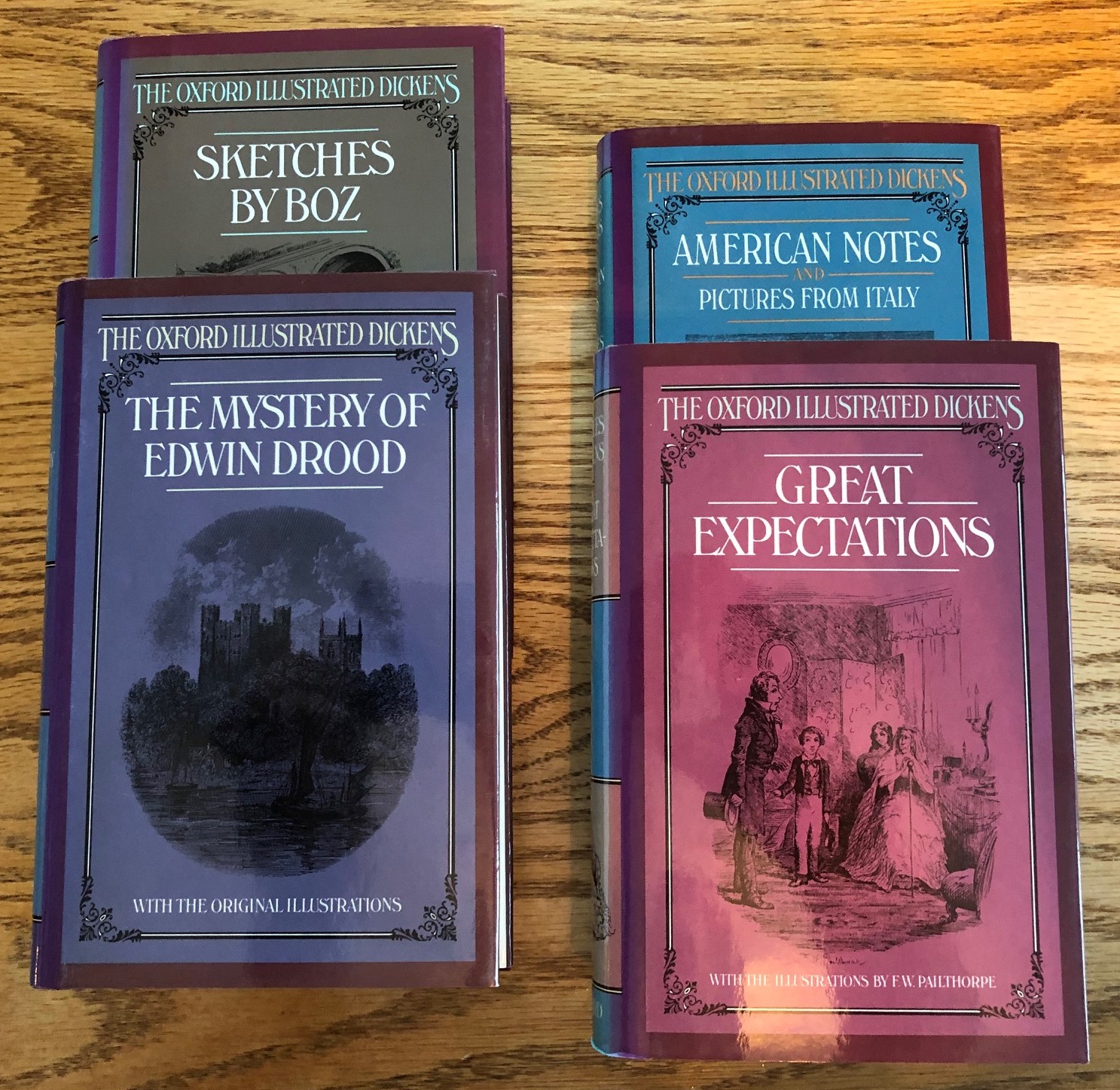
The Oxford University Press, a publisher for more than 700 years, churns out 6,000 physical titles a year despite today’s electronic alternatives. Oxford focuses on educational materials, including dozens of dictionaries. At one time the Press had the exclusive right to print the King James Version of the Bible. I know Oxford for one other reason, however: their 21-volume illustrated collection of the works of Charles Dickens.


I’ll bet you have a collection of something yourself, where the number of items in the lot goes beyond pure necessity. We have more Christmas ornaments than any reasonably-sized tree can hold. We have more mugs than we’ll ever use for coffee or tea. My brother seems to collect cars (or maybe he really does drive them all). Whatever feeds our need to collect also fuels our stubbornness to ever let these items go.

Such is the case with my Dickens collection. When I was in my twenties I got a mailer from Oxford Press advertising “a Dickens book a month”.  Must’ve been inexpensive back then, and somehow the collection spoke to me even though I’d never read a lick of Dickens.  Maybe I envisioned my future dwelling with shelves of classic literature (never happened). Several decades after I purchased the last Dickens I still haven’t read a page, but the books sure look nice all standing in a row.  I’ll never get rid of them.

This talk of Dickens and collecting is just a preface to my real topic today.  I’d like you to meet PixxiBook.  Maybe you don’t collect books (outside of those you purchase on your e-reader) but ask yourself: what if you could have your blog posts pressed into books worthy of your coffee table?  That’s what PixxiBook does, and they do it well.

PixxiBook is one of those I-wish-I’d-thought-of-it businesses.  The husband and wife behind the scenes did what most startups do: create a business based on a personal need.  “Tim and Sabrina” wanted to convert their travel blog into a book but realized the process takes more time and effort than most people are willing to invest.  So they designed a computer program to do the work instead.  Then they partnered with a printing press, aligned with WordPress and a few other blogging hosts, and a business was born.

I’m not sure whether Tim or Sabrina gets the credit, but here’s the marketing genius of Pixxibook (and the point where you’ll stop reading this post).  You can create your PixxiBooks from your blog now… and instantly preview the finished product.  No charge.  Just go to Pixxibook’s website, enter your blog’s URL, and watch the computer program crunch through your posts to create your books.  If you like what you see, you can purchase the real thing.  When my wife ordered my PixxiBooks as a 60th birthday present, they were printed and shipped so quickly I’d only written two new posts by the time I got them.  Seven years of weekly posts published in three elegant volumes.  Life In A Word is now a “triple-booked” anthology.

I wrote this one three years ago.

Earlier I mentioned your coffee table, and how PixxiBook is worthy of its surface.  Not quite true.  Some of you – especially you non-bloggers – are thinking, “Nobody’s gonna leaf through old blog posts, Dave”.  Hey, I agree with you.  Blog posts are read and digested, and then we move on to other things.  So why pay for books?

Go back to my Dickens’ collection for the answer.  Those Oxford Press gems are mine.  Not my wife’s, not my dog’s, not someone’s who we invite over for a dinner party.  Mine.  I can admire them from across the room, leaf through one every now and then, or maybe finally start to read Oliver Twist.  Doesn’t really matter what I do with them.  Just like my PixxiBooks.  They’re a nice collectible and worthy of my shelf space.  I’m never getting rid of them.

——————–

Lego Grand Piano – Update #4

Today’s portion of the concert was legato or “smooth” (read about my hesitant warm-up in Let’s Make Music!), though I won’t go so far as to say “effortless”.  The only real drama with Bag #4 – of 21 bags of pieces – was the one little piece that skitted off my desk and tried to escape the room.  Caught the little bugger before he got too far.

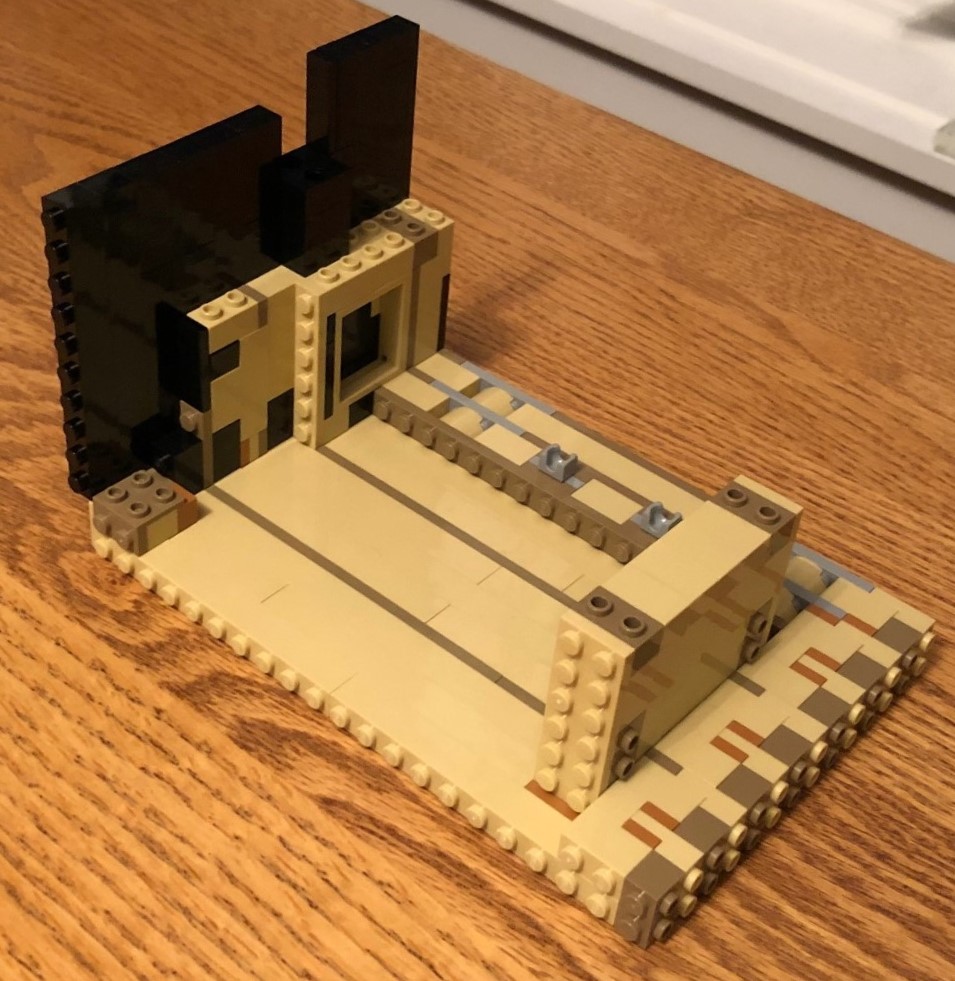
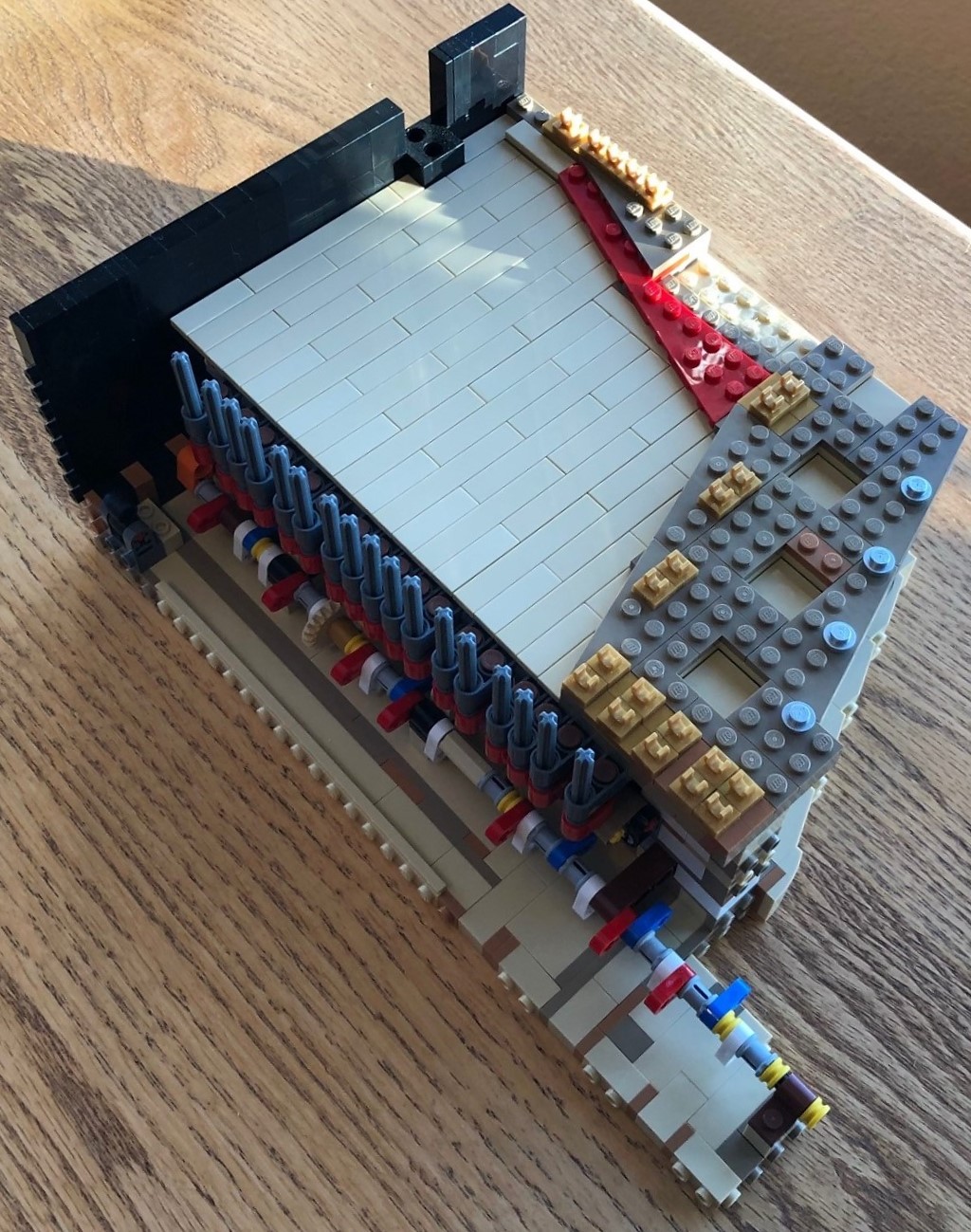
All Bag #4 pieces assemble to a single structure: the light-colored “deck” you see here with the red pieces towards the top and the grey pieces to the right.  Those little yellow grabbers will eventually secure the piano strings.

The second photo is a good look at the piano “mechanics”.  This view would be as if you were sitting at the bench looking directly at the keys.

Running Build Time: 4.2 hours.  Musical accompaniment: Vivaldi’s The Four Seasons. Leftover pieces: 3

Conductor’s Notes: Mr. Instruction Manual included a couple extra pages today; pictures to show me how to “turn on” the piano by pushing a button on the battery pack.  Once I did, the battery pack started flashing.  Had to disconnect a cable to make it quit.  Wish I knew what that was all about.  Patience, maestro, patience.

I Just Turned 59.99589!

It may interest you to know there are real Memory Lanes in the bedroom communities of every American state. Look them up on Google Maps (I stopped searching after finding dozens.) Must be fun to be one of those residents and see the look on someone’s face when you give them your address.  No, I don’t know anyone who lives on Memory Lane, but me, I kind of do; one with no stripes or sidewalks. Mine is paved with sixty years of material, some of it worth a visit; other items best left alone.  All of this “Dave” stuff is somewhere between my ears and today it’s time for a big – okay, little – reveal.

59.99589.  If you’re reading this post the day it was published, I’ve just revealed my age to ridiculous exactness.  The 0.99589 amounts to 363 out of the past 365 days.  You could say I’m still in my late fifties (very late, Dave), but more accurately you’ll say I’m either sixty on the dot or a mere forty-eight hours removed from it.  Do I feel old now?  Of course not!  Er, until I calculate my age in months.  I’ve spent 720 of those bad boys.  For Pete’s sake, what have I been doing all my life?

Well, let me answer that question.  In fact, let’s make it a game because then you get to play too.  Think about the last sixty years (or in your case, however many decades you’ve been around).  Now let’s create a list – off the top of our graying heads – of up to ten significant world events in the timeframe of our years.  No, no, no; not the events you learned in the history books, but the ones with lasting, maybe even personal impact.  Here are mine, in no particular order:

  1. 9/11 (2001)
  2. COVID-19 (2020-???)
  3. San Francisco Bay Area earthquake (1989)
  4. Space Shuttle Challenger (1986)
  5. America’s war in Afghanistan (2001-2021)
  6. Apollo rockets (1961-1972)
  7. Colorado’s Black Forest wildfire (2013)

I don’t have enough time to explain my choices (after all, I only have forty-eight hours until I”m a “sexy-genarian”) but trust me; these seven came to mind in a heartbeat.  Now arrange them in chronological order to paint an interesting picture.  My childhood was inspired by Apollo rocket launches (courtesy of black-and-white TV’s); my young adult years by two disasters – the Challenger explosion and the devastating earthquake in the San Francisco Bay Area; and my adult years by big-bad-ticket items like terrorism, war, wildfire, and a global pandemic.  Sadly, not one of these events makes anyone’s “good list” (am I a product of headline news or what?). But that’s not to say my sixty years have been altogether bad.  Quite the contrary.

Now, here’s where the game gets more interesting.  Make a similar list as above, but include up to ten significant events of a personal nature.  These are the formative moments, where you’re not the same person after they happened as you were before.  Leave off relationships (including marriage) and having kids, because most of us have or will have those in common.  Let’s see now.  My eyes are closed, I’m in a thoughtful trance, and I’m typing, all at the same time (a man of many talents, no?) Okay, pencils down.  Here’s my “formative” list, also in no particular order:

  1. Corrective eye surgery (1977)
  2. I-survived-but-the-car-didn’t rollover (1984)
  3. Immersive year of studies in Rome, Italy (1982-83)
  4. Traded California’s coast for Colorado’s Rockies (1993)
  5. First job <McDonald’s> (1975)
  6. All things Boy Scouts (1973-1978)
  7. Architecture career ends, tech career begins (1993)
  8. All things basketball (1974-1979)

Again, I’d love to wax on about my choices but I’d turn 61 before I’d be done typing.  Instead, sort my formatives from earliest to most recent.  Notice anything?  All happened between the ages of 10 and 30.  My “clay was molded’ in a mere one-third of my lifetime.  Not really true, of course.  Ages 1-10 – none of us remember much of those.  But now I hear you saying, “So Dave, what have you been doing for the last thirty years?”  Well, you know the answer already  The same thing as most every other red-blooded American male.  Raising a family.  Making a living.  Loving my wife.  Loving my life.

I predict my sixties will be my greatest decade; just you wait and see.  I’ll witness another significant world event or two (maybe even a “good one”!)  I’ll break my thirty-year run of nothing and come up with at least one more formative experience.  I’ll write another 520 blog posts (and you’ll block a chunk of your calendar to read them).  But let’s be real; this is just musings about my sixties.  I’m only in my fifties. My account still shows a credit of forty-eight hours.

——————–

Lego Grand Piano – Update #2

The concert is underway! (read about my hesitant warm-up in the post Let’s Make Music!).  Bag #2 – of 21 bags of pieces – started out innocently enough, with big pieces and easy assembly.  My maestro-confidence overfloweth.

Suddenly things got v-e-r-y complicated in Mr. Instruction Manual.  Tiny, tiny pieces!  Mechanical components!  Cables!  Batteries!  Here’s last week’s build, and then below, this week’s additions for comparison.  Enlarge the second photo for a better look at the colorful, scary-looking “spindle”, running top left to bottom right.  I have no idea what it’s for but it connects to the gray/white motor (at least I think it’s a motor) just behind it. I count forty-five little Legos on the spindle, each required to be positioned exactly as you see them.  Almost walked off the stage when I was done with that step.

Running build time: 2.5 hours.  Musical accompaniment: Beethoven’s Piano Concerto No. 5 “Emperor” (three times through!)  Leftover pieces: 5 (Conductor’s note: Last week I only had 1 leftover piece.  5 = concern.  I need to double-check this week’s work before moving forward.  Safe to say you can’t go back and “repair” after the fact).

Fantastic Plastic

On Christmas Day, any parent of small children will stifle a yawn, having built bicycles, dollhouses, and train sets the night before. After all, Santa doesn’t deliver unassembled toys. But hang in there a few years, Mom & Dad, because the building shifts from the giver to the receiver. Older kids want to create. In my generation it was Hot Wheels, Erector Sets, and Lincoln Logs. And one other toy surpassed all others for its ease of use and versatility. Lego.

This piano even plays!

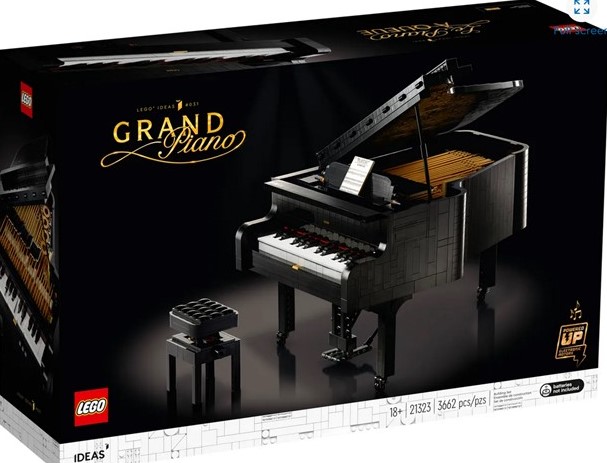
My Christmas gift from my wife this year was a grand piano. Can you top that? Okay, so it wasn’t the kind worth five figures or special movers to get it across the threshold.  My piano measures a mere 12″ x 14″ and comes from the Lego “Ideas” collection.  When it’s finished it will have been built from 3,662 individual pieces.  I can’t wait to get started.

A grand piano made of Legos means the simple interlocking blocks I had as a kid have come a long, long way.  Lego Ideas sets are “products inspired by and voted for by Lego fans”.  The collection includes a typewriter, a ship in a bottle, the house from the Home Alone movies, and the apartment from the Seinfeld sitcom.  Every Ideas product involves thousands of Lego pieces to assemble.  Every Ideas product was also completely sold out for Christmas on the Lego website.

Fifty years ago, Lego was blessedly innocent.  All you had were small bricks in primary colors and if you were lucky, a paper set of instructions to create a simple house or a vehicle.  Otherwise, you just built whatever your imagination could come up with.  When my own kids were kids, Lego moved to product-specific sets like a T. Rex from Jurassic World or an X-wing Starfighter from Star Wars.  Sure, they looked cool when they were built, but I was always skeptical because the sets removed creativity from the experience.  You’d just follow the step-by-steps in the little booklet and voila – a T. Rex.  But call me a hypocrite because this sixty-year-old can’t wait to build his step-by-thousand-steps Lego Grand Piano.

Lego has an interesting history – too many chapters to cover here.  The numbers tell the story in a nutshell.  The Denmark-based company is considered the largest toy company in the world.  Their bricks have inspired movies, video games, building competitions, and eight amusement parks.  Their factories have been churning out little plastic pieces for almost 75 years.  And at last count, that pile of pieces surpassed 600 billion (or 75 Legos for every man, woman, and child on earth).

I didn’t expect to be a Lego fan as an adult but then came the Architecture series in 2008, cool buildings like the Taj Mahal, Eiffel Tower, and Empire State Building.  I just had to have one, so last Christmas my wife gifted me the 1,032-piece United States Capitol Building.  I didn’t clock how long it took to complete but I must’ve looked awfully confident in the assembly because now I’m staring down the more daunting Grand Piano.  Maybe my wife wants me locked down in my home office for the next several months?

To underscore the popularity of Lego these days, the Architecture series alone includes 50 buildings and cityscapes, with more coming out each year (the Taj Mahal was released just last summer).  These sets run anywhere from $50 to $250, with the discontinued ones setting you back three times as much.  Sure, I’d love a Lego version of Frank Lloyd Wright’s “Fallingwater” house, but I’m not going to pay $800 to a collector just to have one.

Lego “Church of Christ”

No discussion of Lego would be complete without a nod to custom creations.  Our local Scheels department store has a larger-than-life Denver Broncos football player made of Legos, posing front and center in the toy department.  The Church of Christ creation in the photo here didn’t forget seating for an 80-member choir (below the big yellow crosses).  And the biggest custom creation of them all?  A full-scale Lego replica of the previously-mentioned X-wing Starfighter, first displayed outdoors in New York’s Times Square.  Try to picture 5.3 million Lego pieces and 23 tons of “toy” in the shape of a fighter jet.  Or just check out the photos here.

Now that I’m done writing it’s time to break open the first bag of pieces to begin my Lego Grand Piano (and time for you to watch the ingenious stop-motion video below).  I’ll use the stopwatch on my iPhone to capture the hours I consume to complete it.  Er, days? Weeks?  I mean, Rome wasn’t built in a day.  Neither is a grand piano.  You might want to check in with me next summer to make sure I haven’t gone bats.

Some content sourced from Wikipedia, “the free encyclopedia” and the Lego.com website.

Fa-La-La Land Down Under

I have two nieces who, along with their families, call islands their homes. One lives on Hawaii’s Oahu, her house perched on the cliffs above Honolulu with sweeping ocean views to the west. The other lives in Brisbane, on the east coast of Australia. Sure, Australia isn’t really an island, though it is surrounded by water. By definition its landmass makes it a continent instead. But Australia does lay claim to a few islands off its shores.  Including one named “Christmas”.

Christmas Island’s picture-perfect “Flying Fish Cove”

Imagine living in a world so small you can walk from one end to the other in less than two hours.  Your fellow islanders are so few, your entire social life is like living in a college dorm.  Your diet consists of fruits, nuts, and crab.  Lots and lots of crab.  And the single contribution you and your island-mates make to the outside world is phosphorous from your underground mines.  That, in a crab shell, is life on Christmas Island.

The first time someone told me there was a “Christmas Island”, I was young enough to be watching Rudolph the Red-Nosed Reindeer every December on TV.  My favorite part of Rudolph’s story was the “Island of Misfit Toys”.  You remember, don’t you?  Rudolph was the reindeer-a non grata, mocked by the others because of his shiny nose.  Along with a couple other outcasts (Hermie, Santa’s elf who’d rather be a dentist, and Yukon Cornelius, the prospector who can never find silver or gold), Rudolph discovers the Island of Misfit Toys.  The island is a repository for unwanted toys.  As sad as that sounds, Rudolph’s island brings Christmas to mind much more than the little landmass I’m talking about today.

Palm trees (not pines) on Christmas Island

If you wonder why you’d ever visit Christmas Island, consider almost 65% of the island is a national park of unspoiled rainforest, with walking paths past 25 species of trees and 135 species of plants.  The only animals you’ll spy in the forest include the “flying fox” fruit bat, the recently introduced Javan deer, and the golden bosun (the island’s “official” bird).  Outside of the forest however, it’s impossible to miss the crabs.  Coconut crabs.  Red crabs.  Thirteen different species of land crabs, let alone those who prefer the ocean.  And here’s the best part.  Every year, one hundred million of them migrate from solid ground to water (to spawn), a sight mind-blowing enough to be called “one of the wonders of the natural world”.

Watch the following short video on the chaotic Christmas Island crab migration.  Makes you wonder how you can walk anywhere without getting “crabs”.  If this is something you simply must see in person, find your way to Perth on Australia’s western mainland, and book one of two weekly flights to Christmas Island courtesy of Virgin Airlines.  Your 3+ hours in the air will take you over nothing but the vast Indian Ocean.

It’s high time we addressed the most burning question about our little fa-la-la land down under.  Why is it named Christmas Island?  Here are popular theories.  One, “The rainforest is made up of nothing but evergreen (Christmas) trees.”  Two (for the geographically challenged), “The island is the closest landmass to the North Pole.”  And three “Christmas Island was the origin of the species diospyros virginiana, more commonly known as the sugar plum tree.”  The correct answer?  None of the above.  In the 1600s, European explorer Richard Rowe first set foot on the island, doing so on December 25th.  With no more creativity than a glance at the calendar, his discovery was dubbed Christmas Island.

Norfolk Island pine

I’ve got a much better “Christmas Island” for you.  Flip over to just off the east coast of Australia and you’ll find an even tinier landmass called Norfolk Island.  It’s about a quarter the size of Christmas, with the same number of inhabitants.  But Norfolk Island’s primary export is much more “Christmas” than phosphorous.  It is the evergreen Norfolk Island pine, a popular ornamental tree in Australia.  My wife and I found one at Home Depot a few years ago and bought it for her mother.  For small spaces, Norfolk Island pines make great Christmas trees.

“Christmas” looks a little like an Aussie Shepherd!

In defense of Christmas Island, there’s more going on within its shores than phosphorous and crabs.  Most of the residents live in the northern area of the island surrounding a coastal region known as Flying Fish Cove.  They speak one or more of five different languages.  There’s a high school and a public library.  There’s even a cricket club, which just celebrated sixty years in the game.  And most fitting to this time of year, twenty percent of the population call themselves Christians.  In other words, despite the uninspiring reason for its name, Christmas really does come to Christmas Island.

Some content sourced from Wikipedia, “the free encyclopedia”.

O’ Come Let Us Adorn

There’s an older fellow in Egypt who wakes up every morning, throws on a flannel shirt and well-worn pants, and goes to his workshop behind the corrugated roll-up door of a small, industrial warehouse. Using ancient tools and techniques, he churns out hundreds of colorful, ornate, square cement tiles. He’s a true artisan, our tilemaker, carrying on his craft from many generations before him.  His product endures amid countless mass-produced ceramic and porcelain alternatives. Perhaps our tilemaker would feel more at home in Lauscha, Germany.  Lauscha is home to dozens of glassblowers, who still create colorful, ornate, Christmas ornaments by hand.

Lauscha “baubles”

Every December about this time, my wife & I bring home our Christmas tree (real, not artificial – see Is It Live or Is It Memorex? for that debate).  We take our tree through the same steps from start to adorned.  First, fresh-cut the trunk, set the tree into the stand, and fill with warm water (and one baby aspirin!).  Next, let gravity bring the branches down for a few days.  Then, bring out the ladder, top the tree with the angel, and string the lights generously down all sides.  Finally, adorn with ornaments.  Our collection is larger than the real estate of any Christmas tree we buy, so there’s always debate on which ornaments make the tree and which are re-relegated to the closet for another year of waiting.  In the end, we stand back and admire a pleasing mix of homemade, school-made, photo-framed, and collectibles.

You can never have enough ornaments, and the glassblowers in Lauscha would agree.  The process they use to create the simplest of glass balls is already beyond my artistic abilities.  For one, you must work fast because the molten glass cools in a hurry.  For two, you must have steady hands as you add color and detail.  Have a look at the following short video and you’ll learn a thing or two you never knew about making Christmas ornaments.  My favorite part of the process? “Silvering”.  Who knew the mirror-like aspect of a Christmas ball is painted on the inside of the glass?

Germans (and more people than I’d probably guess) refer to Christmas ornaments as baubles, which is ironic because Americans define a bauble as a “showy cheap trinket”.  Nothing produced in Lauscha, Germany is a showy cheap trinket.  Then again, Americans figured out how to mass-produce Christmas ornaments and the result is a generic, sometimes-plastic alternative to the real thing.  “Bauble” indeed.

The very first Christmas ornaments were anything but glass-blown baubles.  You had fruit, candy canes, pastries, strings of popcorn, and whatever else you could find around the house.  The Lauscha baubles then came along in the mid-1600s.  Short of the post-WWII years (when the German government used the glass factories for more important products) they’ve been making them ever since.

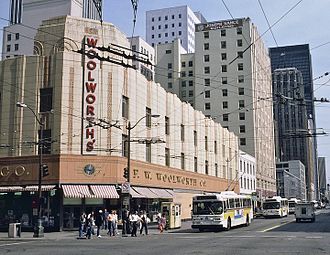
Credit Woolworth’s once-popular department stores for the proliferation of Christmas ornaments in America.  In the late 1800s, Woolworth’s started carrying the Lauscha baubles.  Soon after, they stocked mass-produced American-made versions, taking tree-decorating to a whole new level.  By the mid-20th-century, Woolworth’s was banking $25 million on Christmas decoration sales alone.

Hallmark “Keepsake Ornament”

Hallmark jumped on the bauble bandwagon in the 1970s.  Clever folks, those people at Hallmark.  Their original ornament collection was made available only for the current year, followed by a new collection the following year, and so on.  Today, Hallmark Keepsake Ornaments are so popular you have to join a club (just $49.95!) if you want to own their newest limited-edition ornaments.

As much as I’d like to add a Lauscha bauble or two to my tree, I prefer the more personal ornaments we hang instead.  A dozen or more of them were designed around primary-school photos of our kids (“art projects”, they called them).  Souvenir ornaments from favorite trips we’ve taken over the years.  Several more with imprinted dates, to remind us of special occasions like weddings, births, or passings.

Five years ago, I wrote my one and only work of fiction on this blog, a post about a Christmas ornament.  It seems fitting to include a link to The Best Branch on the Tree, assuming you haven’t followed me that long.  Because, you know, ornaments – er, baubles – have feelings too.

Some content sourced from Wikipedia, “the free encyclopedia”.

Going Home

Last Friday, my family and I hosted – at long last – an in-person service of thanksgiving for my mother, who passed away in late 2020 at the age of 92. Travel restrictions denied us the opportunity to gather sooner but this year’s Thanksgiving weekend seemed most appropriate. The service program included hymns, Bible readings, a biographical homily, and reflections from my four brothers and me. But it was another element – a solo of “Going Home” – which brought a flood of tears and took my breath away, all at once.

As if the singing of “How Great Thou Art” or the reading of Psalm 23 wasn’t moving enough, “Going Home” brought my emotions to an entirely new level.  Sure, the song’s lyrics speak beautifully – to the peaceful transition from a life well-lived to what lies beyond – but it was the music that made my heart skip a beat.  “Going Home”, you see, borrows its instrumentals from the Largo movement of Antonin Dvorák’s “New World Symphony”.  And Dvorák’s symphony is one of my very favorite pieces of classical music.

I alluded to classical music when I spoke at my mother’s service.  I took piano lessons for several years as a child, and it was my mother who pushed me to practice when I would’ve much rather been playing outdoors.  It was my mother who faithfully attended my many recitals and competitions.  And it was my mother, as a result, who I credit for my lifelong love of classical music.

The New World Symphony’s (NWS) Largo movement is instantly recognizable to anyone who knows classical music (listen to the first two minutes above if you don’t believe me).  It may be the most beautiful solo ever written for the English horn; a short, meandering melody backed by soft strings.  I can’t think of a more appropriate instrument for the Largo, even though the English horn is an orchestra oddball with its distinctive wail.  Now layer the “Going Home” lyrics on top, as with the crystalline voice of Sissel Kyrkjebo above, and you wonder if music can get any better.

Following the English horn solo, the NWS Largo shifts to a minor chord passage which “evokes a nostalgic and desolate mood”, sometimes perceived as a funeral march.  But let’s be clear; my mother’s service was no funeral.  Rather, it was a blessed celebration attended by those who loved and admired her.  I think Dvorák knew this because the NWS Largo leaves the funeral march behind and concludes with another round of the peaceful English horn solo.  For me, this music brings a cleansing sigh, and a feeling of calm and content.  Just as my mother would want it to be.

I’ve saved the best for last here.  After my brothers and I finished our remembrances, my father spoke.  He said – to my utter amazement – my mother had effectively written her own service, picking the hymns, readings, and solos.  In other words, “Going Home” was no random choice; it was my mother’s preference.  Just as the New World Symphony Largo movement is my own preference.  Maybe she was aware of the connection?  Maybe not but it doesn’t really matter.  What matters is I’ll always remember her, especially when I hear the English horn.

I miss you, Mom.

Some content sourced from Wikipedia, “the free encyclopedia”.

Scour Power Bars

I like to calculate trivial quantities for my own entertainment. For instance, in the timeframe of my years in grade school, my mother made me over 2,000 sack lunches (thanks, Mom!)  Or how about, in the sixteen years my wife & I have lived at our current address, I’ve driven up and down our street over 12,000 times. Trivial or not, these numbers lend perspective to things we don’t think a lot about.  Like soap.  And my soap number is +650.  That is, the number of bars I’ve consumed over the years in a daily effort to keep clean.

Seriously, when was the last time you gave a bar of soap more than a passing glance?  The poor little 3″ x 2″ x 1″ pastel-colored brick spends its month-long life sitting somewhere in your shower or bath, 23.75 out of 24 hours a day.  In those remaining fifteen minutes (probably less) he gets his one moment of adventure, traveling all over your body while he works to return you to fresh ‘n’ clean.  But with each passing day, Mr. Soap gets smaller and smaller until the dreaded moment of deliberation.  Is his remaining sliver too little for effective scour power?  You’d never know it with all the water, but maybe Mr. Soap sweats as he shrinks, anticipating the moment he gets demoted from the shower to the trash bin.

In the spirit of don’t try this at home (because it’s already been determined), a bar of soap really does last about a month, assuming a daily shower.  And that’s me.  I take a morning shower every day whether I need it or not.  Even if there’s nothing to “get ready” for I still want to face my day like there is.  So, Mr. Soap matters to me. You can understand why I’m getting into a bit of a lather on this topic.

In the chemistry lab, soap equals a surfactant derived from the chemical compound of a fatty acid.  In the supermarket, soap is simply a waxy, floral-smelling substance you purchase in solid or liquid form.  Behold some of the more common brands in America (as advertised online by Wal*Mart):

  • Caress
  • Coast
  • Degree
  • Dial
  • Dove
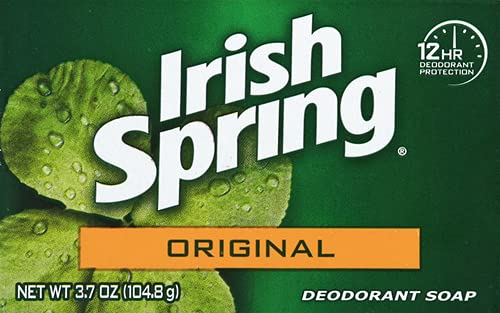
  • Irish Spring
  • Ivory
  • Jergens
  • Lever
  • Olay
  • Safeguard
  • Yardley
  • Zest

Admit it, as unimportant as soap may be to you, there’s a favorite brand out there, probably from the list above.  Mine is a little more exotic.  I go with Dr. Bronner’s All-One Hemp Lavender Pure-Castile (and how’s that for a mouthful of soap?)  Dr. Bronner’s is harder to find and more expensive than the commoners above, but I sure like it.  Maybe it’s the hemp; you know, maybe I’m getting a little “high ‘n’ clean”?  You could claim I’m “soap-stoned” when I shower.

My wife & I stream most of our entertainment these days so we miss a lot of commercials.  But ads for soap – at least those of several decades ago – took scrubbing bubbles to ridiculous claims.  Coast convinced you its product would “awaken your senses” and “bring you back to life” in the mere minutes of a shower.   Irish Spring advertised itself as “springtime in a bar” as a towel-clad Irishman cut into the soap with a knife he just happened to be carrying, uh… where, exactly?  And Zest had you thinking “you’re not fully clean until you’re Zest-fully clean”.  As if Zest was somehow noticeably better than other options.

Even though my Dr. Bronner’s might label me a soap snob, I want to give a shoutout to Ivory.  The simple white bars claim to be 99.44% pure soap.  The other 0.56% includes the sharp tang of fresh ginger root, a smell I will always associate with my grandparent’s house.  I can’t come up with another smell so “cleanly” connected to my distant past, so Ivory gets my nod of gratitude.

Some of you reading this far dismiss the entire topic since your preference is liquid soap.  I say, good on you!  Liquid soap has all of the cleansing benefits of bar soap and is typically a better moisturizer for the skin.  Liquid soap is also less likely to gather germs than Mr. Soap since he sits fully exposed in the shower all day every day.  But bar soap contains fewer ingredients and more natural ingredients than liquid – better for you and for the environment.  As they say, tom-ay-to, tom-ah-to. 

This opera of soap is just about done, but not before I leave you with one final trivial number: 4,800.  That’s how many years soap’s been a thing, invented by those brilliant but ancient Egyptians.  Think about it the next time you unearth a mummy.  You’ll never know who’s under the wrappings, but at least you can be pretty sure he or she was left fresh ‘n’ clean.

Some content sourced from the RompaGroup article, “17 facts about soap, the most popular hygiene product in the world”, the Healthy Group article, “Is Liquid Soap Better than Bar Soap?”, and Wikipedia, “the free encyclopedia”.

Once-A-Year Cake-and-Cheer

I caught a radio show last week where a caller mentioned her birthday fell on December 25th. She lamented how, as a kid, she received presents for Christmas and others for her birthday, not knowing which were meant for which. Without missing a beat the radio host goes, “Hey! At least you get to share your birthday with Jesus! I have to share mine with Madonna!”

I decided to play the game myself (and you can too, at the Famous Birthdays website).  Type your special day into the box at the top of the screen and up pop all these, uh, interesting people you share something of a kinship with.  You’ll see names, ages, and occupations under big, colorful photos.  People the website deems famous.  But don’t get too excited now.  I had to scroll through seventeen before I recognized anyone.  Maybe that’s because their occupations are Rapper, YouTube Star, and TikTok Star?  For Pete’s sake, can’t they have real jobs?

Mercifully, I find “real” birthday buddies among the self-proclaimed famous.  Steve Perry – lead singer for the band Journey – shares my birthday, born eleven years before I was.  So does Sam Cooke, whose soulful voice captured hearts in the 1960s.  But one birthday buddy stands gracefully above the rest.  Diane Lane, exactly three years my younger, is one of my favorite actresses.  When Diane turned 14 in 1979, she debuted as the adorable lead in the France/Italy adventure A Little Romance.  I’ve been smitten ever since.

Ms. Lane

Birthdays represent a variety of celebrations as we pass through life, don’t they?  As babies, our parents celebrate for us since we have no clue what the fuss is all about.  As young children, the celebrations become the most colorful: parties with friends of the same age and activities from amusement parks to backyard bouncy houses.  As young adults, birthdays tend to be celebrated at restaurants and bars, with plenty of alcohol flowing.  In the decades following we seem to favor SURPRISE! parties.

Now, as my sixtieth birthday looms like the next interstate exit, I’m all about more subdued celebrations.  A quiet dinner out with my wife.  A trio of phone calls from my kids.  A single piece of birthday cake instead of something big enough to hold five dozen candles.  Wouldn’t want the day to pass without acknowledgment but the simpler the gesture the better.

Speaking of birthday cake, it’s perhaps the single tie that binds as we celebrate our years young and old.  I picture a baby’s birthday cake as small and round, with a big #1 candle on top.  Cover your kid in plastic and put the cake close enough so he or she can dig in with both hands.  We have these priceless and messy pictures for each one of our kids.

Young children have the most adventurous cakes.  I picture a blank rectangle just waiting to be populated with frosting, decorations, and little toys, like an artist’s canvas.  Dump trucks working on a cake-top construction site.  Animals living in a cake-top jungle.  Ballerinas dancing across a cake-top stage.  The possibilities are endless.

After childhood, cake designs evolve to the age itself.  Whether big wax numbers or individual candles, the focus of the cake becomes the number.  After enough of those years, we try to be more subtle (ex. spell out the age with candles) so we don’t set the house on fire.  Later in life, we save the biggest celebrations (and cakes) for the round numbers because ages 80, 90, and 100 are achievements in themselves, aren’t they?

There’s evidence to suggest birthdays and cakes have been a combo as far back as ancient Roman times but for me, birthday cake is simply a nod to happy childhood memories.  Birthday-cake-flavored ice cream, cookies, and even protein bars are all the rage for this reason.  We just want to be kids again, breathlessly anticipating the celebration of our special day.

Some content sourced from IMDb, the Internet Movie Database, and Wikipedia, “the free encyclopedia”.

Peanuts and Pumpkins

Three years ago, New York Magazine’s website Vulture ranked all forty-five Peanuts animated television specials from worst to best, including a paragraph on each one to justify its ranking. I wouldn’t have guessed Charlie Brown, Linus, and Lucy appeared in fifteen television specials let alone forty-five. But let’s be honest; only two Peanuts adventures have had any staying power: It’s the Great Pumpkin, Charlie Brown (#2 on Vulture’s list), and A Charlie Brown Christmas (#1).

Maybe I’ll weigh in on the Christmas special in a couple of months, but with Halloween on the horizon I need to speak to the runner-up. It’s the Great Pumpkin, Charlie Brown first aired on television in 1966, so those who were alive back then (me) have the chance to see it for the 56th time this year. But maybe not? The networks stopped showing Great Pumpkin two years ago.  Other than PBS in select locations, you’ll have to buy the DVD or subscribe to Apple TV+ to watch Charlie Brown get another rock in his trick-or-treat bag.

Writing about a Peanuts special dates me – there’s no question.  But it’s still worth the words.  The Peanuts gang was the comic strip of my youth.  I remember the anticipation of the Sunday morning newspaper and the “funnies” pages.  Charles M. Schulz and his Peanuts characters always got the first slot.  When the specials debuted in the mid-60s, it was a big deal.  It’s the Great Pumpkin, Charlie Brown only showed up once a year, in mid-October.  We didn’t have DVRs (let alone streaming) back then, so watch it live or you’d miss it.  Peanuts specials were always the hot topic of conversation at grade school the next day.

After so many watches, Great Pumpkin becomes an interesting study.  You pick up on the little things, the ones which would implode under the weight of today’s social media scrutiny.  Right out of the credits, Linus & Lucy head to a patch to pick out a pumpkin.  On the way, Linus picks up an apple among the fallen leaves, takes a single bite, and tosses it into a trash can. (Unnecessary waste!).  In another scene, Lucy stabs a pumpkin with a giant knife as she begins carving (Children with weapons!).  Then Linus looks on in horror and says, “I didn’t realize you were going to kill it!” (Violence!)

Great Pumpkin touches on other themes to sink today’s children’s shows, including bullying, teasing, and casual use of words like “stupid” and “blockhead”.  Charlie Brown is the butt of several jokes, including Lucy pulling the football away just as he tries to kick, and the girls using the back of his head to draw a pumpkin carving design.  Yes, I laughed at these scenes when I was a kid, but only because I wasn’t that kid (and because it was the 1960s humor).

Here’s an oddity with Great Pumpkin.  You’d think a short animation would be a continuous story.  Not so.  Great Pumpkin jumps awkwardly between disconnected scenes, from carving pumpkins to trick-or-treating to a Halloween Party.  The middle minutes shift randomly to Snoopy acting out his costumed “World War I Flying Ace” in the middle of France.  It’s as if Great Pumpkin didn’t have enough Halloween material to fill a half-hour, or at least needed an excuse to include Snoopy in the story.

Finally, “the Great Pumpkin” itself is completely akin to Santa Claus, but for a different holiday.  Linus writes a letter to the Great Pumpkin to say he’s looking forward to the arrival on Halloween night and hoping for lots of presents.  The Great Pumpkin visits pumpkin patches the way Santa Claus visits houses.  There’s even a mention of “pumpkin carols”.  You’re left wondering why this figment of Linus’ imagination wasn’t a little more unique.

If you haven’t watched It’s the Great Pumpkin, Charlie Brown, I probably haven’t given you reasons to rush to your television.  It’s simple and disjointed, and the animation doesn’t win the show any awards (even in the 1960s).  But just like A Charlie Brown Christmas, the characters are endearing, and the story has a pretty good message.  I’ll probably find myself looking for it again next year.

Some content sourced from Wikipedia, “the free encyclopedia”.