Scour Power Bars

I like to calculate trivial quantities for my own entertainment. For instance, in the timeframe of my years in grade school, my mother made me over 2,000 sack lunches (thanks, Mom!)  Or how about, in the sixteen years my wife & I have lived at our current address, I’ve driven up and down our street over 12,000 times. Trivial or not, these numbers lend perspective to things we don’t think a lot about.  Like soap.  And my soap number is +650.  That is, the number of bars I’ve consumed over the years in a daily effort to keep clean.

Seriously, when was the last time you gave a bar of soap more than a passing glance?  The poor little 3″ x 2″ x 1″ pastel-colored brick spends its month-long life sitting somewhere in your shower or bath, 23.75 out of 24 hours a day.  In those remaining fifteen minutes (probably less) he gets his one moment of adventure, traveling all over your body while he works to return you to fresh ‘n’ clean.  But with each passing day, Mr. Soap gets smaller and smaller until the dreaded moment of deliberation.  Is his remaining sliver too little for effective scour power?  You’d never know it with all the water, but maybe Mr. Soap sweats as he shrinks, anticipating the moment he gets demoted from the shower to the trash bin.

In the spirit of don’t try this at home (because it’s already been determined), a bar of soap really does last about a month, assuming a daily shower.  And that’s me.  I take a morning shower every day whether I need it or not.  Even if there’s nothing to “get ready” for I still want to face my day like there is.  So, Mr. Soap matters to me. You can understand why I’m getting into a bit of a lather on this topic.

In the chemistry lab, soap equals a surfactant derived from the chemical compound of a fatty acid.  In the supermarket, soap is simply a waxy, floral-smelling substance you purchase in solid or liquid form.  Behold some of the more common brands in America (as advertised online by Wal*Mart):

  • Caress
  • Coast
  • Degree
  • Dial
  • Dove
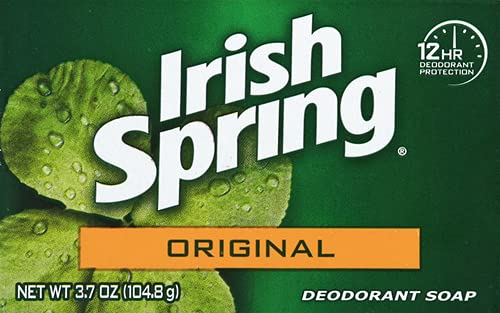
  • Irish Spring
  • Ivory
  • Jergens
  • Lever
  • Olay
  • Safeguard
  • Yardley
  • Zest

Admit it, as unimportant as soap may be to you, there’s a favorite brand out there, probably from the list above.  Mine is a little more exotic.  I go with Dr. Bronner’s All-One Hemp Lavender Pure-Castile (and how’s that for a mouthful of soap?)  Dr. Bronner’s is harder to find and more expensive than the commoners above, but I sure like it.  Maybe it’s the hemp; you know, maybe I’m getting a little “high ‘n’ clean”?  You could claim I’m “soap-stoned” when I shower.

My wife & I stream most of our entertainment these days so we miss a lot of commercials.  But ads for soap – at least those of several decades ago – took scrubbing bubbles to ridiculous claims.  Coast convinced you its product would “awaken your senses” and “bring you back to life” in the mere minutes of a shower.   Irish Spring advertised itself as “springtime in a bar” as a towel-clad Irishman cut into the soap with a knife he just happened to be carrying, uh… where, exactly?  And Zest had you thinking “you’re not fully clean until you’re Zest-fully clean”.  As if Zest was somehow noticeably better than other options.

Even though my Dr. Bronner’s might label me a soap snob, I want to give a shoutout to Ivory.  The simple white bars claim to be 99.44% pure soap.  The other 0.56% includes the sharp tang of fresh ginger root, a smell I will always associate with my grandparent’s house.  I can’t come up with another smell so “cleanly” connected to my distant past, so Ivory gets my nod of gratitude.

Some of you reading this far dismiss the entire topic since your preference is liquid soap.  I say, good on you!  Liquid soap has all of the cleansing benefits of bar soap and is typically a better moisturizer for the skin.  Liquid soap is also less likely to gather germs than Mr. Soap since he sits fully exposed in the shower all day every day.  But bar soap contains fewer ingredients and more natural ingredients than liquid – better for you and for the environment.  As they say, tom-ay-to, tom-ah-to. 

This opera of soap is just about done, but not before I leave you with one final trivial number: 4,800.  That’s how many years soap’s been a thing, invented by those brilliant but ancient Egyptians.  Think about it the next time you unearth a mummy.  You’ll never know who’s under the wrappings, but at least you can be pretty sure he or she was left fresh ‘n’ clean.

Some content sourced from the RompaGroup article, “17 facts about soap, the most popular hygiene product in the world”, the Healthy Group article, “Is Liquid Soap Better than Bar Soap?”, and Wikipedia, “the free encyclopedia”.

Once-A-Year Cake-and-Cheer

I caught a radio show last week where a caller mentioned her birthday fell on December 25th. She lamented how, as a kid, she received presents for Christmas and others for her birthday, not knowing which were meant for which. Without missing a beat the radio host goes, “Hey! At least you get to share your birthday with Jesus! I have to share mine with Madonna!”

I decided to play the game myself (and you can too, at the Famous Birthdays website).  Type your special day into the box at the top of the screen and up pop all these, uh, interesting people you share something of a kinship with.  You’ll see names, ages, and occupations under big, colorful photos.  People the website deems famous.  But don’t get too excited now.  I had to scroll through seventeen before I recognized anyone.  Maybe that’s because their occupations are Rapper, YouTube Star, and TikTok Star?  For Pete’s sake, can’t they have real jobs?

Mercifully, I find “real” birthday buddies among the self-proclaimed famous.  Steve Perry – lead singer for the band Journey – shares my birthday, born eleven years before I was.  So does Sam Cooke, whose soulful voice captured hearts in the 1960s.  But one birthday buddy stands gracefully above the rest.  Diane Lane, exactly three years my younger, is one of my favorite actresses.  When Diane turned 14 in 1979, she debuted as the adorable lead in the France/Italy adventure A Little Romance.  I’ve been smitten ever since.

Ms. Lane

Birthdays represent a variety of celebrations as we pass through life, don’t they?  As babies, our parents celebrate for us since we have no clue what the fuss is all about.  As young children, the celebrations become the most colorful: parties with friends of the same age and activities from amusement parks to backyard bouncy houses.  As young adults, birthdays tend to be celebrated at restaurants and bars, with plenty of alcohol flowing.  In the decades following we seem to favor SURPRISE! parties.

Now, as my sixtieth birthday looms like the next interstate exit, I’m all about more subdued celebrations.  A quiet dinner out with my wife.  A trio of phone calls from my kids.  A single piece of birthday cake instead of something big enough to hold five dozen candles.  Wouldn’t want the day to pass without acknowledgment but the simpler the gesture the better.

Speaking of birthday cake, it’s perhaps the single tie that binds as we celebrate our years young and old.  I picture a baby’s birthday cake as small and round, with a big #1 candle on top.  Cover your kid in plastic and put the cake close enough so he or she can dig in with both hands.  We have these priceless and messy pictures for each one of our kids.

Young children have the most adventurous cakes.  I picture a blank rectangle just waiting to be populated with frosting, decorations, and little toys, like an artist’s canvas.  Dump trucks working on a cake-top construction site.  Animals living in a cake-top jungle.  Ballerinas dancing across a cake-top stage.  The possibilities are endless.

After childhood, cake designs evolve to the age itself.  Whether big wax numbers or individual candles, the focus of the cake becomes the number.  After enough of those years, we try to be more subtle (ex. spell out the age with candles) so we don’t set the house on fire.  Later in life, we save the biggest celebrations (and cakes) for the round numbers because ages 80, 90, and 100 are achievements in themselves, aren’t they?

There’s evidence to suggest birthdays and cakes have been a combo as far back as ancient Roman times but for me, birthday cake is simply a nod to happy childhood memories.  Birthday-cake-flavored ice cream, cookies, and even protein bars are all the rage for this reason.  We just want to be kids again, breathlessly anticipating the celebration of our special day.

Some content sourced from IMDb, the Internet Movie Database, and Wikipedia, “the free encyclopedia”.

Peanuts and Pumpkins

Three years ago, New York Magazine’s website Vulture ranked all forty-five Peanuts animated television specials from worst to best, including a paragraph on each one to justify its ranking. I wouldn’t have guessed Charlie Brown, Linus, and Lucy appeared in fifteen television specials let alone forty-five. But let’s be honest; only two Peanuts adventures have had any staying power: It’s the Great Pumpkin, Charlie Brown (#2 on Vulture’s list), and A Charlie Brown Christmas (#1).

Maybe I’ll weigh in on the Christmas special in a couple of months, but with Halloween on the horizon I need to speak to the runner-up. It’s the Great Pumpkin, Charlie Brown first aired on television in 1966, so those who were alive back then (me) have the chance to see it for the 56th time this year. But maybe not? The networks stopped showing Great Pumpkin two years ago.  Other than PBS in select locations, you’ll have to buy the DVD or subscribe to Apple TV+ to watch Charlie Brown get another rock in his trick-or-treat bag.

Writing about a Peanuts special dates me – there’s no question.  But it’s still worth the words.  The Peanuts gang was the comic strip of my youth.  I remember the anticipation of the Sunday morning newspaper and the “funnies” pages.  Charles M. Schulz and his Peanuts characters always got the first slot.  When the specials debuted in the mid-60s, it was a big deal.  It’s the Great Pumpkin, Charlie Brown only showed up once a year, in mid-October.  We didn’t have DVRs (let alone streaming) back then, so watch it live or you’d miss it.  Peanuts specials were always the hot topic of conversation at grade school the next day.

After so many watches, Great Pumpkin becomes an interesting study.  You pick up on the little things, the ones which would implode under the weight of today’s social media scrutiny.  Right out of the credits, Linus & Lucy head to a patch to pick out a pumpkin.  On the way, Linus picks up an apple among the fallen leaves, takes a single bite, and tosses it into a trash can. (Unnecessary waste!).  In another scene, Lucy stabs a pumpkin with a giant knife as she begins carving (Children with weapons!).  Then Linus looks on in horror and says, “I didn’t realize you were going to kill it!” (Violence!)

Great Pumpkin touches on other themes to sink today’s children’s shows, including bullying, teasing, and casual use of words like “stupid” and “blockhead”.  Charlie Brown is the butt of several jokes, including Lucy pulling the football away just as he tries to kick, and the girls using the back of his head to draw a pumpkin carving design.  Yes, I laughed at these scenes when I was a kid, but only because I wasn’t that kid (and because it was the 1960s humor).

Here’s an oddity with Great Pumpkin.  You’d think a short animation would be a continuous story.  Not so.  Great Pumpkin jumps awkwardly between disconnected scenes, from carving pumpkins to trick-or-treating to a Halloween Party.  The middle minutes shift randomly to Snoopy acting out his costumed “World War I Flying Ace” in the middle of France.  It’s as if Great Pumpkin didn’t have enough Halloween material to fill a half-hour, or at least needed an excuse to include Snoopy in the story.

Finally, “the Great Pumpkin” itself is completely akin to Santa Claus, but for a different holiday.  Linus writes a letter to the Great Pumpkin to say he’s looking forward to the arrival on Halloween night and hoping for lots of presents.  The Great Pumpkin visits pumpkin patches the way Santa Claus visits houses.  There’s even a mention of “pumpkin carols”.  You’re left wondering why this figment of Linus’ imagination wasn’t a little more unique.

If you haven’t watched It’s the Great Pumpkin, Charlie Brown, I probably haven’t given you reasons to rush to your television.  It’s simple and disjointed, and the animation doesn’t win the show any awards (even in the 1960s).  But just like A Charlie Brown Christmas, the characters are endearing, and the story has a pretty good message.  I’ll probably find myself looking for it again next year.

Some content sourced from Wikipedia, “the free encyclopedia”.

Lucky Strikes

Have you checked your basement lately? (uh, Dave, I don’t have a basement). How about the crawl space (nope, don’t have one of those either). Maybe a deep closet, the kind with empty space behind the hanging clothes? If I haven’t pegged you yet, just lift up your area rugs (assuming your floors have been around a while). Why? You might find something interesting down there! Loose change. Old love letters. Bowling balls.

Bowling balls?

A small part of Dave’s “bowl” collection

Talk about a lucky strike.  Another Dave in my country (he of Norton Shores, MI) recently began a DIY house renovation when he unearthed a bowling ball from behind the crumbling concrete of his back porch.  So he pawed the sand some more and found another ball.  And another.  Pretty soon he had fifteen.  By the time our industrious friend cleaned out his subterranean bowling alley – er, crawl space, he’d amassed 150 balls – some black, most blue, and all designed to knock down pins.  I’m sure Dave would agree with this Dave when I say, “What the HECK?

Seriously, how would you react if you found hundreds of bowling balls under your house?  Me, I’d wonder if they weren’t part of the structural foundation (Don’t laugh; a 1940’s house we used to live in had glued-together schoolroom yardsticks in the walls.)  My next thought would go to an abandoned underground city, with my house right on top of the bowling alley.  And my final thought?  Aliens.  Aliens put those hundreds of bowling balls down there.

Did THIS used to be under Dave’s house?

Norton Shores Dave was more rational than my own thinking.  After finding the first fifteen balls he stopped digging and picked up the phone to Brunswick Bowling.  Some of the balls had date stamps back to the 1950s and Dave was concerned about toxicity. (Good thinking there, Dave.) But Brunswick glanced at a few of the photos he sent and said the balls were fine.  So it’s official: bowling balls last forever.

Hidden rooms – and the hidden treasures they contain – have always captured my imagination.  In the movie National Treasure, Nicolas Cage sorts through clue after clue on the hunt for a hidden fortune.  The final scene where the underground room reveals itself in bursting firelight is jaw-dropping.  Or how about any movie scene where a sliding bookcase protects a passage to the secret space beyond?  Wouldn’t that be a great feature in your house?

I designed a house with a sliding bookcase once (true story), back in my days as an architect.  The hidden room was accessed from the landing halfway up an open staircase, behind innocent-looking shelves of books.  The hidden room was meant to be a home office, with a small balcony overlooking the backyard.  I pictured the owner’s guests, standing on the lawn and looking up, saying, “Wait a sec’, how come I haven’t seen that room?

Admittedly, bowling balls aren’t a sexy find (even 150 of them).  It’s not like you’d go, “Perfect… just what I’d been hoping for!”  That’s not stopping Norton Shores Dave, however.  He thinks there may be even more balls down there, but – letdown ending to the story – he’ll probably just turn them into decorative pavers in the yard.

Plant orange trees… find a church instead!

Other hidden-space stories yield more satisfying treasures.  Last year a gardener in England – simply pulling weeds – unearthed sixty-three gold coins from the era of Henry VIII (now that’s what you call “paydirt”).  Another gardener – this one in Turkey – found an entire 6th-century church under the ten acres of land where he was about to plant orange trees.  Old rolled-up movie posters under the floorboards of a house were so pristine they brought $600,000 USD at auction.  Finally, in 2009, an English doctor passed away and left his house to his relatives.  What they overlooked for many months? The dusty, vintage 1937 Bugatti in the garage.  Selling price: $4.2 million.

Maybe the best finds are up in the attic.  In 2013 a family found a Van Gogh in the rafters of the house of deceased relatives.  The painting had been gathering dust for over a century because the original owner thought it was a fake.  Not so.  It turned out to be a priceless example from Van Gogh’s most prolific years.  Okay, not quite “priceless”, but how about $90.6 million?

It’s only fitting – as Halloween approaches – I ask you to crack the seal on your hidden spaces.  You’ll probably need a flashlight.  You’ll brush aside spiderwebs or put the boot on a creepy crawler or two.  But c’mon, you know you’re curious.  There could be something valuable right there underneath your feet.  A stash of cash.  A famous painting.  Or 150 bowling balls!

Some content sourced from the CNN.com article, “Home renovation leads to the discovery of over 150 bowling balls under a family’s porch”, and the lovemoney.com article, “People who bought homes and found treasure”.

Sour Grapes

I’m not a fan of French wines. Er, let me rephrase – I don’t appreciate French wines. My palate for bottles of the red and the white has traveled as far as Napa (Chardonnay and Cabernet) and California’s Central Coast (red blends) but nowhere further unless I count the occasional bottle of Chianti from a college year in Italy. I can’t even name a French wine, other than a sparkler like Dom Pérignon. But maybe it’s time for a change, my friends. I’ve taken a sudden interest in a new Viognier… you know, the wine from the vineyards of Grey Poupon?

But does it “pass muster”?

You read that right.  Grey Poupon, the maker of Dijon mustard, wants to be a maker of fine wine as well.  Described as “bright hints of spice and pronounced citrus” and “floral characteristics”, a bottle of Grey Poupon white “pairs ideally with charcuterie boards and sandwiches”.  Of course it does, because there’s an infusion of crushed mustard seeds in every glass.

Mustard-flavored wine.  Sounds like sour grapes, doesn’t it?  Mustard wine sounds as appealing as the scoop of Goat Cheese Beet Swirl ice cream I can get right up the road in Denver.  And if you think the name on the Grey Poupon bottle sounds fancy – La Moutarde Vin – think again.  Translation: mustard wine.

I don’t expect to stock my wine cellar with bottles of La Moutarde Vin (once I have a wine cellar, that is) but I do stock my frig with mustard.  Despite endless baloney-and-mustard-on-white sandwiches in my grade school days, I bounced back as an adult and reembraced mustard.  The yellowest of condiments is delicious in potato salad.  It’s ideal on bratwurst or a hot dog.  And mustard wins out over mayonnaise any day on a ham-and-cheese.

For all the attention ketchup gets (for some reason Batman and Robin come to mind here), mustard has been around longer and comes in more varieties.  In typical fashion, Americans first flocked to its most basic version, “yellow mustard”, before maturing to the spicy brown varieties of Europe.  Mustard was created in Dijon (France) in the 1800s.  Anyone who knows the taste of Dijon knows it’s a wholly different animal than the yellow.  Why so different?  Dijon mustard is made with white wine.  And there’s the role reversal in a nutshell.  Now we have white wine made with Dijon mustard.

[Trivia break: A popular brand of mustard in America is French’s.  Where in France did it come from?  No, no, no, back up the truck.  It’s just yellow mustard.  It has nothing to do with France. But it has everything to do with the guy who invented it: Robert Timothy French.]

We Americans adore mustard so much we built a shrine in its honor.  The National Mustard Museum in Middleton, WI proudly boasts the world’s largest collection of mustards and mustard memorabilia.  I have no plans to visit, but I do wonder if they’ve added a bottle of La Moutarde Vin to their display.

As long as I’m grappling with American vs. Dijon or mild vs. spicy, let’s address another challenge with mustard.  It’s a branded color, as in mustard yellow.  Sure, I get it – the yellow evokes the bright blooms of mustard plants.  You’ll even find mustard yellow in a box of Crayola crayons.  But what if you’re a kid in France?  How does a French mom explain to her kid why his mustard yellow crayon looks like bright sunshine instead of Grey Poupon?

Grey Poupon’s La Moutarde Vin is a limited-edition product, sort of a “cheers” to the wine used in the mustard.  At $30 a bottle, it’s reaching the high end of what I typically spend on wine.  But with every bottle you also get a free jar of Grey Poupon.  Okay, so maybe I have a taste for mustard wine after all.

Some content sourced from the CNN Business article, “Grey Poupon wine now exists”, and Wikipedia, “the free encyclopedia”.

Picking Poison

If you have me over for dinner and ask what I’d like to drink, I’m probably going to disappoint you. My go-to “adult beverages” are wine and, well… wine.  Nothing mixed.  Nothing with a lot of proof on the bottle.  A margarita with Mexican and a beer after a long day in the sun, but otherwise it’s pretty much a glass of Chardonnay or a full-bodied Cabernet. Not much creativity in picking my poison, it seems. Yet that’s not quite true.  Out on my property I’m faced with poison just about every day, as I fight a persistent onslaught of noxious weeds.

Dalmatian toadflax

Noxious weeds make their appearance around here every spring – without fail – just when I’m fooled into thinking this, this is the year they’ll cut me a break and infiltrate someone else’s property instead.  I’ll walk out one morning and seemingly overnight the uninviteds have taken prominent positions among the prairie grass.  Knapweed.  Toadflax.  Mullein.  And the worst of this noxious bunch: thistle.

Weeds annoy most anyone, but noxious weeds deserve a place in Hollywood’s scariest horror flick.  These bad boys earn descriptors like “aggressive invader”, “detrimental to native plants”, and “poisonous to livestock”.  Noxious weeds fall into a family of growees known as “alien plants”, which means they don’t belong here in Colorado.  Nor anywhere else on Earth if you ask me.  Name one redeeming aspect of these pernicious inhabitants.  I can’t, except perhaps I get a solid workout while I struggle to keep them at bay.

Thistle

Operative phrase there, keep them at bay.  Not kill them.  Most noxious weeds establish an underground root system as strong as chain link fence.  Many are impervious to the most aggressive chemical warfare.  Try yanking out the whole plant and you’ll burn through a bank’s worth of sweat equity.  Better to use something gas-powered instead.  Or a flame thrower.

Knapweed

Yes, Colorado has its Rocky Mountains and seasons of snow, but most of the Centennial State is high and dry desert.  We’re constantly challenged by drought, and in those conditions noxious weeds thrive.  Our county even has a “Noxious Weeds Division”, of the Environmental Division of the Community Services Department.  Send them an email and they’ll tell you everything you need to know about noxious weeds.  Most disturbingly, how they’re here… to… stay.

Let’s get to know these persistent plants a little better:

  • Diffuse knapweed – Picture a tumbleweed.  Large, round, and spiny.  Not very nice to look at.  You can knock off knapweed by severing the single taproot, but, its seeds can still develop on the cut plant.  Time for a bonfire.
  • Dalmatian toadflax – Showy, yellow, snapdragon-like flowers.  One plant can produce a half-million seeds.  The best way to control this bugger is… with bugs.  Can anyone spare some root-boring moths or stem-boring weevils?
  • Common mullein – Starts as an innocent, flat, green “rosette”, then bursts into a ramrod straight stalk, several feet tall.  Mercifully, mullein has a shallow root.  Meanwhile, people think you’re growing corn in your pasture.
  • Canada thistle – Small purple flowers bunched on tall, dark green stalks, replete with thorns and other self-defense mechanisms.  Hand-pulling this freakshow of nature stimulates its growth.  If you ask me, Canada thistle is better named “Satan’s Rosebush”.
I prefer this kind of dalmatian

How do I know the exact species of my noxious weeds?  Because my county’s Noxious Weeds Division tells me… when they send letters threatening to charge for maintenance if I don’t do it myself.  My advice: it’s best to obey the Noxious Weeds Division.

Mullein

Now for some noxious weed trivia:

  • Worldwide damage caused by noxious weeds: $1.4 trillion USD.
  • Russian thistle lives longer than humans.
  • Giant hogweed (which causes a nasty, blistering skin rash) earns a spot in the Guinness Book as “world’s largest weed”.  Its umbrella-like blooms can hover more than eighteen feet, on stalks three or more inches around.  “Giant” indeed.
  • Lastly… (and my personal favorite), before the chemical embalming process, tansy ragwort was used to line coffins because of its ability to repel vermin.  Hey!  Another redeeming aspect of noxious weeds.

I have a fond weed memory (believe it or not).  When I was a kid, I stayed at my uncle’s house for several days alongside a cousin about the same age.  Somehow my uncle had us weeding his front yard (work in exchange for food?).  Those straight-and-tall weeds looked like a vast army of soldiers.  So that’s how my cousin and I took to the job.  We split the yard down the middle, declared ourselves generals, and started taking down the soldiers one by one.  When the dust cleared and the “bodies” were removed, the battlefield was admirably clean.  We declared victory and went inside for a much-needed shower.

I’ve just returned from another battle with my noxious weeds.  I lopped off dozens of mullein tops with my pruning shears, to shut down their seed spread.  It’s exhausting work and I’m done picking poison for the day.  I could use a drink.  Nothing mixed, of course.  A beer will do just fine.

Some content sourced from the Noxious Weeds and Control Methods guidelines document, State of Colorado, El Paso County, Community Services Department, Environmental Division.

Merry (go) Round Numbers

Smack-dab in the middle of last week the odometer on my car clicked over to 111,111 miles. I noticed the running total around 111,100, so for eleven slow-as-molasses miles I had one eye on the road and the other on the digits. The final mile was an unusually scenic tour of a Costco parking lot, but at long last there it was.  One hundred and eleven thousand, one hundred and eleven, on the nosey.  My phone was already balanced on the steering wheel for the photo. Click!

I know what you’re thinking.  Who keeps an eye on their car’s odometer at all, except when it’s time for an oil change?  Who even knows where their odometer is on the dashboard, what with trip computers and cruise control and all those other digits taking up space?  Well… I do, thank you very much.  I look at my odometer almost as much as my speedometer.  Because I’m searching.  Searching for merry numbers as they go round.  Like 111,111.

It’s a knack for knowing numbers to come, this game.  It’s the reason I didn’t miss the spectacular 98,765.  Or the elegant 48,484.  One glance at the odometer and my brain senses a “fun” number is just around the street corner.  When the final digit clicks into place there’s this little feeling of euphoria.  At least, until I drive another mile.

The numbers-game gene comes from my dad, I’m sure of it.  He has a laser-keen eye for the fun ones.  I still remember when I was a kid, him leaning over in the front seat to my mom and saying, “Marion, look at THAT!” And the mechanical (vs. digital) odometers of his day, they made the moment more dramatic.  Odometers used to count in tenths of a mile, and you’d watch a digit s-l-o-w-l-y slide up and out of view as it expired, to be replaced by a fresh one from below.

Right about now you’re thinking who is this guy and why do I read his posts?  Sorry, we all have our quirks and one of mine is fun numbers.  So here’s another angle.  I remember the zip codes of my childhood neighborhoods as if they’re tattooed on my brain.  90049.  92014.  Also the street addresses.  3349. 2600. 1944.  Even the ten-digit phone numbers.  Today, those zip codes come in handy when I need a short, numeric password, like a locker combination or a luggage lock.  At least zip codes are more unpredictable than 12345.  Disturbingly, 12345 is a popular passcode.  People can be so lazy.

As for the street addresses, four-digit numbers don’t allow for much creativity.  I don’t find myself glued to my bedside digital clock, waiting for 01:23am or even 1:22am (my birthday).  I don’t get a grin out of 11:11 or 4:44.  On the other hand, 9:11 catches my attention way too often.  Nothing fun about that one.

To be clear, I’m not describing obsessive-compulsive behavior (more like get-a-life behavior, right?)  This is just me getting satisfaction out of random numbers.  Numbers OCD is more like – using my wife as the example – turning the radio volume up, but only to the even numbers (as if the odds don’t exist).  Or nightmares about recipes calling for the oven to be set to 351°.  Or countdowns from ten that go “THREE… TWO…”, but “ONE” never comes.  OCD peeps don’t handle those numbers scenarios very well.

Here’s one more numbers game I take a lot of pride in.  My four brothers and I were born in (respectively) 1956, 1958, 1960, 1962 (hello, world), and 1964.  As a result, one of us celebrates a round-numbered birthday every two years.  When the middle brother turned 40 we started gathering together, face-to-face, at a location of the birthday guy’s choosing.  And we’ve done so ten times since, for the rest of the 40’s birthdays, all of the 50’s birthdays, and now into the 60’s birthdays.  Next month we’ll celebrate again (COVID delayed this gathering by a year).  Nice to know I’ll see my brothers every two years from here on “out”.

If you’re still reading to this point, maybe merry, round numbers aren’t the quirk I think they are.  I’m still reveling in the appearance of 111,111 on my odometer last week.  Yes, I might’ve had a little cry when it blinked over to 111,112 a few minutes later.  But that’s okay.  I captured the moment on my phone.  Not to mention, I’ll be targeting 123,456 before I know it.

Sliced With Love

In ten months’ time, my daughter will be getting married. The planning of this event is sure to inspire an occasional post on this blog. My daughter is so laser-focused on the details of her big day it’s as if her hospital crib should’ve been labeled “Wedding Planner” instead of “Kelly”. Let’s pluck one item from her list today.  Or rather, taste one item.  Let’s talk about wedding cake.

Are you a fan of this grandiose dessert?  Do you revel in the wedding ceremony and the reception, but secretly count down the minutes ’til the big white cake is sliced and served?  Twenty years ago you’d be guaranteed a piece of wedding cake.  Today, the after-dinner options run the gamut.  A cupcake from a tower.  A cookie from an endless table.  Strawberries from a chocolate fountain.  Petit fours or truffles.  Cream puffs.

That’s some veil… er, CAKE!

Given all those temptations, I still choose wedding cake.  Why?  Because it’s not just any cake.  Wedding cake is heavy and layered and full of frosting.  It’s sinfully delicious.  Furthermore, wedding cake makes a statement, one much bigger than the generic desserts you find in the supermarket bakery.  Consider, wedding cake is:

  • white.  “Well of course it is, Dave, but so are a lot of other cakes.”  Yes, but in this case, white means pure and refined (as with the bride’s dress).  Makes that bite of cake just a little more special.
  • tiered.  It’s like several cakes in one.  Stacked with columns or not, cake tiers create an elegant display (and serve a lot of people, avoiding a cake the size of the American flag).  Don’t even think about a taste of the uppermost layer.  It’s (supposed to be) reserved for the bride & groom to enjoy on their one-year anniversary.
  • topped.  Sure, a kid’s cake can have a doll or a dump truck, or some other toy on its surface.  Birthday cakes are dotted with candles.  But only wedding cakes have true “toppers”, typically a miniature bride & groom.  These days you don’t see wedding cake toppers so much.  I’m okay with that (even though I liked the little Precious Moments couple atop our own cake).
  • fondant-ed.  Fondant is like edible wallpaper.  It’s a smooth, dense, shiny layer of sugary frosting you can roll out like cookie dough, to perfectly costume the cake, or to create flowers and other three-dimensional objects.  Fondant seems to come out of the closet just for wedding cakes.  My take?  Fondant looks a lot better than it tastes.  In other words, I’m not really “fond” of it.
  • a statement.  Think about it.  At a wedding you’re celebrating what is, at least for now, the most important day in the lives of the bride & groom.  It’s not as if this occasion happens once a year or on holidays.  It happens once.  Sit back and admire your plate for a second.  That’s an important slice of cake you’ve got there.
Gotcha!

Here’s a happy-ending wedding cake story for you.  When my wife & I got married, our hotel not only hosted the reception, but also created the wedding cake.  As we dashed away to our honeymoon they assured us they’d keep the top layer in their refrigerators.  But when we returned, there was no top layer to be found anywhere.  Maybe a waiter got a little hungry one night or something.  Anyway, without skipping a beat, they perfectly recreated our top layer at no extra charge.  One year later we enjoyed our anniversary with cake after all.  How did it taste?  Just like you’d expect a one-year-old piece of cake to taste.  We threw the rest away.

Our cake (w/ fondant latticework!)

Here’s a slice of wedding cake trivia.  It’s technically called “bride’s cake”.  Sometimes you find two cakes at wedding receptions.  The darker, shorter, more modest-looking dessert; he’s called a “groom’s cake”.  He’s meant to acknowledge more manly tastes.  Accordingly, a groom’s cake is often alcohol-infused.  Or covered in chocolate.  Or shaped like a football.  But no matter how you slice it, the bride’s cake wins out with the bigger, bolder statement.  Hmmm… guys, is there an underlying message at work here?

A groom’s cake

Heads up as I close this post.  There’s a reason I chose wedding cake as today’s topic.  This week, you and the $300 you’ve been saving for a rainy day could win a slice of Princess Diana’s wedding cake.  It’s up for auction as we speak.  It’s forty years old, wrapped in plastic and packed into an old cake tin.  One of a kind, right?  Not really.  Charles and Diana had so many guests at their royal celebration they required twenty-three wedding cakes.

No wonder there’s still a slice left.

Some content sourced from the CNN.com article, “A slice of Princess Diana’s wedding cake is going up for auction”, and Wikipedia, “the free encyclopedia”.

Covering My Tracks

A passenger train sweeps through this little vacation town every morning at a quarter past eight. The first sound you hear is an almost apologetic “ding-ding-ding” to alert cars approaching the seaside crossing. The next is the “click-clack-click-clack” as the wheels grind a percussive beat with the twin rails below. Finally, you’re consumed by the rush and roar of the train itself, barreling towards its next destination without so much as a split-second’s thought about stopping.

Dings, clicks, rushes, and roars – which typically wake me from my vacation slumber – are comforting music to my aging ears.  These trains cover the same tracks they did during the innocent summer days of yesteryear.  The beaches here are more crowded than they used to be.  The houses make grander statements.  The ocean is a few centimeters higher and the sand threatens to wash away with each passing season.  But the train, which once called this town a destination (but now simply passes through), faithfully maintains its daily schedule from points north to points south and back again.  Some things never change.

My family’s first summer house here – the upper floor of a duplex – was mere steps from the train tracks.  In those ten-and-under years, well past dark, my pajama-clad bleary-eyed brothers and I would bolt to the front screen door in the middle of the night, drawn to the roar of an oncoming freight train.  We just had to see the roving locomotive headlight flash by one more time.  During the day we’d dash to the rails just before the train passed by, laying down countless pennies to be flattened.  I still see them – pancaked, shiny and hot – as the giant wheels flipped the coins wildly off the rails.  Sometimes we’d never find them again.

The allure of the passing train was something intangible; a magnetism I can’t find words for, even today.  You had its awesome mechanical power, its symphony of distinct sounds, the romance of faraway destinations, and the untold stories of countless passengers.  You had the promise there would always be another train coming down the tracks, if you were just willing to wait long enough.  To a kid, the train was equal parts come hither and go away; the exciting and the scary combined into one imposing, larger-than-life spectacle.

There was a time I would’ve thought trains were meant for childhood and nothing more.  But they still click-clacked through my life after that.  As a teenager, I rode those same “Pacific Surfliner” coaches several times as a convenient connection between Los Angeles and San Diego.  In college, a freight train rumbled across campus in the wee hours, most often witnessed as I walked back to my dorm from late-night dates.  In my junior year in Rome, Italy; Eurail pass in pocket, the entire continent beckoned with its on-schedule trains and speedy routes to exotic locales.

Living in the San Francisco Bay Area begged a resident to ride trains.  My first corporate commute was on a train of sorts: the Powell-Hyde cable car line from Fisherman’s Wharf to Union Square.  When we moved south of the city, Caltrain became the easiest way to commute to the heart of downtown.  When my job also moved to the south, Caltrain still served as the easiest option, the nearest station a twenty-minute walk from my front door.

“Royal Canadian Pacific”

No mention of trains – at least for me – would be complete without a nod to the Royal Candian Pacific.  RCP rail tours include private rooms in restored vintage carriages, daily meal service prepared on-board, and spectacular scenery as you click-clack through the Canadian Rockies wilderness.  The RCP is kind of like a…, no, it’s exactly like a five-star hotel on wheels. They even throw in tuxedoed waitstaff.  Unless the Orient Express is your idea of a typical vacation there’s nothing quite as grand as the RCP.

Years ago, my wife bought me an LGB model train set.  The LGB was probably the largest scale of any of the model railway sets out at the time; its cars a good foot in length and almost as high.  We’d set up the tracks every December so our “Christmas train” could cruise under the boughs of the tree above.  I often wonder why my wife bought me that train set.  Maybe I commented enough about how much I enjoyed the rail commute to work back then.  More likely, she still recognized the boy in the man, the one who would rush to the screen door in his pajamas when the locomotive went barreling past.

Some content sourced from Wikipedia, “the free encyclopedia”.

Behind the Wheels

Every summer when my wife and I head to the West Coast for a little sunshine and sand, the only intentional exercise we get is a walk on the beach or a dip in the ocean. So this year we decided our vacation equation needed to get behind the wheels. We skipped the flight, racked the bikes onto the back of the SUV, and drove 1,100 Utah/Arizona/Nevada desert miles to bridge the gap between Colorado and California. Now the Pacific Coast sun shines above, the Pacific Ocean waves crash below, and the bikes… well, the bikes just beckon to be ridden every day.

It’s already happened, as I suspected it would.  When we took our first pedal tour around this little seaside town, I saw him for a few fleeting moments.  He was a younger, thinner, blonder version of me.  He was seated confidently behind the drop handlebars of a white Nishiki Regal ten-speed, focused solely on the road in front of him.  He was dressed in Converse tennis shoes, ballcap in place of a bike helmet, white socks halfway to the knees.  When this kid wasn’t body surfing, playing basketball, or working the evening shift at McDonald’s, he was logging mile after mile on his bicycle, in search of driver’s license freedoms, even if he wasn’t old enough to have one.

My fleeting companion is the “me” of forty-five years ago.  In most respects it’s a long period of time.  In others we could be talking about last week.  Bicycling was serious thread in the fabric of my childhood.  It was a way to leave the familiar behind, to pursue esoteric wonders beyond the streets I grew up on.  Bicycling asked the questions, “Where would you like to go?” “Why?”  “And how far?”  At fifteen years old, the answers were limitless.

The Schwinn “Lemon Peeler”

My love of cycling began at a young age (and continues today in weekly spin classes at the gym).  I still remember the very first hand-me-down bike my brothers and I shared – a small blue two-wheeler with no gears, the kind you had to pedal backward to brake.  From there I graduated to a glam Schwinn Lemon Peeler Sting Ray, the all-yellow beauty with the fenders above fat tires, sporting the signature banana seat.

But my Nishiki Regal ten-speed brought bicycling to a whole new level.  I bought it myself: months of hard-earned allowance and odd-jobs cash plunked down for the biggest purchase of my young life.  The Nishiki granted me access to the more sophisticated language of bicycling; terms like “chain stay”, “saddle”, and “derailleur”, even if I couldn’t afford the Raleigh or Motobecane imports more deserving of those words.

Also, the Nishiki meant bike maintenance became a labor of love instead of a chore; a bonding afternoon with friends.  The shade of my dad’s carport colored our “workshop”, where we dismantled, fine-tuned, and reassembled over and over; my friends and I exchanging tools and advice for each other’s spare parts.  I still remember the final touch when the Nishiki was all back together: the pristine white finishing tape wrapped carefully around those drop handlebars, signifying it was finally time to ride.

I was never far behind…

One story of me and my Nishiki will always stand out.  It was all about beating the school bus home.  When the bell rang after my final class, I’d sprint to the rack, jump on my bike, and launch into the six-mile trek back to my house.  The bus meanwhile, needed several minutes to load its passengers, not to mention dozens of stops before it would’ve dropped me.  It was always a neck-and-neck battle as I’d pass the bus and then it’d pass me.  Most times I’d lose the race by mere seconds, easing up on the pedals in exhausted frustration.  But every now and then I’d get the victory.  Did some of my friends deliberately take their time exiting the bus, knowing I was in hot pursuit?  Maybe.

In 1979, a few months after I turned seventeen, a wonderful little film called Breaking Away won the Academy Award for Best Picture.  The movie centered around four friends, bicycling, and Bloomington, Indiana’s “Little 500” bike race, but it was mostly about coming of age.  Learning life’s lessons while putting the miles on the pedals.

Little wonder Breaking Away‘s lead character was named Dave.

[Note: If anything about this post resonates with you, be sure to read Steve Rushin’s Sting-Ray Afternoons.  The author’s childhood is set in Minnesota, but the growing-up memories are remarkably similar to my own.  Even the kid on the cover looks a little like me.  Steve and I could’ve been brothers.]

Some content sourced from Wikipedia, “the free encyclopedia”.