Banana Rant

Let’s start with a song today; or at least a verse from a song.  See if you remember this little number:

Jack, Jack bo-back, Banana-fana fo-fack. Fee-fi-mo-mack, Jack!

The song? It’s “The Name Game”, that annoying rhyming chant that should stick in your brain for the next several hours.  Here’s another one:

Day-O! Day-O! Daylight come and me wan’ go home!

The song?  It’s the “Banana Boat Song”, made popular by Harry Belafonte.

65-expunge-1

I mention these songs because they’re happy on bananas.  And I hate bananas. Let me rephrase: there is no fruit, vegetable, or otherwise consumable item on God’s green earth more singularly unappetizing to me than bananas.  I only have to think about the taste of a banana and I consider tossing my cookies.  Bad news for me though – supermarkets, songs, commercials, movies and desserts ensure my world is constantly bombarded with the yellow fruit.  Bananas are as prevalent in the urban jungle as they are in the real one.

I blame my growing-up years, now that I think about it.  My first bike was a 1968 Schwinn “Lemon-Peeler”- the one with the “banana” seat.  What in God’s name was I thinking?  I could’ve had Schwinn’s “Pea-Picker” (green) or Schwinn’s “Cherry-Picker” (red) but no; I had to opt for a “Banana-Peeler” (as it came to be known).  It horrifies me to realize I sat on a banana for a good chunk of my childhood.

My Saturday mornings included “The Banana Splits Adventure Hour”; that silly animal rock band I somehow found entertaining.  Disney crushed me with “The Jungle Book”: King Louie eating bananas every time he was on-screen and even singing about them.  (I will never sing about bananas.)  Finally, I can’t shake those Chiquita banana commercials, the ones with Miss Chiquita dancing and singing: I’m Chiquita banana and I’m here to say… catchy little jingle.  It’s like the media was conspiring to force me to like bananas.

65-expunge-2

Fruit was a requisite item in my school lunches back then.  Oftentimes my mom would put a banana in my school lunch instead of an apple or an orange or grapes.  My protests went unacknowledged at home so I gave bananas away at school, to anyone who showed interest.  Not that I got anything worthwhile in return.  Bananas have little value in the American high school.

All of the above pales in comparison with one ghastly horror-film-worthy banana-filled-memory.  Coming into the kitchen one morning before school, I found my mom busily frying bananas on the stove.  I rubbed my eyes in disbelief but the image didn’t go away – banana slices sizzling and popping in an oil-filled pan.  Seriously?  Aren’t bananas bad enough the way nature made them?  Couldn’t I opt for a bowl of sliced bananas and oranges instead, where enough shredded coconut on top blocks out the banana taste?  Apparently not.  Mom just had to be adventurous.  I can still picture that plate of thin, dark, hot, greasy banana slices next to my more redeeming breakfast items.  Gag.  It’s a forever-imprint on my brain.

65-expunge-4

Even the concept of “acquired taste” failed me with bananas.  For example, I used to hate tomatoes (and yogurt repulsed me even more), but somewhere in my food journey I actually learned to enjoy them.  Now they are staples in my diet.  Not so bananas.  Bananas are as choke-worthy today as they were in that frying pan forty years ago.

If I must eat bananas there’s only one way they’re going down the hatch – in banana bread.  I actually like banana bread.  That’s probably because the dozen other ingredients win the battle and effectively expunge the banana taste.  It’s like Fig Newtons if you hate figs.  Or Oysters Rockefeller, with enough broiled cheese and spinach to effectively kill the oyster.

Opinion: bananas foster, banana splits, banana cream pies, and banana pudding are all outstanding dessert choices as long as you leave off the bananas.

65-expunge-4

Facts: 100 billion bananas are consumed every year across the globe.  Americans alone account for 27 pounds/person/year, which equates to 108 bananas!  You’ll find bananas on the list of the “World’s Healthiest Foods”.  The Latin word for banana translates to “Fruit of the Wise Men”.  California even has a Banana Museum for crying out loud. (17,000 items!)

None of that moves me.  Gwen Stefani may sing B-A-N-A-N-A-S on “Hollaback Girl” and shirts or sweaters may tempt me at Banana Republic, but I will never put “like” and “bananas” into the same sentence (er, except this one).  But hey, call me if you’re hungry.  My 108 bananas are all yours.

65-expunge-5


Foods are Something Else!

Let’s talk about hamburgers. Depending on your druthers a carefully-proportioned build of the bread, meat, vegetables and condiments makes for an American classic that – despite trendy variations – hasn’t changed in over a century. But here’s a curiosity for you: Why does every ingredient in a burger also serve an entirely different purpose in the English language? Let’s disassemble, shall we?  Top to bottom, I now give you the eleven essential ingredients.

64-druthers

The bun comes first of course; the capstone to lock all other burger components into place. But a bun is also an element of a hairstyle, is it not? You have that coil of hair on top of the head or at the nape of the neck and you call it a bun.  We even have the man-bun.  Er, not me.  The only bun I identify with is on my burger.

Below the bun we find a very small vegetable garden.  For today’s purposes we include onions, tomatoes, lettuce and pickles.  But did you know, if you know all there is to know about a topic, you “know your onions“?  Did you also know a tomato is old-world slang for a woman or a girl?  Lettuce is today’s language for cash – dollar bills if you will.  And a pickle, well that’s one of those predicaments where you say, “how did I get into this?”

Here’s a favorite ingredient.  I like bacon on my burger.  But not only are we all trying to bring home the bacon (i.e. make a living), but we’re also occasionally trying to save someone’s bacon (i.e. they desperately need our help).

Time for condiments.  In no particular order, squeeze on a little mustard, relish and ketchup.  Now, if I approve of your hamburger I tell you it “cuts the mustard“.  And when you sit down to enjoy your burger I assume you relish the taste.

(Confession timeout: ketchup exists for the one and only purpose of serving as king of the condiments.  Call it ketchup or catsup; all I know is the Chinese claim its invention.  So opportunity knocks; let’s get ketchup out of the bottle and into an alternative use in the English language!)

Now add a slice of cheese.  Think about that ingredient for a moment.  Where else do you use cheese outside of the food world?  Why, in front of the camera of course!  And when you “say cheese” let’s also agree it has nothing to do with the food, but rather the way the word forces your mouth into the requisite smile for the photographer.

We’re almost there.  The beef (patty) that is the essential ingredient of the hamburger is so much more than ground round.  It’s a reference to muscle or brawn (but not to be confused with “beefcake” as this blog is rated “G”).  Having a beef is about a complaint or an argument.  Building something in size or amount means beefing it up.

Let’s not forget about the bottom bun.  If we combine it with the top bun we have the plural, and that of course refers to a certain part of the human anatomy.  Pursue your “buns of steel” if you must; I will settle for my buns on burgers.

That’s all for today’s enlightenment on the vocabulary of the hamburger.  For extra credit check out the spice rack (“salt”, “pepper”, and so many more) or the bakery case (“cookies”, “rolls”), Foods are chomping to be more than just something to eat!

Sentimental Utensil

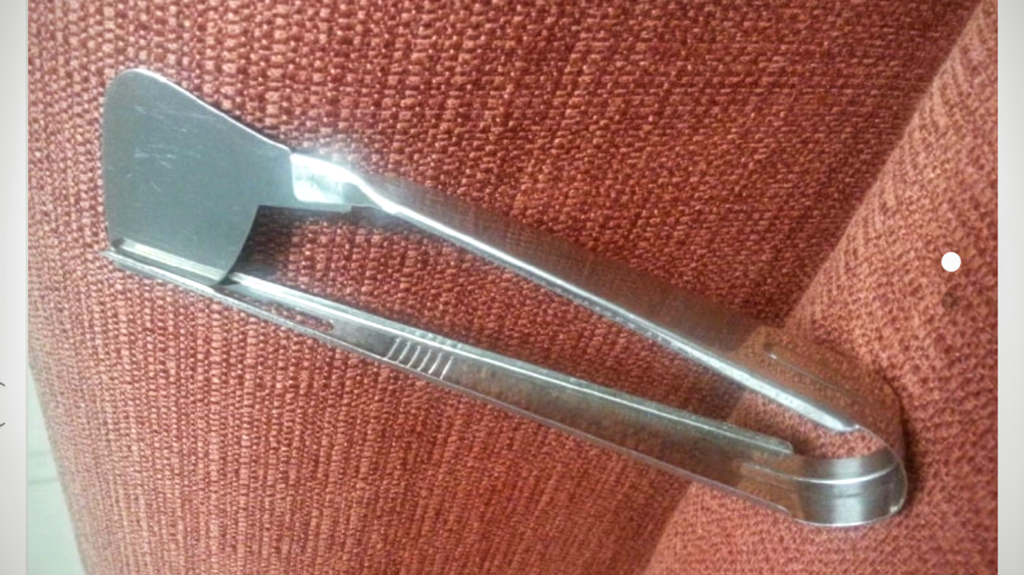
My wife and I were cleaning out the kitchen a few weeks ago when we came across a rather strange-looking device. It could be described as a combination between a small pair of metal tongs and some kind of slicer. We racked our brains trying to figure out what it was for.  Eggs?  Nuts?  Ice?  Bewildered, we wondered if it even belonged in the kitchen.

I showed our gadget to a couple of friends but they were as confounded as I was.  Then I turned it over to my ever-resourceful sister-in-law. She took it to a a couple of kitchen stores and asked several friends, all to no avail. Finally she showed the device to her hair stylist – who sent a phone video to his girlfriend – and voila! – mystery solved.  Turns out our little mechanical metal friend is a butter cutter.

I don’t blame you if you’re still confused.  Not only did I wonder why (as in, why do you need a butter cutter?) or how (as in, how do you use the darned thing?), but also when (as in, when did people ever use one of these?).

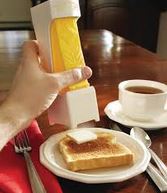
I’ll get to the why in a minute.  As for the how, a butter cutter is used by holding the blade perpendicular to a stick of butter, pressing the base down into the stick, then pushing down on the blade.  The push down and spring back of the blade produces the “pat” of butter you sometimes get with a dinner roll at restaurants.  Move on down the stick and you can churn out butter pats to your heart’s content.

As for the when, it turns out our butter cutter is vintage.  It was popular back in the 1950’s.  If you simply must have one for your kitchen, go here.  But my research also led me to ask which, as in which one?  It turns out there are several butter cutters for your consideration:

61-vintage-2Here’s another vintage model – a bunch of pats all at once!

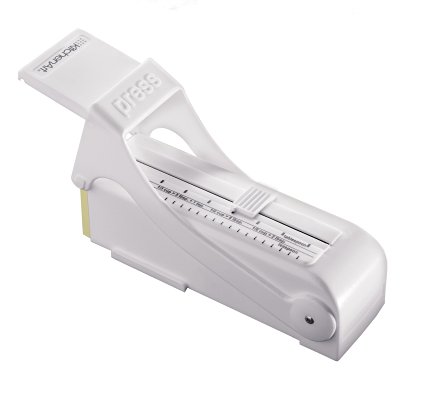
     61-vintage-3        An updated model – regurgitates pats one at a time.

61-vintage-4The Rolls-Royce of cutters.  How thick do you like your pats?

   61-vintage-5      No comment.  This one is simply disgusting.

Remarkably, there are lots of butter cutters out there if you search long enough.  Some claim to also work on rolls of cookie dough.  Others claim to also cut potatoes into chips.  But the more models you find, the more you’re inclined to ask why?  Why go to so much trouble to cut butter when a perfectly ordinary kitchen knife will do just fine (and with far less mess?).  That earth-shattering question is actually covered at unclutterer.com, a blog about “getting and staying organized”.  Check out the hot debate and the wealth of reader comments here (from people who clearly have too much time on their hands).

My own take on why is more satisfying.  The more I thought about our butter cutter, the more I realized I probably inherited it from my mother.  Along with other kitchen items, she probably tossed it into a box as I was heading off to my first apartment so many years ago.  And thinking about it even more, I can picture my mother using her butter cutter when I was a kid, leaving a perfect little pat beside the crescent roll that was positioned carefully on the bread plate beside each place setting at the dinner table.  Because that was my mother.  She was all about the dinner table.  Everything had its place, even the pats of butter.  And there’s an element of grace that comes with the butter cutter that would not be found in simply using a knife.

Laugh at the pointlessness of a butter cutter if you must.  But I will cherish mine instead, as well as the vintage memories that spring back every time I use it.

Fallen Arches

We have a McDonald’s in the middle of our small Colorado town.  The restaurant has been expanded over the years, to include double wrap-around drive-thru lanes and a “PlayPlace” for the kids.  At some point in time, demand pushed the hours of operation to 7/24.  So imagine my surprise last Saturday night around 6:30pm, when I passed by and didn’t see a single car – not one! – in either of the drive-thru lanes.  Apparently my town is not “lovin’ it” so much these days.

44 - venerable

The truth is, the fast food times they are a-changin’ and McDonald’s is struggling to move on from its burger-n-fries roots.  It’s hard enough to compete with the Panera’s and Chipotle’s and other “healthy” alternatives.  In this game, McDonald’s is either venerable or outdated – take your pick.

Growing up in California, the go-to fast-food restaurants were McDonald’s, Jack-in-the-Box, and Kentucky Fried Chicken.  Not many weeks went by where my family didn’t make it to at least one of the three.  In high school, my brother and I worked in a McDonald’s that drew busloads of patrons from the nearby interstate, and hundreds more from the adjacent movie theater.  The lines to the counter would stretch into the seating area; a fury of a demand for fast-food.  But my how times have changed.  A few weeks ago I was shocked to discover another neighborhood McDonald’s had closed down completely.  That’s no one-off; McDonald’s is shutting down hundreds of restaurants across the globe as part of a renewed corporate strategy.

I never thought I’d see the day where I question the long-term future of McDonald’s.  Health magazine recently published a list of “America’s Top Ten Healthiest Fast Food Restaurants” – http://www.health.com/health/gallery/0,,20435301,00.html – and McDonald’s lands comfortably at #8.  Dig deeper however and you’ll find the telling comment: “although McDonald’s made our list, this is still the land of supersizing and giant sodas.”

McDonald’s is trying new approaches to gain market share, and I’m not just talking new menu items (although “garlic fries” are fighting for a spot).  In several of its Texas restaurants, McDonald’s is testing “fresh beef” instead of the “flash frozen” it has used for decades.  McDonald’s also sponsored a nutrition push in schools, but their message of portion control couldn’t overcome their burger-and-fries stereotype, so they cancelled the program.  McDonald’s latest proposed slogan is “The Simpler the Better”, but that’s more about a streamlined menu and faster service.  It’s makeup instead of the face lift they really need.

I have a soft spot for McDonald’s because it was my first formal paycheck.  I worked the grill and dressed the burgers and wore the uniform with pride.  But I can’t tell you the last time I hit a McDonald’s drive-thru, let alone walked into the restaurant.  Even the recent “all-day breakfast” campaign isn’t bringing me back.  Yes, we all still “deserve a break today”, but it may be time to finally dim the lights on the golden arches.


Don’t Mess with Jack!

This week, the original junk food Cracker Jack introduces a new look to its packaging, and – brace yourself – no more “prize inside”.  The tiny toys synonymous with the brand since 1912 have been replaced with QR code stickers, which connect to games on your phone when scanned.  Farewell to those temporary tattoos, finger-sized comic books, and decoder rings; – another slice of Americana is gone.  Check out Facebook’s Cracker Jack page if you want a sampling of the overwhelmingly negative reaction to the news.

41 - click bait

Cracker Jack’s announcement shamelessly reduces the “toy surprise inside” to mere click bait.  Akin to so many Facebook posts, the allure of click bait is to discover the rest of the story.  In the process you get a healthy dose of advertising.  Click bait never gets my attention, nor will Cracker Jack’s QR codes.  The thrill of the prize is gone.

Cracker Jack has a special place in my heart.  My great uncle became synonymous with the treat when he showed up at family gatherings with enough boxes for his dozen grandnephews and nieces.  More significantly, I hid my wife’s engagement ring inside the prize packet of a box of Cracker Jack just before my proposal.  She used to be a Crunch ‘n Munch fan until she opened that particular “toy”.

Cracker Jack is another link to the past that has suffered never-go-back changes.  The boxes are smaller now (in fact, the latest packaging is not even a box), and the ratio of peanuts to popcorn has increased.  It’s the typical product manipulation that has you thinking you’re consuming the same thing you did ten years ago.  Like ice cream, where brands are now sold in smaller containers designed to look like the standard half-gallon.  Or fast-food “quarter-pound” burgers that are no longer as big, yet still qualify by definition.  Perhaps the most obvious example: Oreos have less filling and thinner cookies than the originals.  Ironically, today’s “Double-Stuff” are probably more like the “singles” from a generation ago.

Changes like Cracker Jack hit me hard, not only because I’m paying more for less but because the tampering seems like an injustice.  Why not keep the original and charge more?  I’d pay.  And I’m not alone.  Wikipedia claims the New York Yankees tried to replace Cracker Jack with Crunch ‘n Munch at home games ten years ago, but the public outcry forced them to switch back within a matter of days.  Don’t mess with Jack!

Speaking of baseball, Cracker Jack is immortalized in the lyrics of “Take Me Out To the Ballgame”, sung in the middle of seventh inning stretches.  I wonder if today’s generation knows what they’re singing about with “…buy me some peanuts and Cracker Jack”?  Even if they do they’re singing about a different product now, including the updated images of mascots Sailor Jack and his dog Bingo.  No doubt Cracker Jack’s founder had that in mind before he passed away in 1937.  The original Sailor Jack is carved on his tombstone.  Now there’s something they can never change.

The Meal of Champions

Last weekend my family and I had breakfast at a small place in downtown Denver called “Syrup”. Syrup’s menu includes breakfast and lunch, but make no mistake; breakfast is king here. I chose the Eggs Benedict with corned beef hash, and all of us shared the Cinnamon Roll Waffle flight – a delight to the senses.  It was a breakfast to savor.

28- breakfast

Breakfast has always been my favorite meal, or should I say breakfast “out”.  People always say “really?”, but I never hear them go on to say whether lunch or dinner is their favorite.  Lunch is the neglected and oft overlooked meal of the three – perhaps a topic of its own for a future blog.  Dinner represents 95% of what people mean when they recommend a restaurant.  Maybe that’s what makes breakfast so endearing to me.  It’s the most compact of the meals.  Breakfast has its essentials and therefore creativity can only go so far.  Dinner has no boundaries, but breakfast can go very wrong if you stray from the expected.

I’ve sampled several of the more exotic approaches to breakfast.  I’ve been to the Cafe du Monde in New Orleans for the famous coffee au lait and French-style beignets (fried dough topped with enough powdered sugar to sneeze at).  I’ve been to the little Danish town of Solvang, California for aebleskivers (pancake balls with fruit in the middle).  I’ve even toured the Kellogg’s factory in Michigan, and to this day I still can resurrect the smell of cooked corn flakes.  Put all that aside though, because breakfast for me comes down to just a few essentials on the plate.  Eggs any style.  Bacon or sausage (the requisite “protein”).  And toast or some other form of carb load.  At breakfast “out” the eggs may become an omelet or a skillet or a scramble.  The bacon may be applewood-smoked and the sausage will have a hint of sage.  The toast usually runs a distant second to a freshly-made waffle or fruit-topped pancake.  But dress it down and the plate looks pretty much the same as what I prepare for myself at home.

I like breakfast because I’m a morning person (though not one of those restless souls who make it to 5am yoga).  I also like breakfast because virtually everything on the menu appeals to me.  Except bananas.  If I ever opened a breakfast place you’d have to bring your own bananas.

Sunday brunch is not only a favorite meal but a favorite activity.  I associate Sunday brunch with family and with special occasions like Easter and Mother’s Day.  I love dressing up for church and going to brunch after the service.  I love the serve-yourself aspect of brunch – the more options to savor the better.  But the “unch” in brunch gets no love from me.  As my family will attest to, my plate is always 100% breakfast.

I never understood the term “American breakfast” until college, when I spent a year abroad in Rome.  I love the Italians and their “dolce vita” way of life.  They perfected the coffee bar concept long before it became a staple in America.  But they never gave breakfast it’s proper due.  Indeed, “breakfast” in Italy is a small cup of espresso and a hard, barely-sweet roll, downed hastily at the counter before rushing off to wherever it is one is going.  No eggs or bacon or pancakes.  What’s the fun in that?

In Ireland breakfast essentials include tomatoes and blood sausage.  I can’t come to terms with vegetables for breakfast, and blood sausage shouldn’t even be mentioned in a post about breakfast.  Again, no fun on that plate.

Here’s an example of breakfast fun.  In the classic movie Chitty Chitty Bang Bang my favorite scene is with the breakfast machine.  Dick Van Dyke’s character creates the magical car of course, but he also creates a contraption that cooks and distributes eggs, sausage, and toast, all while the breakfast plate moves along a heated track, eventually rolling down to the table ready to eat.  Genius.

Breakfast places – at least in Colorado – are a born-again trend these days.  Rather than Denny’s or Waffle House we now choose from “Over Easy” or “Snooze” or “The Egg & I”.  And in the ultimate nod to my favorite meal, McDonald’s recently changed their menu to include All Day Breakfast.  I think McDonald’s gets my drift.  Breakfast is not just “the most important meal of the day”.  It’s the one that should be on the menu morning, noon, and night.

copious

Ricky Gervais, the English comedian, once said, “the only reason I work out is to live longer so I can eat more cheese and drink more wine.”  Maybe he was thinking about me when he came up with that one.  I like a glass of wine, but my love of cheese borders on the unhealthy.  Every time I pose for the camera and “say cheese!”, I’m salivating instead of smiling.  I must be part mouse.

23 - copious

Cheese came into my life at an early age; probably true for most of us.  A kid’s meal was a single slice of Kraft cheese sandwiched between two pieces of Wonder bread, mayonnaise or Miracle Whip for the glue.  The cheese was technically “pasteurized processed cheese product” – infused with enough preservatives to sit in the frig for a decade and still taste the same.  Like margarine.  Or Twinkies.

By middle school I was making my own cheese sandwiches, with real cheddar cut straight from the brick.  You could make the slices as thick as you wanted, and it was a great excuse to wield one of Mom’s biggest kitchen knives.  One time though, the knife slipped from the cheese to the knuckle of my ring finger and the result was a small scar I still carry to this day.  It’s like my little badge of courage, only for cheese.

When I discovered the wonders of grilled cheese, there was no turning back.  We had this little cast-iron sandwich maker (the precursor to the panini press, I suppose) that would imprint a clam shell on the bread as it grilled the sandwich.  Like I cared about an imprint, but it was a convenient excuse to crank out dozens of grilled cheese sandwiches.

Eventually I was adding Monterey Jack to my omelets, a spicy Mexican blend to my quesadillas, and handfuls of Mozzarella to my homemade pizzas.  I was consuming copious amounts of queso.  Cheese became its own level on my personal food pyramid.

Several years ago, in a particularly cruel twist of fate, I developed what I think was an allergy to cheese.  Every time I ate a little Swiss or Ricotta my lips would puff up to the point where they didn’t look like lips anymore.  Picture a blowfish minus the gills.  No amount of antihistamines would bring me back to normal.  It was like God waving a big white flag and saying “Dave, the (cheese) party is OVER!”  Mercifully, the allergy went away and my cheese consumption returned to its previously unhealthy levels.

Trivia time-out: If you sample every variety of cheese ever made – one a day – it would take you more than five years to get through them all.  Dang.  My lips would explode.

My taste for cheese has become more refined in recent years.  I actually sort through and sample all those little blocks you find at your supermarket deli.  I’ll pair my cheeses with a nice wine for an overly elegant appetizer.

On a recent trip to Estonia, my wife and I visited a small dairy farm that specializes in cheese and yogurt production (our tour guide was appropriately nicknamed “cheese angel”).  We bought an entire wheel of Gouda, just because I thought it was cool to have a “wheel” of anything.  Shreds and slices, blocks and bricks; now entire wheels of cheese.

The U.S. is the world’s leader in cheese production, at more than 5,700,000 tons per year.  You could pave a very long, very wide, yellow-bricked road to Oz with all that Provolone.  I’d call us the “big cheese” of the world’s producers, wouldn’t you?  Speaking of the U.S., Vermont has what may be the country’s only “cheese trail”.  40 dairy farms and cheese factories are networked on a back-country circuit of highways that covers most of the state.  Many farms operate on an honor system, with free samples and help-yourself purchases.  I need to go to Vermont.  Tomorrow.

If I’m looking for an excuse to continue my copious consumption, they say cheddar, Mozzarella, and some varieties of Swiss and American help prevent tooth decay.  But they also say without your gall bladder you’ll have a hard time digesting fats (like cheese).  So I need to take care of that little guy.  And there’s my reason to work out.

connoisseur

I love licorice.  It is hands down my favorite choice from any aisle, bag, box or bin in the candy store.  A lot of people love chocolate and so do I, but it’s not even a close second to licorice in my book.  Furthermore, I have a lifetime of experiences with licorice to where I am a practiced judge when it comes to flavors, textures, and brands.  Red or black, sweet or salty, soft or hard, domestic or imported.  I am a connoisseur of this unique confection.

photo - licorice

I was tastefully (ha) reminded of my licorice obsession this past Christmas.  My son and his wife gave me a Santa’s bag worth of the black and red (and yellow, green, and orange).  There were over twenty flavors, brands and colors in the bag.  For most people this would be a year’s worth of satisfaction.  For me, I’ve made a pretty good dent after just three months.  I’ll probably be looking to replenish my stash sometime this summer.

Licorice has come a long way since my childhood years.  My dad also had an affection (confection?) for licorice and he introduced me to a hard chewy black button known as the “Heide”, from the Henry Heide candy company.  To this day, the Heide is still my favorite licorice.  Years ago Heide was snapped up by a bigger candy manufacturer.  Before they were, I wrote them a letter and expressed my appreciation for their wonderful licorice products.  In return they sent me a generous box of samples and a small book that told the story of their product.  I wonder if companies still make that gesture today when they hear from their satisfied consumers.

Inevitably I get the question “red” or “black”?  Until recently I gave a rather smug answer, saying “black” is the only real licorice by definition.  Then I discovered the product of a small New Zealand company, through my local natural foods store.  Their soft, red raspberry licorice knocked me over; so much so that I sent my dad a bag.  It’s made from organic ingredients local to New Zealand, with a full-bodied fruity taste (no, I’m not talking about wine).  Isn’t it a wonder a product so unique and captivating can travel halfway around the world to the shelves of my local organic grocery?  Life is good.

I have several childhood memories of licorice.  Heide made other licorice-like products, including Jujubes, Jujyfruits, and Red Hot Dollars.  “Switzer’s” was a common brand years ago with a twist product similar to today’s “Twizzlers” or “Red Vines”.  Finally, I know I’ve eaten miles of “shoelaces” – the kind of licorice that some would call edible phone cable.

Here’s a fact that’s probably true of a lot of candies.  A generation or more ago licorice was made with “real” ingredients.  Even inside of the harsh plastic wrapper, you would find some derivative of licorice root in the ingredient list.  Then a really smart food chemist came along and figured out how to imitate for cheaper.  Any connection to real licorice disappeared, at least in this country.  But in the last few years I think we’re getting back to where we belong.  Whole organic foods are becoming the norm.  Even prepared foods, like my New Zealand brand licorice, are made from raw, natural, healthy ingredients.  For that reason, I will continue to be a connoisseur of the world’s brands of true licorice.  The next generation can have their Red Vines.