Tricks of the Trader

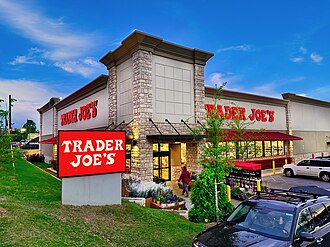
Our town, like so many others, offers the choice of grocery shopping at a national-brand market or at one with a more local vibe. We spend our dollars at Publix (1,300 stores across eight Southeastern states) but also splurge at The Fresh Market (161 stores) when we’re after something a little more unique. Having said that, our town lacks another popular market and it begs the question: What is the appeal of Trader Joe’s?

Chattanooga, TN

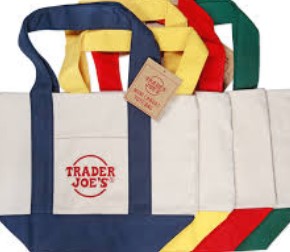
This post was originally headed in a different direction.  Trader Joe’s made the headlines because of its popular cloth “mini-tote” bags; so popular they were reselling on eBay for $500.  That led me to think, America has an obsession with miniatures and let’s make that today’s topic.  But no, I can’t get Trader Joe’s itself out of my mind, so let’s walk through their aisles for a few minutes.

Very popular!

The cloth bags are a great place to start.  Did you know Trader Joe’s was the first grocer to offer reusable shopping bags, beginning in 1977?  The trend didn’t catch on with other stores for another fifteen years.  Even better, “TJ’s” encourages use by refunding you $0.05 per bag or entry into a weekly raffle for a $25 gift card.

The above paragraph was brought to you by the food-and-drink enthusiast website Tasting Table.  Their 25 Facts About Trader Joe’s… is a convincing sell, maybe getting you to dash over to your nearest TJ’s for a look inside.  But a company’s commitment to sustainability isn’t enough to draw me in over and over.  There must be something else at play.

Maybe it’s more about TJ’s “revolving door of new products”.  They frequently discontinue one product in favor of another, so what you find on the shelves is constantly changing.  They limit certain items to seasons (right now you’ll find pumpkin-spice everything).  And their product line is impressively diverse for a medium-sized grocery store, which probably attracts more than your run-of-the-mill shopper.

I suppose you could make the same argument for a restaurant.  Shaking up the menu is a good idea every now and then (hence “specials”).  Leave the core set of entrees alone but occasionally introduce new ones to see if they’ll take.  Yet it’s not a perfect analogy for Trader Joe’s.  My impression is, nothing on TJ’s shelves is safe for the long haul because all products are under constant scrutiny.

How about “affordable prices”?  Here’s where I take my hat off to TJ’s.  The advertised price of a given product at Trader Joe’s is the one-and-only price.  No discounts, coupons, gift card offers, special promotions, or even online ordering to cloud the cost to the consumer.  And since 80% of what TJ’s sells can only be purchased at their stores, price-shopping the competition is a waste of time.

Stuffed animals are hiding at TJ’s

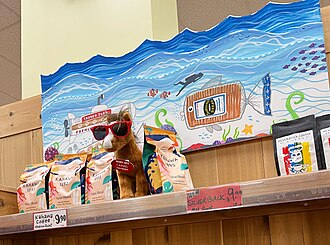
TJ’s probably draws in young families because the shopping experience is fun.  The nautical theme is apparent in its decor, as well as on its “crew member” uniforms.  A stuffed animal hides somewhere in the store – find it and win a prize.  And a bell rings (again, the nautical thing) to alert employees to open new check-out lines or answer customer questions.  I like that approach a whole lot more than simply announcing the need over a loudspeaker.

You can try a lot of things at Trader Joe’s (Costco on steroids?), you can call the store ahead of time to reserve popular items, and you can usually get a refund on anything you regret buying (regardless of reason, proof of purchase, or the amount of the product you’ve consumed).  What I highlight in italics here is impressive for a grocery store yes, but it still doesn’t make me a return customer.

At the end of the day (or a list of “25 Facts…”) I go to a grocery store because it carries the items I need.  To put it another way, I am brand-loyal and fairly routine in what I buy.  Perhaps that is the genius of Trader Joe’s.  It draws people in again and again because, well, they want to be more creative in the kitchen.  Try out new things.  Emerge from the doldrums of the same thing on their plates every other week.  And who can argue with variety as the spice of life?

Oakland, CA

Maybe, collectively, 25 facts explain Trader Joe’s success.  Or maybe someone from out West will chime in and solve the mystery.  After all, California was the birthplace of Trader Joe’s (Pasadena), and the number of stores in the state has ballooned to over 200.  There should be plenty of TJ’s experts out there to explain what the fuss – er, repeat business is all about.  Then, just then, I might get into my car to drive the hour and change it’ll take me to get to my nearest location.

Some content sourced from Wikipedia, “the free encyclopedia”.

Keeping Score at the Grocery Store

In the chaos of the supermarket a few days before Christmas, milk, eggnog, and a package of those Li’l Smokies sausages fell into our shopping cart. These items don’t usually find their way into our frig but the year-end holiday meals somehow demanded them. If the market wasn’t so frantic I would’ve also whipped out my phone to see if these purchases deserved my dollars. After all, just about everything we use in the kitchen (and bathroom) these days has a little numeric value lurking just below the surface.

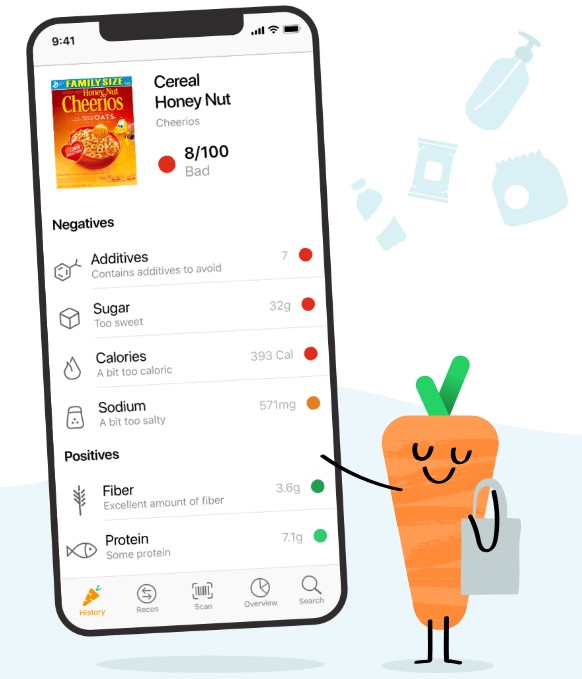
Nacho Cheese Doritos are now a “5” in my world.  You might say pretty good! until I tell you that’s on a scale of 1-100.  But let’s say you choose Blue Diamond’s Almond Nut-Thin Crackers instead.  The number skyrockets to 84.  A roll of Wint-O-Green Life Savers earns a 28 while a box of Tic Tac Freshmints doubles the number.  Nature Valley Granola Bars? 51. Heinz Ketchup? 33.  And in the ultimate insult to products considered “food”, perfectly round Nabisco Oreos earn a perfectly round 0/100.

What’s with all the tallying, you ask?  The numbers are simply the output of a little smartphone app called Yuka, which joined my personal parade of subscriptions last May.  In the words of its young French founders (Julie, and brothers Francois and Benoît), Yuka “deciphers product labels and analyzes the health benefits of foods and cosmetics”.  Plain English: Scan the barcode of anything in the supermarket and Yuka tells you whether to buy it or not.

Candidly, it wasn’t the numbers that sold me on Yuka.  Rather it’s this: the app is completely ad-free because brands cannot pay Yuka to advertise their products.  In other words, the numerical ratings I’ve shared are generated objectively, using common perceptions of the health benefits of ingredients.  Yuka has rocked the small space known as my kitchen pantry.

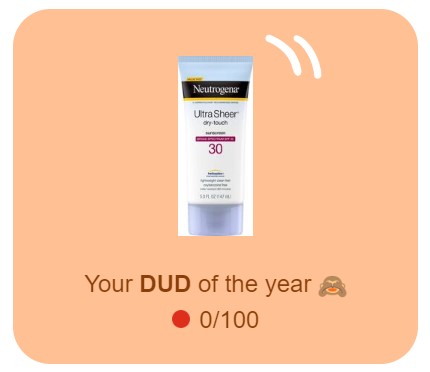
Never is this overhaul more evident than with “cosmetics”, Yuka’s catch-all for everything you find in the bathroom.  In the last eight months I’ve swapped out my deodorant, mouthwash, shaving cream, shampoo, and face wash for items with better Yuka numbers.  Five products I used every day and purchased for years just went flying off my medicine cabinet shelves, replaced by other products that are healthier on and in me (including Aveeno’s facial cleanser, which earns a perfect 100).

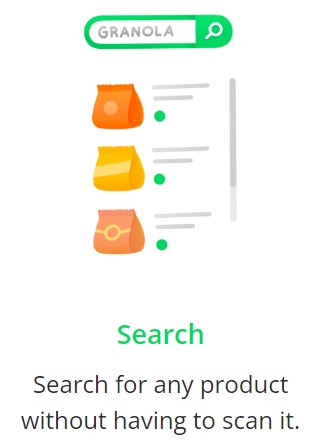
Yuka (the name is a nod to Yucatán) is about more than scan-and-score.  You can also simply search on products, mining a database of five million entries.  Even if a product isn’t in the database you can enter the ingredients from the label and Yuka will give it a number.  And if that number is lousy (like it is for your Oreos or my L’il Smokies) Yuka will point you to a list of alternatives with better numbers.  Again, Yuka doesn’t recommend one product over another; it just presents the numbers for you to consider.

In a nod to the healthy habits of Europeans (who favor fresh foods), Yuka’s founders realized its app was most popular in America, where we are so fond of packaged products.  So they packed up their French offices and French families and moved to the middle of Manhattan – temporarily – to better connect with their target audience.  Eventually they’ll head back home but not before Yuka is sure to land on the smartphones of millions of Americans.

Here’s one more aspect of Yuka I appreciate: the founders take time to communicate with their users.  In the eight months I’ve subscribed, they’ve sent me twelve emails with interesting articles about healthy eating, healthy “cosmetics”, and the entertaining evolution of their little company (which includes a dog as an employee).  They also sent me a fun video of their first few days in New York City.  And just last week I received a year-end recap of my app use (93 products scanned with an average score of 46).  No advertisements and no product pushes.

The subscriber version of Yuka is $15/year (you can try a more limited version for free), which includes the convenient scan-for-a-score feature.  Furthermore, your subscription dollars are what keeps Yuka in business, instead of funding manufacturers who’d like nothing more than to push their products on you.  That’s just one of the reasons I now keep score at the grocery store.

Shelf Life

The rural neighborhood I live in hosts a Nextdoor electronic newsletter, allowing residents to post online for all sorts of reasons. (Loose animals are a frequent topic.) Today, however, one thoughtful neighbor said to look beyond first responders and hospital staff for a moment and acknowledge other workers deserving of the spotlight: grocery store employees. Talk about people we take for granted. After all, they’re keeping an eye on 20,000 different products on the shelves of the average U.S. supermarket.

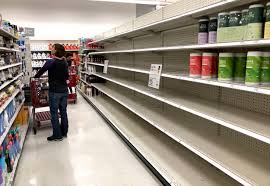
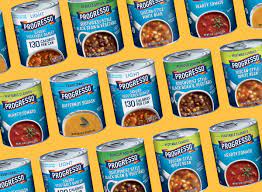
I had to double-check that number to believe what I was reading.  Nielsen, the research and ratings firm not only confirmed the number but said U.S. grocery stores experienced a 4.5% decline in 2020 (so more like 18,000 products).  Shouldn’t surprise us, especially with global supply chain interruptions.  And it’s easy to remember the most popular products missing in action.  Bath tissue, cleaning wipes, and canned soup, for example.  Others however, you probably didn’t notice.  Bumble Bee, the tuna maker, reduced its product count from 300 to 225.  Progresso Soup (a personal favorite), dropped its canned choices from 90 to 50.

Now, guess what?  Bumble Bee is not only back to its 300 products but adding new ones regularly.  Progresso is back to its ninety soups and doing the same thing.  So much for the “death of variety”, huh?  And speaking of variety, did I say ninety soups from a single manufacturer?  I’d be lucky if I could name twenty-five (“tomato”, “chicken noodle”, “clam chowder”, uh, uh…)  No wonder soup gets so much real estate on supermarket shelves.

J.M. Smucker is taking a similar tack.  They make a dozen varieties of peanut butter and two dozen more of jelly but last year you had to go without “Simply Jif”, “Reduced Fat”, and “Omega 3” versions of both.  Today, not only are their PB&J’s back but Smucker has introduced “Jif Natural Squeeze” and a smaller snack version of their popular “Uncrustables” frozen sandwiches.  It’s as if the pandemic was a small speed bump en route to ever-increasing variety.

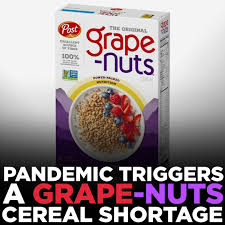
Post Grape-Nuts cereal (which earned solo attention from me in “Ever Eat a Pine Tree?“) disappeared entirely in 2020.  For a while there you couldn’t find any version of the tooth-shattering cereal on the shelves.  But now the gravel is back, and Post is making a bold move to “apologize” for last year’s inconvenience.  If you paid $10 or more for a box of Grape-Nuts from November 2020 to March 2021, Post will issue a partial refund for the “unreasonable” portion of the cost.  You need your receipt, of course.  Clever marketing there.  How many people keep their grocery store receipts from six months ago?

Speaking of bold moves, here’s one I think we should sustain; a sort of pandemic silver lining.  At many hotels “housekeeping” has been reduced to the time between stays instead of every day.  My wife and I recently spent four nights in a Marriott hotel and at no time did housekeeping enter our room.  Instead, we gathered up dirty towels and exchanged for new ones at the front desk.  We emptied our own trash.  We made the mini soap/shampoo/conditioner bottles last.  It was hardly an inconvenience.  It was also nice to know our room was undisturbed the entire time.

Similarly, dropping grocery store product totals from 20,000 to 18,000 was subtly a good thing.  We were forced to simplify our pantries and go more back-to-basics.  We cooked more.  We ate more whole foods (instead of fast foods).  Let’s hope those habits remain, even while consumer goods manufacturers crank out ever-more variety.

There’s a newish bad habit driving grocery store shelf life however; one bound to stay a while.  The percentage of snack/junk foods you’ll find is higher than pre-pandemic days.  Why?  Because working from home drives the demand.  Accordingly, you’ll find 10.9% more salty snacks on the shelves, 11.5% more energy drinks (including PepsiCo’s caffeine-laden Mountain Dew Rise), and 14.8% more pastry items.  And (most disturbingly), you’ll find 79.2% more pre-mixed cocktails.  Whoa now.  Somebody might want to post on Nextdoor for the invention of a web-based sobriety test.  They’ll make a fortune.

Some content sourced from the CNN Business article, “These foods disappeared from grocery stores last year…”, the CNN Business article, “The Grape-Nuts shortage is over…”, and Wikipedia, “the free encyclopedia”.
Meet Cute

Every now and then McDonald’s gets it right. In 1973, they introduced the Quarter-Pounder because customers demanded more than a 10 oz. patty inside of a boring bun. In 1987, McDonald’s added “PlayPlace” indoor playgrounds to suburban locations: crawl tubes, slides, and ball pits contributing to countless happy childhoods.  This year, the restaurant chain is stepping it up with its McCafé Bakery offerings. The Apple Fritter, Blueberry Muffin, and Cinnamon Roll will step back to give the spotlight to the newest McDonald’s kid on the block: the adorable Glazed Donut.

Seriously, just look at this little guy.  Isn’t he the cutest donut you’ve ever seen?  The McCafé Glazed Donut looks like a happy gathering of donut holes, all nestled up against each other for warmth and protection.  The Donut is pleasingly symmetrical.  Even the spelling is cute (instead of the more substantial “doughnut”).  And the best part: its “donettes” pull apart the way you would a hot, flaky croissant.  It’s like getting seven for the price of one.  And it’s cute to boot.

I admit I didn’t wake up this morning intending to write about cute donuts.  Even the headline about this doughnut’s upcoming debut didn’t really catch my eye.  But then I saw the photo and I was utterly smitten.  It’s the same way I felt when I first saw a package of those colorful little Plink garbage disposal cleaners.  I just had to have them.

Some would describe this as a “meet cute” moment.  Meet cute is the early-on scene in television or movies where two people connect for the first time and you just know they’re headed for romance.  The Hallmark Channel is all about meet cute.  Any scene where Hallmark movie man meets Hallmark movie woman, combined with something funny or unusual is 99% headed towards future romance.  It’s like you’re ten minutes into the story and you already know how it ends.

Plenty of “meet cute” in this one

And that’s how it’s gonna go with the McCafé Glazed Donut.  We had our meet cute this morning.  Now I have two weeks of anticipation and heart palpitations before I can actually buy one.  But I already see it.  I (almost) already taste it.  And the whole pull-apart thing?  Pure sex(y) appeal.

Meet cutes don’t always lead to predictable endings.  After the meet, the movie leads you to believe the characters are destined for romance.  But sometimes they’ll throw a curve (usually in the form of a third character) and the story goes in another direction.  Could happen with the Glazed Donut too.

Let’s use supermarkets as an example.  You stroll into the store, grab a basket, and think about your shopping list.  But before you even reach the aisles you’re greeted with front-of-store marked-down day-old doughnuts.  They’re just sitting there like little round orphans, begging you to spend another $0.69 to “adopt” one.

They’ll be front-of-store by tomorrow

So you do.  And you make sure the little guy’s placed in your basket as an easy find.  Then you slide behind the steering wheel and polish him off before you even leave the parking lot.  Tastes great, right?  Maybe now.  Later you’ll reflect on the slight, sickly feeling in the pit of your stomach and wonder why you caved.

That’s my thinking with the McCafé Glazed Donut.  I can cruise past the Fritter, Muffin, and Cinnamon Roll without so much as a passing glance.  But mark my words, next month I’ll find any excuse to be near a McDonald’s during McCafé Bakery hours.  I’ll purchase the Glazed Donut and my meet cute will blossom into a full-on romance. When I consider the Protein Shake I have most mornings, I’ll feel like I’m about to cheat on my mainstay.  Heck, this scandal could go viral! I see the headline now: Man Opts for Sweet & Sexy over Cold & Icy.  But can you blame me?  My Protein Shake really IS cold and icy, and there’s nothing satisfyingly pull-apart about it at all.  Meanwhile a small, soft, almost UFO-looking donut beckons.

Forgive me, my beautiful, healthy breakfast-in-a-cup.  Looks like I’m gonna stray.

Some content sourced from the CNN.com article, “McDonald’s is adding a sweet new treat for fall”, and Wikipedia, “the free encyclopedia”.