Ellen Makes Her Move

When we moved into our current house (and even the one before it), we made the classic mistake of saying, “We’re never moving again”.  After all, picking up and going from one place to the next can be a real pain in the you-know-what, especially with pets and vehicles to relocate on top of the furniture and clothes. But at least we’re only talking about moving houses. What if you had to move an entire town?

Ellenton, SC

If you live in an RV or a tiny home, you’d think nothing of pulling up stakes and going somewhere else.  You have the wheels or the flatbed to make it happen.  But moving an entire town means a population of people and a collection of structures.  it sounds like something that could only happen on a Hollywood movie set.  Unless you’re the U.S. government with its sights set on Ellenton, South Carolina.

Ellenton train depot

Ellenton first appeared on a map the way a lot of small towns did back in the day.  The railroad was interested in running new tracks through the farms of the area and a deal was made to acquire the land, including a plot for the train station.  In Ellenton’s case, the railroad developer was smitten with the primary landowner’s daughter (Ellen).  The relationship never blossomed but he did name the budding town after her.  Thus we have “Ellen’s Town”, shortened to “Ellenton”.
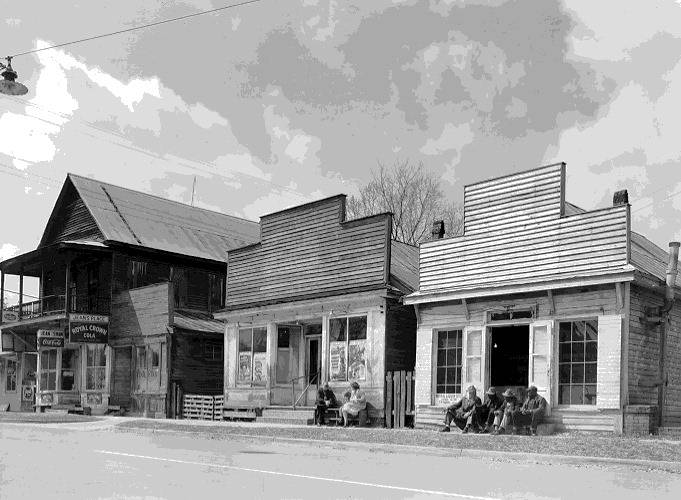
Ellenton grew quickly in the late 1800s, from a host of agricultural productions to a working, living community of 600 residents.  Eventually you’d find churches, schools, a post office, a general store, a dairy, and even a milling company and a cotton gin.  But what nobody saw coming was the potential of the area for the construction of a massive facility know as the Savannah River Site (SRS).  In the 1950’s in Cold War America, the U.S. government decided Ellenton and its surrounds were the perfect riverside location for plutonium and tritium production, for the development of the hydrogen bomb.  Ellenton “won the lottery” over a hundred other locations.
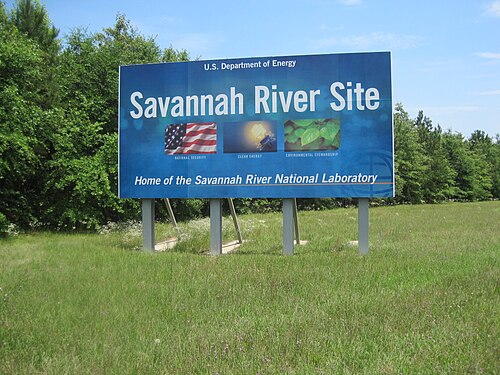
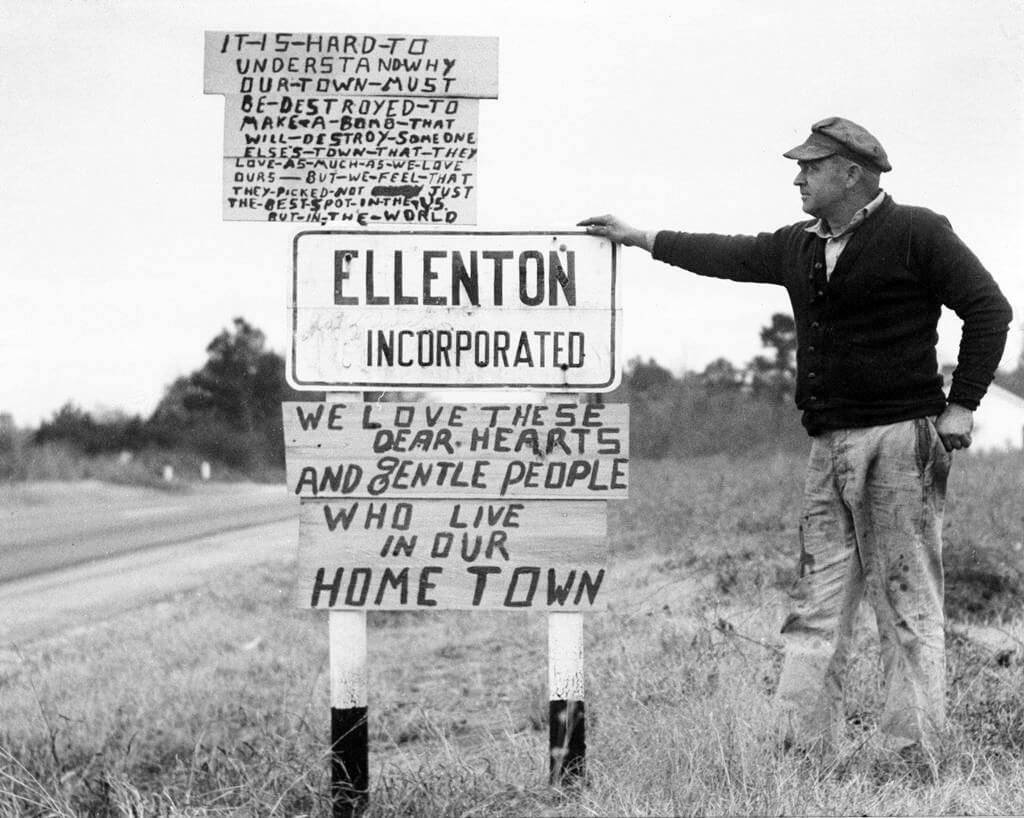
I can’t imagine sitting in Ellenton’s town hall back when the announcement was made.  Someone who drew a very short straw had to stand in front of the residents and say, “Sorry folks, we’re going to tear down your town so we need you to find somewhere else to live”.  Then the government wrote checks for the properties and businesses and simply walked away.  Eminent domain in capital letters.
I’ll admit I thought the government really did move Ellenton to another location.  I pictured a cartoon image of the world’s largest spatula, sliding under Ellenton’s streets and buildings like an entire sheet cake, then dropping the whole mess several miles away.  But I really thought the government moved Ellenton because we live right down the street from a town called New Ellenton.  Turns out, New Ellenton is simply where a good chunk of the original residents chose to call home.  The government had nothing to do with it.

Maybe the government didn’t move the living but the law required they move the dead.  By the time Ellenton and several other small towns were acquired and shut down, the SRS property encompassed 310 square miles.  That meant the relocation of 130 cemeteries, amounting to over 6,000 grave sites.  They didn’t get every last one, so it’s fair to say old Ellenton still has a few residents.

The black-and-white photos I share here – from the Ellenton website – give the town a charming, old-timey feel.  The few residents alive today hold reunions to share the memories of a place they can no longer see or even visit.  Some of Ellenton’s stories make it sound very cozy.  I wish I could say the same about New Ellenton, which is nothing more than a couple miles of highway with gas stations and bars scattered on either side.  Frankly, the only reason you drive through New Ellenton is because you’re on your way to somewhere else.

I wouldn’t be nostalgic for Ellenton if the government didn’t make it disappear.  Kind of reminds me of Brigadoon, the Scottish village that magically appeared out of the mist every hundred years.  Maybe Ellenton will appear out of a nuclear winter on the hundredth anniversary of it’s own demise.  In the meantime, a songwriter captured the story of the town in a rather sad ballad.  “The Death of Ellenton” was never a big hit, but the town it celebrates sure took one.

Some content sourced from the WJBF website article, “Hometown History: The Forgotten Town of Ellenton”; the Ellenton SC website (including all photographs); and Wikipedia, “the free encyclopedia”.

Tripping on Trips

I should pay more attention to the actual cost of things. A movie ticket is fifteen dollars… until you add in concessions, preferred seating, and online processing. A dinner out can be reasonable… until you add in the taxes and tip. And rental car companies add so many fees to the base rate it’s like you’ve just been bumped to a new tax bracket. With that in mind let’s visit the airport today, or more specifically, getting to the airport.

How do I get here?

Flying is expensive; always has been.  But it’s easy to overlook the cost of the airport itself.  Maybe you already know, a portion of the ticket you just bought goes to a landing fee (LF) – what the airline pays the airport for the privilege of pulling up to the gate.  Maybe you also know another portion goes to a passenger facility charge (PFC), which supposedly goes to improvement projects in the name of airport safety and security.

I don’t trust PFCs.  I think they really go to things like art exhibits, children’s play areas, pet relief areas, and smoking lounges.  I mean really, how much less would that plane ticket be if all you had for an airport was a ticket counter, some security and restrooms, and a gate to board your plane? 

You pay dearly for this space

The airport needs more than LF’s and PFC’s to pay its bills, of course.  It’s the reason you pay so much for parking.  I mean, think about it.  Once the parking garage is built it requires little to operate.  Mechanical systems and a few employee salaries yes, but certainly nothing in the neighborhood of say, $30/car/day.  Which brings me to my current conundrum.

By taxi? Cost-prohibitive

Most of you don’t have the following challenge.  When you fly, you’re close enough to the airport to where you can get a ride from a friend or take mass transit.  Me?  I have a choice of three major airports here in the South… but each of them is a two to three hour drive from my house.  Which begs the question, how does Dave get from his house to the airport and back for the least amount of money?

  1. Simple but Expensive.  Dave drives his car to the airport, parks, and drives his car back to his house after he gets back.  Works for short trips but what if I’m gone for three weeks (starting next Saturday)?  Parking at Atlanta-Hartsfield is $30/day (and that’s long-term). Throw in a tank of gas for the car and I’m north of $700 just for the airport to/from.
  2. Simpler but Even More Expensive.  This idea unexpectedly sent me in the wrong direction (financial, not travel).  I put in for a quote for car and driver from a service right here in our little town.  They got back to me almost immediately.  Little did I know my car is a limo and my driver wears a tuxedo.  My wife and I can “sit back and enjoy their ride” for $520 each way.  Gratuity not included.
  3. Slightly Less Expensive.  Here’s a fun option/comparison.  Drive to nearby (tiny) Augusta Regional Airport and fly to Atlanta.  The two round trip tickets plus parking?  Less than the cost of the drive and parking at Atlanta. If flights out of Augusta were ever on time I might actually consider it.
  4. Clever But… Drive to nearby (tiny) Augusta Regional Airport, rent a car, drive to Atlanta, and return the car.  Repeat the procedure in reverse when I return.  No.  The rental car companies want $300+ for Augusta to Atlanta.  Multiply that by two to get back home.
    By shuttle? “Cozy”
  5. Less Expensive but More Cozy.  We have shuttle services nearby; van companies where you share the ride to the airport with strangers.  $200 gets us the trip to Atlanta and back.  Okay, but now we’re driving our car just to get driven by a van just to get flown in a plane.  Seems like a lot.  And you leave when the shuttle service says you leave; not when you really want to.

Five solutions in and I still haven’t made it to Atlanta with any sense of fiscal satisfaction.  I’m starting to think I should just skip the airplane and drive all the way to our destination.  Or ride my bike with a pile of luggage on my back.  But wait!  There’s always 6. Entirely Less Expensive.  Convince local son-in-law to drive us to Atlanta (and back).  He can’t charge me more than the options I presented here, can he?  Er, not if he doesn’t read this blog post first.  I better call him… stat.

Here’s What’s Bugging Me

In the years we raised our family in Colorado we made a lot of friends and acquaintances… but none of them were bugs. Actually that’s not true; every now and then a spider would introduce itself; somehow enduring the region’s high altitude and low oxygen. But the other 99.9% of the world’s insect population flew south for the winter… and stayed there. Or rather, here. Right here on the property where we now live.  On that not-so-exaggerated claim let’s you and I make a deal.  I’ll happily take all of your cicadas, wasps, and fire ants in exchange for my countless gnats.

You-see-um?

A gnat may be the most annoying living thing you’ll ever encounter, (including every last one of your family members).  Anyone who’s experienced an out-of-nowhere cloud of these little dive-bombers knows what I’m talking about.  Gnats are so tiny instead of “now you see ’em, now you don’t” you just say no-see-um.  Gnats are so whiny you’ll swear your ears are being perforated by dozens of microscopic dentist drills.  Finally, gnats have such a sense of smell that once you give off your particular scent (i.e. sweat) they’ll happily follow you to the ends of the earth.

Here’s what a gnat looks like (blown up a million, billion times).  I’m not surprised to see they’re a relatively simple-looking creature.  After all, there can’t be much to something beyond microscopic.  In all fairness, a gnat’s virtual invisibility has to do with a preference for shade, nighttime hours and things that grow.  At least that’s my experience.  I’m out there walking the dog on a humid summer evening and it’s as quiet as the “g” in gnat.  Suddenly the little air force shows up out of nowhere and for the rest of the walk you’re swatting your head every time you hear a dentist drill.  And it’s not like you kill gnats with your swats (or maybe you do but they’re so small you have no idea if you did, so why bother?)

Entering this third summer of my newfound cloud of Southern friends, I decided it was time to go on the offensive.  My wife bought a stack of human-head sized mosquito nets.  These nets work great in that you’ll no longer feel that slightest of sensations when a gnat lands on your ear.  But the little sand grains still knock-knock-knock on the net with their dentist-drill buzzes.  You still swat and you still no-see-um.  Not to mention, a sweaty mosquito net is really uncomfortable.

A month or so ago we were at our local farm supply and came across this product at check-out.  The cashier was all about it, so I figured I’d give it a try.  Gnats don’t like particular botanicals: citronella, lemongrass, rosemary, and geranium, and No Natz has them all in a nice little spray cocktail.  Darned if the stuff doesn’t work!  You put it on like sunscreen, you smell like an entire can of Lemon Pledge, but the gnats keep their distance.  For a little while anyway.  Eventually you sweat off the No Natz and then it’s “mo natz” all over again.

Flower power

I might have to try a batch of pyrethrins instead (my new favorite word). Pyrethrins are compounds found in chrysanthemums which, conveniently, target the nervous system of a gnat.  Gets at ’em from the inside out.  The idea of a gnat spiraling out of control like a wounded helicopter is entirely appealing in my present state of mind.

Per Wikipedia, there is “no scientific consensus on what constitutes a gnat”.  Whichever ones are my new best friends here are harmless because they just buzz around your eyes and ears making their dentist-drill noises.  Other varieties prefer biting and blood so I guess I should be grateful.  Doesn’t make “Gnatus South Carolinus” any less annoying.

Maybe subscribing to the alleged origin of “no-see-um” will put me out of my misery.  The word is rooted in skeptical theism.  That is, if a human (me) thinks hard enough about a given thing (gnat) and can’t come up with a single God-justifying reason for permitting such an organism (nope, not one), AND considering said organism can’t be seen (they’re invisible!) then perhaps I should entertain the notion that a gnat doesn’t really exist.

Figment of my imagination?

Yes, let’s go with skeptical theism.  There aren’t any gnats in South Carolina after all (hooray!)  Ignore the previous 500+ words of this post.  My countless friends were all in my head.  Or uh, around my head?  Whatever.. guess I’m just hearing things.

Some content sourced from Wikipedia, “the free encyclopedia”.

Dead-Letter Danes

Denmark strikes me as a charming little country. It’s only half the size of South Carolina. The central town of Billund (pop. 7,300) is the birthplace of LEGO. The Little Mermaid – the famous waterfront bronze statue – honors the fairy tales of Danish author Hans Christian Andersen. And the Viking warriors of Denmark’s past seem like cartoon characters compared to today’s warmongers. Now let’s add another reason to admire the Danes. By the end of 2025 their postal service will no longer deliver the mail.

Imagine walking out to your mailbox, dropping down the little door, and finding… nothing.  Do you really have to imagine it?  I can’t remember the last time my mailbox contained anything worth putting my hands on.  It’s a daily pity-party pile in there: postcard ads, clothing catalogs, and random solicitations addressed to “Resident”.  Christmas, birthday, and occasional thank-you cards are about the only personal touch we’re giving USPS anymore, and I speak as a baby boomer.  The younger generations click keys instead of lick stamps.

Denmark discovered the obvious.  Since Y2K their personal mail volume has dropped 90%.  It’s pretty much the same as removing eleven eggs from the box of twelve.  You used to deliver a dozen but now you deliver just one.  Denmark’s Postal Service has been around for over 400 years so understandably a few of its citizens – seniors in particular – are upset about the quit.  But are they really happy to pay 29 Danish krone (about $4.20) to mail a letter somewhere within their tiny country?  That cost would have me turning to email as well.

Let’s put a “stop” to this

Denmark is already beginning to remove its 1,500 public mailboxes, which got me to thinking.  What will the U.S. do with all of our own mailboxes when our time comes?  We have tons of the free-standing blue ones, where you pull open the door and drop in a letter.  By my (questionable) math, since Denmark is half the size of South Carolina, and South Carolina is only 1% of the U.S. geography, we could have over 300,000 of these dead-weights just taking up space.

And what about the mailbox in front of your house?  Remove it from its stand and then what? Oversized breadbox for the kitchen?  Storage for a stack of small tombstones?  Garage for Mini Cooper?  The odd shape of traditional mailboxes just makes you want to melt them down for scrap.

It’s time for the U.S. to get on board with mighty Denmark and stop delivering the mail.  UPS, FedEx, Amazon and a host of others now command package delivery.  Any bill worth paying can be settled online.  And for every twenty “circulars” my wife likes to leaf through, maybe one catches her eye with something she’d want to buy.

I can’t reconcile the fact that a letter to my niece way out in Hawaii or one to my neighbor right next door costs the same to mail: $0.73 for the first-class stamp.  Maybe it’s why USPS reported a loss of ten billion dollars in 2024 alone.  With that much red, the cost could be 29 krone (or $4.20, remember?) and it still wouldn’t make a profit.  If you ask me, removing that particular debt from the federal budget sounds as sweet as… well… a cinnamon Danish.


LEGO Notre-Dame de Paris – Update #8

(Read about the start of this “church service” in Highest Chair)

Christian hymns sometimes refer to “tearing down the walls”.  We were doing anything but tearing down at Notre-Dame de Paris today.  Bags 12, 13, and 14… of 34 bags of pieces, had us beginning to surround the nave (the main space) with walls of stone, glass, and columns galore.  The vertical construction progressed so quickly I swear I heard a parishioner cry, “Let us out!  Let us out!”

Check out all those columns in the first photo.  It’s like an army of soldiers took up residence in the cathedral, bracing themselves like Atlas for the weight of what is soon to be built above them.  It’s a wonder the congregation can move about in the sanctuary without banging into a soldier here or there.

One, two, three, four, five, six, seven

Today’s math lesson: multiples of seven.  We built seven of this or fourteen of that, or in the case of those soldier columns, twenty-eight.  And you know those Lazy Susan spinners the cake decorators use for frosting and such?  I could’ve used one today since I built a little on the north wall, then switched to the south wall, then back to the north, and so on.

Cathedral doors forthcoming

It’s a good thing I’m showing you the sanctuary looking down from above (feeling divine?)  As you can see from the west end here – where the bell towers will soon rise – we’re already pretty well buttoned up.  Settle in, all ye faithful; get comfortable.  Those walls will continue to rise up around you.

Running build time: 6 hrs. 50 min.

Total leftover pieces: 26

Some content sourced from the BBC.com article, “Denmark postal service to stop delivering letters”, and Wikipedia, “the free encyclopedia”.

Adventures in Library-ing

Early each calendar year I look back on the previous year’s expenses to discover areas in the family budget where I can trim. The price of food, gasoline, and other “have-to-have’s” always seems to go up, so I search for items that are not so “have-to-have” to balance things out. A good example is books. I read two or three a month on my Kindle e-Reader. At say, $14.99 a pop that’d be over $500 I could carve out of annual expenses… if I could only get those same books at no cost. But where-oh-where could I possibly find books for free?

You bibliophiles out there (and the rest of you, for that matter) are laughing as I’m about to describe going to the library as an adventure, but here’s the thing.  I’ve been e-reading on my Amazon Kindle for so long that the idea of holding a book and turning its pages – let alone checking one out of a library – has become, well, novel again.

I wouldn’t have reached this crossroads were it not for a particular book.  Amazon described Frank Delaney’s The Matchmaker of Kenmare just the way I’d hope: an intriguing WWII-era work of fiction.  So I went to “try a sample”(where Amazon allows you the first several pages of the book for free) and – horror of horrors – it’s not available in digital format.  WHAT?  No e-Version?  You’re saying, Amazon, I have to shell out $24.99 for the hard copy if I want to read it?

A book for $10 doesn’t make me pause but one for $25 sure does.  Hence began my library adventure.  The last time I spent meaningful time in one was in college (and I don’t want to tell you how long ago that was).  The library experience is probably different in every way now, starting online. When I “checked out” my library’s website (ha) I discovered I could get a digital library card almost immediately.  With the digital card I could reserve and check out books from the comfort of my home computer.  Hurrah, free books here I come!

Oh how I wish it were that easy.  Turns out, my library’s software is not compatible with an Amazon Kindle.  No digital books for me, sigh.  And besides, physical books – like the one I wanted – require a physical library card.  So with no other excuse to avoid it, I got in my car and headed off to my local branch.  Guess what?  Parking at the library is free.  Entering the building itself is free (no cover charge!).  Getting a library card is free.  Even the library bathrooms can be used without having to check out a book first.

Our main (and modern) library branch

Yes, this is my tax dollars at work of course, but the illusion of all this free stuff is fun while it lasts.  And boy howdy, libraries aren’t what they used to be.  Ours has all these rooms and services and people, as if the surrounding shelves of books are merely a carry-over from past generations.  You can sit down to public-access computers, attend a lecture, host a meeting, rent DVDs, buy coffee, and even spend time in a room of books dedicated to the history of the surrounding county.  Maybe this is all review for you, but it’s a little overwhelming for an e-reader who’s navigating libraries of the new world.

Our secondary (and ancient) library branch

There’s more to this adventure in library-ing than I have time for today (including the over-the-river and through-the woods visit to a different and decidedly ancient branch in my library’s network), but let’s close the book on this topic with a “laugh’s on me” conclusion.  As I was researching for this blog post I went to the Amazon page for my Matchmaker… novel again.  Go figure; it’s available in digital format after all, and even in paperback.  How did I miss these options the first time around?  Must be the library gods telling me to go old-school and get a physical copy for free.


LEGO Notre-Dame de Paris – Update #4

(Read about the start of this “church service” in Highest Chair)

Click the photo for a more detailed view

As Notre-Dame de Paris rises slowly from its foundations, I often picture a congregation of parishioners down there at ground level, sitting quietly in the pews.  Startled by the snap of a LEGO block above them, they gaze skyward, see my giant fingers, and wonder, “OMG is that the hand of God?”  No, no, little ones, it’s just Dave, working through Bag 7… of 34 bags of pieces.

The little devil was still in the bag

Today almost included the long-awaited moment where I realize with mock horror that LEGO left a piece out of one of their model sets.  I churned through my piles of pieces, endlessly stirring and turning them over and over, but to no avail.  A piece was missing, and that sick-to-your-stomach feeling settled in deep, the way you reach the end of a jigsaw puzzle minus one piece.  Then, to my utter amazement, I spied it out of the corner of my eye.  The tiny traitor was still in Bag 7.  Wow.  Good thing that plastic bag wasn’t already relegated to the trash, huh?

“Underfed” buttresses

On the other hand, with more excitement than it probably deserved, today we began construction of Notre-Dame’s signature flying buttresses.  At first I was disappointed in the LEGO pieces, because I thought they looked a little, well, “underfed”.  Then I remembered; we’re only beginning the structure of the buttresses.  The finished look you see on the outside of Notre-Dame is supported by a complex of arches and columns well below it.  Here I thought my “God’s hand” was already working at roof level but in fact, we’re only about halfway up the structure.

Running build time: 3 hrs. 32 min.

Total leftover pieces: 16

For Whom the Road Tolls

Because we raised our kids in Colorado, vacations to visit our extended families were often by airplane, since my relatives were in California and my wife’s were in Florida. It was the rare trip where we could see any of them by taking the car. So when my wife and I drove from South Carolina to Pennsylvania recently to visit my brother and his wife, we were reminded of what makes travel by car different than by plane. Toll roads, for instance.

Take your pick of payment

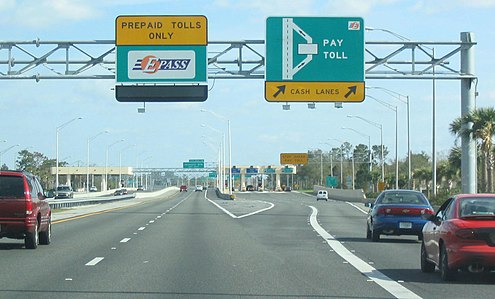
I have memories of toll roads my kids will never have. They’re old enough to remember passing through the booths and handing coins or bills to the collector. But they won’t remember the unmanned alternative, which was to toss exact change into a big plastic basket, listen to the coins process through the mechanics below, and hope/pray the gate to the toll road would raise. That automated approach seems almost quaint compared to today’s electronic alternatives.

I say alternatives (plural) because yes, that’s what we have with today’s toll roads. It confounds me. Why in heaven’s name haven’t we developed a painless, seamless, and most importantly, nationally coordinated approach to toll road payments? To some extent (nineteen states) we have a solution – E-ZPass, which by subscription and sticker allows convenient passage.  But even E-ZPass is not a perfect system.

Not so E-Z

For the rest of the country’s tolls – and for most of our round-trip drive between South Carolina and Pennsylvania – we have the clunky alternative. You pass through a now-unmanned (“un-personned?”) toll booth, where a camera grabs your license plate with a noticeable flash. Then, somewhere down the road (ha) a paper bill arrives in your mailbox. By my count I have four or five of these bills coming my way. It’s been ten days since we’ve returned home and I have yet to receive even one.

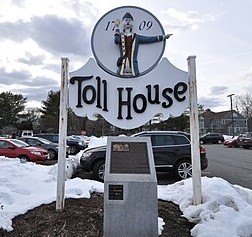
The cookie recipe is still on the back of the package

[Trivia detour:  Nestlé’s famous Toll House chocolate chip cookies aren’t named after toll booths but rather for an inn in Massachusetts where baker Ruth Wakefield came up with the recipe.  Wakefield and Nestlé struck a deal in the 1940s: her recipe printed on their bags in exchange for a lifetime supply of chocolate.  How very “Willy Wonka”, eh?]

Here is my unequivocally efficient approach to paying tolls across our many-highway’d nation. When you first get a driver’s license, you also sign up for a bank account-linked program which allows seamless paying of ALL tolls across the land – roads, bridges, tunnels, whatever – through a single readable sticker on your windshield. If you somehow don’t pay the tolls because of say, “insufficient funds”? Well sorry, your driver’s license doesn’t get renewed until you settle up at the DMV.

A $3 toll gets you through Baltimore’s Harbor Tunnel

My system is so logical it’s probably the reason I’ve never been pegged for a government job. In Colorado and elsewhere they almost have it right with the E-ZPass system – a sticker linked to a bank account. The problem is, they hold a minimum balance in a middleman (middle person?) account to guarantee payment of tolls.  I object, your honor. Why should Colorado have forty-odd dollars of my hard-earned money at all times when they can just settle up unpaid tolls whenever I renew my license?

Warning: cash-cow crossing

Then again, I have a beef with the tolls themselves, and that is, they pay for far more than the maintenance of the roads. You can’t tell me $10 per vehicle per crossing of the Golden Gate Bridge (GGB) is needed just to maintain the bridge. Here’s the jaw-dropping math for you.  112,000 cars cross the GGB every day.  That’s over forty million cars per year.  That puts the annual toll-taking at over four hundred million dollars.  $400M for bridge maintenance?  Sorry, fair traveler, you’re voluntarily lining the coffers of California (and San Francisco) every time you cross. “If I’m elected” (as we’ll hear countless times in the next two months), I’ll limit toll-taking to whatever it costs to maintain the bridge, road, or tunnel.  Not a dollar more.

On our return trip from Pennsylvania, I was amused to pass through one toll both with an actual human toll-taker. Those cordial people are still out there, collecting cash one car at a time. The woman in our instance happily returned us $19.25 on a $20.00 bill (and who’s happy to do that anymore?).

Time to bake cookies!

I was also amused… no, “gratified” is the better word; to pull into the parking lot of a South Carolina “rest area” shortly before we got home, for the use of a perfectly safe, clean, toll-free restroom on a toll-free highway. Maybe rest areas and their restrooms are the reason tolls cost more than the maintenance of the roads? Probably not. That would equate to a logical explanation for a government expenditure, which is an oxymoron.

Some content sourced from Wikipedia, “the free encyclopedia”.

“Thoughtless Driving”

One of the inconveniences of living in a small town is the proximity to airports. In western South Carolina we actually have a choice of six, including tiny Augusta Regional just beyond the nearby Savannah River. But whether Augusta or one of the larger airports hours away on the East Coast, the drive to get there is mostly two-lane blacktop, speeding along and then slowing down through the small towns along the way. Correction. You’re supposed to slow down through the small towns.

Blame it on puzzle apps. My wife and I were just thirty miles into our eastward trek to Charleston International when we hit the pretty-much-forgotten small town of Springfield, SC. The speed limit sign suggested 25 through its residential streets. I chose 38 instead. Okay, I didn’t intentionally choose 38. I simply elected to ignore the laws of little Springfield, in favor of focusing on the puzzles my wife was trying to solve on her iPad. Maybe I missed the speed limit sign, but I did see the spinning blue/red lights on the police car sitting quietly in a church parking lot.

Here’s something all four of my life’s speeding violations have in common. As soon as each of them happened, I pulled over pretty much the moment the cop reached for his lights. My thought process went, “Hey, I’m breaking the law”, followed by “Hey, that cop noticed me breaking the law” and finally, “I think I’ll just pull over immediately and save him or her any further trouble”.

38 mph in a 25; yeah, that’s pretty bad. Totally deserved the ticket. At least it wasn’t another school zone this time. My last two speeding tickets, one in the middle of 1992 and the other around 2013, were earned as I passed by primary schools with loads of children on their playgrounds. Even worse, the 1992 ticket was collected from the driver’s seat of a midlife crisis two-door convertible Alfa Romeo Spider. Bet the cop loved ordering youngish me to traffic school in lieu of the ticket.

Speaking of “in lieu”, my Springfield, SC cop (who had nothing better to do because there’s nothing at all to do in Springfield) gave me a no-brainer choice in settling my flagrant speeding violation. Option 1: Pay the fine as advertised and earn four points against my driver’s license (“Ouch!”) Option 2: Pay an additional 30% on the fine and avoid the points entirely (not-so-“Ouch!”) Maybe Springfield’s not a bad little town after all… even if the ticket mocked my violation with a description of “thoughtless driving”.

Here’s the nice thing about making peace with a speeding violation before the cop even reaches the driver’s side window: you have a pleasant conversation. Officer: Do you know why I pulled you over?  Me: Why yes sir, I do, and here’s my driver’s license and registration. Officer: Okay Mr. David, let me spell out your options here (spells out options).  Me: Why thank you sir, I’ll take Option 2, if you please. Officer: Okay then Mr. David, pay the fine online and enjoy the rest of your day.  Me: And you too, officer!  It was almost as if a friendship was born over a speeding ticket.

I can’t talk about three of my speeding tickets without a mention of the fourth.  I made it through my high school driving years before ever getting pulled over – but just barely. It was on a graduation trip, where my parents loaned me their car and paid for enough gas to get me and a buddy a driving tour of the Western U.S. And right there in the middle of Colorado, streaking up the interstate towards the Rockies, I earned the blue/red lights for the very first time.

I will always remember two things about that first ticket. First, the officer gave me a personal escort to a nearby mailbox so he could watch me mail the check for the violation (no online or credit card option in 1980). Second, I turned to my buddy afterwards and said, “My parents are gonna kill me!”… which wasn’t true at all, but it’s how most teenagers feel after they get a speeding ticket in their parents’ car.

I doff my hat to those who make the effort to plead down a speeding ticket. I also admire those who continue driving after a violation, as if they don’t think the police car in the rear-view mirror intends to pull them over. Me, I embrace the fines for my brushes with the law.  It’s easy to claim accountability when you’ve only had four instances. And for the foreseeable future, I’ll be the most well-behaved driver behind the wheel.  You just won’t find me anywhere near Springfield, SC.

Ear Plugs Recommended

I try to avoid topics causing thoughts of negativity or fear. After all, who wants to read about invasions when they can find plenty about them in their daily news feed? But one particular assault has been relentless, both in the media’s coverage and the anticipation of its arrival. They’re coming… I know they’re coming. One day very soon I’m going to be surrounded by buzzing, mating, disgusting cicadas.

“I’m coming for you!”

Until we moved to the South, I admit to knowing virtually nothing about cicadas.  Sure, I could pronounce the word and probably had a vague idea of what they looked like, but I’d never heard, let alone seen the insect in locales further to the West.  Well, Mother Nature has decided to address that deficit of knowledge this year, in spades.  The forecast infiltration of B-flick bugs is projected to run into the billions (as if anyone could possibly count how many).  And they’ll be here in the next week or two.

To prepare for this overwhelming assault, I decided to learn a little more about the humble cicada.  It is one of God’s more bizarre creatures, both the look and the lifecycle.  Cicadas live underground almost their entire lives.  They feed on the sap of plant roots.  The only time they surface is to mate, about fifteen years after birth.  The females lay their eggs in slits they make in the branches of trees.  After birth their little “nymphs” plunge to the ground, where they burrow down deep to begin their subterranean lives, and the cycle starts over again while Mom and Dad promptly enter the pearly gates of cicada heaven.

“Bug eyes”

It’s the stuff of horror movies, this bonanza of bugs.  The problem is, a realistic depiction on the big screen has to include a soundtrack loud enough to make the viewing unbearable.  THIS is what your local reporter is so jazzed about.  The male cicada makes a shrill sound to attract the female, which can only be described as an incessant scritch-scritch, scritch-scritch.  Now multiply the sound by billions, and the better descriptor is “lawnmower” or “jet engine”.  Best get a set of earplugs while the stores still have them.

The “buzz” (ugh) about this year’s offensive is the overlapping emergence of two broods where there would normally only be one.  It’s a doubling-up that hasn’t happened since the days of Thomas Jefferson.  There’s enough membership in both clubs to adjust the forecast from “billions” to “trillions”.  Brings a new meaning to “take shelter”.

Let’s build the horror film script, shall we?  Cicadas make their skritch-skritch sound with vibrating membranes on their abdomens [pausing here to allow stomachs to settle].  Cicadas shed their exoskeleton as they transition from juvenile to adult (time to grow up, little ones), and leave those shells all over tree trunks for us humans to find afterwards.  Finally, cicadas are chock full of tree sap.  For a wish-I’d-never-read-it analogy, just think of cicadas as nature’s Gushers… the bright green variety of the candy.

Nope, absolutely not

Birds will be thrilled with the arrival of trillions of Gushers.  They’ll feed on them to their heart’s content.  Okay, so now we’re talking about two cicada invasions followed by one bird invasion.  Oh, and throw in several poisonous copperhead snakes while you’re at it.  The copperheads like to hang out at the base of the trees, to feed on any falling cicadas.  I told you this would be a horror movie.

The rumors are flying on the when and where of this year’s cicada onslaught.  America’s Midwest and Southeast regions seem to be sure things.  More specifically, Illinois and Georgia, although one report includes several counties here in South Carolina.  Seriously, the thought of untold numbers of these winged nightmares living below the very ground I walk my dog on puts some serious shakes into my legs.

Despite the headlines and anticipation (and the inevitable movie due out next Halloween) there’s very little “horror” to expect from the cicada raid.  They don’t bite, they don’t move around much, and they die pretty darned quick after they mate.  I’m guessing they don’t care much about the humans walking underneath them either, because they’re too busy making trillions of nymphs.

Mr. and Mrs. Miller

Normally this time of year I’m complaining about a wholly different invasion of insects. Out in Colorado – where we still have a “For Sale” sign on the property of our former ranch – we’re about to get a visit from the wretched miller moth (which I blogged about in Late Night Racquet Sports).  Like the cicada, miller moths don’t bite and don’t care much about humans, but man do they migrate.  Like, from the Midwest to the Rocky Mountain states and on into Utah.  They’re so messy I’d almost prefer a double dose of trillions of cicadas instead.  Like I have a choice.

Some content sourced from the Mercer University article, “What’s up with all the cicadas?…”, and Wikipedia, “the free encyclopedia”.

Living On The Edge

The state line between South Carolina (SC) and Georgia (GA) follows the twists and turns of the Savannah River. You know you’re heading into one state or the other whenever you cross the water. Driving from our part of South Carolina into nearby Augusta, GA is interesting. The interstate loops Augusta by starting in SC, touches a bit of GA, goes back to SC for a few miles, then continues into GA again as it follows the river. It’s an example of my life on the edge.

In California, W means “water”

Growing up on the coast of California, it never occurred to me the geography of my younger days was limited to only three of the four cardinal directions.  If I headed north I’d leave the urban stretches of Los Angeles for the more rural towns of the the central coast.  Head south and I’d parallel the beaches all the way to San Diego.  The only thing east of the city seemed to be the endless Mojave Desert.  As for the last of the four directions?  Not an option, at least not without a boat, plane, or a whole lot of swimming.  Horace Greeley would’ve never told me to “Go West, young man”.

South Bend sits where the yellow and red come together at the very top of Indiana.

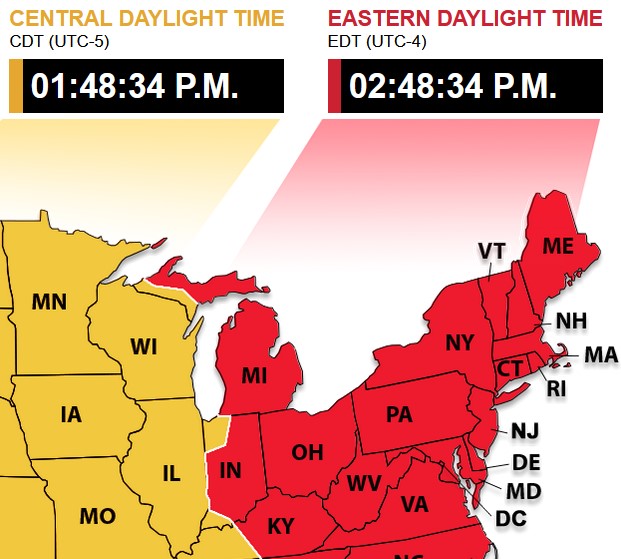
In my college years in South Bend, IN, I was a fifteen-minute drive from the line where the Central and Eastern time zones meet.  Back then you didn’t touch your clock for Daylight Savings, so half the year you were the same time as Detroit while the other half you were Chicago.  It was confusing, but not as confusing as someone who lived on one side of the line and worked on the other.  Imagine leaving the house at 8:00am, driving an hour, and arriving at the office at… 8:00am?  It’s a neat trick, pulled off by a lot of those who live on the edge of a time zone.

Raising our kids in Colorado Springs, we always knew which direction we were heading because the line of the Rocky Mountains lay immediately to the west.  Those peaks rose up like the Great Wall of China, just daring you to push through.  Sure, we drove the interstates into the Rockies for skiing, hiking, and such, but day-to-day we were down at the base, literally living on the edge.  Like California, we had one less cardinal direction at our disposal.

Grays Peak, on Colorado’s Continental Divide

The Rockies conceal another important edge, known as the Continental Divide.  The Divide is elevated terrain separating neighboring drainage basins.  Plain English?  The north-south line from which water flows either west to the Pacific Ocean or east to the Atlantic.  I always wanted to stop somewhere flat on the Divide and pour out a bottle of water.  Let’s see if it really flows both ways from the line, right?  It’s an experiment that to this day remains unconducted.

Football is a game of lines and edges

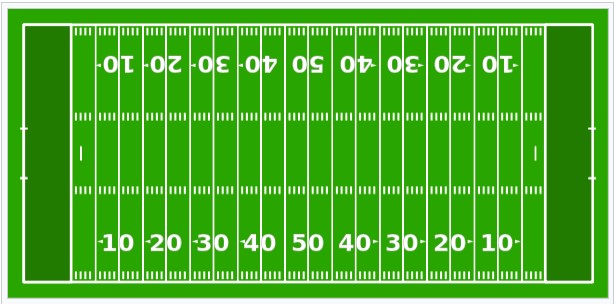
Football, one of my favorite spectator sports, is all about lines and edges.  One team faces the other, on an imaginary line defined by where the referee places the ball.  Cross that line before the ball is snapped and you’ll be flagged with a penalty.  Advance the ball ten yards past that line – to another imaginary line – and your team is awarded more play.  The sidelines of the field might as well drop off to a bottomless void.  Catching a pass outside of that edge is not allowed.  Running the ball outside of that edge brings the game to a halt.  But catching or running across the lines at end of the field?  That rewards you with a score.

$50 gets you a spot on “The Edge” sky deck

For all this living and playing on thresholds, maybe I should visit one of New York City’s newest high-rise attractions.  One hundred floors above the sidewalk, The Edge is billed as “the highest outdoor sky deck in the Western Hemisphere”.  Jutting out from its host building, The Edge allows unparalleled views of the city below, because the surrounding walls are solid glass, as is a portion of the deck floor itself (yikes!) If Spider-Man is your thing, you can go even higher by scaling the outside of the remaining floors of the skyscraper.  I have to say, this sort of thing draws a “fine line” between entertainment and, well, insanity.

I won’t be going to The Edge… ever.  I’m not good with heights, so anything above a pedestrian Ferris Wheel just isn’t my cup of tea.  Nope, leave me behind, comfortably grounded, where crossing the Savannah River from one state to another is plenty adventurous.  That’s my definition of life on the edge.

Some content sourced from Wikipedia, “the free encyclopedia”.

Sphere Delight

My wife’s sister and her husband just wrapped up a visit here in South Carolina. On the drive down from Colorado they made several sightseeing detours, but the trip back was pedal-to-the-metal… with the exception of one stop: the Moon Marble Company in Bonner Springs, Kansas. Moon Marbles stocks beautiful handmade wooden games and toys but c’mon, who braves the barren wastelands of Kansas for those? Marbles on the other hand, would draw me in like a bee to nectar.

A marble is the perfect example of a sphere, isn’t it?  I love spheres (including the word itself; much more elegant than “ball” or “orb”).  Take a semicircle, revolve it a full loop around its diameter and voila! – a sphere.  Calculating the volume of a sphere involves cubing its radius but let’s stop right there with the math lesson.  Cubes and spheres just don’t belong in the same conversation.

Lemons can be oblate spheroids

Most of you readers are tuned in from the Northern Hemisphere, the half of our planet above the Equator.  I find it cool to think of Earth as a sphere (with “big blue marble” a close second).  It’s the biggest sphere we humans know (or have you been to Jupiter?)  At your next party, wow your friends by telling them Earth is actually an oblate spheroid: flattened at both poles and bulging at the Equator.  Ewwwww.  Not a very pretty sphere, now is it?

Here’s the paragraph where I cop out and simply list a bunch of spheres, like oranges, Christmas ornaments, eyeballs, pearls, and the moon, but that’s just so three-hundred-blog-posts ago.  Spheres can be much cooler.  For instance, picture an atom (I’ll pause for those who need a microscope).  An atom is a spherical cluster of neutrons and protons (which are also spheres) encircled by whizzing electrons (more spheres).  Did you know your body is made up of over 7 octillion atoms?  That’s a lot of spheres.  You might want to lose a little weight.

Glinda traveled to Oz in a sphere (photo courtesy of MGM)

Soap bubbles are spheres.  Sure, you aim to create those giant wibbly-wobbly monsters but for the most part you generate a cloud of perfectly spherical transparent globes, born on a whisper of air and extinguished seconds later.  I’m guessing soap bubbles have the shortest lifespans of all spheres.

When a college buddy visited several years ago, he brought a paperweight made by an artist near his hometown in New Jersey.  It’s a glass sphere with just the slightest bit of the bottom lopped off so it doesn’t roll off my desk.  I’ve picked up a lot of tchochkes over the years but I’m not letting this one go.  Did I mention spheres are cool?

Three years before he wrote Jurassic Park, Michael Crichton authored a novel called Sphere.  It’s about a group of scientists exploring a giant spacecraft sunk to the bottom of the Pacific Ocean.  In the spacecraft’s cargo hold: a mysterious sphere, determined to be extraterrestrial and literally mind-blowing.  Mark my words; spheres can be as terrifying as dinosaurs.  Read it.

Dimples can be cute.  Not this one.

Star Wars focused on a giant spherical colony – the Empire’s “Death Star” – but the air went out of my perfectly round balloon as soon as I saw the giant divot on its side, not to mention all those channels and openings pierced by the X-wing starfighters.  In other words, the Death Star was a decidedly less-than-perfect orb.  So I applauded alongside everybody else when Luke Skywalker blew this sphere to kingdom come.

Here’s a place you wouldn’t expect to find a sphere: a Christian hymn.  In the first verse of This Is My Father’s World we have, “All nature sings and round me rings, the music of the spheres”.  The plural throws me off, because more than one sphere suggests more than just Earth (the entire solar system?)  Or maybe we aren’t singing about the planets at all.  A quote from August Rush seems relevant; the final line in the movie: “The music is all around us… all you have to do, is listen.”

Coming soon to Sin City

We’re starting to go round and round here (heh) so let’s conclude with the world’s largest sphere.  The Guinness Book writers will deem it so once the “MSG Sphere” opens in Las Vegas in a few months.  At 300 feet tall and 500 feet wide, the Sphere will dramatically change a skyline that’s already pretty dramatic, especially with 1.2 million LEDs on its surface generating all sorts of images and animation.  For concerts, sports, and the like, the Sphere can seat up to 18,000 spectators.  I plan to be one of them…  just as soon as I make it to Moon Marbles in Kansas.

Some content sourced from the CNN Travel article, “This futuristic entertainment venue is the world’s largest spherical structure”, and Wikipedia, “the free encyclopedia”.