Running Amuck

Last Saturday our little town hosted a festive 10k run.  High school cheerleaders pom-pommed us away from the starting line while hundreds of residents waved flags and tossed water bottles along the way. The finish in the town square was packed with people, and included the music, food, and fun you’d find at a carnival.   As I struggled to complete the last couple of “k’s” I struck up a conversation with a nearby runner to distract myself from the effort.  She was pleasant enough, with just the right pace, and she was even a human being.  At least, I think she was.

Suddenly, shockingly, we’ve come to this.  The entry form for your next running race may ask you to identify as 1) human being, or 2) human-oid .  If you choose the latter, you’re saying you still have the physical form and characteristics of a human being.  You just happen to be a robot.

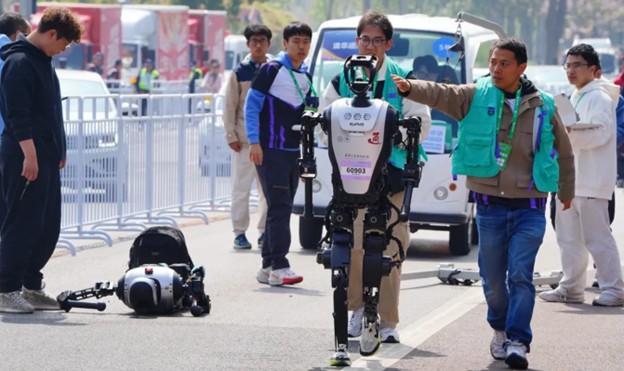
Ten days ago this eerie scenario really played out in Beijing.  A half-marathon took place with thousands of human participants, but the spotlight was clearly on the twenty-one humanoids who also showed up at the starting line.  These robots were accompanied by operators running close behind them, but make no mistake; absent of the wires or other attachments you might expect with a remote-controlled device.  They were running free, with the look and gait of any other runner in the race.
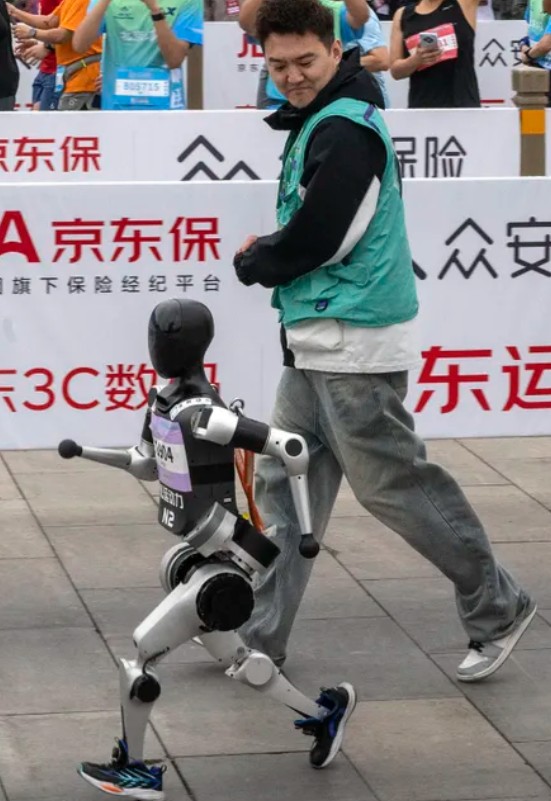
I’m wondering how any of the human runners kept their focus as they ran this race.  I’d want to pace myself against one or two of these machines and just admire their every step.  The humanoid winner, Tiangong Ultra, finished the half-marathon in 2 hours and 40 minutes, or about five miles an hour.  Trust me: five miles an hour is not a walk; it’s a run.

I’ll have to search for the video online, because a still of a running humanoid doesn’t do the accomplishment justice.  I just can’t get over the fact we now have robots who run.  Granted, the Beijing half-marathon wasn’t what you’d call a “run in the park” for these technological marvels.  Only six of the twenty-one finished the race.  Others fell down or exhausted their battery packs.  Still others lost their heads or spun out of control.  If there had been a humanoid hospital nearby, its ER would’ve been a machine-shop hotbed of activity.
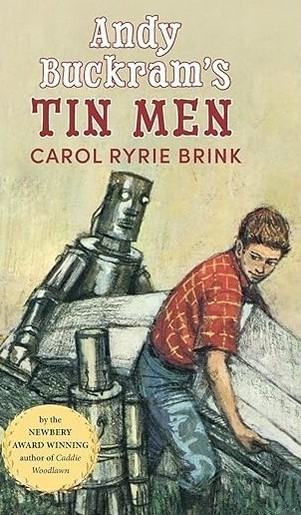
My perception of all things “robot” is clearly outdated.  I’m more inclined to picture self-guided vacuum cleaners and assembly-line automatons than race-running humanoids.  Case in point: I’ll never forget the grade-school novel, Andy Buckram’s Tin Men.  It was a wonderfully imaginative tale about a boy who created a family of robots from a pile of cans, and his unexpected adventures when those robots came to life courtesy of a lightning strike.  The book was written in the 1960s and was a work of fiction.  Of course it was.
I’ll also never forget the movie Silent Running (1972), a future shock story of a destroyed Earth, with spaceships housing giant terrariums cared for by lovable lifelike service robots.  Or Westworld – the 1973 original, not the HBO series  – an adult amusement park of sorts where robots catered to the guilty pleasures of their human customers (until collectively the robots decided to run amuck).

C-3PO

C-3PO from the original Star Wars trilogy (1977) might’ve been the first humanoid to get me wondering if such technology was possible.  Blade Runner (1982) took the concept an interesting step further, with humanoids desperate to demonstrate their emotional capacity.  Less than fifty years later we’re still working on that emotions bit, but I certainly wouldn’t have bet we’d have humanoids who could run.

Let’s be clear – we’re at least another fifty years removed from any technology that remotely suggests “human”.  Even if Siri and Alexa appear to read your mind and hold meaningful conversations with you, they’re not going to jump out of your smartphone tomorrow and land on two legs.  Even if  your little robot dog wags its tail, lies down, and rolls over, it’s not going to take a bite out of your leg when it doesn’t get enough attention.  Your Roomba might suck up the lion’s share of dust and dirt in your house but it’s not coming for your valuables.
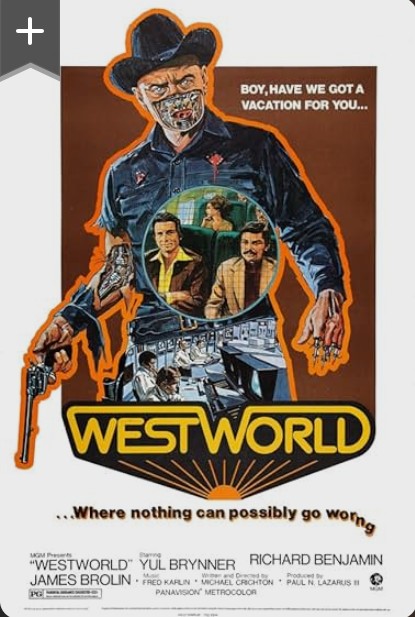
I sleep peacefully at night knowing the nightmares of Westworld and Blade Runner continue to be the stuff of (evil) Hollywood imaginations.  Virtual reality will remain virtual, and robots will continue to be nothing more than subservient devices for years to come.  But admittedly, you can’t help but question “years to come” when you see a humanoid run a half-marathon.


LEGO Notre-Dame de Paris – Update #13

(Read about the start of this “church service” in Highest Chair)

I’m not sure I’ve ever stopped the construction of a LEGO model smack-dab in the middle of a bag of pieces.  Imagine our priest at Notre-Dame de Paris, pausing midway/mid-sentence into his homily only to say to his congregation, “I’m tired.  Let’s pick this up next week, shall we?”
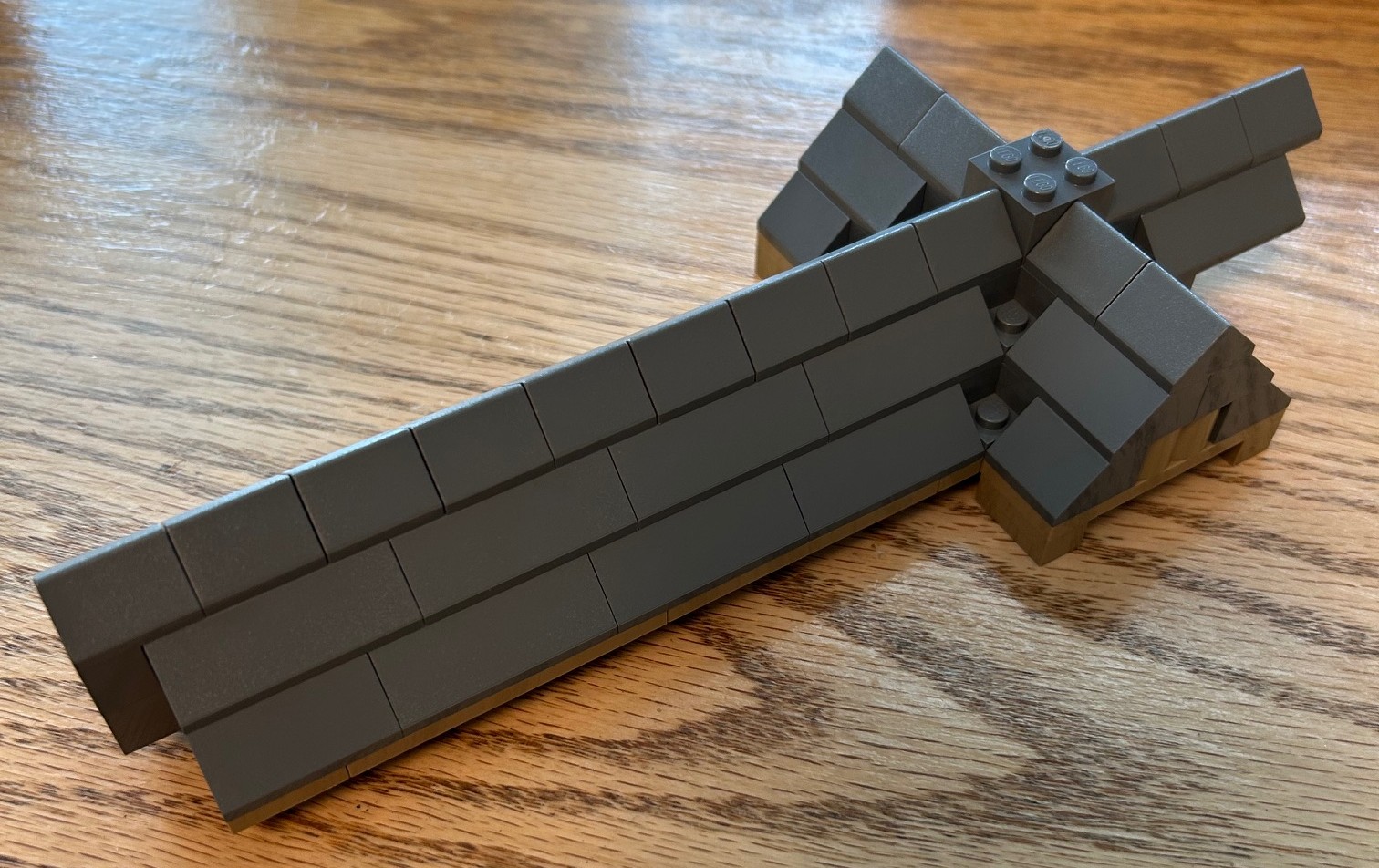
Cathedral roof structure

Bags 25-28 – of 34 bags of pieces, were a study in opposites.  In a crisp fifteen minutes, Bag 25 assembled to the roof structure you see here, covering the remainder of the nave (the sanctuary) and transept (the cross section).  Even Bag 26 wasn’t a stretch as we built the “cores” of the uppermost cubes of the cathedral towers.
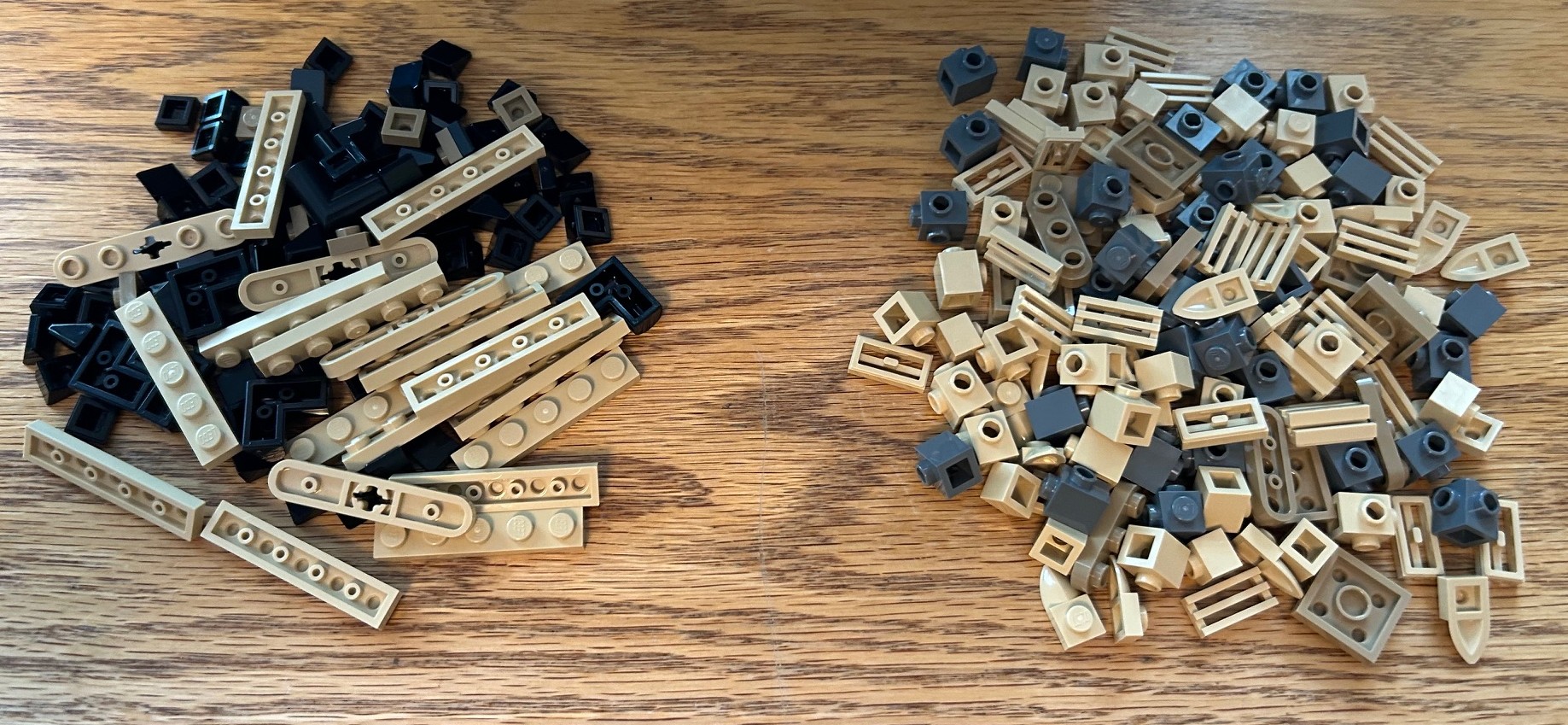
Two bags = hundreds of pieces.  Seriously.

But that’s when I should’ve stepped on the brakes.  The instruction manual told me to break open Bags 27 and 28 together and this is what stared up at me.  If you think the pile on the right adds up to a lot of pieces, you are correct about both piles and you’re probably underestimating the number.  These tiny, tiny pieces come together slowly to complete the uppermost cubes of the cathedral towers.  One cube took 75 minutes.  Why so long?  186 pieces each.  No kidding – zoom in on the top of the completed tower below and you’ll get some sense of how intricate it is.  Now you understand why we paused in the middle of the homily.  I just didn’t have the energy to build up the other tower.  Next week!

(Click the photo for more detail)

Since we’re close to the end of the build, let me admit to looking ahead in the process.  The remaining six bags are small, and the pieces inside of them are minuscule.  If I had visions of finishing off the cathedral in a flurry of construction, they’ve been dashed by the thought that I’m still a good five hundred pieces from the finish line.  Sigh… this church service is getting a little long.

Running build time: 13 hrs. 0 min.

Total leftover pieces: 32

Some content sourced from the Smithsonian Magazine article, “Humanoid Robots Just Raced Alongside Human Runners…”, and Wikipedia, “the free encyclopedia”.
Boston Long

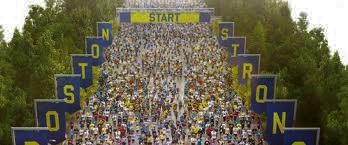
Durgin-Park, the venerable restaurant inside of Boston’s Faneuil Hall, recently closed its doors after almost two hundred years of operation. You read that right; D-P opened for business a few decades after the Revolutionary War, but served its last patron this year, citing “an inability to turn a profit”. For America at least, that’s some serious history. For Beantown on the other hand, that’s par for the course. After all, this week the Boston Marathon completed its 123rd consecutive running.

I am in awe of runners who qualify for – let alone run – the Boston Marathon.  It’s daunting enough to compete for 26.2 miles, but you can’t join the “fun” in Boston unless you complete a qualifying marathon in under 3 hours (men, ages 18-34), or 3.5 hours (women).  Consider, 3 hours is an average pace of 7 min./mile.  To appreciate that, go to the gym, crank up the treadmill to eight or nine miles/hour, and see how long you can maintain it.  Now imagine running that fast for three hours straight, up and down the city streets of Boston.  It’s superhuman.

The Boston is the world’s oldest annual marathon.  Simply achieving the age-specific qualification time is the goal of most elite long-distance runners.  But if that’s all you know about New England’s most-spectated event, you’re missing out on some fascinating race-related trivia.  Here’s a sampling:

  1. The Boston is run every “Patriots’ Day” (the third Monday in April), a holiday to commemorate the start of the American Revolutionary War.  Effectively, the marathon is a nod to freedom.
  2. The Boston was first run in 1897, one hundred years after the first Olympic marathon in Athens, Greece.  That marathon, as most know, was inspired by the fabled run of the Greek soldier Phillipides from Marathon to Athens, announcing a battle victory over the Persians.  Effectively, Phillipides’ run was also a nod to freedom.
  3. The Boston Red Sox play every Patriots’ Day in Fenway Park.  The game finishes in time for the fans to walk a mile east along the Charles River, arriving in Copley Square as the marathon runners are crossing the finish line.
  4. Until 1986, the men’s and women’s winners received a wreath of olive branches and a trophy; no cash prize.  Today?  First place: $150k, Second: $75k, Third: $40k, and Fourth: $25k.  Might want to dust off the running shoes and start training.
  5. Check out Derek Murphy’s “marathon investigation” blog here.  Derrick started his sleuthing five years ago and outed over 250 cheaters, including several who faked their race qualification times in order to run.  Too bad Derrick wasn’t around for the 1980 race, when Rosie Ruiz pulled off the marathon’s most famous heist (see her story here).
  6. In the 2011 race, Geoffrey Mutai of Kenya effectively broke the world marathon record (even though it wasn’t deemed official), finishing in 2:03:03.  Try that pace on a treadmill.  Set the speed at twelve miles/hour and… well… let it spin from a safe distance and just watch.
  7. The Boston draws an average of 30,000 participants each year, cheered on by 500,000 spectators.  The participants are divided into men’s and women’s categories of “elite runners” (i.e. pros), the remaining qualified runners (waves of 10,000), wheelchair-bound, and hand-cyclists.  The Boston even accommodates blind runners.
  8. The Boston is famous for Heartbreak Hill; the incline located a few miles from the finish where runners tend to hit an endurance “wall”.  Why the name? In the 1936 race, Johnny Kelley caught up with rival Tarzan Brown on that hill, giving him a pat on the back as he passed by.  Bad move.  Brown took the gesture as a challenge, found another gear, and went on to win the race.  Brown effectively “broke Kelly’s heart” and the hill gained a name forever.
  9. Halfway through the Boston, the lively women from nearby Wellesley College form a long “Scream Tunnel”, yelling and blowing kisses as the runners pass by.  These ladies are so loud, you’ll know the Scream Tunnel is coming a mile before you get there.
  10. And finally… the Boston Marathon is not really run in Boston; not until the final couple of miles.  Before that, you’re touring twenty-four miles of eight neighboring towns instead.

Remarkably, this year’s Boston Marathon included four finishers in the top hundred from right here in Colorado Springs.  The next day, my cycle instructor casually mentioned she’d run the race before.  Ditto my former boss at Hewlett-Packard.  And my sister-in-law has a good chance of qualifying in the next couple of years.  Superhumans.  As for me?  I do like to run, but I’d be happy enough just to spectate beside those hundreds of thousands of “Boston Strong”.  I’m just sorry I can’t have dinner at Durgin-Park afterwards.

Some content sourced from Wikipedia, “the free encyclopedia”; and the Mental Floss article, “11 Fast Facts About the Boston Marathon”.

Running for Roses

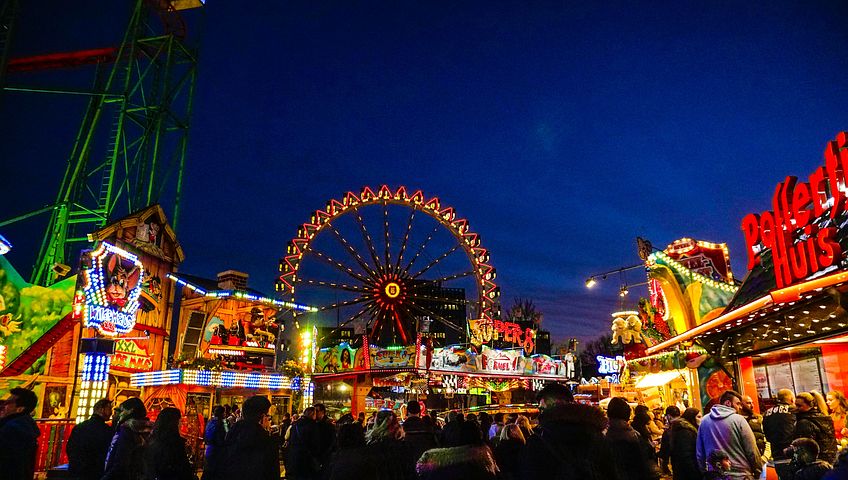
On the treadmill this week, surrounded by dozens of others tackling their workouts, an idea formed in my head. Whether it’s running, sprinting, or even dancing on the treadmill (the new trend these days), there’s a subconscious sense of competition with those around you.  Someone wants to leave the room believing they “won” their workout.

Flash back to state fair or neighborhood carnival memories for a second. Those light-bright terror-filled rides drew me in as a kid, but how about the midway games?  That’s where I dropped some serious cash. Ring toss. Shooting galleries. Fishing pond. Skee ball.

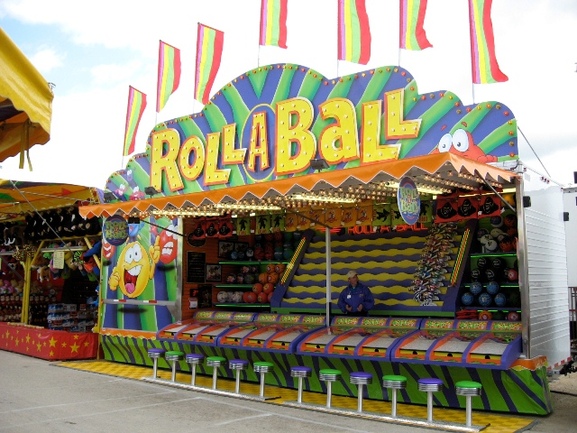
In my book, the most memorable of the midway games was the Roll-A-Ball horse race. A larger-than-average booth with a dozen open stools invited you to have a seat. Along the back was a massive tote-board with horses lined up top to bottom. You had a brief sense of mounting a thoroughbred and trotting into the starting gate. The game began (with an obnoxious bell), and each “jockey” rolled a ball up a small wooden board and into holes.  The further away the hole the faster your horse galloped across the board.  The closer the hole the less the gallop but also the quicker the ball came back to you.  First horse across the finish line won (another obnoxious bell).  Some versions of the game had you shoot targets with water guns instead of Roll-A-Ball.

Here’s a video of the Roll-A-Ball horse race in action.

There’s a ton of frantic energy with Roll-A-Ball.  You play while nervously glancing at the tote-board to see how your horse is coming along. Whenever someone hits a high-score hole their horse surges to the lead. Towards the end you’re aiming for the further holes in a desperate attempt to make up furlongs.  As if the distraction of carnival sounds isn’t enough, thundering hoof beats blare every time a horse makes a move.

With Roll-A-Ball in mind, let’s go back to the gym.  I propose we combine the horse-race concept with the treadmill workout.  Place a big tote board at the front of the room. Assign each treadmill to a runner on the board.  Then create several competitions as everyone works out simultaneously. Who has been running the longest? Who is running the fastest? Who is covering the most distance?  The runners advance across the tote-board according to the individual efforts on the treadmills.  Tote-board results change constantly as runners join or leave the game.

Would people “play”?  You bet they would.  Runners are competitive by nature as they vie to “medal” or win their age category or even just improve their “personal best”.  Runners are entering 5K’s and 10K’s, half-marathons and marathons in record numbers.

Me?  I run because it makes me feel good.  But don’t think I don’t notice the results of my workout spelled out in big, bold numbers on the treadmill display. Total Time. Total Miles. Average Speed. Calories Burned.  Sometimes I race against my former self.  Sometimes I increase my pace to match the faster runner three treadmills over. Sometimes I run longer to outlast the creeper who chose the treadmill right next to me when several others were open.

Competition leads to better workouts so the racing element is a slam-dunk.  Add a “join” option to the treadmill display and you instantly pop up on the tote-board.  Quit whenever your workout is done.  Even if you don’t “win” I’d bet dollars to doughnuts you’d get a better workout than if you were running in isolation.

Mark my words, someone more innovative than me will take this idea and “run with it”.  Gyms will cough up the purchase price because racing games would attract more memberships.  And maybe, just for a moment, runners will feel like they’ve stepped off the treadmill and back into the carnival of their childhood.

Thirst (for) Knowledge

Water.

Two parts hydrogen compounded with one part oxygen.  Transparent, odorless, and tasteless, yet we can’t survive more than a few days without it.  If not for oceans, lakes, ponds; rivers, streams, and creeks; and a whole lot of underground aquifers, we humans would be in a heap of trouble.  With due respect to Harry Potter, water is the elixir of life.

63-elixir

It’s fair to say most of us don’t drink enough water for optimal health. The long-held belief that eight glasses a day is sufficient has been replaced by the following formula: your body weight in pounds, divided by two, expressed in ounces. For most of us that means even more than eight glasses.  Gulp.

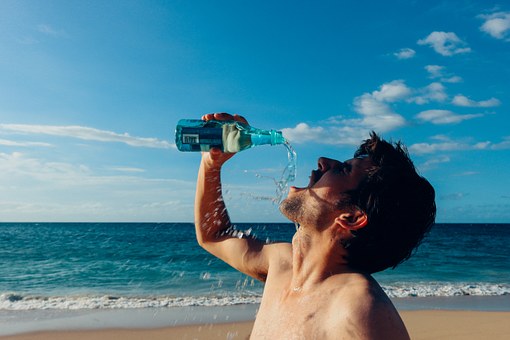
Somewhere along the way of several years of working out, I developed the habit of drinking small amounts of water during exercise, instead of chugging just before or just after.  On the treadmill for instance, I take a slug every time I complete a kilometer.  In the cycle class I drink every time the instructor says to pick up the bottle.  In a road race I never pass up the tables of water cups.  No question; the body works better with a regular intake of water.  Or at least a splash to the face.

Whenever I know I’m not drinking enough water I recall two vivid memories where I reached full-on dehydration status.  The first occurred as a child, when I was driving in the desert with my family.  I let the day go by way too long without taking a drink, and before I knew it my throat was so parched I could barely speak.  The heat of the day surely made it worse.  I pleaded to my grandparents to stop at a gas station (or anywhere with a halfway sanitary drinking fountain), which we eventually did, and I’m sure I took in a quart or more to quench my thirst.  Here’s a little irony: my desert dehydration is a fond memory because I can still hear my grandfather’s distinctive voice, saying, “need to wet your whistle, do ya?”  That was over forty years ago.

My second “parchment” occurred just short of the summit of Pikes Peak here in Colorado Springs – the first time I climbed it.  Pikes Peak is the highest mountain in the southern Front Range of the Rockies, at just over 14,000 feet.  Using the popular Barr trail it’ll take you five or six hours to get to the top.  Despite recommendations to carry a lot of water I only brought one 12-oz. bottle in my pack, which I refilled at a campsite halfway up the mountain.  I was getting by okay until the very last mile, when I ran out of water and my body literally began to shut down.  The combination of the effects of dehydration and altitude was devastating.  I could only walk a hundred yards at a pop, taking a seat on the rocks each time to recover for several minutes.  Mercifully I was close enough to the summit that I finished the hike, but not before realizing I’d been woefully unprepared.  In extreme circumstances the body demands a lot of water.  Certainly more than half your body weight in ounces.

If an elixir is defined as “a magical or medicinal potion”, then water qualifies in my book, and especially here in the high altitude of the Rocky Mountains.  It took a few years for me to gain a little thirst knowledge, but now my water bottle is my constant companion.  On that note, I think I need a drink!

Just Beyond the Spotlight

34.9 million people (including most of Jamaica) watched on Monday night as Usain Bolt claimed track and field legend at the Olympics by winning the Men’s 100m.  It was Bolt’s third straight gold medal in the event; remarkable considering he is eight years older now than when he won it the first time.  Like Michael Phelps and swimming, the hype leading up to Bolt’s latest victory was justified.  NBC covered every one of Bolt’s qualifying heats in prime-time, and delivered a good twenty minutes of back story before the final.  Bolt will be a household name if he is not already.

runner-311737__340_edited

The 100m run is one of several Olympic events I never miss.  It is a wondrous display of athletic power, and I’m always on edge to see who will become the “world’s fastest human”.  However, the prime-time Olympic spotlight need also shine on lesser known events and athletes.  Herein lies the oft-overlooked beauty of the Olympics: it is these “others” that emerge with the most inspiring stories.  They are not so much superstars, yet are still among the best at what they do.  A few examples for your consideration:

57 - wondrous 1

Charlotte Dujardin of Great Britain rode to a gold-medal performance in Individual Dressage.  Show Jumping may be the more popular Olympic equestrian event but Dressage is the more difficult (and defined as “the highest expression of horse training).  Dujardin and her Dutch Warmblood horse “Valegro” floated through an almost magical routine, completing one spectacular movement after another.  Dujardin and her mount were graceful, elegant, and significantly better – at least on points – than the silver medalist.  And her story became even more poignant when I learned Dujardin was engaged to be married shortly after receiving the gold medal, while Valegro has earned his last championship (of many) and will be retired from the sport.

57 - wondrous 2

Sanne Wevers of the Netherlands leaped to a gold-medal win on the balance beam in Women’s Gymnastics.  It was the first women’s gymnastics medal of any kind in her country’s history.  Wevers’ routine featured several jaw-dropping maneuvers I’d never seen before, including several spins while balanced precariously on one foot.  The judges were won over by Wever’s creativity and skill.  American television tried desperately to keep the spotlight on our own athletes (who were favored to win), but Wevers was clearly the humble star this night.  And her story was made even more poignant when the cameras turned to her twin sister Leika in the stands – also a member of the Dutch gymnastics team – as she reacted to Sanne’s upset win with tears of disbelief.

57 - wondrous 3

Molly Huddle of the United States ran what should have been a gold-medal performance in the Women’s 10,000m run.  Except she didn’t win the gold medal.  When a group of eight women broke away from the pack after several laps – most of them Kenyans and Ethiopians – Huddle broke away with them.  After twenty-five laps Huddle crossed the finish line in sixth place, breaking the American record for the event by almost nine seconds.  And her story was made even more poignant when I learned Huddle’s finishing time would have been good enough for the gold medal in three of the last four Olympics.

The Games continue for several more days.  More superstars will be at their best on prime-time television.  Just remember to look around and see what else is going on.  There are wonderful stories just beyond the spotlight.

Four in the Forest

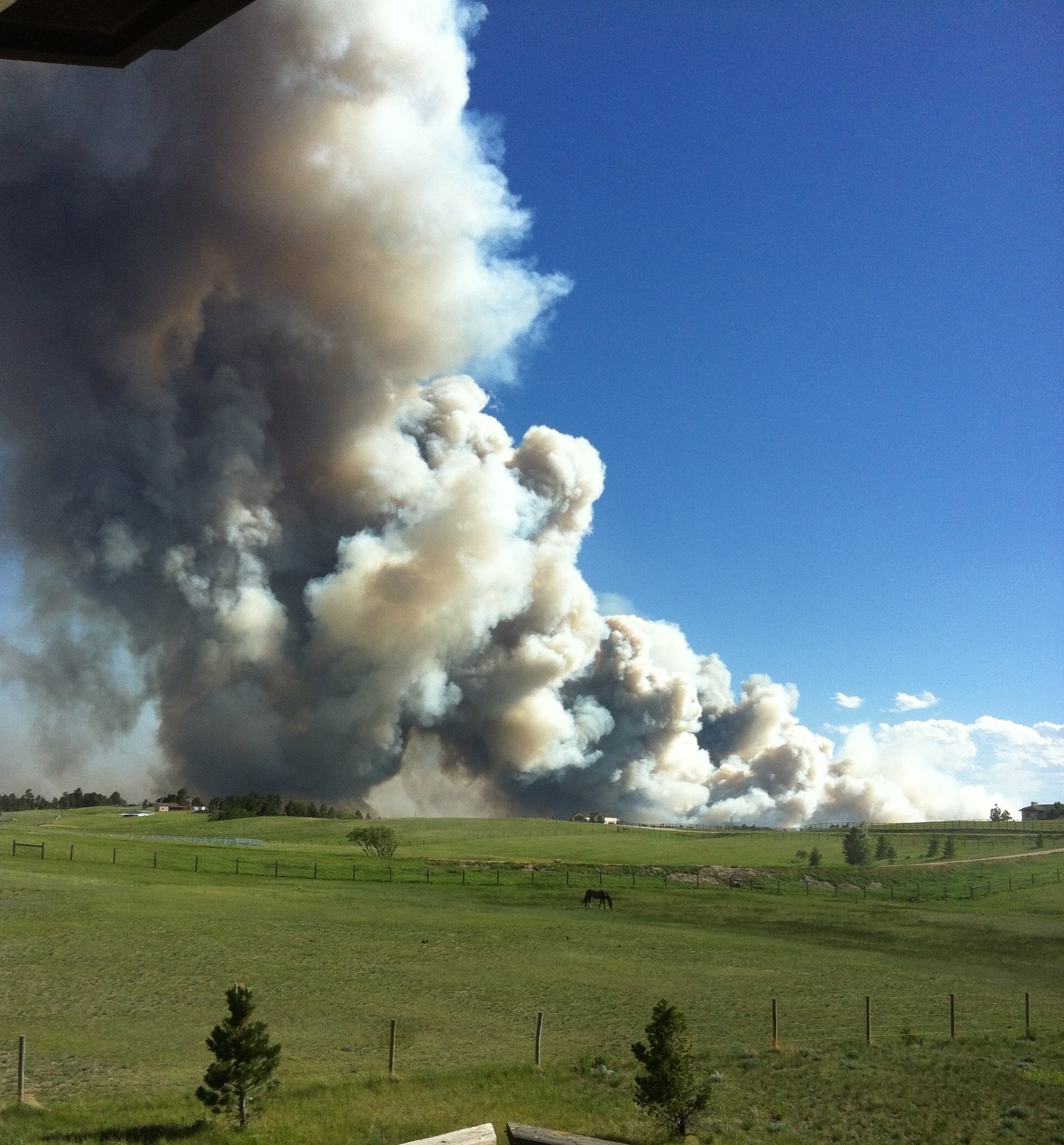
Three years ago this month, our community suffered a devastating wildfire the likes of which had never been seen in Colorado history.  Inside of a week, the Black Forest Fire consumed almost 15,000 acres and displaced 38.000 residents.  When the fire was finally contained over 500 homes had been destroyed.  It was an almost unimaginable force of nature, and a miracle that only two residents lost their lives.

50 - epitome 0

My family and I – and the several horses on our property – were forced to evacuate thirty miles to the north, waiting almost a week to learn the fate of our home.  We couldn’t check our phones for real-time updates.  Instead, we were at the mercy of twice-daily television reports.  We were glued to the screen as the spokesperson would list impacted streets and addresses.  By the grace of God our house was spared, even though the fire came within a mile of our property.  But the beautiful Black Forest now bears a miles-long scar that will be evident for decades, if not hundreds of years.

50 - epitome 1

The fire was a testament to a higher power, but also to the efforts of the “first-responders”.  Almost 500 firefighters battled the blaze; probably ten times the number manning our local stations.  I am in awe of these professionals, working tirelessly as well as putting their lives on the line for people like myself whom they will never meet.  They are the epitome of heroism.

50 - epitome 2

A year after the fire our community established “4 Miles in the Forest”, an annual fun run to benefit the Black Forest Fire/Rescue department.  “4 Miles…” attracts several hundred participants, including the firefighters themselves.  It is conducted at Section 16, a square mile of the forest with a trail around the perimeter for walking, running, biking, and horseback riding.  Thanks to an elementary school within the Section the firefighters held the line and saved the entire property.

50 - epitome 3

When I ran the inaugural “4 miles…”, I was delighted to find I was pacing one of the firefighters most of the way.  He must have been carrying 50 pounds of gear as he ran.  He was being coached by one of his superiors – as if in boot camp.  My own effort was buoyed by the thought that I was accompanied by this truly selfless individual.

50 - epitome 4

This year’s run was different.  I found myself alone most of the way, well-spaced between the leaders and the walkers.  The solitude gave me time to dwell on the significance of the race: a memorial to a tragic event as well as a testament to those who brought the fire to an end.  As I completed the run, I realized my participation had nothing to do with winning the race or where I placed or how fast I had run.  In fact it had nothing to do with me at all.  Instead my running was a tribute to the selflessness of others; their willingness to fight and protect without reward or recognition.  I know they would come to my rescue again without question.  They are heroes in every sense of the word.


exhilarating

Imagine a jog on a quiet trail that wanders through the forest.  Nothing but gentle breezes and sunlight filtering through the trees.  All you can hear are birds in the distance.  Your own little slice of heaven.  Except you’re not breathing very well.  In fact, you’re gasping for air as you run, trying to establish any kind of rhythm and focus, and wondering where the enjoyment is in all of this.  But at some point further down the path a page turns.  Your breathing relaxes and you’re moving easier.  You can focus and you’re feeling good.  What just happened?  You found your “second wind”!  And the sensation is nothing short of exhilarating.

12 - exhilarating

I found my second wind on a recent run.  It’s difficult to pinpoint the moment it kicks in, but it’s similar to driving as you shift from a low gear to a higher one.  Everything feels smoother and more efficient.  In this instance I intended to run several miles but after the first couple of minutes I wanted to quit.  I couldn’t get my breath and I wasn’t getting any satisfaction out of it.  It’s like I wasn’t in the mood to be there at all.  Yet I was familiar enough with the trail to know I was coming to an easier stretch – some downhills and flats, and a scenic tour of the pines.  I figured the least I could do was to complete that portion before I started walking.  Next thing I knew, I was even further down the trail and running with ease. My pace and breathing were controlled and comfortable.  So I completed my run without ever stopping.  There you have it: second wind.

When I run, I like to lose myself in thought because the creative juices seem to flow better. So it was somewhere out on the trail when I realized second wind applies to other aspects of life.  A year or so ago I left a job I held for over fifteen years.  Initially I was not comfortable losing the routine of the daily grind.  The meetings and conference calls and people just vanished.  There was an unsettling feeling of no longer running the rat race. There was the constant question of “what’s going on out there in the world?” as I kept myself busy at home.  But eventually I found a comfort level with my new routine – several smaller commitments instead of a single all-consuming one.  I became at ease with my new circumstances.  Second wind.

This is not an advice column, but second wind may hint at a healthier outlook on life. Push through the “first wind” of a given situation, especially when the going is tough and uncomfortable.  Give yourself the chance to get to the chapter where the pace and the rhythm and the conditions are favorable.  Once you hit that second wind, life suddenly feels exhilarating.