America Makes the List

Last Friday’s celebration of the Chicago Cubs in the Windy City made headlines the following day. The fantastic turnout to celebrate a long-awaited World Series victory – from those lining the parade route to those further south at the rally – was generously estimated at FIVE MILLION people. That’s a serious confluence of baseball fans. But the number really gave me a jolt several days later, when someone ranked the gathering as the seventh largest in human history.

69-confluence-1

Five million.  Hard to picture that many people in one location.  The population of Chicago is only half as much so the suburbs must’ve emptied out as well (it was a record day for the Metra commuter rail service).  Maybe I should’ve hired a helicopter or the Goodyear blimp and flown overhead, just to see all those human heads from a single vantage point.

Perspective?  If you take the combined attendance to Major League Baseball games in the 2016 season – 73,159,044 fans watching 30 teams play 2,424 games  – Friday’s crowd was almost 7% of that.  If you only consider the attendance to the seven games of the World Series – 299,704 fans watching 2 teams play 7 games, Chicago’s party drew seventeen times that many.

Five million people live in Norway (though I challenge you to see every single Norwegian from one location).  Five million people also live in the Russian city of Saint Petersburg, but how would you get them all to stand still while you counted?

I still can’t picture five million, but maybe the following will help.  Dunkin’ Donuts just announced its “DD Perks Rewards” program exceeded five million members.  Whirlpool just announced a recall of five million tumble dryers in the UK because of “blaze risk” (same technology as the Galaxy Note 7 phone?)  A recent census indicated five million people have jobs in Switzerland.  By the year 2020, a bunch of new robots will be added to the global workforce, thereby eliminating – you guessed it – five million jobs.  Finally, here in Colorado the government’s ‘Project Baseline” built a vault to store all kinds of seeds for future experiments, in response to climate change and environmental degradation.  Scientists have been collecting the seeds since 2012 and the vault now contains… five million of the little buggers.

Those are some fun facts but they don’t really paint the picture I’m looking for.  Let’s consider five million another way.  When someone says “seventh-largest gathering”, you want to know about gatherings one through six, don’t you?  What would you guess – religious pilgrimage?  Papal mass?  State funeral?  Correct, correct, and correct.  Here are the top ten gatherings in mankind’s recorded history:

  1. Kumba Mela pilgrimage, India, 2013 – 30 million
  2. Arbaeen festival, Iraq, 2014 – 17 million
  3. Funeral of CN Annadurai, India, 1969 – 15 million
  4. Funeral of Ayatollah Khomeini, Iran, 1989, 10 million
  5. Papal gathering in the Philippines, 2015 – 6 million
  6. World Youth Day (also attended by the Pope), Philippines, 5 million
  7. Chicago Cubs World Series Celebration – 5 million
  8. Funeral of Gamal Abdel Nasser, 1970 – 5 million
  9. Rod Stewart concert, Brazil, 1994 – 3.5 million
  10. Hajj pilgrimage, Mecca, Saudi Arabia – 3 million

Thanks to the Cubs, America finally makes the list.  But I’m no closer to picturing five million people than I was at the start of this post, and I’m running out of words.  Tell you what.  If the Cubs win the World Series next year (meaning the world comes to an end again), I’m heading to Chicago to be a part of the victory celebration.  If I can’t picture the number, at least I can say I was “one in a million”.  Or five million.

Let’s Do the Time Warp Again

Here we go again, time-travelers. This Sunday at 2:00am a good portion of the world will effortlessly move backwards one hour as we roll off of Daylight Savings Time (DST). It’ll be dark outside earlier (no more “summer nights”) and it’ll still be dark when most people wake up. Slam the door on summer – our days will feel shorter for the next eighteen weeks.

68-mnemonic-1

The rules of DST have changed over time (ha), at least here in the United States.  The concept itself was borrowed from the Germans as a way of conserving fuel, and began in 1918; the same time the U.S. adopted “standard time zones” (Pacific, Mountain, etc.).  At first it was a federal mandate in conjunction with wartime activities.  Several years later DST was abandoned entirely.  Then it was turned over to the individual states to adopt (or not).  Finally, DST was given formal guidelines in 1966 as part of the Uniform Time Act.

DST still feels like an experiment with no satisfactory results.  In 1974-1975 the U.S. tried DST for an entire year, but went back to the on-off approach when concerns were raised about kids heading off to school in the dark.  In 1986 DST was extended from the half-and-half calendar to include the entire month of April.  In 2005 DST was extended again to the first Sunday in November -to accommodate trick-or-treating on Halloween.  That last modification was only eleven years ago, for a concept that has been around for a century.  Any bets the rules of DST will change again?

Arizona (outside of their Navajo lands) and Hawaii may have the last laugh.  Both states leave their clocks untouched while the rest of us move backward and forward year after year after year.

Whether or not DST continues, this much is true.  On Sunday I will be resetting two alarm clocks (my wife’s actually auto-adjusts but doesn’t understand post-2005 DST), three wall clocks, three temperature gauges, two thermostats, two car clocks, and several appliances and watches.  Any of these products could be designed to auto-adjust (like phones and computers) but maybe their creators don’t trust the DST rules won’t change yet again?

A word of advice about Sunday’s change.  Proceed with caution when you head out on Monday.  Not only will it be darker, but your body clock – which can’t be adjusted with a button – will be slightly out of kilter.  Strange things happen the day after clocks adjust, including more accidents between cars and people (if certain Department of Transportation reports are to be believed).

68-mnemonic-2

Last thought.  Today’s word is mnemonic, which refers to any means of making the retention of information in the brain easier.  MNEMONIC is also an acronym for “Memory Needs Every Method Of Nurturing Its Capacity” (I like that).  That brings to mind a couple other mnemonics.  The Great Lakes can be remembered with HOMES (Huron, Ontario, Michigan, Erie, and Superior).  The bass clef in music (the notes A,C,E,G) can be remembered with “all cars eat gas”.  And of course, DST has its own mnemonic to determine which way the clocks adjust.  Remember: “Spring forward, Fall back!”

Some content sourced from Wikipedia, “the free encyclopedia”.


Hooked on Classics

If I am to believe certain lists, there are over forty different genres of music in the world today. The more common ones come to mind quickly: “Rock”, “Pop”, “Hip-Hop”. But now we have “Industrial” and “Tex-Mex” as well.  Indeed, definitions of music are becoming as diverse as the cultures from which they took flight.

Among music genres – the list of which inflates to hundreds if you include sub-categories – “Classical” looks a little lost. Classical music’s definition is broad and complicated, but most of us would acknowledge its “golden age” as the time frame between the lives of Bach and Beethoven (effectively, the 18th century). The volume of symphonies and concertos and sonatas created in that period is so vast, even those with no interest cannot deny a familiarity with the genre’s most famous compositions.

67-genre-1

The absence of orchestras (or music programs altogether) in today’s schools and universities is a tragedy.  Attendance at classical music concerts is down.  Even classical radio stations lack the advertising revenue to survive, depending instead on the generosity of their donors.  But here’s the good news: the genre still finds its outlets.

Consider the movies.  Year after year Hollywood produces fairly forgettable films, yet certain scenes are worth the watch if only to hear the accompanying classical music.  Some examples:

1) Ocean’s Eleven (2001). Danny Ocean’s gang of thieves finally completes the heist at the Bellagio Hotel, and gathers outside at the fountains for a moment of reflection.  The enchantment of that scene is as much about the fountains as it is in the soaring strings of Claude Debussy’s mesmerizing “Clair De Lune”.  Watch and listen here.

2) If I Stay (2014). Chloe Moretz’s character Mia performs “The Swan” (from Camille Saint-Saens’ “Carnival of the Animals”) on solo cello at a community concert, and the music continues through several more scenes.  “The Swan” is elegant and lullaby-soft.  Listen here (performance by Yo-Yo Ma).

3) Somewhere in Time (1980).  Christopher Reeves’ character’s obsession with the lovely Jane Seymour leads to a desperate time-travel effort to find her in her youth.  When the couple is finally reunited (in his dreams, of course),  we are treated to Sergei Rachmaninov’s powerful “Rhapsody on a Theme of Paganini”.  This scene would be nothing without Rachmaninov.  Listen here.

67-genre-2

Hollywood once created an entire movie about classical music.  The Competition (1980) – an early film in the careers of Richard Dreyfuss and Amy Irving – explored the rigors of the real-life Van Cliburn International Piano Competition.  Watch the movie and you’ll hear excerpts of Beethoven’s Piano Concerto No. 5 and Sergey Prokofiev’s Piano Concerto No. 3.  Listen to the glorious Prokfiev piece from start to furious finish and you’ll wonder how anyone can play the piano with that kind of speed and dexterity.

Even a child’s story can be uplifted by classical music.  In the stage production of “You’re A Good Man, Charlie Brown” Schroeder plays Beethoven’s “Moonlight Sonata” on his toy piano while Lucy accompanies him in song.  The lyrics are creative and work surprisingly well for a sonata created over 200 years ago.  Watch and listen here.

This post would not be complete without a begrudging nod to the album “Hooked on Classics”, created and performed in the 1980’s by Louis Clark and the Royal Philharmonic Orchestra.  “Hooked” is a mash-up of familiar classical pieces, attached to an annoyingly robotic drum track.  It’s a ten-minute audio nightmare for anyone who truly respects the genre.  Remarkably, the title track made it to #10 on the Billboard Hot 100 in 1982 (alongside Joan Jett’s “I Love Rock ‘n Roll” and Journey’s “Don’t Stop Believin'”).  If you must listen, go here.

67-genre-3

My campaign for the survival of classical music stems from years of childhood piano lessons, including a teacher who demanded strict adherence to the genre.  Thus I didn’t practice “Twinkle Twinkle Little Star” or “Frere Jacques”, but rather Bach’s “Solfeggietto”, Beethoven’s “Ecossaises”, and Albert Ellmenreich’s “The Spinning Song”.

Listen carefully the next time you’re at the movies.  Lend an ear to the classical strains of an orchestra or philharmonic.  Flip the radio dial to something instrumental every now and then.  Classical music lives, and still deserves a prominent place among the music genres.

Athens of the South

Ever been to Nashville?  It’s a lot to see and do in a city that still feels like a small town.  My brothers and I visited Music City for the first time two weeks ago.  We toured the historic Ryman Auditorium – the “Mother Church of Country Music” and former home of the Grand Old Opry.  We walked through the massive Gaylord Opryland Hotel.  We drove down “Music Row”, the area of town with hundreds of record labels, publishing houses, and recording studios.  We even sampled carefully-crafted moonshine (if you believe there is such a thing).

66-colossus-1Yet, none of these sights prepared me for another of Nashville’s attractions that frankly deserves more press.  Just southwest of the downtown area in Centennial Park, rising prominently on manicured lawns, you’ll find a full-scale fully-authentic reproduction of the Parthenon – that most famous of ancient structures on the Acropolis in Greece.  If one can laugh and be in awe at the same time, that was me.  A reproduction of a temple built in 438 BC?  That’s the last thing I expected to see in Nashville.

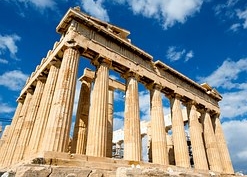
66-colossus-2Here’s what’s left of the original Parthenon (or “O-Parthenon” if you will) – which I spent significant time studying in architecture school.  It is considered the most important surviving building of the classical culture of Greece, and the finest example of Greek architecture.  It is a temple dedicated to the goddess Athena, whom the Greeks considered their patron.  If you visit O-Parthenon today you won’t see much of the original structure, thanks to a mid-1600’s explosion of a munitions dump inside the building.  Attempts to restore O-Parthenon have failed for lack of funding.  Ironically, back in its heyday O-Parthenon was used as a treasury.

66-colossus-3Nashville’s Parthenon (“N-Parthenon”) is the complete restoration, and it is a colossus.  N-Parthenon is 200 ft. x 100 ft. with a surround of 70 columns.  Inside its main space you’ll find a massive statue of Athena, rising 42 feet from the floor and gilt with more than eight pounds of gold leaf.  A likeness of the goddess Nike standing in her right had is fully six feet tall.  Pictures don’t do justice to the scale of N-Parthenon.

The origin of the Nashville Parthenon is almost as impressive as the building itself.  Nashville’s Centennial Park was the site of the 1897 Tennessee Centennial and International Exposition, a celebration of the state’s 100th year in the Union, including dozens of pavilions, restaurants, and large-scale carnival rides.  Prominent within the Exposition was the Parthenon, which was surely a nod to the “Athens of the South”.  Nashville earned that nickname in the 1850’s for the city’s establishment of several institutions of higher education.

The Exposition Parthenon was built of plaster, wood, and brick; not robust enough to last beyond the year of the celebration.  But the cost of demolition and its popularity drove a movement to reconstruct the building in concrete – authentic to O-Parthenon to the last detail.  N-Parthenon was completed in 1931.  Athena herself was added in 1990.  Appropriately, N-Parthenon contains a wonderful collection of photographs and descriptions from the Exposition.  Makes our county fair look like small potatoes.

66-colossus-466-colossus-5

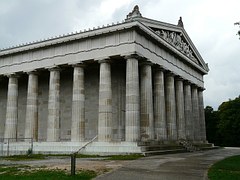
There have only been two other attempts to replicate O-Parthenon since its creation 2,500 years ago.  The Walhalla Memorial in Germany (above, left) was built in 1826, but the completed structure is merely a nod to the architecture of O-Parthenon and much more about the distinguished people in German history.  The National Monument of Scotland (above, right) was also built in 1826 – go figure – but abandoned three years later due to lack of funds.  Take your pick; I say N-Parthenon beats “G”-Parthenon and “S”-Parthenon in a runaway.

Any visit to Nashville should include some aspect of the city’s rich history and allegiance to the music industry.  But add the Parthenon to your agenda as well (especially if you think you’ll never make it to Greece).  Oh, and per the sign, leave the wheels at home.

66-colossus-6

Some content sourced from Wikipedia, “the free encyclopedia”.

Banana Rant

Let’s start with a song today; or at least a verse from a song.  See if you remember this little number:

Jack, Jack bo-back, Banana-fana fo-fack. Fee-fi-mo-mack, Jack!

The song? It’s “The Name Game”, that annoying rhyming chant that should stick in your brain for the next several hours.  Here’s another one:

Day-O! Day-O! Daylight come and me wan’ go home!

The song?  It’s the “Banana Boat Song”, made popular by Harry Belafonte.

65-expunge-1

I mention these songs because they’re happy on bananas.  And I hate bananas. Let me rephrase: there is no fruit, vegetable, or otherwise consumable item on God’s green earth more singularly unappetizing to me than bananas.  I only have to think about the taste of a banana and I consider tossing my cookies.  Bad news for me though – supermarkets, songs, commercials, movies and desserts ensure my world is constantly bombarded with the yellow fruit.  Bananas are as prevalent in the urban jungle as they are in the real one.

I blame my growing-up years, now that I think about it.  My first bike was a 1968 Schwinn “Lemon-Peeler”- the one with the “banana” seat.  What in God’s name was I thinking?  I could’ve had Schwinn’s “Pea-Picker” (green) or Schwinn’s “Cherry-Picker” (red) but no; I had to opt for a “Banana-Peeler” (as it came to be known).  It horrifies me to realize I sat on a banana for a good chunk of my childhood.

My Saturday mornings included “The Banana Splits Adventure Hour”; that silly animal rock band I somehow found entertaining.  Disney crushed me with “The Jungle Book”: King Louie eating bananas every time he was on-screen and even singing about them.  (I will never sing about bananas.)  Finally, I can’t shake those Chiquita banana commercials, the ones with Miss Chiquita dancing and singing: I’m Chiquita banana and I’m here to say… catchy little jingle.  It’s like the media was conspiring to force me to like bananas.

65-expunge-2

Fruit was a requisite item in my school lunches back then.  Oftentimes my mom would put a banana in my school lunch instead of an apple or an orange or grapes.  My protests went unacknowledged at home so I gave bananas away at school, to anyone who showed interest.  Not that I got anything worthwhile in return.  Bananas have little value in the American high school.

All of the above pales in comparison with one ghastly horror-film-worthy banana-filled-memory.  Coming into the kitchen one morning before school, I found my mom busily frying bananas on the stove.  I rubbed my eyes in disbelief but the image didn’t go away – banana slices sizzling and popping in an oil-filled pan.  Seriously?  Aren’t bananas bad enough the way nature made them?  Couldn’t I opt for a bowl of sliced bananas and oranges instead, where enough shredded coconut on top blocks out the banana taste?  Apparently not.  Mom just had to be adventurous.  I can still picture that plate of thin, dark, hot, greasy banana slices next to my more redeeming breakfast items.  Gag.  It’s a forever-imprint on my brain.

65-expunge-4

Even the concept of “acquired taste” failed me with bananas.  For example, I used to hate tomatoes (and yogurt repulsed me even more), but somewhere in my food journey I actually learned to enjoy them.  Now they are staples in my diet.  Not so bananas.  Bananas are as choke-worthy today as they were in that frying pan forty years ago.

If I must eat bananas there’s only one way they’re going down the hatch – in banana bread.  I actually like banana bread.  That’s probably because the dozen other ingredients win the battle and effectively expunge the banana taste.  It’s like Fig Newtons if you hate figs.  Or Oysters Rockefeller, with enough broiled cheese and spinach to effectively kill the oyster.

Opinion: bananas foster, banana splits, banana cream pies, and banana pudding are all outstanding dessert choices as long as you leave off the bananas.

65-expunge-4

Facts: 100 billion bananas are consumed every year across the globe.  Americans alone account for 27 pounds/person/year, which equates to 108 bananas!  You’ll find bananas on the list of the “World’s Healthiest Foods”.  The Latin word for banana translates to “Fruit of the Wise Men”.  California even has a Banana Museum for crying out loud. (17,000 items!)

None of that moves me.  Gwen Stefani may sing B-A-N-A-N-A-S on “Hollaback Girl” and shirts or sweaters may tempt me at Banana Republic, but I will never put “like” and “bananas” into the same sentence (er, except this one).  But hey, call me if you’re hungry.  My 108 bananas are all yours.

65-expunge-5


Foods are Something Else!

Let’s talk about hamburgers. Depending on your druthers a carefully-proportioned build of the bread, meat, vegetables and condiments makes for an American classic that – despite trendy variations – hasn’t changed in over a century. But here’s a curiosity for you: Why does every ingredient in a burger also serve an entirely different purpose in the English language? Let’s disassemble, shall we?  Top to bottom, I now give you the eleven essential ingredients.

64-druthers

The bun comes first of course; the capstone to lock all other burger components into place. But a bun is also an element of a hairstyle, is it not? You have that coil of hair on top of the head or at the nape of the neck and you call it a bun.  We even have the man-bun.  Er, not me.  The only bun I identify with is on my burger.

Below the bun we find a very small vegetable garden.  For today’s purposes we include onions, tomatoes, lettuce and pickles.  But did you know, if you know all there is to know about a topic, you “know your onions“?  Did you also know a tomato is old-world slang for a woman or a girl?  Lettuce is today’s language for cash – dollar bills if you will.  And a pickle, well that’s one of those predicaments where you say, “how did I get into this?”

Here’s a favorite ingredient.  I like bacon on my burger.  But not only are we all trying to bring home the bacon (i.e. make a living), but we’re also occasionally trying to save someone’s bacon (i.e. they desperately need our help).

Time for condiments.  In no particular order, squeeze on a little mustard, relish and ketchup.  Now, if I approve of your hamburger I tell you it “cuts the mustard“.  And when you sit down to enjoy your burger I assume you relish the taste.

(Confession timeout: ketchup exists for the one and only purpose of serving as king of the condiments.  Call it ketchup or catsup; all I know is the Chinese claim its invention.  So opportunity knocks; let’s get ketchup out of the bottle and into an alternative use in the English language!)

Now add a slice of cheese.  Think about that ingredient for a moment.  Where else do you use cheese outside of the food world?  Why, in front of the camera of course!  And when you “say cheese” let’s also agree it has nothing to do with the food, but rather the way the word forces your mouth into the requisite smile for the photographer.

We’re almost there.  The beef (patty) that is the essential ingredient of the hamburger is so much more than ground round.  It’s a reference to muscle or brawn (but not to be confused with “beefcake” as this blog is rated “G”).  Having a beef is about a complaint or an argument.  Building something in size or amount means beefing it up.

Let’s not forget about the bottom bun.  If we combine it with the top bun we have the plural, and that of course refers to a certain part of the human anatomy.  Pursue your “buns of steel” if you must; I will settle for my buns on burgers.

That’s all for today’s enlightenment on the vocabulary of the hamburger.  For extra credit check out the spice rack (“salt”, “pepper”, and so many more) or the bakery case (“cookies”, “rolls”), Foods are chomping to be more than just something to eat!

Thirst (for) Knowledge

Water.

Two parts hydrogen compounded with one part oxygen.  Transparent, odorless, and tasteless, yet we can’t survive more than a few days without it.  If not for oceans, lakes, ponds; rivers, streams, and creeks; and a whole lot of underground aquifers, we humans would be in a heap of trouble.  With due respect to Harry Potter, water is the elixir of life.

63-elixir

It’s fair to say most of us don’t drink enough water for optimal health. The long-held belief that eight glasses a day is sufficient has been replaced by the following formula: your body weight in pounds, divided by two, expressed in ounces. For most of us that means even more than eight glasses.  Gulp.

Somewhere along the way of several years of working out, I developed the habit of drinking small amounts of water during exercise, instead of chugging just before or just after.  On the treadmill for instance, I take a slug every time I complete a kilometer.  In the cycle class I drink every time the instructor says to pick up the bottle.  In a road race I never pass up the tables of water cups.  No question; the body works better with a regular intake of water.  Or at least a splash to the face.

Whenever I know I’m not drinking enough water I recall two vivid memories where I reached full-on dehydration status.  The first occurred as a child, when I was driving in the desert with my family.  I let the day go by way too long without taking a drink, and before I knew it my throat was so parched I could barely speak.  The heat of the day surely made it worse.  I pleaded to my grandparents to stop at a gas station (or anywhere with a halfway sanitary drinking fountain), which we eventually did, and I’m sure I took in a quart or more to quench my thirst.  Here’s a little irony: my desert dehydration is a fond memory because I can still hear my grandfather’s distinctive voice, saying, “need to wet your whistle, do ya?”  That was over forty years ago.

My second “parchment” occurred just short of the summit of Pikes Peak here in Colorado Springs – the first time I climbed it.  Pikes Peak is the highest mountain in the southern Front Range of the Rockies, at just over 14,000 feet.  Using the popular Barr trail it’ll take you five or six hours to get to the top.  Despite recommendations to carry a lot of water I only brought one 12-oz. bottle in my pack, which I refilled at a campsite halfway up the mountain.  I was getting by okay until the very last mile, when I ran out of water and my body literally began to shut down.  The combination of the effects of dehydration and altitude was devastating.  I could only walk a hundred yards at a pop, taking a seat on the rocks each time to recover for several minutes.  Mercifully I was close enough to the summit that I finished the hike, but not before realizing I’d been woefully unprepared.  In extreme circumstances the body demands a lot of water.  Certainly more than half your body weight in ounces.

If an elixir is defined as “a magical or medicinal potion”, then water qualifies in my book, and especially here in the high altitude of the Rocky Mountains.  It took a few years for me to gain a little thirst knowledge, but now my water bottle is my constant companion.  On that note, I think I need a drink!

Sphere Elegance

I love full moons.  They look a little too perfect to be one of nature’s essential elements and too large for the vast universe that surrounds them.  Yet there they are, perched silently above the horizon every month or so, beckoning to be plucked out of the night sky.

62-astronomic-1

We had a full moon last Friday and the next will be in mid-October.  But September’s stands alone, as it is rises closest on the calendar to the “Autumnal Equinox”.  It signals the end of the longer summer days, earning the nickname “Harvest Moon”.

The Autumnal Equinox (AE) takes place on September 22nd.  In fact, I timed the publishing of this post to the exact minute of the AE: 8:21am MDT.  The AE is the instance the earth’s axis is exactly perpendicular to its rotational axis around the sun.  When the axis is straight up and down you have equal amounts of “day” and “night” in that twenty-four hours.  That’s a pretty cool slice of astronomy.

As long as we’re in the classroom, the AE also signals the transition from summer to fall in this part of the world.  Yet anywhere in the earth’s Southern Hemisphere the AE signals the transition from winter to spring.  That fact brings a moment of confusion when you consider the Summer Olympics were just hosted in Brazil, doesn’t it?  At least they had a full moon last Friday, same as everywhere else.

Growing up in a narrow winding canyon, a full moon was a rare sight.  Back then I should’ve thought to wake up in the middle of the night, stand out on the lawn, and stare straight up into the sky to see one.  Maybe I saw a few fulls when I was camping in the Boy Scouts.  Or maybe I just remember them from several of the animated Peanuts specials.  (Charles Schultz was a fan of full moons.  Just watch “It’s the Great Pumpkin, Charlie Brown” next month on TV; or “Snoopy, Come Home” on NetFlix).

62-astronomic-2

As much as I enjoyed our Harvest Moon, it turns out I have an even bigger lunar event around the corner.  On November 14th we get a “Super Full Moon”.  A Super is the one full moon each year where the orbit of the moon is closest to the center of the earth.  So the Harvest may be big but the Super should be astronomic!

No discussion of full moons would be complete without a nod to the “Blue Moon”.  They say, “once in a blue moon”, and that means not very often.  A Blue is a second instance of a full moon in a calendar month.  There were no Blue Moons in 2016 (except the several I purchased for my own consumption of course).

62-astronomic-3

Thankfully I no longer live in a narrow winding canyon but instead in wide open spaces.  No fulls can slip by me anymore.  And I assure you, on that Tuesday in November the week before Thanksgiving, I’ll be hanging out in my family room window at dusk gazing east into the sky.  My Super will be on the rise.

Note: Portions of this post are credited to the research found at timeanddate.com.

Sentimental Utensil

My wife and I were cleaning out the kitchen a few weeks ago when we came across a rather strange-looking device. It could be described as a combination between a small pair of metal tongs and some kind of slicer. We racked our brains trying to figure out what it was for.  Eggs?  Nuts?  Ice?  Bewildered, we wondered if it even belonged in the kitchen.

I showed our gadget to a couple of friends but they were as confounded as I was.  Then I turned it over to my ever-resourceful sister-in-law. She took it to a a couple of kitchen stores and asked several friends, all to no avail. Finally she showed the device to her hair stylist – who sent a phone video to his girlfriend – and voila! – mystery solved.  Turns out our little mechanical metal friend is a butter cutter.

I don’t blame you if you’re still confused.  Not only did I wonder why (as in, why do you need a butter cutter?) or how (as in, how do you use the darned thing?), but also when (as in, when did people ever use one of these?).

I’ll get to the why in a minute.  As for the how, a butter cutter is used by holding the blade perpendicular to a stick of butter, pressing the base down into the stick, then pushing down on the blade.  The push down and spring back of the blade produces the “pat” of butter you sometimes get with a dinner roll at restaurants.  Move on down the stick and you can churn out butter pats to your heart’s content.

As for the when, it turns out our butter cutter is vintage.  It was popular back in the 1950’s.  If you simply must have one for your kitchen, go here.  But my research also led me to ask which, as in which one?  It turns out there are several butter cutters for your consideration:

61-vintage-2Here’s another vintage model – a bunch of pats all at once!

     61-vintage-3        An updated model – regurgitates pats one at a time.

61-vintage-4The Rolls-Royce of cutters.  How thick do you like your pats?

   61-vintage-5      No comment.  This one is simply disgusting.

Remarkably, there are lots of butter cutters out there if you search long enough.  Some claim to also work on rolls of cookie dough.  Others claim to also cut potatoes into chips.  But the more models you find, the more you’re inclined to ask why?  Why go to so much trouble to cut butter when a perfectly ordinary kitchen knife will do just fine (and with far less mess?).  That earth-shattering question is actually covered at unclutterer.com, a blog about “getting and staying organized”.  Check out the hot debate and the wealth of reader comments here (from people who clearly have too much time on their hands).

My own take on why is more satisfying.  The more I thought about our butter cutter, the more I realized I probably inherited it from my mother.  Along with other kitchen items, she probably tossed it into a box as I was heading off to my first apartment so many years ago.  And thinking about it even more, I can picture my mother using her butter cutter when I was a kid, leaving a perfect little pat beside the crescent roll that was positioned carefully on the bread plate beside each place setting at the dinner table.  Because that was my mother.  She was all about the dinner table.  Everything had its place, even the pats of butter.  And there’s an element of grace that comes with the butter cutter that would not be found in simply using a knife.

Laugh at the pointlessness of a butter cutter if you must.  But I will cherish mine instead, as well as the vintage memories that spring back every time I use it.

American Pastime

Over the next three months, on any given Saturday, the spotlight of college athletics will shine brightly on football. Millions of fans will flock to stadiums (or in one instance, a motor speedway) to witness this most American of sports. Tailgate parties will crop up hours before kickoff.  Team-branded merchandise will fly off shelves to the tune of millions of dollars.  Broadcasters will endlessly debate one team’s merits versus another’s shortcomings.  It’s fair to say college football will be a more consuming topic than the presidential election.

60-indelible

Last weekend my family and I experienced the unique opportunity to attend two college football games in Texas on consecutive days. UCLA played Texas A&M in College Station on Saturday, where A&M’s Aggies won in thrilling fashion in overtime. Then Notre Dame played Texas in Austin on Sunday, where UT’s Longhorns also won in thrilling fashion in double overtime. On Friday we could’ve added yet another game, passing through Waco as Baylor opened its season against Northwestern State.

Here are a few college football statistics for your consideration:

  • There are well over 100 NCAA Division 1 college football teams competing on any given Saturday of the season.
  • The combined attendance to last weekend’s games involving at least one team in the Associated Press (AP) Top 25 was over 1.5 million fans. That included UCLA-Texas A&M (100,443) and Notre Dame-Texas (102,315 – an all-time record for a Texas home game).
  • The face value of a major college football game ticket is around $100 this year.  Accordingly last Saturday’s AP Top 25 games alone generated $150 million (not counting merchandise, concessions, and parking).
  • There are eight college football stadiums in the U.S. with more than 100,000 seats, and another twenty-two stadiums with more than 75,000 seats.  The largest NFL football stadium has 82,500 seats.
  • Next Saturday’s college football game between Tennessee and Virginia Tech will be held at Bristol Motor Speedway (TN).  The 150,000 fans expected in the grandstands will shatter the all-time record for college football single-game attendance.

Sure, college football has some impressive numbers.  The game will only get more popular.  Yet last weekend also reminded me there are more indelible memories than the game or the venue itself.  Consider:

  • The heart-warming spirit of hometown Texas A&M.  As a fan of the opposing team, the reception in College Station is akin to a stranger inviting you into his living room for sweet tea and cookies.  I lost track of how many Aggies welcomed us to campus, wished our team well, or simply thanked us for making the trip.  Their politeness is downright 1950’s-sitcom.  With that in mind, add See a football game in College Station to your bucket list.
  • A&M’s Fightin’ Texas Aggie Band.  Also known as the Corps of Cadets, the four hundred musicians comprise the largest military marching band in the world.  Their movements are so coordinated and precise you’d swear you were looking at a computer-generated equivalent.  One Aggie actually apologized to me for the “old-fashioned” feel of the Corp.  On the contrary; it was one of the most impressive halftime shows I’ve ever seen.
  • The Littlest Fans.  Texas A&M and Texas alike draw a healthy number of families to their games.  My favorites are the little ones: those fans between the ages of 5 and 15.  They’re decked out in their team colors and face paint, with shiny hair ribbons and pom-poms.  We had several of them sitting right in front of us at the Notre Dame-Texas game.  Their innocence and unabashed enthusiasm were priceless.

My advice after my mega-weekend of college football?  Ditch the television.  GO to a game and see what you’re missing.  There happens to be one this Saturday, and not far from where you live.