
Hello, I’m Veronica
The sky is not completely dark at night. Were the sky absolutely dark, one would not be able to see the silhouette of an object against the sky.


-
Selfish Shopping
The hustle and bustle of the holiday season is on full display this week. We’ve reached the critical timeframe – ten days out – where packages must be sent if they’re getting to destinations by Christmas. We’re making lists, not just for Santa but also for last-minute purchases. Now here’s the good news, weary shopper: no matter where you’re spending your holiday dollars, self-checkout is often an option.
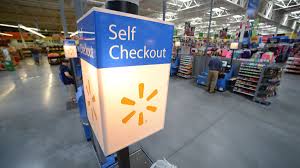 If you’re like me, you beeline to self-checkout when you’re done shopping. You still have “the control”, as people like to say (who also prefer to drive instead of fly). With self-checkout you believe you can scan and bag faster than those who are paid to do so. Maybe, but consider the decisions you have to make in the process::
- When do you choose self-checkout? Most of the time, (especially if the checker-bagger lines are long) but what if you have a lot of items? Self-checkout is awkward with a full shopping basket (ignore the stares). One time my wife and I snagged side-by-side registers, put the cart between them, and scanned away. Against the rules, you say? What rules? 🙂
- Where do you stand in line? This is touchy territory, shopper. If you face the typical arrangement where one set of registers sits opposite the other, with enough open space in between, you can get separate lines for each set… which gets ugly when a person assumes he/she is entitled to the next available register on either side. Prepare for battle.
- Which register do you choose? Murphy’s Law of Self-Checkout: One of the registers doesn’t work. You just assumed it was available because you couldn’t see the “out of order” screen until you were right in front of it. Now you have to turn around and reclaim your place in line. Again, ignore the stares.
- When do you alert the self-checkout human assistant (oxymoron?) How many times have you gotten ahead of the system only to hear, “unexpected item in bagging area” or “please wait for assistance”? Here’s a tip: don’t wait for assistance. Most of the time the register is trying to catch up and just needs a little more time. Congrats, you’re faster than a computer.
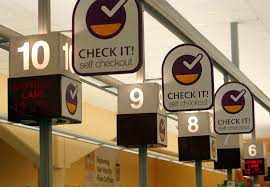 Hard to believe, but retail self-checkout just celebrated forty years. We shoppers been doing what one writer describes as “quasi-paid unforced labor under surveillance” since the 1980s. I remember how I wasn’t thrilled about the concept when it debuted. Back then I thought, “Why do I have to do the checking out when someone else is paid to do it for me?”
I was even more annoyed when the airlines put up their “selfish” kiosks and dared travelers to check themselves in and print their own boarding passes. How quickly we adapt. Today I’ll choose self-checkout any time I’m given the option (even though surveys say 67% have a bad experience). In fact, we’ve been conditioned to self-checking out ever since the debut of the bank ATM in the late 60s. DIY checkout will only get more prevalent as companies reduce labor costs. One of these days I can picture a self-checkout Starbucks, with a fully mechanical barista standing by to whip up your skinny latte. Don’t bet against it.

Reasons we choose self-checkout (web.mit.edu) Self-checkout is about to enter a new arena: clothing stores. But what about those security devices attached to the sleeves or pant legs? And how will they know if we slip an extra pair of shoes into the box? The bigger concern, however, may be image. How will Saks or Bloomingdales look with a bank of self-checkout registers next to their fancy cosmetic counters? Not the pretty picture of luxury shopping we’ve come to expect.
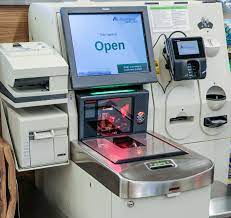 Image doesn’t matter to me so much, but my time does. If self-checkout returns a few minutes to my day, I say sign me up. But somewhere we’ve got to draw the line, people. At the rate we’re going, human interaction will soon be the exception, not the rule. It’s also not the direction a world in need of more face time should be heading.
With that, I put down the keyboard for the remainder of 2022. Remember, the holidays are anything but “selfish”, and everything about face time. Merry Christmas!
Some content sourced from the CNN Business article, “Self-checkout annoys some customers…”
-
Bread, Salt, and Wine
As the endless loop of Christmas-cookie-cut Hallmark movies beckons yet again this year, the tried-and-true season classics struggle for air time and our time. If it weren’t for streaming you might not be able to watch A Charlie Brown Christmas anymore. You’ll have an easier time finding Miracle on 34th Street (but maybe not the 1947 original). On the other hand, you should find It’s A Wonderful Life right there in your online library or movie collection. You do have a copy of the greatest Christmas movie of all time, don’t you?
 CNN Entertainment recently posted a list of “Hollywood’s stars’ favorite Christmas movies”, which is wrong on so many levels. I’m not saying an actor can’t be an authority on movies. Some of those interviewed have been in Christmas movies themselves. No, it’s more about the concept of ranking Christmas movies. It’s a futile attempt to place one above another, when the truth is each of us already has a favorite. I may be trying to sway you to my favorites today, but deep down I know you have yours and they’ll never change. Until a better one comes along, that is.
CNN’s list – or anyone’s for that matter – includes movies I struggle to associate with Christmas. Home Alone? The Holiday? You’ve Got Mail? Sure, each of these takes place during the season but they’re not really Christmas movies. Strike them from the list, please.
How about The Santa Clause, Rudolph the Red-Nosed Reindeer (the 1964 stop-motion original), or How the Grinch Stole Christmas (Boris Karloff or Jim Carrey, you choose). Okay, now we’re starting to get somewhere. With each of these films you can at least claim a story about Christmas. They even include pretty good messages about the spirit of Christmas. Just not THE message.
 A Charlie Brown Christmas still gets me at the end when the Peanuts gang sings, “Hark! The Herald Angels Sing”. The Polar Express asks us to just “Believe”, which I would if I could get past its creepy animation technique. And Love Actually is a collection of feel-good rom-com stories where viewers tend to choose just one as their favorite (again with the rankings). But none of these films dig much below the surface of the reason for the season.
 [For the record, I’ve never been a fan of “A Christmas Story”. I think it’s a cult classic with a bizarre sense of humor. One or more of you will disagree, which means you’ll be happy to know about HBO Max’s follow-up film featuring Peter Billingsley (again) as very grown-up Ralphie.]
Okay, I’ve stalled long enough. I could take on another dozen so-called classics and explain why they don’t belong on any “best list” of the season’s movies. Instead, let’s cut to the chase and cover the three films whose stories illustrate the meaning of Christmas:
 A Christmas Carol. The Charles Dickens classic has been recreated on film more times than I can count (and most versions are pretty good) but it’s hard to top the 1938 original. Maybe it’s because Dickens’ ghosts really scared me the first time I saw them (even in black-and-white). More likely it’s because Reginald Owen so perfectly portrays the remarkable transformation of Ebenezer Scrooge from mean and miserly to giddy and grateful.
 Miracle on 34th Street. Again we have several versions here, but none better than Edmund Gwenn’s turn as Kris Kringle in the 1937 original (for which he won an Academy Award). Also, I’ll watch any movie with the lovely Maureen O’Hara, and Natalie Wood is adorable as sweet, innocent Susan Walker. But above all, “Miracle…” is about believing. C’mon, you remember the scene… all those bags of letters to Santa being dragged into the courtroom…
 It’s A Wonderful Life… is, simply put, in a Christmas class all by itself. When critics describe this film as, “The holiday classic to define all holiday classics…”, you know you’ve got something special. If you’ve never seen It’s A Wonderful Life, kindly put down your electronic device and spend the next two hours with George Bailey in his little town of Bedford Falls. Talk about the meaning of Christmas. I won’t give it away, but the final scene where Mary drags George down the stairs to see “the miracle” is the message of the entire movie.
Maybe you don’t agree with my top Christmas movies (comments, please!), but you should at least admit to an underlying concern. All three of my choices were produced over fifty years ago. Fifty years! Am I suggesting there hasn’t been a more meaningful Christmas movie made in the last half-century? YES, I AM! Seriously, Hollywood, you can do a whole lot better than Elf.
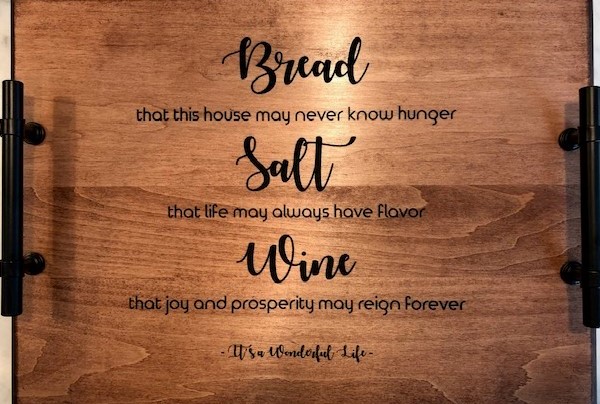
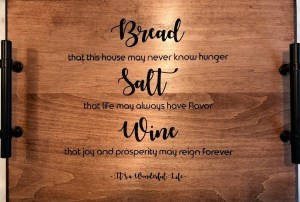 If you’ve spent any time watching the Hallmark Channel this season (and… sigh… a ranking of those Christmas movies can be found here), you owe it to yourself to also watch at least one of the three movies I highlight above. Hopefully you’re watching them again, not for the first time. After all, as we learn in It’s A Wonderful Life, there’s much more to bread, salt, and wine than just the title of a blog post.
Some content sourced from the CNN Entertainment article, “Tom Hanks and more stars share their favorite Christmas movies”, and IMDb, the Internet Movie Database.
-
Doorstop Topper
The word nerd in me thinks it’s cool when one can be modified to make four others simply by changing the same vowel. Batter will be in abundance the next several weeks with all of the baking. The holidays are always better when shared with others. Colorado’s bitter cold winters are a thing of our past now that we’ve moved to the South. The chaos of the holiday season doesn’t really “bott_er” me (okay, that one’s reaching). But finally, we have butter. Ah, there’s nothing better than (or bitter about) butter, is there?
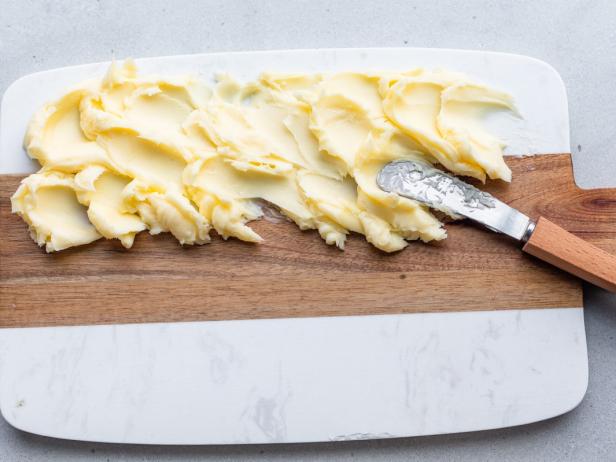
 The topic of butter is brought to you today by an utterly ridiculous here-today-gone-tomorrow suggestion to make your holiday hosting more glam than your neighbor’s: butter boards. When I saw this picture I didn’t even understand what I was looking at. Even more insulting to this word nerd: the opinion piece I found describes a butter board as “charcuterie”. No, it’s not. Charcuterie is meats, not dairy. This unappetizing appetizer is nothing but butter, spread on a board, with toppings designed to take your attention away from the fact that it’s, well, butter on a board. I mean, if you’re gonna do faux-fancy at least go with peanut butter on a board, right?
Butter boards are an insult to butter. I think we can all agree, butter stands alone. You don’t need nuts or roasted garlic or dried fruit to
hidedress it up. As long as your butter comes from fresh, quality ingredients, it makes anything it pairs with better. Except a board. Can you tell I’m “bott_ered” by butter boards? It’s because my wife and I take our butter so seriously. Ever since a trip to Ireland, we learned the best butter is not only about quality, but quantity. At dinner in a quaint hotel in the Connemara region north of Galway, the waiter brought us a big serving of bread with an even bigger serving of butter. Seriously, the butter was more “brick” than “stick” (and certainly not “pat”). Ever since, our go-to butter is a brick. It also makes a great doorstop straight from the freezer.
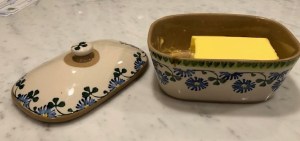 Our butter dish is even designed for a brick, see? A stick would be lost in this Irish pottery; a pat even more so.
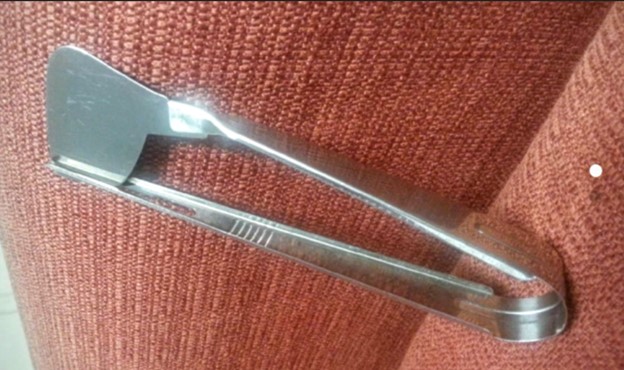
Speaking of butter pats, I must make mention of the device in the photo below. I wrote a whole post about it once called Sentimental Utensil. Who knew this petit guillotine was a timesaver to make butter pats? It showed up mysteriously in one of our kitchen drawers one day and I can only assume I inherited it from my mother. But inherited it shall stay. I can never get enough memories of my mother, as I alluded to in this paragraph from the past post:
 And thinking about it even more, I can picture my mother using her butter cutter when I was a kid, leaving a perfect little pat beside the crescent roll that was positioned carefully on the bread plate beside each place setting at the dinner table. Because that was my mother. She was all about the dinner table. Everything had its place, even the pats of butter.
If you read the article on butter boards (please don’t) there are several dead giveaways on how forced this holiday trend feels. The first is right up there in the teaser subtitle: “Butter boards have gone viral…”. No, they haven’t, else this topic wouldn’t be worth
warning youposting about. “… because of their novelty and shock value.” Their novelty? Shock value? Is one of your guests going to look at your butter board and say, “Well now, isn’t that novel?” And just what about a butter board causes “shock” other than the writer’s excuse to use (part of) the overused phrase “shock and awe”? It’s just butter, people.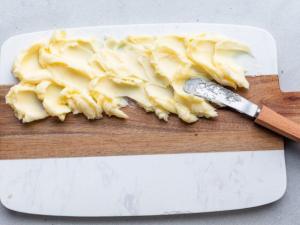 The article should’ve gone with just the title so we could draw our own conclusions. Instead, you’ll find phrases like “… how fun the concept is…”, “… what’s fascinating about butter boards…”, and “… extremely versatile as an appetizer…”; none of which are true. The writing takes itself way too seriously and goes on way too long about something I will way never prepare. Unless it were frosting, of course. A “frosting board” would get my attention for sure. Put out a plate of cookies with a frosting board and I’m all hands.
But enough of the butter boards. You’d have to be blind as a bat to fall for this faux-fancy offering. I’ll bet you’ve already stopped reading. If you did make it this far, thanks for sparing a bit of your time. Comment so I know you’re not a bot.
Some content sourced from the Food Network article, “How to Make the Perfect Butter Board for the Holidays”.
-
Feast of Family
- The turkey reminds me of my father-in-law, who always assumed the carving duties and insisted all dinners begin precisely at the top of the hour.
- The dressing reminds me of my mother-in-law, who insists you taste-test as you go to make her meal-in-itself recipe just right.
- The whipped cream reminds me of my son, who would top off his pie and then tip the can directly into his mouth for a second helping.
- The crescent rolls remind me of my other son, who never lets the meal go forward without them.
- The sweet potatoes (in scooped-out oranges) remind me of my daughter, whose version is best described as a work in progress.
- The Waldorf salad reminds me of my dear mother, whose recipe – as I discovered years later – is notably different than the one served at the famous New York City hotel.
- The mincemeat pie reminds me of my dear father, with whom I was the only family member to indulge in this carb-laden throwback treat.
- … and finally, the pumpkin pie reminds me of my beautiful wife, who always doubles the spices to make the dessert (and everything else about the meal) twice as nice.
Today reminds me of the bounty of family and friends; a Thursday best spent with those you love (instead of reading blog posts).
Happy Thanksgiving!
-
Decades to Decadence
Waiting in line for the bank teller, as I did last Monday, is decidedly old-school. It’s a face-to-face experience so much more inefficient than the drive-thru lane or smartphone options. But sometimes we still go brick-and-mortar, don’t we? Stopping into the bank is either convenient in the moment or perhaps the transaction demands a real, live person. And so we wait. But at least cashing a check doesn’t take thirty years. It just seems that long sometimes.
 Every now and then you see a headline and say, “Wait a minute… WHAT?” And then, even with no interest whatsoever you still read the article. Such was the case this week with a story about Kobe beef. I’ve never eaten Kobe beef. I’m too cheap to even give it a try. I’ll concede the price is justified by the high quality, high demand, and low supply. But what if you had to wait until Thanksgiving of 2052 to be able to enjoy it?
Here’s the gist of the story. A small, family-run butcher shop in Japan makes a beef croquette so popular it’ll take you thirty years to get one. Asahiya, about to celebrate a century in the meat business, began producing its croquettes shortly after World War II. The deep-fried meat-and-potato dumplings were designed as a tease; a mere taste to draw customers to its larger, more expensive products. The strategy didn’t pan out so well but the croquettes themselves became an Internet sensation, and the inevitable hype that followed created a line of customers thirty years long.
 [Note: If a Kobe beef croquette sounds “decadent” you’re probably right, but you’re using the wrong word to describe it. Decadent actually means “excessively self-indulgent”. Instead of the food itself perhaps you’re talking about a customer willing to wait thirty years.]
I hear what you’re saying. I wouldn’t pay big bucks for something like this Dave, let alone wait thirty years for it. But go figure; an Asahiya beef croquette costs only $3.40 USD. You could buy a box of ten for less than you probably paid for your Thanksgiving turkey. You just need a very comfortable chair as well. Asahiya makes only two hundred croquettes a day (or twenty customers’ worth) so it’s no wonder you have to wait so long.
Technology being what it is today, we’re not patient waiters anymore. Amazon and others are getting close to same-day delivery on the items we consume regularly. Many amusement parks and tourist attractions have adopted Disney’s approach, where you can pay more to “jump the line”. Want tickets to the next Taylor Swift concert? Pay a “line-stander” to buy them for you. Want season tickets to the Green Bay Packers? Okay, sorry, there’s no way around that one. The seats at sold-out Lambeau Field simply pass down the line from generation to generation. But you can still join the list for this impossible get, just to say you’re on it.
 This week’s visit to the bank felt like an impossible get. I made it to within one customer of the front of the line before things came to a grinding halt. Only two tellers were open out of the four. One was preoccupied by a woman who wanted cash and a money order, with terms so specific you knew she was going to be awhile. The other was completely preoccupied by an older gent, carrying on a personal conversation while constantly losing track of whatever he was asking for in the first place. Meanwhile, the back window drive-thru teller was cranking out transaction after transaction after transaction. Shoulda, coulda… I know, I know.
I thought the beef croquette story was timely, not because I went to the bank but because next Thursday is Thanksgiving, when Americans wait all day long. We wake up early, get the oven going, prep the bird, and spend a long time putting the rest of the meal together. We eat earlier than most dinners (does that make it “supper”?) but it’s still a waiting game. Hours and hours of anticipation before the food is finally brought to the table.
 If there’s any good news about Asahiya’s Kobe products, it’s that they have options besides the “Extreme” beef croquettes. There’s a more accessible variety called the “Premiere”. You only have to wait four years for those. When you consider how fast we’re going through U.S. Presidents lately, four years doesn’t seem like a long time at all.
Some content sourced from the CNN Travel article, “These Japanese beef croquettes are so popular there’s a 30-year waiting list”.






About Me
The sky is not completely dark at night. Were the sky absolutely dark, one would not be able to see the silhouette of an object against the sky.
Follow Me On
Subscribe To My Newsletter
Subscribe for new travel stories and exclusive content.
 Life In A Word