
Hello, I’m Veronica
The sky is not completely dark at night. Were the sky absolutely dark, one would not be able to see the silhouette of an object against the sky.


-
Sitting in the Catbird Seat
Though she’s only four, our granddaughter relishes being the eldest in her family. She already demonstrates the authority associated with the role, especially in the presence of her siblings. She seems to understand how her position in the order comes with slightly increased expectations. Her sisters will challenge her command as they grow older (and won’t that be fun?) but for now, for the most part, they take her lead. Not that I would understand “first position”, mind you. I’m neither the oldest nor the youngest in the family I grew up in. I’m what you might call an “off-center middle”.
 If there’s a significant advantage to being a middle child (I’m the fourth of five) I’ve yet to discover it after all these years. The eldest child experiences the “firsts” (driving, voting, etc.) while the rest of us wonder when it’ll be our turn. The youngest receives a gentler version of parenting (and who can blame a parent after five kids?) Meanwhile, the middle(s) are looking in both directions wondering where to take sides. Inevitably, to appease all, the middle child finds a way to agree with everyone. Our son is also a middle and he’s neutral so often we’ve nicknamed him “Switzerland”.
 Maybe we middles have it better after all. It’s not often I fall into the vast minority on a topic but today I do, because… I prefer the middle seat on airplanes. A recent survey says only 6 out of every 1,000 frequent flyers feel the same way. My five outliers and I have our reasons; mine make flying more comfortable for me. On the aisle I can’t help leaning out a little, to where beverage carts or those passing by brush up against me. On the window (which I happily bequeath to my wife) I have less elbow room up against the glass. Even when the passengers on either side of me take the armrests (a subject to toss about another day) I still feel my greatest sense of freedom is in the middle seat.
 I can now reap rewards for my middle-mindedness. In a promotion sounding equal parts creative and desperate, Virgin Australia (VA) is giving away prizes to make the middle seats on its airplanes more appealing. Just by choosing the middle, I enter a lottery for a million VA frequent flyer miles, a helicopter pub crawl (a what?), or a bungee jump (but isn’t Australia flat?). I can even win tickets to the final of the Australian Football League. Of course, entering VA’s “Middle Seat Lottery” assumes I want to fly somewhere within Australia. I also have to join VA’s frequent-flyer program. And I’ll need to figure out Australian football, which may be the toughest ask of all. But you get the idea. “In the middle” is now a little cooler.
Maybe the airlines should revive an old saying. They could call the middles catbird seats instead. After all, “sitting in the catbird seat” refers to a position of advantage or superiority. I can win the helicopter pub crawl and you can’t (advantage) and I’ve deluded myself into thinking I have more elbow room than you do (superiority). All from the catbird seat.
 Try as I might, definitions of “middle” never stray far from “average”, or at best “neither one extreme nor the other”. The dictionary also labels me as “ordinary”, “mediocre”, “commonplace”, and “pedestrian”. Even if I spice up the word to “middling”, I’m still defined as just “medium” or “moderate”. I could stretch things a bit and go with “fair to middling” but even then I’m merely slightly above average. Nope, the only “outstanding” middle I can come up with is our stomachs when we’re, ahem, not in the best of shape.
  “Sitting in the catbird seat” works well for today’s topic, because I moved to the American South just a few months ago. The phrase originated down here a long time ago. Literally, it’s a bird’s habit of singing from way up high in a tree, a sort of nyah-nyah-nyah to its predators who can’t climb nearly as high. And maybe that’s my aim for today: to elevate us “middle-peeps”, even if I haven’t come up with much substance to do so. But consider this: the more of us there are, the less likely you’ll be sitting in the middle seat. As a thank-you, the least you can do is meet me in the middle and pick up my beer tab when I win the helicopter pub crawl.
Some content sourced from the CNN Travel article, “Airline launches lottery to entice more passengers to sit in the middle seat”.
-
Big Shoes to Fill-y
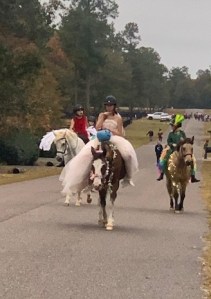
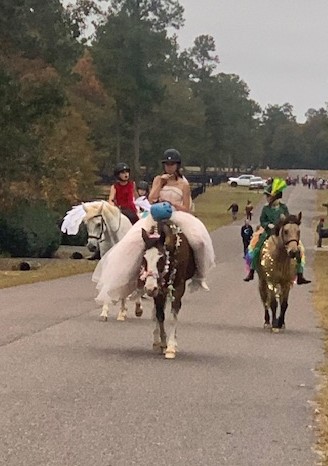
Last Sunday, the day before Halloween, our neighborhood hosted a lively parade. Kids of all ages dressed in adorable to “a-horror-full” costumes, to trick-or-treat past each driveway… on horseback. In a bit of a role reversal, we residents walked treats out to the horses and riders (because trust me, a stallion trotting up your front walk is not recommended). Candy for the kids, cookies for the parents who walked beside them, and carrots for the hardworking horses. As you would expect, a steady “clip-clop” filled the air for hours. Yet it could’ve been a lot quieter.
 Here’s an idea I never ever would’ve thought of. Take a pair of sneakers, break them down into their component parts, and reassemble them to fit a horse’s hoof. Making a statement of purely fashion (vs. function), Horse Kicks allow your equine to sport two pairs of your favorite New Balance, Adidas, or Nikes. These giant “tennis shoes” are built on top of a pre-made protective boot so they really do support an animal weighing a thousand pounds or more. Order yours today for only $1,200.
 Sorry, I’m not buying. I don’t think sneakers are a good look on horses, any more than when paired with formalwear on a human. If a filly could talk, she would say, “Get those ridiculous things off of me!”, even though ladies love shoes. Sneakers are best left to walkers and athletes, while steel horseshoes, as they have for thousands of years, fill a horse’s bill as comfortably as a couple of pairs of flip-flops (er, “clip-clops?”)
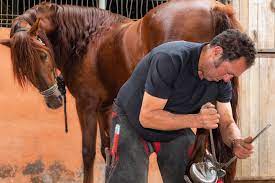
I can’t imagine the effort it takes for Horse Kicks to create their shoes (besides the seventeen hours of assembly time) but they don’t work nearly as hard as a traditional horseshoer. That person, a farrier, might as well be an ironworker. Watch one in action sometime as he/she trims a horse’s hoof or hammers the steel shoes to achieve the perfect fit. It’s the kind of backbreaking work that can lead to early retirement.
 Occasionally a horse throws a shoe, which is probably the origin of horseshoes as a game. The first time I “threw a shoe”- besides getting it nowhere near the stake – I remember thinking, “Man, these are kind of heavy”. (A horse wouldn’t agree.) And weight matters in the game because the shoe needs to fly a long way, like forty feet, for the chance for a “ringer”. Yes, horseshoes is basic (and predates similar games like ring toss, cornhole, and bocce) but it has its finer points. You flip a shoe to determine who goes first. After players throw two shoes each you’ve completed an “inning”. And a “dead ringer” really is a horseshoes term (too complicated to explain here), not just someone who looks like someone else.
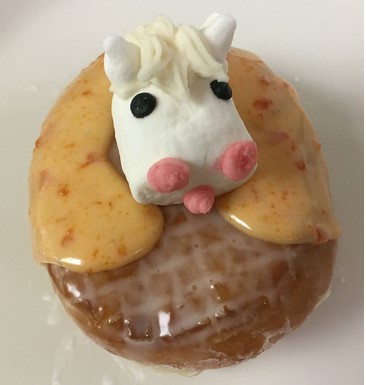
  [Snack break. Speaking of horseshoes, if you’re looking for “the best darn donuts in Colorado” you should check out Horseshoe Donuts, where we used to live just north of Colorado Springs. You’ll pay upwards of $25/dozen but trust me, these shoes… er, doughnuts are huge and worthy of expensive tastes. Most are shaped like traditional rings but the raised, glazed variety are giant horseshoes.]
 Even if I never buy a pair of Horse Kicks, that doesn’t mean you shouldn’t. You’ll probably see several on display this weekend at the Breeder’s Cup races in Lexington, KY (close to where they’re created). Part of the company’s initiative is to “bring awareness to the Bluegrass State”. And 10% of the proceeds go to central Kentucky charities. All of which makes Horse Kicks a worthy product. Not that I expect to see any in next year’s neigh-h-h-h-borhood trick-or-treat parade. It’ll be, as usual, clip-clops in steel flip-flops.
Some content sourced from the CNN Style article, “You can now buy $1,200 sneakers — for horses”, and Wikipedia, “the free encyclopedia”.
-
First Class is now un-American
On our return flight from Denver last Saturday, the woman across the aisle coughed so many times I lost count before I had a sip of my complimentary beverage. Another woman ten rows back had a speaking voice so loud you wondered how she could hear herself think. And then there were the backpacks, so… many… backpacks. Nothing wrong with carrying your stuff on your shoulders, except when walking down the aisle and the slightest turn of the hips gives me a not-so-gentle whack as I sit in my aisle seat. Which pretty much confirmed what I already knew. I should’ve flown First Class.
 Heads up, weary travelers. If your brand of travel abroad is a first-class seat, you’d better book one while you can. American Airlines (AA) just announced they’re removing those premium seats in favor of several more in Business Class. Why? Because nobody wants them. It’s not rocket science. Airplanes need to be full (like, 97% full) or airlines don’t make money. If a class of seat doesn’t interest a passenger the airline will find one that does. Put the champagne on ice, flight attendants.
 Even if dropping the very best seats makes good business sense, it doesn’t mean I’m happy about it. I’ve never deliberately flown First Class but I still get to walk down their aisle on the way to the cozier confines of
 CattleEconomy. As I do, I steal a glance to the left and to the right. What are they wearing? What are they drinking? Most importantly, what are they talking about? After all, these are America’s movers and shakers.Except they’re not anymore, now are they? Tell me who (or “what”) you see the next time you pass through First Class. The domain of the rich and famous is now diluted with passengers who simply rack up enough frequent flyer miles. Thus, next to the woman in the stylish suit with the glass of Pinot Noir, wrapping her important business call, you have the young tattooed character in tank top, shorts, and sandals, slurping a Rockstar energy drink while obliterating his latest Call of Duty foe. No wonder these seats aren’t selling anymore.
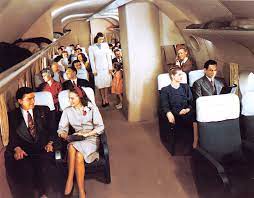 My kids don’t believe me but there was an era when people dressed up to travel. When I was young I wore a suit and tie on airplanes, as spiffy as a Sunday morning in church (although church attire has changed too, sigh…). Instead of a palm-sized bag of peanuts in Economy, you still got something of a meal. Flying was, back then, a classy step above other forms of travel.
Just because I can – and knowing American’s about to crash the party (poor choice of words) – I decided to book a first-class ticket to London for Thanksgiving. Get me to jolly ol’ England the day before (so I can overcome jet lag before the big meal) and have me back in my own bed by Sunday night. I know, I know, it’s practically Halloween already but guess what? There are still plenty of first-class seats for my un-American Thanksgiving. They’re just a little – ahem – pricey.
 My least expensive option on AA is $6,054, which includes two stops, choice of seat (but isn’t every first-class seat equally wonderful?), free baggage, and a full refund if I have second thoughts (which I will). My most expensive option is $12,966, with identical terms as the first option except this ticket is nonrefundable. Huh? Whatever. Even the least expensive option is more than my annual grocery bill. Let’s not book this trip after all. Let’s have turkey at home instead.
You can see where this is headed. Next thing you know AA will get rid of First Class on all of its flights. Then passengers will lose interest in Business Class so that’ll have to go too. Premium Economy will be the last to fold, until all we’re left with is a planeful of
CattleEconomy, every row and every seat. But given the attire and attitudes of passengers these days, isn’t Economy a perfectly-fitting shoe? As a friend described it, air travel these days is effectively a Greyhound bus with a couple of wings.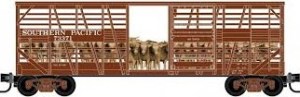 I just ran another itinerary on the AA website. I can visit my son in Dallas over Thanksgiving, flying First Class, for just over $1,000 roundtrip. That’s a bargain compared to London and I can get my turkey from a smoker (delicious!) Maybe I’ll splurge. After all, there may come a day when my grandchildren ask me, “What’s ‘First Class’?”
Some content sourced from the Fox Business article, “American Airlines ditching first class…“.
-
Drinkin’ Problem
Thanks to social media, product advertising is a complex challenge these days. Hiring an “agency” no longer suffices, at least not for major corporations. They depend on “brand builders” instead – Interbrand, for example. Interbrand boasts “…a global team of thinkers and makers [encouraging] bold moves to leap ahead of customers and competitors.” Interbrand also values the companies they help build. On their list, well inside the top ten: Coca-Cola.
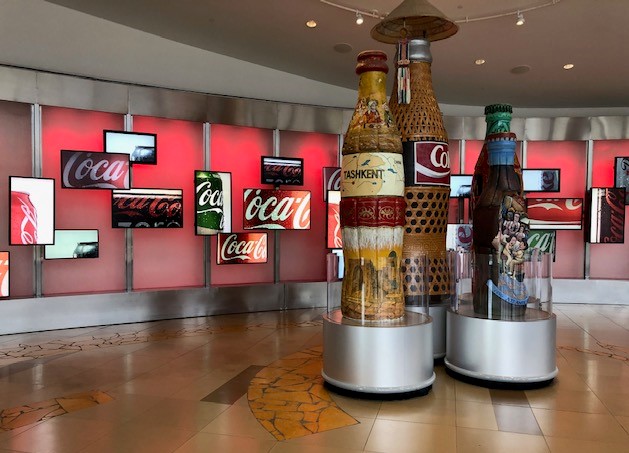
 My brothers and I gathered in Atlanta last week for a semi-annual reunion. Our initial stop wasn’t Coca-Cola’s world headquarters but rather, its popular “World of Coca-Cola” tour. If you haven’t walked through these doors, Coke has turned an impressive three-story building into a glittery three-ring circus to promote its products, with a side of historical context. As if Coke needs more promotion. The genius of this soft drink, as we learn on the tour, is the relentless, boundless effort to put Coke’s brand everywhere imaginable. Cans, clothing, and cars, just to name a few. But pixels?
 Here’s a weird suggestion. Go into your home laboratory, create a flavor, and label it something that doesn’t have a flavor. This is Coke’s latest go-to gimmick to retain market share. Coca-Cola Zero Sugar “Byte” has come and gone (limited-edition products are another way to retain market share) and you probably didn’t have a taste. And what does “data” taste like? According to drinkers it’s pretty much the same as Coke Zero, adding in the sensation of the old “Pop Rocks” candy.
 Coca-Cola also developed “Coke Starlight”, somehow determining the taste of “outer space”. Drinkers said it tasted like Coke with an aftertaste of cereal milk (ewwwww). Go to the store today and you can purchase the latest of these curiosities: “Coke Dreamworld”, which has been described as “Coke soaked in sour peach rings” (ewwwww again). As the saying goes, there’s no accounting for taste… or should I say, with Coca-Cola there’s no caring for taste. Instead, the bottles and cans promote music, videos, and other products through a QR code. And there’s the branding concept in a nutshell. You’re attracted to the purchase because it’s a Coca-Cola product, but the draw is anything but the drink itself.
I shouldn’t be surprised how far the taste of Coke has, uh, evolved in the one hundred and thirty years since its market debut. The variations on the original formula are myriad, including Cherry Coke, Vanilla Coke, Diet Coke, and “Coke Zero” (no added sugar but plenty of artificial sweeteners). Let’s not pretend any of these drinks are actually good for your consumption. But at least vanilla and cherry are tastes we understand. Dreams? Not so much.
 “Dreamworld” and the other recent flavors target “gamers and younger audiences”. My brothers and I saw a lot of kids on the “World of Coca-Cola” tour so maybe the advertising is working. Regardless, Coca-Cola has a bigger challenge to confront. Sales of soft drinks are on a serious decline, in favor of bottled water and healthier options. Coke recently cut its portfolio of soft drinks by fifty percent (bye-bye Tab) in an effort to improve its bottom line. To me, that’s a sound business strategy. But flavors that aren’t really flavors? That’s desperate.
 Coca-Cola had a big red flag in the 1980s (appropriate color, no?), one that should’ve discouraged future dabbling with their products. Who among you doesn’t remember the debacle of “New Coke”? The flavor variation – the first in Coca-Cola’s long history – debuted to rave reviews, with claims it was better than Coke or Pepsi. But here’s what Coca-Cola didn’t see coming: consumers immediately defended the original flavor. Instead of buying New Coke, they cleared the shelves of the original flavor for fear it would go away forever. Begrudgingly (and very quickly), Coca-Cola returned the original flavor to stores under the name “Coke Classic”. But New Coke never found legs and eventually disappeared from the shelves altogether, while “Coke Classic” returned as simply “Coke”.
” Coke Dreamworld”, as you would expect, features prominently in the “World of Coca-Cola” tour. The flavor that isn’t a flavor, along with a silly 3-D movie and a giant retail store, targets the youngest of consumers. But let’s be honest, most people go on the tour for the tasting room, where they can sample Coca-Cola’s products to their heart’s content. “New Coke” is not among those choices. Pretty soon I don’t expect to see any flavors-that-aren’t flavors either.
Some content sourced from the CNN Business article, “Coke’s latest bizarre flavor is here”, and Wikipedia, “the free encyclopedia”.
-
Cute Tips
I find it interesting a horse has its eyes on the sides of the head, not on the front like us humans. If a horse wants to “look you in the eye” he or she needs to turn its head ninety degrees one way or the other. On the other hand (or hoof) a horse has a clear advantage here in that it can see in two directions at once. If you think about it (er, “listen about it”) it’s the same setup as human ears.
 Last week, my sister-in-law came home from an acupuncture appointment to discover a few needles still stuck in her ear. Can’t blame her for not being aware, since those tiny needles are painless once they’re in. But removing them must’ve been tricky, either by pure feel or with the help of a mirror. You can’t see your ears. It’s kind of like a backscratcher for those places you can’t reach.
So it is with ears. Just because they can’t be seen doesn’t mean they don’t need occasional attention. The phrase has been lost on younger generations but parents used to double-check their kids’ hygiene by saying, “Did you wash behind your ears?” I did, and I still do. I also wash in my ears. With cotton swabs.
 We’re all built differently, which means some of us need cotton swabs for the ears and others can get by without them. For me, it’s two a day, every day (that’s over 700 a year for you counters). I’m an earwax factory and if I don’t attend to my canals regularly, I’ll be heading to the doctor for a rather awkward “irrigation” treatment. So I swab. Not like a sailor swabs the decks but you know what I mean.
I’m also built to collect water in my ears (the dreaded “swimmer’s ear”). It’s not too bad after a shower but I can count on it after a dip in the pool or the ocean. Sometimes swabs don’t do the trick and I have to resort to alcohol drops to dry things out. It’s messy business, this cleaning of the ears.
Cotton swabs (or “buds” for you Brits) have a succinct history. They were invented a century ago by a man who simply attached cotton to toothpicks as a way to clean his infant’s ears. He gave his product the name “Q-tip” (the “Q” for “quality) and eventually sold the patent to Unilever. About that time a woman came forward to say she invented the very same thing. Unilever settled the claim with her, and a hundred years later they’re selling $200 million in cotton swabs every year. That’s a lot of “cute tips”.
Cleaning ears with Q-tips, by and large, is discouraged by the medical community. Most of what you’ll read suggests you’re putting your hearing at risk by inserting anything into the ear canal. Common sense, yes, but there was a time Q-tips were marketed specifically for this reason. Today the advertising is for anything but, like dabbing makeup or sanitizing computer keyboards. The last thing a company wants is to promote a product that can potentially damage the body. Like the person who forgot they had a Q-tip in their ear and then whacked the side of their head. Ouch. That’s a trip to the ER if I ever heard of one.
 Q-tipping also feels good (to which those ER doctors say, “don’t try this at home!”) It’s like a tiny massage inside the ear and it’s addicting. You’re stimulating nerves that are hypersensitive because they don’t get much attention. For some, it generates an itch-scratch cycle that is difficult to stop.
 But enough about cotton swabs. Enough about ears. You can re-forget you have a pair on your head. Except if you’re me and they itch a lot. Or you live in the South, where gnats are attracted to them (a serious annoyance). Just remember to wash behind them. Use cotton swabs very carefully. And be thankful you’re not an elephant.
Some content sourced from Wikipedia, “the free encyclopedia”.







About Me
The sky is not completely dark at night. Were the sky absolutely dark, one would not be able to see the silhouette of an object against the sky.
Follow Me On
Subscribe To My Newsletter
Subscribe for new travel stories and exclusive content.
 Life In A Word