
Hello, I’m Veronica
The sky is not completely dark at night. Were the sky absolutely dark, one would not be able to see the silhouette of an object against the sky.


-
Cim-ple Memories
My weekday breakfasts are routine. Besides a cup of coffee I’ll have yogurt and fruit one day, eggs the next. That’s about it, alternating between one or the other. Something about this relatively healthy repeat comforts me. On the weekends, however, we fancy it up. Maybe homemade waffles or pancakes. An omelet with whatever leftovers we can find in the frig. Or even breakfast out, where someone else does the cooking. And very occasionally, especially on Sundays, I’ll step back to my childhood and bake the earliest breakfast I can remember – homemade cinnamon rolls.
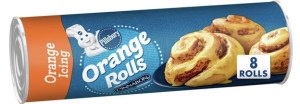 Last week, my son texted to let me know he was making breakfast with his young daughters. The three of them were putting together eggs, fruit, and rolls to start their Saturday right. The rolls – the Pillsbury variety where you whack the tube on the counter and separate the rolls onto a cookie sheet – are topped with a distinctive orange icing my son remembers from many of his childhood breakfasts. Now he’s carrying on the tradition in his own kitchen, which warms my heart. But I also realized it’s time he joined the succession of family members who still bake our trademark cinnamon rolls.
If you’re hoping I’ll include a recipe at some point in this post – something with secret ingredients to make our cinnamon rolls the best ever – you’re about to be disappointed. These rolls are as simple as it gets. Begin with… Bisquick. Maybe you’re not familiar with this breakfast-in-a-box product from General Mills but it’s still on the shelf. You just add milk to the mix and voila, you’re making anything from pancakes to biscuits.
 Our cinnamon rolls use the Bisquick biscuit recipe with the dough pressed out flat, adding sugar and spice, and then rolled up to be cut and baked in the oven. The process is designed to crank out the rolls in hurry, as for a family of seven on the clock before Sunday church.
Now here’s where I pay homage to my father. He steps into the story because he was the one who made the cinnamon rolls, almost every Sunday without fail. I’d shuffle into the kitchen bleary-eyed from the night before and there’d be my bathrobed, unshaven father, preparing what we affectionately called the “cims”. As soon as he rolled out the dough, a kid could help the rest of the way. Sprinkle brown sugar from one end to the other. Add raisins here and there. Dust with cinnamon for a final flourish. Roll up the dough from one side of the board to the other and cut into segments.
 Some of my brothers didn’t like raisins so Dad upped his baking game a bit by leaving them out of some of the rolls. Eventually he even made “jelly rolls”, substituting the sugar and spices with one of our favorite flavors from Smucker’s or Knott’s.
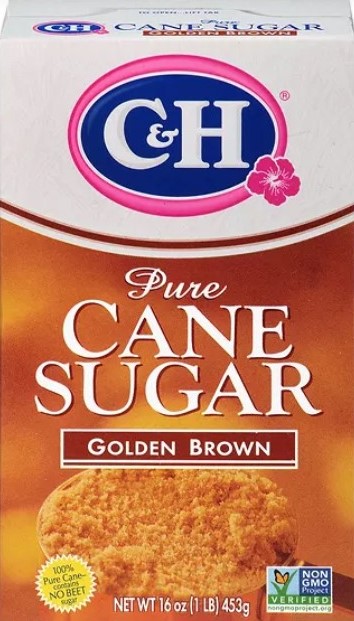
 Speaking of ingredients, our cinnamon rolls were brand dependent. Besides the essential Bisquick, the brown sugar came from C&H, the raisins from Sun-Maid, and the milk and butter from a local dairy called “Edgemar Farms“. Funny how those come back to me like yesterday, yet I never thought much about the names until now. “Bisquick” is literally “biscuit” + “quick”. C&H is the “California and Hawaiian Sugar Company”, their product refined from sugar cane (instead of beets). Their jingle still dances around in my head (“C&H… pure cane sugar… from Hawaii… growing in the sun…”)
The updated “Maid” Sun-Maid put the spin on “Made”, of course, but I never “made” the connection between the name and the woman in the logo until now. They’ve updated her image several times over the years the way KFC and Wendy’s updated theirs.
Here’s the real point of this post. My dad and the family cinnamon roll recipe are forever inseparable. Even though his sons (and their children, I hope) carry on the tradition, it’ll always be Dad and the rolls. One is not a memory without the other. I realize – all these years later – Dad made the rolls to give Mom a break from the countless meals she made the rest of the week. Honestly, the only memories I have of Dad in the kitchen are mixing drinks, tending to the barbecue, or making the “cims”.
 Soon after my son texted, I sent him the cinnamon roll recipe. I hope he “cim-ply” abides as part of his Sunday morning routine. I hope he refers to the leftover dough bits as “collywobbles” the way my dad did and his dad did before him. I hope his daughters mispronounce “cinnamon” as “cimmanin” the way I used to (which maybe inspired the nickname “cims”). But most importantly, I hope he remembers his Grandpa every time he rolls out the dough, preparing breakfast for the family just to give Grandma a break.
Some content sourced from Wikipedia, “the free encyclopedia”.
-
Conifer Confetti
When you move to a new city and state, you deal with the expected and the unexpected. The expected includes boxes that don’t unpack themselves (but what a great invention, right?), over-the-fence greetings with neighbors (categorized as “nice”, “cranky”, and “utterly weird”), and enough wrong turns on roads where you finally pull over and mutter, “Where the heck am I?” Unexpected includes the drip of a leaky pipe ($$$, sigh), chew-crazy squirrels in the backyard (anything plastic is fair game), and, oh yes… pine cones. Lots and lots of pine cones.
 Five acres may seem like a lot to some of you readers but to us it’s downsizing from our ranch in Colorado. You’d think a property a sixth the size of the former would suggest lower maintenance. After last Sunday I’m not so sure. My wife came in from the barn the day before and said, rather gently, “We should probably pick up the pine cones in the back pasture before they get out of control.” Simple enough. After we fed and watered the horses, we went out to the field with the muck rakes and began picking. A muck rake can hold ten pine cones. Around the first tree I figured I picked up fifteen rakes’ worth. Again, simple enough… except we have at least twenty pine trees. Do the math. Our pickup amounted to a motherlode of pine cones, somewhere between two and three thousand.
Back in Colorado we had, like, one pine tree on our property (a magical one actually, which I wrote about in My Dandy-Lion Pine Tree). After last weekend I’m thinking I should’ve amended our purchase agreement on the new place to say, “Remove nineteen of twenty pine trees”.
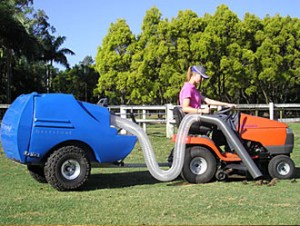
I need the “giant” version of this What does Dave do with all of his pine cones? Nothing, for now. The most efficient system of gathering is to throw them against the base of the trees and then haul them away to the “yard waste” dump. But in the three hours we collected cones, I had plenty of time to think about better ways to do it. The neighbors suggested a “pasture vacuum”, which is like one of those big spinning brushes you see in the car wash, dragged behind the tractor. Others suggested a big bonfire, pretty much the last thing a person from Colorado wants to see in their backyard.

My new pet Here’s thinking outside of the box: I could get a pet Parasaurolophus, the dinosaur with a distinctive crested head. The Para has thousands of teeth perfectly suited for their favorite meal: pine cones. But I’d need a time machine so I can bring one back from sixty million years ago. Looks like it’s still me and the muck rake for now.
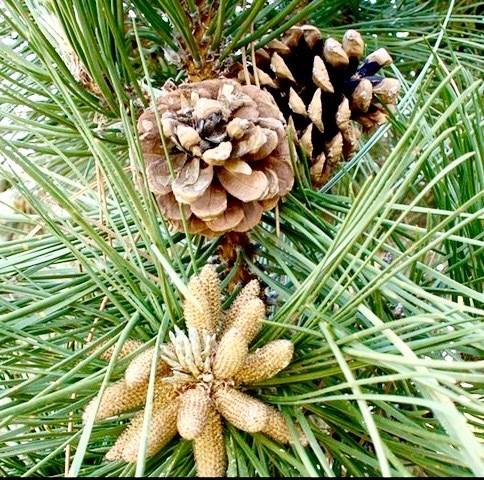
“Conifer cones”, which include pine cones, play a vital role in the evolution of the trees. Between all those little wooden scales are the seeds, first pollinated and later released. It’s a sophisticated process which you can read a lot more about here. In its simplest terms you have the smaller, meeker “males”, who release pollen for the “females” to catch. Then the females release the seeds, even after they lay in my pastures by the thousands, seemingly dead.

“He” (lower) doesn’t even look like a pine cone There was a moment in all that raking where I followed a squirrel as he bounded across the grass and onto the trunk of one of the trees. Up, up, up he went until he disappeared into the umbrella of the branches above. And that’s where, to my horror, I noticed how many thousands of pine cones sat poised above me. Maybe millions… almost all of them female. It’s like having the world’s biggest sorority row above my backyard, and every house is about to disgorge its girls for a giant party on the ground. Maybe I should hire Sticky Vikki & The Pine Cones for the music.

“Widowmaker” cone I know, I know, it could be worse. I could live in Maine, where there are so many pine trees the state flower is the pine cone (and a pine cone is not even a flower). Or I could have Coulter pine trees, with cones so big they’re nicknamed “widowmakers”. Seriously, these ladies are massive – you don’t want one falling on your head. Speaking of falling, the mere sound of a plummeting cone is unnerving enough. It’s like a warplane flying overhead and releasing a bomb, only the bomb whistles straight to the ground without detonating. “THUNK”.
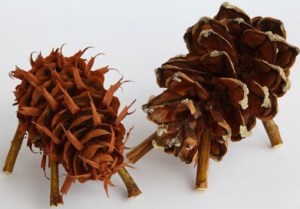
I’d have a massive herd of these Scandinavian toys We shared the story of our pine cone bounty with my brother-in-law, who promptly encouraged us to do something creative with them. Make wreaths for the holidays. Turn them into coffee and jam like they do in Eastern Europe. Sell them as the fertility charm they’re supposed to be. Nah, I don’t have time for all that. We’re expecting extra wind in the next few days courtesy of Hurricane Ian. I have another three thousand pine cones to pick up.
Some content sourced from the HuffPost blog, “Thirteen Things You Never Knew About Pine Cones…”, and Wikipedia, “the free encyclopedia”.
-
Blue-Blood Spuds
As I was digging into dinner last night, I surveyed the contents of my plate and decided the food was looking rather pedestrian. Yes, I’d topped the roast pork with a tasty sour cream and onion sauce. I added lemon zest and shredded cheese to the broccoli. But the potatoes were run-of-the-mill, simply diced and baked with nothing but salt and pepper. I could’ve done more there; a lot more. Starting with potatoes from La Bonnotte. It’s just, I don’t want to spend $300 for a pound of them.
 $300 for potatoes – yikes. It sounds ridiculous unless you’re British royalty or the finest restaurants in Europe. A couple of medium-sized Russets – the ones we bake – weigh a pound, but the Bonnotte potato is more like the small red ones you cut up and season. 10-12 Bonnottes in a pound; so like, $30 each. That’s a pricey bite (and not exactly “small potatoes”). But if you’re willing, you can purchase your share of this delicacy; that is if you’re quick. They’re only on the market ten days a year.
What makes the Bonnotte the aristocrat of spuds? Here’s the meat and potatoes of it:
- La Bonnotte potatoes are found on a small island off the Atlantic coast of France, and nowhere else. It’s as if they’re grown in some fortified castle, surrounded by a wide moat.
- The potato field is limited to fifty square meters, so they’re not even using the entire island. You could walk the perimeter of the entire crop in about five minutes.
- Even though the island soil is ideal for growing La Bonnottes, the “secret sauce” is nearby seaweed and algae, mixed into the dirt by hand. This is perhaps the first time I’ve heard of a good use for seaweed.
- Every Bonnotte is harvested by hand, then treated, cleaned, and sold by a small cooperative of local farmers. Talk about an exclusive club.
- As I said, the harvest is only available for purchase ten days a year. Mark your calendars for May 1-10, 2023.

The island of Noirmoutier-en-l’ile has a church, a chateau, and very expensive potatoes. Here’s my favorite reason to buy this hot potato (and for heaven’s sake, don’t drop one): you don’t peel them. You shouldn’t peel them. Their unique flavor – tastes of lemon, earth, “the sea”, and chestnut – is most concentrated in the skin. You eat them just the way they come out of the ground.
Luxuo is an online news portal whose mission is “to uncover the values which permeate the fiber of the world’s most recognizable luxury brands” (Got all that?) The Luxuo website has a dropdown menu for timepieces, yachting, motoring, properties…. and now you’ll find potatoes, because La Bonnottes (you don’t even call them “potatoes” at this price) are the most expensive potatoes in the world. By some measures they’re one of the most expensive foods in the world. Saffron, macadamia nuts, Beluga caviar, and white truffles are the top four, followed by La Bonnottes. Blue-blood spuds indeed.
 [Author’s Note: I just had to know why we refer to things as “blue blood”. The term originated in Spain. It was used to differentiate between people with light skin from those with darker complexions. The veins of southern Europeans appeared bluer due to their pale and translucent skin. Wealthy landowners or their descendents were part of an upper class in Spain, and somewhere along the line the veins were associated with wealth. Not a look I prefer, but the money is tempting.]
Couch potato fare After the La Bonnotte harvest and sell, a small number of the potatoes are reserved for a local festival, where they’re served plain, just as you see them in the entertaining video below (because no other ingredient deserves to share the pan). Who can blame the farmers for throwing a party? They’ve convinced the world to purchase potatoes for $300/pound yet again, just as they’ve done for decades before.
Some content sourced from Wikipedia, “the free encyclopedia”.
-
P.S. I Love You
When it comes to snack foods, I’m not a fan of variations on a theme. Kellogg’s Pop-Tarts debuted in the 1960s with just four flavors: strawberry, blueberry, apple, and brown sugar cinnamon. Today you choose from more than twenty Tarts, including “Hot Fudge Sundae”. The original Triscuit cracker was a baked whole wheat square with a little salt. Today you’ll find a dozen Triscuit flavors on the shelf, including “Fire Roasted Tomato & Olive Oil”. Then we have the Oreo cookie. The original, of course, was two chocolate wafers sandwiching just the right amount of vanilla cream filling. Now Oreo flavors are too numerous to count. But there’s one you can be sure is a whopping success: pumpkin spice.
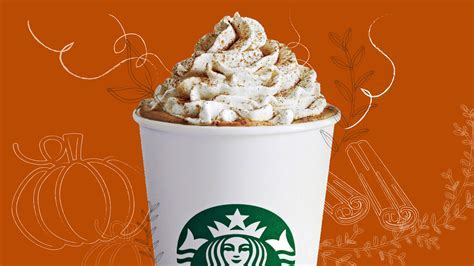
 Welcome to mid-September, Americans, and the beginning of our pumpkin spice delirium. For the next two months you can expect an endless parade of “P.S.” product advertisements. My wife & I, we’ve already caved to the obsession. We have a package of “Pumpkin Spice Snaps” sitting on the counter. We have two leftover pieces of this year’s first homemade pumpkin pie sitting in our frig. And it’s only a matter of time before my car veers off the road and right through a Starbucks drive-thru for one of their classic P.S. lattes. (I’ll take a grande, if you please).
My daughter just reminded me Starbucks also brings back their pumpkin cream cold brew this time of year. That’s a good one too but let’s be real: none of Starbucks’ P.S. offerings should be considered “coffee”. We buy them for the spice and the sweet, not for the taste of the beans underneath.
 Lest you think Starbucks gets the credit for our pumpkin spice mania, the record must be set straight. McCormick and Company, they of the little red-capped spice bottles, debuted their “Pumpkin Pie Spice” in 1934. At least three of the following are in the bottle: cinnamon, ginger, allspice, cloves, and nutmeg. Do I have this spice blend? Yes. Do I use it? Heck, no. My wife’s family recipe for pumpkin pie contains a different proportion of the individual spices than McCormick’s, which may be the secret to its delectable flavor. Plus, pumpkin pie is easy enough to make without having the spices combined for you. Dump the ingredients into a bowl and mix well. Pour into a pie shell. Bake. My kind of dessert.
 Starbucks can’t even take the credit for the first P.S. latte. That accolade goes to Mexico’s Candle Company in 1995. The Starbucks version debuted eight years later. But you could argue Starbucks kicked off the forever-trend where we infuse P.S. into everything imaginable, including the good (Krispy Kreme doughnuts, Cheerios, candles) and the ridiculous (lip balm, deodorant, beer). As of 2016, “pumpkin spice consumables” accounted for an annual market of over $500M. Yep, we’re hooked.
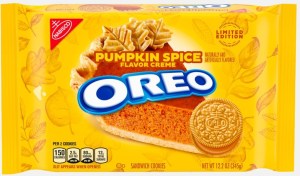 The “Pumpkin Spice Flavored Creme Oreo” is not even an Oreo, at least not in my pantry. Nabisco attached the word “Oreo” but c’mon, let’s just admit it’s a seasonal wolf in sandwich cookie clothing. “Golden” Oreo cookies… with “festive pumpkin spice flavored cream” (and is it cream or creme?) Nope, the only Oreos in my book are black and white, though I will allow shelf space for the “Double Stuf” variety.
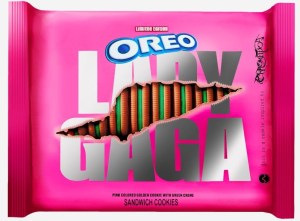 I’m not sure why this topic caught my eye because I haven’t had an Oreo in years. The last time I did I realized the taste was different from the Oreo of my youth. The cookies are not as soft, and there’s less cream filling in between (which is like messing with the ratio of chocolate and peanut butter in a Reese’s, a sin for all mankind). Like the misfortune of many other snack foods though, size and ingredients change for the sake of profit. And new varieties pop up to keep consumers buying. At least we’re not talking about the Lady Gaga Oreo. You’ll need your sunglasses for that one.
 Now you’ll excuse me as I head off to a doctor’s appointment. My drive will take me past several Starbucks, which means I could be caving to my first P.S. latte of the season. Not that I’m worried about missing out. As soon as the P.S. season is over I can look forward to Starbucks’ Chestnut Praline latte all the way through New Year’s Day. Now we’re talking!
Some content sourced from the CNN Business article, “Oreo is bringing back this flavor after a 5-year hiatus:, and Wikipedia, “the free encyclopedia”.
-
Credit Guards (or AT&T pt. 2)
When my “favorite” service provider AT&T (tongue-clearly-in-cheek) challenged my creditworthiness last month amidst an adventurous request for internet service, I was forced to bow down before the Big Three. No, not Ford, Chrysler, Dodge – I don’t drive any of ’em. And not CBS, NBC, ABC either – I can now stream their programming (since I finally have internet). Rather, today’s big three are Equifax, Experian, TransUnion – those behind-the-curtains guards who man the credit rating tollbooths as sternly as passport checkers from former Eastern Bloc countries.
 Credit guard companies are more difficult to deal with than credit card companies. The moment I entered college, offers for credit came pouring into my mailbox. I could qualify for ridiculous amounts on little plastic cards, even though I was a penniless freshman with little reportable income. But they want you hooked on credit at an early age so you’ll pay back a lifetime of fees in interest. Yet now, with decades of credit history under my belt (all of it positive, I say with muted pride), dealing with the credit guards is infinitely more challenging. It’s like walking up to Fort Knox and asking for a bar of gold.
 If you don’t check (or even know) your credit score, you may not be familiar with the Big Three. They’re like triplets hired to do the same job: “consumer credit reporting agencies… collecting and aggregating information… on consumers and businesses worldwide”. Equifax tracks 800 million consumers. Experian tracks a billion. In other words, the next time you use your credit card, you can bet the Guards will be watching.
 The Guards help themselves to your transaction, blend it with the others you’ve racked up recently, look at how well you manage your total credit and debt, and come up with a score. If you and your wallet behave, you get a number in the neighborhood of 700; if not, you’re closer to 500 (sounds like a college entrance exam, no?) 1.2% of Americans maintain an absolutely perfect credit score, though darned if I know how they do it. Maybe they pay for everything in cash.
 Consumer credit reporting agencies are b-o-r-i-n-g (I’m surprised you’ve made it this far) so I’m not fired up to write about them today. Instead, let me tell you a story – humor at my expense, really – where the Guards were peripherally involved… and I was fired up.
 When I was
 battlingworking with AT&T on my request for internet last month, the customer service rep stole took a full hour of my valuable time tobotchset up the account, even though I already had another account with AT&T for wireless service. He asked a million questions (including the oft-scripted “how’s the weather where you are today?”). A marathon later – because I could’ve run one by this point – he said it was time to check my credit. Here’s where I should’ve thought to hang up because AT&T owns decades of credit history on me (thanks to the Guards). If AT&T couldn’t tap into my score already then maybe I shouldn’t be doing business with them. But I really wanted internet so Isurrenderedcooperated like a good little lamb, supplying my name, rank, and social security number. And this is where everything went horribly wrong.“I’m sorry sir, but your credit is blocked.”
Blocked? What the
*$%^#!HECK does that mean? When I asked him to please explain, my smooth operator countered by saying, “Let me run the check again. Repeat <your> social security number”… which I did, only to hear the word “blocked” again. When the third time wasn’t the charm he made a ratherstupidbold announcement:“I’m sorry sir, but you must have an invalid social security number.”
Invalid social? So you’re saying the nine-digit number I memorized when I was like, oh, an infant; the one I’ve spoken or written millions of times in my life, the one I’ve been trying to protect from identity thieves since I was born, is “invalid”? What kind of
incompetent foolprofessional was I dealing with here?
More like “think twice” Again I should’ve
slammed the phone downhung up, but silly me, I surrendered more minutes of time to understand my “two options for service when I have blocked credit”. One, I could set up the account in my wife’s name. Involve an innocent bystander in thiscircusrequest and risk divorce? No way. Two, I could pay AT&T a $250 retainer fee to offset my newfound credit liability. Okay, NOW I’m insulted. When I declined both options, mycustomer service impostertemporary friend apologized, bid me good day, and hung up without another word. Seriously, he hung up on me (without so much as a sales pitch for DirecTV). I suppose you could call it a fitting conclusion to a totally worthless call.My story does have a happy ending. Several days later I mustered the courage to call (A)nguish, (T)orment, & (T)orture again. Maybe the more you call them the better the service because the next rep let me know my credit was frozen (not “blocked”). Ah, now we’re getting somewhere! Frozen credit, for those of you in the not-know, is initiated by the consumer (me). A credit freeze is put in place to counter identity theft. I totally forgot I’d done that, like, last century, but thanks to a smidge of online access (the Guards are more hospitable these days) I was able to drop the freeze with just a few keystrokes. Bingo. Credit check passed. Internet service permitted.
 The inspiration for this post was a recent headline about Equifax. The Guard issued millions of incorrect credit scores last spring, which meant consumers were either denied loans when they shouldn’t have been or charged higher-than-deserved interest rates. One ambitious soul is leading a class action lawsuit to reclaim the interest she never should’ve have paid. As for me, I choose not to deal with the Guards any more than I have to. After all, I get enough credit check grief from AT&T.
Some content sourced from Wikipedia, “the free encyclopedia”.













About Me
The sky is not completely dark at night. Were the sky absolutely dark, one would not be able to see the silhouette of an object against the sky.
Follow Me On
Subscribe To My Newsletter
Subscribe for new travel stories and exclusive content.
 Life In A Word