Bon Voyage!

Every now and then I come up with a topic for my blog, and then the topic somehow surfaces in the natural course of conversation later the same week. It’s a little unnerving – perhaps divine intervention – to watch someone bring up something you hadn’t thought about in years, or at least until a few days earlier.

85-bon-voyage-1

Such was the case this week when I opted for a (virtual) visit to Mont Saint-Michel, the majestic island commune and fortified abbey just off the coast of Normandy, France. Mont Saint-Michel came to mind because I received a mailer from my alma mater advertising a ten-day trip to the region next summer. The itinerary includes a stopover in Paris, a base hotel in the historic seaport village of Honfleur, extensive tours of Normandy focusing on the events of World War II, and finally, a full day exploring the island of “St. Michael’s Mount.” Mon dieu, what an adventure!

Mont Saint-Michel has a remarkable history on top of its dramatic architectural elements (which you can read about here).  Its buildings date to the 8th century, with the Romanesque abbey and monastery at the very top (“closest to God”), literally supported by a vast network of halls for stores and housing, and finished elegantly at the bottom – outside the walls – with individual houses for the handful of fishermen and farmers who live there.  The church inside the abbey is partnered with an open-air cloister (a square covered walkway for reflection).  A statue of the archangel Michael watches over the land from the very top of the church spire.  Magnifique, no?

85-bon-voyage-2      85-bon-voyage-3

Here’s an interesting bit of trivia about Mont Saint-Michel.  You may think the following photo is a distant view of the island.  Au contraire.  The Mont has a “sister” across the channel near Cornwall.  England’s island of “St. Michael’s Mount” is much smaller, but it still shares the characteristics of Mont Saint-Michel, including the significant rise/fall of the surrounding tides, the conical shape of the island, and a chapel at the top.

85-bon-voyage-5

In today’s world Mont Saint-Michel is a little touristy for my tastes, so perhaps it’s just as well I’ve never made the pilgrimage.  2.5 million visitors descend upon the island every year, hosted by only 25 full-time inhabitants (monks, nuns, and shopkeepers).  Tourism is literally the only source of income.  Besides a walk through the abbey and the spiraling streets, you’re channeled into the requisite shopping area, for food (including the famous to-go omelettes), and for purchases that can only be labelled as “tacky”. I actually have one of these souvenirs (below photo). Sacre’ bleu!  Maybe if they’d left off the sailboat…

85-bon-voyage-4

To further detract from the mystique of the Mont Saint-Michel, a permanent walking bridge was built three years ago, allowing round-the-clock access from the mainland car-park.  Once upon a time you had to wait until low tide and then quickly walk across the natural spit of land before the water returned.  Now you just cross whenever you want.  Too bad, but apparently the channel was filling in with silt and a bridge was the only way to keep the island an island.  C’est la vie.

My first introduction to Mont Saint-Michel was forty-odd years ago on the shores of California, not France.  San Diego County hosts elaborate sand-castle building competitions on its beaches, and one year I snapped the following photo of the winner.

86-bon-voyage-6

To visit Mont Saint-Michel, you’ll need to drive four hours to the west of Paris, all the way to the coast of the English Channel.  Unless you have a hankering for WWII history, there isn’t much else to draw you to the region.  Which brings me back to the start, and my comment about topics resurfacing later in the week.  Three days after I wrote this post, I was having a beer with some older friends and we got talking about the movie “Saving Private Ryan”.  One of the guys said his dad served in WWII and he’d taken him back to the beaches of Normandy, where he’d spent part of his time as a medic.  “Normandy?”, I said.  “Yes”, he said. “You know, in the northwest of France near Mont Saint-Michel?” To which I almost said, “excusez-moi?”

Some content sourced from Wikipedia, “the free encyclopedia”.


Athens of the South

Ever been to Nashville?  It’s a lot to see and do in a city that still feels like a small town.  My brothers and I visited Music City for the first time two weeks ago.  We toured the historic Ryman Auditorium – the “Mother Church of Country Music” and former home of the Grand Old Opry.  We walked through the massive Gaylord Opryland Hotel.  We drove down “Music Row”, the area of town with hundreds of record labels, publishing houses, and recording studios.  We even sampled carefully-crafted moonshine (if you believe there is such a thing).

66-colossus-1Yet, none of these sights prepared me for another of Nashville’s attractions that frankly deserves more press.  Just southwest of the downtown area in Centennial Park, rising prominently on manicured lawns, you’ll find a full-scale fully-authentic reproduction of the Parthenon – that most famous of ancient structures on the Acropolis in Greece.  If one can laugh and be in awe at the same time, that was me.  A reproduction of a temple built in 438 BC?  That’s the last thing I expected to see in Nashville.

66-colossus-2Here’s what’s left of the original Parthenon (or “O-Parthenon” if you will) – which I spent significant time studying in architecture school.  It is considered the most important surviving building of the classical culture of Greece, and the finest example of Greek architecture.  It is a temple dedicated to the goddess Athena, whom the Greeks considered their patron.  If you visit O-Parthenon today you won’t see much of the original structure, thanks to a mid-1600’s explosion of a munitions dump inside the building.  Attempts to restore O-Parthenon have failed for lack of funding.  Ironically, back in its heyday O-Parthenon was used as a treasury.

66-colossus-3Nashville’s Parthenon (“N-Parthenon”) is the complete restoration, and it is a colossus.  N-Parthenon is 200 ft. x 100 ft. with a surround of 70 columns.  Inside its main space you’ll find a massive statue of Athena, rising 42 feet from the floor and gilt with more than eight pounds of gold leaf.  A likeness of the goddess Nike standing in her right had is fully six feet tall.  Pictures don’t do justice to the scale of N-Parthenon.

The origin of the Nashville Parthenon is almost as impressive as the building itself.  Nashville’s Centennial Park was the site of the 1897 Tennessee Centennial and International Exposition, a celebration of the state’s 100th year in the Union, including dozens of pavilions, restaurants, and large-scale carnival rides.  Prominent within the Exposition was the Parthenon, which was surely a nod to the “Athens of the South”.  Nashville earned that nickname in the 1850’s for the city’s establishment of several institutions of higher education.

The Exposition Parthenon was built of plaster, wood, and brick; not robust enough to last beyond the year of the celebration.  But the cost of demolition and its popularity drove a movement to reconstruct the building in concrete – authentic to O-Parthenon to the last detail.  N-Parthenon was completed in 1931.  Athena herself was added in 1990.  Appropriately, N-Parthenon contains a wonderful collection of photographs and descriptions from the Exposition.  Makes our county fair look like small potatoes.

66-colossus-466-colossus-5

There have only been two other attempts to replicate O-Parthenon since its creation 2,500 years ago.  The Walhalla Memorial in Germany (above, left) was built in 1826, but the completed structure is merely a nod to the architecture of O-Parthenon and much more about the distinguished people in German history.  The National Monument of Scotland (above, right) was also built in 1826 – go figure – but abandoned three years later due to lack of funds.  Take your pick; I say N-Parthenon beats “G”-Parthenon and “S”-Parthenon in a runaway.

Any visit to Nashville should include some aspect of the city’s rich history and allegiance to the music industry.  But add the Parthenon to your agenda as well (especially if you think you’ll never make it to Greece).  Oh, and per the sign, leave the wheels at home.

66-colossus-6

Some content sourced from Wikipedia, “the free encyclopedia”.

That’s (Not) the Spirit!

In the latest Skytrax airline review, Spirit Airlines received an overall rating of 3 (out of 10). Not so good, eh? I’d love to debate that grade with those who fly Spirit.  But what if those travelers also learned Spirit received a mere 4 for “value for money”. Value for money?  This is an airline that touts itself as “the leading ultra-low cost carrier in the United States”!  Have we been duped?

37 - duped

One of my family members flew Spirit earlier this week, and from her I learned the extent to which a business model can go “no frills”.  I thought Spirit simply attached a fee to everything outside of the ticket itself.  It’s more convoluted than that.  Best example: Spirit’s checked bag fee starts at $30 (paid at time of booking), increases to $35 (before online check-in), then to $40 (during online check-in), then to $50 (at ticket counter), and summits at $100 (at gate).  Pack carefully too, because an “overweight bag” begins at forty pounds (not fifty), and the fee-on-top-of-the-baggage-fee for overweight begins at $25.

Here are some other gotchas with Spirit; enough to consider your nearest emergency exit.  Choosing a seat yourself runs $50 and up (not so unusual with the airlines these days).  Carry-on bags that can’t be jammed under your seat cost you $55.  Boarding passes are $2 if printed at a kiosk; $10 if printed by an agent (must be premium-weight paper, huh?)  Unaccompanied minors are an extra $100 each way.  Finally, the drink you’ll need to survive this a-la-carte menu starts at $3, even if it’s plain ol’ water.  And don’t forget to press the flight attendant button or your beverage will never, ever arrive.

All of the above might read as criticism, but it’s apparent the Spirit model works for enough passengers to keep their planes in the air.  If you choose to fly Spirit you are – ideally -a person traveling alone, carrying only one bite-sized piece of luggage, and you don’t mind where or with whom you sit on the plane.  You also don’t care about comfort, because Spirit proudly reduces legroom to create “more seats for less airfare”.

I waged a little fares-war to see how Spirit’s “bare fare” stacks up to the competition.  I chose five of Spirit’s larger-city destinations and compared those fares to the next lowest carrier.  Here’s what you pay if you book a one-week round-trip flight from Denver starting April 15th:

  • Chicago – Spirit: $108, Next Lowest: $117
  • Atlanta – Lowest: $167, Spirit: $270
  • Dallas – Spirit: $78, Next Lowest: $86
  • Phoenix – Lowest: $130, Spirit: $150
  • Los Angeles – Spirit: $91, Next Lowest: $138

Percentage-wise, the best deal is to Los Angeles, where you only pay 65% to Spirit vs. the next lowest.  But are you going to fly all the way to the coast with a bag that fits under your seat?  Not likely, so add another $55.  Whoops – Spirit is no longer the lowest-cost option.

I’m not necessarily throwing Spirit under the bus here (even though a recent DOT report showed they had the highest number of complaints per-passenger among major U.S. airlines).  I’m not saying they don’t care about you the customer (even though my sister-in-law took three hours and five agents/supervisors/managers to get her storm-delayed flight re-booked).  I’m not even saying Spirit doesn’t run its business above board (even though the FAA recently slapped them with a $375,000 penalty for false advertising and refusal to reimburse customers).

What I am saying is do the math and know what you’re paying for.  Don’t be duped.

I’ll conclude with a bit of irony.  Three years ago my overnight flight to Florida was cancelled because I couldn’t connect through Houston on account of bad weather.  But I simply had to get to Florida by the next morning.  After exhausting all options the counter agent informed me my only option was out of another airport an hour’s drive to the north, and the only option out of that airport was… Spirit.  And I’ll be damned if Spirit didn’t get me to Florida the next morning – right on time.  So there you have it – I’m a fan of Spirit!  Er, that is, after exhausting all other options.

extraordinary

When my wife and I took a cruise last month, I had one of those smile moments on board that did not fully explain itself until much later.  You see, the cruise was a tour around the Baltic Sea, where you wake up in a different port each morning and spend each day off the ship exploring the cities.  Translation: the only cruising you do is at night while you are sleeping.

17 - extraordinary 1

But that’s not entirely truthful.  Fact: if you travel on the Baltic Sea from Tallinn, Estonia to St. Petersburg, Russia, it takes a full day to get from one to the other.  Which means you actually do get a “day at sea”.  Ours was a Sunday.  And Sunday includes a Sunday afternoon.  So on that Sunday (smile moment), I found myself humming the tune made famous by Marvin Gaye:

“Cruisin…’ on a Sunday afternoon.  Really… couldn’t get away too soon…”

For those of you in the know, I found out well after the cruise that I need to work on my Marvin Gaye lyrics.  It’s actually “Groovin’… on a Sunday afternoon”.  Well okay, maybe I was crusin’ AND groovin’ on a Sunday afternoon.  I’m just glad I wasn’t singing out loud.

I want to share a few details about this cruise; the jaw-dropping experiences that add the “extra” to “ordinary”.  “Ordinary” my wife and I have already experienced, several years ago on the only other cruise we’ve taken.  “Extraordinary” arrived last month in the form of the cruise ship Marina, a 1,200-passenger stunner that is the newest member of the Oceania fleet.

Here’s an example of extraordinary.  When we arrived at our cabin door after boarding Marina, we were greeted almost immediately by our room steward; a lovely woman from the Philippines named Remy (another smile moment, as we have a dog by the same name).  Remy gave us the full “tour” of our cabin and insisted we call on her day or night for anything we needed.  Then she disappeared almost as soon as she arrived.  But we saw her several more times in the hallways, and she always greeted us by name.  “Good morning Mr. and Mrs. Wilson”.  “Good evening Mr. and Mrs. Wilson”.  How does she do that?  I know she was room steward for a dozen other cabins and there’s no way I would remember all those names after a single, brief introduction.  Extraordinary.

Here’s another example.  When my wife and I returned to Marina from our daily “land excursions”, the crew arranged afternoon tea in a beautiful ballroom near the stern.  Dozens of small tables for two or four, with comfy chairs, tablecloths and steaming teapots (we always chose the peppermint).  A black-tied four-piece string quartet would entertain us.  A waiter materialized with a choice of sandwiches (with the crusts cut off no less) and several scrumptious desserts.  It was that feeling of being under-dressed but over-pampered.  It was also the feeling – apparently – of English royalty.  Extraordinary.

Final example.  Our cruise line offered on-board culinary classes, so we just had to bite (ha).  We donned our chef whites for three blissful hours one afternoon, preparing and tasting delicious pasta dishes and sauces.  It was a scene right out of the Food Channel.  You had your master chef at the front of the room, behind her spotless and stainless kitchen counter, with the requisite mirror overhead to make it easier to watch.  Then you had her several assistant chefs scurrying around the room to help you, making sure your prep station was cleaned up for the next step; ingredients perfectly measured.  All you had to do was watch and prepare, cook and consume.  I could get used to that.  Extraordinary.

17 - extraordinary 2

Take a cruise sometime and see if it doesn’t get you groovin’ too.  I also find it extraordinary that my brain still remembers the lyrics from a song written in 1967.  Well, I remember the lyrics incorrectly (which is a great topic for another blog) but you get the idea.

certitude

Several posts ago I told the woe-is-me story of leaving my Kindle e-reader in an airplane seat pocket.  Much to my chagrin I wrote, this was the second time in two years; exiting a plane without my prized portable technological wonder.  In the post I made two predictions about the eventual destination of my e-reader.  The first was into the hands of the Delta employee who cleans the plane.  The second was into the hands of the next traveler who reached into my seat pocket (“Congratulations!  You’ve just won an Amazon Kindle!”)  So one or the other of these scenarios was the end of the line for my e-reader.  I drew those conclusions as if they were fact.  I wrote with certitude.

Here then, “the rest of the story”.  On the eventual destination of my e-reader I was wrong – way wrong.  In what I would label a small miracle, my Kindle ended up… in my own hands.  The perseverance of DALLIRT (Delta Air Lines Lost Item Recovery Team) won the day.  Perhaps my Kindle was found immediately or perhaps it traveled on to one or more exotic destinations.  Either way, a human took pity on me and made things right.  Imagine my disbelief (and chagrin) when I received an email from DALLFC (Delta Air Lines Lost & Found Central) that began “Dear David Wilson:  We are happy to tell you that we have located an item that closely matches the description of your reported lost item”.  Twelve dollars and seventy-seven cents of postage and three days later, my Kindle was dropped on my doorstep.  No damage.  No note.  Everything intact.

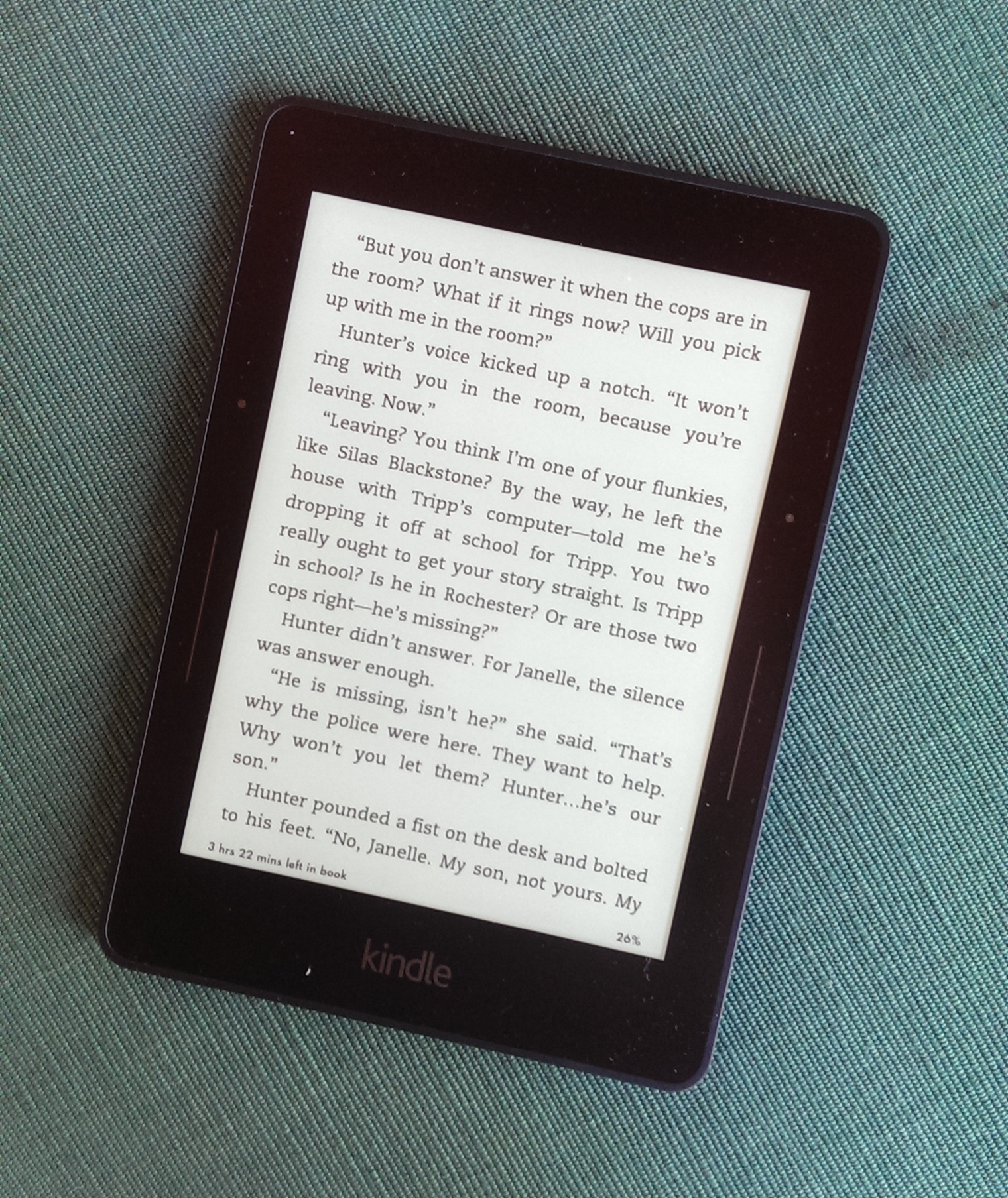
I must own up to one other aspect of this story.  A day or two after I filed the lost item report with Delta, I promptly logged onto Amazon and bought another Kindle.  That’s right; before I gave Delta’s process a chance, I purchased a new e-reader.  I even upgraded to a newer version (“Voyage” – oooo).  That’s certitude in a nutshell.  Zero faith in the alternative.

14 - certitude

I suppose the lost dollars to Amazon represents my penance (another good word for my blog) for not trusting a process designed to correct my mistakes.  But to further cleanse my guilt, I sent DALCC (Delta Air Lines Customer Care) a glowing email, complimenting them on their lost item recovery process.  And they wrote right back, beginning with the following line: “It’s so easy to leave something important behind while flying”.  Gee, thanks for making me feel better.  Except I did it twice.

My son will probably inherit my recovered Kindle.  Yes I should probably keep it because things happen in threes but I’ll take my chances.  I’ll trust the process.  And I’ll certainly consider Delta Airlines the next time I fly.

chagrin

A year or so ago I left my Kindle e-reader in an airplane seat pocket when I deplaned.  Those seat pockets contain just a few things – an in-flight magazine, a plastic card that describes safety features, and the timeless airsickness bag.  So there’s plenty of room to lose an e-reader in there.  Does that sound like an excuse?  Well imagine my utter frustration and disappointment – my chagrin – when I did it AGAIN this past weekend.  Same drill.  I stowed my Kindle in the seat pocket along with some magazines before takeoff.  I did all of my reading in-flight.  And then in my haste to deplane, I took the magazines and left the Kindle.

photo - chagrin

There’s an interesting dance you do when you realize you’ve left something on an airplane.  It typically begins when you’re unpacking your bags.  You take out the clothes and bathroom stuff and then you get down to the little things.  About that time you start to wonder when a particular item will surface.  Laptop – check.  iPod – check.  Kindle – oh no, not again.  You double-check (okay, you triple-check) your suitcase and your carry-on.  You tear your car apart to make sure it didn’t slip between the seats on the way home.  And then after you’ve bounced around the bedroom cursing at the walls, you resign yourself to the fact that your Kindle is now in the hands of Delta Airlines.  Or one of its enterprising employees.

Delta has a promising process to claim “lost articles”.  You go on-line and fill out an official-looking form.  You describe the lost article to prove it’s yours.  And then you wait.  And wait.  After three days I got an email reply.  It started positively enough. “Dear Mr. Wilson:  The search continues… “.  But the paragraphs that followed are collectively referred to as “form letter”.   It was painfully obvious Delta was not going to drop everything to unearth my Kindle.

My theory on the current whereabouts of my Kindle has two endings.  In one, a Delta “cleaner” finds my Kindle and pockets it; or gifts it to his/her child; or stocks the nice little black market he/she has going on the side.  In the other, Delta doesn’t have enough employees to clean the seat pockets after every trip so my Kindle just continues on to the next destination.  To the person who got my seat after me, I say “you’re welcome”.

Here’s a great invention inspired by my Kindle-down experience.  It’s a wireless “leash”: a band that goes around your wrist with a removable Velcro button that can be attached to small personal items (i.e. Kindles).  When the wrist band and the Velcro button are far enough apart, the band beeps and you realize something is not right.  Not bad, huh?

In my defense for having abandoned my Kindle twice, a laptop is too big for the seat pocket so at least a portion would be visible.  iPods and mobile phones are too small to risk putting in the seat pocket and forgetting about.  But a Kindle?  The perfect size.  Small enough and flat enough to disappear into seat pocket oblivion.

This story will have an ending, happy or not.  Remember, according to Delta, “the search continues”…