Arid (and) Extra Dry

Most of us reacted to eighteen months in the unwelcome company of COVID-19 the same. We reflected on our time with Mr. Virus and wondered, “What would we have done more of?” More get-togethers? More travel? More dinners out?  Yes, yes, and yes.  But instead, we hunkered down and waited for things to get better. Our routines became more… routine.  Everything faded to black and white.  Clocks came to a standstill. It’s the same feeling I had, coincidentally, enduring a drive from Colorado to California earlier this month.
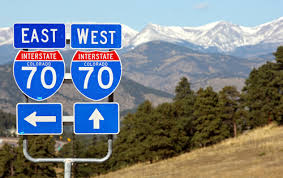
My advice: choose “East” while you still can

Maybe you’ve made the trek: Denver to San Diego via Interstate 70 and then Interstate 15.  Sounds so clean and easy, doesn’t it?  Two highways.  Plenty of lanes.  Rocky Mountains on one end and Pacific Ocean on the other.  Yeah, well, it’s all the mind-numbing in-between stuff that makes you want to burst through your sunroof and flag down a helicopter heading west.  There’s a whole lot of nothing in the desert.

The problem with this drive (which was not a flight because my wife & I wanted to bring our bikes) is the beautiful part comes first.  From Denver, it’s four hours of majestic snow-capped mountains, rushing rivers, red rock canyons, and breathless (literally) summits as you cruise on over to Grand Junction.  There’s good reason America the Beautiful was penned in the Rockies.
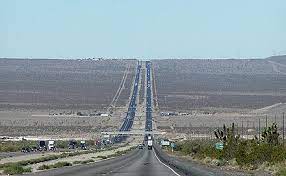
Cruise control suggested here

But don’t get comfortable.  Once you reach Grand Junction (which isn’t so grand), beauty takes a big break.  Pretend you’re a marble inside a rolled-up blanket.  Then someone flips that blanket out and off you go, rolling across the flattest, most desolate desert floor you’ve ever seen.  The mountains reduce to buttes reduce to sand dunes reduce to nothing.  The highway morphs from all sorts of curvy to ruler-straight. Your cell phone signal goes MIA.  You suddenly feel parched.  And you wonder, why-oh-why does the dusty sign say “Welcome to Utah” when there’s nothing welcoming about it at all?

So it goes in middle-eastern Utah.  Every exit is anonymously labeled “Ranch Road” (and why would you want to exit anyway?)  The highway signs counting down the mileage to Interstate 15 march endlessly.  When you finally do arrive at I-15 (your single steering wheel turn the entire journey), you bring out the balloons and the confetti and do a happy dance.  YOU MADE IT ACROSS THE MOON!  Well, sort of.  Now you’re just in central Utah.

I-15 wanders south a couple hours to St. George.  It’s probably a perfectly nice place to live, but St. George reminds me of the Middle East.  Squarish stucco/stone buildings, mostly white.  Not many people on the streets.  The temperatures quietly ascended to triple digits when you weren’t looking.  You realize you’re starting to sunburn through the car windows.
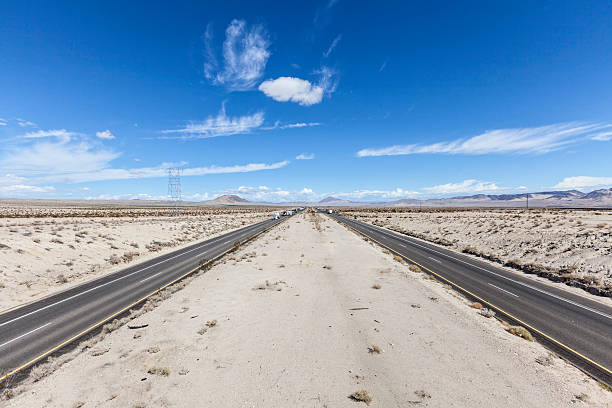
Proceed with caution (and water)

But then you make it to Arizona (briefly).  The landscape changes, suddenly and dramatically, as if Arizona declares, “Take that, Utah!  We’re a much prettier state!”  You descend through curve after highway curve of a twisting, narrow canyon, rich with layers of red rock. It’s the entrance to the promised land!  Alas, Arizona then gives way to Nevada, and here my friends, are the proverbial gates of Hell.  Welcome to the arid, endless, scrub-oak-laden vastness of the Mojave Desert, where everything is decidedly dead except for a brief glittery oasis known as Las Vegas.  The Mojave looks like it wants to swallow you whole and spit you out (except spit requires water so you’d probably just be gone forever).

Hang on to those dashboard gauges for dear life, friends, because it’s a full four hours in the Mojave broiler before your car gasps past the “Welcome to California” sign.  In those hours you’ll call your kids (one last time?), declare your final wishes, and wonder why you didn’t visit your parents more often.  Anything you see in motion off the highway is probably a mirage.  If you do make it to California, you’ll pull over and kiss the ground sand before wondering, “Hey, how come California looks exactly like Nevada?  Then Google Maps smirks the bad news.  You’re nowhere near the end of the Mojave Desert.

Baker. Barstow. Victorville. Hesperia.  You’ll pass through each of these towns and wonder, a) Why does anybody live here? and b) Is this the land that time forgot?  But finally, mercifully, you’ll descend the mighty Cajon Pass (the outside temperature descending alongside you), burst forth onto the freeway spaghetti of the LA Basin, and declare, “Los Angeles.  Thank the Good Lord.  I must be close now”.

You’re never alone on the Cajon

Except you’re not.  The Basin is dozens of cities, hundreds of miles, and millions of cars collectively called “Los Angeles”.  Hunker down, good buddy.  The Pacific is still hours away.

Here’s the short of it.  My wife & I made it to San Diego.  The car didn’t die in the middle of the Mojave.  Neither did we (though I left a piece of my soul behind).  We even rode the bikes a few times.  But I can’t account for those nineteen hours behind the wheel.  It’s like Monday morning became Tuesday night in a single blink.  Just like 2019 became 2021 without much in between.

What goes down must come back up.  The time has come to do the death drive in reverse.  Ugh.  Maybe we’ll leave the bikes in San Diego and catch a flight instead.

Covering My Tracks

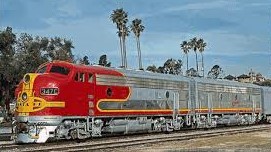
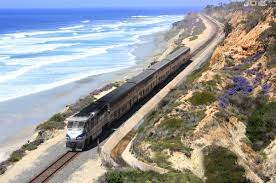
A passenger train sweeps through this little vacation town every morning at a quarter past eight. The first sound you hear is an almost apologetic “ding-ding-ding” to alert cars approaching the seaside crossing. The next is the “click-clack-click-clack” as the wheels grind a percussive beat with the twin rails below. Finally, you’re consumed by the rush and roar of the train itself, barreling towards its next destination without so much as a split-second’s thought about stopping.

Dings, clicks, rushes, and roars – which typically wake me from my vacation slumber – are comforting music to my aging ears.  These trains cover the same tracks they did during the innocent summer days of yesteryear.  The beaches here are more crowded than they used to be.  The houses make grander statements.  The ocean is a few centimeters higher and the sand threatens to wash away with each passing season.  But the train, which once called this town a destination (but now simply passes through), faithfully maintains its daily schedule from points north to points south and back again.  Some things never change.

My family’s first summer house here – the upper floor of a duplex – was mere steps from the train tracks.  In those ten-and-under years, well past dark, my pajama-clad bleary-eyed brothers and I would bolt to the front screen door in the middle of the night, drawn to the roar of an oncoming freight train.  We just had to see the roving locomotive headlight flash by one more time.  During the day we’d dash to the rails just before the train passed by, laying down countless pennies to be flattened.  I still see them – pancaked, shiny and hot – as the giant wheels flipped the coins wildly off the rails.  Sometimes we’d never find them again.

The allure of the passing train was something intangible; a magnetism I can’t find words for, even today.  You had its awesome mechanical power, its symphony of distinct sounds, the romance of faraway destinations, and the untold stories of countless passengers.  You had the promise there would always be another train coming down the tracks, if you were just willing to wait long enough.  To a kid, the train was equal parts come hither and go away; the exciting and the scary combined into one imposing, larger-than-life spectacle.

There was a time I would’ve thought trains were meant for childhood and nothing more.  But they still click-clacked through my life after that.  As a teenager, I rode those same “Pacific Surfliner” coaches several times as a convenient connection between Los Angeles and San Diego.  In college, a freight train rumbled across campus in the wee hours, most often witnessed as I walked back to my dorm from late-night dates.  In my junior year in Rome, Italy; Eurail pass in pocket, the entire continent beckoned with its on-schedule trains and speedy routes to exotic locales.

Living in the San Francisco Bay Area begged a resident to ride trains.  My first corporate commute was on a train of sorts: the Powell-Hyde cable car line from Fisherman’s Wharf to Union Square.  When we moved south of the city, Caltrain became the easiest way to commute to the heart of downtown.  When my job also moved to the south, Caltrain still served as the easiest option, the nearest station a twenty-minute walk from my front door.

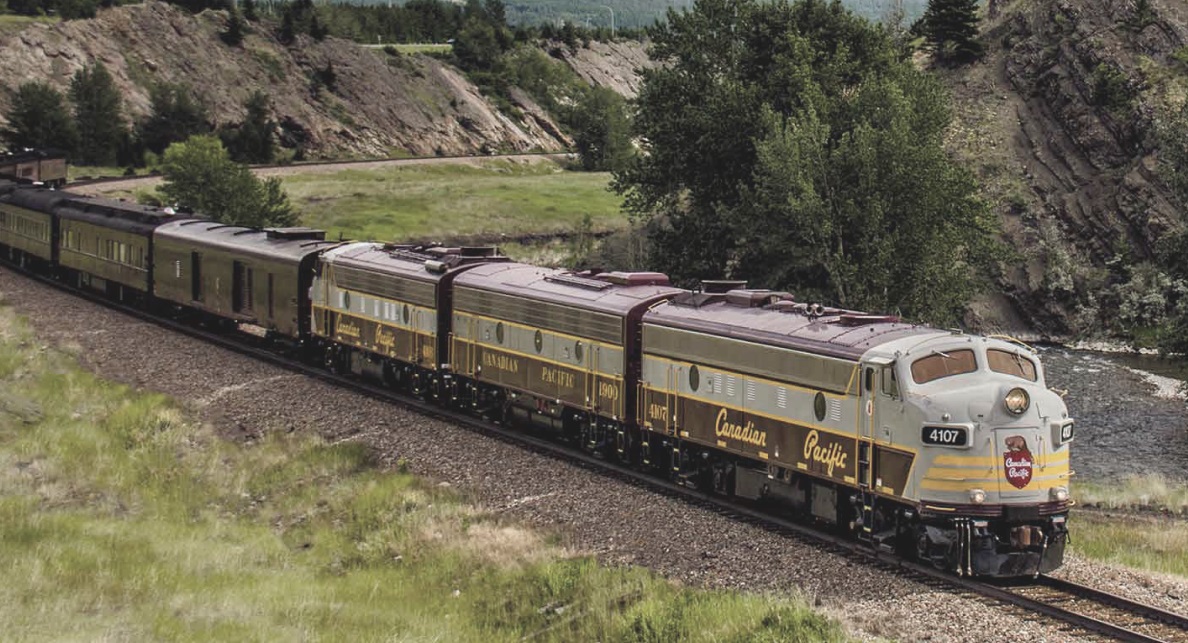
“Royal Canadian Pacific”

No mention of trains – at least for me – would be complete without a nod to the Royal Candian Pacific.  RCP rail tours include private rooms in restored vintage carriages, daily meal service prepared on-board, and spectacular scenery as you click-clack through the Canadian Rockies wilderness.  The RCP is kind of like a…, no, it’s exactly like a five-star hotel on wheels. They even throw in tuxedoed waitstaff.  Unless the Orient Express is your idea of a typical vacation there’s nothing quite as grand as the RCP.

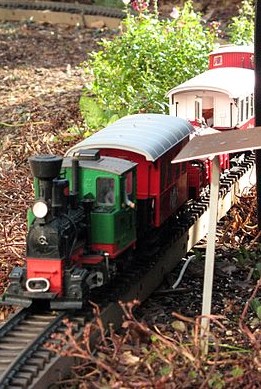
Years ago, my wife bought me an LGB model train set.  The LGB was probably the largest scale of any of the model railway sets out at the time; its cars a good foot in length and almost as high.  We’d set up the tracks every December so our “Christmas train” could cruise under the boughs of the tree above.  I often wonder why my wife bought me that train set.  Maybe I commented enough about how much I enjoyed the rail commute to work back then.  More likely, she still recognized the boy in the man, the one who would rush to the screen door in his pajamas when the locomotive went barreling past.

Some content sourced from Wikipedia, “the free encyclopedia”.

Behind the Wheels

Every summer when my wife and I head to the West Coast for a little sunshine and sand, the only intentional exercise we get is a walk on the beach or a dip in the ocean. So this year we decided our vacation equation needed to get behind the wheels. We skipped the flight, racked the bikes onto the back of the SUV, and drove 1,100 Utah/Arizona/Nevada desert miles to bridge the gap between Colorado and California. Now the Pacific Coast sun shines above, the Pacific Ocean waves crash below, and the bikes… well, the bikes just beckon to be ridden every day.

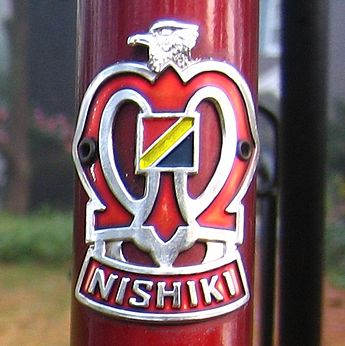
It’s already happened, as I suspected it would.  When we took our first pedal tour around this little seaside town, I saw him for a few fleeting moments.  He was a younger, thinner, blonder version of me.  He was seated confidently behind the drop handlebars of a white Nishiki Regal ten-speed, focused solely on the road in front of him.  He was dressed in Converse tennis shoes, ballcap in place of a bike helmet, white socks halfway to the knees.  When this kid wasn’t body surfing, playing basketball, or working the evening shift at McDonald’s, he was logging mile after mile on his bicycle, in search of driver’s license freedoms, even if he wasn’t old enough to have one.

My fleeting companion is the “me” of forty-five years ago.  In most respects it’s a long period of time.  In others we could be talking about last week.  Bicycling was serious thread in the fabric of my childhood.  It was a way to leave the familiar behind, to pursue esoteric wonders beyond the streets I grew up on.  Bicycling asked the questions, “Where would you like to go?” “Why?”  “And how far?”  At fifteen years old, the answers were limitless.

The Schwinn “Lemon Peeler”

My love of cycling began at a young age (and continues today in weekly spin classes at the gym).  I still remember the very first hand-me-down bike my brothers and I shared – a small blue two-wheeler with no gears, the kind you had to pedal backward to brake.  From there I graduated to a glam Schwinn Lemon Peeler Sting Ray, the all-yellow beauty with the fenders above fat tires, sporting the signature banana seat.

But my Nishiki Regal ten-speed brought bicycling to a whole new level.  I bought it myself: months of hard-earned allowance and odd-jobs cash plunked down for the biggest purchase of my young life.  The Nishiki granted me access to the more sophisticated language of bicycling; terms like “chain stay”, “saddle”, and “derailleur”, even if I couldn’t afford the Raleigh or Motobecane imports more deserving of those words.

Also, the Nishiki meant bike maintenance became a labor of love instead of a chore; a bonding afternoon with friends.  The shade of my dad’s carport colored our “workshop”, where we dismantled, fine-tuned, and reassembled over and over; my friends and I exchanging tools and advice for each other’s spare parts.  I still remember the final touch when the Nishiki was all back together: the pristine white finishing tape wrapped carefully around those drop handlebars, signifying it was finally time to ride.

I was never far behind…

One story of me and my Nishiki will always stand out.  It was all about beating the school bus home.  When the bell rang after my final class, I’d sprint to the rack, jump on my bike, and launch into the six-mile trek back to my house.  The bus meanwhile, needed several minutes to load its passengers, not to mention dozens of stops before it would’ve dropped me.  It was always a neck-and-neck battle as I’d pass the bus and then it’d pass me.  Most times I’d lose the race by mere seconds, easing up on the pedals in exhausted frustration.  But every now and then I’d get the victory.  Did some of my friends deliberately take their time exiting the bus, knowing I was in hot pursuit?  Maybe.

In 1979, a few months after I turned seventeen, a wonderful little film called Breaking Away won the Academy Award for Best Picture.  The movie centered around four friends, bicycling, and Bloomington, Indiana’s “Little 500” bike race, but it was mostly about coming of age.  Learning life’s lessons while putting the miles on the pedals.

Little wonder Breaking Away‘s lead character was named Dave.

[Note: If anything about this post resonates with you, be sure to read Steve Rushin’s Sting-Ray Afternoons.  The author’s childhood is set in Minnesota, but the growing-up memories are remarkably similar to my own.  Even the kid on the cover looks a little like me.  Steve and I could’ve been brothers.]

Some content sourced from Wikipedia, “the free encyclopedia”.

As the Wind Blows

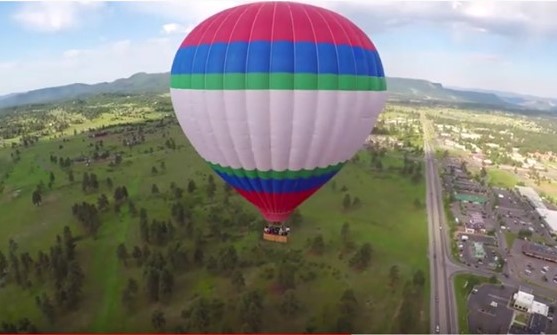
Pagosa Springs, a small town in Colorado’s San Juan Mountains, lies 7,100′ above sea level. It is locally known for its therapeutic hot springs. Pagosa also boasts a 35-year business called Rocky Mountain Balloon Adventures, which takes you an additional 3,000′ above sea level for “360° views of the beautiful valley [of Pagosa] below”. Maybe you’ll climb aboard their basket and go for a float someday.  If you do, my apologies for not joining you.  I’d rather spend my time in the terra firma of Pagosa’s hot springs than the “terror for-sure-a” of a balloon ride above.

Getting high, above Pagosa Springs

Logic says my fear of heights denies me the thrill of soaring up, up, and away.  Not true.  It’s more about the “gone with the wind” part (sorry for that, Scarlett).  Once the balloon reaches cruising altitude, the pilot extinguishes the fire and Mother Nature silently takes over.  Then your high-rise ride gets a little dicey unpredictable.  It’s the whole not-knowing-where-you’re-gonna-end-up moment that gets me.

Possible outcomes as follows.  You descend gracefully into a farmer’s field with the “chase vehicle” just minutes away.  You zip hundreds of feet up and then hundreds more down, depending on which fickle air stream you encounter.  Or, you float all the way to nearby New Mexico on the strong winds we have here in Colorado.  All while literally hanging by threads.

Albuquerque’s big balloon bash

Speaking of New Mexico, it wouldn’t be the worst destination for one of Pagosa’s rogue hot air balloons.  After all, the International Balloon Fiesta – the largest gathering of balloonists in the country – takes place every October in Albuquerque.  At least you’d have professionals on the ground eager to reel you in.  Also in Pagosa’s favor: small town = few power lines.  Hot air ballooning and power lines do not mix.  See here for what happens when they do (coincidentally, just weeks ago in Albuquerque).

Despite the occasional crash landing, ballooning fatalities are rare.  In fact, hot air ballooning has been designated “safest air sport in aviation” according to years of statistics, and a Swiss aeronautics organization whose name I can’t pronounce.  So maybe it’s not so bad if you never have a neatly paved runway to greet your touchdown.  Heck, Pagosa locals love it when a hot air balloon ends up in their backyard.  They come running out of their houses to greet you with coffee and cinnamon rolls.  Breakfast?  Hmmm.  Maybe I can do this ballooning thing after all.

I may not be a balloon flyboy but that doesn’t mean I’d rain on a parade of those big colorful inflatables.  After all, hot air balloons first appeared to me in favorite childhood stories, like L. Frank Baum’s The Wonderful Wizard of Oz, William Pène du Bois’s The Twenty-One Balloons, or Albert Lamorisse’s priceless (and wordless) The Red Balloon.  They show up as flying animals every Thanksgiving Day at the Macy’s parade in New York City.  As well, right here in my hometown we have an impressive showing of hot-air balloons every Labor Day weekend, including a “balloon glow” in the evenings.  Now that I think about it, there’s probably more ballooning going on in this part of the country than anywhere else.

Colorado Springs’ beautiful balloon glow

It’s not as if hot air ballooning is some new-fangled sport (hoverboarding, anyone?)  The first untethered hot-air balloon flight took place back in the eighteenth century.  Hundreds of commercial operators offer hot-air balloon rides in the United States, and hundreds more are private owners.  Add a little perspective and 3000′ above Pagosa Springs is nothing.  The world record for the flight height of a hot-air balloon is 64,980′ (like a Mt. Everest on top of a Mt. Everest).

Up, up, and seriously away

Strict definitions aside, the altitude record for hot air ballooning is about to topple, in a big way.  A company called Space Perspective is now taking reservations for its giant hot air balloon, launching in early 2024.  You, seven other passengers, and your pilot astronaut will take a six-hour ride in a pressurized capsule under a giant balloon… to the edge of the Earth’s atmosphere.  A seat on “Spaceship Neptune” costs $125,000.  Operators are standing by to take your payment…. for 2025, that is.  The 300 seats offered in 2024 are long gone.

Maybe 3000′ above Pagosa Springs doesn’t sound so bad after all.

Some content sourced from the CNN Travel article, “On sale: $125,000 balloon trips to the edge of space”, and Wikipedia, “the free encyclopedia”.

Maker’s Marks

In the 1993 thriller Cliffhanger, the opening scene is truly disturbing. Having summited a mountaintop for a little adventure, young climbers suspend a cable across a deep chasm to a nearby peak, then cross the open space one by one in zip-line fashion. One climber, terrified to cross the void, gets caught in the middle of the fraying cable, holding on by her fingers for dear life. Despite Sylvester Stallone’s valiant efforts, she shockingly loses her grip, plunging untold feet into the abyss. I remember envisioning myself as her and thinking, “I’m going to die”.

Almost sixty years into life as I know it, I have three unforgettable, take-it-to-the-grave moments where I thought, “I’m going to die”.  One of them happened two nights ago.

Returning from a Rockies baseball game in downtown Denver, I drove myself and a friend through a long stretch of interstate road construction.  We chatted about nothing and everything as we eyed the late-night traffic around us.  I’ve driven this stretch countless times, so much so my brain moves to a certain degree of autopilot.  However, I was not prepared for one unexpected moment.  As we ascended a rise in the divided two-lane highway, the lane to our right began to disappear without warning.  Orange cones cut across its width too quickly, with no signage or blinking lights to grab our attention.

All would’ve been fine were it not for the well-lit semi-trailer truck already occupying the disappearing lane.  He was just enough ahead of me he wasn’t going to back off.  I don’t think he could even see my car was occupying the lane into which he was about to merge.  Instinctively, I pressed the brake pedal, but not before realizing how much of his trailer was still trailing my car.  How the back of his trailer didn’t merge directly with the hood of my car is beyond me.  As he swung over into my lane there couldn’t have been two inches between his bumper and mine.

This miracle of a no-accident is an example of a “shoulda died” moment.  The semi was at least four times the length of my car (and three times as high).  It’s safe to say he and his truck would’ve survived the collision (me, not so much).  It’s also safe to say providence of a higher being was present at that very moment.

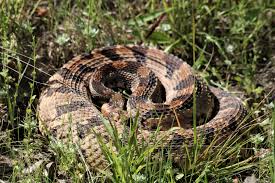
The two other “shoulda” moments in my life are etched into my brain as clear as crystal.  When I was a kid, I once hit a tennis ball over my neighbor’s fence and into their backyard.  It was easy enough to sneak through their side gate and down the side of their house.  Then I ran into their tall grass to the approximate location of the ball.  Just short of it, I leaped instinctively over a fully coiled rattlesnake, ready to strike.  No question, the most terrifying moment of my young life.  I remember yelling and screaming until our neighbor came out and killed the snake.  “Shoulda died?”  Maybe not, but tell that to a ten-year-old who was sure he’d be bitten by a poisonous snake.  To this day I’m convinced there was an angel nearby telling me to “JUMP!” at just the right moment.

My one other “shoulda” happened in my twenties.  Driving back to my college after a road trip, I fell asleep at the wheel in the early-morning hours of an almost deserted divided highway.  My car drove itself into the road’s grass median at 60 mph, where I awoke to the horrifying realization I was completely out of control.  Struggling to get the car in hand, I swerved this way and that until finally crossing three lanes of oncoming traffic, plunging into a ditch, completely rolling the car, and finally skidding to a stop, adding the flourish of a 180° spin.  How was the hospital?  Never saw it.  I walked away from my totaled car with just cuts and bruises, in an understandable state of shock.  Why wasn’t I hit by oncoming traffic?  Why didn’t I perish in the remains of my car?  Another dose of providence, I think.

We all have one or two of these “shoulda” moments in our lives.  They leave an indelible stamp on our memory as if to say, “Nope, not done with this life just yet.”  Now let’s add “coulda” and “woulda” moments.

“Coulda died” moments are all over the map:

I coulda died if I didn’t catch my balance on the edge of that cliff.

I coulda died if I hadn’t been strong enough to swim out of that riptide.

I coulda died if I rode my bicycle on that busy highway.

And so on.

“Woulda died” moments are even worse because you know the life-or-death consequences beforehand.  “Woulda’s” are typically fraught with ignorance.  Choosing to drag race down a busy city street.  Choosing to scale the steep roof of your house in shorts and sandals.  Choosing to act on your road rage.  Have I done any of these “woulda’s” myself?  No. I choose to live instead.

Maker’s Mark is a small-batch bourbon whiskey produced in Loretto, Kentucky by the company Beam Suntory. Maker’s marks, by my definition, are those “shoulda” moments where we emerge on the other side, a sweating bundle of nerves, thankful to be alive.

That semi and I had a “shoulda” moment the other night, but divine providence chose to play a part.

Thanks be to God.

Amending Fences

We’re keeping a close eye on our new neighbor these days.  You see, he’s building a fence on his property.  In most cases the only discussion neighbors have about fences is who pays for what, or how the fence will look on either side.  But this situation’s more complicated.  Our neighbor doesn’t realize the driveway separating he and me is not right on the property line.  If his new fence line marches down his side of the driveway, he’s actually claiming several square yards of our property.

Better left alone

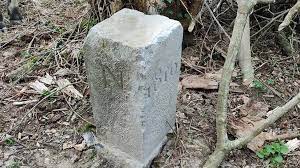
Here’s a story you never hear, certainly not in the United States.  A Belgian farmer was working on his property and decided to move a giant rock in one of his fields.  Several days later, federal authorities knocked on his front door.  Turns out, moving that rock adjusted the border of Belgium.  Our farmer moved one rock (as it turns out, a 300-year-old stone marker) and singlehandedly increased the size of his country by 1,000 square meters.  The very sovereignty of his nation was called into question.  Neighboring France was not thrilled.

So it is with my neighbor.  Unless he has a plot plan on hand he’ll unknowingly increase the size of his property while decreasing mine.  But that’s why we put up fences, right?  A fence specifies property; a literal landmark to indicate, “this is mine”.  That’s just for starters because we use fences for a lot of other reasons.

If I’m guessing right, my neighbor needs a fence to keep horses (or other livestock) between his house and the edges of his property.  His animals will be shut in from adjacent roads and lands.  Good luck with that, friend.  Most people around here seem to have breaks in their fences (if they have fences at all).  Not a day goes by where someone doesn’t post a notice on our neighborhood’s electronic newsletter about animals on the loose.  This morning’s alert concerned a bunch of cows grazing peacefully… on the wrong property.  You can’t blame ’em if “the grass is greener on the other side”, right?

Last week on our vacation to Charleston, South Carolina, we drove down streets full of the town’s characteristic row houses, with tasteful pastel colors and two-story side “piazza” porches.  We also walked by stately antebellum mansions in the waterfront “south of Broad” neighborhood.  Each of these estates was surrounded by high gates and brick walls, an obvious nod to security.  Yes, these palaces were beautiful, but their surrounding “fences” seemed to declare, “keep out”.  So we did.

Here’s another need for fences.  At last Saturday’s Triple Crown Belmont Stakes in New York, the eight thoroughbreds were guided – and in one case pushed – into the starting gate before the race began.  In the split second where the horses were all in a row, each standing in a sort of starting cage, there was structure.  Once they burst out of the gate, all horses and riders shifted to the left, jockeying chaotically for prime position on the rail.  Imagine the start of that race without that starting “fence”.  Disorder with a capital “D”.

Some fences don’t even need a physical definition.  Picture your city streets without lane markings (as if you lived in India).  All cars would tend to compete for the best position, just like those Belmont Stakes horses.  Horns would honk and road rage would rise to new levels.  Roll down your window and throw out any sense of safety.

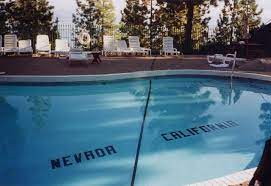
I leave you with one final fence.  The shuttered Cal Neva Lodge and Casino overlooking Lake Tahoe straddles the border between California and Nevada.  A solid line on the floor splits the dining room and then the swimming pool, to indicate which state you’re dining or soaking in.  Drink on one side of the line; drink and gamble on the other.  I just hope the hotel’s current remodel doesn’t include relocating the pool.  California might become even bigger!

Some content sourced from the CNN Travel article, “Belgian farmer moves border with France by mistake”.

Ice Cream Dreams

Before our vacation in South Carolina last week, I took measures to ensure I was fully prepared for the low country’s late-May heat and humidity. I packed a reliable SPF 30 sunscreen. I purchased a couple of bottles of spray-on insect repellant. I added several hats to the wardrobe. I even brought a USB-chargeable mini-fan, which hangs around the neck, operates at three speeds, and adjusts to just the right angle. But guess what? I didn’t need any of these items in South Carolina last week (for the weather gods were merciful). Instead, I should’ve left it all at home and just brought my bed.

South Carolina is nicknamed “The Palmetto State”

Is it me getting older or can we all agree on the exceptional value of a good night’s sleep?  For me, it’s a day of brain fog if I don’t get a quality 7.5 hours in la-la land the night before.  When I’m up past midnight (which is never my intention), I know I’m going to pay dearly at 7am the next morning.  Because, I wake up without fail (and without alarm clock) every morning at 7am.  Even if I don’t hit the hay until 3am.

 Stay in a hotel – any hotel – and after one night you’re reminded how the circumstances of quality sleep are frustratingly beyond your control.  My wife and I booked a charming historic inn our first night last week, and what-do-you-know, our bed was just as historic.  The seemingly elegant four-poster contained a lumpy mattress with a few squeaky springs, and a decided slope from my side of the bed to my wife’s.  Throw in the two-hour time change and we tossed and turned like a washing machine’s most violent agitation cycle.

The second day we drove over to Charleston (half asleep), where you’d think a Courtyard-by-Marriott room would deliver the Z’s just a little bit better.  No such luck.  Our fifth-floor corner space included two windows with not-so-blackout curtains.  Our first night’s sleep was interrupted by the hotel fire alarm, triggered because one of the elevators malfunctioned.  The rest of our night’s sleeps were interrupted by the several amped-up bachelorettes and wedding parties resident in the hotel.  Finally, we were adjacent to the fire exit stairs, with a bangy access door used constantly… because of the malfunctioning elevator.

Once upon a time, I was happy just to afford a bed to sleep in.  But over the years I’ve developed a respect for the crucial elements of quality sleep.  A comfortable mattress is worth the max you can afford to pay.  A mattress where you can raise/lower the head and foot is even better.  Make the room pitch black (which in our case includes a small piece of cardboard to block the fireplace pilot flame).  Adjust the temp to the high sixties °F.  Invest in a white noise machine.  And table the electronic devices and alcohol several hours before bedtime.

If there was a plus side to my Charleston sleep, it was this.  We discovered a very good ice cream place within walking distance of the hotel.  Don’t know about you but ice cream does wonders for my sleep.  Specifically, my dreams.  Maybe it’s the sugar or maybe it’s just the late-night munchies, but I’m guaranteed all kinds of REM-sleep adventures when I’ve had ice cream.  Some are haunted-house scary, others earn a movie-theater R-rating, and still others are a jumbled hodgepodge of individual memories making no sense when thrown together.  Whatever the subject, my ice cream dreams are a ton of fun.  They also disappear from memory as fast as the ice cream did the night before.  I’m not one of those who greet you at breakfast with, “You’re not gonna believe what I dreamed about last night!”  Because I’ve already forgotten.

Dreams are the topic of an entire post and alas, I’ve already used up my typical word count this time around.  But let me leave you with some dreamy trivia.  The average person enjoys three to five dreams a night.  Like me, most people quickly forget their dreams the moment they wake up.  Dreams last longer as the night progresses.  The older you get, the less you dream.  Finally, for all we know about the brain, we know next to nothing about dreaming.

I can’t fit a bed in my suitcase so I already know the next time I travel means quality sleep stays behind.  But maybe I’ll pack a little ice cream on dry ice.  If I can’t get my usual dose of Z’s, the least I can do is enjoy a forgettable sweet dream or two.

Some content sourced from Wikipedia, “the free encyclopedia”.

A Million Little Leaks

Several years ago, I worked out with a personal trainer in a bunch of one-hour sessions at my gym.  She was all about proper lifting and careful stretching – and nasty core exercises I’ve patently avoided to this day.  But she did give me one time-proven piece of advice: after working out, go relax 10-15 minutes in the dry sauna. You’ve already revved up your metabolism with the workout, so the sauna helps extract toxins from the body. Yes, and the sauna also helps imitate the heat and humidity of South Carolina in the summertime.

My wife & I are heading to the Palmetto State for a long-overdue getaway at the end of May.  We’ll be spending a few days in the western counties before catching up with our daughter and her boyfriend in coastal Charleston.  We’ve taken this trip before.  The difference?  Last time we were there in early April when the heat and humidity sort of caressed your cheek with a soft kiss.  This time we’ll be there to kick off summer and it’ll feel like standing under a hot shower.  Outdoors.  Fully dressed.

I’ve always been a sweater (no, I don’t mean the extra layer you pull over your head in the winter months).  After a long jog, my t-shirt and shorts are so wet they could double as sponges.  My hair falls wet-stringy straight down my forehead and the perspiration runs in rivers here and streams there.  Yep, I’m one handsome dude.  But where most people say ick, I recognize sweating for the healthy cooling/cleansing process it is. A sign my metabolism is alive and kicking.  Turn on the faucets, baby.

Speaking of moisture, isn’t moist one of the most atrocious-sounding words in the English language?  I’ve never made peace with those five letters and I know I haven’t used moist in a sentence in years (no matter how good my baked goods taste).  The English language has such beautiful words, like chimes and delicacy and silhouette.  Why disrupt the sweet-sounding party with a word like moist?

Photo courtesy of Warner Bros.

I’m not gonna pretend a good sweat is ever comfortable (maybe it’s because I feel moist) but I’ve certainly gotten used to the sensation over the years.  And now that I live in Colorado?  Zero humidity.  Well, okay, there’s a little humidity here at 7,500 feet above sea level.  But most of the time it’s so dry, the needle on your tank seems to be perpetually on “E”.  This pathetic little voice deep inside your body pleads for, “water… water…” (think Tin Man asking for his oil can – that kind of voice).

A dry sauna room (aka a “hot box”)

Let’s go back to my dry sauna sessions.  Since you’re already asking the question, I don’t mean “wet sauna” (where steam is introduced into a room as tiled as a Chinese kitchen). I’m talking about that other room, with nothing but wooden benches and a nasty little blast furnace in the corner (wood-burning, electric, hot rocks – whatever heats like hell).  You sit there draped in a small towel in 200º F and for a few minutes, all is quiet and comfortable.  But then, almost imperceptibly, your skin develops a sheen.  You begin to glisten.  Suddenly droplets of perspiration pop out all over the place and it’s “open the floodgates, Poseidon”.  A million little leaks.

I won’t speak for the ladies’ locker room (that mysterious country club adjacent to our locker room), but sometimes the men’s dry sauna can get a little awkward.  When you approach the glass door, it’s so steamed you can’t tell how many guys are already in there.  Once you enter, choose a place on the bench without hesitation or you’ll be judged.  Good chance you’ll end up next to a heavy breather, which in some schools of thought is therapeutic.  Other times you’ll end up next to someone with headphones, which somehow don’t block the four-letter words of his rap music.  One time I was subjected to the wellness preachings of a huge Samoan-looking guy, where I thought it best not to argue with his musings.  All of which is to say, you never really know what you’re gonna get with the dry sauna.  It’s an intimate little sweatbox filled with semi-naked strangers.  Good times, huh?

South Carolina’s “Holy City”

When I’m in Charleston I won’t miss the dry sauna because Mom Nature will provide her own version round-the-clock.  The heat and humidity will promote enough of my perspiration to – as the family says – “make my face rain”.  I’m like one of those mysterious underground springs, where the water keeps bubbling up from the ground and you wonder if it’s ever gonna stop.  Every gonna stop?  Not with my metabolism.  For sheer entertainment value, if you’re in Charleston later this month, keep an eye out for me.  I’m the one with the million little leaks.

Whirlybird Wonder

“Ginny”

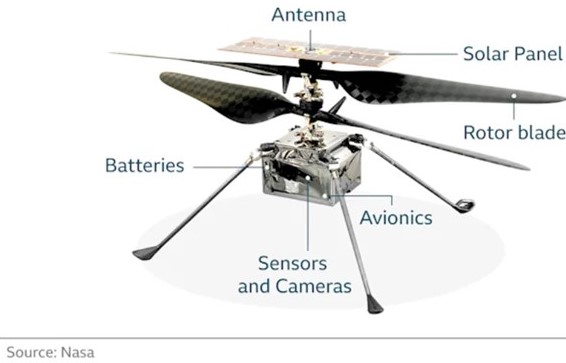
If you haven’t been following the dog-and-pony pony-and-dog show taking place on Mars the last couple of months, you might want to break out the telescope. Not that you’ll be able to see a car-sized rover or a toy-sized helicopter from millions of miles away. But you can see Mars itself, and then you can imagine “Percy” and “Ginny” sniffing around the red dirt and rocks up there. They’re just sampling things to see if Mars can roll out the welcome mat to humans someday.

The rover “Perseverance” is the pony in this show; “Ingenuity” the dog. I want to talk about the dog. Last July Percy hitched a nine-month ride to Mars, launching from Florida’s Cape Canaveral aboard a massive Atlas V rocket. Little Ginny hitched a ride on Percy; she the steadfast little soldier clinging to the rover’s underbelly. Considering Ginny measures only a few feet in all dimensions, it must’ve been a hang-on-for-dear-life E-ticket kind of adventure.

I’d love to make this a children’s story, but Ginny is anything but soft and cuddly. Have a look. She’s about as cute as a wasp. Consider Martian atmosphere is only 1/100th as dense as that of Earth, which means Ginny has virtually nothing to grab onto to sustain flight. But she whirls at five times the rate of a regular helicopter (2,400 rpm!), and then she rises.  Product safety warning: don’t go anywhere near Ginny’s rotor blades.

Ten days ago Ginny lifted off Mars to a skyscraping height of ten feet.  Then she hovered briefly before rotating about ninety degrees, kind of just observing the Mars-scape.  Finally, she landed.  The whole exercise lasted less than forty seconds.  Big deal, right?  Well, that little maneuver qualified Ginny as “the first powered controlled flight by an aircraft on a planet besides Earth”. Way to go, little wasp.  You just reserved a spot in the Smithsonian after you return home.

Will Ginny end up here?

When I picture Ginny clinging to the rover Percy, then hurtling through outer space for months on end, my middle-aged mind recalled the old Thunderbirds television show.  Thunderbirds featured the Tracy family (marionettes!) and their fleet of wicked-cool space vehicles.  The five Thunderbirds included a giant green supersonic carrier (“Thunderbird Two”), whose massive belly carried a yellow utility submersible (“Thunderbird Four”).  Kind of like Percy carried Ginny.  Trust me young(er) readers, Thunderbirds was awesome television in the 1960s… even if it was just puppets getting their strings pulled.

I’ve ridden in a helicopter exactly once in my life, on our honeymoon over the Napali Coast on the Hawaiian island of Kauai.  I turned to my bride mid-flight and probably uttered some not-so-nice words as I remembered how much I dislike heights.  The glass of champagne beforehand certainly helped.  For me, the fear has always been a toss-up between vertigo (physical) or the idea that terra firma is far, far below me (mental).  No matter the reason, heights just aren’t my cup of tea.

My acrophobia probably goes back to my first ride on a Ferris Wheel, with adolescent nightmares of slipping through the metal lap bar and taking an unplanned skydive.  Or ski lifts, where a little bit of fiddling with the lap bar latch could mean the end of everything.  Parasailing? (No).  Hang-gliding? (Never).  Hot-air balloons? (Why even ask?).  Sorry – airplanes aside, and only the bigger ones mind you – I prefer my thrills securely grounded.

For all the recent broadcast news on Percy and Ginny, I can’t seem to find the part of the story where Ginny returns to Percy, who then returns to the Atlas V rocket, who then returns to Earth.  I’m looking for the part about splashdowns and photo ops and ticker-tape parades – the happy-ending kind of stuff.  My earlier comment about a spot in the Smithsonian may have been a little premature (can you say, “Ginny replica”?).  Note to reader: if you do decide to make this a children’s story you might want to edit things a bit.  Just say our little pony and dog are now asleep on Mars, waiting for their human friends to get there someday.  It sounds much better than, “we just left them there”.

Some content sourced from Wikipedia, “the free encyclopedia”.

O-Love

I like a lot of foods people seem to hate. My favorite Thanksgiving pie is mincemeat, not pumpkin. My favorite licorice color is black (red is just a licorice imposter). You can heap any kind of shellfish you want on my plate except oysters. You’ll find blue cheese in my salad and Brussel sprouts cozying up to my steak. But what about “America’s Most Hated Food”? Was I born in the wrong country? Sorry fellow citizens, I must respectfully disagree with the winner of a recent survey on hated foods.  Black or green, stuffed or plain, sliced or diced, there’s nothing quite like the taste of an olive.

Zippia is a job-search engine I’d never heard of, until I came across their just-released survey called The Food Each State Hates the Most.  Zippia’s road to its results is rather unscientific.  First, come up with a list of forty-odd foods where people tend to say, “gross”.  Then, use Google Search Trends to determine which of these foods people look up the least.  Finally, group the search results by state.  After that meandering highway, here’s what you get:

    (Click image to enlarge)

I think Zippia produces these surveys as a clever way to attract customers.  Didn’t work for me – they just insulted my taste buds!  Thirteen of fifty states claim the olive as their most hated food?  Two of those states are California and Georgia, where the lion’s share of America’s olives is grown.  I’m already suspicious.

Not a pile of tires

I’ll grant Zippia’s survey this.  Most people I know don’t care for olives.  They don’t like the look or the smell, and even though they’ll admit to olive oil in their salads and heart-healthy recipes, they’ll still deny any affection for the fruit.  Yes, I said fruit, not vegetable.  Doesn’t that make those little sodium balls a bit more palatable?

The rest of the survey, I can buy.  Anchovies shouldn’t swim anywhere near a pizza (good call, America’s Heartland).  Washington and Oregon residents probably sat next to me in elementary school, overdosing on bologna sandwiches.  Eggplant, ick.  And beets… beets… I’m almost sixty years into this world and have yet to acquire the taste.  Check back with me in the next life.

If the Zippia survey is to be believed, I live in a state where turkey bacon is our most hated food.  Really?  We just bought several pounds of the stuff last weekend at Costco.  It’s not so bad.  On the other hand, olive oil and vinegar stores are trendy around here.  Most markets have an olive bar adjacent to the cheeses.  Meats and breads have been enhanced with bits of olives for years.  And for the really fancy, serve a tapenade with your crackers; a French spread made of finely chopped olives, capers, and anchovies.  Okay, so tapenade’s probably not for everyone.  But I like it.

I developed a taste for olives as a kid because my mother kept tossing them into her casseroles.  Before I knew it I was eating olives as a snack (and what kid hasn’t done the “wave” with one on each finger?)  One regrettable afternoon I downed a whole can of the large black ones before discovering my mother intended them for one of her recipes.  Believe I went to bed with no dinner that night.  At least my belly was full of olives.

[Side note: The only member of my family who likes olives is my daughter.  Maybe I should’ve named her Olivia? I did have a childhood crush on Olivia Newton-John.]

Not “monster eyeballs”

As if you need more proof of my love of olives, you’ll always find several cans in my pantry.  The sliced ones go into my pizzas, salads, and tacos.  The diced ones go into my omelets.  The whole ones sneak onto vegetable trays next to the carrots and celery (when my wife isn’t looking) or I just down ’em by the can.  And their green siblings with the red pimentos jammed down the middle?  They go perfectly with chips ‘n’ dip in front of the TV.

Step aside, America.  Spain produces more olives than any other country.  Italy and Greece aren’t far behind.  It would be appealing enough to live on the sands of the Mediterranean, growing old on their uber-healthy diet.  But also having trees of “America’s Most Hated Food” everywhere you look?  That clinches the deal.  I just might take my O-Love overseas one of these days.
Some content sourced from the Zippia.com article, “The Food Each State Hates The Most”, and Wikipedia, “the free encyclopedia”.