(Not So) Gently Down the Stream

The small gym I belong to has a fairly set routine with its instructor-led classes. You spend a half-hour on the treadmill and another half on the weight floor, effectively giving the heart and muscles equal attention. The runner in me prefers the treadmill but the brain in me knows – at my age – the weights are the more critical component. Now if only they didn’t throw in the rower every now and then.

torture device

If you belong to a gym yourself, I’d be curious to know what piece of equipment (or kind of workout) appeals to you most.  Some people get lost in a treadmill run by following a virtual trail or listening to a really good playlist.  Others stomp endlessly on the stair-stepper like they’re climbing the Empire State Building.  Fans of the elliptical machine look like cross-country skiers going back-and-forth to nowhere.  But where-oh-where are the rowing machines?  Oh, they’re parked way over in the corner, just begging somebody to jump on.

I can’t remember when I first I tried the rower but I do remember thinking, there is nothing appealing whatsoever about this exercise.  A straight back is critical to avoid injury (something I learned years later), and your arms and legs get a heckuva workout.  But unlike say, planks, the workout on your abs is not as obvious.  Not until later the same day at least, when you can’t sit or stand without midriff pain.

The Brothers Maclean

The topic of rowing makes it into my blog because of a recent and ridiculous world record.  Three brothers – Ewan, Jamie, and Lachlan Maclean (how’s that for Scottish?) – just finished a row from Peru (the country) to Australia (also the country) in 139 days.  That’s 9,000 miles for those of you who didn’t scurry over to Google Maps to find out.

As if 9,000 miles isn’t impressive enough, the Macleans row-row-rowed their boat continuously, which is to say they never stopped.  Two brothers rowed while one brother slept.  Their food supply was fresh fish (of course) or the occasional freeze-dried meal.  The brothers endured everything you’d expect the Pacific Ocean to throw at them: seasickness, tropical storms, a shrinking food supply, and so on.  One of the brothers even went man-overboard one night when a rogue wave came out of nowhere.

The Maclean vessel

“World record” implies someone gave this crazy journey a shot before the Macleans did.  Yep, a Russian made the same trip in 2014, only he did it solo.  Don’t these crazies know they can get their rowing fill at a nearby gym?

Maybe your image if rowing is a little more romantic, as in crew, where teams of athletes scull long, narrow boats down rivers in races against each other.  Crew really is elegance in motion whether “eights” or “singles”, the long oars moving back and forth in perfect synchronization to generate the glide, with hardly a disturbance to the water below.  Crew is Oxford, Harvard, and Yale.  Crew is outdoors on a picturesque, tree-lined river.  Crew is anything but synonymous with the pursuit of a world record on the Pacific Ocean.

Speaking of racing, my little gym often injects “challenges” into our workouts by timing performance against a set distance.  On the rower, the longest go is 2,000 meters, which most of us do in say, 8-10 minutes.  I’ll admit, the competitor in me tolerates rowing just a sliver more when I’m on the clock.  I close my eyes and pretend I’m in the Olympics, going for the gold.  Okay no, I don’t do that at all.  I just stare in the mirror in front of me with agony written all over my face instead.

Why in the world is she smiling?

My 2,000m gym row equates to about a mile and a quarter.  Great.  My online calculator says I only need another 7,200 rounds to make it to 9,000 miles.  But hey, if I can maintain my pace and never sleep, I’ll go the distance in 50 days!  Shatters the Maclean world record!  Yeah, no.  Not only am I putting down my rowing machine “oars”, I’m heading back to the treadmill with hopes of putting this torture device completely out of my mind.

Some content sourced from the CNN World article, “Scottish brothers complete record 139-day row across Pacific…”, and Wikipedia, “the free encyclopedia”.


Running Amuck

Last Saturday our little town hosted a festive 10k run.  High school cheerleaders pom-pommed us away from the starting line while hundreds of residents waved flags and tossed water bottles along the way. The finish in the town square was packed with people, and included the music, food, and fun you’d find at a carnival.   As I struggled to complete the last couple of “k’s” I struck up a conversation with a nearby runner to distract myself from the effort.  She was pleasant enough, with just the right pace, and she was even a human being.  At least, I think she was.

Suddenly, shockingly, we’ve come to this.  The entry form for your next running race may ask you to identify as 1) human being, or 2) human-oid .  If you choose the latter, you’re saying you still have the physical form and characteristics of a human being.  You just happen to be a robot.

Ten days ago this eerie scenario really played out in Beijing.  A half-marathon took place with thousands of human participants, but the spotlight was clearly on the twenty-one humanoids who also showed up at the starting line.  These robots were accompanied by operators running close behind them, but make no mistake; absent of the wires or other attachments you might expect with a remote-controlled device.  They were running free, with the look and gait of any other runner in the race.

I’m wondering how any of the human runners kept their focus as they ran this race.  I’d want to pace myself against one or two of these machines and just admire their every step.  The humanoid winner, Tiangong Ultra, finished the half-marathon in 2 hours and 40 minutes, or about five miles an hour.  Trust me: five miles an hour is not a walk; it’s a run.

I’ll have to search for the video online, because a still of a running humanoid doesn’t do the accomplishment justice.  I just can’t get over the fact we now have robots who run.  Granted, the Beijing half-marathon wasn’t what you’d call a “run in the park” for these technological marvels.  Only six of the twenty-one finished the race.  Others fell down or exhausted their battery packs.  Still others lost their heads or spun out of control.  If there had been a humanoid hospital nearby, its ER would’ve been a machine-shop hotbed of activity.

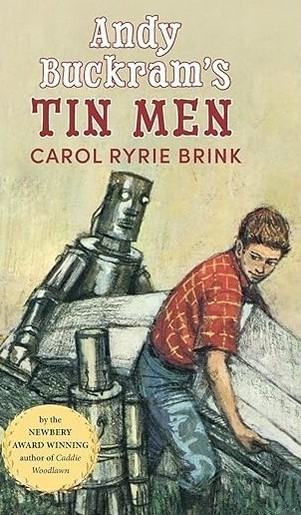
My perception of all things “robot” is clearly outdated.  I’m more inclined to picture self-guided vacuum cleaners and assembly-line automatons than race-running humanoids.  Case in point: I’ll never forget the grade-school novel, Andy Buckram’s Tin Men.  It was a wonderfully imaginative tale about a boy who created a family of robots from a pile of cans, and his unexpected adventures when those robots came to life courtesy of a lightning strike.  The book was written in the 1960s and was a work of fiction.  Of course it was.

I’ll also never forget the movie Silent Running (1972), a future shock story of a destroyed Earth, with spaceships housing giant terrariums cared for by lovable lifelike service robots.  Or Westworld – the 1973 original, not the HBO series  – an adult amusement park of sorts where robots catered to the guilty pleasures of their human customers (until collectively the robots decided to run amuck).

C-3PO

C-3PO from the original Star Wars trilogy (1977) might’ve been the first humanoid to get me wondering if such technology was possible.  Blade Runner (1982) took the concept an interesting step further, with humanoids desperate to demonstrate their emotional capacity.  Less than fifty years later we’re still working on that emotions bit, but I certainly wouldn’t have bet we’d have humanoids who could run.

Let’s be clear – we’re at least another fifty years removed from any technology that remotely suggests “human”.  Even if Siri and Alexa appear to read your mind and hold meaningful conversations with you, they’re not going to jump out of your smartphone tomorrow and land on two legs.  Even if  your little robot dog wags its tail, lies down, and rolls over, it’s not going to take a bite out of your leg when it doesn’t get enough attention.  Your Roomba might suck up the lion’s share of dust and dirt in your house but it’s not coming for your valuables.

I sleep peacefully at night knowing the nightmares of Westworld and Blade Runner continue to be the stuff of (evil) Hollywood imaginations.  Virtual reality will remain virtual, and robots will continue to be nothing more than subservient devices for years to come.  But admittedly, you can’t help but question “years to come” when you see a humanoid run a half-marathon.


LEGO Notre-Dame de Paris – Update #13

(Read about the start of this “church service” in Highest Chair)

I’m not sure I’ve ever stopped the construction of a LEGO model smack-dab in the middle of a bag of pieces.  Imagine our priest at Notre-Dame de Paris, pausing midway/mid-sentence into his homily only to say to his congregation, “I’m tired.  Let’s pick this up next week, shall we?”

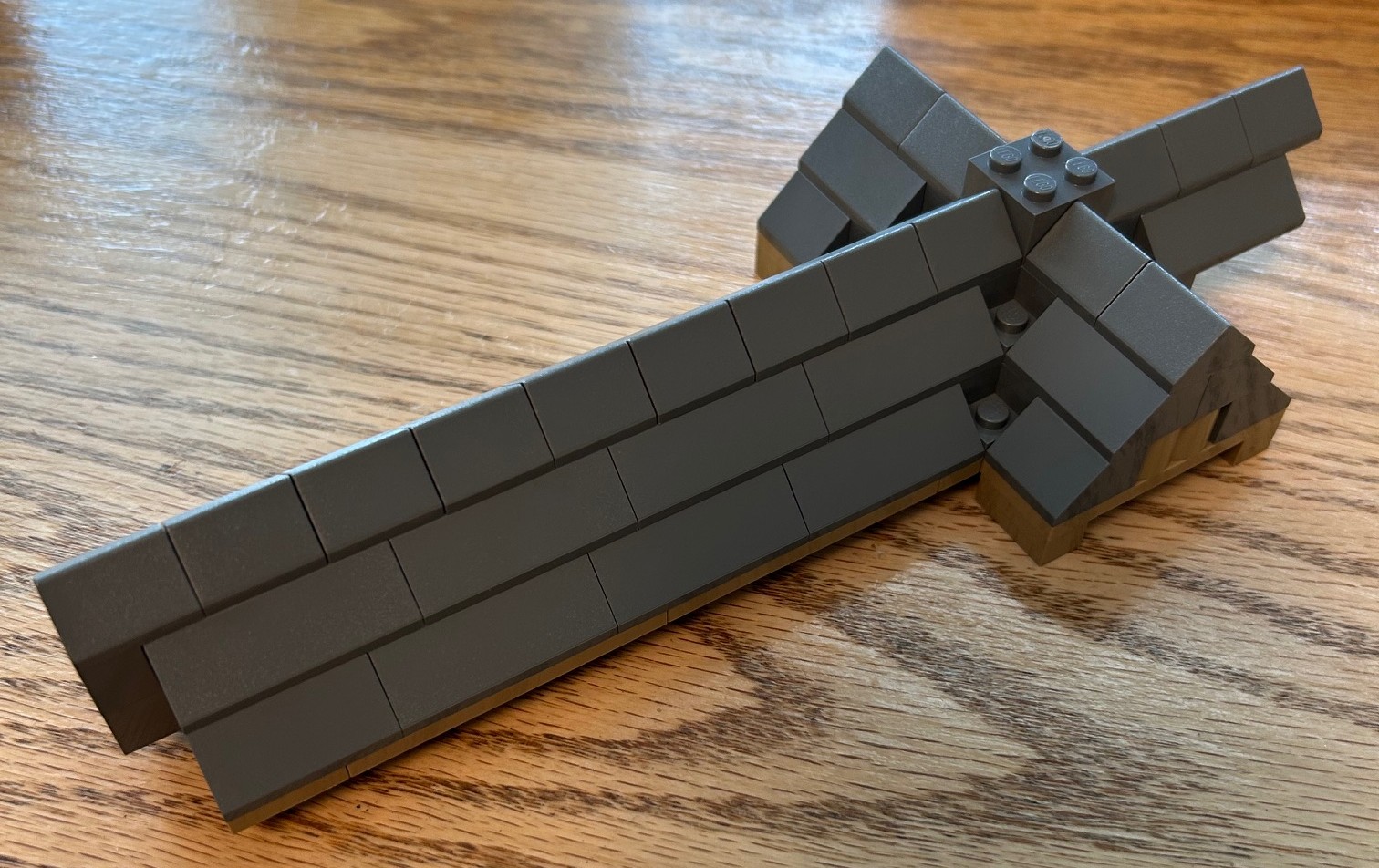
Cathedral roof structure

Bags 25-28 – of 34 bags of pieces, were a study in opposites.  In a crisp fifteen minutes, Bag 25 assembled to the roof structure you see here, covering the remainder of the nave (the sanctuary) and transept (the cross section).  Even Bag 26 wasn’t a stretch as we built the “cores” of the uppermost cubes of the cathedral towers.

Two bags = hundreds of pieces.  Seriously.

But that’s when I should’ve stepped on the brakes.  The instruction manual told me to break open Bags 27 and 28 together and this is what stared up at me.  If you think the pile on the right adds up to a lot of pieces, you are correct about both piles and you’re probably underestimating the number.  These tiny, tiny pieces come together slowly to complete the uppermost cubes of the cathedral towers.  One cube took 75 minutes.  Why so long?  186 pieces each.  No kidding – zoom in on the top of the completed tower below and you’ll get some sense of how intricate it is.  Now you understand why we paused in the middle of the homily.  I just didn’t have the energy to build up the other tower.  Next week!

(Click the photo for more detail)

Since we’re close to the end of the build, let me admit to looking ahead in the process.  The remaining six bags are small, and the pieces inside of them are minuscule.  If I had visions of finishing off the cathedral in a flurry of construction, they’ve been dashed by the thought that I’m still a good five hundred pieces from the finish line.  Sigh… this church service is getting a little long.

Running build time: 13 hrs. 0 min.

Total leftover pieces: 32

Some content sourced from the Smithsonian Magazine article, “Humanoid Robots Just Raced Alongside Human Runners…”, and Wikipedia, “the free encyclopedia”.

First-Name Basis

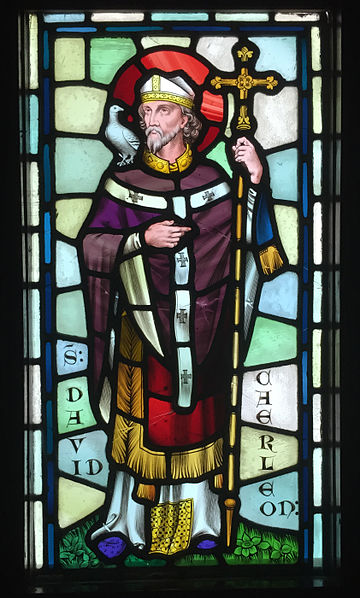
It’s only Tuesday as I type, but I’ve already cleared my calendar for Friday. After all, I have a very important day ahead of me. So important in fact, I need to organize a parade, raise a flag, and prepare unique dishes for the expected throng of adoring fans. But why am I wasting words on the details? You already know we’re celebrating Saint David’s Day in a few days, don’t you?

They’ll be celebrating in Wales, at least, just as they do every first day of March.  You’ll find my cathedral there too, way down in the southwest corner of the country.  Well, St Davids Cathedral, I mean.  And the funny thing is, he’s not the David you’re thinking of, the one from the Bible who took down Goliath as a boy and became king as a man.  This David helped to spread Christianity throughout the UK, united the Welsh people against a warring England, and performed several miracles.  David’s a big deal in Wales.

David’s parade (not Patrick’s)

St. Patrick’s an even bigger deal, of course.  At least Patrick rates a celebration in the U.S.  But admit it, you’re not celebrating Patrick’s spread of Christianity throughout Ireland, nor his miracle of removing all snakes from the land.  You’re thinking more about what garment of green to wear, four-leaf clovers, beer, and maybe, just maybe, this is the year you participate in your local St. Paddy’s Day 5k.

Nice cathedral, Dave

This business of saints is interesting to me because, well, it’s not as defined as I was led to believe.  The rules and processes to put “Saint” in front a first name are a little vague.  Suffice it to say, you need to be a model citizen, as well as a teacher, person of influence, and someone who cares little for the material goods and comforts of this world.  I know a lot of people who fill this bill, but add in “wonder worker” or “source of benevolent power” and the list drops to zero.

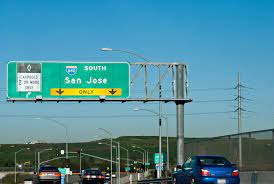
Do you know the way to… ?

Saints are also on my mind because I grew up in California and, well, they’re all over the place out there.  Francisco to the north.  Diego to the south.  Barbara somewhere in the middle.  My childhood home was right down the street from Monica.  My brother lives in Fernando’s valley.  99.9% of the state’s residents think of those as “places”, but firstly they were people.  You’ll find “San’s” and “Santa’s” all over the Golden State.

Saints get a little watered down when you consider the Catholic Church’s take on them.  More than 10,000 have been recognized over time.  Even more to the point, Catholics acknowledge anyone making it to heaven to be a saint.  I’d hope that count is way more than 10,000 by now.  Maybe it’s the reason we have patron saints: the cream of the crop, the ones regarded as “heavenly advocates of particular nations, families, or people”.  My patron saint isn’t David by default, but I sure like his name.

Eat Welsh Rarebit when you celebrate on Friday (grilled cheese on toast, zero rabbit)

Admittedly, my mind wanders somewhere other than historical figures when I think of saints.  Our dog is a Saint Bernard, one of those gentle giants you picture with a brandy brandy around the neck.  A few years ago we went on a cruise, with a stop in the Baltic Sea port of Saint Petersburg.  “St. Elmo’s Fire” is a luminous phenomenon caused by an atmospheric electric field. (also a pretty good movie from the 1980s).  And so on.

You can read a bit more about Saint David and his cathedral in one of my very first blog posts: unsung.  You’ll discover that his town of Pembrokeshire – the smallest kingdom enclave in the UK – is right across St. George’s Channel from the Irish town of Kildare, where you’ll find St. Brigid’s Cathedral, my wife’s namesake.  The blog post is really about Brigid but at least David gets a mention towards the end.  Even if you don’t “read a little more”, remember, Friday’s the big day.  Parades, flags, and fun food, all for a darned decent guy.  Makes me blush anytime somebody says, “Dave, you’re a saint.”

Some content sourced from Wikipedia, “the free encyclopedia”.
The Times of Sand

I’ve often thought the airport is the best place to people-watch. With downtime while you wait for your flight and the close proximity to others, it’s inevitable you’re going to look around. Every kind of person can be found at the airport (sporting every size, shape, fashion statement, stress level, and age). Travelers are unknowingly entertaining to those who watch them. But today let’s explore perhaps an even better venue where people do their thing: the beach.

As I type today, a sweeping look at the sandy shore beyond my patio shows me (in no particular order): A mother and daughter in animated conversation with a lifeguard; a group of teenagers (male) playing an aggressive form of beach four-square called Spikeball; another group of teenagers (female) sprawled on beach towels in giggly conversation; a father dragging his young son through the shallow waves on a boogie-board; a surfer wiping out in the not-so-shallow waves further out; and an ambitious child shoveling dirt out of a divot of sand as if digging to China.

I look away for a second and then look again: A pack of aggressive seagulls pecking away at someone’s leftovers aside their abandoned beach chair; that same lifeguard sprinting into the water to rescue a struggling swimmer; an older couple having a (clearly) not-so-happy conversation at the water’s edge; a jogger attempting to put in the miles while dodging the less active in his way; and a paused beach volleyball game where the players can’t determine if the ball hit the (sand) line or not.

It’s a rare treat when I can create a blog post from the goings-on on right in front of me, but the beach allows me to do just that.  More to today’s point, an active beach like this one changes character throughout the day.  In other words, there are the sands of time and then there are the times of sand:

  • Dawn: Seagulls, sand, and surf.  The beach at its most peaceful and pristine.
  • Early morning: Serious runners at the shore (unlike the casual joggers later in the day); an Asian elder performing a standing form of meditative yoga; a surf camp for pre-teens to the north; a lifeguard training camp for teens to the south; a pickup truck clearing the trash from the evenly-spaced cans.
  • Mid-morning: The gradual arrival of the masses (and all they bring with them).  Also the arrival of the lifeguards, with bright cones marking the “no-man’s land” for emergency vehicles, flags indicating the adjacent street number so people know where to find you, and more flags to mark the beach’s “surf zone” versus “swim zone”.
  • Midday: Everything I observed at the start of this post (and so much more).
  • Mid-afternoon: The gradual departure of the masses, and (hopefully) all they brought with them.  Also the departure of the lifeguards, signing off with a megaphone farewell to those who remain behind.
  • Early evening: The ritual of the sun-worshippers, who simply must remain behind to witness the (West Coast) sunset.  There’s nothing like a setting sun to bring a person to a focused standstill.
  • Dark: An umbrella of stars, a rhythmic ribbon of white foam as the waves crash to shore, and an occasional party of two out for a romantic stroll at the water’s edge.

Trust me, it’s easy to be mesmerized by the times of sand if you watch them long enough.  They’re the reason I never make progress with my latest “summer read”, and the reason I can abandon my electronic devices for hours at a time.  Frankly, it’s a wonder I was able to turn away from the sands long enough to bring you this blog post today.

Rocket Men (and Women)

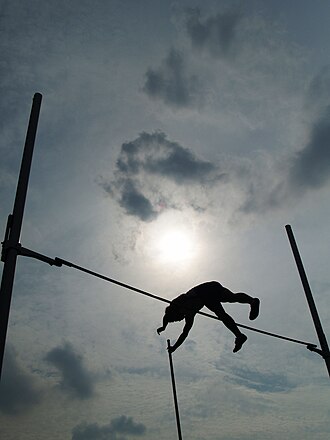
A year from today, we’ll all be glued to our televisions and tablets watching the Olympic Games in Paris. I will be glued, at least.  The Summer Games get me all fired up, especially the track and field events. Especially especially the field events. I mean, c’mon, you can watch running all year long, but how often do you get to see a javelin thrown, a discus tossed, or a shot “put”? (and how often do you even say “javelin” or “discus”?)  But one field event tops all others.  There’s simply nothing more gawky-entertaining than a human launched into space by a pole.

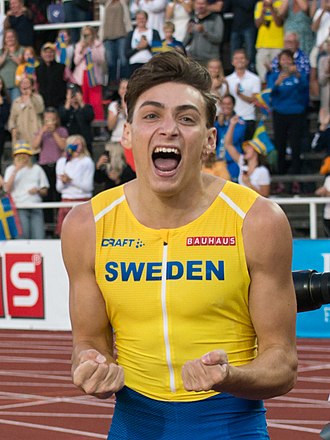
If you live in a two-story place with a fairly flat roof, it might be a little unnerving to learn Swedish-American pole vaulter Armand Duplantis can jump over your house.  While the rest of us have to walk around at ground level to get to your backyard, Armand will simply sprint up your front path, plant his pole in your rose bushes, launch himself past the bedroom windows and between the chimneys, and make a splash landing in your swimming pool.  Armand can do this because he can pole vault 20.4 feet, a world record he set last February.  It’s the fifth time this twenty-something has broken his own world record.

Duplantis

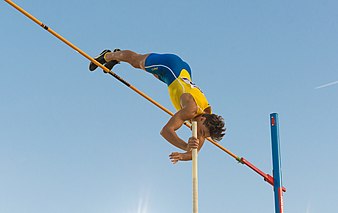
Pole vaulting is a truly bizarre sequence of movements constituting an Olympic event.  The vaulter balances a long fiberglass pole in one hand while sprinting down a rubber-surfaced runway. Just before running out of runway he or she raises the pole overhead with both hands, stabs the leading end into a boxed area on the ground, and pushes… hard.  The ensuing bend of the pole and a whole lot of momentum hoists the vaulter into the air, feet first.  With gymnastic flair, the vaulter then rotates his or her body around to be facing a high horizontal bar, just as gravity counters flight.  The final flop back to Earth (and onto a giant cushion) is typically punctuated with a mid-air fist pump if the bar is successfully cleared.

Armand doing what Armand does best

Imagine that exhilarating feeling when a pole vaulter is at peak height, pointing skyward, feet above body, pole released, practically cruising into the earth’s atmosphere.  As Elton John sings “… it’s gonna be a long, long time ’til touchdown brings me round again…”

Four Olympic field events involve jumping: 1) pole vault, 2) long jump, 3) high jump, and 4) triple jump (the ol’ “hop, skip, and jump”).  None of the last three hold my interest because they’re easy to do.  But not pole vaulting, not even close.  Launching my body even a few feet off the ground with a bendy pole?  Let’s just agree, I am no Rocket Man.

Pole vaulting brings to mind two questions (or three if you include Why in heaven’s name does anyone do this?).  First question: What happens if the pole breaks?  Seriously, sports equipment fails.  Golf clubs break in two with enough swings.  Tennis racket strings get loose.  At some point a pole vault pole will bend one too many times.  Yikes.  Second question: How does the pole translate horizontal energy into vertical energy?  It’s a physics problem akin to the catapult, but I’d have to go back to high school to solve it.  No thanks.

Leap of faith

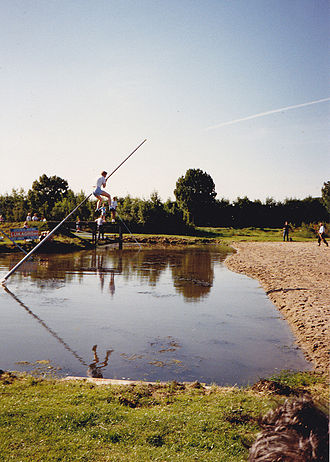
The origin of pole vaulting is a bit of a letdown.  My too-many-movies imagination pictured a medieval war, with soldiers clearing castle walls on long pieces of bamboo.  Instead, pole vaulting is a rough translation of an old technique used to scale narrow natural obstacles, like watery marshes.  Get a running start, plant the pole, and sail from one side of the marsh to the other.  But those poles don’t bend, and nobody cares how high you go as long as you make it over.  So you see, even the origin of pole vaulting is gawky. 

The pole vaulting world record was eighteen feet in 1970.  Fifty years later it’s been pushed two feet higher.  Do the math; maybe we’ll be clearing one hundred feet by the year 2773.  But we’ll probably have flying cars by then as well, so any interest in humans launched by poles will be gone.  My advice: watch the Paris Games, especially the pole vault.  These rocket men and women won’t be around forever.

Some content sourced from the CNN article, “Olympic champion Armand Duplantis…”, and Wikipedia, “the free encyclopedia”.

The Cheese Stands Alone

Back in his days of stand-up comedy, Bill Cosby did a great routine on golf. He talked about the frustration of watching the game on TV, trying to locate a little white dot as it flies through a screen of blue sky. I can still hear his puzzled description of playing the game, where he’d say, “You had the ball right there in your hand, but then you went and hit it away! Now you have to go get it!” It’s the sort of “play on play” I thought of when I heard about cheese rolling.

Ready for racing!

Humans thrive on competitions and we’ve come up with some weird ones over the years.  Wife-carrying.  Fruitcake tosses.  Pole vault.  Or just about anything from the Scottish Highland Games (caber toss, anyone?) But the Cooper’s Hill Cheese-Rolling and Wake may be the weirdest one of them all.  Seriously, who willingly signs up to sprint down a seriously steep hill, in hot pursuit of a rolling, bouncing wheel of cheese, where the grand prize is… the cheese itself?

Here’s a video of one of this year’s races at Cooper’s Hill (near Gloucester in England).  I dare your jaw not to drop as you watch these contestants spill into view at the top of the hill.  Notice the leaders have already left their feet and are literally falling down the mountain.  It reminds me of the ad where the tire goes over the cliff, starts rolling down a steep incline, and then bounces high off the rocks and terrain as it gathers speed before disappearing below. 

The cheese really does stand alone at Cooper’s Hill because it’s never actually caught.  A rolling wheel of Double Gloucester is simply too fast.  Instead, the winner is the runner (“faller?”) who makes it to the bottom first.  Just about every participant sustains injuries.  In last week’s running, with the usual nod to the hospital emergency room, the winner of one of the women’s races knocked herself unconscious just as she crossed the finish line.  Revived in a nearby recovery tent, only then did she realize she’d won.

Cooper’s Hill

Organizers expect “damage to participants” at Cooper’s Hill.  A first-aid service is at the ready, as are several ambulances.  A local rugby club volunteers to be “catchers”, positioned on the hill to rescue anyone who finds themself out of control.  In a quote from the Sydney Morning Herald (yes, this event gets global attention), a participant described the race as “twenty young men chasing a cheese off a cliff and tumbling 200 yards to the bottom, where they are scraped up by paramedics and packed off to hospital.”  Sounds like a blast, doesn’t it?

Here’s my favorite quote about cheese-rolling.  Matt Crolla, who won one of this year’s men’s races, was asked how he trains for the event.  He admitted, “I don’t think you can train for it, can you?  It’s just being an idiot”.  That about sums it up in my book.

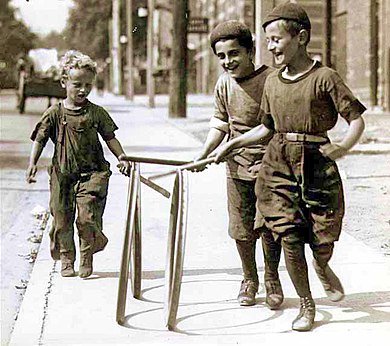
I tried to think of similar sports to cheese-rolling and drew a total blank.  Golf, shot put, and javelin all start by sending an object on its way (like a rolling cheese) but in none of them do you race after it.  Then I thought about hoop rolling.  Remember that game?  No, you don’t – you’re too young!  Nobody rolls hoops anymore! But there was a time when kids did just that, using a short stick to propel a wooden hoop along the sidewalk, trying to keep it upright as long as possible.  Sounds about as boring as cheese-rolling is dangerous.

In the timeless nursery rhyme The Farmer in the Dell, one of early lyrics includes “the child takes a nurse”. Several lines after that, “the cheese stands alone”.  Maybe the song was a nod to cheese-rolling.  After all, most participants are going to need a nurse whether or not they win this crazy race.  Maybe even a wake.

Some content sourced from the CBS News article, “Women wins chaotic UK cheese race…”, and Wikipedia, “the free encyclopedia”.

A Million Little Leaks

Several years ago, I worked out with a personal trainer in a bunch of one-hour sessions at my gym.  She was all about proper lifting and careful stretching – and nasty core exercises I’ve patently avoided to this day.  But she did give me one time-proven piece of advice: after working out, go relax 10-15 minutes in the dry sauna. You’ve already revved up your metabolism with the workout, so the sauna helps extract toxins from the body. Yes, and the sauna also helps imitate the heat and humidity of South Carolina in the summertime.

My wife & I are heading to the Palmetto State for a long-overdue getaway at the end of May.  We’ll be spending a few days in the western counties before catching up with our daughter and her boyfriend in coastal Charleston.  We’ve taken this trip before.  The difference?  Last time we were there in early April when the heat and humidity sort of caressed your cheek with a soft kiss.  This time we’ll be there to kick off summer and it’ll feel like standing under a hot shower.  Outdoors.  Fully dressed.

I’ve always been a sweater (no, I don’t mean the extra layer you pull over your head in the winter months).  After a long jog, my t-shirt and shorts are so wet they could double as sponges.  My hair falls wet-stringy straight down my forehead and the perspiration runs in rivers here and streams there.  Yep, I’m one handsome dude.  But where most people say ick, I recognize sweating for the healthy cooling/cleansing process it is. A sign my metabolism is alive and kicking.  Turn on the faucets, baby.

Speaking of moisture, isn’t moist one of the most atrocious-sounding words in the English language?  I’ve never made peace with those five letters and I know I haven’t used moist in a sentence in years (no matter how good my baked goods taste).  The English language has such beautiful words, like chimes and delicacy and silhouette.  Why disrupt the sweet-sounding party with a word like moist?

Photo courtesy of Warner Bros.

I’m not gonna pretend a good sweat is ever comfortable (maybe it’s because I feel moist) but I’ve certainly gotten used to the sensation over the years.  And now that I live in Colorado?  Zero humidity.  Well, okay, there’s a little humidity here at 7,500 feet above sea level.  But most of the time it’s so dry, the needle on your tank seems to be perpetually on “E”.  This pathetic little voice deep inside your body pleads for, “water… water…” (think Tin Man asking for his oil can – that kind of voice).

A dry sauna room (aka a “hot box”)

Let’s go back to my dry sauna sessions.  Since you’re already asking the question, I don’t mean “wet sauna” (where steam is introduced into a room as tiled as a Chinese kitchen). I’m talking about that other room, with nothing but wooden benches and a nasty little blast furnace in the corner (wood-burning, electric, hot rocks – whatever heats like hell).  You sit there draped in a small towel in 200º F and for a few minutes, all is quiet and comfortable.  But then, almost imperceptibly, your skin develops a sheen.  You begin to glisten.  Suddenly droplets of perspiration pop out all over the place and it’s “open the floodgates, Poseidon”.  A million little leaks.

I won’t speak for the ladies’ locker room (that mysterious country club adjacent to our locker room), but sometimes the men’s dry sauna can get a little awkward.  When you approach the glass door, it’s so steamed you can’t tell how many guys are already in there.  Once you enter, choose a place on the bench without hesitation or you’ll be judged.  Good chance you’ll end up next to a heavy breather, which in some schools of thought is therapeutic.  Other times you’ll end up next to someone with headphones, which somehow don’t block the four-letter words of his rap music.  One time I was subjected to the wellness preachings of a huge Samoan-looking guy, where I thought it best not to argue with his musings.  All of which is to say, you never really know what you’re gonna get with the dry sauna.  It’s an intimate little sweatbox filled with semi-naked strangers.  Good times, huh?

South Carolina’s “Holy City”

When I’m in Charleston I won’t miss the dry sauna because Mom Nature will provide her own version round-the-clock.  The heat and humidity will promote enough of my perspiration to – as the family says – “make my face rain”.  I’m like one of those mysterious underground springs, where the water keeps bubbling up from the ground and you wonder if it’s ever gonna stop.  Every gonna stop?  Not with my metabolism.  For sheer entertainment value, if you’re in Charleston later this month, keep an eye out for me.  I’m the one with the million little leaks.

Watch Your Steps!

The punk rock duo The Proclaimers are Scottish twins Craig and Charlie Reid. Now 58, the Reid’s were born just a month after I was, back in 1962. Even though The Proclaimers produced eleven albums and sold five million copies, I only know them for their 1988 chart-topper, “I’m Gonna Be (500 Miles)”. It’s the song thrumming in my head every time I’m close to getting my 10,000 steps for the day.

5,514.  Good Lord, I’m only halfway to my 10,000 steps today and it’s already two in the afternoon.  I need to get moving.  I even worked out this morning (lifting doesn’t get you many steps).  As usual, I strapped on my (Fitbit) tracker immediately after waking up but I’m usually further along by now.  I’m gonna have to go long with the dog tonight if I have any shot at making the magic number.

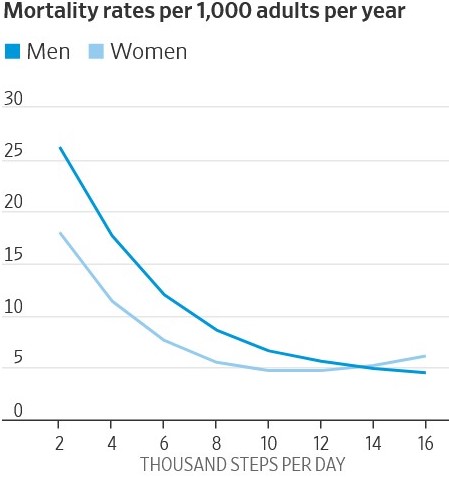
Magic number?  10,000 steps?  Who made this the “minimum for good health”?  A Japanese pedometer company; that’s who.  In 1965, they nicknamed one of their trackers the “10,000 step meter” and the number stuck all these years later.  Not that 10,000 steps has any significance when it comes to health benefits.  It’s all relative to whatever number you normally walk.  For that reason, we Americans can go less than half the 10,000 and still lower our mortality rate in a big way.

If you’re reading this post and you’re Amish, you’re already pooh-poohing 10,000 steps.  You and your people average 14,000-18,000/day just by removing motor vehicles from your world.  If you’re Australian or Swiss, 10,000 is just another day in the outback or the Alps (yodelayheehoo!).  Even the Japanese find a way to average 7,500 steps/day inside a small island nation.  Bringing up the rear?  The Americans, of course (drum roll, please…).  We clock an average of 4,800 steps a day – downright pathetic for residents of the fourth largest land-mass country in the world.  Is it any coincidence the U.S. makes and sells more vehicles than any other country besides China?

Source: Pedro F. Saint-Maurice, National Cancer Institute

Back to the “magical” 10,000 steps.  Let’s diminish the facts, shall we?  A recent collaborative five-year study of 15,000+ participants determined as few as 4,400 steps a day associates to a 40% reduction in mortality rate (when the norm is more like 2,700 steps).  Make it to 7,500 steps and the mortality rate drops by 65%.  In other words, you’re doing your body good well below 10,000 steps.  Unless you’re Amish, Australian, or Swiss.  Sorry, you people have to keep going.

Alas, no collaborative study nor determined blog post is going to change the world’s obsession with 10,000 steps.  The U.S. Department of Health and Human Services instead recommends five hours of moderate exercise a week (or half that much in “vigorous” exercise).  Doctors prefer a rather vague recommendation of “about 2,000 steps more than you normally walk”.  But none of that shuts down tracker production: 33 million devices shipped in the first quarter of this year alone.  You know who you are; doing mindless laps in the kitchen late at night just to “close your rings”.  10,000 steps remains the benchmark no matter the expert advice.

Close those rings!

Speaking for Americans at least, the magic number really is burned into our culture.  We’ve switched out our most glam watches for fitness trackers (because even a Rolex can’t count steps).  We download apps, print out weekly results, and obsess over “rings”, consecutive days, and “personal bests”.  We get cheap thrills when our tracker vibrates 10,000 and those little digital fireworks shower the screen.  Companies offer employees financial incentives if they can demonstrate extended habits of 10,000+/day.  We are beguiled of time and money for this fairly arbitrary number.

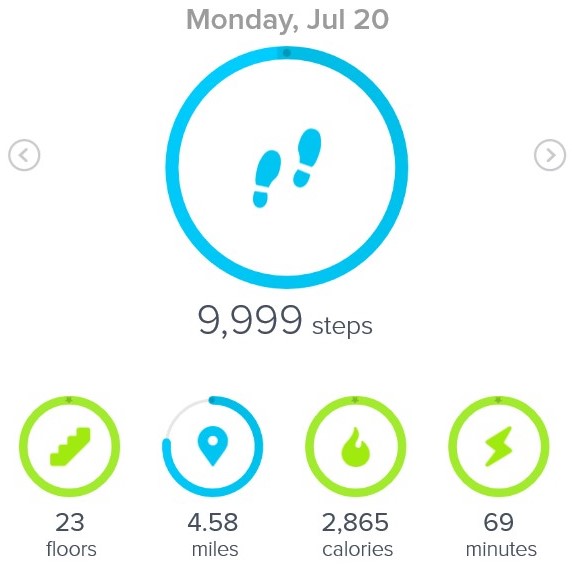
[Side note: The other day I woke up and checked my Fitbit history, only to discover I’d hit 9,999 steps the day before.  Didn’t bum me out; still strapped on the tracker and started a new day.  Kinda proud of that.  On the other hand, one time I strapped my tracker to my ankle to try to get “steps” out of a cycle class.  Didn’t work.  Not so proud of that.]

The pertinent lyrics of The Proclaimers’ “I’m Gonna Be” go like this:  But I would walk 500 miles, And I would walk 500 more, Just to be the man who walks a thousand miles, To fall down at your door.  No wonder I’ve got that song on the brain.  I don’t think I’d walk a thousand miles, even for my girl.  But I would walk five miles (about 10,000 steps) to hit my daily tracker goal.

Some content sourced from the 6/12/2020 Wall Street Journal article, “10,000 Steps a Day Is A Myth.  The Number to Stay Healthy Is Far Lower”, and Wikipedia, “the free encyclopedia”.
Boston Long

Durgin-Park, the venerable restaurant inside of Boston’s Faneuil Hall, recently closed its doors after almost two hundred years of operation. You read that right; D-P opened for business a few decades after the Revolutionary War, but served its last patron this year, citing “an inability to turn a profit”. For America at least, that’s some serious history. For Beantown on the other hand, that’s par for the course. After all, this week the Boston Marathon completed its 123rd consecutive running.
I am in awe of runners who qualify for – let alone run – the Boston Marathon.  It’s daunting enough to compete for 26.2 miles, but you can’t join the “fun” in Boston unless you complete a qualifying marathon in under 3 hours (men, ages 18-34), or 3.5 hours (women).  Consider, 3 hours is an average pace of 7 min./mile.  To appreciate that, go to the gym, crank up the treadmill to eight or nine miles/hour, and see how long you can maintain it.  Now imagine running that fast for three hours straight, up and down the city streets of Boston.  It’s superhuman.

The Boston is the world’s oldest annual marathon.  Simply achieving the age-specific qualification time is the goal of most elite long-distance runners.  But if that’s all you know about New England’s most-spectated event, you’re missing out on some fascinating race-related trivia.  Here’s a sampling:

  1. The Boston is run every “Patriots’ Day” (the third Monday in April), a holiday to commemorate the start of the American Revolutionary War.  Effectively, the marathon is a nod to freedom.
  2. The Boston was first run in 1897, one hundred years after the first Olympic marathon in Athens, Greece.  That marathon, as most know, was inspired by the fabled run of the Greek soldier Phillipides from Marathon to Athens, announcing a battle victory over the Persians.  Effectively, Phillipides’ run was also a nod to freedom.
  3. The Boston Red Sox play every Patriots’ Day in Fenway Park.  The game finishes in time for the fans to walk a mile east along the Charles River, arriving in Copley Square as the marathon runners are crossing the finish line.
  4. Until 1986, the men’s and women’s winners received a wreath of olive branches and a trophy; no cash prize.  Today?  First place: $150k, Second: $75k, Third: $40k, and Fourth: $25k.  Might want to dust off the running shoes and start training.
  5. Check out Derek Murphy’s “marathon investigation” blog here.  Derrick started his sleuthing five years ago and outed over 250 cheaters, including several who faked their race qualification times in order to run.  Too bad Derrick wasn’t around for the 1980 race, when Rosie Ruiz pulled off the marathon’s most famous heist (see her story here).
  6. In the 2011 race, Geoffrey Mutai of Kenya effectively broke the world marathon record (even though it wasn’t deemed official), finishing in 2:03:03.  Try that pace on a treadmill.  Set the speed at twelve miles/hour and… well… let it spin from a safe distance and just watch.
  7. The Boston draws an average of 30,000 participants each year, cheered on by 500,000 spectators.  The participants are divided into men’s and women’s categories of “elite runners” (i.e. pros), the remaining qualified runners (waves of 10,000), wheelchair-bound, and hand-cyclists.  The Boston even accommodates blind runners.
  8. The Boston is famous for Heartbreak Hill; the incline located a few miles from the finish where runners tend to hit an endurance “wall”.  Why the name? In the 1936 race, Johnny Kelley caught up with rival Tarzan Brown on that hill, giving him a pat on the back as he passed by.  Bad move.  Brown took the gesture as a challenge, found another gear, and went on to win the race.  Brown effectively “broke Kelly’s heart” and the hill gained a name forever.
  9. Halfway through the Boston, the lively women from nearby Wellesley College form a long “Scream Tunnel”, yelling and blowing kisses as the runners pass by.  These ladies are so loud, you’ll know the Scream Tunnel is coming a mile before you get there.
  10. And finally… the Boston Marathon is not really run in Boston; not until the final couple of miles.  Before that, you’re touring twenty-four miles of eight neighboring towns instead.

Remarkably, this year’s Boston Marathon included four finishers in the top hundred from right here in Colorado Springs.  The next day, my cycle instructor casually mentioned she’d run the race before.  Ditto my former boss at Hewlett-Packard.  And my sister-in-law has a good chance of qualifying in the next couple of years.  Superhumans.  As for me?  I do like to run, but I’d be happy enough just to spectate beside those hundreds of thousands of “Boston Strong”.  I’m just sorry I can’t have dinner at Durgin-Park afterwards.

Some content sourced from Wikipedia, “the free encyclopedia”; and the Mental Floss article, “11 Fast Facts About the Boston Marathon”.

Nature’s Constant Call

It wasn’t supposed to be this difficult.  Merely tweaking a former New Year’s resolution to create a new one should be the proverbial walk in the park.  But clearly, I wasn’t prepared for the, uh, “inconveniences” of my particular undertaking.  So it goes when you commit to drinking a dozen glasses of water a day instead of ten.

(Hey, give me a sec’… I’ll be right back.)

Are you a New Year’s resolution kinda person?  Do you sit down towards the end of the holidays and pen (or pencil, for you not-so-brave) a list of gonna-do’s for the coming year?  Me, I’m on the fence with the whole promises-promises thing.  Sure, turning the calendar from December to January evokes a fresh start; I’m just not convinced I must be “resolute” in the process.  I prefer casual, undocumented, safe-zone agreements.  Gonna eat better. Gonna get to the gym more. Gonna read a bunch of new books.  Whether I blow them out of the water or just achieve slightly better than last year, I win!

The water thing, though.  Why-oh-why did I read my latest fitness club newsletter and choose to drink their Kool-Aid?  (Wait, hang on… the phone’s ringing… it’s Nature again.)

Can you hear it? Does it make you want to…?

Forget the glittering generality of eight-glasses-per-day.  Not only is the rule passé, it holds no water.  Eight glasses is simply too generic for the myriad human bodies out there.  Ditto downing “half your weight in ounces of water” – too generic.  On the other hand, a pile of research and scientific evidence in my newsletter suggested the following: Men should consume 15.5 cups (3.7 liters) of fluids per day, while women should consume 11.5 cups (2.7 liters).

Now then, “fluids” includes all liquids swallowed in a day, so right away we have an appealing math problem.  Fluids from foods = 20% (just go with it), so my 15.5 cups instantly evaporate to 12.4.  A cup of coffee in the morning and a glass of wine in the evening can also be subtracted (don’t believe the dehydration claims – they don’t hold water).  However – and here we pause the calculator – I can’t escape the negative impacts of a) regular exercise (I sweat like a baby rainstorm), b) environment (Colorado = high altitude = dehydration), and c) breathing.  Those three moisture-robbers elevate me back to 12.4 cups.  Maybe I should stop breathing – that’s worth at least the 0.4 cup.

12 cups = 3/4 gallon

Ten cups a day – now that’s navigable waters in my book.  I start the morning with two (supposedly a good habit) as I wash down my multi-vitamin.  I drink another two mid-morning, another two at lunch, another two or three in the afternoon, and one at dinner.  But twelve cups?  How the heck do I jam another two into my schedule?  More importantly, where to I find the extra time to uh, um… (a little patience here, I need to talk to a man about a horse).

Time to get personal (as if we haven’t been already).  When I morphed from child to teenager to full-grown adult, my body parts grew accordingly, EXCEPT my bladder.  That little balloon remains the same size as when I was born – I’m sure of it.  The bladder is a remarkable organ, “capable of expanding from 2 to 6 inches with a capacity of 16 to 24 ounces”.  MY bladder is capable of expanding to 2 inches (a guess) with a capacity of 16 ounces (another guess).  And here’s the best part.  The urge to urinate comes when the bladder is one-quarter full. Whose idea of a cruel joke is THAT?  Do the math on me and I’m only halfway through cup #1 before I’m scheduling time with the porcelain goddess. Speaking of the goddess, uh… (hold tight while I go water the flowers).

About these down-the-hall interruptions: is it just me or does the sound of running water “accelerate” the process?  In my twelve-cups-a-day world, I continue to brush my teeth, make a cup of coffee, refill the dog bowl, refill the bedroom humidifier, and refill water bottles every time I go to the gym.  You’d better believe every one of those tasks has me wanting to go powder my nose – and I really don’t powder my nose if you know what I mean.  Gee whiz (for God’s sake, don’t say WHIZ!), can’t a guy catch a break that doesn’t have the word “bathroom” in front of it?

My fitness newsletter also claimed, “women who are pregnant or are breast-feeding need additional fluids to stay hydrated”.  Bless my stars, I am not a woman. But seriously, twelve cups?  I’ll be moving my laptop into another “office” in my house before I know it.  There’s more to say on this topic but it’s gonna have to wait because… (I need to make a pit stop).