An Unhealthy Modern Phenomenon

Somewhere in the wee hours of Tuesday morning I had a bizarre dream; one I retained well into my conscious hours. I was on some sort of overseas sightseeing excursion with others, and our group stopped for lunch at a historic convent. Egg salad sandwiches were handed out by the nuns and I promptly dropped mine onto the cobblestones. The dream only gets more disconnected from there but I’ll share one more noteworthy detail. My traveling companion was the actress Mary Stuart Masterson.

“Watts” on the right

Got all that?  Okay, now forget about everything except Mary Stuart.  Masterson has had a respectable (if not award-winning) career as an actress.  She was only ten years old when she first appeared on the silver screen, in the original version of The Stepford Wives.  She went on to play colorful characters in Fried Green Tomatoes and Benny & Joon.  But her most enduring performance – the one she will forever be linked with – was as “Watts”, the companion/tomboy of “Keith” in the high school rom-com Some Kind of Wonderful.  Masterson’s turn as the loyal friend who quietly wanted to be more absolutely stole the show.

As if nuns and egg salad sandwiches aren’t enough, you’re wondering why Mary Stuart Masterson was sitting next to me in my dream.  Actually it wasn’t Masterson herself; it was her movie character Watts.  Which brings me to the Cambridge Dictionary’s 2025 Word of the Year.  Would you believe Cambridge added 6,000 new words to its big book this year?  5,999 of them were runner-ups to parasocial, a word “describing a connection people feel with someone they don’t know (ex. celebrities, influencers, and other online personalities)”.

Blogger’s Note: WordPress needs to get on the ball here.  “Parasocial” is underlined here in my draft post as being an unrecognized word.

Taylor & Travis

Parasocial’s win as Word of the Year has everything to do with Taylor Swift.  Her engagement to NFL star Travis Kelce generated countless claims of “heartfelt feelings toward a couple the vast majority had never met”.  The same applies to Watts.  I don’t know the first thing about Mary Stuart Masterson herself, but I know everything about Watts from watching Some Kind of Wonderful a dozen times or more.

“Parasocial” has actually been around since the 1950’s.  In that era it referred to the innocence of television viewers connecting to television characters (or in my case, movie viewer to movie character).  But today’s version of the word is described as “an unhealthy modern phenomenon”.  Why?  Because of social media.  Because of artificial intelligence.

Ms. Masterson today

My example of Watts is one movie and one instance.  I’ll finish this post and the “encounter” will fade into my memory forever.  But social media – which brings the viewer constant feeds about the “viewed”, and artificial intelligence – which creates a sense of connection where there really isn’t one, makes it clear why there’s reason to be concerned.  Are we really so desperate as to develop foundation-less relationships with strangers?

AI has already found its place on Spotify.  Search for Xania Monet, the first artificially intelligent singer to grab a ranking on a Billboard chart (Adult R&B).  Everything about Xania was created on a keyboard.  But her face, her social media profile, and her voice suggest she’s a living, breathing human somewhere out there in the world.  I wouldn’t be surprised if you can even chat online with Xania.  If so, you’re developing a one-sided relationship (you) with someone who isn’t real whatsoever (a computer).  Seriously, who has time for this nonsense?

“Xania Monet”

Coincidence or not, one of the Cambridge Dictionary’s runner-ups for Word of the Year was “slop”, which in this day and age means “content on the internet that is of very low quality, especially when created by artificial intelligence”.  Let’s declare “slop” a lot of what’s going in parasocial relationships as well.

The real message of this dictionary winner is clear.  We need to remove the “para” from parasocial and focus on simply socializing with our fellow humans.  It’s the only path to truly fulfilling relationships.  Having said that, for some reason I’d love an egg salad sandwich right about now.

—————-

LEGO Trevi Fountain – Update #4

(Read about the start of this build in Brick Wall Waterfall)

The travertine is stacking up quickly  as we continue our work on the LEGO Trevi Fountain.  Bags 7 and 8 – of 15 bags of pieces – came together like the Domenico Scarlatti piano sonatas that accompanied them – seemingly simple on the surface but more intricate and involved the further we dove in.

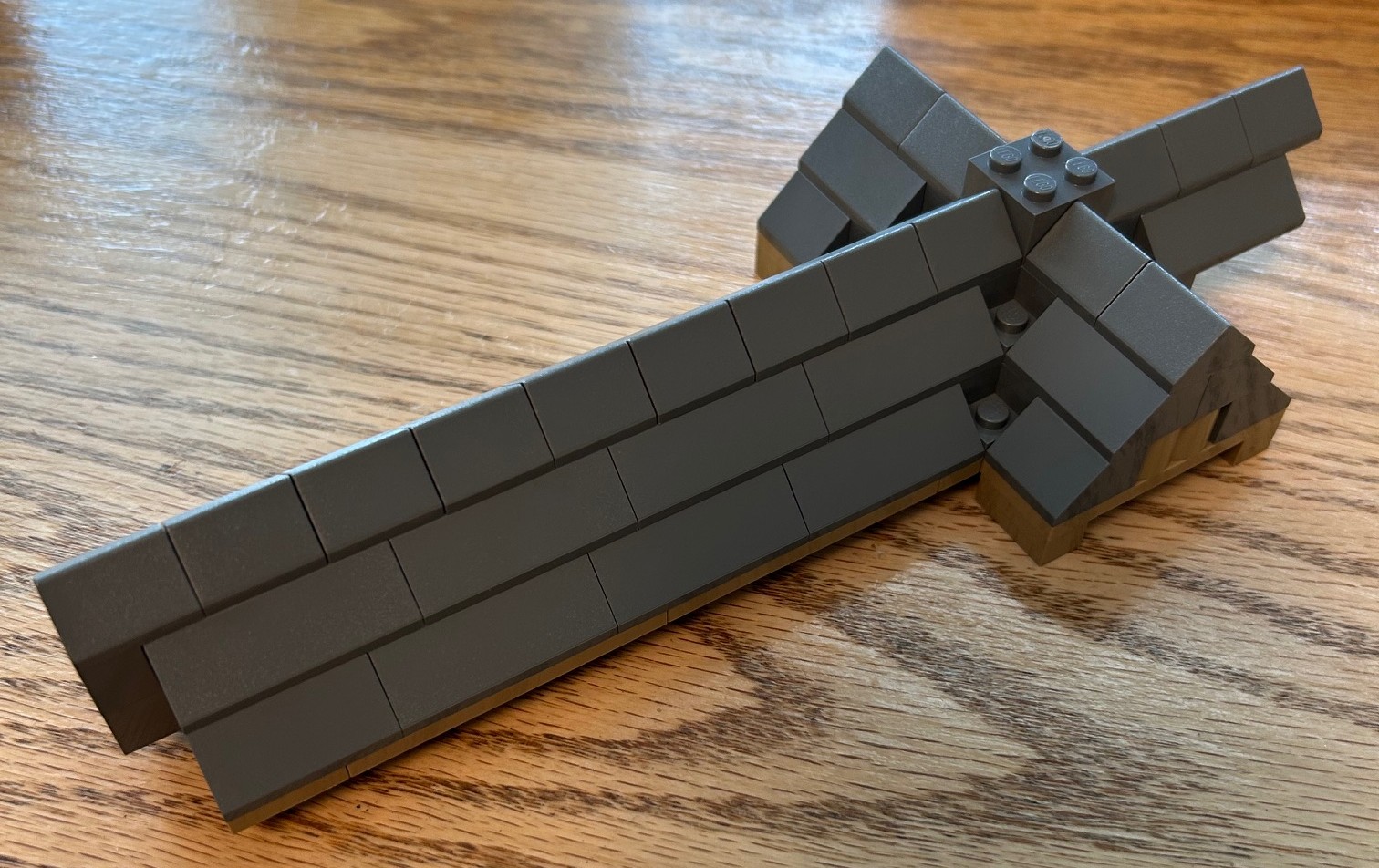
The Trevi Fountain has some strange elements, made even stranger when represented by chunky LEGOs.  Check out the shapes I assembled today (and don’t ask me what they’re meant to represent).  Little LEGO pieces positioned in just about every point on the compass.  My singular mistake this round – realized well after the fact – was putting the right piece in place, only the wrong color.  Then when I came across another “right piece wrong color” I knew I had them transposed.  Took a little disassembly to get everything correct.

Bag within a bag

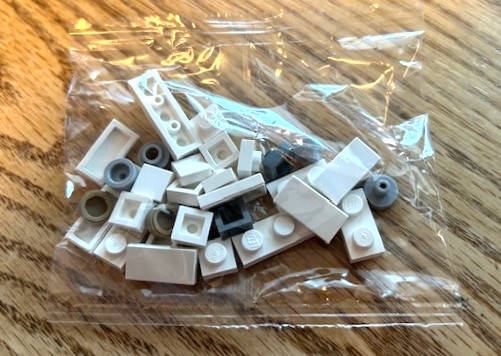
A continuing mystery of LEGO sets is bags within bags.  When I opened Bags 7 and 8, each came with a smaller bag of pieces like you see here.  It’s not like the smaller bag represents its own unit of the fountain.  You just tap into those pieces every now and then as the instruction manual demands.  Yes they’re tiny, tiny but you also find tiny pieces in the bigger bag.  Maybe someday I’ll tour the LEGO factory and solve this packaging mystery.

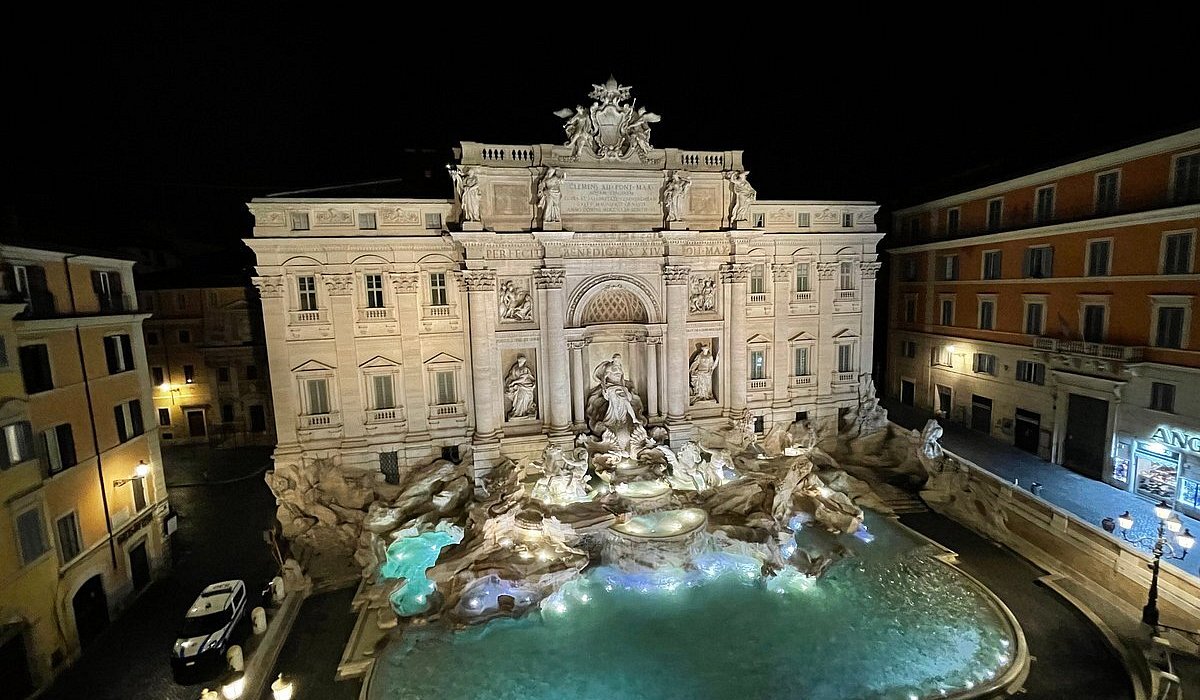
We worked with some surprisingly large pieces of travertine today – the entire wall of white you see behind the fountain and the white surround you now see defining the entire front of the main pool.  Would’ve taken a dozen Italians to put these monster pieces in place on the real Trevi.  And don’t miss the pink accent strips to the left and right of center (pink!)  This fountain is turning out to be more colorful than I expected.

Running build time: 3 hrs. 5 min.

Total leftover pieces: 23 (10 more extras today!)

Some content sourced from the BBC.com article, “Parasocial is Cambridge Dictionary Word of the Year”, IMDB, “the Internet Movie Database”, and Wikipedia, “the free encyclopedia”.

A Bowl of Snowflakes

Part of the appeal of Halloween – at least for us baby boomers – is the thought of innocent days (and nights) from our distant past. Not only were we kids back then, we cavorted in full costumes through our neighborhoods without a parent in sight. Every house left a light on or a door open to welcome trick-or-treating. Every street seemed safe and inviting.  And the treats were often as homemade as they were store-bought. Cookies. Lollipops. The odd neighbor doling out little sausages hot off the grill from his front yard (BBQ sauce optional). And the occasional popcorn ball.

Who doesn’t love a good popcorn ball?  Me.  I don’t.  Popcorn balls may be a nostalgic Halloween memory but they’re also an insult to popcorn.  Whoever invented them turned a savory snack into a sickly sweet one.  We’re not talking caramel-, chocolate-, or even kettle-corn sweet here;  just liquid sugar designed to act as glue to make popcorn a convenient handheld.  Awful.

I admit it, I’ve become a popcorn snob the way some people are about coffee.  There’s a way to enjoy popcorn and there’s a dozen ways not to.  It’s a snack that deserves to get it right, because getting it wrong is anything but a “treat” (like popcorn balls).

Popcorn eased its way into our after-dinner desserts by necessity.  One day (night) my wife and I sat there after the evening meal and realized we were having dessert way too often.  It was always ice cream, cookies, or whatever else we could find in the pantry.  Somehow a savory dinner necessitated a sweet dessert.  Bad habit – very bad.  Instead, make the dinner healthy enough, eat it early enough, and keep yourself off the couch watching TV.  Then dessert rarely enters the conversation.  Yeah, uh, we’re still working on that.  The dinners are healthy, but we can never get them on the table – er, couch – before 7pm.

Popcorn to the rescue. It’s a dessert that doesn’t feel like a dessert.  It’s not sweet, and with an air popper it’s all of three ingredients.  Popped corn, topped with butter and salt.  Make those first two “organic” and the last one “Celtic sea”, and it sounds like something that’s actually good for you.

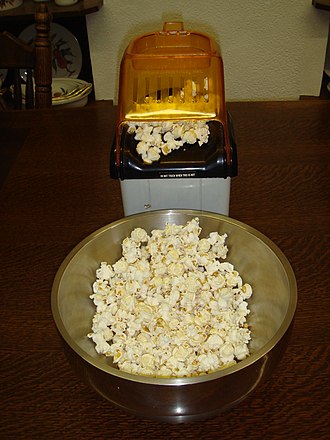
Popcorn belongs in a bowl, not in a ball.  We take the largest bowl in our kitchen, fill it almost full with popped corn, and call it dessert.  Oh, right, but that’s just for me.  Then we take the second-largest bowl in our kitchen and pop a similar serving for my wife.

Before…

Since I always aim to educate a little, here’s popcorn trivia worth remembering.  One, the corn used for popping is not the same as the kernels on the cob (so don’t get any ideas).  Two, when the kernels burst – literally inside out – you get one of two shapes; snowflakes or mushrooms.  Snowflakes are what we have at night for dessert, and what you find severely overpriced in movie theaters.  Mushrooms are what you find in a box of Cracker Jack or Fiddle-Faddle.  Think teeny-tiny popcorn balls.  As for the kernels that don’t pop?  They’re called “old maids”.  In the world of popcorn at least, you’d rather be a snowflake than an old maid.

After…

Some more fun facts.  Popcorn displaced movie candy during the WWII years because there was a shortage of sugar.  Years later it’s still the more popular concession at the theater.  On average every American consumes 58 quarts of popcorn every year.  Picture those red/white striped cardboard containers you see when you purchase popcorn from a cart.  Multiply by 58.  You eat a lot of popcorn.  But why shouldn’t you?  It’s convenient, easy-to-make, and healthy as long as you use an air popper.  Really healthy if you substitute olive oil for the butter, which a lot of people do these days.  But I say ewwwwwww to that.  Leave olive oil to the Mediterranean diet instead.

All this talk of popcorn has me thinking it’s time for dessert.  It’s easy to forego the sweet stuff when savory snowflakes beckon.  Just remember, it’s not a ball of popcorn, it’s a bowl.  A proper presentation precedes perfect popcorn.

—————-

LEGO Trevi Fountain – Update #2

(Read about the start of this build in Brick Wall Waterfall)

Let it echo throughout the streets of Rome, Dave is no Michelangelo (and yes, I know Michelangelo didn’t design the Trevi Fountain but he could sure sculpt).  In today’s effort to rise the LEGO fountain from its foundation, I made countless placement mistakes.  I got four steps into Bag 4 – of 15 bags of pieces – and realized I’d placed everything  just a little bit off on the foundation.  That meant breaking it all down, going back to the first step, and starting over.  Can you imagine my fate if I made this mistake with the real Trevi?  Placed and set the travertine just a little bit off?  The foreman would have my head! (which is no joke, at least not three hundred years ago).

“Building” water is not that easy

Frankly, everything seemed off today.  I kept getting the piece placement slightly wrong, as if I refused to learn from my last mistake.  At one point I turned two pages forward in the instruction manual instead of one, skipping a full two steps in the build.  And the below photo is what “broke the camel’s travertine”.  Tell me reader, what’s wrong with this picture?  Five little leftover pieces and one BIG piece, that’s what.  LEGO never throws in big leftover pieces.  Sure enough, I paged back through the manual, and there it was.  I’d overlooked the step where you place that arch.  Never mind that it’s buried under “pieces” of blue water now.  Leave it out and our beautiful fountain might collapse into a pile of very expensive rubble.

You know who’s laughing about all of my missteps today?  The singers in the music I chose for my accompaniment: Rossini’s The Barber of Seville.  His opera may be about money, disguises, lovers and all that, but it sounded more like getting scolded over and over through song.  You got overconfident, Dave (tra-la-la).  You’re no sculptor, Dave (la-ha-ha).  Maybe LEGO isn’t for you after all, Dave (wha-ha-ha-HA!)

The gleeful singing in “The Barber of Seville” is all in Italian, so for all I know they really did change their tune to berate my amateur building efforts.  I took that to heart.  Bags 5 and 6 are gonna have to wait until next week.  I sure hope the foreman won’t look at this decision as “getting behind schedule”.  He might have my head!

Running build time: 1 hr. 44 min.

Total leftover pieces: 10

Some content sourced from Wikipedia, “the free encyclopedia”.

Brick Wall Waterfall

If you were to spend an entire year in Rome, you could visit five churches every day and still miss out on some of the more than 1,600 within the city limits. You could also visit five piazzas (public squares) and never see all 2,000. If monuments are your thing, Rome has so many that instead of an actual count they simply say “more than any other city in the world”. And then we have Rome’s fountains. You could dip your hand in five a day and never see them all in a year. So here’s a better idea.  Just spend a few hours at the Trevi and assume all of the others are second best.

Fontana di Trevi

I wouldn’t decree “best fountain in all of Rome” if I hadn’t been there and seen it for myself.  I spent a college year in the Eternal City studying architecture, and you can’t help noticing the other elements of the city while you’re at it.  Like fountains on every street corner.  The Trevi Fountain was walking distance from the hotel/dorm we Americans lived in, so you can bet I stood before the Trevi’s gushing waterfalls many a day.  Even a few nights.

Most people assume “Trevi” is an Italian word.  It’s actually two words mashed into one. Tre = three, vie = ways.  The Trevi is located at the intersection of three streets.  It’s also the terminus for an aqueduct from ancient times.  Water is picked up from a source outside of the city, carried over fourteen miles through the aqueduct, and deposited “with a splash” at the Trevi, to be further dispersed to the city underground.

Here’s a little more trivia on the Trevi.  It was designed and built in the 1700s, on the back wall of a palace.  It’s primary material is travertine stone (pricey!) quarried from nearby Tivoli.  Besides the columns, arches, and niches along the wall, you have quite the trove of imagery going on over the water, with mythological creatures like tritons and hippocamps.  I have no idea who the sculpted figures gazing down from either side are, but the big guy front and center is Oceanus, a pre-Olympian god.

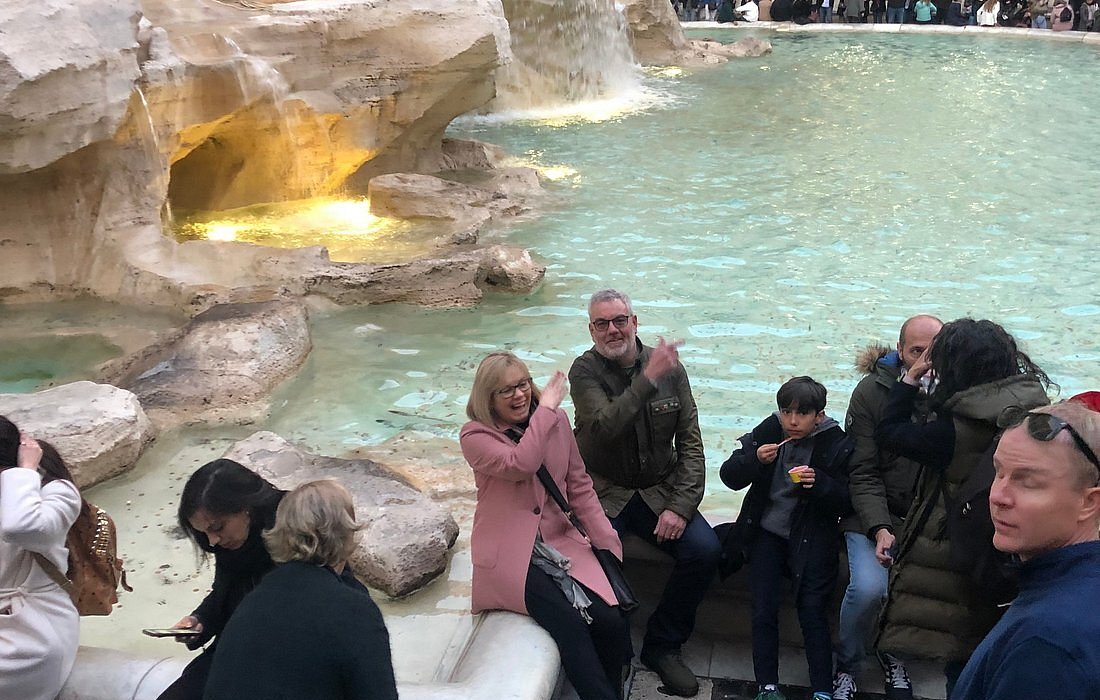
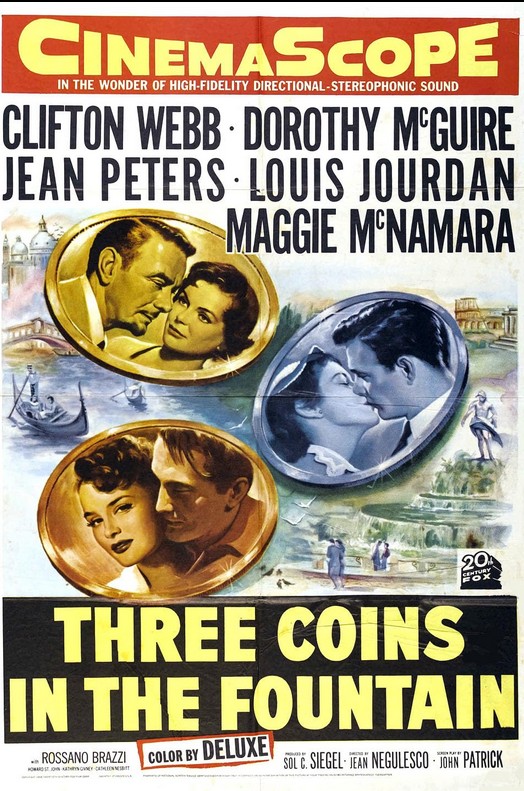
If you’re a top-five tourist attraction in Rome, you must be pretty darned attractive for a city with countless places to visit.  Maybe it’s the coin thing.  Why do tourists stand with their backs to the fountain and toss three coins over their shoulder into the water (right hand, left shoulder)?  Because legend says they’ll return to Rome some day if they do.  “Legend” is really just Hollywood, from the movie Three Coins in the Fountain.  But if you really know your Trevi trivia, you say the tossed coins follow the ancient tradition of honoring the gods of the waters, granting you safe passage home.  

I’ve talked about the Trevi before, in Too Many Roads Lead to Rome.  The fountain has become so popular you now need a ticket and a specific time to stand in front of it.  But what I haven’t done before is build the Trevi.  Last spring, the “architects” at LEGO immortalized the fountain in a 731-piece model, which I will construct over the next several blog posts.  I haven’t put my hands on a piece of LEGO since Notre-Dame du Paris last January (which still beckons me to add its lighting kit).  I might be a little rusty at this.  The fountain might leak a little.  But I’m up for a dip in this brick wall waterfall if you are.

Author’s Note: The title of this post was inspired by the strange-but-sweet Dickie Roberts: Former Child Star.  The movie included a little ditty my thirty-one year old daughter can still recite to this day: “Brick wall, waterfall, Dickie thinks he got it all but he don’t, and I do, so BOOM with that attitude. Peace punch, Cap’n Crunch, I’ve got something you can’t touch. Bang-bang choo-choo train, wind me up I do my thing. No Reese’s Pieces, 7-Up, you mess with me, I’ll mess you up.”

Some content sourced from the TripAdvisor.com article, “Everything you need to know about the Trevi Fountain coins”; IMDB, “the Internet Movie Database”; and Wikipedia, “the free encyclopedia”.

Golden Recall

My wife and I go for massages once a month, which has turned out to be a solid therapeutic routine. As is the case with any spa, the air is diffused with pleasant scents as well as soothing instrumental music. They also overlay a soundtrack of birds, as if to place you in the out of doors. The sensations are designed to relax and they do their job; so well in fact I’d swear I was transported to the shores of a pond.  More on that in a minute.

Candidly, it’s not often I notice the background music in a spa. I focus on breathing deep and keeping my eyes closed instead. But I couldn’t ignore the music when “Bring Him Home” from Les Miserables started playing. Whatever playlist the spa chose included a simple rendition of that song; just piano and violin. It was beautiful, and suddenly I was back in the Broadway theater where we saw the show years ago. I would’ve put “Bring Him Home” on “repeat” if I could have.

But we’re not talking about Les Miserables today. We’re talking about a pond. “Bring Him Home” was followed by a nameless instrumental piano piece, and again my mind began to drift. Then I heard the birds. Piano keys.  Birds.  And there I went… back to “On Golden Pond”.

Several instrumental movie soundtracks will reside in my brain forever. Whenever their signature melodies play I’m immediately returned to the film itself. I’m not talking about the bold, orchestral works of John Williams (think Star Wars or Jurassic Park) but rather the simpler repetitive tunes that still somehow define the story on the screen. Chariots of Fire is a good example. Cast Away is another. Leap Year was a so-so movie but the soundtrack is wonderfully catchy. And the music of A Little Romance – Diane Lane’s debut film – was so well done it won 1979’s Oscar for Best Original Score.

So you see, this is how a massage becomes a trip back to On Golden Pond, a movie from almost fifty years ago. The piano plays. The birds sing (even if they aren’t loons). And there it is, that simple poignant story playing out in front of my closed eyes as if I’d just seen the film last week.

Was I ever a fan of Jane Fonda? Not really. I remember her more for her workout videos than her movies. But On Golden Pond was the exception because she’s on screen with Henry Fonda, her father in real life and her father in the movie. The movie is about the struggles of their father-daughter relationship, which surely echoed real life. Add in Katherine Hepburn as the mother character and the bar is raised well beyond the movie itself. The story is good enough, but who from my generation wouldn’t watch Henry Fonda and Katherine Hepburn in anything together?

Henry Fonda died less than a year after the filming of On Golden Pond. Katherine Hepburn made a few more movies but this was pretty much the conclusion of her career as well. So On Golden Pond is something of a swan song for both. If you have any recollection of the film, try this: Ask Alexa for instrumental piano music. Ask Siri for a soundtrack of birds at the same time. Then close your eyes and relax.  You may be transported back to a golden pond. It’s pretty cool.

Some content sourced from IMDB, the “Internet Movie Database, and Wikipedia, “the free encyclopedia”.

Up, Up and Away Birthday

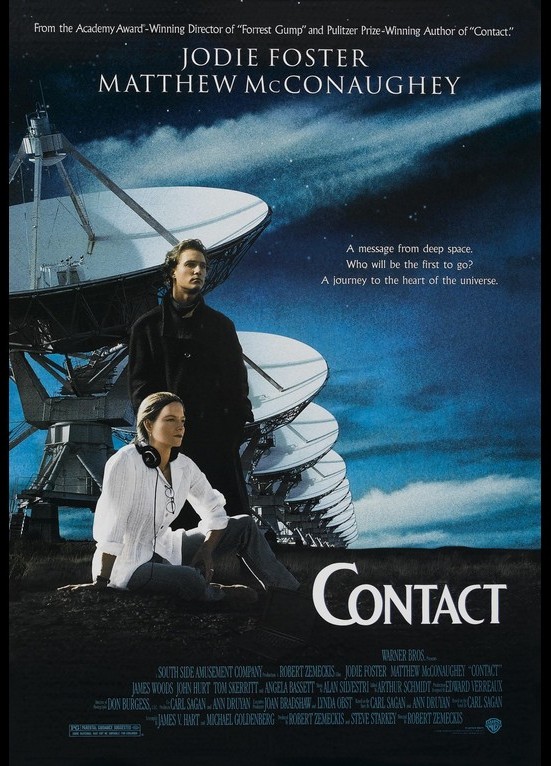
One of my favorite lines from the science-fiction classic “Contact” (starring a young Jodie Foster and and even younger Matthew McConoughey) comes from one of the lesser-known characters. Foster’s Dr. Arroway discovers a communication stream from beyond Earth, while an anonymous millionaire funds the spaceship capable of traveling to the source of the signal. The donor then turns to Foster’s character with a smirk and says, “What do you say, Dr. Arroway… wanna take a ride?”  This year, the same question was posed by the (good) people at Goodyear.

Wingfoot Two is a “semi-rigid airship”

In a nod to my advancing age, the Goodyear Blimp turned 100 on Tuesday (or I should say, one of the Goodyear Blimps).  “Pilgrim”, Goodyear’s dirigible based in Akron, Ohio, took it’s first flight on June 3, 1925.  Now Goodyear can claim a hundred years of lighter-than-air travel, even if this noteworthy form of transportation never made it to the masses.

To be clear, Goodyear started with rubber, and then tires.  They manufactured tires for bicycles and carriages back in the day as well as horseshoe pads and poker chips, before Pilgrim first took to the skies.  Sure, you’ll find their products on vehicles everywhere but what comes to mind when I say “Goodyear”; tires or blimps?

The Goodyear Blimp of my childhood

I choose blimps.  I grew up just thirty minutes from Goodyear’s blimp airbase in Carson, CA.  The blimp I saw back in the ’60’s and ’70’s was named something like “Puritan” or “Reliance” or “Defender”, because Goodyear honored the sailboat winners of the America’s Cup.  Not today.  Thanks to a public naming contest the blimp down the street from my childhood neighborhood is named “Wingfoot Two”.  (I prefer the America’s Cup names instead.)

Maybe you also choose blimps because you drive on Michelins or Firestones.  More likely it’s because you’ve seen a blimp buoyant over the Super Bowl or other sporting event.  And speaking of football, if the Goodyear Blimp sets down on the field it covers 80% of the yardage.  That’s one big balloon.

“LZ 129 Hindenburg”

Goodyear’s flying machines of my childhood were literally balloons filled with helium, without any of the technology of today to make them easier to steer.  Coincident with middle-school history class, whenever I’d see the blimp I’d think of Germany’s Hindenburg, the Nazi propaganda passenger dirigible that, like the Titanic, is best known for its final flame-filled disaster, on approach to Lakehurst Naval Air Station in New Jersey in 1937.  Perhaps we should be thankful Goodyear never promoted its blimps as a form of mass transportation.

Also in my childhood, blimps offered a far more romantic image in the movie Chitty Chitty Bang Bang, where a colorful zeppelin traveled here and there over the fictional country of Vulgaria, carrying the villainous Baron Bomburst and his crew.  (And here’s my opportunity to distinguish between terms.  A zeppelin has more of a cylindrical shape, while a blimp looks more like a sausage.  A dirigible? Just a general term for an airship.)

Speaking of sausage, it was inevitable someone would open a sub sandwich shop named after the aircraft.  The Blimpie franchise (“America’s Sub Shop”) began in the 1960s, spread to locations around the world, and enjoyed a good fifty years of success.  Today most of the helium has left their balloon.  There are only about 25 Blimpie stores left in the U.S. (compared with almost 20,000 Subways).  IMHO Blimpie’s was the better product, at least the version I remember from the 1990s.

Oh how I wish I could’ve concluded this post with another wanna take a ride?  You and I missed the boat, er, airship on that opportunity.  Goodyear held a contest at the start of 2025 and leading up to Pilgrim’s birthday, where three lucky passengers won a blimp ride.  I say “lucky”, when in fact my fear of heights takes away any personal appeal to float up, up, and away.  No worries, because now I’m thoroughly distracted by hunger pangs.  Think I’ll hunt me down a “blimp sandwich”.

Some content sourced from IMDb,  “the Internet Movie Database”, and Wikipedia, “the free encyclopedia”.

My Unforeseeable Future

In the not-so-distant year of 2062, forecasters predict we will have perfected the invention of “nanofabricators” – machines capable of producing food, clothing, electronics and such, not from assembly-line parts but from the very atoms of those parts. It’s a mind-blowing concept: technology that creates virtually anything by manipulating the structure of raw materials at the molecular level. Too bad I won’t be around to see it.

Is it making your dinner?

When you reach your mid-sixties, the harsh reality is that predictions of what life on Earth will look like in the future focus on a period of time beyond the years you’ve been given.  The experts tend to look fifty years ahead or more, so, sorry Dave, you just won’t be here when all these wonders take place.  It’s a little strange to think about a world without you in it.  Sure, you can also imagine the years before you were born, when your parents and grandparents were living life without you, but those were simpler times devoid of the technology we take for granted today.

Driver’s license not necessary

Consider self-driving cars. Fifty years ago I was a teenager and couldn’t wait to get my driver’s license (the very definition of “freedom” back then). But had you told me, “Hey Dave, you’re not going to need that little card in fifty years because cars will drive themselves”, I would’ve given you a strange look and accused you of watching too many science-fiction movies. Yet here we are.

I hit on this topic today because I’m still processing the fact we have humanoids who can run half-marathons (my post from last week).  When the world’s technology exceeds your expectations, you push the pause button and wonder if you’re getting left behind (or just getting old).  Am I suddenly more inclined to believe those fifty-year forecasts?  You bet I am.  And nanofabricators are just the tip of the inventive iceberg.

Ping-pong partner

Nanobots (does everything in a post-Dave world start with “nano”?) are in the works as well.  A nanobot is a robot so tiny you might not be able to see it with the naked eye.  I was introduced to the concept in Michael Crichton’s sci-fi novel Prey.  Imagine a pile of nanobots sitting in the corner of a window in your house.  Once a day those nanobots spill out over the glass like a wave, consuming any dirt or other matter like little vacuums.  Perfectly clean windows!  Of course, “Prey” takes the technology in a more sinister, out-of-control direction and a bestseller is born.

[Blogger’s note: You’ll find “nanobot” in your favorite online dictionary. At least in some lab environment out there, nanobots are already here.]

With Prey in mind, Hollywood isn’t helping us to embrace these fifty-year forecasts.  Virtually every movie (or book) about yet-to-be-here technology takes the concept in a not-so-nice direction. (The Terminator comes to mind.)  The fact is, nobody’s going to buy a ticket just to watch a happy application of future tech on the big screen.  Something always has to go “worng” (to quote Westworld).

I hope you’ll be around in fifty years to see and experience some of the wonders our forecasters predict today.  Brace yourself: you’ll have a “wearable” of some sort (watch, eyeglasses, implant).  One of you will have bionics in a limb or organ that wasn’t functioning properly.  Some of you will live up in space or deep down in the ocean instead of on terra firma.  It’s a wonderous world I’ll never get to see, but I’ve made peace with it.  At least I won’t be around in 2182, when Asteroid Bennu (we name asteroids?) will be on a collision course with Earth.


LEGO Notre-Dame de Paris – Update #14

(Read about the start of this “church service” in Highest Chair)

The service is rapidly coming to a close. I sense the inevitable benediction and dismissal of the congregation as our work on LEGO Notre-Dame de Paris wraps up. The remaining pieces in Bag 28 brought the cathedral’s bell towers to an even (if not finished) height, while Bags 29 and 30 – of 34 bags of pieces – added more detail to those towers, as well as some elegant structure above the transept doorways.

Bell tower detail

We worked high off the ground today; quite a bit higher than the roof line of the cathedral. My shaking fingers had a sense of vertigo as I added the little drainpipes, railings, and such you see here. I imagined one of those towering mechanical cranes dropping the LEGO pieces into place until, of course, I remembered I was working in the thirteenth century. The word “crane” hadn’t even been invented yet.

Again with the missing pieces.  For the first time since I laid the cornerstone I thought I threw a piece away, along with the plastic bag it came in.  I searched in vain on my office desk, only to decide I’d be going through the garage trash later on.  Then lo and behold, just as I was completing today’s build, there sat the missing piece right in front of me as if to say, “What the heck is wrong with you?  I was right here in plain sight!”

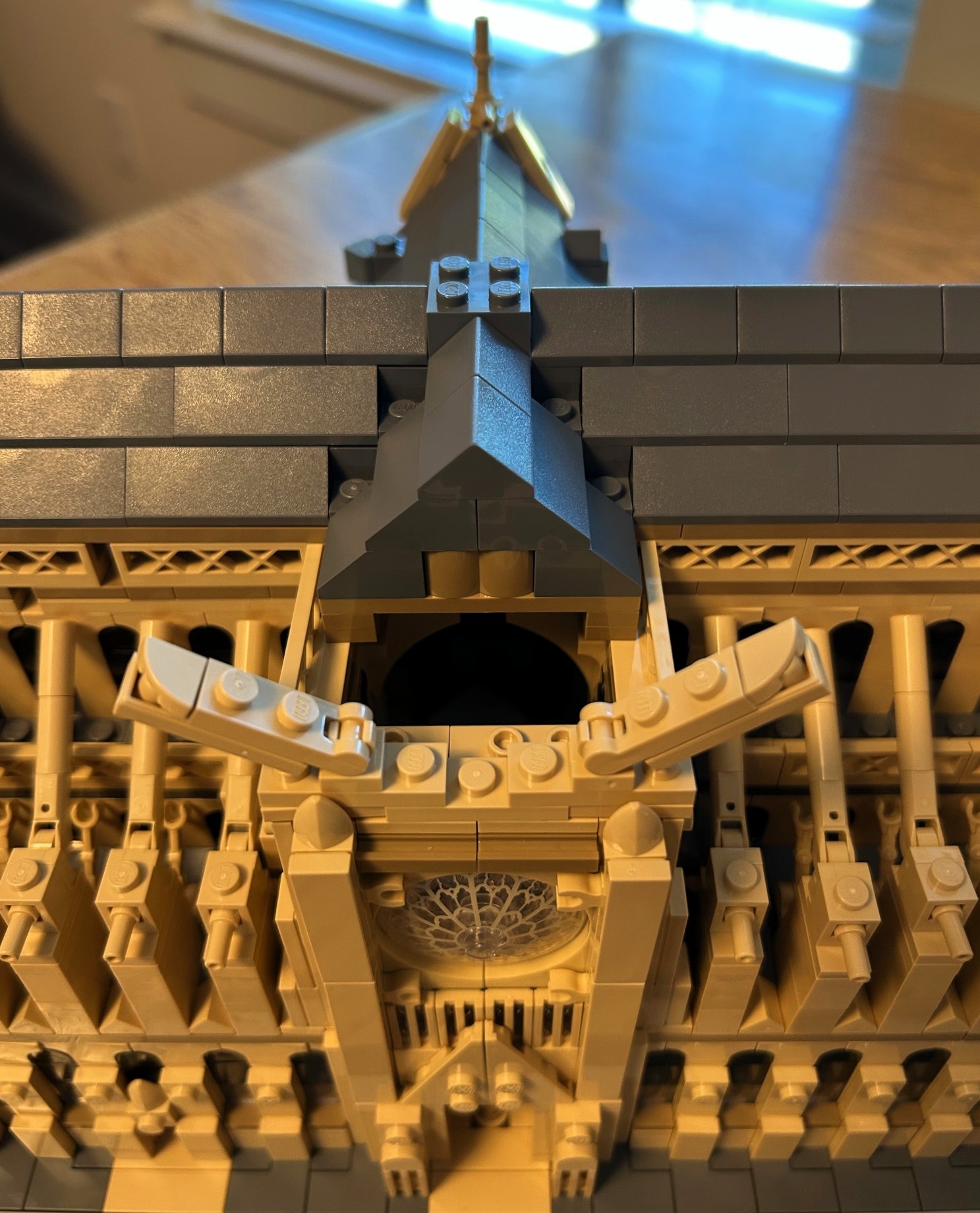
My hat is off to LEGO’s engineers today.  Look at the process above where I completed the structure above the transept doorways.  Those two long LEGO pieces in the first photo are designed to hinge open, simply to allow easier placement of the central cap piece in between.  Then you close those long pieces around the cap like a hug and voila – second photo – the transept is complete.

Our work really is almost done.  Just four small bags of pieces remain – two for the top structure of the bell towers (and a little ornamentation around the cathedral roof), and two for landscape elements to soften the edges of the model.  Don’t walk out of the sanctuary just yet.  The final product includes a surprise!

Running build time: 13 hrs. 58 min.

Total leftover pieces: 40

Some content sourced from the FutureTimeline.net website, the CNN Science article, “Near-Earth asteroid Bennu could hit Earth in 157 years…”, and Wikipedia, “the free encyclopedia”.

Running Amuck

Last Saturday our little town hosted a festive 10k run.  High school cheerleaders pom-pommed us away from the starting line while hundreds of residents waved flags and tossed water bottles along the way. The finish in the town square was packed with people, and included the music, food, and fun you’d find at a carnival.   As I struggled to complete the last couple of “k’s” I struck up a conversation with a nearby runner to distract myself from the effort.  She was pleasant enough, with just the right pace, and she was even a human being.  At least, I think she was.

Suddenly, shockingly, we’ve come to this.  The entry form for your next running race may ask you to identify as 1) human being, or 2) human-oid .  If you choose the latter, you’re saying you still have the physical form and characteristics of a human being.  You just happen to be a robot.

Ten days ago this eerie scenario really played out in Beijing.  A half-marathon took place with thousands of human participants, but the spotlight was clearly on the twenty-one humanoids who also showed up at the starting line.  These robots were accompanied by operators running close behind them, but make no mistake; absent of the wires or other attachments you might expect with a remote-controlled device.  They were running free, with the look and gait of any other runner in the race.

I’m wondering how any of the human runners kept their focus as they ran this race.  I’d want to pace myself against one or two of these machines and just admire their every step.  The humanoid winner, Tiangong Ultra, finished the half-marathon in 2 hours and 40 minutes, or about five miles an hour.  Trust me: five miles an hour is not a walk; it’s a run.

I’ll have to search for the video online, because a still of a running humanoid doesn’t do the accomplishment justice.  I just can’t get over the fact we now have robots who run.  Granted, the Beijing half-marathon wasn’t what you’d call a “run in the park” for these technological marvels.  Only six of the twenty-one finished the race.  Others fell down or exhausted their battery packs.  Still others lost their heads or spun out of control.  If there had been a humanoid hospital nearby, its ER would’ve been a machine-shop hotbed of activity.

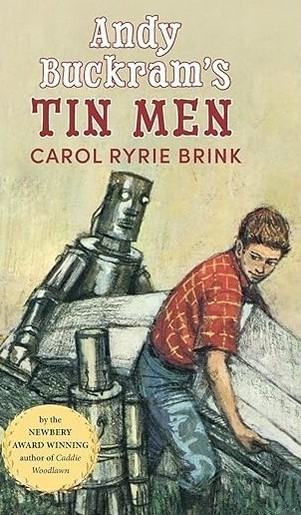
My perception of all things “robot” is clearly outdated.  I’m more inclined to picture self-guided vacuum cleaners and assembly-line automatons than race-running humanoids.  Case in point: I’ll never forget the grade-school novel, Andy Buckram’s Tin Men.  It was a wonderfully imaginative tale about a boy who created a family of robots from a pile of cans, and his unexpected adventures when those robots came to life courtesy of a lightning strike.  The book was written in the 1960s and was a work of fiction.  Of course it was.

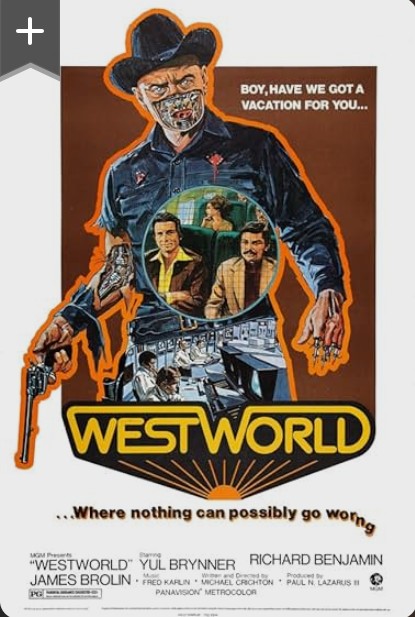
I’ll also never forget the movie Silent Running (1972), a future shock story of a destroyed Earth, with spaceships housing giant terrariums cared for by lovable lifelike service robots.  Or Westworld – the 1973 original, not the HBO series  – an adult amusement park of sorts where robots catered to the guilty pleasures of their human customers (until collectively the robots decided to run amuck).

C-3PO

C-3PO from the original Star Wars trilogy (1977) might’ve been the first humanoid to get me wondering if such technology was possible.  Blade Runner (1982) took the concept an interesting step further, with humanoids desperate to demonstrate their emotional capacity.  Less than fifty years later we’re still working on that emotions bit, but I certainly wouldn’t have bet we’d have humanoids who could run.

Let’s be clear – we’re at least another fifty years removed from any technology that remotely suggests “human”.  Even if Siri and Alexa appear to read your mind and hold meaningful conversations with you, they’re not going to jump out of your smartphone tomorrow and land on two legs.  Even if  your little robot dog wags its tail, lies down, and rolls over, it’s not going to take a bite out of your leg when it doesn’t get enough attention.  Your Roomba might suck up the lion’s share of dust and dirt in your house but it’s not coming for your valuables.

I sleep peacefully at night knowing the nightmares of Westworld and Blade Runner continue to be the stuff of (evil) Hollywood imaginations.  Virtual reality will remain virtual, and robots will continue to be nothing more than subservient devices for years to come.  But admittedly, you can’t help but question “years to come” when you see a humanoid run a half-marathon.


LEGO Notre-Dame de Paris – Update #13

(Read about the start of this “church service” in Highest Chair)

I’m not sure I’ve ever stopped the construction of a LEGO model smack-dab in the middle of a bag of pieces.  Imagine our priest at Notre-Dame de Paris, pausing midway/mid-sentence into his homily only to say to his congregation, “I’m tired.  Let’s pick this up next week, shall we?”

Cathedral roof structure

Bags 25-28 – of 34 bags of pieces, were a study in opposites.  In a crisp fifteen minutes, Bag 25 assembled to the roof structure you see here, covering the remainder of the nave (the sanctuary) and transept (the cross section).  Even Bag 26 wasn’t a stretch as we built the “cores” of the uppermost cubes of the cathedral towers.

Two bags = hundreds of pieces.  Seriously.

But that’s when I should’ve stepped on the brakes.  The instruction manual told me to break open Bags 27 and 28 together and this is what stared up at me.  If you think the pile on the right adds up to a lot of pieces, you are correct about both piles and you’re probably underestimating the number.  These tiny, tiny pieces come together slowly to complete the uppermost cubes of the cathedral towers.  One cube took 75 minutes.  Why so long?  186 pieces each.  No kidding – zoom in on the top of the completed tower below and you’ll get some sense of how intricate it is.  Now you understand why we paused in the middle of the homily.  I just didn’t have the energy to build up the other tower.  Next week!

(Click the photo for more detail)

Since we’re close to the end of the build, let me admit to looking ahead in the process.  The remaining six bags are small, and the pieces inside of them are minuscule.  If I had visions of finishing off the cathedral in a flurry of construction, they’ve been dashed by the thought that I’m still a good five hundred pieces from the finish line.  Sigh… this church service is getting a little long.

Running build time: 13 hrs. 0 min.

Total leftover pieces: 32

Some content sourced from the Smithsonian Magazine article, “Humanoid Robots Just Raced Alongside Human Runners…”, and Wikipedia, “the free encyclopedia”.

Too Many Roads Lead to Rome

I’ve wanted to take my wife to Italy pretty much since the day we met. After a memorable college year in Rome in the 1980s I knew I’d go back one day, especially since I tossed a few coins into the famous Trevi Fountain before I left. Today however, I sit wondering if I really will set foot in the Eternal City again. Thanks to overwhelming numbers of tourists, Rome might as well put a “sold out” sign on its city gates. Blame it on the Catholics?

Trevi Fountain, Rome

2025, less than four months from now, is a Jubilee Year for the Catholic Church.  Maybe your idea of a jubilee is a celebration, much like Britain’s in 2022 when they honored Queen Elizabeth’s unprecedented seventy years of service to the Crown.  Not so the Catholics.  They define a jubilee – every 25 or 50 years – as a “marked opportunity for the remission of sins, debts, and of universal pardon”.

Catholic jubilees traditionally include a pilgrimage to Rome.  I’d love to know who runs the calculations (and how) but the forecast for next year in Rome has Catholic pilgrims at around 32 million… in addition to the 50 million tourists who normally pass through.  To put that total in perspective, the population of Rome is only 3 million.  That’s a whole lot of extra pepperoni on the pizza (or piazza, if you will).

[Side note: 1983, the year I lived in Rome, was an out-of-cycle Catholic jubilee known as the Holy Year of the Redemption.  Do I remember millions of Catholics “roaming” through the city streets?  I do not.  Then again I’m a Methodist, so maybe I have an excuse for missing the obvious…]

You call this a crowd? Just wait ’til 2025.

Thanks to next year’s jubilee, officials are clamping down on a visitor’s ability to see or tour the city’s most famous attractions.  The Fontana di Trevi is a good example of how things will change.  In the 1980s I could stand in front of the Baroque fountain to my heart’s content.  In 2025 I will need a ticket through a reservation system.  That ticket gets me entry through one side of the piazza and exit through the other, at a specific time and for a specific (amount of) time.  Hired “stewards and hostesses” make sure I don’t linger, and collect a 2-euro fee for the experience.

If I really wanted to be herded like sheep I’d join a flock on the green, green grass of Ireland, instead of paying for the privilege in Rome.  And speaking of paying, the Trevi already collects over $1.5M in coins voluntary thrown into its waters (the money then donated to local charities).  Add in the new 2-euro fee, and even if just 10% of next year’s visitors make it to the Trevi, Rome will nab an additional $18M.  Jubilee indeed.

St. Peter’s Square, Rome

If I sound jaded about Rome’s forced hand, it’s only because I have the perspective of a time when everything seemed so much easier.  In the 1980s I could wander through St. Peter’s Square without photo-bombing dozens of iPhones.  I could also wander without encountering a random protest about a religious war or climate change.  I still remember plunking down on the cobblestones of that grand piazza to paint a watercolor of the Basilica, and nobody bothered me.  I also remember Frisbee with a fellow student in another piazza, while the local Italians watched the spinning disc in wonder.  Innocent times indeed.

Roman Forum

In 2024, a guided tour of the Vatican (the only way to see it) – including the sublime Sistine Chapel – will set you back $50.  A tour of the Colosseum and Roman Forum will cost you twice that much.  I’m sure next year’s pilgrims will pay these fees without blinking a sin-forgiven eye.  I just can’t get past my free-and-easy days as an architecture student, when each of the city’s wonders was as wide open and come-on-in accessible as you can imagine.

The truth is I’d go back to Rome in a heartbeat, even if I knew untold millions of pilgrims would be standing alongside me.  The Eternal City is worth the look even if you never step inside any of its buildings.  On the other hand, if I’m patient and wait until 2032, it’ll be the 50th anniversary of my college year.  That calls for a jubilee!  I’ll be the only pilgrim of course (er, two of us counting my wife) but at least we’ll have no hassles dropping coins into the Trevi.

Some content sourced from the Skift Newsletter article, “Rome Tourism Chief Says There’s ‘Total Chaos’ at Trevi Fountain…”, and Wikipedia, “the free encyclopedia”.

Do-Re-Mi… Oh My!

Salzburg, Austria, a day-trip destination from our recent Viking River Cruise, is a popular draw for tourists.  On most days you’ll find more internationals roaming Salzburg’s Old Town than you’ll find Austrians themselves.  The compact city is famous for its historic buildings: churches, palaces, and fortresses dating back 1,000 years or more.  Mozart was born here.  But try as they might, Austrians will never be able to separate Salzburg from what attracts many to its streets: The Sound of Music.

I can think of only one movie we forced our kids to sit down and watch while they still lived under our roof.  Close to Christmas one year (an arbitrary connection because of the lyrics of “My Favorite Things”), the five of us spent three hours together in front of our not-so-big-screen TV watching the somewhat true story of the von Trapp family.  I’ve lost track of the number of times I’ve followed Maria, the Captain, and those seven engaging children as they outwit the Nazis.

For all of the movies I’ve watched in my life (and I’ve watched quite a few), The Sound of Music stands alone.  I’d describe it as a jewel you display in an elegant glass box on the shelf, taken down every once in a while to appreciate up close. The Sound of Music is a feel-good story – if not accurate – produced in 1965 at the end of the Hollywood’s Golden Age.  It remains the most successful movie musical of all time (adjusted for inflation), but I question whether today’s movie-goers would appreciate it as much as I do.

Salzburg, Austria

Most tours of Salzburg include references to buildings and locations included in The Sound of Music.  Our own tour – cut well short because of the flooding of the Danube – was a brisk walk around the Old Town, with only an occasional mention of the movie.  What surprised me was not how little of The Sound of Music was actually filmed in Salzburg (most was done on sound stages back in the States) but rather the Austrians’ utter disdain for the movie.

Salzburg’s Nonnberg Abbey

Consider, when it was first released The Sound of Music was only twenty years removed from the end of WWII.  The Nazi overtones of the film didn’t sit well with citizens of Austria and Germany.  Reviews (and box-office receipts) were not favorable in either country.  Coupled with the liberties the producers took with the story, you can see why Salzburg residents don’t exactly “Climb Ev’ry Mountain” to claim the movie as their own.

You’ll find endless trivia about The Sound of Music at IMDB.com and elsewhere.  Most facts are meant to point out discrepancies between the film and the actual story.  Here are fifteen of “My Favorite Things”:

1) Julie Andrews was cast as Maria, of course, but only because Audrey Hepburn declined the part.  Hepburn also denied Andrews the opportunity to play Eliza Doolittle in the movie version of My Fair Lady.  Each played the opposite role in the original stage adaptations on Broadway.

2) Andrews kept getting knocked off her feet in the famous opening scene where she sings and spins in an Alpine meadow.  She couldn’t keep her balance because the hovering helicopter used to film the scene generated too much wind.

Not as easy as it looks!

3) Andrews’ hair was meant to be worn longer but a bad color job forced the pixie cut, which Andrews kept for most of her acting career

4) Christopher Plummer was not a fan of The Sound of Music.  He reluctantly agreed to the part of Captain von Trapp and regretted every moment on set, especially those with the children.  He described working with Julie Andrews as “being hit over the head with a big Valentine’s Day card, every day”.  He nicknamed the movie The Sound of Mucus.  Much later he acknowledged the film’s worldwide success, as well as the Oscar-nominated talent of Andrews.

5) Plummer regularly drowned his acting sorrows in Salzburg bars and restaurants.  As a result his outfits needed to be resized towards the end of filming to accommodate his added weight.

The gazebo (moved from its original location). The interior scenes were filmed In a much larger stage set reproduction.

6) The von Trapp children are Rupert, Agathe, Maria, Werner, Hedwig, Johanna, and Martina… not Liesl, Friedrich, Louisa, Kurt, Brigitta, Marta, and Gretl.  Also, none of the nine leads are Austrian (which certainly didn’t help the appeal of a film based in Salzburg).

7) Auditions for the parts of the von Trapp children included the four eldest Osmond brothers (not Donny), Kurt Russell, and Richard Dreyfuss.

8) Kym Karath, who played Gretl, the youngest of the von Trapp children, created her fair share of challenges.  She had a cold during much of the filming.  She almost drowned in the scene where the boat overturns in the lake because she didn’t know how to swim.  And she ate enough sweets on set to where her weight was too much for Christopher Plummer.  As a result, in the final scene walking over the Alps, Plummer is carrying a stand-in actress instead of Karath.

9) Nicholas Hammond, who played Friedrich, was not a natural blonde so his hair was bleached for the movie.  The coloring process caused some of his hair to fall out, which is why you see him wearing a “Tyrolean Traditional Alpine” hat when he’s seen singing “Do-Re-Mi”.

10) The day after the real von Trapp family left Austria (by train to Italy and then to the U.S., not on foot over the Alps to Switzerland), the Germans shut down all of Austria’s borders.

Salzburg’s Schloss Leopoldskron, where lakefront and garden scenes were filmed

11) The real Maria von Trapp is on screen at the beginning of the movie.

12) The real Maria also claims, if you can blieve it, her own personality was livelier than Andrews’ on-screen version.

13) The real Maria taught Julie Andrews how to yodel.  Watch the lesson here.

14) The film’s production demanded 4,500 extras, including those in the sold-out theater for the music festival.  The audience sings “Edelweiss” as if they know the song, but only because they spent time beforehand learning the words.

15) Despite the aforementioned Austrian disdain, The Sound of Music is played nonstop on the televisions of most Salzburg hotels.

Maybe all of this trivia changes your opinion of The Sound of Music.  Not mine.  There are countless reasons this film includes the tagline, “The Happiest Sound In All The World”.  The Sound of Music will always be that jewel in a glass box, waiting patiently to be enjoyed once more.  Suffice it to say, I’ll never say “So Long, Farewell” to the adventures of the von Trapp family.

Some content sourced from the Internet Movie Database (IMDb), and Wikipedia, “the free encyclopedia”.

Ear Plugs Recommended

I try to avoid topics causing thoughts of negativity or fear. After all, who wants to read about invasions when they can find plenty about them in their daily news feed? But one particular assault has been relentless, both in the media’s coverage and the anticipation of its arrival. They’re coming… I know they’re coming. One day very soon I’m going to be surrounded by buzzing, mating, disgusting cicadas.

“I’m coming for you!”

Until we moved to the South, I admit to knowing virtually nothing about cicadas.  Sure, I could pronounce the word and probably had a vague idea of what they looked like, but I’d never heard, let alone seen the insect in locales further to the West.  Well, Mother Nature has decided to address that deficit of knowledge this year, in spades.  The forecast infiltration of B-flick bugs is projected to run into the billions (as if anyone could possibly count how many).  And they’ll be here in the next week or two.

To prepare for this overwhelming assault, I decided to learn a little more about the humble cicada.  It is one of God’s more bizarre creatures, both the look and the lifecycle.  Cicadas live underground almost their entire lives.  They feed on the sap of plant roots.  The only time they surface is to mate, about fifteen years after birth.  The females lay their eggs in slits they make in the branches of trees.  After birth their little “nymphs” plunge to the ground, where they burrow down deep to begin their subterranean lives, and the cycle starts over again while Mom and Dad promptly enter the pearly gates of cicada heaven.

“Bug eyes”

It’s the stuff of horror movies, this bonanza of bugs.  The problem is, a realistic depiction on the big screen has to include a soundtrack loud enough to make the viewing unbearable.  THIS is what your local reporter is so jazzed about.  The male cicada makes a shrill sound to attract the female, which can only be described as an incessant scritch-scritch, scritch-scritch.  Now multiply the sound by billions, and the better descriptor is “lawnmower” or “jet engine”.  Best get a set of earplugs while the stores still have them.

The “buzz” (ugh) about this year’s offensive is the overlapping emergence of two broods where there would normally only be one.  It’s a doubling-up that hasn’t happened since the days of Thomas Jefferson.  There’s enough membership in both clubs to adjust the forecast from “billions” to “trillions”.  Brings a new meaning to “take shelter”.

Let’s build the horror film script, shall we?  Cicadas make their skritch-skritch sound with vibrating membranes on their abdomens [pausing here to allow stomachs to settle].  Cicadas shed their exoskeleton as they transition from juvenile to adult (time to grow up, little ones), and leave those shells all over tree trunks for us humans to find afterwards.  Finally, cicadas are chock full of tree sap.  For a wish-I’d-never-read-it analogy, just think of cicadas as nature’s Gushers… the bright green variety of the candy.

Nope, absolutely not

Birds will be thrilled with the arrival of trillions of Gushers.  They’ll feed on them to their heart’s content.  Okay, so now we’re talking about two cicada invasions followed by one bird invasion.  Oh, and throw in several poisonous copperhead snakes while you’re at it.  The copperheads like to hang out at the base of the trees, to feed on any falling cicadas.  I told you this would be a horror movie.

The rumors are flying on the when and where of this year’s cicada onslaught.  America’s Midwest and Southeast regions seem to be sure things.  More specifically, Illinois and Georgia, although one report includes several counties here in South Carolina.  Seriously, the thought of untold numbers of these winged nightmares living below the very ground I walk my dog on puts some serious shakes into my legs.

Despite the headlines and anticipation (and the inevitable movie due out next Halloween) there’s very little “horror” to expect from the cicada raid.  They don’t bite, they don’t move around much, and they die pretty darned quick after they mate.  I’m guessing they don’t care much about the humans walking underneath them either, because they’re too busy making trillions of nymphs.

Mr. and Mrs. Miller

Normally this time of year I’m complaining about a wholly different invasion of insects. Out in Colorado – where we still have a “For Sale” sign on the property of our former ranch – we’re about to get a visit from the wretched miller moth (which I blogged about in Late Night Racquet Sports).  Like the cicada, miller moths don’t bite and don’t care much about humans, but man do they migrate.  Like, from the Midwest to the Rocky Mountain states and on into Utah.  They’re so messy I’d almost prefer a double dose of trillions of cicadas instead.  Like I have a choice.

Some content sourced from the Mercer University article, “What’s up with all the cicadas?…”, and Wikipedia, “the free encyclopedia”.