Terminal Trans-formation

In the United States, you have what are known as the Big Four airlines: American, Southwest, Delta, and United. According to Statistica, these carriers account for two-thirds of America’s commercial flights. Not so long ago, the Big Four were American, Eastern, Trans World (TWA), and United. Eastern folded its wings in 1991; TWA a decade later.  But TWA left an iconic legacy structure behind. Welcome to JFK International’s Terminal 5.
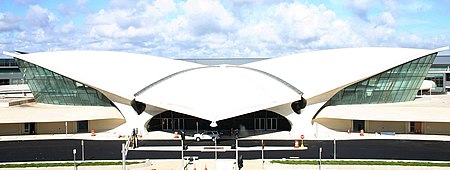
JFK International Airport’s “Terminal 5”

If you’re flying to New York City, LaGuardia Airport is just a hop, skip, and a landing from Manhattan.  For my money I prefer JFK International, ten miles to the south, if only for the chance to visit Terminal 5. “T5”, as it’s known today, embraces one of the most unique airport buildings in the world – the TWA Flight Center.  We’re lucky it’s still standing.

Go back to the first photo of T5.  Doesn’t it look like a giant, white B-2 Stealth Bomber draped over the rest of the building?  That part of the structure – or the “head house” as it’s called – was designed by Finnish-American architect Eero Saarinen as the TWA Flight Center. Would you have guessed it was constructed in the 1960s?  I think it looks decidedly more modern.

You can tell how dramatic the interiors of the Flight Center are without even stepping inside.  Those window walls at both ends are two stories tall.  The soaring “bomber” thin-shell concrete roof is shouldered at its corners by massive Y-shaped piers, allowing for the uninterrupted gathering space within.  The Flight Center was the first terminal to introduce concourses and jetways to airport design, allowing passengers to board an airplane without having to drop down to ground level first.

Washington D.C.’s Dulles International Airport

Saarinen’s most famous designs feature similar swoops and curves.  He gave the main terminal at Dulles International Airport the same look.  He served on the advisory board for the design of the Opera House in Sydney, Australia.  But his best-known work towers over St. Louis (coincidentally, TWA’s headquarters city): the Gateway Arch.  Sadly, Saarinen saw none of these structures to completion, passing away in 1961 at the age of 51.

St. Louis’s Gateway Arch

So if TWA is long gone, why is the Flight Center still around? Because it’s been transformed into a wholly different animal.  Yes, you’ll find the typical mix of concourses, gates, and restaurants you see at most airports – the so-called “T5” aspect of the building.  But the Flight Center itself – the head-house – has been converted into a kitschy hotel, with hundreds of rooms, a central lounge between the window walls, and a cocktail bar inside a restored Lockheed Constellation airliner.  Brass light fixtures, rotary phones, and bright red carpet evoke the heyday of TWA.  They’ve even retained the mechanical split-flap display board used to advertise arriving and departing flights.

“Trans-formed” into the “TWA Hotel”

Architecture is an important part of a culture, a museum of pieces placed here and there in the landscape.  Preserving those pieces takes time, money, and sometimes, the gamble to repurpose.  The TWA Flight Center may now be referred to as the TWA Hotel, but it’ll always be Eero Saarinen’s masterpiece.

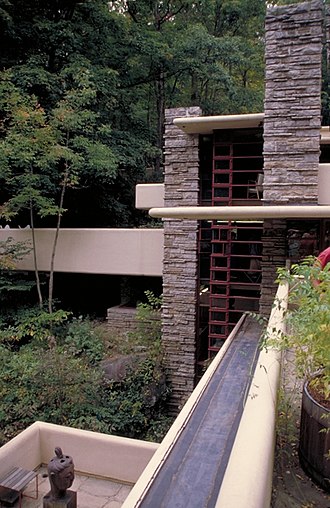
Now for the latest on LEGO Fallingwater…

____________________

LEGO Fallingwater – Update #5  (Read how this project got started in Perfect Harmony)

Today we spent landscaping “outdoors” around the foundation of the house.  40 pages (or 44%, or 136 minutes) into the build, this is what we have:
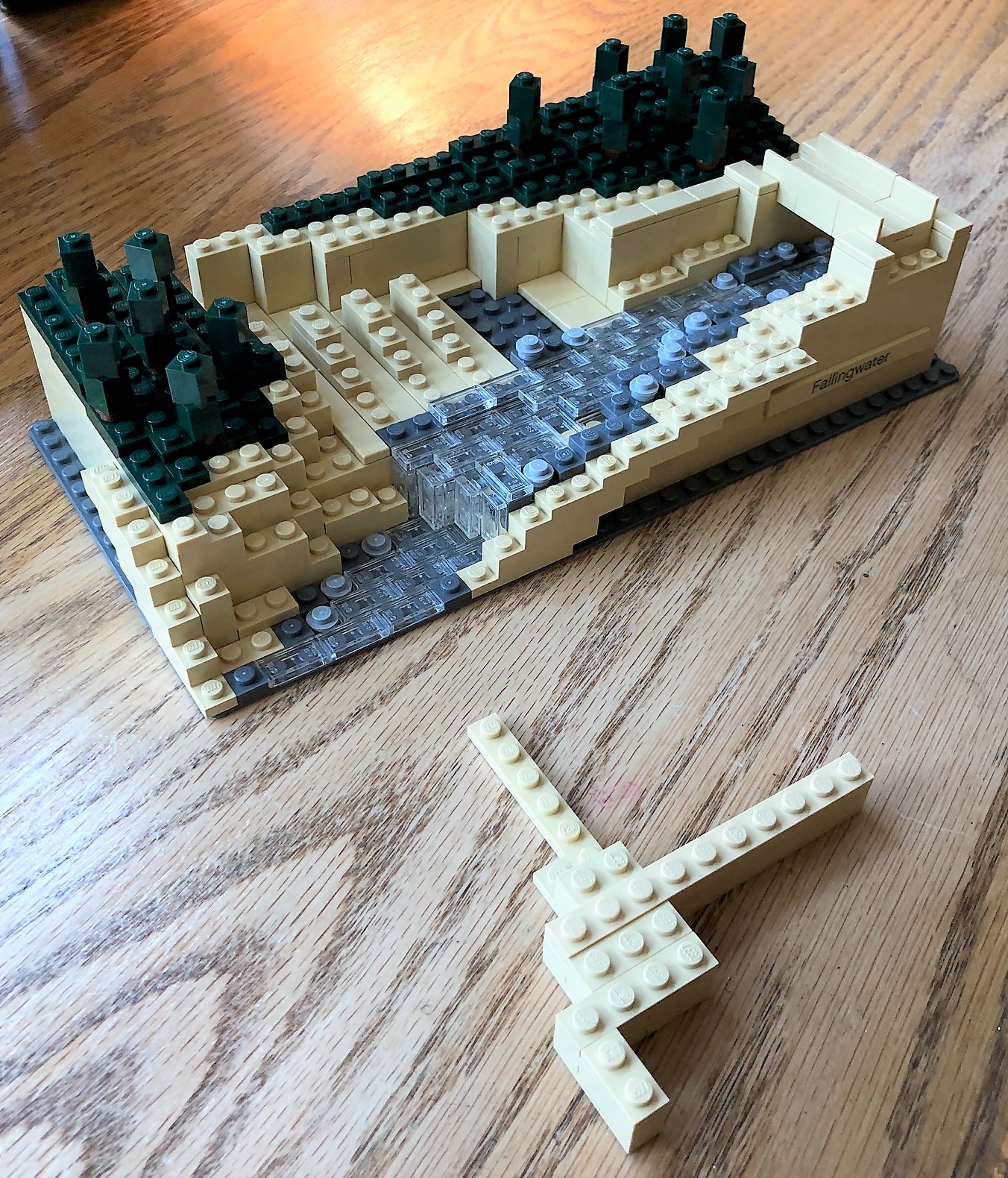
The fourteen trees on the Fallingwater model property are each nothing more than one small green LEGO cube snapped on top of another one.  Compare this basic look to LEGO’s more recent take on growees, as in blogger Andrew’s View of the Week’s LEGO Flower.  Slightly more realistic, wouldn’t you say?

At least we’re seeing a portion of the house itself begin to emerge.  We’ve built a bridge over the stream (back right), and we’re starting construction on one wing of the house – the piece you see in front of the model.

Tune in next Thursday as construction continues!  Now for another nod to Frank Lloyd Wright…

R. W. Lindholm Oil Company Service Station

No commission is to big or too small for an architect, which is why Wright put his signature on a gas station, very close to the time he was designing Fallingwater.

R. W. Lindholm Service Station

The Lindholm Service Station was part of Wright’s vision of Broadacre City, a utopian community planned for a four-square-mile property in Cloquet, MN.  The Service Station fueled automobiles, yes, but also encouraged residents to gather in its upper space for what Wright envisioned as “… neighborhood distribution center, meeting place, restaurant… or whatever else is needed.”  The cantilevered copper roof and band of glass windows is vintage Wright.  The angular end of the roof canopy points to the St. Louis River as a symbolic nod to river transport.

The Lindholm Service Station is the only part of Broadacre City ever constructed, is included on the National Register of Historic Places, and is open to the public… to fill up your car, of course.

Some content sourced from the Frank Lloyd Wright Foundation website, and  Wikipedia, “the free encyclopedia”.

Wings and Prayers

One of the must-sees on a visit to Colorado Springs is the campus of the United States Air Force Academy (USAFA). Besides a training ground for our future servicemen and women, the Academy hosts a high school, an airfield, two golf courses, and a cohesive campus of modernist buildings spread across 18,500 acres of the Rocky Mountain Front Range. But one structure stands prouder and taller than anything else on the property. Welcome to the USAFA Cadet Chapel.

USAFA Cadet Chapel

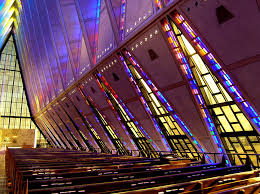
If you’re following my blog posts on architecture (as I complete my LEGO Fallingwater model), you’ll recall Thorncrown Chapel from a few weeks back.  The USAFA Cadet Chapel is a much bolder animal, dominating the academy campus skyline and easy to see from miles around.  Instead of Thorncrown’s wood and glass, the Cadet Chapel boasts an impressive open structural steel frame, married with tall triangular stained glass windows.  The main sanctuary is big enough to seat 1,200 (or about 25% of the USAFA student body); more like a church than a chapel.  Frankly, the only thing the Cadet Chapel has in common with Thorncrown is its design inspiration: France’s Sainte-Chapelle.

Fighter jets all in a row?

The distinctive feature of the USAFA Cadet Chapel is its seventeen spires, marching from one end of the building to the other.  The bold design, by architect Walter Netsche, took a little getting used to when the doors opened in 1962.  Visitors described the structure as a giant accordion made of triangles.  I describe it, more fittingly, as a series of fighter jets standing on their tails.

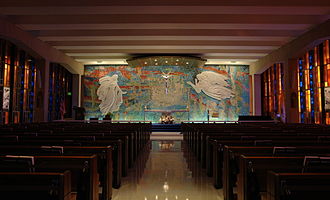
If you haven’t visited the Cadet Chapel you probably don’t know its biggest secret.  It’s a chapel for all faiths.  The main sanctuary is just the top floor of a multi-level structure.  Hidden below, you’ll find individual chapels for Catholics (500 seats), Jews (100 seats), Muslims, and Buddhists.  You’ll even find two “all-faiths rooms” and an outdoor area for “Earth-Centered Spirituality” (reserved for you Pagans and Druids).  It’s safe to say your acceptance into the Academy has nothing to do with who or how you choose to worship.

USAFA Catholic chapel (lower level)

The Cadet Chapel is a structural marvel, assembled from precisely one hundred prefabricated tetrahedral panels.  Over the years its popularity has grown to where it was designated a National Historic Landmark in 2004.  That’s the good news.  Now for the bad.  The original design called for a series of gutters to transfer water away from the building, instead of streaming directly down its panels.  But the gutters were scrapped due to budget constraints…

Mistake.

Sixty years of caulking and recaulking leaks finally forced the Academy to close the chapel for remodeling in 2019.  Now for the really bad news… they’re still not finished with the repairs.  In fact, you won’t be able to walk through the doors for another four years.  What’s taking so long?  Adding all those gutters, the ones that were supposed to be there in the first place.

The Cadet Chapel is “boxed” until 2027

One more bit of bad news (the fighter jets are really nosediving).  Getting construction workers to the tops of the chapel spires meant building an entire hangar-like structure around the chapel.  No joke – they put the whole building in a box.  In other words, not only can you not walk through the doors, you can’t even see the Cadet Chapel today.  Trust me, absence makes the heart grow fonder.  Mark your calendar for 2027, because you really need to see the USAFA Cadet Chapel.  It’s the only place I know where a (jet) wing and a prayer can be found in the same place.

Now for the latest on LEGO Fallingwater…

____________________

LEGO Fallingwater – Update #4  (Read how this project got started in Perfect Harmony)

I’m starting to wish I’d built Fallingwater before the LEGO Grand Piano, so you’d see me taking on a greater challenge versus the other way around.  30 pages (or 33%, or 118 minutes) into the build, this is what we have:

Pretty much the same as last week.  We added some landscape to the left side (the green/brown pieces), more landscape along the back, and we raised the foundation a little higher up off the water.  We have yet to see any of the distinctive house itself.  Not so adventurous.

What IS adventurous is sifting through 800 tiny pieces.  There’s no logic in how they were bagged (thanks, LEGO!) so I end up just spilling everything out onto the desk, searching for a lot of minutes followed by building for a few minutes.  Tedious?  Heck no, this is a blast.  If “tedious” entered my brain I’d have no business building LEGO models.

LEGO Gamble House by Grant W. Scholbrock

Props to my college buddy Bruce for sharing this photo, an example of a custom LEGO build… and one you can’t buy.  It belongs in a museum if you ask me.  There are pedestrian model builders (yours truly) and then there are professionals.  Way to go, Grant!

Tune in next Thursday as construction continues!  Now for another nod to Frank Lloyd Wright…

Solomon R. Guggenheim Museum

Guggenheim Museum

I’m not a big fan of museums.  Maybe that’s because, as Frank Lloyd Wright said, a lot of them look like “Protestant barns”.  No wonder New York City’s Guggenheim Museum is radically different.  When Wright set out to design it in 1943 he vowed to “make the building and the paintings a symphony such as never existed before in the World of Art”.

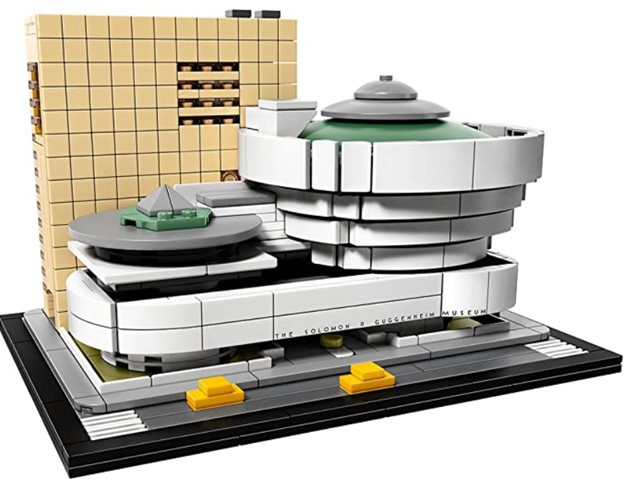
I can’t describe “The Goog” any better than the website of the Frank Lloyd Wright Foundation.  Their words: “… a white ribbon curled into a cylindrical stack that grows continuously wider as it spirals upwards towards a glass ceiling.” In other words, you the visitor climb in circles ever-ascending, enjoying the art as you go.  The Guggenheim was the first museum design where the “physical home” played an important role in the experience of the art itself.  If you’ve ever been to a museum that deserves a similar description, you have the Guggenheim to thank.

LEGO Guggenheim

In closing I ask, is the Goog significant enough to earn a spot in the LEGO Architecture series of models?  Why yes, it is!

Some content sourced from the Frank Lloyd Wright Foundation website, and  Wikipedia, “the free encyclopedia”.

This Gamble Pays Off

In the movie Back to the Future, there’s a memorable scene shortly after Marty McFly time-travels back to 1950s California. Marty looks up Doc Brown in the phone book and heads over to his house. Doc doesn’t recognize Marty when he opens the door but he drags him inside anyway.  The scene is memorable because Doc’s house (the exterior, at least) is recognizable to any student of American architecture. Welcome to Pasadena’s Gamble House.

Greene and Greene’s Gamble House

Maybe you guessed this Gamble wasn’t won in a wager (although it would’ve been a handsome payoff!)  Rather, it was built for a member of the (Proctor &) Gamble family who liked the look of his next-door neighbor’s place.  That house, and many others on the same street, was designed by sibling architects (Charles) Greene and (Henry) Greene.  The Gamble House is perhaps their most famous design.

Front doors and foyer

The Greene brothers, who studied architecture at MIT, made a significant stop on their journey to the West Coast.  They spent time at the 1893 Columbian Exposition in Chicago.  While there, they picked up design influences from the temple look of the Japanese pavilion (wood construction, tiled roofs, open verandas).

Dining area

The Greene and Greene “ultimate bungalow” look, with its liberal use of dark wood slats and panels, became known as the Craftsman style of architecture.  This label was all the more fitting because the Greene brothers also studied furniture design, and incorporated many custom pieces into their houses.  Even more impressive, the finished look relies on elegant leather straps and wooden pegs as fasteners; not a nail or screw in sight.

Main staircase

The Gamble House is 6,000 square feet of indoor/outdoor living, in concert with California’s mild temperatures.  You can tour the house courtesy of the USC School of Architecture students who get to live there every school year (luckies!)  A separate tour walks you through the neighborhood to see other Greene and Greene designs.  But the Gamble remains their masterpiece.  And if you ever see this inviting residence, you may wish you owned a time-traveling DeLorean to take you back to its heyday in the early 1900s.

Courtesy of Universal Pictures

Now for the latest on LEGO Fallingwater…

____________________

LEGO Fallingwater – Update #3  (Read how this project got started in Perfect Harmony)

I find it funny how this Fallingwater model is “rising” off of its foundation at the same time the water below is “falling”.  It’s like I’m going in opposite directions at the same time.  20 pages (or 22%, or 83 minutes) into the build, this is what we have.

As you can see, the stream is now “built” from the front of the house all the way to the back, with the modest waterfall front and center.  We also have our first piece of “landscape”, that dark green strip you see on the left.  Otherwise, we’re still at the foundation level.  I expect the house to rise dramatically in the next few chapters of the build.

LEGO “wrench”

Here’s something unnerving about this model.  You don’t really understand what you’re building as you go.  You’re putting together very small pieces which look like, well, LEGO blocks, until you stand back and take the whole model in.  For this reason, you have to build very, very carefully.  I still got the location of a few pieces wrong and had to utilize my handy-dandy wrench to yank them out.  It’s like pulling teeth.

Tune in next Thursday as construction continues!  Now for another nod to Frank Lloyd Wright…

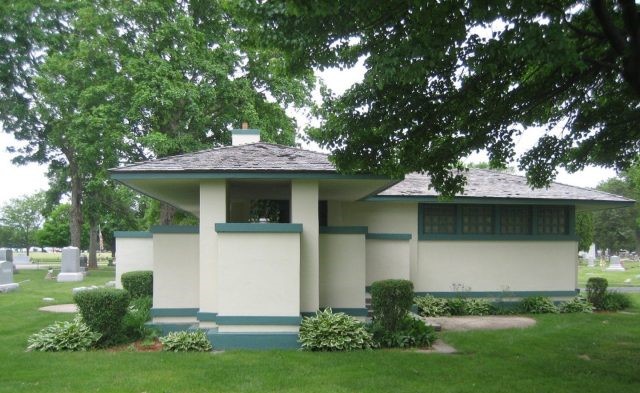
Pettit Memorial Chapel

Over five hundred structures were built from the designs of Frank Lloyd Wright, but only one of those five hundred is in a cemetery.  That would be the Pettit Chapel in Belvidere, Illinois.  Dr. Pettit was a beloved physician of his time, and his sudden passing prompted his wife to hire Wright to design a graveside chapel as a memorial to the man.

Pettit Chapel

The design of the “petite” Pettit is very much in line with Wright’s signature Prairie Style.  The low roof lines, broad eaves, and high horizontal bands of glass are typical.  Wright used the shape of a cruciform – common in medieval cathedrals – to house the smallest of sanctuaries, as well as two open-air porches and a central fireplace.  He then added storage, restrooms, and a furnace so the chapel could be used for public functions.

The Pettit Chapel has survived since its construction in 1906, thanks to restorations in 1977 and 2003.  The chapel is open to the public, and, like many structures designed by Wright, included on America’s National Register of Historic Places.

Some content sourced from The Museum of Lost Things website article, “The Real ‘Back to the Future’ House”, and Wikipedia, “the free encyclopedia”.
Get Your Feet Wet!

I love urban plazas where water jets through an array of holes at ground level, creating fountains and arcs at random. Watching kids run and play in the midst of these unpredictable showers brings a smile. It’s also a creative way to cool off. Down in Texas, where it always seems to be hot, they’ve created an entire garden of water, where you can get your feet wet in all sorts of ways. Welcome to Fort Worth’s Water Gardens.

Fort Worth Water Gardens

Maybe you don’t think of an outdoor venue as “architecture” but the fact is you don’t need walls and a ceiling to define space.  The Water Gardens are a perfect example.  This city block oasis pops up (er, down), unexpectedly as you pass through the urban grid of Fort Worth.  Most of the park is hidden below street level but you can’t miss the rising mist and symphony of moving water.  It’s a celebration of sorts, urging you to join in on the fun.  The few photos I share here don’t begin to do it justice.

The Water Gardens challenge my logical brain because there’s no rhyme or reason to their haphazard design.  Maybe that’s the point.  Wander, gaze, and “soak in” their five acres.  The Gardens are a multi-faceted experience of water.  Phillip Johnson (one of America’s foremost architects), and John Burgee (a graduate of my own university) designed the Water Gardens to include “… pathways, wayside stops, events, and hideaways to draw out the experience, to convey more of the sense of a Central Park… than its limited acreage would’ve suggested possible.”  That may be saying a lot about a little, but consider the Gardens’ offerings:

Quiet Pool

The “Quiet Pool” sits at the base of twenty-foot walls.  Water descends almost silently down the stone from a trough above.  Deep in the Gardens by the pool itself, you’re so far below ground level it’s as if the city has somehow been relocated far, far away.

Aerated Pool

The “Aerated Pool” is a nod to the water jets I mentioned above.  Forty nozzles create an “orchard” of water in this smaller pool, the tops of the “trees” reaching back to the ground level of the city above.

The “Mountain” is a series of stepped concrete terraces, descending to a corner of the park removed from the water elements.  Sitting on the Mountain is almost like being blindfolded.  You can hear the rush of the Water Gardens nearby; you just can’t see them.

Active Pool. Watch your step!

The “Active Pool” is the largest and most distinctive feature of the Water Gardens, literally a canyon through which the water streams and falls, terminating in a pool thirty-eight feet below the ground.  A series of open steps dares you to descend through the water from top to bottom (check out this video for a sense of the experience).  The Active Pool gained notoriety in the final scene of the movie Logan’s Run, as the inhabitants of the dystopian city climb into the outdoors for the very first time.

The major elements of the Water Gardens are tied together by a central plaza, where you can experience everything from one location.  But to do so would betray the Gardens’ intent.  They’re meant to be a moving experience, much as the water itself rushes, mists, and pools throughout.

Architecture is structured, while landscape is unstructured.  Blend the two and the result can be unlike anything you’ve seen before.  The Water Gardens beckon you to escape, to wander, to contemplate, and most importantly, to get your feet wet.  Will you accept their invitation?

Now for the latest on LEGO Fallingwater…

____________________

LEGO Fallingwater – Update #2  (Read how this project started in Perfect Harmony)

The instruction manual for LEGO Fallingwater includes about ninety pages for the assembly, so I figured I’d divide the build into nine equal parts.  In the spirit of today’s topic, I proceeded to “dive in”.

Heaven help me.

You see, the 3,000+ pieces of the LEGO Grand Piano were separated into twenty-one numbered bags.  Build one bag at a time – easy-peasy.  On the other hand, the 800+ pieces of the LEGO Fallingwater model are separated arbitrarily into nine bags, with no indication of what piece is where.  It’s like opening a jigsaw puzzle and realizing every piece looks almost exactly the same.

This scene is even scarier when you click to zoom in…

I took a photo of my desk so you could see how much chaos I created on my first day.  Did I open all nine bags in search of pieces?  Yes, I did.  Did I consider just dumping all of the pieces into a big pile so I could search in one place? Yes (but I was afraid there was good reason they’re separated into nine bags).  Did I build part of the model wrong and have to backtrack?  Absolutely (and thank goodness for that little orange wrench you see next to the scissors.  It came with the LEGO Grand Piano and unsnaps pieces that are snapped together incorrectly).

Ten pages (or 11%, or 49 minutes) into the build, this is what we have.  We’re looking at Fallingwater from the same angle as the photo above, only all we’ve got is the lowest perimeter foundation wall and a spill of waterfall and creek emerging from the front corner.  Not very exciting.  Tune in next Thursday as the construction continues.  Now for another nod to Frank Lloyd Wright…

Romeo and Juliet Windmill

For all of his famous residential and commercial projects, Frank Lloyd Wright had plenty of lesser-known designs, such as the Romeo and Juliet Windmill in Wyoming, WI.  The tower was commissioned by Wright’s aunts, to pump water to a nearby school where they taught.  You might describe its shingle-clad look as quaint but in fact, the design is intentional.  The taller piece in the rear (“Romeo”) serves as structural support to counter the prevailing winds of the area.  Romeo also contains the mechanics of the windmill and water pump.  The cupola-topped octagonal piece in front (“Juliet”) is largely ornamental and softens the look of the tower when observed from further down the hillside.  Neither part of the tower can really stand on its own, hence the name “Romeo and Juliet”.

Some content sourced from the website for Fort Worth Parks and Trails, and from Johnson/Burgee: Architecture, and Wikipedia, “the free encyclopedia”.
Crowned Jewel

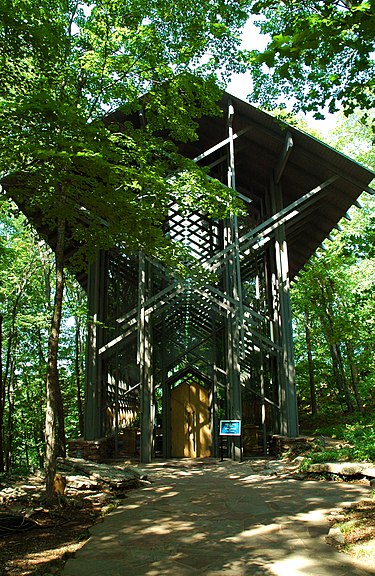
A little south and a little west of our downtown proper, you’ll find a wide street with stately old homes. The homes sit to the back of their properties, playing second fiddle to lines of majestic oak trees closer to the street. Overhead, the tree branches are densely intertwined, barely allowing the sun to peek through, creating a cozy, comforting canopy as you drive through. It’s a look that could’ve inspired the design of Thorncrown Chapel in Eureka Springs, Arkansas.

Thorncrown Chapel

When I gushed about Fallingwater in last week’s Perfect Harmony, I thought it would be appropriate to revisit some of my favorite American architecture as I share the adventure of my LEGO model build.  Were it not for my architecture degree in college I probably wouldn’t be aware of these beautiful structures.  Instead, all these years later I can recall my favorites from memory.  They’re a diverse bunch but I think they exemplify almost-perfect spaces, thanks to the work of the architect behind the scenes.

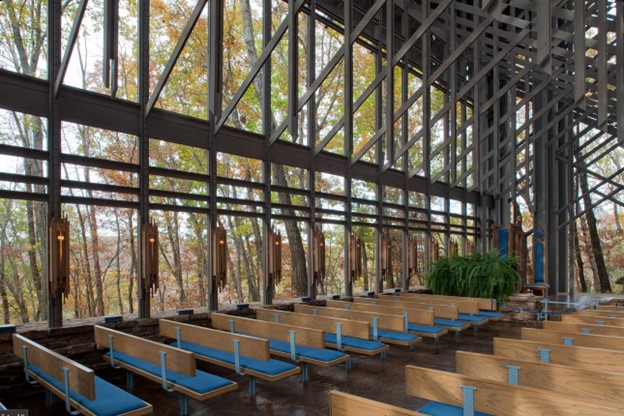
Thorncrown Chapel is an appropriate choice to lead off my list.  Just like Fallingwater, the chapel’s intent is to bring the outside in so that worship (or weddings, or any other celebration) feels as if you’re one with nature, yet with the conveniences and comfort of an enclosed space.  Thorncrown was built in 1980 (by coincidence, my freshman year of college).  Its architect, E. Fay Jones, turned a childhood interest in treehouses into a decorated career, including an apprenticeship under Frank Lloyd Wright.  Fay Jones’ designs “focused primarily on the intimate rather than the grandiose“.  Hence, chapels.

As a disciple of Wright (and the only one to win the American Institute of Architect’s [AIA] prestigious Gold Medal), it’s no surprise Fay Jones’ Thorncrown Chapel design is reminiscent of Wright’s Prairie School houses, with its broad overhanging eaves, horizontal lines,  and deliberate integration with the landscape.  Thorncrown contains 425 individual windows.  Those with stained glass bring in so much colored light the chapel’s interior is often described as “jewel-like”.

As with Fallingwater, Thorncrown is constructed of organic materials, including Southern pine and flagstone from the surrounding area.  The chapel seats 100 and is non-denominational, intended more for meditation for those who make the pilgrimage to Eureka Springs (in other words, go see it!)  For all of the beautiful structures you’ll find in America over the last forty years, the AIA has given Thorncrown the distinction of “best American building constructed since 1980”. 

Sainte-Chapelle

Despite my longtime familiarity with Thorncrown, I never thought to wonder how it got its name.  Turns out, Thorncrown’s design was not only inspired by Frank Lloyd Wright but also by Sainte-Chapelle, the Gothic church in Paris, France.  And at some point in its history, Sainte-Chapelle supposedly housed the crown of thorns worn by Jesus Christ.

If your wanderings ever bring you to the northwest corner of Arkansas, take time to visit this crowned jewel of a chapel.  Whether it strikes you as a treehouse or a miniature cathedral, being in church will never feel so comforting and cozy.

Now then, let’s turn our attention to (LEGO) Fallingwater, shall we?

____________________

Fallingwater – Update #1

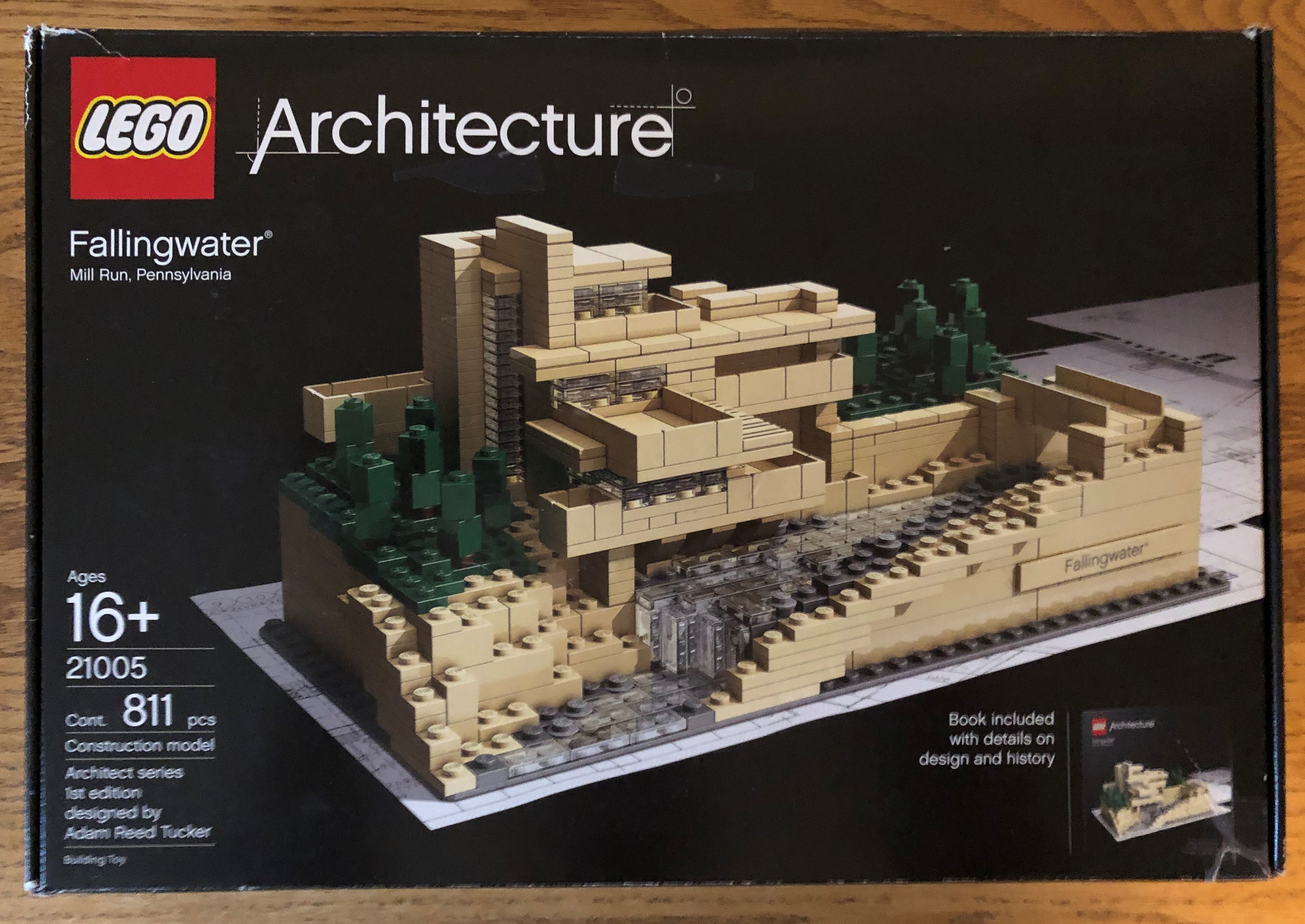
As with the LEGO Grand Piano, the first step in the build is to simply open the box and assess the contents.  Here’s what is immediately apparent about the LEGO Fallingwater model:

  1. The finished product will look much more like LEGO than the Grand Piano looks like a miniature piano.  I can’t pinpoint the date LEGO first produced its Fallingwater model but it must’ve been years before the Grand Piano, with pieces more in line with basic LEGO blocks.  I mean, check out the photo below.  Would you believe this inventory of boring little pieces comes together as a house over a waterfall?
  2. The Fallingwater model will be completed much faster than the Grand Piano.  The design is intricate, yes, and we’re still talking about thousands of pieces, but the instruction manual hints at a much easier assembly.  I won’t have those heartstopping moments like I did with the Piano, where I realized I’d built a section backwards.  (Then again, my LEGO-building confidence may be getting the best of me.)
  3. The Piano was interesting to look at even as it was coming together.  Fallingwater… not so much.  Under construction it’ll look like haphazard piles of LEGO bricks.  Not exactly riveting to you the reader.  Instead, as I did with the Piano and classical music, I’ll cover a few of Frank Lloyd Wright’s other designs, so you gain a better appreciation for the diversity of his life’s work.

Next week, “groundbreaking”!

Some content sourced from the official Thorncrown website, and Wikipedia, “the free encyclopedia”.

Perfect Harmony

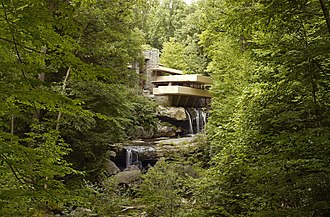
In the toe of my wife’s Christmas stocking this year, I nestled a small gift to help her sleep. It’s a travel version of one of those sound machines, where you can dial up anything from rain to ocean waves to lull you off to Never Never Land. You can even mimic a waterfall, which would be my personal choice. After all, it’s the same sound the Kaufmann family enjoyed for years at their stunning retreat in the Pennsylvania forest, southeast of Pittsburgh. Seeing this famous house is an entry on my bucket list. Yes, one of these days I will make the trek to Fallingwater.

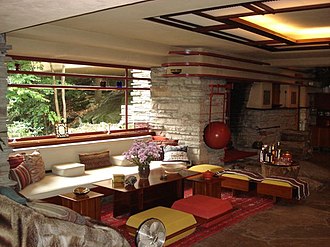
If you’re old enough to remember, “I’d Like to Teach the World to Sing”, you know the song’s about more than just apple trees and honey bees.  It’s about “perfect harmony”, which is how anyone would describe Fallingwater.  This beautiful structure is exactly as named: a house on top of a waterfall.  It is considered one of architect Frank Lloyd Wright’s greatest achievements.  The design is a melding of interior and exterior spaces, a principle borrowed from the Japanese.  Fallingwater is a building, yes, but it’s more often described as “… harmony between man and nature”.

If you know anything about Wright, you know he was an eccentric architect.  When the Kaufmann’s called to stop by his studio for a progress report, Wright hadn’t even begun the drawings.  Yet by the time they arrived two hours later, Wright had completed the entire design.  This production under pressure reminds me of author Ray Bradbury’s Fahrenheit 451, a novel written in just nine days and considered one of Bradbury’s greatest works.

The genius of Fallingwater’s design is in the details, or perhaps the lack of them.  The house is constructed of reinforced concrete, stone, and glass.  Its interior spaces are small and dark, encouraging more time spent outdoors.  The sound of water can be heard everywhere, whether from the stream and waterfall below or from the natural spring allowed to drip along one of the hallways.  Fallingwater’s distinctive cantilevered terraces are meant to resemble nearby rock formations, extending in every direction to the forested surroundings.  Its dramatic perch on top of the waterfall is hidden from the approach to the house, lending to a sense of modesty.

Fallingwater brings the outdoors in wherever possible, and its best example may be a ledge-shaped rock in the living room, left undisturbed in its original location.  The surrounding stone floor is waxed while the ledge is left plain and dull, creating the look of a rock protruding from a stream.  A stair descends from the same room, several steps down to a platform whose function is to simply admire the stream.  From photos, you’d believe Fallingwater was constructed entirely offsite and dropped gently within the forest by pushing aside a few tree branches.

Today, Fallingwater is a National Historic Landmark.  You can tour the house and grounds with the purchase of a ticket at the visitor’s information website.  If I were to visit, it’d be a ten-hour drive from where I live.  That’s not going to happen anytime soon.  Instead, I will build Fallingwater; literally.  It is a model in the LEGO Architecture series and I am lucky to own a copy.  As I tell my family, there are only two LEGO models I’ve ever wanted to build: the Grand Piano (completed last year and blogged about here), and Fallingwater.  It’s a new year and it’s time to get started.

I’ll bring you along for the ride as my miniature Fallingwater takes shape in my home office.  You can look for updates at the end of the next several posts.  Eight hundred pieces from now, when all is said and done, I may borrow that little sleep aid I gave my wife for Christmas.  After all, no house built on top of a waterfall would be complete without the sounds to go with it.  Remember, we’re talking (er, singing) about perfect harmony here.

Some content sourced from Wikipedia, “the free encyclopedia”.

Finishing on a Low Note

I usually associate “finishing” with sporting events. Think about the finish line of a car race, the eighteenth hole of a golf tournament, or the ticking seconds of the clock as a football game runs out of time. In these scenarios, the finish can be a tense, hold-your-breath moment, triggering a burst of euphoria if your favorite takes the win. So it comes as a bit of a surprise to reflect on the completion of my Lego Grand Piano. Tense? Hardly. Held my breath? Not at all. Euphoria? Anything but. No, this finish feels a little forlorn.

Three thousand, six hundred, and sixty-two tiny pieces ago, I began the assembly of Lego’s Grand Piano, just about the closest gift to “perfect” my wife has ever given me.  Piano is inextricably connected with my childhood – hours upon hours of practice and playing and determined progress at a tender age, eventually succumbing to other temptations of time.  Piano introduced me to commitment, skill, and patience, even frustration and disappointment.  My parent’s big, black grand sat patiently in our living room, beckoning me to play every time I passed by.  The instrument was always perfectly tuned and sparklingly clean, thanks to my mother’s weekly persistence with a dust cloth.  I can still hear her sweeping the eighty-eight keys from one end to the other – a delightfully musical moment.

Korg’s “Sampling Grand” keyboard

Believe it or not, the Lego Grand Piano is the second gift of a piano from my wife.  On our wedding day in 1987, she presented me with Korg’s “Sampling Grand”, an electronic keyboard with weighted keys and surprisingly realistic sound, much less expensive than the real thing.  Thirty-five years later, the Korg still plays like a champ and still earns a spot in our living room. (Unlike the Lego version, the Korg was already assembled when I got it.)

The start-to-finish journey of my Lego Grand Piano has been a more enjoyable ride than I expected.  When I opened the box last Christmas, I remember my jaw dropping a little, not only because I never saw the gift coming but because of the sheer complexity of the project staring up at me from the box  That’s a complicated-looking instrument, I thought.  That’s a ton of pieces, I also thought.

The unopened Lego box sat on my home office desk for a couple of weeks, looking elegant without even being touched.  My curiosity eventually got the better of me and I finally had a look inside.  Talk about intimidating.  A 500-page instruction manual awaited, along with forty-odd individual bags of pieces.  Even though this was a twenty-one-step journey, some steps involved “sub-bags” of tiny, tiny pieces, grouped separately so as not to escape!  Was I really brave enough to dive into this mess?

Contents of the box

The first chapter – shared with you readers on January 6th of this year (a date we Americans wish to forget) – spoke to my hesitation when I wrote an entire post about building the piano without actually building anything.  I just poked around the box and marveled at the contents and felt pretty good about even opening up the box.  But I did get started seven days later, and the subsequent journey was wholly satisfying and something of a weekly escape.

Leftovers

At first, I made several mistakes as the piano began to take shape.  Since the pieces are small it’s easy to place them backward, or even mistake one for another.  I also fretted when extra pieces remained after a given section of the build. (For the record, there were 38 extra pieces when all was said and done.  I can fit all of them into the palm of my hand.)  There were at least two instances where I had to disassemble several pieces to get back to the point where I’d done something wrong.  Those moments were utterly unnerving and confidence-shattering (take your pick).

[Author’s Note: After weeks and weeks of building the Lego Grand Piano, it only now occurs to me I’m describing one type of keyboard while typing on another. Don’t you just love the coincidence?]

So let’s finish this post by revisiting “finishing”.  What should be a moment of triumph feels a tad sad instead.  After the first few weeks, the build of the Lego Grand Piano became a weekly treat, accompanied by some of my favorite classical music.  Many stages were mini-surprises, not knowing what section I was building until the last piece was in place.  And of course, sharing the progress with all of you was also fun.  One reader admitted she would first scroll to the bottom of a post before reading my weekly topic.  She couldn’t wait to find out how the piano was coming along.

So, here we are now, finally done.  Next week’s post will feel a little empty without a reference to the Lego Grand Piano.  By total coincidence, my daughter got married this past weekend, also the end of a journey (months of planning and all).  My son just turned 30 yesterday, the finish line of his 20’s.  And soon, my wife and I will point our cars east for our move to South Carolina, the finish of our days in Colorado.  To be finished is to be sad?  You bet it is.

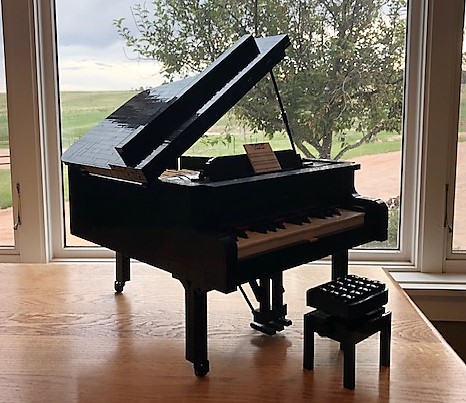
I’ll dive into another Lego build one of these days, I promise.  Maybe I’ll even take you along for the ride again.  In the meantime, I’ll flip the hidden switch and play the piano every now and then.  I’ll also find an acrylic box in which I can display this magnificent project.  After all, with my mother’s good habits in mind, I don’t want it gathering dust.

——————–

Lego Grand Piano – Update #21

(Read about how this project got started in Let’s Make Music!)

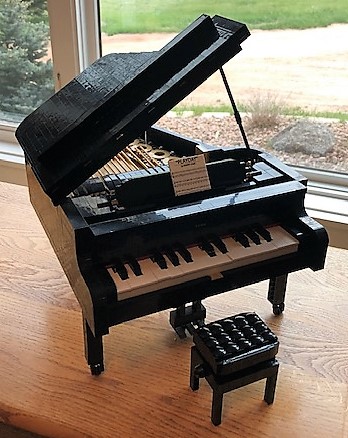
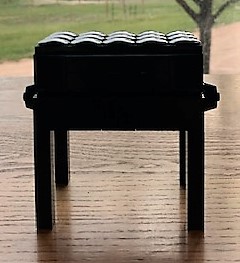
The finále of the Lego Grand Piano assembly, as expected, was the build of the pianist’s bench and the placement of the sheet music onto the stand.  Bag #21 – of 21 bags of pieces – was bigger than I expected.  I mean, a bench is a seat with four legs, right?  Not according to Lego.  This bench raises and lowers with the little dials you see on the sides, to accommodate the height of our fictitious pianist.


Let’s give credit where credit is due.  The Lego Grand Piano was designed by the guy you see below, Donny Chen, a 33-year-old piano teacher and tuner from Guangzhou, China.  No surprise, Donny’s passions are the piano and Lego.  He’s a lot smarter than I am, evidenced by this quote: “I’ve always seen toys as something to be imagined, not just played with”.  Me, I just played with toys.

[Pianist’s Note: The Lego Grand Piano DOES play, I know it does.  I just have to figure out two things.  One, how did I manage to disconnect the cable to the sound box buried deep within the piano frame?  Two, how the heck am I going to get it reconnected?  That’ll take more time than I have today and is part of why I “finished on a low note”.  But I’ll share a concert with you when you least expect it – I promise. “Stay tuned”.]

Donny Chen

Running Build Time: 14.0 hours.  Musical accompaniment: Jarratt and Reedman’s Hooked on Classics. Leftover pieces: 1

Conductor’s Note: Apologies to the purists but I just couldn’t resist this somewhat tongue-in-cheek accompaniment to the final chapter of the Lego Grand Piano.  Hooked on Classics is a top-ten Billboard Hot 100 hit from 1981, a mashed-up perversion of bits of the world’s most recognized classical pieces… overlaid on a drum track.  It was recorded by Louis Clark and the Royal Philharmonic Orchestra and bred several spin-offs (ex. Hooked on RomanceHooked on Classics came along just as I was wrapping up my childhood piano “career”.  I much prefer the originals of the several classical pieces in Hooked but maybe this peppy number is your cup of tea.  Have a listen:

Some content sourced from Wikipedia, “the free encyclopedia”.

I Made This Up

Words get stuck in my head – often.  If I hear “cattywampus” or “chartreuse” or “onomatopoeia” (and for the record, spellcheck didn’t flag any of them) my brain hangs on for a while because I’m entertained by the sound or the meaning. Sometimes a word repeats so often in my mind it doesn’t sound right anymore, like putting the accent on the wrong syll-AH-ble. But this is the reason I never struggle to include a unique word in every Life In A Word post. It’s the reason my topics often become unexpected adventures in writing – several hundred words spun from the single word ricocheting around in my brain. So what word am I stuck on this week, you ask? Make.

I know, I know.  You expected a more sophisticated word; something you could really sink your teeth into.  Certainly a word with more than four letters.  But here’s the thing.  Some words have one meaning while others have a list of definitions a mile long.  “Make” is wonderfully (sometimes confusingly) versatile.  It seems to have limitless uses. So, while “make” shows up in, like, every other conversation we have, consider just how many different ways we’re using it.

Here’s an example, probably my favorite for today’s topic.  We contracted with a bakery in Denver to create the perfect cake for my daughter’s upcoming wedding.  You call them first to make a sit-down appointment (yes, I’m aware I just used our word-of-the-day).  Then you work with a consultant on sketch paper to design exactly what you’re looking for. Then you taste-test six cakes and six frostings (using a tray of cupcakes) to come up with your dream combination.  The name of this establishment?  The Makery.  At first I thought it was a strange name, but then I realized, no; it’s a cool, tidy spin on words.  The Makery is not just a bakery.  A bakery would fill their glass display case with creations for you to choose from.  The Makery is all about custom creations, based on your input and your preferences.  In other words, The Makery declares “baking” a subset of “making”.

Without peeking at your Webster, guess how many definitions you’ll find for “make” in the dictionary.  Five? Ten? Two dozen? How about fifty-six? “Make” has forty-seven definitions as a verb and another nine as a noun.  I told you “make” was versatile, didn’t I?

I’m not about to go through fifty-six definitions of “make” because you can make better use of your time.  But here are my favorites:

  • To bring into existence by shaping or changing material, combining parts, etc. (as in, “Dave is making his Lego Grand Piano”).  The formality of this definition – the first in the line-up of the fifty-six – cracks me up.  It takes a lot of words to explain the most basic use of “make”.
  • To put in the proper condition or state, as for use; fix, prepare.  “This morning, Dave made his bed.  Then he made his coffee.  Tonight, Dave will make his dinner.”
  • To become by development; prove to be.  “Someday, Dave, you’ll make a heckuva writer.”
  • To be sufficient to constitute.  “One blog post does not make a writer, Dave.”
  • To arrive at or reach, attain.  Dave just turned sixty years old. Will he make it to sixty-one?
  • To plant and cultivate or produce (a crop). “Dave makes some of the best corn in the entire county.” (Note: this one is specific to the U.S. South.  Since I’m moving there soon I’d better get used to it.  And no, I don’t have any plans to “make” corn when I get there.)
  • To cause oneself, or something understood, to be as specified.Make sure this is a good blog topic, Dave.”
  • To show oneself to be or seem in action or behavior.  “Dave plans to make merry the day his daughter gets married.”

Make Love, Not War” was a slogan born out of protests over America’s involvement in the Vietnam War but it’s probably getting renewed use in the last couple of months.  Not that I can explain what “make love” really means.  Something physical?  Metaphysical?  Peace treaties?  Making out? I can’t make up my mind (and don’t make me).  Besides, it’s time I make for the exits with this post.

——————–

Lego Grand Piano – Update #20

(Read about how this project got started in Let’s Make Music!)

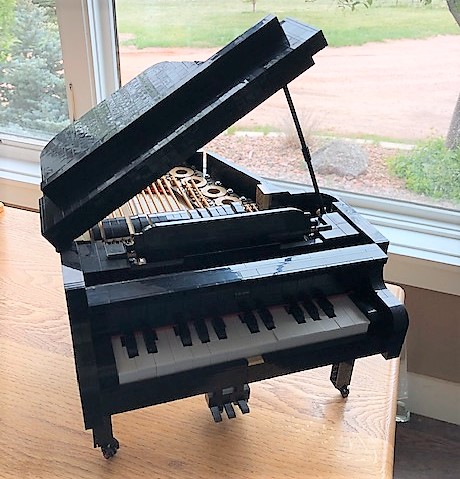
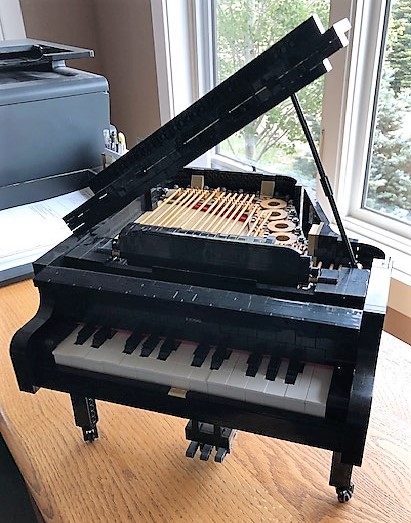
Today’s section of the Lego symphony was a ten-minute sprint.  Bag #20 – of 21 bags of pieces – assembled nothing more than the underlying support structure of the piano lid, with hinges to anchor it in place on the left side of the instrument. The dark, raised bar you see running across the top of the lid is part of that structure.  The support “stick” to the right was already there, lying quietly across the piano strings from a previous build, just waiting to be raised.

Bag #21 will be a rapid final chapter, perhaps as fast as this one.  We only have the free-standing bench for the pianist to go, and (with a final flourish), the sheet music we’ll center on the stand above the keys.  We’ll bring the entire assembly to the finish line inside of fourteen hours. Then you and I will step back, admire all that we’ve accomplished these last twenty-one weeks, and take a well-deserved bow.

Next week: the final movement!

Running Build Time: 13.5 hours.  Musical accompaniment: Liszt’s Liebestraum No. 3 in A-flat Major (two times through). Leftover pieces: None again!

Conductor’s Note: Liebestraum means “love dream” in German. This short piano piece could certainly be interpreted that way. It starts out soft and melodious, a soothing lullaby. But it picks up steam in a hurry, building to a crescendo and using the entire keyboard.  It’s a beautiful piece, which is more than I can say for Franz Liszt’s last name.  Every time I say “Liszt” I sound like I have a lisp.  Maybe he did too?

Some content sourced from Wikipedia, “the free encyclopedia”.

Curtains for Calls

Denver’s getting a new area code next month!

No, I’m not short on blog topics – stay with me here.

“983” will be added to 303 and 720 because Denver’s rapid growth means they’re running out of new phone numbers. But it’s not our state’s fifth area code itself that has my attention (by comparison, California blows us away with 36). It’s the 25 years “983” is expected to last before Colorado needs a sixth area code. Seriously? Will we even have phones in 25 years?

“719” reaches my corner of Colorado

“Area code” feels like an old-fashioned term. I associate area codes with the physical act of “dialing” (also an old-fashioned term). Sure, we need area codes to establish new numbers the first time we get smartphones (as preschoolers?) but then they become more labels than three-digit numbers, don’t they?  Think about it.  If you need to call someone these days, forget about their area code because you already have it in their profile.  You either tell your phone to call the person or you pull them up in “Contacts” and simply touch the number on the screen.  In other words, your phone dials the area code but you do not. Not anymore.

How to call someone in D.C.

Before smartphones, area codes had more prestige.  They were required to make “long-distance” phone calls, which meant you had to dial an extra three digits.  Outside of toll-free numbers, area codes conjured up exotic destinations, as if dialing halfway around the world instead of somewhere else in your state.  Area codes made you feel like you were calling someone important.  Today, they’re just labels.

If I really wanted to date myself, I could be talking about telephone exchange numbers instead of area codes.  KLondike, WRigley, and TEmpleton all referred to the central offices of telephone exchanges, with every phone number in an exchange starting with the first two letters of the central office.  PEnnsylvania 6-5000 was a memorable example because it connected you with the famous Hotel Pennsylvania in New York City, and Glenn Miller made the number into a popular swing jazz tune in the 1940s.  I wasn’t around in the 1940s (or even the 1950s), so enough with this topic.

Let’s flush “dialing” out of conversations about phones, shall we? Nobody “dials” anymore.  Dialing (for you preschoolers) hearkens back to a time when phones were phones.  You picked up the corded “handset” from the “cradle” on the “base”, nestled it against your jaw so the “receiver” lined up with the ear and the “microphone” with the mouth, toggled the “switchhook” for “dial tone”, and placed a call by spinning the rotary dial once for each digit in the phone number (got all that, kids?)  The dial would rotate back to its original position after each digit so you could dial the next one.  The whole process took 30-45 seconds, followed by a long pause, and then the “ringer” sounded on the receiving phone.  With that in mind, do you take the ease of your smartphone touchscreen for granted?  Of course you do.

[Author’s Note: The mechanics of rotary phones (base, dial, ringer, handset) made them HEAVY.  You can find movies from the 1940s or 1950s where a character uses a rotary phone as a weapon simply by clocking someone over the head with it.]

Dialing eventually gave way to “touch-tones” (thanks to the invention of the transistor).  The rotary dial was replaced with a grid of plastic pushbuttons, one for each digit.  Yes, we still “dialed” area codes but with buttons instead.  The buttons then migrated from the phone base to the handset.  The handset then went cordless.  Finally, the base disappeared altogether, and voila! – you had the first “mobile” phone.

Area codes make me nostalgic because I associate them with actual phone calls, one voice talking to another.  Today we’d sooner text than talk.  Delivered mail to your box on the street isn’t long for this world.  One of these days it’ll be curtains for phone calls as well.  Which re-begs the question about Denver’s latest area code.  Do we really need bright and shiny-new “983”?

The Jetsons don’t know “phones”

Phone calls of the future may simply be mind games where we’re able to “ring” each other brain-to-brain. A little far-fetched, you say?  Probably, and the idea of thought control makes me squeamish anyway.  Call it old-fashioned, but I hope we’re still talking about area codes in 25 years after all.

Some content sourced from Wikipedia, “the free encyclopedia”.

——————–

Lego Grand Piano – Update #19

(Read about how this project got started in Let’s Make Music!)

Today’s section of the symphony was short and entirely predictable.  Bag #19 – of 21 bags of pieces – assembled the rest of the piano’s top lid, shown completed in the photos below.  I simply picked up where I left off from last week’s Bag #18, continuing to build up the “wall” of the lid until it was complete.  It’s a repetitive process using pieces of similar sizes and shapes.  Now, all we are left with – my patient audience members – is the support structure of the piano lid (so it can be raised to its very elegant angle when open), and the free-standing pianist’s bench.

  Today’s build took less than twenty minutes. (I could’ve built Bag #20 as well, but why change my weekly pace this late in the game?)  As I was finishing the piano lid it occurred to me using Mr. Instruction Manual is a lot like using sheet music.  You shift your eyes between the manual and the piano itself constantly as you work, step-by-step-by-step.  Just as you would when playing the piano from a sheet of music.

Running Build Time: 13.3 hours.  Musical accompaniment: Brahams’ Violin Concerto in D. Leftover pieces: None again!

Conductor’s Note: Johannes Brahms had to be included in the list of musical accompaniments for my Lego Grand Piano build because, well, he’s one of the “bigs” in classical music. His Violin Concerto in D Major sits on Germany’s Mount Rushmore of violin concertos, beside Beethoven’s, Mendelssohn’s, and Max Bruch’s.  You, however, know Brahms best for his beloved lullaby “Cradle Song”, which starts “Lullaby, and goodnight, with roses bedight…”

Changing Planes

My wife & I are boarding more flights than usual as we anticipate our upcoming relocation to South Carolina. “More than usual” deserves context I suppose, since so many of us skipped airports altogether the last couple of years. Flying is different now – some ways better, others not so much (and unquestionably more expensive). Regardless, I was happy to learn our favorite choice of airline before AND after the emergence of COVID just earned the label “world’s best” for 2021. Care to guess which one?

I already gave you the subtlest of hints in my blog title.  With mathematics at least, the world’s best airline is also known as “an incremental change in a variable”, which makes its logo – the triangle – a fitting symbol.  Its slogan is the uber-confident “world’s most trusted airline” but I prefer one of its older ones:

Maybe Delta Air Lines is your airline of choice too.  If not, you’re wondering where your favorite ranks among the world’s best.  I’ve never heard of Cirium (have you?) but the data-mining company spends its days converting 300 terabytes of aviation performance metrics into annual best-in-class rankings. (300 TB meant nothing to me until I crunched a few numbers.  A ten-page Word doc is about 2 MB  By my calcs Cirium is sorting through five million pages of data.  I’d say their rankings are legit, wouldn’t you?)

Let’s end the suspense.  Here are the top ten airlines measured by “operational performance”, for 2021:

  1. Delta (“Platinum Award” winner)
  2. Alaska
  3. American
  4. United
  5. Spirit
  6. Frontier
  7. Southwest
  8. JetBlue
  9. Air Canada
  10. Allegiant

Delta should put a lot of stock in this win, and not just because 9 of its 10 aircraft arrived on time in 2021 (10% better than second-place Alaska).  It’s more about the impact of the passenger experience to the result.  Is the boarding process efficient?  Is the flight crew rested and available?  Is the aircraft properly maintained? How is baggage handled? How are unruly passengers dealt with (a more recent trend)?  Every one of these details number-crunches to a measure of on-time arrivals.  And no one does it better than Delta.

I may be biased but my own experiences seem to back up the numbers.  My wife & I have flown Delta several times since 2019 (including a trip to Europe) and every one of those journeys met or surpassed our expectations.  I’m not saying Delta goes over the top to gain customer loyalty (though a warm chocolate-chip cookie would help).  They simply do what I expect.  Arrive on time and make the journey as pleasant and efficient as possible.  Is that too much to ask?

Sadly, my affection for Delta is bolstered by my dissatisfaction with its competitors. I’m surprised to see American and United make the top five.  My family and I have had several lousy experiences with American, including delayed or canceled flights and could-care-less customer service agents.  Meanwhile, United may know how to arrive on time, but their coach seats should be labeled “cattle class” (not unlike Spirit and Frontier).  Drop down the tray table and open your laptop.  I challenge you to type comfortably.

Southwest could’ve been higher in Cirium’s rankings but I’m sure their logistical issues last year contributed to the number.  Scores of their canceled flights were attributed to “weather challenges” during an unprecedented upheaval in the workforce.  I’ll forgive the bald-faced excuse.  When Southwest is running on “all engines” their brand of customer service is second to none – which keeps me coming back for more.

From my days in corporate America, I remember an equilateral triangle as the symbol of a successful company, giving balance to customers, employees, and shareholders.  Looks a lot like the Delta logo, doesn’t it?  More than just a nod to the Greek letter (Delta) or a throwback to its origins in the Mississippi (“Delta”, that is).  Even the dictionary definition of delta belongs in the conversation. Positive change befits operational excellence.

If my wife & I were relocating to Salt Lake City or Atlanta (or one of Delta’s other hubs), we’d be changing planes and flying more often with the “triangle”. Just this week my wife enjoyed another Delta flight she described as “perfect except for a few inconsiderate passengers” (which seems to be the norm these days). Delta celebrates one hundred years of passenger flights in 2029 so it’s safe to say they’re guided by experience.  The Cirium ranking is just a numbers-crunching confirmation of what I already know.  Delta is ready when I am.  Or, to put it mathematically, Δ = (S)atisfaction + (L)oyalty.

Some content sourced from the CNN Travel article, “The world’s best-performing airline has been revealed”, and Wikipedia, “the free encyclopedia”.
——————–

Lego Grand Piano – Update #18

(Read about how this project got started in Let’s Make Music!)

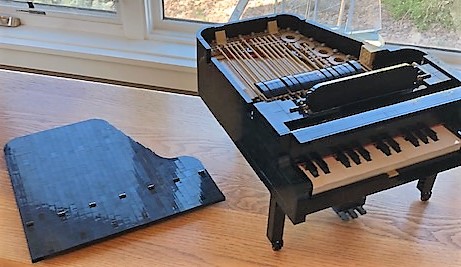
Today’s section of the symphony could’ve, maybe should’ve used a stand-in pianist.  Bag #18 – of 21 bags of pieces – assembled a little more than half of the piano’s top lid.  I show the structure on its side in the first photo because that’s how I built it, from the ground, er… desk up.  I imagined myself as a tiny mason, building a wall brick-by-little-brick, working right-to-left, then over to the right again.  You – my faithful reader – could’ve handled this part of the construction easily.  In Lego terms, it’s a wall made with various lengths of rectangle pieces.  That’s it.

Not a wall, but part of the hinging piano lid.

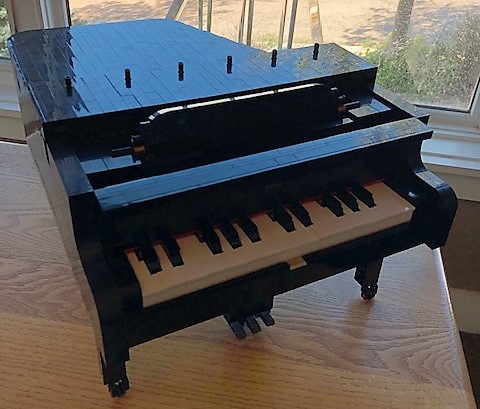
Know what I love about this adventure? (which is rapidly coming to a close!) You don’t always see what’s coming.  I knew I was building the top lid, but it was hard to see how it fit the piano until I set it on its side when I was done (second photo).  More to my point, I have three bags of pieces remaining.  One is the remainder of the piano lid.  One is the free-standing bench for the pianist.  Which leaves… you see? I still have no idea what’s coming.

Running Build Time: 13.0 hours.  Musical accompaniment: Berlioz’s Symphonie fantastique. Leftover pieces: None!

The top lid rests in its future location.

Conductor’s Note: The story behind Louis-Hector Berlioz’s Symphonie fantastique is more interesting than the piece itself (seriously).  At the somewhat tender age of 24, Berlioz fell in love with an Irish Shakespearean actress, who kept him at bay until she finally agreed to be his –  seven years later. Maybe the length of Berlioz’s pursuit extinguished the flame because the romance didn’t last.  But Berlioz wasn’t left empty-handed.  He composed the Symphonie fantastique to depict the idealized version of his Irish lover. I just didn’t find his music fantastique.