Phantom Farewell

Tonight, hours after this post goes public, my wife and I will attend a local stage production called Lovesong.  It’s our first foray into the offerings of our community theater so we’re really looking forward to it.  Lovesong has a run of five evening performances and one Sunday matinee while it’s in town.  A check of the theater website indicates about 20% of Thursday’s seats have been sold.  By my calculation, that’s about 80% less than any Broadway performance of Phantom of the Opera.

Maybe you heard.  After 35 years and 14,000 performances, last Sunday the curtain dropped for good on Phantom of the Opera.  Its creator, Andrew Lloyd Weber, was on hand at New York City’s Majestic Theater to offer the cast and crew a personal farewell.  He claimed their final performance as the best he’d ever seen.  You’ll forgive Andrew for being a little sentimental after all these years.

Theater District, Midtown Manhattan, NYC

Whether the stage production, the 2004 movie, the glorious soundtrack, or even the books on which it was based, you’re familiar with Phantom.  It’s a captivating story; part haunting and part romantic, with a lead character who has you wondering, “Is he real or imagined?”.  Reading Phantom’s synopsis (which you can do here), I realize I overlooked some details of the story the one and only time I saw the show. No matter.  The sets and the songs will stay with me for life.

Phantom took my admiration of stage performances to an entirely new level.  The one time my wife and I saw the show, in San Francisco in 1997, it literally took our breaths away.  The only shows we’d seen prior were the “off-off-off Broadway” offerings; the kind where they recruit locals just to fill out the cast.  Phantom left us yearning for more of the best, including seeing something on Broadway (which we did years later with Les Miserables, deserving of its own blog post).

Phantom was also a technical marvel.  What other show boasted a giant chandelier swinging out over the audience and threatening to fall?  Or a staircase giving the optical illusion of descending several levels as the Phantom dragged Christine downward?  Or the subterranean lake the Phantom rowed across, where you swore you were looking at a giant body of water right there on the stage?

Every Broadway production seems to have three or four unforgettable songs.  Phantom was no exception.  The show kicks off with an orchestral version of “Phantom of the Opera”, turns sweet with Christine’s solo “Think of Me”, and overwhelms with the duet All I Ask of You and especially The Music of the Night.  The latter includes one of the most powerful notes I’ve ever heard, when the Phantom sings, “Close your eyes… and let music set you… FREE-E-E-E-E-E-E-E-E…!”

Deservedly, Phantom won the “Laurence Olivier Award” for Best New Musical in 1986, the Tony Award for Best Musical in 1988, and pretty much everything else it was nominated for.  Besides the London and Broadway productions, Phantom enjoyed nine worldwide tours and one revival.  Over its 35 years, Phantom employed 6,500 people and played to over twenty million theater-goers.  Phantom even had a short-lived sequel, Love Never Dies, debuting in London but never making it to Broadway.

Sadly, Phantom’s closing can be considered a casualty of the pandemic.  The show was suspended from March 2020 to October 2021 (when all Broadway productions ceased).  After reopening, attendance was sporadic because patrons were still hesitant.  Meanwhile, Phantom’s production costs continued at a staggering $1M/week, which eventually became unsustainable.

Phantom was originally slated to close in February but once theatergoers found out, the show experienced a brief resurgence and lasted another two months.  I don’t expect Lovesong to extend its little run at our community theater.  Thanks to Phantom of the Opera however, I’m simply excited for the potential of a wondrous stage performance.

Some content sourced from the CNN.com article, “Final curtain comes down on ‘Phantom of the Opera'”, and Wikipedia, “the free encyclopedia”.


Crescents and Con Artists

Every Christmas without fail, my family enjoys croissants as part of the morning meal. We pop them into the oven after seeing what Santa left in our stockings (but before unwrapping anything under the tree). So last week, as I loaded our Easter ham into the garage frig, a tantalizing thought occurred to me: the leftover Christmas croissants are parked right next door in the freezer. Could they possibly be as light and flaky as they once were, four months after their initial rise-and-shine?

If you know anything about authentic croissants, “rise and shine” is a fitting description.  Thanks to some seriously active yeast, croissants rise to a soft, pillow-y consistency.  Thanks to a whole lot of butter (and a little egg yolk), croissants finish with a pleasing sheen on their delicate, crispy crust.  If there’s a more decadent baked good on the planet, my crescent-shaped ears are open and listening.

Austrian kipferi

Croissants have been around a long time.  They got their start centuries ago in France Austria as the more pedestrian kipferi yeast bread roll.  Eventually the French stepped up the game using leavened laminated dough and butter, ending up as the light, flaky, many-layered version you know and love today.

Croissant means “crescent” of course (which is why I get hunger pangs whenever I gaze at the moon).  Croissant also has an elegant pronunciation.  Turn the “roi” into a “weh”, drop the final “t”, and keep the sound a little inside the nose.  Cweh-saw.  Congratulations!  You speak French.

Even “crescent” has a dignified definition: a shape resembling a segment of a ring, tapering to points at the ends.  Can you picture it?  Sure you can, because now you’re thinking of Pillsbury Crescent Rolls.  They’re so “American”, aren’t they?  We take a centuries-old, meticulously refined shoo-in for the Baked Goods Hall of Fame and reduce it to sticky, doughy, fast food; vacuum-packed into a can you open with a spoon.

The Poppin’ Fresh family

[Speaking of Pillsbury, here’s something you didn’t know about the Dough Boy, otherwise known as “Poppin’ Fresh”.  He has a family!  His wife is Poppie Fresh, his kids are Popper and Bun-Bun, his grandparents Granpopper and Granmommer, and his Uncle Rollie.  Don’t forget the dog (Flapjack) and the cat (Biscuit).  In the 1970s you could purchase the entire clan as a set of dolls.]

BK’s “Croissan’wich”

Pillsbury isn’t the only crescent con artist out there.  Burger King made a name for itself with its popular Croissan’wich breakfast entrees.  And Galaxy, the Williams-Sonoma mail-order croissants my family and I enjoy at Christmas, start out as frozen minis, rise impressively overnight on the kitchen counter, and bake to an excellent knock-off of the bakery-made originals.

The preparation of authentic croissants requires time and attention we Americans don’t have the patience for.  Watch the following video (which is thirteen minutes long so… maybe not) and you’ll learn what it takes.  At the least, you’ll understand why I pay almost $4.50 for a single croissant from Galaxy/Williams-Sonoma.

Most of us wouldn’t make it past  the initial “pre-dough” step in the video, let alone the labor-intensive lamination (folding/flattening), forming, fermentation, baking, cooling, and storage.  We’re talking hours and hours in the kitchen here, and that’s assuming you have the right equipment.  No wonder we’d rather just whack a Pillsbury tube on the counter edge and produce “crescent rolls” hot out of the oven 9-11 minutes later. 

Still, I implore you to watch the cweh-saw video.  The star of the show is Frédéric from Boulangerie Roy Le Capitole, narrating the process in his beautiful native language.  This man could be saying … and then we drag the smelly garbage out to the back alley for the cats to dig through and I’d still be glued the sound of his words.  Or, listen to our lovely video host and her delightful French accent (with the occasional incorrect word sprinkled in).

Lamination = Layers

I was so mesmerized by the French voices I really don’t remember much about the croissant-making itself.  But it’s hard to forget the facts.  Making an authentic batch takes three days.  A croissant is 30% butter and can have as many as fifty layers.  French bakeries have “bread laws” to protect their artisan products.  Finally, you can “hear” the sound of an authentic croissant by pushing through the crispy crust to the softer layers inside.

To the matter of my Christmas… er, Easter croissants, I’m happy (and satisfied) to report they tasted just as good last week as their holly, jolly predecessors a while ago.  Apparently four months isn’t too long to wait for good croissants.  But three days is too long to make them from scratch so I’ll keep buying from con artists.

Some content sourced from Wikipedia, “the free encyclopedia”.

Trees We’ll Never See

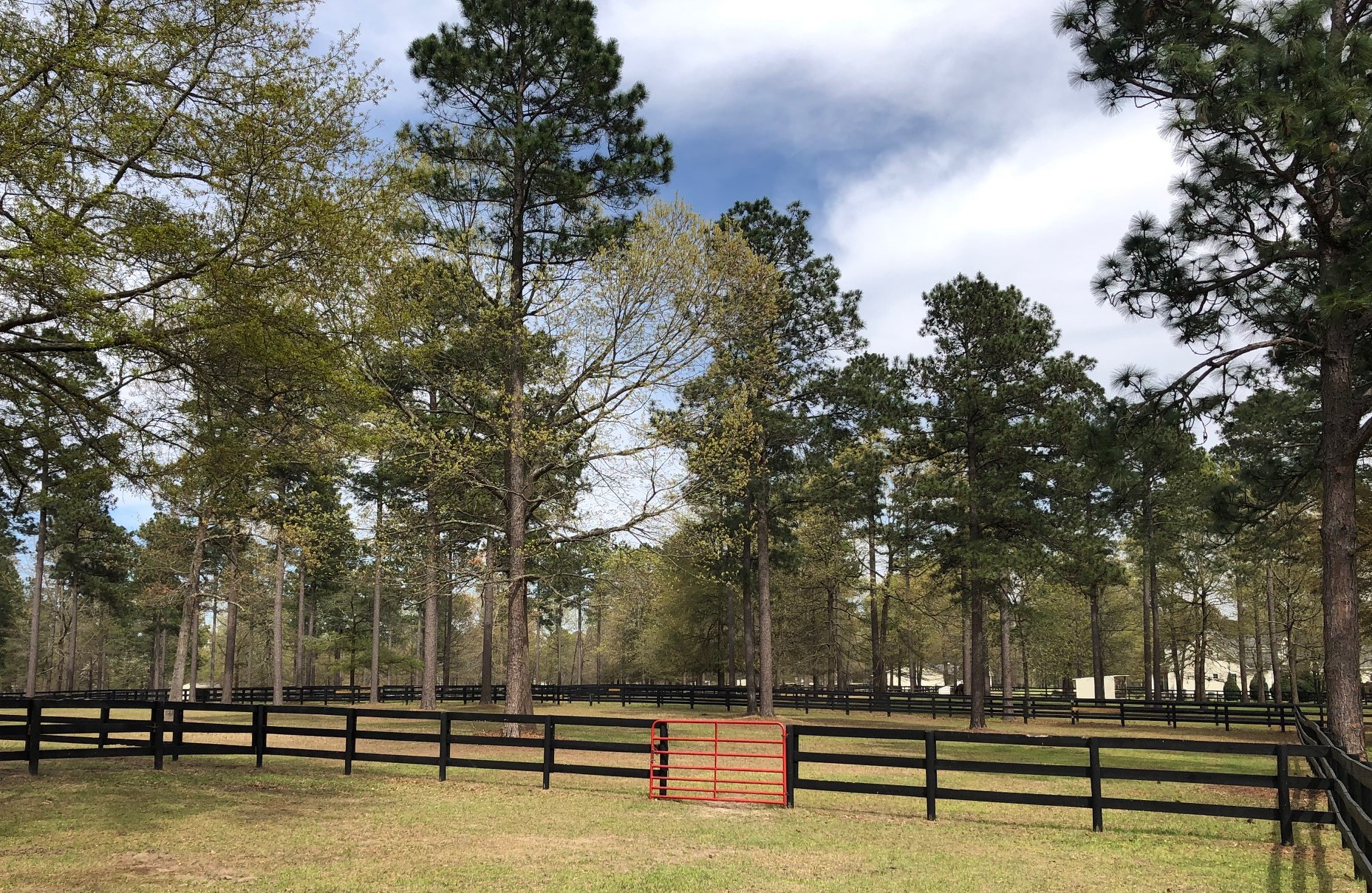
A few weeks ago my wife requested a landscaper’s estimate to remove six or seven trees from the back of our property. They’ll have to knock down a few lengths of perimeter fencing so they can get their big equipment through, and they’ll make several trips to the dump with all of the branches and stumps they’ll pile up.

It’s time for some of these to go

But when all’s said and done my wife will have the blank canvas she wants for a future riding arena for her horses.  Minus a few trees, of course.

The neighbor lady won’t be happy because she’s all about keeping the trees,  She drops hints here and there about “leaving things the way God intended”.  She also doesn’t seem to mind the endless waste the trees generate, whether falling leaves from the oaks or cones and needles from the pines. But here’s what I want to say to her. First, we have over forty trees on our property (and thousands in the community) so losing six is just a needle in the haystack. Second, we’ll replace those trees over time, in other areas of the property. We’re already making plans to switch out the rose bushes in our driveway circle for a Flowering dogwood.

Future Dogwood

I can still hear the neighbor lady pleading, “Dave, do you know how long those trees have been standing back there?”  Why yes, good neighbor, I’m sure some of them have been around a hundred years.  But just like the ones that came down so our house could be built, it’s time to get rid of a few more.  You sort of make an agreement with the forest when you live in it.  Let me take down a few of your trees and in return I’ll care for the ones that remain.

Amy Grant

Amy Grant, the well-known Christian singer (and most recent recipient of the Kennedy Center Honors), just released her latest single.  It’s perfect for the start of spring.  Trees We’ll Never See is a gentle, lilting ballad about the brevity of human life.  The song covers a lot of ground in its few verses: the things we learn from our parents, the challenges we face, the value of hard work, and leaving a legacy.  Amy also reminds us about the importance of faith and prayer (as she usually does).  But it’s the song’s title that sticks with me.  We’re all planting trees we’ll never see.

I remember talking to one of my cousins years ago, and hearing about a locked-down project he was a part of for America’s Space Administration.  I can’t recall the what, where, or why of it all, but I do remember the time frame to get it done.  Generations.  Meaning, my cousin (and his kids, and maybe even their kids) will be long gone before the work is finished.  My cousin is planting a tree he’ll never see.

Here’s my favorite lyric in the Amy Grant song:

Statues fall and glory fades but a hundred-year-old oak tree still gives shade. 

That’s powerful stuff in my book.  You can be somebody big or you can do something big, but what can you be or do to make the world a better place after you’re gone?  I’m still working on my answer to that question.

I first covered Amy Grant a few years ago, blogging about her single I Need A Silent Night.  It’s a frank anthem about seeking the Christmas spirit amidst the inevitable chaos.  I’m not always struck by Amy’s lyrics but I was then and I am again now.

This one stays

Here’s my final take on Amy’s song.  If you’re familiar with her music you know she’s been around a long time.  She released her first album in 1977, meaning almost fifty years and hundreds of songs.  And in that time Amy’s style moved a little towards pop and a little towards country, but never far from Christian themes.  Trees We’ll Never See could be straight out of Amy’s early years.  It’s like she tapped the roots of a tree she planted decades ago, just to create a brand new one for future generations.  I’ll keep that in mind whenever we plant our Dogwood.

Some content sourced from IMDB, “the Internet Movie Database”, and Wikipedia, “the free encyclopedia”.

Advert Converts

Texting while driving has quickly become the norm, at least in U.S. states where it continues to be legal. Not a day goes by where I’m not witness to a slow or erratic driver, the annoying behavior the direct result of a smartphone. My car horn gets a regular punch, reminding drivers, “HEY… the light just turned green!” All of which makes the notion of billboards as a driving distraction almost obsolete.

Like most things, billboards had their young and innocent days.  They popped up on interstates and major thoroughfares almost as soon as cars themselves did; bright, colorful advertisements meant to plant seeds in driver brains for future purchases.  At last count there were over 350,000 billboards in America alone.

Unlike smartphones however, billboards earn nothing but a passing glance as you speed by.  Their images and words are simple by design so you “get the picture” in an instant.  A few scientific studies went to great lengths to prove billboards increased the potential for accidents. Others showed they really had no impact at all.  Whichever is true, billboards stubbornly continue a part of the urban landscape.

But no matter how I spin this topic, we’re just talking about a straightforward means of advertising.  What’s so interesting about that, you ask?  Well, let me tell you.

Consider the lifespan of a billboard.  The artwork is created on a smaller scale, reproduced to billboard size (previously by hand, now by computer), mounted up high on a roadside frame, and then allowed to distract drivers for months.  But eventually the billboard comes back down and you’re left with 700 square feet of heavy-duty used vinyl.  What now – off to the dump?

Not if you’re Rareform.  This company converts adverts into bags, totes, and duffles.  You can purchase anything from a travel surfboard bag to a soft-sided cooler, all fashioned from billboard vinyl.  You can even buy a cross-body bag for your laptop, with a cushy interior made of recycled water bottles.  Talk about “walking advertisements”, eh?

“Billboard” notebook

I really admire people who think outside of the box (because I find it so much more comfortable inside).  Rareform thinks outside of the board.  They brokered deals with advertising agencies for the used vinyl, hired cleaners, designers, sewers, and photographers to produce their one-of-a-kind products, and then created a website to bring it all to you.  As Rareform’s founders put it, “We’re in the business of change… and we believe billboards deserve a second chance.”  Considering they stock over 50,000 unique re-creations in their warehouse, I’d say they’re on to something.

A billboard can be a cooler if it wants to be

Billboards never really caught my eye until now.  Sure, I enjoy their creative advertising tactics, like using several billboards spread out over a mile or two, each one containing part of a message about a business you’ll find off the next off-ramp.  Or how about the ones like Chick-fil-A’s, with three-dimensional characters in front of the boards?  In 2010 in North Carolina, you could find a billboard of a giant, juicy steak with a big fork sticking out of it, emitting the scent of black pepper and charcoal.  Ready to grill?

Today’s billboards, of course, have gone digital.  You can pack a rotation of advertisements into the same space where there used to be one.  On broadcasts of Major League Baseball, you’ll see advertisements on the walls behind home plate as the camera shows the pitcher’s view of the batter.  Those advertisements aren’t really in the ballpark;  they’ve just been digitally applied back in the television studio.

Times Square is full of billboards

None of these billboard tricks impress me like the one Rareform conjured up.  I mean, what kind of brain looks at a billboard and goes “Hey, that could be a fashionable bag one day!”  Not my brain.  Rareform not only diverts tons of vinyl from landfills, it then puts it to practical re-use.  Makes me want to dumpster-dive my garbage can out back to see if I can come up with a trash rehash of my own.

Some content sourced from the Rareform website, and Wikipedia, “the free encyclopedia”.

Making An Entrance

My son will complete the purchase of his first house next week. We’ve helped him mull over properties the last few months, scrutinizing everything from floor plans to foundations. But I always focus on whether a house has a formal entry or not. There’s something about a foyer that feels essential to me, as if to say, “Welcome!”.  Apple must’ve felt the same way when they designed their flagship store in New York City. Welcome to Apple Fifth Avenue.

Apple Fifth Avenue

If you’ve been to an Apple Store (and who am I kidding here; we’ve all been to an Apple Store), you know they’re essentially a room of tables and shelves. You’re greeted up front, asked what brings you in, and directed to wherever you need to go. Apple Fifth Avenue, on the other hand, needs no greeters.  Its dramatic foyer beckons you in all by itself.

Apple Fifth Avenue’s entry is a 32 ft. glass cube dropped into the middle of a plaza in downtown Manhattan.  The adjacent skyscrapers make the transparent structure stand out even more.  There’s no signage whatsoever; simply a large, suspended Apple logo inviting you to descend the elevator or elegant spiral staircase to the store itself (which is entirely below ground).  It’s the same strategy employed by the Louvre in Paris, with its above-ground glass pyramid serving as the entrance to the museum’s lobby below.

Plaza skylights and “lenses”

Without this entry I’m not sure Apple Fifth Avenue’s design would garner much attention, yet there are other elements worth noting.  The surrounding plaza is dotted with 62 frosted skylights, bringing welcome natural light to the retail space below.  The plaza also hosts 18 “lenses” – reflective steel shells with glass tops – to give you peeks downstairs.  In the store itself you’ll find several (real) trees, with seating incorporated into their circular planters.

Planters double as seating

Apple Fifth Avenue became so popular a destination that secondary entrances were added (two staircases in the plaza) and the square footage of the store itself was doubled.

One of the more interesting stories behind Apple Fifth Avenue’s design concerned the size of the entry.  CEO Steve Jobs wanted a 40-ft. cube while the property owner insisted on 30.  To bridge the gap, a full-scale mock-up was created and placed in the plaza for Apple executives to see.  The problem: Apple didn’t want to draw the attention of the public any more than they had to.  So the mock-up was installed for just a couple of hours at 2 a.m. on a random weekday.  When a 40-ft. cube was deemed too large (sorry, Steve), it was quickly disassembled to reveal a smaller cube inside – the size of the one you enter today.

It’s about time I included a NYC building in my posts on architecture, wouldn’t you agree?  New Yorkers know I had plenty of choices, like the Empire State Building, Waldorf Astoria Hotel, St. Patrick’s Cathedral, and Grand Central Station.  But those have been around a long time.  Apple Fifth Avenue opened its doors less than twenty years ago, and is already in the top sixty on the list of America’s Favorite Architecture.

As I recall the houses we looked at with my son, some had no foyer whatsoever.  You walked across the threshold and found yourself standing in the front room or living room.  That’s no way to make an entrance, is it?  Apple knows better.  At most of their stores you get a greeter.  At Apple Fifth Avenue you get a full-on welcome. 

Now for the latest on LEGO Fallingwater…

____________________

LEGO Fallingwater – Update #10 (Read how this project got started in Perfect Harmony)

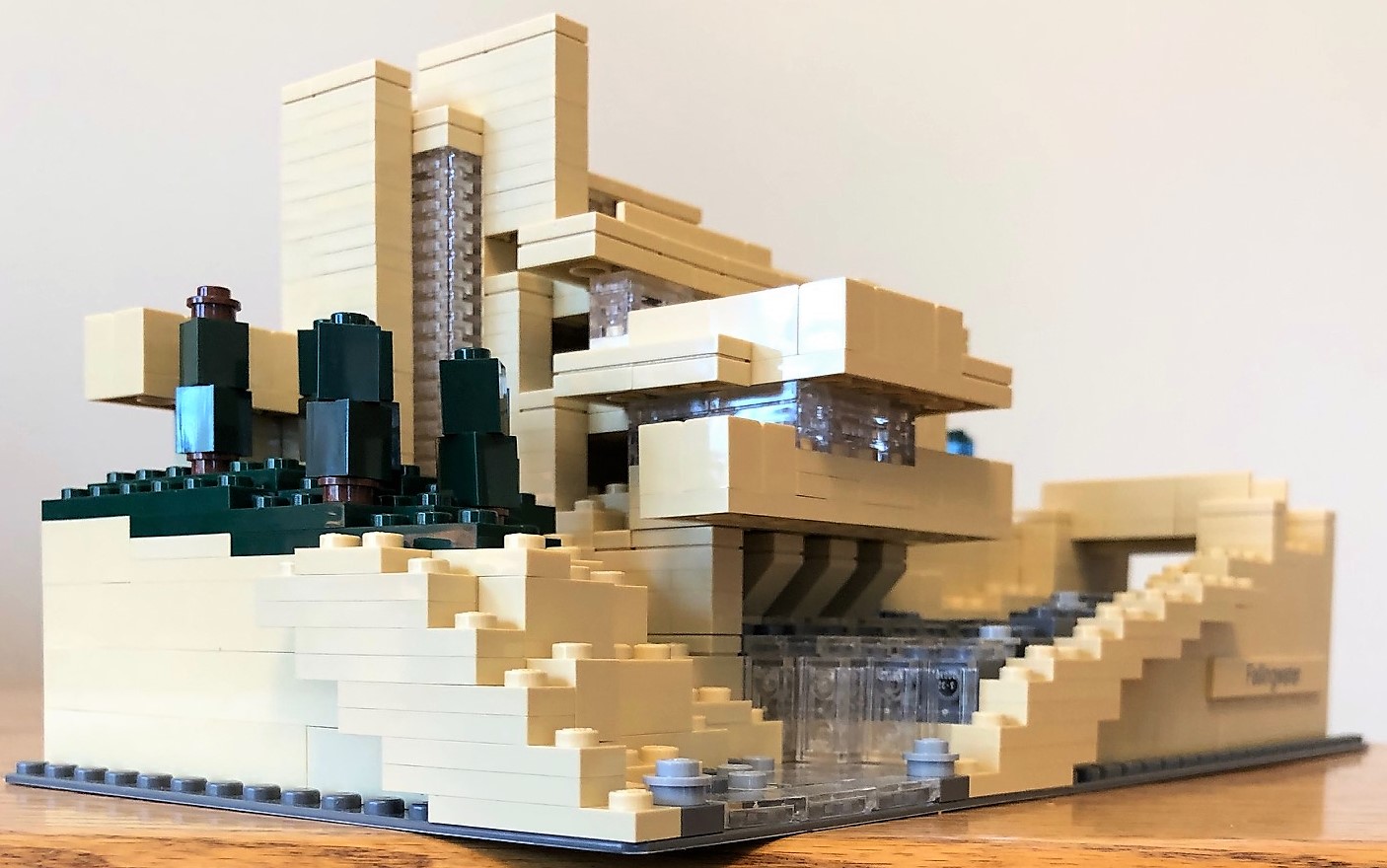
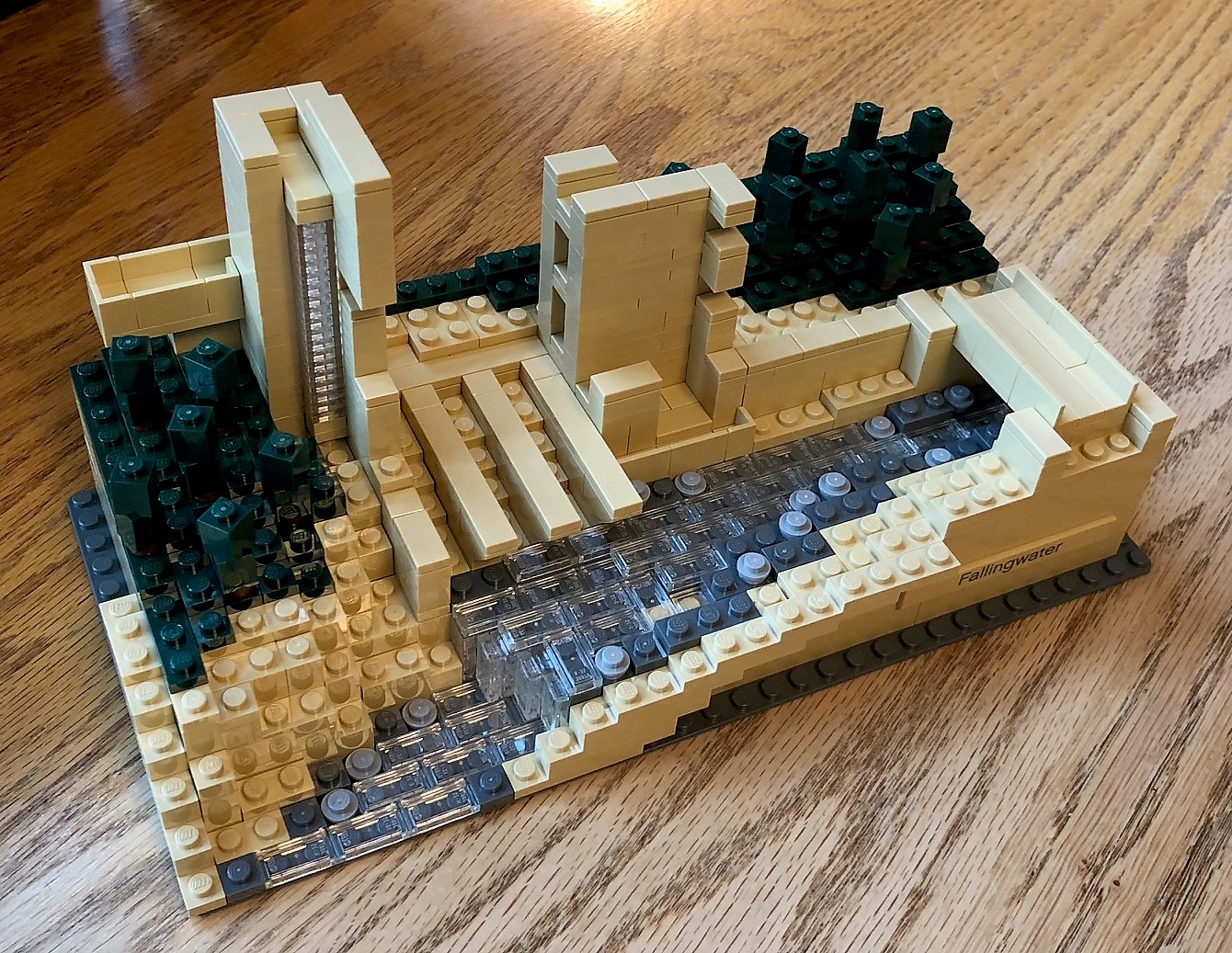
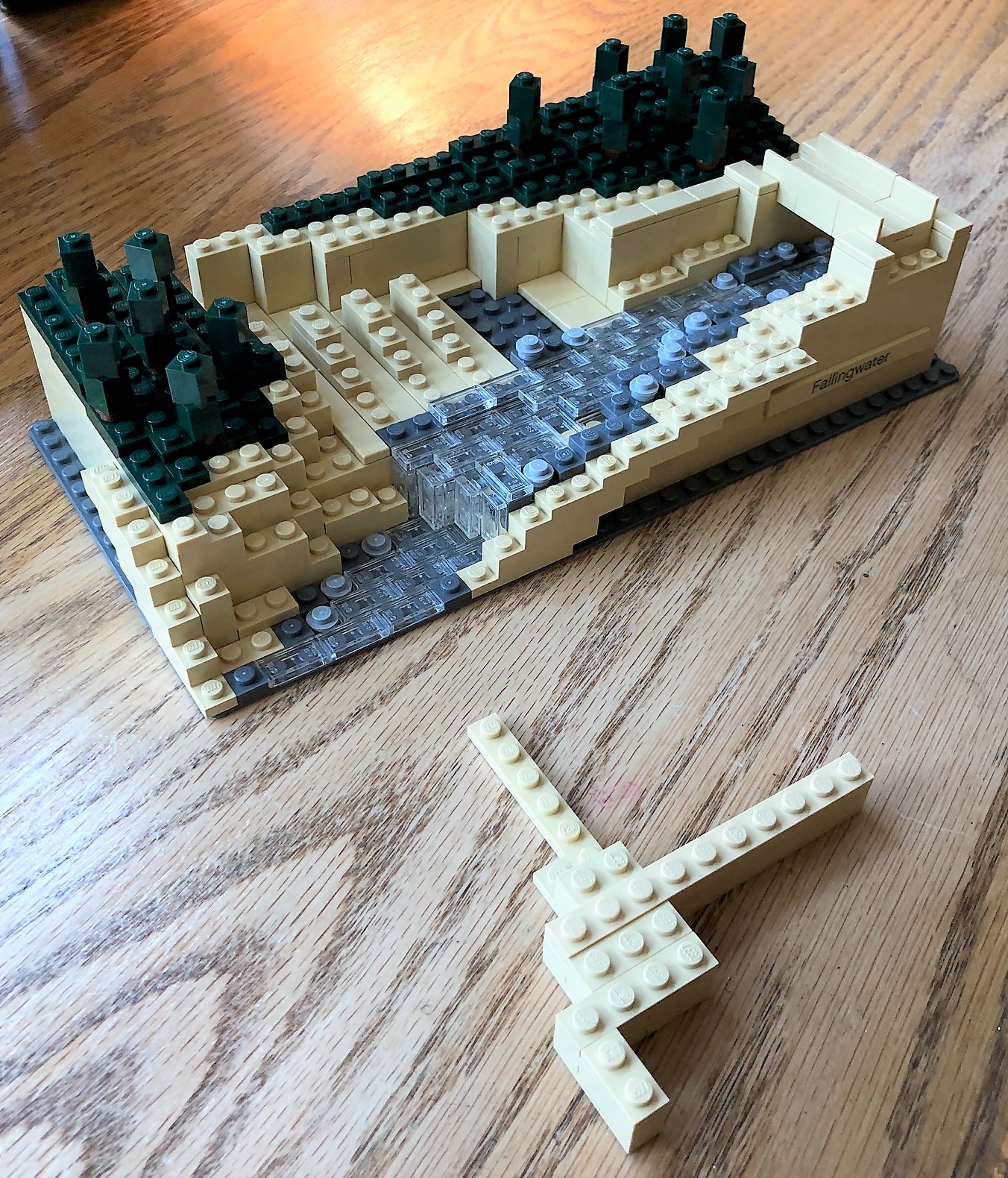
We’ve placed the very last brick into place, closing the assembly manual on our ten-week construction of LEGO Fallingwater.  92 pages (or 100%, or 222 minutes) into the build, here is the final product:

LEGO Fallingwater

The angle of this photo is intended to match the photo above so you can compare the model to the real thing.  I want to label the model “crude” but how about “rudimentary” instead?  The intricacies of LEGO models have come a long way since this one.

A note about missing pieces.  As I worked through the final steps I realized a handful of pieces were missing.  I write this off to a less-than-perfect mechanism doling out the pieces for each model (or was this done by hand?)  The LEGO Grand Piano wasn’t missing a single piece out of 3,000+.  The gaps aren’t obvious at a glance so we can still call Fallingwater complete.  Thanks for coming along for the ride!

Now for one last nod to Frank Lloyd Wright…

Oak Park Home & Studio

It’s fitting to finish where it all began.  Wright’s first design (of which he was the sole architect) was his own home, built just west of Chicago in 1889.

Frank Lloyd Wright Home & Studio, Oak Park, IL

The house’s style, “Seaside Colonial” (borrowing from similar designs on the East Coast) was Wright’s first experiment with the Prairie Style elements that would later come together in so many of his other designs.  The exterior is grounded with brick and stone while the interior has a largely open floor plan.  The barrel-vaulted playroom was built on a smaller scale; a deliberate nod to its young occupants.

Barrel-vaulted playroom

The rapid success of Wright’s architecture practice allowed for the expansion of the house a few years later, including the large octagonal structure you see on the left (for drafting studios, offices, a library, and a reception hall).  Wright wore all the design hats on this project, including the mechanical systems, lighting, furniture, and decor.

Wright’s Oak Park Home & Studio is a National Historic Landmark and is open to the public.  Even better, you can take a walking tour through the nearby neighborhoods to see ten houses he designed that still stand today.

Some content sourced from the Frank Lloyd Wright Foundation website, and Wikipedia, “the free encyclopedia”.

All Manor of Reflection

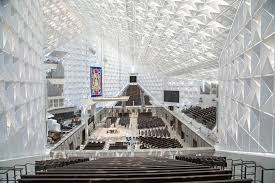
I find music boxes enchanting, especially the small glass cases where you can watch the cylinder spin its tune like a lazy water wheel. It’s as if someone opened the top, held it up to the wind, and captured a simple melody floating by. Maybe this is why I find the concept of a glass church so appealing. Welcome to California’s Crystal Cathedral.

Crystal Cathedral, Garden Grove, CA

Whether or not you liked Phillip Johnson’s Glass House from a couple of posts ago (survey says “not”), you’ll concede he was creative in his use of glass.  The Crystal Cathedral is, by far, his most impressive example.  When it was constructed in 1980, it was immediately dubbed the largest glass church in the world.  By a mile.

Schuller standing in the “cheap seats”

Johnson designed the Cathedral (partnering with architect John Burgee) for Dr. Robert Schuller.  Rev. Schuller was a televangelist in the 1970s, beginning his ministry by preaching to carloads from atop the refreshment stand of a Southern California drive-in theater.  The proceeds of his Sunday morning “Hour of Power” financed the Cathedral, on a property Schuller called a “22-acre shopping center for Jesus Christ”.  As for the building itself, Schuller declared, “If a two-by-four comes between your eyeball and the changing edge of a cloud, something is lost”.  Hence, he demanded a glass church.

The Crystal Cathedral is impressive enough to look at from the surrounding parking lot; a flattened diamond floor plan covered with 10,000 rectangle panels of glued-on mirrored glass.  But walk inside – and believe me, it’s a walk – passing beneath the floating bleachers of pews and choir lofts into the explosion of the sanctuary itself, and you’ll understand why the Cathedral really “shines”.  The space is so vast that – like some of today’s enclosed football stadiums – you’ll swear you’re still outside.

The Crystal Cathedral is a glass music box of sorts.  Its organ is the fifth-largest in the world, with 16,000 pipes.  Its choir numbers into the hundreds of voices.  Needless to say, the church service needs to be grand to satisfy a room of 2,500 parishioners.

As much as I prefer a modest venue for worship, I can appreciate the megachurch approach if it’s done with a modicum of grace.  I’m not sure this is the case with the Crystal Cathedral.  Down the center aisle you’ll find a long reflecting pool, spotted with gushing fountains that suddenly cease when Schuller appears at the pulpit.  A pair of towering “Cape Canaveral” doors behind the altar swing open, so Schuller can give a wave and a prayer to the masses parked outside.  And in a full-on nod to Broadway, the Cathedral’s annual “Glory of Christmas” pageant includes a smoke machine for storm simulations, seven flying angels, and scores of live animals (everything from camels to water buffaloes).  Should this surprise me, in the cavernous glass box of a world-famous televangelist?

The Crystal Cathedral is open to the public… er, if you’re willing to take in a Catholic Mass while you’re at it.  Schuller’s Reformed Church ministry filed for bankruptcy in 2010 (in part because of the overwhelming operating costs of the facility).  Schuller himself died in 2015.  Soon after, the local Catholic diocese purchased the property at a deep discount and renamed it “Christ Cathedral”.  I hope the fountains, spaceship doors, and Broadway shows have taken a break since then.  After all, the building itself is ample reason for reflection.

Now for the latest on LEGO Fallingwater…

____________________

LEGO Fallingwater – Update #9 (Read how this project got started in Perfect Harmony)

We worked off-model again this week, on the house itself, assembling one floor at a time before everything comes together.  80 pages (or 88%, or 203 minutes) into the build, this is what we have:

It’s convenient to halt the construction for this photo, because you can see the individual floors before they’re stacked together and hidden.  The level in the foreground is the bottom story, with the living room in back and smooth decks in front and to the right.  The other level is the middle story, a bedroom with smaller balconies to the left and right.

Next week I’ll assemble the top (and final) level, a “gallery” whose use was as much for the surrounding views as for the interior space.  Then I’ll stack the floors together, insert them into the open space you see to the right of the glass tower, and our Fallingwater model will finally be complete.

Tune in next Thursday as construction continues!  Now for another nod to Frank Lloyd Wright…

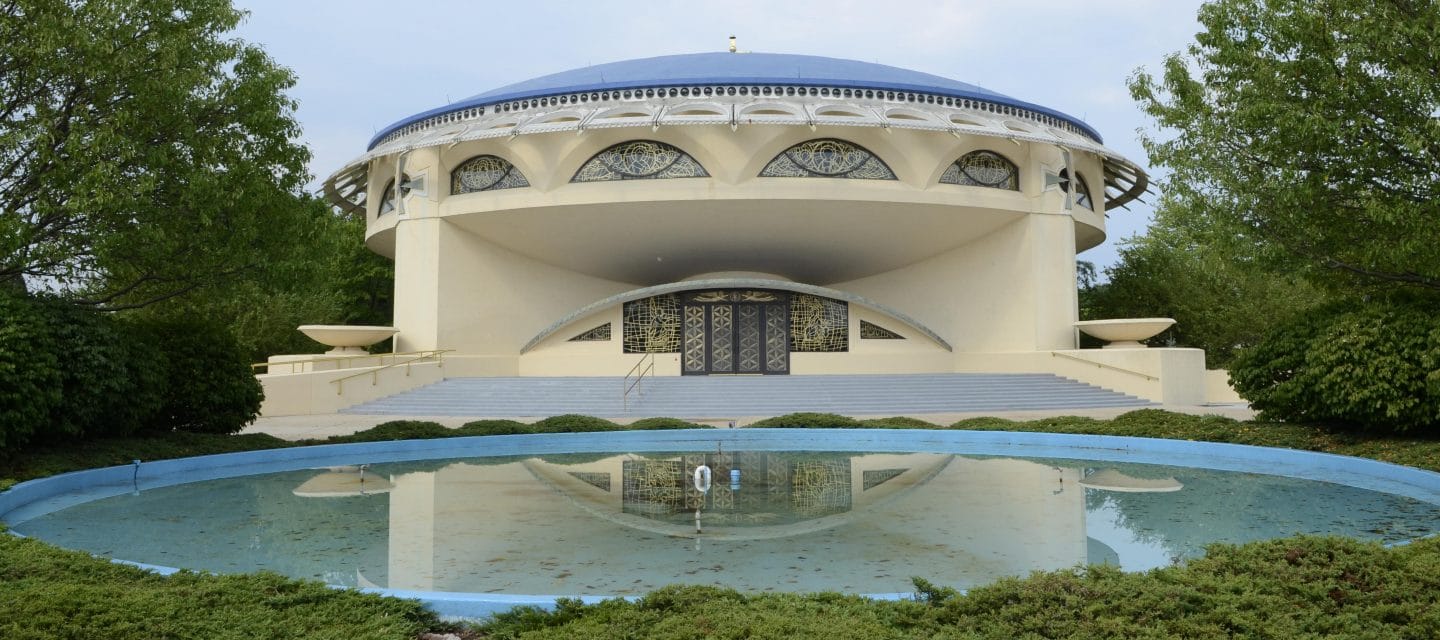
Annunciation Greek Orthodox Church

Since we toured a cathedral today, it seems only fitting we acknowledge one of Wright’s handful of religious structures.  Wauwatosa, Wisconsin’s Annunciation Greek Orthodox Church was one of his last designs, not completed until after his death in 1959.  Wright consulted his wife (who was raised in the faith) on its important symbols.  Accordingly, the dome and the Greek cross play significantly in the building design.  The structural arches and pillars reflected on the exterior allow the sanctuary to be an uninterrupted circular space.  The dome is not as you would imagine the interior to be, but rather the cap on an inverted dome, reflecting as a sort of bowl suspended above the sanctuary.

Annunciation Greek Orthodox Church

Lest you think Annunciation Church is a bit of a spaceship, the design intentionally pulls elements from its more famous predecessor, Hagia Sophia mosque in Istanbul, Turkey.  Annunciation Greek Orthodox Church is included on America’s National Register of Historic Places.

Some content sourced from Johnson/Burgee: Architecture, the Frank Lloyd Wright Foundation website, and Wikipedia, “the free encyclopedia”.

Pandora’s Box

When America’s cities bred lifeless glass-and-steel skyscrapers in the 1960s, an architectural movement was born known as postmodernism. “Postmod” buildings were bold reactions to their dull and repetitive counterparts, using more distinctive materials and brighter colors. Perhaps no better example (or context) exists than in the city government offices of Portland, OR. Welcome to the Portland Building.

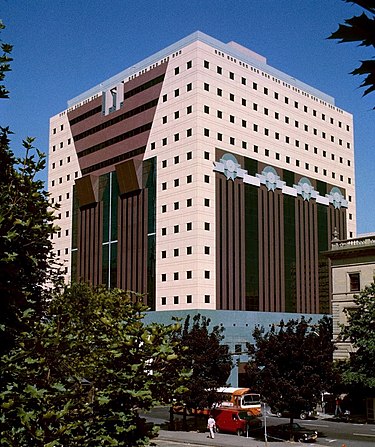
Michael Graves’ “Portland Building”

Every structure I’ve covered in my recent posts on architecture lands on the American Institute of Architects’ America’s Favorite Architecture list.  Even Phillip Johnson’s Glass House – the one I have a love/hate relationship with – makes the cut.  But not the Portland Building.  This may be architect Michael Graves’ signature design but it’s also known as “the building we love to hate”.

Take a good look at the Portland Building photo and tell me what comes to mind.  Christmas gift?  Child’s transformer toy?  Strawberry-chocolate cake?  I suggest Pandora’s box.  I studied the Portland Building in college because the construction was completed in 1982, in the third year of my degree.  It was a landmark statement of postmod.  It was also a disaster from the day its doors opened.

Architects don’t always consider the practical aspects of a building, and budgets sometimes compromise on essentials.  As soon as the city’s employees moved in, they realized the tiny windows don’t bring in much natural light, and the lack of adequate ventilation made it something of a hot box.  Of greater concern, the Portland Building ran into water infiltration and structural issues almost immediately.  The building required the first of several remodels only eight years after its construction, even though the city commissioners would’ve preferred it demolished instead.  Like Pandora’s box, the Portland Building seemed to be an endless font of bad news.

“Portlandia”

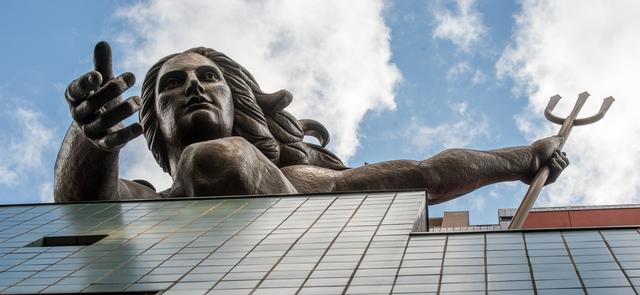
There’s not much to say about the Portland Building to entice you to visit (not even the rather bizarre 6.5-ton copper female poised menacingly above the entrance).  The building is surrounded by blocks of nondescript skyscrapers, which makes the design all the more jaw-dropping when you see it in person.  The only vote of confidence might’ve come from Portland’s mayor himself when it opened.  He proclaimed the building “Portland’s Eiffel Tower… an emblem of the city which will draw the curious from around the world”.

The “goddess” seems to wonder why you’d even enter the building.

The negative commentary is much more fun.  A columnist from a local paper described the Portland Building as “something designed by a Third World dictator’s mistress’ art-student brother.”  Architect Pietro Belluschi said “it’s not architecture, it’s packaging… and there are only two good things about it: it will put Portland on the map, architecturally, and it will never be repeated.”  Travel + Leisure magazine called it “one of the most hated buildings in America”.  Need I say more?

Fish out of water?

The Portland Building is a case study of noteworthy architecture, yes… but that may be its only upside.  The difference between “attractive” and “atrocious” can be as wide as the Grand Canyon.  There’s value in whether you “like” a building.  There’s also a reason you won’t find many other postmodernist structures in Portland.

Now for the latest on LEGO Fallingwater…

____________________

LEGO Fallingwater – Update #8  (Read how this project got started in Perfect Harmony)

Today the off-model structure finally settled into the base, in a brisk twelve minutes of assembly time.  70 pages (or 77%, or 181 minutes) into the build, this is what we have:

As you can see on the left, the house is starting to rise rather dramatically from the underlying landscape and water.  Check out the photo above to understand the vertical glassed-in area that rises from the bottom of the house all the way to the top.

Boring as the build has been these last few weeks, I realize the underlying structure is necessary to support Fallingwater’s distinctive concrete balconies and stone chimneys.  I also realize I have only two weeks remaining on this project.  No wonder the piles of remaining pieces are dwindling!  And rudimentary as those pieces may be, I expect the last two chapters to really bring the house into its fullest presentation.

Tune in next Thursday as construction continues!  Now for another nod to Frank Lloyd Wright…

Taliesin West

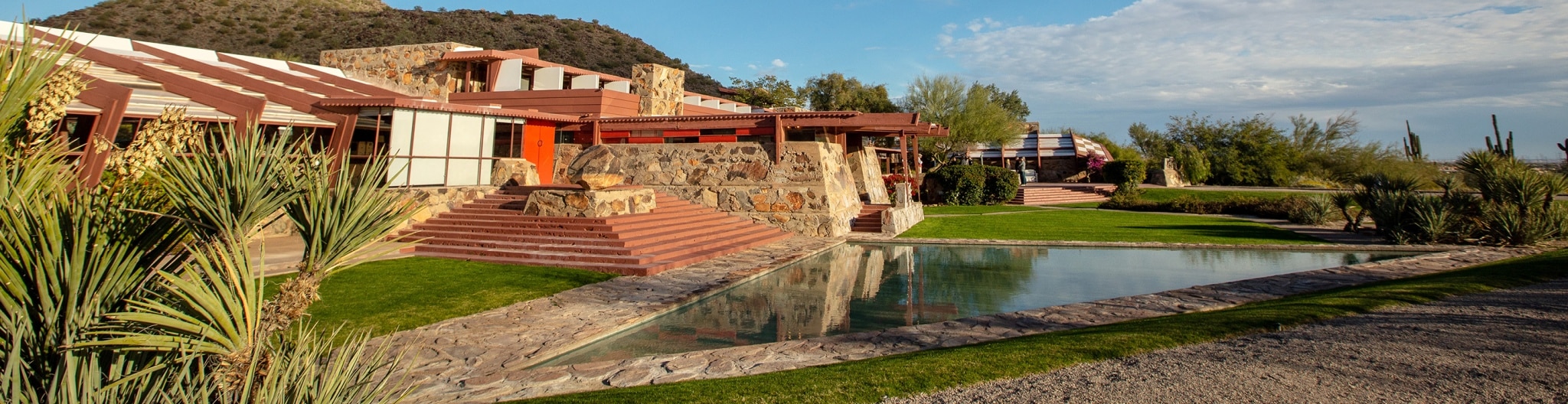
Most of Wright’s life (and designs) took place in America’s Midwest, but at some point the architect visited Arizona and later created the winter getaway he described as his “desert utopia”.  Taliesin West is a campus of buildings, constructed of local materials intent on blending in with the surroundings – rock, sand, redwood; even canvas for the roofs.  The structures are low and horizontal, connected organically by walkways, terraces, and gardens.   The furniture and decor were also designed by Wright.

Taliesin West

Is there a Taliesin East, you ask?  Of course there is!  Wright’s primary estate was built in the Wisconsin River valley on one of his favorite boyhood hills.

But over the years, Taliesin West has gained the most notoriety.  What was once Wright’s winter residence, studio, and offices is now a National Historic Landmark and a museum to the man.  Taliesin West serves as the home of the Frank Lloyd Wright Foundation and School of Architecture, and is open daily for tours.

Some content sourced from the Frank Lloyd Wright Foundation website, and Wikipedia, “the free encyclopedia”.

Don’t Throw Stones

Back in Colorado where we used to live, there was a house down the street – a new build – where you walked through the front door, crossed a narrow hallway, and immediately found yourself outside again on a terrace.  The design was intentional (thanks to stunning views of Pikes Peak), encouraging outdoor living as much as indoor.  It’s a design principle rooted in one of America’s most famous residences.  Welcome to New Canaan, Connecticut’s Glass House.

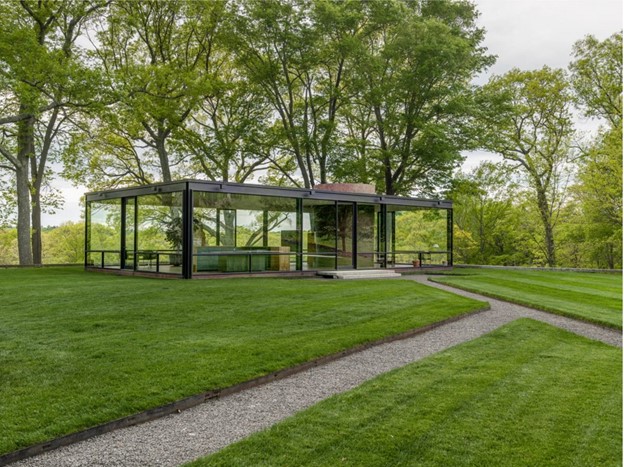
Imagine a classroom assignment where you’re asked to create a pizza.  You choose whatever toppings and seasonings you like, the pizza’s shape and size, and the means to bake it.  But there’s a catch: You can’t use a crust.  Somehow you’d still put it together, right?  Maybe that’s how architect Phillip Johnson approached his design of The Glass House back in 1949.  It’s got windows and doors, a roof, rooms, and furniture, just like any other house; just no walls.

Okay, The Glass House has walls, of course, but their transparency is meant to throw the concept of “house” for a major loop.

As a student of architecture, I have a love/hate relationship with The Glass House.  My first thought when I learned about it was, “I hate it.  It’s just a steel and glass box.  And everything I’d do in there would be on display for all the world to see.  Everything“.

But like important works of art, the more you study The Glass House the more you appreciate all that it has to offer.  You notice the fully open floor plan (bathroom aside), suggesting “rooms” can be defined by furniture or floor coverings, not just walls.  Its transparency invites the outdoors in (whether or not you open the glass door on each of its four sides), suggesting the experience of “home” can go well beyond the walls.  Finally, The Glass House boldly declares that less is more, meaning life in the dozen rooms of a McMansion pales in comparison to a cohesive collection of just three or four.

[Architect’s Note: “Less is more” is a famous mantra in architecture circles, coined by American architect Mies van der Rohe (of whom Phillip Johnson was a disciple).  Marie Kondo might come to mind as well.]

Am I a fan of the harsh German glasarchitektur style of The Glass House?  No.  Would I want to live in such a house?  Absolutely not.  Yet I must admit, its concept of indoor-outdoor living (which has inspired countless residential designs since) is intriguing.  It’s what makes Fallingwater such a captivating design.  Furthermore, the siting of The Glass House puts to rest any concerns I had about privacy, since it’s nestled within fifty acres of open landscape.

The Glass House, as you might expect, is in America’s National Trust for Historic Preservation, and open to visitors through guided property tours.  As the famous saying goes, “People who live in glass houses shouldn’t throw stones”.  I’m pretty sure Phillip Johnson didn’t throw any.  After all, The Glass House was where he made his home for over fifty years.

Now for the latest on LEGO Fallingwater…

____________________

LEGO Fallingwater – Update #7  (Read how this project got started in Perfect Harmony)

Today we spent entirely “off-model” again, building up the structure you see in front.  60 pages (or 66%, or 169 minutes) into the build, this is what we have:

This week’s photo should look virtually identical to last week’s, because all I did was add layers to the “house” in front (which doesn’t look at all like a house).  The only excitement was adding that balcony jutting out in the left rear corner.

I’ve bored you again with the model update, so here’s a poetic quote instead, from Wright himself about designing Fallingwater:

“The visit to the waterfall in the woods stays with me and a domicile has taken vague shape in my mind to the music of the stream… this structure might serve to indicate that the sense of shelter… has no limitations as to form except the materials used and the methods by which they are employed…”

Tune in next Thursday as construction continues!  Now for another nod to Frank Lloyd Wright…

Wingspread

The last of Wright’s Prairie Style houses may have the most creative name.  “Wingspread” was designed and built in 1937 in Racine, WI for the SC Johnson family, for whom Wright also designed his more famous Johnson Wax administration building nearby.

Wingspread is a sprawling pinwheel plan, with each of its single-story arms serving a different purpose.  The central octagon is three stories high.  Wingspread is full of fireplaces (five), but more of interest is Wright’s accommodation of requests by the Johnson children.  For them he added a Juliet balcony bedroom and a crow’s nest.  Let it also be known Wright had an occasional bit of fun with his designs.  Wingspread contains a disappearing dining table and a great room clerestory ceiling inspired by the look of a teepee.

“Juliet” balcony

Wingspread has been converted into a conference center today, but is open for tours by reservation.

Some content sourced from The Glass House website, the Frank Lloyd Wright Foundation website, and Wikipedia, “the free encyclopedia”.
Built More than Most

My short but adventurous blogging tour through my favorite works of American architecture has included Frank Lloyd Wright’s Fallingwater and Greene and Greene’s Gamble House, two residences that couldn’t look more different if they tried. Today we add a third, but to call this one a “house” would be like saying Niagara Falls is a tall drink of water.  Palace?  Château?  Both fit the bill, er… Bilt.  Welcome to North Carolina’s Biltmore Mansion.

Biltmore Mansion

If you enjoy the occasional retreat into the mountains, maybe you’ve thought about owning a second place someday.  A modest cabin on a lake or a condo on the ski slopes.  You’d get away for the weekend to enjoy the fresh air and recharge.  You might call it your “little mountain escape”, which is exactly how George Washington Vanderbilt II described his summer home in Asheville, North Carolina.  All 180,000 square feet of it.

“Front door”

I’ll say this for G.W. Vanderbilt II: he knew how to spend money.  Beginning in 1889 and for the next six years, Vanderbilt created the Biltmore estate on hundreds of thousands of forested acres in North Carolina.  His undertaking was so massive it required the purchase of 700 separate parcels of property.  The mansion itself, the design of architect Richard Morris Hunt, required a temporary three-mile railroad connection (to deliver materials), a woodworking factory, and a kiln capable of creating 32,000 bricks/day.  At the height of its construction the Biltmore estate employed over 1,000 workers.

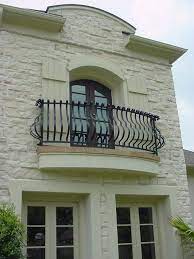
The mansion itself is fairly indescribable, at least with the handful of paragraphs I allot myself today.  Vanderbilt opted for 250 rooms spread across four stories, with 65 fireplaces and three kitchens.  This was his second home?  What the heck did his first place look like, Versailles?

“Dining room”

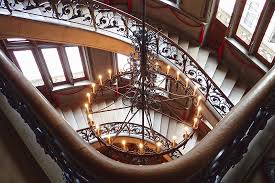
Since we just watched the Super Bowl, here’s a fitting way to picture the size of Biltmore: each of its four floors is the size of a football field.  You can sleep in any one of 35 bedrooms. You can dine in 3,000 square feet of banquet hall alongside sixty other guests.  You can choose from 10,000 books in the two-story library.  You’ll climb a hundred steps on Biltmore’s massive spiral staircase to get to your fourth-floor bedroom (I suggest turning in early).  Finally, the adjacent carriage house is 20,000 square feet – another third of a football field – because you get to choose from Vanderbilt’s twenty horse-drawn vehicles.

The Biltmore mansion also has a basement (of course it does), the largest in America.  Vanderbilt liked his fun, so this floor houses a 70,000-gallon swimming pool, a bowling alley, and a gymnasium.  Throw in electric lights, forced-air heating, walk-in refrigerators, and elevators, and you have a thoroughly state-of-the art structure (at least for the late 1800’s).

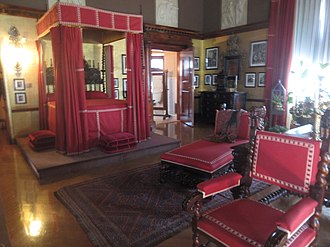
Vanderbilt’s bedroom

News to me, one of architecture’s styles is known as “Châteauesque”.  It describes a handful of the mansions designed in the Gilded Age of the late 1800’s (some covered in a recent tour of Newport, R.I. by blogger Lyssy in the City).  The Biltmore certainly qualifies as a château.  It’s the largest privately-owned house in the United States.  If you’re looking to get your 10,000 steps, check out the tour information here.

Now for the latest on LEGO Fallingwater…

____________________

LEGO Fallingwater – Update #6  (Read how this project got started in Perfect Harmony)

Today we spent entirely “off-model”, creating the random looking structure you see in front.  50 pages (or 55%, or 148 minutes) into the build, this is what we have:

I had to reference the photo of the completed model to understand what I’m building here.  It’s the house itself, of course, but only the base, largely hidden from view when the model is complete.  It appears I’ll be building up this part of the house in similar fashion for the next couple of weeks.

Since today’s update was a little boring, how about an interesting coincidence instead?  I just noticed “Fallingwater” contains the letters, F, L, and W… in that order.  Talk about an architect’s “signature”, eh?  Wouldn’t surprise me if Frank Lloyd Wright came up with the name himself.

Tune in next Thursday as construction continues!  Now for another nod to Frank Lloyd Wright…

Frederick C. Robie House

No history of residential American architecture would be complete without including the Robie House, which you’ll find on the south side of Chicago.  This very long, very narrow house is often described as “two large rectangles that seem to slide past one another”.

Frederick C. Robie House

The Robie House is Wright’s best example of his Prairie Style, which “responds to the expansive American plains by emphasizing the horizontal over the vertical”.  The cantilevered roof, window bands, and liberal use of brick are also characteristic of the style.  The house is laid out with an open, naturally-lit floor plan, a novel design concept for the early 1900s.

Given its troubled history (including its sale a mere fourteen months after it was built), it’s a wonder the Robie still stands today.  The house is now incorporated into the University of Chicago campus and open most days for tours.

Some content sourced from the Frank Lloyd Wright Foundation website, and  Wikipedia, “the free encyclopedia”.

Terminal Trans-formation

In the United States, you have what are known as the Big Four airlines: American, Southwest, Delta, and United. According to Statistica, these carriers account for two-thirds of America’s commercial flights. Not so long ago, the Big Four were American, Eastern, Trans World (TWA), and United. Eastern folded its wings in 1991; TWA a decade later.  But TWA left an iconic legacy structure behind. Welcome to JFK International’s Terminal 5.

JFK International Airport’s “Terminal 5”

If you’re flying to New York City, LaGuardia Airport is just a hop, skip, and a landing from Manhattan.  For my money I prefer JFK International, ten miles to the south, if only for the chance to visit Terminal 5. “T5”, as it’s known today, embraces one of the most unique airport buildings in the world – the TWA Flight Center.  We’re lucky it’s still standing.

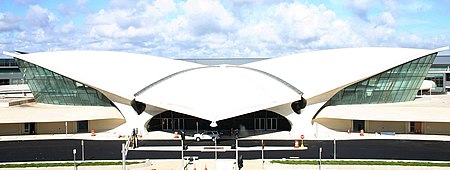
Go back to the first photo of T5.  Doesn’t it look like a giant, white B-2 Stealth Bomber draped over the rest of the building?  That part of the structure – or the “head house” as it’s called – was designed by Finnish-American architect Eero Saarinen as the TWA Flight Center. Would you have guessed it was constructed in the 1960s?  I think it looks decidedly more modern.

You can tell how dramatic the interiors of the Flight Center are without even stepping inside.  Those window walls at both ends are two stories tall.  The soaring “bomber” thin-shell concrete roof is shouldered at its corners by massive Y-shaped piers, allowing for the uninterrupted gathering space within.  The Flight Center was the first terminal to introduce concourses and jetways to airport design, allowing passengers to board an airplane without having to drop down to ground level first.

Washington D.C.’s Dulles International Airport

Saarinen’s most famous designs feature similar swoops and curves.  He gave the main terminal at Dulles International Airport the same look.  He served on the advisory board for the design of the Opera House in Sydney, Australia.  But his best-known work towers over St. Louis (coincidentally, TWA’s headquarters city): the Gateway Arch.  Sadly, Saarinen saw none of these structures to completion, passing away in 1961 at the age of 51.

St. Louis’s Gateway Arch

So if TWA is long gone, why is the Flight Center still around? Because it’s been transformed into a wholly different animal.  Yes, you’ll find the typical mix of concourses, gates, and restaurants you see at most airports – the so-called “T5” aspect of the building.  But the Flight Center itself – the head-house – has been converted into a kitschy hotel, with hundreds of rooms, a central lounge between the window walls, and a cocktail bar inside a restored Lockheed Constellation airliner.  Brass light fixtures, rotary phones, and bright red carpet evoke the heyday of TWA.  They’ve even retained the mechanical split-flap display board used to advertise arriving and departing flights.

“Trans-formed” into the “TWA Hotel”

Architecture is an important part of a culture, a museum of pieces placed here and there in the landscape.  Preserving those pieces takes time, money, and sometimes, the gamble to repurpose.  The TWA Flight Center may now be referred to as the TWA Hotel, but it’ll always be Eero Saarinen’s masterpiece.

Now for the latest on LEGO Fallingwater…

____________________

LEGO Fallingwater – Update #5  (Read how this project got started in Perfect Harmony)

Today we spent landscaping “outdoors” around the foundation of the house.  40 pages (or 44%, or 136 minutes) into the build, this is what we have:

The fourteen trees on the Fallingwater model property are each nothing more than one small green LEGO cube snapped on top of another one.  Compare this basic look to LEGO’s more recent take on growees, as in blogger Andrew’s View of the Week’s LEGO Flower.  Slightly more realistic, wouldn’t you say?

At least we’re seeing a portion of the house itself begin to emerge.  We’ve built a bridge over the stream (back right), and we’re starting construction on one wing of the house – the piece you see in front of the model.

Tune in next Thursday as construction continues!  Now for another nod to Frank Lloyd Wright…

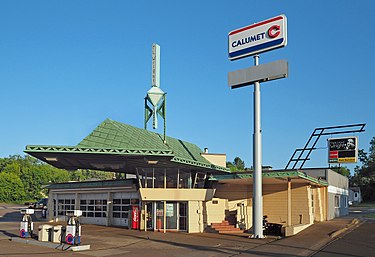
R. W. Lindholm Oil Company Service Station

No commission is to big or too small for an architect, which is why Wright put his signature on a gas station, very close to the time he was designing Fallingwater.

R. W. Lindholm Service Station

The Lindholm Service Station was part of Wright’s vision of Broadacre City, a utopian community planned for a four-square-mile property in Cloquet, MN.  The Service Station fueled automobiles, yes, but also encouraged residents to gather in its upper space for what Wright envisioned as “… neighborhood distribution center, meeting place, restaurant… or whatever else is needed.”  The cantilevered copper roof and band of glass windows is vintage Wright.  The angular end of the roof canopy points to the St. Louis River as a symbolic nod to river transport.

The Lindholm Service Station is the only part of Broadacre City ever constructed, is included on the National Register of Historic Places, and is open to the public… to fill up your car, of course.

Some content sourced from the Frank Lloyd Wright Foundation website, and  Wikipedia, “the free encyclopedia”.