The Game of the Name

When our youngest granddaughter was born last year, I wouldn’t have guessed her first name was the most popular among newborn girls in the U.S.  Olivia is the current front-runner (and Liam for boys), as it has been for the last six years. Emma sits firmly in second place (and Noah) – also on a six-year streak – while Amelia (and Oliver) takes third. It’s nice to see the use of “normal” names in this day and age because you’ve got to admit; some really odd ones float around out there.  But there’s another list of baby names you probably don’t know about: the ones you’re not allowed to use.

Two or three generations ago, the topic of baby naming wouldn’t have made for interesting reading.  Back then parents defaulted to monikers from their family tree or from the Bible.  In the decade of my birth for example (the 1960s), the most popular names for boys were Michael, David, John, and James.  Compare those to today’s “trendy” choices: Truce, Colsen, Bryer, and Halo. (Colsen aside, I’d be hard-pressed to guess the gender of any of the others.)

At least Halo is legal.  The U.S. Constitution protects a parent’s right to name their child, yet the courts still came up with a not-an-option list.  Including the following:

  1. King
  2. Queen
  3. Jesus Christ
  4. III
  5. Santa Claus
  6. Majesty
  7. Adolph Hitler
  8. Messiah
  9. @
  10. 1069

Right off the bat you can understand why most of these would cause problems.  If your baby’s name is “King” I’m looking for his bejeweled crown.  If your baby’s name is “Jesus Christ” I’m looking for a crown of a different sort.  As for Santa Claus, the courts in Miracle on 34th Street may have determined he and Kris Kringle were one and the same but let’s be honest: Nobody south of the North Pole should be named Santa Claus.

“III” and “1069” require a little more explanation.  Both are examples from real court cases where persons decided a numeral or number were preferable to their given name (seriously?)  But the courts denied both petitions, deciding numerals and numbers fall more appropriately into the category of “symbol” than “name”.  The same can be said of the @ sign, which better belongs in your email address than in your signature block.

U.S. federal guidelines seem sensible enough but the individual states add more rules.  Consider New York, where your first name can be no longer than 30 characters, while in Arizona it can be up to 45.  Rhode Island won”t allow you to put an accent above any character.  In New Mexico you can’t name your baby boy “Baby Boy” (nor your baby girl “Baby Girl”).  And in Arkansas you can’t name your child “Test” or “Void” because they wreak havoc with the state computer systems.

The game of the name is not unique to the United States.  Indeed, the lists of illegal names in other countries include some really creative ones.  Here are my favorites:

  • “Thor” – Portugal banned this one but only because they don’t consider Thor to be a word in the Portuguese language.
  • “IKEA” or “Ikea” – Banned in Sweden (of course!)
  • “Judas”, “Cain”, etc. – Switzerland doesn’t wish to promote the Bible’s bad guys.
  • “Fish” and “Chips” – New Zealand decided no child deserves either of these names alongside his or her twin.
  • “Spinach” – Australia said no to the green veggie, probably also warning the parents that just because spinach is good for you doesn’t mean your child will also be.

Considering what my granddaughter could’ve been named I’m glad her parents went with Olivia, even if she is one Olivia among many.  At least her name need not be contested in court… like the French couple who wanted their child to be named “Nutella” and were promptly denied.  They did settle on “Ella” – which is nice enough (and maybe her cutesy nickname will be “Nut”) – but if I were that crazy about Nutella I would’ve just gone with “Hazel”.

Some content sourced from the Parents.com website article, “32 Illegal Baby Names You Might Want To Keep Off Your List”, and Wikipedia, “the free encyclopedia”.
Up, Up and Away Birthday

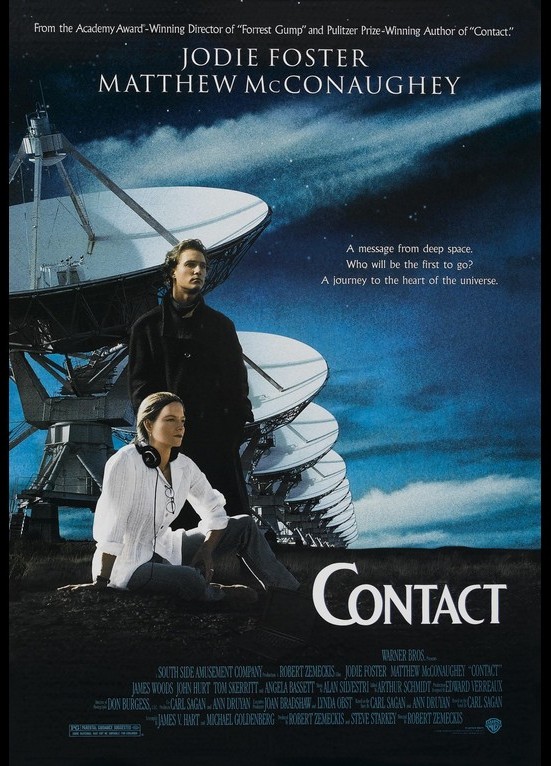
One of my favorite lines from the science-fiction classic “Contact” (starring a young Jodie Foster and and even younger Matthew McConoughey) comes from one of the lesser-known characters. Foster’s Dr. Arroway discovers a communication stream from beyond Earth, while an anonymous millionaire funds the spaceship capable of traveling to the source of the signal. The donor then turns to Foster’s character with a smirk and says, “What do you say, Dr. Arroway… wanna take a ride?”  This year, the same question was posed by the (good) people at Goodyear.

Wingfoot Two is a “semi-rigid airship”

In a nod to my advancing age, the Goodyear Blimp turned 100 on Tuesday (or I should say, one of the Goodyear Blimps).  “Pilgrim”, Goodyear’s dirigible based in Akron, Ohio, took it’s first flight on June 3, 1925.  Now Goodyear can claim a hundred years of lighter-than-air travel, even if this noteworthy form of transportation never made it to the masses.

To be clear, Goodyear started with rubber, and then tires.  They manufactured tires for bicycles and carriages back in the day as well as horseshoe pads and poker chips, before Pilgrim first took to the skies.  Sure, you’ll find their products on vehicles everywhere but what comes to mind when I say “Goodyear”; tires or blimps?

The Goodyear Blimp of my childhood

I choose blimps.  I grew up just thirty minutes from Goodyear’s blimp airbase in Carson, CA.  The blimp I saw back in the ’60’s and ’70’s was named something like “Puritan” or “Reliance” or “Defender”, because Goodyear honored the sailboat winners of the America’s Cup.  Not today.  Thanks to a public naming contest the blimp down the street from my childhood neighborhood is named “Wingfoot Two”.  (I prefer the America’s Cup names instead.)

Maybe you also choose blimps because you drive on Michelins or Firestones.  More likely it’s because you’ve seen a blimp buoyant over the Super Bowl or other sporting event.  And speaking of football, if the Goodyear Blimp sets down on the field it covers 80% of the yardage.  That’s one big balloon.

“LZ 129 Hindenburg”

Goodyear’s flying machines of my childhood were literally balloons filled with helium, without any of the technology of today to make them easier to steer.  Coincident with middle-school history class, whenever I’d see the blimp I’d think of Germany’s Hindenburg, the Nazi propaganda passenger dirigible that, like the Titanic, is best known for its final flame-filled disaster, on approach to Lakehurst Naval Air Station in New Jersey in 1937.  Perhaps we should be thankful Goodyear never promoted its blimps as a form of mass transportation.

Also in my childhood, blimps offered a far more romantic image in the movie Chitty Chitty Bang Bang, where a colorful zeppelin traveled here and there over the fictional country of Vulgaria, carrying the villainous Baron Bomburst and his crew.  (And here’s my opportunity to distinguish between terms.  A zeppelin has more of a cylindrical shape, while a blimp looks more like a sausage.  A dirigible? Just a general term for an airship.)

Speaking of sausage, it was inevitable someone would open a sub sandwich shop named after the aircraft.  The Blimpie franchise (“America’s Sub Shop”) began in the 1960s, spread to locations around the world, and enjoyed a good fifty years of success.  Today most of the helium has left their balloon.  There are only about 25 Blimpie stores left in the U.S. (compared with almost 20,000 Subways).  IMHO Blimpie’s was the better product, at least the version I remember from the 1990s.

Oh how I wish I could’ve concluded this post with another wanna take a ride?  You and I missed the boat, er, airship on that opportunity.  Goodyear held a contest at the start of 2025 and leading up to Pilgrim’s birthday, where three lucky passengers won a blimp ride.  I say “lucky”, when in fact my fear of heights takes away any personal appeal to float up, up, and away.  No worries, because now I’m thoroughly distracted by hunger pangs.  Think I’ll hunt me down a “blimp sandwich”.

Some content sourced from IMDb,  “the Internet Movie Database”, and Wikipedia, “the free encyclopedia”.

Fruit of the Bloom

On Monday I noticed a lot of the wearing o’ the green because, of course, Americans celebrate St. Patrick’s Day as if we are somehow Irish. It’s a fitting burst of color as winter slowly but inevitably surrenders the seasonal baton. Soon you’ll find a full-on rainbow of blooms in every garden you pass. For now however, let’s drink and dance in honor of another bright color this week: pink. More to today’s topic, cherry pink.

If you’re tuning in from Washington D.C. you already know where I’m going with this one.  Today is the first day of spring, and the beginning of the Cherry Blossom Festival in our nation’s capital: four weeks of seemingly countless opportunities to celebrate the flowering of the graceful trees on the banks of the Potomac.  If you’d asked me a week ago what the bloomin’ fuss is all about, I’d have said the festival’s significance is as shallow as the water in the Lincoln Memorial Reflecting Pool.  But now I’m properly informed.  There’s more to this story than just pretty in pink.

“Yoshino” cherry blossom

In the early 1900s, America and Japan were unconditionally friendly countries (years before that little dust-up in the 1940s).  To acknowledge the friendship, Tokyo’s mayor shipped 3,000 Japanese cherry trees to Washington D. C.  There’s a longer, more convoluted history behind this gesture, including players from both countries making repeated efforts to populate the city with trees, but the details are about as interesting as pushing a bill through Congress.  Suffice it to say cherry trees were planted along the river, up and down the avenues, and in numbers worthy of an annual festival starting in the 1930s.

I love cherries; always have.  I think the flavor itself appealed to me before the fruit, in the popular junk food of the 1970s.  Hostess Fruit Pies.  Life Savers.  Slurpees from 7-11.  Or the proverbial maraschino on top of an ice cream sundae.  As much as I got my fill of those, I could never get my fill of my mother’s homemade cherry pie, and I mean homemade.  The cherries were passed down from her mother each year, picked, jarred, and ready to go.  The crust was made from scratch, including the signature latticework on top.  It’s a wonder the butter wasn’t churned from the milk of a family cow.

Alas, no longer on the menu

It’s also a wonder I’ve never been to D.C.’s Blossom Festival, considering my unabashed affection for the fruit.  I’m sure I’d find a couple dozen new ways to enjoy cherries besides the usuals.  I’d happily scarf down a serving of flambéed Cherries Jubilee over ice cream, or the cherry-filled sponge cake of a Black Forest gateau.  For the more adventurous there’s a savory Hungarian soup made with sour cherries.

“Petals and Paddles” race

Of course, there’s a lot more to the Blossom Festival than just food.  You’ll find parades, concerts, and kite-flying, with every shade of pink you can imagine.  Tour the historic Anderson House, filled with art and floral displays (featuring the cherry blossom, of course).  Compete in a “Petals and Paddles” boat race across the tidal basin surrounded by the trees.  Or get wet in “Pink in the Pool”, a family-friendly swim party replete with colorful beach balls.  There’s even an “Opening Ceremony” event on the first Saturday, (already sold out by the time I checked the website).  The weeks-long agenda proudly declares “events are primarily free” but I beg to differ. Tickets to the first several on the list were decidedly pricey.

For all I’ve just written, it’s a wonder the word “cherry” appears less than ten times in the hundreds of posts I’ve published on Life In A Word.  One time I referred to the children’s game “Hi Ho! Cherry-O”.  Another I talked about Cherry Coke.  The rest were the same things I mention here – ice cream sundaes, Slurpees, and so on.  So let’s add the Blossom Festival to the list, shall we?  With four weeks of celebrating, it’s safe to say life is a lot more than just a bowl of cherries.


LEGO Notre-Dame de Paris – Update #9

(Read about the start of this “church service” in Highest Chair)

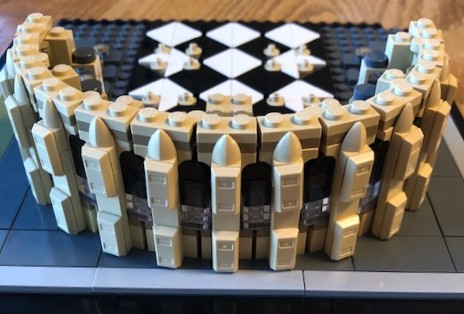
What was once a giant box of LEGO pieces is finally starting to resemble a cathedral!  Bags 15 and 16… of 34 bags of pieces, focused entirely on the body (nave) of the structure.  We’re now building in the years 1220-1225, when the walls of the nave rise to the same height as the semicircular chancel at the east end.

Under construction
Fully fortified

The parishioners look rather tiny, now that we’re working so far above them.  And notice all those free-standing columns from last week aren’t so free-standing anymore.  We’ve capped them with structural elements to support what is still to be built up above.  Also notice we’ve closed in the west end of the cathedral, which patiently awaits the addition of the soaring bell towers.

West end “front doors”

Okay, it’s time to address the elephant in the room; an elephant that gets bigger with every update.  A few of you have sounded the alarm on my running count of leftover pieces.  It’s a fair concern, considering the LEGO Grand Piano also started as thousands of pieces but only amounted to a handful of extras.

extras

Here’s the truth of it: the twenty-six leftovers shown here amount to just a handful as well.  Every one of them is among the tiniest pieces in the entire cathedral.  It probably cost LEGO pennies to add in these “bench players”.  And given the tendency of pieces to run away I’m grateful to have them.  Heck, by the time the cathedral is finished maybe I’ll have enough leftovers to build a small elephant. 

Running build time: 7 hrs. 57 min.

Total leftover pieces: 26

Some content sourced from the National Cherry Blossom Festival website, and Wikipedia, “the free encyclopedia”.

Dead-Letter Danes

Denmark strikes me as a charming little country. It’s only half the size of South Carolina. The central town of Billund (pop. 7,300) is the birthplace of LEGO. The Little Mermaid – the famous waterfront bronze statue – honors the fairy tales of Danish author Hans Christian Andersen. And the Viking warriors of Denmark’s past seem like cartoon characters compared to today’s warmongers. Now let’s add another reason to admire the Danes. By the end of 2025 their postal service will no longer deliver the mail.

Imagine walking out to your mailbox, dropping down the little door, and finding… nothing.  Do you really have to imagine it?  I can’t remember the last time my mailbox contained anything worth putting my hands on.  It’s a daily pity-party pile in there: postcard ads, clothing catalogs, and random solicitations addressed to “Resident”.  Christmas, birthday, and occasional thank-you cards are about the only personal touch we’re giving USPS anymore, and I speak as a baby boomer.  The younger generations click keys instead of lick stamps.

Denmark discovered the obvious.  Since Y2K their personal mail volume has dropped 90%.  It’s pretty much the same as removing eleven eggs from the box of twelve.  You used to deliver a dozen but now you deliver just one.  Denmark’s Postal Service has been around for over 400 years so understandably a few of its citizens – seniors in particular – are upset about the quit.  But are they really happy to pay 29 Danish krone (about $4.20) to mail a letter somewhere within their tiny country?  That cost would have me turning to email as well.

Let’s put a “stop” to this

Denmark is already beginning to remove its 1,500 public mailboxes, which got me to thinking.  What will the U.S. do with all of our own mailboxes when our time comes?  We have tons of the free-standing blue ones, where you pull open the door and drop in a letter.  By my (questionable) math, since Denmark is half the size of South Carolina, and South Carolina is only 1% of the U.S. geography, we could have over 300,000 of these dead-weights just taking up space.

And what about the mailbox in front of your house?  Remove it from its stand and then what? Oversized breadbox for the kitchen?  Storage for a stack of small tombstones?  Garage for Mini Cooper?  The odd shape of traditional mailboxes just makes you want to melt them down for scrap.

It’s time for the U.S. to get on board with mighty Denmark and stop delivering the mail.  UPS, FedEx, Amazon and a host of others now command package delivery.  Any bill worth paying can be settled online.  And for every twenty “circulars” my wife likes to leaf through, maybe one catches her eye with something she’d want to buy.

I can’t reconcile the fact that a letter to my niece way out in Hawaii or one to my neighbor right next door costs the same to mail: $0.73 for the first-class stamp.  Maybe it’s why USPS reported a loss of ten billion dollars in 2024 alone.  With that much red, the cost could be 29 krone (or $4.20, remember?) and it still wouldn’t make a profit.  If you ask me, removing that particular debt from the federal budget sounds as sweet as… well… a cinnamon Danish.


LEGO Notre-Dame de Paris – Update #8

(Read about the start of this “church service” in Highest Chair)

Christian hymns sometimes refer to “tearing down the walls”.  We were doing anything but tearing down at Notre-Dame de Paris today.  Bags 12, 13, and 14… of 34 bags of pieces, had us beginning to surround the nave (the main space) with walls of stone, glass, and columns galore.  The vertical construction progressed so quickly I swear I heard a parishioner cry, “Let us out!  Let us out!”

Check out all those columns in the first photo.  It’s like an army of soldiers took up residence in the cathedral, bracing themselves like Atlas for the weight of what is soon to be built above them.  It’s a wonder the congregation can move about in the sanctuary without banging into a soldier here or there.

One, two, three, four, five, six, seven

Today’s math lesson: multiples of seven.  We built seven of this or fourteen of that, or in the case of those soldier columns, twenty-eight.  And you know those Lazy Susan spinners the cake decorators use for frosting and such?  I could’ve used one today since I built a little on the north wall, then switched to the south wall, then back to the north, and so on.

Cathedral doors forthcoming

It’s a good thing I’m showing you the sanctuary looking down from above (feeling divine?)  As you can see from the west end here – where the bell towers will soon rise – we’re already pretty well buttoned up.  Settle in, all ye faithful; get comfortable.  Those walls will continue to rise up around you.

Running build time: 6 hrs. 50 min.

Total leftover pieces: 26

Some content sourced from the BBC.com article, “Denmark postal service to stop delivering letters”, and Wikipedia, “the free encyclopedia”.

(Not) Making Cents

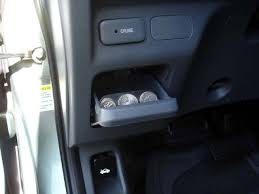
The other day when I drove into town I felt a sneeze coming on, so I reached into my car’s pull-out coin drawer and grabbed a handkerchief. If I’d wanted a breath mint for my mouth or an eye drop for my contacts I’d reach into the same place. But I wouldn’t find quarters, dimes, nickels, or pennies anywhere in there.  Come to think of it, someday soon I won’t find pennies anywhere at all.

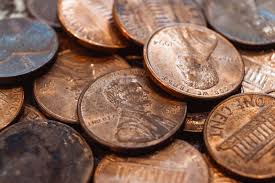
You probably caught the headline in your news feed.  The population growth of U.S. pennies is about to come to a grinding halt.  Our country will no longer mint shiny new “Lincolns” for the first time since their debut in 1787.  Two hundred years and change (ha) is a darned good run for a coin but the penny appears to have been done in by compelling arguments.  One, the production cost is three times the face value.  And two – and perhaps most humiliating – the penny’s face value has descended into, well, obsolescence.

There was a time not so long ago when I wouldn’t pass up a lost penny lying in the street.  In addition to “free money” there was the old adage find a penny pick it up, and all day long you’ll have good luck.  Today you’d better settle for just the luck because you can’t buy anything for pennies anymore.  You’d be better off using them for more practical purposes like checking your tire tread depth or turning screws.  My brother and his wife turned thousands of their pennies into a beautiful, copper-colored floor for their kitchen.

Losing their shine

Speaking of copper (I’m easily distracted today) I had no idea pennies are no longer made of copper.  They’re primarily zinc because of the rising cost of metals (yet they still cost three cents apiece?)  You’d assume quarters, dimes, and nickels were made from an alloy of silver, lead, or aluminum, but – go figure – those coins are primarily copper.

Enough with the facts.  I’m bummed to see the penny put out to pasture.  Along with it goes a ton of childhood memories.  You could roll pennies into coin wrappers and enjoy the thrill of exchanging the whole lot for paper bills at the bank.  You could drop them into handheld banks for untold savings (and my banks were delightfully mechanical).  Finally, you could walk into any 7-Eleven or drug store, hit the candy aisle, and find several “penny candy” choices.  A chunk of Bazooka bubble gum, hard candies, or licorice whips could be purchased for just a few cents back then.

Three cents each… a long, long time ago

Practically speaking I’m on board with the penny’s retirement, because I can’t recall the last time I involved a cent in a financial transaction.  If something costs $9.99, are you telling me you’d reach into your pocket and pay the $9.99 in cash and coin?  Nope, you’d more likely hand over a ten-dollar bill and then what happens?  You get a penny in return.  What are you supposed to do with that?

Certain sayings will have to head out to pasture as well.  An expensive item can no longer be described as “a pretty penny”.  “A penny saved is a penny earned” literally has no value.  A frugal person should now be described as a “quarter-pincher” (in case the nickel and dime are also on life support).  And “pennies from heaven” certainly don’t describe good fortune anymore, even if the song of the same name will continue to be sung.

Do you have one of these?

For my money, I hope car manufacturers continue to include coin drawers in their dashboards.  I keep important things in there and I’d prefer not to change my ways.  Then again maybe I should keep a few pennies in the drawer, if only for my childhood memories.  Those will always have value.


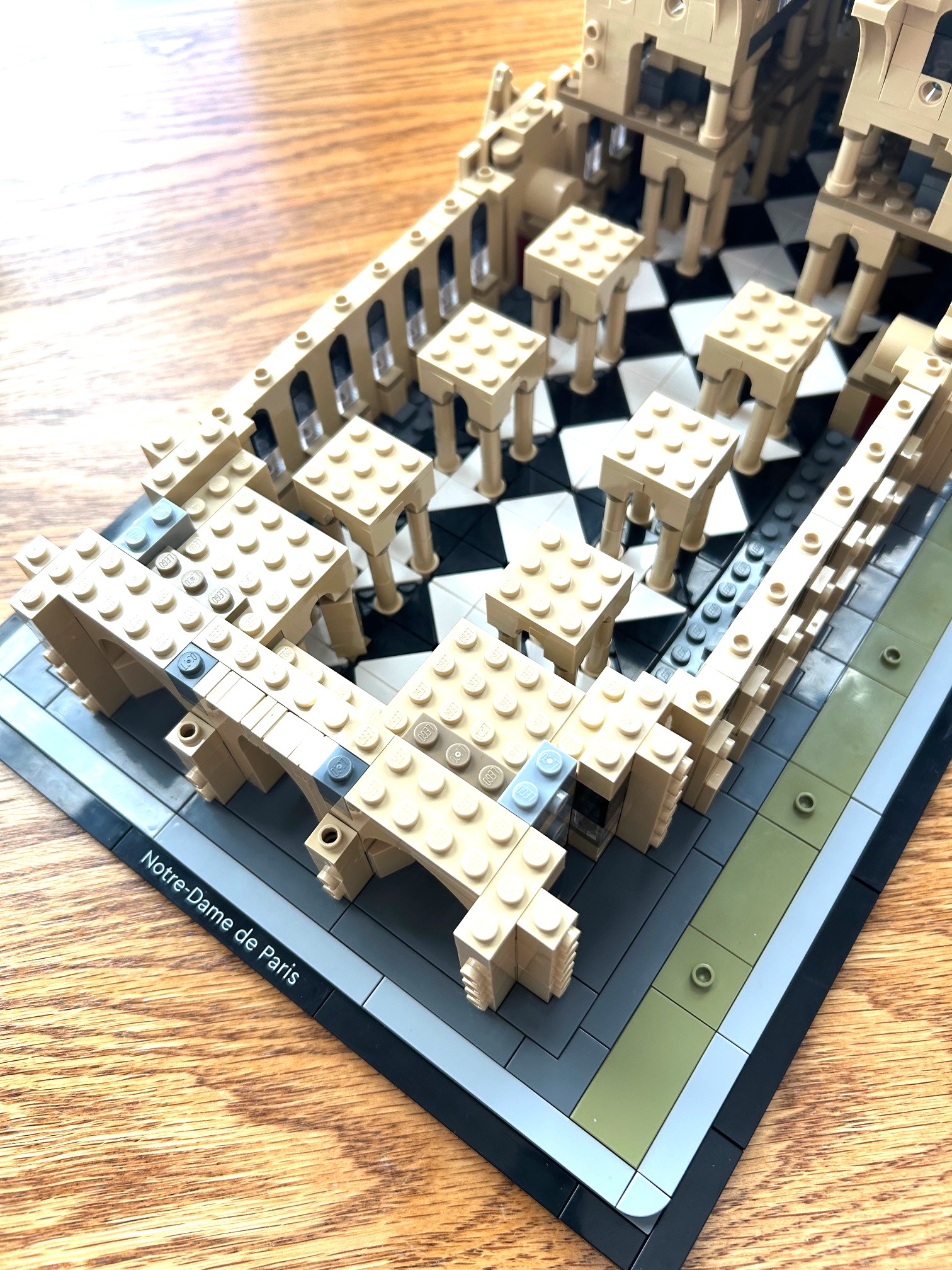
LEGO Notre-Dame de Paris – Update #5

(Read about the start of this “church service” in Highest Chair)

I decided to have my lunch today while working through Bag 8… of 34 bags of pieces.  That was a mistake.  I reached for a LEGO piece, grabbed a little block of cheese instead, and Notre-Dame de Paris almost had cheddar in its walls. I immediately vowed food would go nowhere near the assembly ever again.  It’s unnerving enough putting in the real pieces.

As I worked on the uppermost level you see here I used a little too much force, and a piece in the level below loosened and scampered down into the sanctuary.  I shook, rattled, and rolled the entire cathedral trying to get it out but to now avail.  Just before admitting defeat, the little devil finally emerged (he must’ve gone to confession).  And here’s where I learned an unnerving truth: re-assembling pieces long after you’re supposed to can be near impossible.  I had to tear down an entire wall to get the piece back in place.  We’re working in close quarters here, people.

“LEGO lever”

Today is also a good chapter to point out the tool to the right.  It’s a “LEGO lever” (my words), designed to easily remove a piece from a place it wasn’t meant to go.  I didn’t need my lever through the first seven bags, but today?  Half a dozen times.  My mind’s eye was off just a hair and I kept assembling pieces a quarter or half-inch off from where they were supposed to go.  LEGO lever = life saver.

Pasta noodles?

Bag 8 started slow and repetitious but finished grand and confident.  In fact, I was so full of myself after the mere forty-five minutes of construction, I boldly plunged into Bag 9.  Mistake.  I mean, look at the pieces in this photo!  Are these LEGOs or the little bits of pasta you find in your chicken soup?  Seriously, we may be almost a quarter of the way through the bag count but the pieces are shrinking.  Some Sunday soon the parishioners will look to the heavens and be burned by the giant magnifying glass above them.

Running build time: 4 hrs. 22 min.

Total leftover pieces: 17

Some content sourced from the CNN Business article, “Trump instructs Treasury to halt penny production”, and Wikipedia, “the free encyclopedia”.

Pride, Pomp, and Circumstance

I managed to get through high school literature class without having to wrestle with Shakespeare, not even once. To me, Romeo and Juliet are simply characters from a movie I’ve never seen. Hamlet is another name for a small village. Othello is a board game I played as a teenager. But hey, maybe I should be a fan of Shakespeare. After all, he gets the credit for penning the phrase “pomp and circumstance”.

It’s true – “Pride, pomp, and circumstance (of glorious war!)” is a line from Shakespeare’s play Othello, written way back in 1603.  Somewhere in the hundreds of years since, “Pomp and circumstance” became the name of the musical march we all associate with graduation ceremonies.  But for today’s purposes, pomp and circumstance (or “P&C” if you will) means “formal and impressive ceremonies or activities”.  And Monday’s presidential inauguration ceremony was the perfect example of that.

I am a big fan of American P&C.  Without it the inauguration ceremony would’ve been nothing but mundane repeat-after-me oaths.  With it you get your heart fill-er-upped with pride.  Monday’s ceremony was replete with red, white, and blue decor.  American flags were everywhere.  The guests of honor were escorted to their seats by men and women in splendid uniforms.  The cannons nearby boomed over and over when the oaths were completed.  And for my American dollars, nothing says pomp and circumstance like those patriotic anthems.

U.S. Naval Academy Glee Club

Having spent most of my years in Colorado Springs, “America the Beautiful” is close to my heart because its lyrics were born from the top of nearby Pikes Peak.  All credit to Carrie Underwood for her performance of its first verse on Monday, enduring technical difficulties to sing a cappella.  Then there was the charismatic Rev. Lorenzo Sewell, embellishing his prayer of gratitude with the opening lines of “My Country Tis of Thee”.   And you’d be forgiven for shedding a tear during the soaring “Battle Hymn of the Republic”, belted out by the men and women of the U.S. Naval Academy Glee Club (and earning a standing ovation).

Macchio

But I’m forgetting one more anthem.  Or should I say, I can’t forget the one more.  Yes, Christopher Dean Macchio (“America’s tenor”) sang “The Star Spangled Banner” to close out the inauguration ceremony, but he also performed another anthem to kick things off and I’m still humming it today.  Why, I ask myself, have I never heard “O, America” before?

“O, America” – go figure – was written by an Irishman.  Brendan Graham penned the lyrics into a big hit for the group “Celtic Woman”.  You’d think the words would be from the perspective of someone overseas but “O, America” is clearly about someone here… and someone now.  Have a listen and I think you’ll agree.  In the words of Othello, “O, America” is all about “pride, pomp, and circumstance”.  This week I am filled with all three.


LEGO Notre-Dame de Paris – Update #2

(read about the start of this “church service” in Highest Chair)

I’m glad I remembered my antiperspirant today.  Bags 2 and 3 – of 34 bags of pieces – encouraged sweat, tested patience, and made me realize my fingers are anything but nimble.   My hands are still shaking after the hour and change it took to build this section.

We started by tiling the cathedral floor.  Look closely – those black and white pieces aren’t all the same shape or orientation.  I installed one wrong and almost needed pliers to get it back out.  Imagine if you made the same mistake on the floor of the real Notre-Dame.  You’d get fired for wasting priceless marble!

Having said that, the floor was just a warm up for the colonnade that now rises up around the altar.  It is made from tiny, tiny pieces!  I think LEGO should invent special gloves that a) allow you to easily grasp these little guys while b) protecting your fingers from their sharp edges.  Pressing them into place again and again can be painful!  Those beige column supports you see on the tile floor left little round dents in my fingertips.

Finally, notice the repetitive structure of the colonnade, like a circle of rocket ships ready to launch.  LEGO shows you how to build one of these vertical elements (each one is about twenty pieces) and then goes, “Okay Dave, do that fourteen more times”.  The Grand Piano was also tough but I wouldn’t say it was repetitive.  Notre-Dame de Paris has found a new way to test my patience.

Running build time: 1 hour 37 min.

Total leftover pieces: 5

Some content sourced from the Irish Central article, “Irishman’s song ‘O America’ performed at Trump’s inauguration”, and Wikipedia, “the free encyclopedia”.

Recycled Airbags

As I build the beginnings of this week’s blog post (three “b”s already for those keeping count) my screen distracts me with alerts for Cyber Monday deals. Laptops at 30% off retail. E-readers at 25% off. DNA tests at 70% off (which begs the question: do we really care about our ancestry anymore?) Cyber Monday is a sort of second chance for those who shunned the big box stores the Friday after Thanksgiving (good decision). But here’s what I wonder today. Why endure Black Friday or get distracted by Cyber Monday when you can shop through lost luggage any day of the year instead?

I’ve finally found a reason to visit Alabama.  A six-hour drive due west of my keyboard puts me in the little town of Scottsboro, of which an entire block is consumed by a business known as Unclaimed Baggage.  UB is exactly what you think it is: deep-discounted personal belongings made available to you by the traveling misfortunes of others.  Think of UB as one person’s trash becoming another person’s treasure only, of course, the original owner had no intention of throwing it away.

“Where’s my owner?”

Unclaimed Baggage is the kind of entrepreneurial enterprise I wish I’d thought up myself.  Consider the end-to-end process.  You and your luggage start at Point A, but sadly one of you doesn’t make it to Point B.  The airline (or the bus or the train) spends several months trying to reunite the two of you.  Failing that, they compensate for the loss (sometimes).  But what of your bag if it turns up later?  Dump it into a “Dead Luggage” office?  Actually, yes, and then Unclaimed Baggage comes a-calling.

Here’s an encouraging stat: 99.5% of lost luggage is reunited with its owner.  You wouldn’t think Unclaimed Baggage could make a business of the leftovers.  But those leftover are, on average, 7,000 items every day.  No wonder Unclaimed Baggage needs a city block to house all that it sells.  And the best part of the business?  UB never knows what it’s going to get because the airlines don’t (or aren’t allowed to) open the bags.  It reminds me of the show where bidders vie for contents of storage lockers without being able to raise the roll-up doors beforehand.

The most expensive item UB ever sold was a Rolex watch for $32,000 (50% of retail).  Visit the store today and you can purchase a diamond ring for $20,000 that surely appraises for more.  Some items are so strange they’re relegated to an area known as the “Museum Gallery”.  Wigs. Shark teeth.  A funeral casket key (?)  Items considered “unsaleable”, and items where you have to wonder why they were on an airplane in the first place. 

Treasures from chests suitcases

When I first learned about Unclaimed Baggage I thought, they have something of mine and I want it back!  No, I’ve never lost luggage.  Rather, I’m the passenger who keeps forgetting the little things in the seat back pocket right in front of him.  Reading glasses.  E-readers.  A rather expensive pair of noise-cancelling headphones.  Somehow my stuff gets left behind despite the pointed announcement from the flight attendant: “Please check in and around your seat for personal belongings, as you will not be allowed back on the aircraft after you deplane.”  Sigh…

Unclaimed Baggage has at least one example of an item unintentionally returned to its original owner.  At UB’s annual ski sale (which earned an LOL from me; I mean, just how many skis are left at baggage claim?), a shopper purchased ski boots for his girlfriend.  When he brought them home, she discovered initials on the inside of the boots – hers.  The airline had already compensated her for the lost boots so effectively, she re-owns her boots at a deep discount.

Time is cheap at Unclaimed Baggage

As you might expect, a good percentage of shoppers at Unclaimed Baggage are the same ones who troll garage sales and eBay for items they have no intention of owning.  They simply relist their wares online for purchase (and profit) from others.  It’s another enterprising way to make a buck but it’s not my cup of tea.  I’m the shopper who shows up at sales well after the best items have been picked over.

Unclaimed Baggage has cornered a lucrative market.  I don’t think they have any competition for the business of repurposing lost luggage.  I will say this: I’m less likely to leave my stuff on airplanes now that I know about UB.  I mean, do I really want some stranger buying my stuff for way less than I paid for it myself?

Final thought for the day.  Why don’t they call it Unclaimed Luggage?  Baggage?  Luggage?  Bag?  Lug?  Who the heck added two words into the English language when we only needed one?  The Oxford English Dictionary estimates we use 170,000 words these days.  I’m here to say that’s one too many.

Some content sourced from the CNN Travel article, “US travelers lose millions of suitcases every year…”, and Wikipedia, “the free encyclopedia”.

Overblown Air

When you travel to Colorado, you should pack a few things you might not think to bring. A reusable water bottle will be your constant companion since it’s high and dry in the Centennial State. Lip balm will be your pocket pal. Your wardrobe should be designed in layers since Colorado’s weather is so unpredictable. And finally, for the lack of air in the Rockies, don’t forget to bring a can or two of oxygen.

Canned oxygen?  For the longest time I thought this was the biggest scam on earth.  There was a time you could find “oxygen bars” at Colorado ski resorts – high altitude establishments where you’d pull up a stool and choose from a menu of “airs” to augment your oxygen intake.  Watching those suckers – heh – with their mouths attached to transparent hoses had me picturing a guy on the other side of the wall furiously working the plungers of bicycle pumps.  But forget oxygen bars.  Now you can take a hit from your very own can instead.

Boost , a popular brand of canned oxygen, has been around for a while since its humble beginnings through Shark Tank.  In Colorado you’ll find Boost products in every market, drug store, gas station, and airport concession.  Boost is  advertised as “95% Pure Supplemental Oxygen in lightweight, portable, and affordable canisters for health, recovery, natural energy, and athletic performance”.  That’s an impressive string of words to describe nothing but canned air.

First-timers will react to Boost with a well-defined smirk.  Gag gift for the relatives back home?  Stocking-stuffer?  After all, you’re paying $10 for a can of… well, nothing.  Yes, Boost comes in flavored varieties like lavender or eucalyptus menthol but in the end, it’s just air.  And watching someone take a hit of Boost is just like the goofball in your kitchen who tips the can of whipped cream directly into his mouth.  Even the sound of escaping compressed air is the same.  Just no whipped cream.

Naturally this is the point where I admit I’m a canned-air convert.  Never thought I’d see the day I’d actually need a “boost”.  But last January as I was moving belongings out of our Colorado house, I came to a breathtaking realization: I was no longer acclimated to the thin air of the Rocky Mountains.  Climbing a set of stairs had me huffing and puffing.  Lifting a box made my heart go pitter-patter.  For some reason I’d thought to add a can of Boost into my suitcase, so what do you know?  Compressed air to the rescue.  Every now and then I’d blast the can into my mouth and darned if it didn’t clear my head and help me breathe.  I was no whipped-cream junkie but rather a bold astronaut, seeking the occasional hiss of his supplemental oxygen.

For all its success, the legitimacy of a product like Boost is sullied by similar products having no health benefits whatsoever.  On your next trip to Italy, head up to Lake Como in the far north for a look at the pristine waters and nearby snow-covered Alps.  While you’re there you can purchase a can of “Lake Como Air” for $11.  Lake Como Air claims no value other than “something original, provocative, and fun”, or “… a tangible memory you carry in your heart”.  Really?  I have lots of tangible memories from Italy and they didn’t cost me a dime.

On your next trip to Israel (which best not be anytime soon), head over to the Dead Sea for a look at the biggest, saltiest resource of natural minerals in the world.  You can float in the Dead Sea without even treading water.  And no surprise, you can “purchase” the Dead Sea in small containers.  The so-called manufacturer claims its consumption “contributes measurably to feeling better and to looking wonderful and healthy”.  Huh.  Not sure about you but I like to think I feel better and look healthy just by drinking from the tap at my kitchen sink.

The list goes on and on.  Holy dirt from New Mexico.  Healing waters from right here in western South Carolina.  Rocks from outer space.  I mean, seriously, when are we going to stop paying for natural elements we can help ourselves to just by stepping outside our front doors?  Yeah, probably never.  That train left the station for good the day someone decided to bottle water.  Now we have canned air as well… and it’s a good thing.  Turns out, I’ll never take another trip to Colorado without a little Boost in my suitcase.

Some content sourced from the CNN Travel article, “Cans of ‘fresh air’ from Lake Como on sale to tourists in Italy”.

Let Freedom Ring

In an Election Week – especially one as consequential as this year’s – it’s only fitting I can’t seem to focus on blogging. After all, my country and its prospective leaders demand (and deserve) my undivided attention. Any topic I choose to write about here pales in comparison.

So I urge you to do the same. Set aside the blogs you read or write, if only for a little while. Watch tonight’s tallies, accept tomorrow’s outcomes, and pray for peace and continued prosperity. As the patriotic “My Country, ‘Tis of Thee” reminds us, we live in a sweet land of liberty.

Let freedom ring.

Some content sourced from Wikipedia, “the free encyclopedia”.

Flop O’ the Mornin’

Parked prominently within my wife’s impressive collection of teas are colorful boxes of English Breakfast and Irish Breakfast. The first is described as “expertly blended… a smooth classic” (strength: 4 tea leaves) while the second is “brilliantly blended… bold & robust” (3 tea leaves). Maybe those descriptions are right on the money but I’m a coffee drinker so what do I know? What do I know? I know I’d never let English breakfast or Irish breakfast anywhere near my dining table.

Sorry to disappoint but we’re not talking about tea at all today.  Instead, we’re talking about the food that goes with the tea.  Or rather, the food that should go with the tea.  In my world, the sanctity of breakfast is second only to the cornucopia of the Thanksgiving meal.  There’s a certain well-defined menu of dishes that screams BREAKFAST!!! and nobody in the Western Hemisphere (or at least, in the New World) would disagree.  Even so, I must acknowledge the “illegal aliens”; the dishes that try to crash the morning party when they really belong on the lunch or dinner table.  Or in the trash.  Or at least on the other side of the Atlantic.

The “Full English”

In its various forms, the full English breakfast starts out promising.  You’ll find eggs, bacon, and sausage almost without fail; even hash browns on occasion.  But the plate shatters after that.  You have a tomato, cut in half, fried, and doused with salt and pepper.  You have baked beans in tomato sauce (which aren’t even sweet the way Americans think of VanCamp’s or Bush’s). Finally, you have the horror known as black pudding, which can only be described through the hyperlink above instead of the words of this post, for fear I’ll lose my lunch – er, breakfast.

Unlike the teas, the full Irish breakfast is virtually identical to the full English, with the singular exception of white sausage instead of black.  Again, the definition will remain behind hyperlinked for the sake of a clean keyboard.  I was in Dublin on business years ago and took the “try anything once” approach with white pudding.  Bad, bad, very bad decision.

White pudding (not for the faint of stomach)

If I were born in England or Ireland I probably wouldn’t rain on the breakfast parade on the other side of the pond.  But here’s the thing: even if you like a savory tomato or “pudding” for breakfast, the entire plate is greasier than the wheel bearings in your car.  There’s not even anything to mop up said grease (like the slices of dry toast we Americans prefer).  I can’t imagine having much pep in my step after a weighty meal like this.

Denny’s is very helpful to reestablish breakfast order. If you walk into one of their restaurants and order the “Build Your Own Grand Slam”, you can construct your plate from four of the following: Eggs (7 different ways), pancakes (9 different), bacon (2), sausage, potatoes (3), toast (countless), muffin, biscuit, ham slice, or seasonal fruit.  With all those combos you could eat breakfast at Denny’s every day of the year and no version would be the same as another.  But more to the point, Denny’s offers breakfast items decidedly “All American”.  Add in waffles, hot/cold cereal, baked goods, and hash browns, and you’re looking at everything deserving of the list.

Where real “full breakfast” is served

American breakfast menus do include a few trendy alternatives these days (even at Denny’s).  You can keep it simple with a fruit smoothie, breakfast sandwich, or avocado toast.  These all-in-ones strike me more like convenience foods than full breakfasts.  Yes, you paint yourself a little healthier just for ordering them.  But let’s hang in there a few generations and see if they still show up on breakfast menus.  More likely they’ll just be memories the way porridge or salted meats have become breakfast history.

For the record, my wife’s English and Irish tea boxes sit largely untouched, except for the few bags she’s brewed.  They’re untouched for good reason.  Just the words on the box have me thinking of tomatoes, baked beans, and pudding.  Someone bring me a blueberry waffle stat.

Some content sourced from the CNN Travel article, “The Full English: How a greasy feast came to define and divide a nation”, and Wikipedia, “the free encyclopedia”.