Picking Poison

If you have me over for dinner and ask what I’d like to drink, I’m probably going to disappoint you. My go-to “adult beverages” are wine and, well… wine.  Nothing mixed.  Nothing with a lot of proof on the bottle.  A margarita with Mexican and a beer after a long day in the sun, but otherwise it’s pretty much a glass of Chardonnay or a full-bodied Cabernet. Not much creativity in picking my poison, it seems. Yet that’s not quite true.  Out on my property I’m faced with poison just about every day, as I fight a persistent onslaught of noxious weeds.

Dalmatian toadflax

Noxious weeds make their appearance around here every spring – without fail – just when I’m fooled into thinking this, this is the year they’ll cut me a break and infiltrate someone else’s property instead.  I’ll walk out one morning and seemingly overnight the uninviteds have taken prominent positions among the prairie grass.  Knapweed.  Toadflax.  Mullein.  And the worst of this noxious bunch: thistle.

Weeds annoy most anyone, but noxious weeds deserve a place in Hollywood’s scariest horror flick.  These bad boys earn descriptors like “aggressive invader”, “detrimental to native plants”, and “poisonous to livestock”.  Noxious weeds fall into a family of growees known as “alien plants”, which means they don’t belong here in Colorado.  Nor anywhere else on Earth if you ask me.  Name one redeeming aspect of these pernicious inhabitants.  I can’t, except perhaps I get a solid workout while I struggle to keep them at bay.

Thistle

Operative phrase there, keep them at bay.  Not kill them.  Most noxious weeds establish an underground root system as strong as chain link fence.  Many are impervious to the most aggressive chemical warfare.  Try yanking out the whole plant and you’ll burn through a bank’s worth of sweat equity.  Better to use something gas-powered instead.  Or a flame thrower.

Knapweed

Yes, Colorado has its Rocky Mountains and seasons of snow, but most of the Centennial State is high and dry desert.  We’re constantly challenged by drought, and in those conditions noxious weeds thrive.  Our county even has a “Noxious Weeds Division”, of the Environmental Division of the Community Services Department.  Send them an email and they’ll tell you everything you need to know about noxious weeds.  Most disturbingly, how they’re here… to… stay.

Let’s get to know these persistent plants a little better:

  • Diffuse knapweed – Picture a tumbleweed.  Large, round, and spiny.  Not very nice to look at.  You can knock off knapweed by severing the single taproot, but, its seeds can still develop on the cut plant.  Time for a bonfire.
  • Dalmatian toadflax – Showy, yellow, snapdragon-like flowers.  One plant can produce a half-million seeds.  The best way to control this bugger is… with bugs.  Can anyone spare some root-boring moths or stem-boring weevils?
  • Common mullein – Starts as an innocent, flat, green “rosette”, then bursts into a ramrod straight stalk, several feet tall.  Mercifully, mullein has a shallow root.  Meanwhile, people think you’re growing corn in your pasture.
  • Canada thistle – Small purple flowers bunched on tall, dark green stalks, replete with thorns and other self-defense mechanisms.  Hand-pulling this freakshow of nature stimulates its growth.  If you ask me, Canada thistle is better named “Satan’s Rosebush”.
I prefer this kind of dalmatian

How do I know the exact species of my noxious weeds?  Because my county’s Noxious Weeds Division tells me… when they send letters threatening to charge for maintenance if I don’t do it myself.  My advice: it’s best to obey the Noxious Weeds Division.

Mullein

Now for some noxious weed trivia:

  • Worldwide damage caused by noxious weeds: $1.4 trillion USD.
  • Russian thistle lives longer than humans.
  • Giant hogweed (which causes a nasty, blistering skin rash) earns a spot in the Guinness Book as “world’s largest weed”.  Its umbrella-like blooms can hover more than eighteen feet, on stalks three or more inches around.  “Giant” indeed.
  • Lastly… (and my personal favorite), before the chemical embalming process, tansy ragwort was used to line coffins because of its ability to repel vermin.  Hey!  Another redeeming aspect of noxious weeds.

I have a fond weed memory (believe it or not).  When I was a kid, I stayed at my uncle’s house for several days alongside a cousin about the same age.  Somehow my uncle had us weeding his front yard (work in exchange for food?).  Those straight-and-tall weeds looked like a vast army of soldiers.  So that’s how my cousin and I took to the job.  We split the yard down the middle, declared ourselves generals, and started taking down the soldiers one by one.  When the dust cleared and the “bodies” were removed, the battlefield was admirably clean.  We declared victory and went inside for a much-needed shower.

I’ve just returned from another battle with my noxious weeds.  I lopped off dozens of mullein tops with my pruning shears, to shut down their seed spread.  It’s exhausting work and I’m done picking poison for the day.  I could use a drink.  Nothing mixed, of course.  A beer will do just fine.

Some content sourced from the Noxious Weeds and Control Methods guidelines document, State of Colorado, El Paso County, Community Services Department, Environmental Division.

Meet Cute

Every now and then McDonald’s gets it right. In 1973, they introduced the Quarter-Pounder because customers demanded more than a 10 oz. patty inside of a boring bun. In 1987, McDonald’s added “PlayPlace” indoor playgrounds to suburban locations: crawl tubes, slides, and ball pits contributing to countless happy childhoods.  This year, the restaurant chain is stepping it up with its McCafé Bakery offerings. The Apple Fritter, Blueberry Muffin, and Cinnamon Roll will step back to give the spotlight to the newest McDonald’s kid on the block: the adorable Glazed Donut.

Seriously, just look at this little guy.  Isn’t he the cutest donut you’ve ever seen?  The McCafé Glazed Donut looks like a happy gathering of donut holes, all nestled up against each other for warmth and protection.  The Donut is pleasingly symmetrical.  Even the spelling is cute (instead of the more substantial “doughnut”).  And the best part: its “donettes” pull apart the way you would a hot, flaky croissant.  It’s like getting seven for the price of one.  And it’s cute to boot.

I admit I didn’t wake up this morning intending to write about cute donuts.  Even the headline about this doughnut’s upcoming debut didn’t really catch my eye.  But then I saw the photo and I was utterly smitten.  It’s the same way I felt when I first saw a package of those colorful little Plink garbage disposal cleaners.  I just had to have them.

Some would describe this as a “meet cute” moment.  Meet cute is the early-on scene in television or movies where two people connect for the first time and you just know they’re headed for romance.  The Hallmark Channel is all about meet cute.  Any scene where Hallmark movie man meets Hallmark movie woman, combined with something funny or unusual is 99% headed towards future romance.  It’s like you’re ten minutes into the story and you already know how it ends.

Plenty of “meet cute” in this one

And that’s how it’s gonna go with the McCafé Glazed Donut.  We had our meet cute this morning.  Now I have two weeks of anticipation and heart palpitations before I can actually buy one.  But I already see it.  I (almost) already taste it.  And the whole pull-apart thing?  Pure sex(y) appeal.

Meet cutes don’t always lead to predictable endings.  After the meet, the movie leads you to believe the characters are destined for romance.  But sometimes they’ll throw a curve (usually in the form of a third character) and the story goes in another direction.  Could happen with the Glazed Donut too.

Let’s use supermarkets as an example.  You stroll into the store, grab a basket, and think about your shopping list.  But before you even reach the aisles you’re greeted with front-of-store marked-down day-old doughnuts.  They’re just sitting there like little round orphans, begging you to spend another $0.69 to “adopt” one.

They’ll be front-of-store by tomorrow

So you do.  And you make sure the little guy’s placed in your basket as an easy find.  Then you slide behind the steering wheel and polish him off before you even leave the parking lot.  Tastes great, right?  Maybe now.  Later you’ll reflect on the slight, sickly feeling in the pit of your stomach and wonder why you caved.

That’s my thinking with the McCafé Glazed Donut.  I can cruise past the Fritter, Muffin, and Cinnamon Roll without so much as a passing glance.  But mark my words, next month I’ll find any excuse to be near a McDonald’s during McCafé Bakery hours.  I’ll purchase the Glazed Donut and my meet cute will blossom into a full-on romance. When I consider the Protein Shake I have most mornings, I’ll feel like I’m about to cheat on my mainstay.  Heck, this scandal could go viral! I see the headline now: Man Opts for Sweet & Sexy over Cold & Icy.  But can you blame me?  My Protein Shake really IS cold and icy, and there’s nothing satisfyingly pull-apart about it at all.  Meanwhile a small, soft, almost UFO-looking donut beckons.

Forgive me, my beautiful, healthy breakfast-in-a-cup.  Looks like I’m gonna stray.

Some content sourced from the CNN.com article, “McDonald’s is adding a sweet new treat for fall”, and Wikipedia, “the free encyclopedia”.

Arid (and) Extra Dry

Most of us reacted to eighteen months in the unwelcome company of COVID-19 the same. We reflected on our time with Mr. Virus and wondered, “What would we have done more of?” More get-togethers? More travel? More dinners out?  Yes, yes, and yes.  But instead, we hunkered down and waited for things to get better. Our routines became more… routine.  Everything faded to black and white.  Clocks came to a standstill. It’s the same feeling I had, coincidentally, enduring a drive from Colorado to California earlier this month.

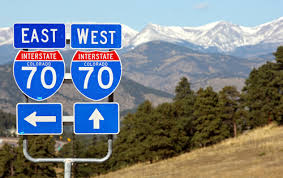
My advice: choose “East” while you still can

Maybe you’ve made the trek: Denver to San Diego via Interstate 70 and then Interstate 15.  Sounds so clean and easy, doesn’t it?  Two highways.  Plenty of lanes.  Rocky Mountains on one end and Pacific Ocean on the other.  Yeah, well, it’s all the mind-numbing in-between stuff that makes you want to burst through your sunroof and flag down a helicopter heading west.  There’s a whole lot of nothing in the desert.

The problem with this drive (which was not a flight because my wife & I wanted to bring our bikes) is the beautiful part comes first.  From Denver, it’s four hours of majestic snow-capped mountains, rushing rivers, red rock canyons, and breathless (literally) summits as you cruise on over to Grand Junction.  There’s good reason America the Beautiful was penned in the Rockies.

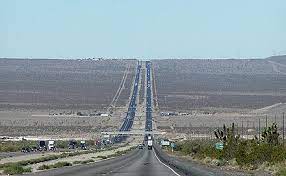
Cruise control suggested here

But don’t get comfortable.  Once you reach Grand Junction (which isn’t so grand), beauty takes a big break.  Pretend you’re a marble inside a rolled-up blanket.  Then someone flips that blanket out and off you go, rolling across the flattest, most desolate desert floor you’ve ever seen.  The mountains reduce to buttes reduce to sand dunes reduce to nothing.  The highway morphs from all sorts of curvy to ruler-straight. Your cell phone signal goes MIA.  You suddenly feel parched.  And you wonder, why-oh-why does the dusty sign say “Welcome to Utah” when there’s nothing welcoming about it at all?

So it goes in middle-eastern Utah.  Every exit is anonymously labeled “Ranch Road” (and why would you want to exit anyway?)  The highway signs counting down the mileage to Interstate 15 march endlessly.  When you finally do arrive at I-15 (your single steering wheel turn the entire journey), you bring out the balloons and the confetti and do a happy dance.  YOU MADE IT ACROSS THE MOON!  Well, sort of.  Now you’re just in central Utah.

I-15 wanders south a couple hours to St. George.  It’s probably a perfectly nice place to live, but St. George reminds me of the Middle East.  Squarish stucco/stone buildings, mostly white.  Not many people on the streets.  The temperatures quietly ascended to triple digits when you weren’t looking.  You realize you’re starting to sunburn through the car windows.

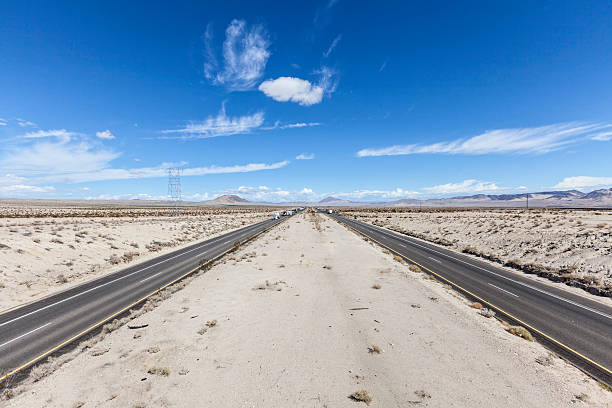
Proceed with caution (and water)

But then you make it to Arizona (briefly).  The landscape changes, suddenly and dramatically, as if Arizona declares, “Take that, Utah!  We’re a much prettier state!”  You descend through curve after highway curve of a twisting, narrow canyon, rich with layers of red rock. It’s the entrance to the promised land!  Alas, Arizona then gives way to Nevada, and here my friends, are the proverbial gates of Hell.  Welcome to the arid, endless, scrub-oak-laden vastness of the Mojave Desert, where everything is decidedly dead except for a brief glittery oasis known as Las Vegas.  The Mojave looks like it wants to swallow you whole and spit you out (except spit requires water so you’d probably just be gone forever).

Hang on to those dashboard gauges for dear life, friends, because it’s a full four hours in the Mojave broiler before your car gasps past the “Welcome to California” sign.  In those hours you’ll call your kids (one last time?), declare your final wishes, and wonder why you didn’t visit your parents more often.  Anything you see in motion off the highway is probably a mirage.  If you do make it to California, you’ll pull over and kiss the ground sand before wondering, “Hey, how come California looks exactly like Nevada?  Then Google Maps smirks the bad news.  You’re nowhere near the end of the Mojave Desert.

Baker. Barstow. Victorville. Hesperia.  You’ll pass through each of these towns and wonder, a) Why does anybody live here? and b) Is this the land that time forgot?  But finally, mercifully, you’ll descend the mighty Cajon Pass (the outside temperature descending alongside you), burst forth onto the freeway spaghetti of the LA Basin, and declare, “Los Angeles.  Thank the Good Lord.  I must be close now”.

You’re never alone on the Cajon

Except you’re not.  The Basin is dozens of cities, hundreds of miles, and millions of cars collectively called “Los Angeles”.  Hunker down, good buddy.  The Pacific is still hours away.

Here’s the short of it.  My wife & I made it to San Diego.  The car didn’t die in the middle of the Mojave.  Neither did we (though I left a piece of my soul behind).  We even rode the bikes a few times.  But I can’t account for those nineteen hours behind the wheel.  It’s like Monday morning became Tuesday night in a single blink.  Just like 2019 became 2021 without much in between.

What goes down must come back up.  The time has come to do the death drive in reverse.  Ugh.  Maybe we’ll leave the bikes in San Diego and catch a flight instead.

Covering My Tracks

A passenger train sweeps through this little vacation town every morning at a quarter past eight. The first sound you hear is an almost apologetic “ding-ding-ding” to alert cars approaching the seaside crossing. The next is the “click-clack-click-clack” as the wheels grind a percussive beat with the twin rails below. Finally, you’re consumed by the rush and roar of the train itself, barreling towards its next destination without so much as a split-second’s thought about stopping.

Dings, clicks, rushes, and roars – which typically wake me from my vacation slumber – are comforting music to my aging ears.  These trains cover the same tracks they did during the innocent summer days of yesteryear.  The beaches here are more crowded than they used to be.  The houses make grander statements.  The ocean is a few centimeters higher and the sand threatens to wash away with each passing season.  But the train, which once called this town a destination (but now simply passes through), faithfully maintains its daily schedule from points north to points south and back again.  Some things never change.

My family’s first summer house here – the upper floor of a duplex – was mere steps from the train tracks.  In those ten-and-under years, well past dark, my pajama-clad bleary-eyed brothers and I would bolt to the front screen door in the middle of the night, drawn to the roar of an oncoming freight train.  We just had to see the roving locomotive headlight flash by one more time.  During the day we’d dash to the rails just before the train passed by, laying down countless pennies to be flattened.  I still see them – pancaked, shiny and hot – as the giant wheels flipped the coins wildly off the rails.  Sometimes we’d never find them again.

The allure of the passing train was something intangible; a magnetism I can’t find words for, even today.  You had its awesome mechanical power, its symphony of distinct sounds, the romance of faraway destinations, and the untold stories of countless passengers.  You had the promise there would always be another train coming down the tracks, if you were just willing to wait long enough.  To a kid, the train was equal parts come hither and go away; the exciting and the scary combined into one imposing, larger-than-life spectacle.

There was a time I would’ve thought trains were meant for childhood and nothing more.  But they still click-clacked through my life after that.  As a teenager, I rode those same “Pacific Surfliner” coaches several times as a convenient connection between Los Angeles and San Diego.  In college, a freight train rumbled across campus in the wee hours, most often witnessed as I walked back to my dorm from late-night dates.  In my junior year in Rome, Italy; Eurail pass in pocket, the entire continent beckoned with its on-schedule trains and speedy routes to exotic locales.

Living in the San Francisco Bay Area begged a resident to ride trains.  My first corporate commute was on a train of sorts: the Powell-Hyde cable car line from Fisherman’s Wharf to Union Square.  When we moved south of the city, Caltrain became the easiest way to commute to the heart of downtown.  When my job also moved to the south, Caltrain still served as the easiest option, the nearest station a twenty-minute walk from my front door.

“Royal Canadian Pacific”

No mention of trains – at least for me – would be complete without a nod to the Royal Candian Pacific.  RCP rail tours include private rooms in restored vintage carriages, daily meal service prepared on-board, and spectacular scenery as you click-clack through the Canadian Rockies wilderness.  The RCP is kind of like a…, no, it’s exactly like a five-star hotel on wheels. They even throw in tuxedoed waitstaff.  Unless the Orient Express is your idea of a typical vacation there’s nothing quite as grand as the RCP.

Years ago, my wife bought me an LGB model train set.  The LGB was probably the largest scale of any of the model railway sets out at the time; its cars a good foot in length and almost as high.  We’d set up the tracks every December so our “Christmas train” could cruise under the boughs of the tree above.  I often wonder why my wife bought me that train set.  Maybe I commented enough about how much I enjoyed the rail commute to work back then.  More likely, she still recognized the boy in the man, the one who would rush to the screen door in his pajamas when the locomotive went barreling past.

Some content sourced from Wikipedia, “the free encyclopedia”.

Behind the Wheels

Every summer when my wife and I head to the West Coast for a little sunshine and sand, the only intentional exercise we get is a walk on the beach or a dip in the ocean. So this year we decided our vacation equation needed to get behind the wheels. We skipped the flight, racked the bikes onto the back of the SUV, and drove 1,100 Utah/Arizona/Nevada desert miles to bridge the gap between Colorado and California. Now the Pacific Coast sun shines above, the Pacific Ocean waves crash below, and the bikes… well, the bikes just beckon to be ridden every day.

It’s already happened, as I suspected it would.  When we took our first pedal tour around this little seaside town, I saw him for a few fleeting moments.  He was a younger, thinner, blonder version of me.  He was seated confidently behind the drop handlebars of a white Nishiki Regal ten-speed, focused solely on the road in front of him.  He was dressed in Converse tennis shoes, ballcap in place of a bike helmet, white socks halfway to the knees.  When this kid wasn’t body surfing, playing basketball, or working the evening shift at McDonald’s, he was logging mile after mile on his bicycle, in search of driver’s license freedoms, even if he wasn’t old enough to have one.

My fleeting companion is the “me” of forty-five years ago.  In most respects it’s a long period of time.  In others we could be talking about last week.  Bicycling was serious thread in the fabric of my childhood.  It was a way to leave the familiar behind, to pursue esoteric wonders beyond the streets I grew up on.  Bicycling asked the questions, “Where would you like to go?” “Why?”  “And how far?”  At fifteen years old, the answers were limitless.

The Schwinn “Lemon Peeler”

My love of cycling began at a young age (and continues today in weekly spin classes at the gym).  I still remember the very first hand-me-down bike my brothers and I shared – a small blue two-wheeler with no gears, the kind you had to pedal backward to brake.  From there I graduated to a glam Schwinn Lemon Peeler Sting Ray, the all-yellow beauty with the fenders above fat tires, sporting the signature banana seat.

But my Nishiki Regal ten-speed brought bicycling to a whole new level.  I bought it myself: months of hard-earned allowance and odd-jobs cash plunked down for the biggest purchase of my young life.  The Nishiki granted me access to the more sophisticated language of bicycling; terms like “chain stay”, “saddle”, and “derailleur”, even if I couldn’t afford the Raleigh or Motobecane imports more deserving of those words.

Also, the Nishiki meant bike maintenance became a labor of love instead of a chore; a bonding afternoon with friends.  The shade of my dad’s carport colored our “workshop”, where we dismantled, fine-tuned, and reassembled over and over; my friends and I exchanging tools and advice for each other’s spare parts.  I still remember the final touch when the Nishiki was all back together: the pristine white finishing tape wrapped carefully around those drop handlebars, signifying it was finally time to ride.

I was never far behind…

One story of me and my Nishiki will always stand out.  It was all about beating the school bus home.  When the bell rang after my final class, I’d sprint to the rack, jump on my bike, and launch into the six-mile trek back to my house.  The bus meanwhile, needed several minutes to load its passengers, not to mention dozens of stops before it would’ve dropped me.  It was always a neck-and-neck battle as I’d pass the bus and then it’d pass me.  Most times I’d lose the race by mere seconds, easing up on the pedals in exhausted frustration.  But every now and then I’d get the victory.  Did some of my friends deliberately take their time exiting the bus, knowing I was in hot pursuit?  Maybe.

In 1979, a few months after I turned seventeen, a wonderful little film called Breaking Away won the Academy Award for Best Picture.  The movie centered around four friends, bicycling, and Bloomington, Indiana’s “Little 500” bike race, but it was mostly about coming of age.  Learning life’s lessons while putting the miles on the pedals.

Little wonder Breaking Away‘s lead character was named Dave.

[Note: If anything about this post resonates with you, be sure to read Steve Rushin’s Sting-Ray Afternoons.  The author’s childhood is set in Minnesota, but the growing-up memories are remarkably similar to my own.  Even the kid on the cover looks a little like me.  Steve and I could’ve been brothers.]

Some content sourced from Wikipedia, “the free encyclopedia”.

As the Wind Blows

Pagosa Springs, a small town in Colorado’s San Juan Mountains, lies 7,100′ above sea level. It is locally known for its therapeutic hot springs. Pagosa also boasts a 35-year business called Rocky Mountain Balloon Adventures, which takes you an additional 3,000′ above sea level for “360° views of the beautiful valley [of Pagosa] below”. Maybe you’ll climb aboard their basket and go for a float someday.  If you do, my apologies for not joining you.  I’d rather spend my time in the terra firma of Pagosa’s hot springs than the “terror for-sure-a” of a balloon ride above.

Getting high, above Pagosa Springs

Logic says my fear of heights denies me the thrill of soaring up, up, and away.  Not true.  It’s more about the “gone with the wind” part (sorry for that, Scarlett).  Once the balloon reaches cruising altitude, the pilot extinguishes the fire and Mother Nature silently takes over.  Then your high-rise ride gets a little dicey unpredictable.  It’s the whole not-knowing-where-you’re-gonna-end-up moment that gets me.

Possible outcomes as follows.  You descend gracefully into a farmer’s field with the “chase vehicle” just minutes away.  You zip hundreds of feet up and then hundreds more down, depending on which fickle air stream you encounter.  Or, you float all the way to nearby New Mexico on the strong winds we have here in Colorado.  All while literally hanging by threads.

Albuquerque’s big balloon bash

Speaking of New Mexico, it wouldn’t be the worst destination for one of Pagosa’s rogue hot air balloons.  After all, the International Balloon Fiesta – the largest gathering of balloonists in the country – takes place every October in Albuquerque.  At least you’d have professionals on the ground eager to reel you in.  Also in Pagosa’s favor: small town = few power lines.  Hot air ballooning and power lines do not mix.  See here for what happens when they do (coincidentally, just weeks ago in Albuquerque).

Despite the occasional crash landing, ballooning fatalities are rare.  In fact, hot air ballooning has been designated “safest air sport in aviation” according to years of statistics, and a Swiss aeronautics organization whose name I can’t pronounce.  So maybe it’s not so bad if you never have a neatly paved runway to greet your touchdown.  Heck, Pagosa locals love it when a hot air balloon ends up in their backyard.  They come running out of their houses to greet you with coffee and cinnamon rolls.  Breakfast?  Hmmm.  Maybe I can do this ballooning thing after all.

I may not be a balloon flyboy but that doesn’t mean I’d rain on a parade of those big colorful inflatables.  After all, hot air balloons first appeared to me in favorite childhood stories, like L. Frank Baum’s The Wonderful Wizard of Oz, William Pène du Bois’s The Twenty-One Balloons, or Albert Lamorisse’s priceless (and wordless) The Red Balloon.  They show up as flying animals every Thanksgiving Day at the Macy’s parade in New York City.  As well, right here in my hometown we have an impressive showing of hot-air balloons every Labor Day weekend, including a “balloon glow” in the evenings.  Now that I think about it, there’s probably more ballooning going on in this part of the country than anywhere else.

Colorado Springs’ beautiful balloon glow

It’s not as if hot air ballooning is some new-fangled sport (hoverboarding, anyone?)  The first untethered hot-air balloon flight took place back in the eighteenth century.  Hundreds of commercial operators offer hot-air balloon rides in the United States, and hundreds more are private owners.  Add a little perspective and 3000′ above Pagosa Springs is nothing.  The world record for the flight height of a hot-air balloon is 64,980′ (like a Mt. Everest on top of a Mt. Everest).

Up, up, and seriously away

Strict definitions aside, the altitude record for hot air ballooning is about to topple, in a big way.  A company called Space Perspective is now taking reservations for its giant hot air balloon, launching in early 2024.  You, seven other passengers, and your pilot astronaut will take a six-hour ride in a pressurized capsule under a giant balloon… to the edge of the Earth’s atmosphere.  A seat on “Spaceship Neptune” costs $125,000.  Operators are standing by to take your payment…. for 2025, that is.  The 300 seats offered in 2024 are long gone.

Maybe 3000′ above Pagosa Springs doesn’t sound so bad after all.

Some content sourced from the CNN Travel article, “On sale: $125,000 balloon trips to the edge of space”, and Wikipedia, “the free encyclopedia”.

Gadgets… Be Gone!

The defining elements of the 1970s included disco music, bell-bottom pants, and really big sunglasses. You had block-long lines at gas stations thanks to the “Energy Crisis”, President Nixon’s resignation because of Watergate, and the long-overdue wrap of the Vietnam War. People preferred their clothes and cars in bright colors, their hair shaggy. I don’t remember much of this stuff, since I was only a budding teenager. But I’ll never forget my very first audio cassette tape deck.

90 minutes of songs in your pocket

You’re seeing obituaries in the news these days for noteworthy people of the 1970s.  Fifty years ago these people were generally in their thirties or forties; a reasonable age to invent something.  So it didn’t surprise me to read about Lou Ottens, who died in March at the age of 94.  Ottens was an engineer for the Philips Corporation.  Never knew him, never heard of him, but I’m forever grateful he invented the compact cassette audiotape.

[Millennials, roll back the clock on music media.  From your digital subscriptions, pass through Blu-Ray and DVD, then compact disc (CDs), until you finally land in the 1970s and the compact cassette audiotape.  If you made it to long-play (LP) vinyl records you went a little too far.]

Cassette tapes were a sensation in the 1970s because not only were they pants-pocket-portable, they were recordable.  Me and my cassette deck spent many an afternoon capturing Top-40 hits off the local FM radio station (Barry Manilow!  Helen Reddy!)  Then I’d store my precious cassettes in their little suitcase, which could hold twenty or thirty inside plastic cases.  Add in the invention of the Sony Walkman at the end of the decade (the first handheld cassette player) and you’ve got a broad overview of 1970s music media.

1970s chic

I did have a Walkman somewhere along the way, but the better memories come with my tabletop cassette deck (like the one shown here).  It lived on the desk in my bedroom, with its square speaker and giant pushbuttons, a precursor to today’s boom box.  It ate the occasional cassette tape with relish, and background noise always accompanied recordings off the radio, but my tape deck was still fairly state-of-the-art for the 1970s.  It only weighed a couple of pounds including the four C batteries.  The pop-out handle made for easy carry.

Lou Otten’s passing speaks to how many inventions, no matter how novel or cutting-edge, are sooner or later kaput.  Like the wax occupants of Madame Tussauds, you know your useful life has passed when you’d be better off in a museum.  So how about a few more inventions from my childhood years – once useful but now “almost gone”?

1960s

  • magnetic stripe card (smartphones are saying, “move over”)
  • plasma display panel (PDP)
  • handheld calculator (just ask Siri now)
  • 8-track cartridge (whoa, that’s ancient history)
  • Liquid Paper
Soon to be kaput

1970s

  • Pong (one of the earliest arcade video games)
  • floppy disk (removable computer file storage)
  • portable GPS device
  • cell phone (audio calls, nothing else)
  • videocassette recorder/player (VCRs)
“Floppy” file storage

I was just as curious to check out the decades of my parents’ childhood.  What inventions from their formative years are no longer?

1930s

  • Polaroid photography (in its original form)
  • IBM electric typewriter
  • coin-operated parking meter (now accepts credit cards)
  • drive-in movie theater (making a COVID-era comeback, perhaps?)
  • twist-tie (now built into your kitchen trash bag)

1940s

  • aerosol spray can (can we at least agree, these need to go?)
  • Slinky and Silly Putty (not today’s child’s toy of choice)
  • atomic bomb (let’s just pretend these are obsolete, shall we?)
  • lp phonograph record
  • jukebox
Early-model boombox

Last summer I went through a few neglected boxes in the garage and found a few of my old audiocassette tapes.  I keep a still-kicking boombox in the garage (for AM radio baseball games), with a dusty cassette tape player in the middle.  One afternoon I popped in one of those old tapes, pressed PLAY, and behold: John Denver was alive and singing again.  The music was as crisp and clear as 1970.

So give it up for Lou Ottens.  Not only did he design audiocassette tapes, he designed those little guys to last!

Some content sourced from the Hackaday.com article, “RIP Lou Ottens, Developer of the Compact Cassette and More”, and Wikipedia, “the free encyclopedia”.

Tale of the Little-Dog

When my son and his wife visited with their daughters last week, the consensus for dinner was hamburgers and hot dogs on the grill.  These choices were noteworthy in that I honestly can’t remember the last time I ate a hot dog.  Sweet Italian sausage?  A couple of times a month cut up into a stir-fry of vegetables.  Beer brats?  Also delicious, hot off the grill with a little mustard.  But a hot dog is child’s play by comparison.  Or should I say, a “dachshund sausage”?

It’s true.  The Germans, who by all accounts can take credit for the invention of the hot dog (five hundred years ago!) nicknamed their frankfurters “dachshunds” – or “little-dog” sausages because, well, they looked exactly like the dog breed.  The only history Americans claim is the re-nickname “hot dog”.  Even the hot dog bun – which really took hold at the Chicago World’s Fair in 1893 – points back to the Germans, who always ate their sausages with bread.

Are hot dogs a staple in your diet, or like me are they simply a distant memory?  If they weren’t hot off the grill in the backyard or at a summer picnic, perhaps you had one at a baseball game (but not so much football or basketball, go figure).  You’ve probably also seen hot dogs on the midway at carnivals and county fairs.  Wherever you get your franks today, they’re just not as likely to come from established restaurants.

In the 1970s, America seemed to have hot dog stands on every corner.  The most popular of these was the distinctive drive-thru Der Wienerschnitzel’s, but you also had – at least from my California-based memory – Pup ‘N’ Taco, Ben Franks, Tail o’ the Pup, and the walk-up Hot Dog on-a-Stick booths you’d find at amusement parks.  Today’s retail hot dog is at a Sonic Drive-In or the food court at Costco.  If you live anywhere near New York’s Coney Island, you can also include “Nathan’s Famous”, or at least the annual hot dog eating contest of the same name.

A hot dog may be “a cooked sausage eaten in a long, soft piece of bread”, but its secondary meanings are less definitive.  “Hot Dog!” is something you used to say when you were VERY happy about something else (“used to”, meaning sixty or seventy years ago).  A “hot dog” is also a person “who makes fast, skillful movements in skiing, snowboarding, or surfing to make people notice them”.  That last definition still stands.

Speaking of “used to say”, we also used to sing about hot dogs, didn’t we?  Oscar Mayer’s jingle convinced us we should BE hot dogs (so everyone would be in love with us).  But the better song came from Armour, which asked us what kind of kids eat Armour hot dogs?  Per the lyrics, “…fat kids, skinny kids, kids that climb on rocks… tough kids, sissy kids, even kids with chicken pox…”  Today’s version of the Armour jingle would probably be censored just for using the word “kids”.

“I wish I had a million dollars. HOT DOG!” (Courtesy of Paramount Pictures and “It’s A Wonderful Life”)

Hot dogs will always be a childhood memory more than a dietary preference in my book.  My mother, raising five hungry boys, developed several dinner recipes when time and ingredients were in short supply.  These included canned baked beans and weenies (two ingredients = dinner!), and a truly odd creation from the Betty Crocker cookbook made up of hot dogs, mashed potatoes, and cheese (three ingredients!).  Whether it tasted good or not – I honestly can’t remember – dogs, mash, and cheese conveniently covered the protein, carb, and fat categories, all in one broiler-blasted casserole.

The Oscar Mayer “Wienermobile”

My most vivid childhood hot dog memories are not the dinners mentioned above.  Instead, I can’t forget snacking on raw hot dogs from the refrigerator (which sounds awful now, but hey, I was a kid).  My mother was faithful to the Oscar Mayer brand so I ate a lot of their hot dogs raw.   Speaking of Oscar Mayer, here’s the better memory.  They built a motorized advertisement which to this day may be the coolest vehicle on wheels.  The “Wienermobile” cruised the streets of Los Angeles, stopping every now and then in a parking lot so you could view it up close.  The driver handed out tiny plastic replicas of the vehicle, appropriately labeled “Weenie Whistles”.

(Courtesy of Walt Disney Pictures and “The Santa Clause”)

Let me conclude with a solved hot dog mystery.  Your grocery store sells most brands in packages of ten.  They also sell hot dog buns but in packages of eight.  Why?  Because hot dogs weigh about 1.6 ounces, which makes a package of ten a convenient sale of exactly one pound of meat.  On the other hand, hot dog buns are baked in trays of four, which work best with conveyor belts and processing.  An odd number of buns – trays of five – is a model of inefficiency.  So until one or the other manufacturer changes their standard, you’ll always have leftovers for snacks.  Or better yet, for your dog.

The hot dogs I served my granddaughters last week were comically advertised as healthy: no fillers, no preservatives, and so on.  They weren’t very good.  Maybe the worst part of a hot dog is what makes it taste so good?  Or maybe hot dogs have simply lost their appeal to me?  No, wait, that can’t be true.  Anything my granddaughters ask me to eat has instant appeal.

Guess I haven’t eaten my last little-dog sausage just yet.

Some content sourced from the National Hot Dog and Sausage Council (NHDSC) website, and Wikipedia, “the free encyclopedia”.

A Million Little Leaks

Several years ago, I worked out with a personal trainer in a bunch of one-hour sessions at my gym.  She was all about proper lifting and careful stretching – and nasty core exercises I’ve patently avoided to this day.  But she did give me one time-proven piece of advice: after working out, go relax 10-15 minutes in the dry sauna. You’ve already revved up your metabolism with the workout, so the sauna helps extract toxins from the body. Yes, and the sauna also helps imitate the heat and humidity of South Carolina in the summertime.

My wife & I are heading to the Palmetto State for a long-overdue getaway at the end of May.  We’ll be spending a few days in the western counties before catching up with our daughter and her boyfriend in coastal Charleston.  We’ve taken this trip before.  The difference?  Last time we were there in early April when the heat and humidity sort of caressed your cheek with a soft kiss.  This time we’ll be there to kick off summer and it’ll feel like standing under a hot shower.  Outdoors.  Fully dressed.

I’ve always been a sweater (no, I don’t mean the extra layer you pull over your head in the winter months).  After a long jog, my t-shirt and shorts are so wet they could double as sponges.  My hair falls wet-stringy straight down my forehead and the perspiration runs in rivers here and streams there.  Yep, I’m one handsome dude.  But where most people say ick, I recognize sweating for the healthy cooling/cleansing process it is. A sign my metabolism is alive and kicking.  Turn on the faucets, baby.

Speaking of moisture, isn’t moist one of the most atrocious-sounding words in the English language?  I’ve never made peace with those five letters and I know I haven’t used moist in a sentence in years (no matter how good my baked goods taste).  The English language has such beautiful words, like chimes and delicacy and silhouette.  Why disrupt the sweet-sounding party with a word like moist?

Photo courtesy of Warner Bros.

I’m not gonna pretend a good sweat is ever comfortable (maybe it’s because I feel moist) but I’ve certainly gotten used to the sensation over the years.  And now that I live in Colorado?  Zero humidity.  Well, okay, there’s a little humidity here at 7,500 feet above sea level.  But most of the time it’s so dry, the needle on your tank seems to be perpetually on “E”.  This pathetic little voice deep inside your body pleads for, “water… water…” (think Tin Man asking for his oil can – that kind of voice).

A dry sauna room (aka a “hot box”)

Let’s go back to my dry sauna sessions.  Since you’re already asking the question, I don’t mean “wet sauna” (where steam is introduced into a room as tiled as a Chinese kitchen). I’m talking about that other room, with nothing but wooden benches and a nasty little blast furnace in the corner (wood-burning, electric, hot rocks – whatever heats like hell).  You sit there draped in a small towel in 200º F and for a few minutes, all is quiet and comfortable.  But then, almost imperceptibly, your skin develops a sheen.  You begin to glisten.  Suddenly droplets of perspiration pop out all over the place and it’s “open the floodgates, Poseidon”.  A million little leaks.

I won’t speak for the ladies’ locker room (that mysterious country club adjacent to our locker room), but sometimes the men’s dry sauna can get a little awkward.  When you approach the glass door, it’s so steamed you can’t tell how many guys are already in there.  Once you enter, choose a place on the bench without hesitation or you’ll be judged.  Good chance you’ll end up next to a heavy breather, which in some schools of thought is therapeutic.  Other times you’ll end up next to someone with headphones, which somehow don’t block the four-letter words of his rap music.  One time I was subjected to the wellness preachings of a huge Samoan-looking guy, where I thought it best not to argue with his musings.  All of which is to say, you never really know what you’re gonna get with the dry sauna.  It’s an intimate little sweatbox filled with semi-naked strangers.  Good times, huh?

South Carolina’s “Holy City”

When I’m in Charleston I won’t miss the dry sauna because Mom Nature will provide her own version round-the-clock.  The heat and humidity will promote enough of my perspiration to – as the family says – “make my face rain”.  I’m like one of those mysterious underground springs, where the water keeps bubbling up from the ground and you wonder if it’s ever gonna stop.  Every gonna stop?  Not with my metabolism.  For sheer entertainment value, if you’re in Charleston later this month, keep an eye out for me.  I’m the one with the million little leaks.

Whirlybird Wonder

“Ginny”

If you haven’t been following the dog-and-pony pony-and-dog show taking place on Mars the last couple of months, you might want to break out the telescope. Not that you’ll be able to see a car-sized rover or a toy-sized helicopter from millions of miles away. But you can see Mars itself, and then you can imagine “Percy” and “Ginny” sniffing around the red dirt and rocks up there. They’re just sampling things to see if Mars can roll out the welcome mat to humans someday.

The rover “Perseverance” is the pony in this show; “Ingenuity” the dog. I want to talk about the dog. Last July Percy hitched a nine-month ride to Mars, launching from Florida’s Cape Canaveral aboard a massive Atlas V rocket. Little Ginny hitched a ride on Percy; she the steadfast little soldier clinging to the rover’s underbelly. Considering Ginny measures only a few feet in all dimensions, it must’ve been a hang-on-for-dear-life E-ticket kind of adventure.

I’d love to make this a children’s story, but Ginny is anything but soft and cuddly. Have a look. She’s about as cute as a wasp. Consider Martian atmosphere is only 1/100th as dense as that of Earth, which means Ginny has virtually nothing to grab onto to sustain flight. But she whirls at five times the rate of a regular helicopter (2,400 rpm!), and then she rises.  Product safety warning: don’t go anywhere near Ginny’s rotor blades.

Ten days ago Ginny lifted off Mars to a skyscraping height of ten feet.  Then she hovered briefly before rotating about ninety degrees, kind of just observing the Mars-scape.  Finally, she landed.  The whole exercise lasted less than forty seconds.  Big deal, right?  Well, that little maneuver qualified Ginny as “the first powered controlled flight by an aircraft on a planet besides Earth”. Way to go, little wasp.  You just reserved a spot in the Smithsonian after you return home.

Will Ginny end up here?

When I picture Ginny clinging to the rover Percy, then hurtling through outer space for months on end, my middle-aged mind recalled the old Thunderbirds television show.  Thunderbirds featured the Tracy family (marionettes!) and their fleet of wicked-cool space vehicles.  The five Thunderbirds included a giant green supersonic carrier (“Thunderbird Two”), whose massive belly carried a yellow utility submersible (“Thunderbird Four”).  Kind of like Percy carried Ginny.  Trust me young(er) readers, Thunderbirds was awesome television in the 1960s… even if it was just puppets getting their strings pulled.

I’ve ridden in a helicopter exactly once in my life, on our honeymoon over the Napali Coast on the Hawaiian island of Kauai.  I turned to my bride mid-flight and probably uttered some not-so-nice words as I remembered how much I dislike heights.  The glass of champagne beforehand certainly helped.  For me, the fear has always been a toss-up between vertigo (physical) or the idea that terra firma is far, far below me (mental).  No matter the reason, heights just aren’t my cup of tea.

My acrophobia probably goes back to my first ride on a Ferris Wheel, with adolescent nightmares of slipping through the metal lap bar and taking an unplanned skydive.  Or ski lifts, where a little bit of fiddling with the lap bar latch could mean the end of everything.  Parasailing? (No).  Hang-gliding? (Never).  Hot-air balloons? (Why even ask?).  Sorry – airplanes aside, and only the bigger ones mind you – I prefer my thrills securely grounded.

For all the recent broadcast news on Percy and Ginny, I can’t seem to find the part of the story where Ginny returns to Percy, who then returns to the Atlas V rocket, who then returns to Earth.  I’m looking for the part about splashdowns and photo ops and ticker-tape parades – the happy-ending kind of stuff.  My earlier comment about a spot in the Smithsonian may have been a little premature (can you say, “Ginny replica”?).  Note to reader: if you do decide to make this a children’s story you might want to edit things a bit.  Just say our little pony and dog are now asleep on Mars, waiting for their human friends to get there someday.  It sounds much better than, “we just left them there”.

Some content sourced from Wikipedia, “the free encyclopedia”.