Celestial Silver Dollar

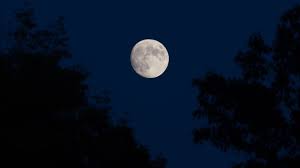
I walk the dog late at night, just to be sure he doesn’t nudge me awake in the wee hours of the morning. The walk can be a chore when I’m tired but most nights it’s a quiet, peaceful stroll through our pitch-black horse pastures. We’re usually blessed with clear skies here in South Carolina, which means the stars and planets put on a display worthy of a paid ticket to an observatory. Regardless, the moment I’m out the door I’m in search of my other faithful companion: the moon.
Through the trees

The “heavens” offer a plethora of topics to blog about (which I have: Saturn in Of Rings and Romans or Starlink satellites in Celestial Strings of Pearls, for example) but I’m overdue with a few words about the moon. Our nearest galactic neighbor is a constant wonder to me.  The moon (or is it “The Moon”?) is the reason we have ocean tides here on Earth and solar eclipses far, far away.  The moon has been the target of some of the most impressive space technology and exploration in history.  But let’s put the science aside, shall we?  Today I’d rather just muse about the moon as its sits in the night sky, like a shiny silver dollar laid out on top of a black velvet cloth.

My favorite moons are full – the perfectly round ones – but the shadowed partials can be just as beautiful.  Depending on the season and the atmosphere, the moon takes on countless looks.  Some nights it rises giant above the trees, as if invisible binoculars rest before my eyes.  Other nights the moon sits as an elegant crescent, a perfectly white slice of melon.  Still other nights the moon doesn’t rise at all, or at least, not until well after I’m in bed.  It’s a guessing game every time the dog and I head out into the dark.

I also make a game of trying to guess when the moon is full just by looking at it.  On the nights just before or after it occurs the moon can still appear as full.  So you have to look very carefully at the edges to decide if it’s perfectly round or not.  Conveniently, the moon is full about once a month, or at least, once every month in 2024.  Next year or the year after, perhaps we’ll get a “blue”: that second full moon in a calendar month.  Doesn’t happen very often, of course.

Here’s a fascinating fact about the moon.  It’s locked into place by the earth’s gravity, meaning it’s always showing you the same face.  Try to picture the earth taking a trip around the sun (once a year or so), while it’s spinning on its own axis (once a day), while the moon is spinning around the earth.  Technically the moon is rotating, just not on its own axis.  So you never get to see “the dark side”.

Here’s another fact that makes me pause.  If you drive across the United States from coast to coast and back again, you’re driving about 6,000 miles.  Do that same drive thirty times and you’ve driven to the moon.  Suddenly our celestial silver dollar doesn’t seem so far away, does it?

The next full moon (from my perspective), nicknamed “The Wolf”, is a week from this posting, on Thursday, January 25th.  It’ll be the first full one of the new year.  Good timing really, because some of you readers don’t make it to my blog until several days after the fact.  If you’re exactly a week late, walk outside tonight after dark.  A spectacular scene in the heavens awaits.

Some content sourced from Wikipedia, “the free encyclopedia”.

The Times of Sand

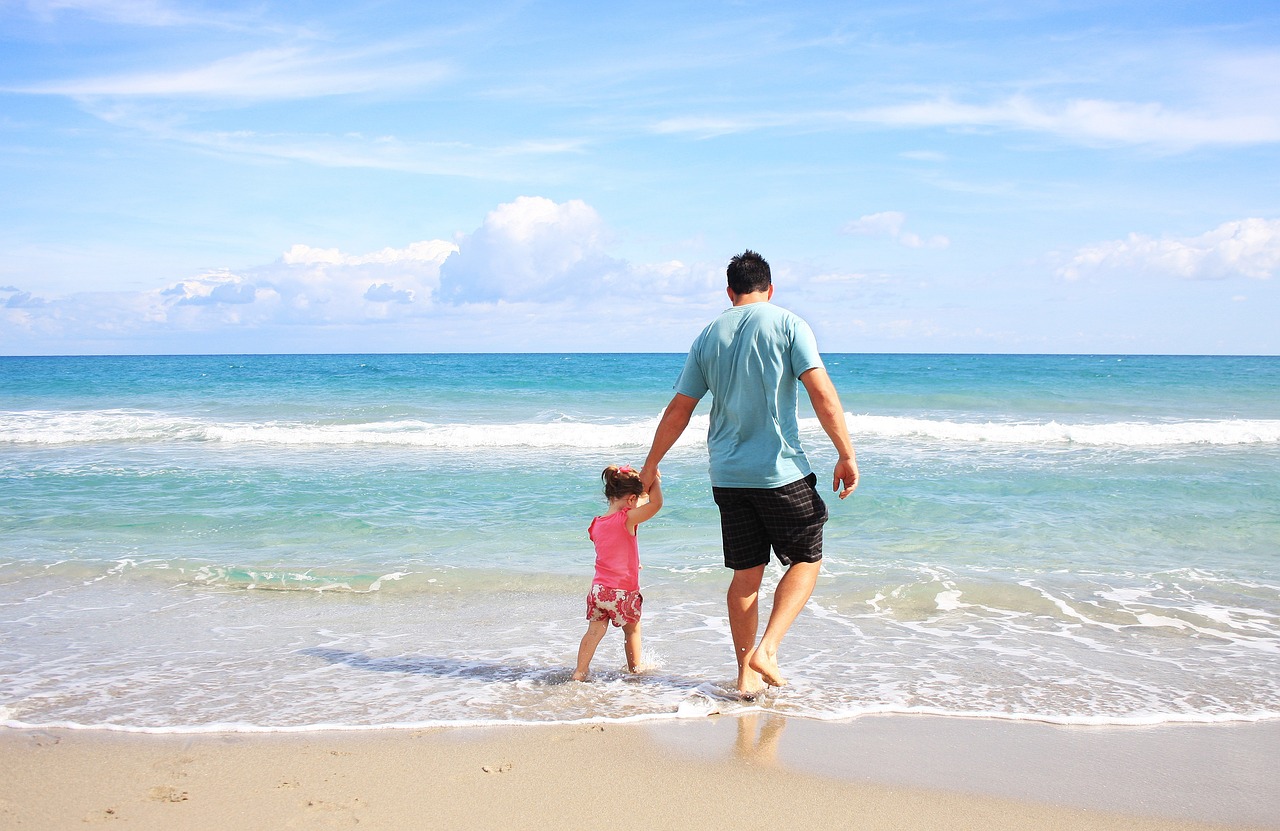
I’ve often thought the airport is the best place to people-watch. With downtime while you wait for your flight and the close proximity to others, it’s inevitable you’re going to look around. Every kind of person can be found at the airport (sporting every size, shape, fashion statement, stress level, and age). Travelers are unknowingly entertaining to those who watch them. But today let’s explore perhaps an even better venue where people do their thing: the beach.

As I type today, a sweeping look at the sandy shore beyond my patio shows me (in no particular order): A mother and daughter in animated conversation with a lifeguard; a group of teenagers (male) playing an aggressive form of beach four-square called Spikeball; another group of teenagers (female) sprawled on beach towels in giggly conversation; a father dragging his young son through the shallow waves on a boogie-board; a surfer wiping out in the not-so-shallow waves further out; and an ambitious child shoveling dirt out of a divot of sand as if digging to China.

I look away for a second and then look again: A pack of aggressive seagulls pecking away at someone’s leftovers aside their abandoned beach chair; that same lifeguard sprinting into the water to rescue a struggling swimmer; an older couple having a (clearly) not-so-happy conversation at the water’s edge; a jogger attempting to put in the miles while dodging the less active in his way; and a paused beach volleyball game where the players can’t determine if the ball hit the (sand) line or not.

It’s a rare treat when I can create a blog post from the goings-on on right in front of me, but the beach allows me to do just that.  More to today’s point, an active beach like this one changes character throughout the day.  In other words, there are the sands of time and then there are the times of sand:

  • Dawn: Seagulls, sand, and surf.  The beach at its most peaceful and pristine.
  • Early morning: Serious runners at the shore (unlike the casual joggers later in the day); an Asian elder performing a standing form of meditative yoga; a surf camp for pre-teens to the north; a lifeguard training camp for teens to the south; a pickup truck clearing the trash from the evenly-spaced cans.
  • Mid-morning: The gradual arrival of the masses (and all they bring with them).  Also the arrival of the lifeguards, with bright cones marking the “no-man’s land” for emergency vehicles, flags indicating the adjacent street number so people know where to find you, and more flags to mark the beach’s “surf zone” versus “swim zone”.
  • Midday: Everything I observed at the start of this post (and so much more).
  • Mid-afternoon: The gradual departure of the masses, and (hopefully) all they brought with them.  Also the departure of the lifeguards, signing off with a megaphone farewell to those who remain behind.
  • Early evening: The ritual of the sun-worshippers, who simply must remain behind to witness the (West Coast) sunset.  There’s nothing like a setting sun to bring a person to a focused standstill.
  • Dark: An umbrella of stars, a rhythmic ribbon of white foam as the waves crash to shore, and an occasional party of two out for a romantic stroll at the water’s edge.

Trust me, it’s easy to be mesmerized by the times of sand if you watch them long enough.  They’re the reason I never make progress with my latest “summer read”, and the reason I can abandon my electronic devices for hours at a time.  Frankly, it’s a wonder I was able to turn away from the sands long enough to bring you this blog post today.

Smallest and Innermost

Mercury

Last month, I spent an entire post lavishing love and affection on Earth’s beautiful space neighbor, the planet Venus (see here). I was quick to point out – from Earth – you can occasionally see the planets Mars, Jupiter, and Saturn as well. Turns out that list is, ahem, incomplete by at least one planet. Clearly miffed by my post, our solar system’s Mr. Smallest and Innermost – the planet Mercury – decided to speak up this week.

Don’t burn yourself, little one (image courtesy of NASA)

For those of you who missed it, Mercury passed in front of the Sun on Monday.  For five hours or so, Mercury looked like a little black mole on the bright cheek of a much larger creature.  His orbit took him almost directly across the center of the Sun.  You may think Mercury’s show is no big deal; after all, he circles the Sun every 88 Earth days.  However, consider Earth, Mercury, and the Sun must be exactly lined up (put a ruler on it) for humans to witness a Mercury “Sun transit”.  We only get fourteen Mercury transits every Earth century.  The next one won’t happen until 2032.

I missed Monday’s Mercury transit myself, because a) I wasn’t up at sunrise in the Northern Hemisphere (when it happened), and b) I didn’t have the necessary eye protection to give it a direct look.  Instead, I enjoyed the online photos and videos from NASA and the world’s other space agencies (like this one).

Mercury’s the tough little guy on the left

The truth is, you don’t have to wait for a Mercury transit to observe the first rock from the Sun.  On several early mornings last month, you could’ve seen Mercury rising in the east (same as Venus), and you’ll see him again early next year – no telescope required.  Guess I got caught up in the allure of Venus and completely ignored her nearby brother.

If Mercury and Earth were side-by-side

Mercury – like all the planets – has some interesting facts.  He completes three rotations about his axis (days) for his every two orbits of the Sun (years).  Pretty slow for the smallest orbit in the solar system.  He has no moons.  He’s only about a third the size of Earth.  He’s pretty beat up, with the most craters of any planet, and “wrinkles” caused by the cooling and contracting of his iron core.  Only two of Earth’s spacecraft have ever visited Mercury, and even those stayed far away from the surface for obvious reasons (800.6°F on the sunny side; -279.4°F in the shade).

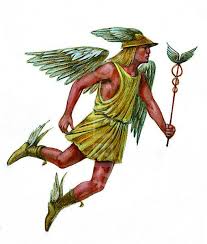
The Roman god for which Mercury is named is a lot “cooler” than the planet itself (ha).  Young Mercury wears a lot of hats, including (god of) financial gain, eloquence, and divination.  (Side note: perhaps Mercury should’ve been my blog mascot.  “Eloquence” was the theme of my very first post).  He also serves as the guide of souls to the underworld. Curiously, all these responsibilities take a back seat to Mercury’s most commonly known role – as speedy messenger to the other gods.  This role explains the naming of the planet, the fastest of the eight to circle the Sun.  Maybe we should also consider Mercury as messenger to the other planets, in case something gets weird with the Sun.  After all, Mercury will be the first to know.

I can’t talk about Mercury without a reference to the late, great Ray Bradbury.  Of all his wonderful science-fiction short stories – and there have been at least a hundred – my Bradbury top five includes “The Golden Apples of the Sun”.  “Apples” followed an exploratory rocket ship heading past Mercury to the Sun.  The crew is tasked with collecting a sample of the Sun’s golden fire.  I can still imagine the ship’s giant scoop as it extends from the hull and grabs a bit of the Sun.  The story’s real drama comes just after the collection, as the ship overheats and the life-support systems begin to shut down.  With respect to Bradbury, I won’t give away the ending.

Well then, enough about Mercury (probably too much).  I’ll conclude with a great tweet from Katie Mack, who was quick to note about Monday’s Mercury transit: “The official song of #TransitOfMercury is, obviously, ‘King of Pain’ by the Police.  But please note that the ‘little black spot on the Sun today’ referenced in the song is a ‘sunspot’, not Mercury, since ‘it’s the same old thing as yesterday,’ and (Mercury) transits only last a few hours.”

Keep on a-circling the Sun, Mercury.  I won’t forget ya next time.

Some content sourced from the BBC.com article, “Planet Mercury passes across the face of the Sun”, the Space-Facts.com article, Mercury Facts – Interesting Facts about Planet Mercury, and Wikipedia, “the free encyclopedia”.